Tag: bull

  • The Year The Secular Bitcoin Bull Run Could End

    The Year The Secular Bitcoin Bull Run Could End

    [ad_1]

    When the December 31, 2021 candle came to a close in Bitcoin, it didn’t just begin a new calendar year – it triggered a sell setup of epic proportions. Here is why the secular bull run in cryptocurrency could come to an end this year, and the first true bear market emerge.

    Bitcoin Yearly Chart Triggers First Ever Sell Setup

    You wouldn’t know it based on the recently bearish price action, but Bitcoin has been in an ongoing bull market since the second the genesis block was generated exactly thirteen years ago today.

    In the span of a normal childhood growing into a teenager, the price per coin has ballooned and bubbled its way from zero to $68,000 per BTC.

    Related Reading | Point & Figure: The Chart That Makes Bitcoin Support Cut And Dry

    The trajectory hasn’t always been up, as the price chart has shown, but the asset has been outrageously bullish nonetheless. Many indicators back up this theory, having never crossed into bear territory ever once since price was recorded.

    For example, the monthly MACD hasn’t made it below the zero line since 2015 despite the 2018-2019 “bear market.” The monthly Directional Movement Index had only a month-long temporary bear cross around mid-2015, but aside from that has never been bearish for an extended phase.

    However, the sequence of ups and downs experienced over the years, like any thirteen-year-old would experience, has resulted in a specific sell setup according to the TD Sequential. The tool is a market timing indicator developed by Thomas DeMark – which on other timeframes has been useful in calling reversals.

    BTCUSD_2022-01-03_11-09-07

    The signal that makes you want to scream "nine!" | Source: BTCUSD on TradingView.com

    At thirteen years since the asset’s debut, the first ever TD9 sell setup has appeared on the BTCUSD yearly price chart. On the TradingView BTCUSD Index, price action began in 2010. Bear market years of 2014-2015 and 2018-2019 excluded, there have been exactly 9 candles with a higher open than the previous candles – triggering the sell setup.

    Theorizing The End Of The Secular Bull Run

    Despite the ominous signal, all is not lost for the current bull cycle – although it does give more credence to another bull market-ending pattern that could be developing.

    According to Elliott Wave Theory, markets grow in five waves. These five impulse waves are broken down into similarly-behaving sub-waves that alternate between uptrend and corrective phases. In the larger cycle, these corrective phases are what we call bear markets. In smaller timeframes, corrections often feel just as severe as the current sentiment would confirm.

    bitcoin BTCUSD_2022-01-03_11-34-56

    The good news and the bad news in one chart | Source: BTCUSD on TradingView.com

    Bitcoin appears to be well into its fifth impulse wave in the major motive wave cycle. The current count would suggest that the cryptocurrency is also within wave four of five sub-waves, hinting that the grand finale should unfold the in the year ahead.

    Related Reading | Bitcoin Falls Flat: Examining A Rare Bull Market Corrective Pattern

    If Bitcoin price does make it to $100,000 or higher, given the TD9 sell setup on the yearly, and the potential wave structure, this might be a sell signal worth taking. But when?

    Follow @TonySpilotroBTC on Twitter or join the TonyTradesBTC Telegram for exclusive daily market insights and technical analysis education. Please note: Content is educational and should not be considered investment advice.

    Featured image from iStockPhoto, Charts from TradingView.com


    [ad_2]

    Source link

  • Bitcoin NUPL Says Market Stands At Key Junction Between Bull And Bear Trends

    Bitcoin NUPL Says Market Stands At Key Junction Between Bull And Bear Trends

    [ad_1]

    The Bitcoin NUPL indicator shows the market is currently testing a key support level that may be a junction between bullish and bearish trends.

    Bitcoin NUPL Shows Market Currently Stands At Key Support Level

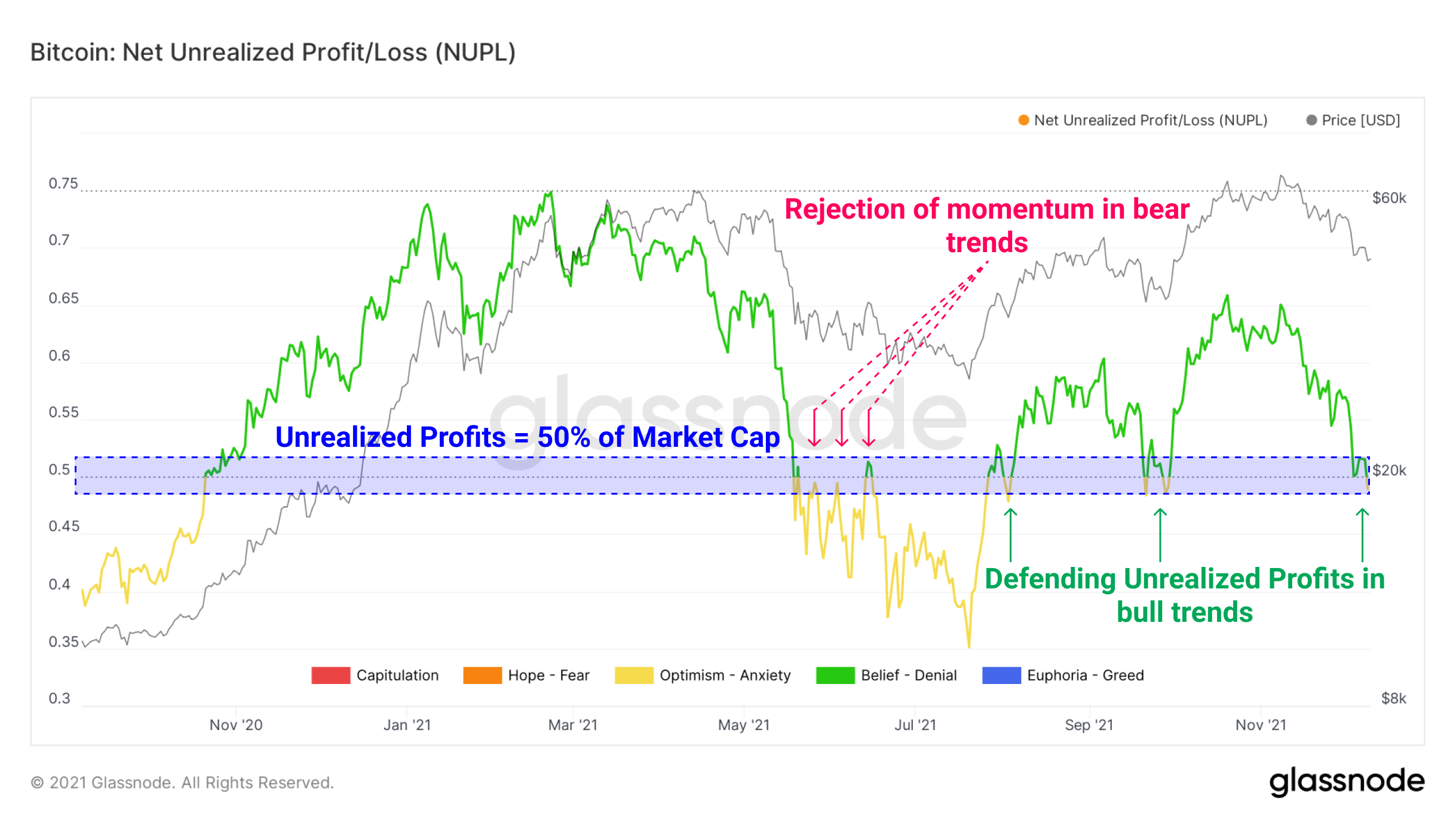
    As per the latest weekly report from Glassnode, the NUPL shows that the market has entered a key zone that can decide whether the following trend will be bullish or bearish.

    The Net Unrealized Profit/Loss (NUPL) is an on-chain indicator that measures the difference between the unrealized profit and loss to check whether the market as a whole is currently in a state of profit or loss.

    The metric measures this by looking at what price each coin on the chain was bought at, and comparing it with the current price.

    When the value of the indicator is below zero, it means the overall Bitcoin network is in a state of profit at the moment.

    On the other hand, when NUPL assumes values above zero, then the market is, on an average, having unrealized gains.

    Related Reading | Weekend Volatility Awakens Bitcoin Buyers, Active Addresses

    Now, here is a chart that shows how the value of this Bitcoin indicator has changed over the past year:

    Bitcoin NUPL

    Looks like the overall market is currently in a state of profit | Source: The Glassnode Week Onchain (Week 50)

    As you can see in the above graph, there is a highlighted zone around the NUPL value of 0.5. At this value, 50% of the Bitcoin market cap is in the form of unrealized gains.

    Related Reading | Goldman Sachs CEO Sidesteps Bitcoin Inquiries, Says Blockchain Is More Important

    The report describes this zone as a historical battleground between the bulls and the bears. During periods of bearish trend, this zone usually provides resistance, while in times of bullish sentiment, the zone would act as support.

    Now as the chart shows, the indicator seems to be touching this zone again. This type of retest has already happened a few times in the past few months, and the bulls stood strong during those.

    Back during the May crash, however, the support didn’t last and the indicator shot below the zone. Afterwards each touch of the zone sent the price back down.

    It’s possible that the market might hold support here as well just like the last few retests. But it’s not set in stone; any transition down here could be bad for the coin’s price, just like how it was in May.

    BTC’s Price

    At the time of writing, Bitcoin’s price floats around $46.9k, down 8% in the last seven days. The below chart shows the trend in the price of BTC over the last five days.

    Bitcoin Price Chart

    BTC's price once again plunges down | Source: BTCUSD on TradingView
    Featured image from Unsplash.com, charts from TradingView.com, Glassnode.com

    [ad_2]

    Source link

  • Bitcoin will peak at $253K, Ethereum at $22K this cycle if 2016 halving bull run repeats

    Bitcoin will peak at $253K, Ethereum at $22K this cycle if 2016 halving bull run repeats

    [ad_1]

    Bitcoin (BTC) may be over seven times higher than at its last halving, but if history repeats, that number could grow another 300% and more.

    As tracked by on-chain data source Ecoinometrics this month, BTC/USD has the potential to eclipse estimates simply by following historical precedent.

    Bitcoin: Compared to 2017, you ain’t seen nothing yet

    Bitcoin currently trades 7.3 times its price since the halving in May 2020. If the last halving cycle is anything to go by, however, price action will not stop until it is 30 times higher.

    The data relates to the roughly four-year halving cycles in which Bitcoin has exhibited identical behavior since its inception.

    The current cycle, despite impatience from some traders, remains closely tied to the previous two.

    Taking 2017 as an example, the next BTC price peak could be as much as $253,800 — and even then, Bitcoin would still be acting within previously defined parameters.

    Ecoinometrics also includes data on Ether (ETH) and its performance relative to the stage of Bitcoin’s halving cycle.

    The largest altcoin saw much larger comparative gains relative to Bitcoin — 120 times its halving price marked last cycle’s peak in 2018.

    Thus, a repeat performance would mean ETH/USD trading at $22,300 — again not beyond the realms of possibility.

    In terms of what the subsequent bear market could bring, Bitcoin would need to bottom out at around $42,000 to copy its post-2017 correction. ETH’s price, on the other hand, would fall to $1,347.

    Bitcoin and Ether post-halving performance chart. Source: Ecoinometrics/Twitter

    1 BTC = 1 BTC

    If such sky-high figures are difficult to comprehend, they pale in comparison to what well-known data analyst Willy Woo now believes.

    Related: Bitcoin retests support, with trader forecasting BTC price dip to $55K

    In a tweet this week, Woo reiterated that this Bitcoin halving cycle would be unique in one specific way: It will end in things being priced in BTC, not United States dollars, as using anything to measure BTC value will be pointless.

    “What’s my prediction for the top of this cycle? Since I think this is the last cycle, the one that takes us to saturation, which if it wins, we can’t put a USD value on it because things get valued in BTC,” he wrote.

    “Thus the cycle top is easy to pick. It will be 1 BTC = 1 BTC.”

    A separate post noted how close Bitcoin was getting by market capitalization compared to U.S. dollar M2 supply. The situation in the next five years — the remainder of the current cycle and start of the next — he commented, will be “very interesting.”