[ad_1]

BTC continues to lose ground, but if the $40,000 level is reclaimed, LEO, MANA, KLAY and XTZ could be the first to recover.
[ad_2]
Source link

[ad_1]
BTC continues to lose ground, but if the $40,000 level is reclaimed, LEO, MANA, KLAY and XTZ could be the first to recover.
[ad_2]
Source link
[ad_1]
Bitcoin (BTC) has given back some of its recent gains, but on-chain data resource Ecoinometrics said that whales are accumulating because they believe the price is attractive from a long-term perspective.
On the downside, analyst Willy Woo believes that $33,000 is a strong bottom for Bitcoin. Popular Twitter trader Credible Crypto citing data from PlanC said that the odds of Bitcoin declining below $30,000 are poor.

Fidelity Digital Assets Head of Research Chris Kuiper believes that Bitcoin’s downside risk could be minimal when compared to other digital assets, but it could rally substantially if it manages to replace gold as a store of value.
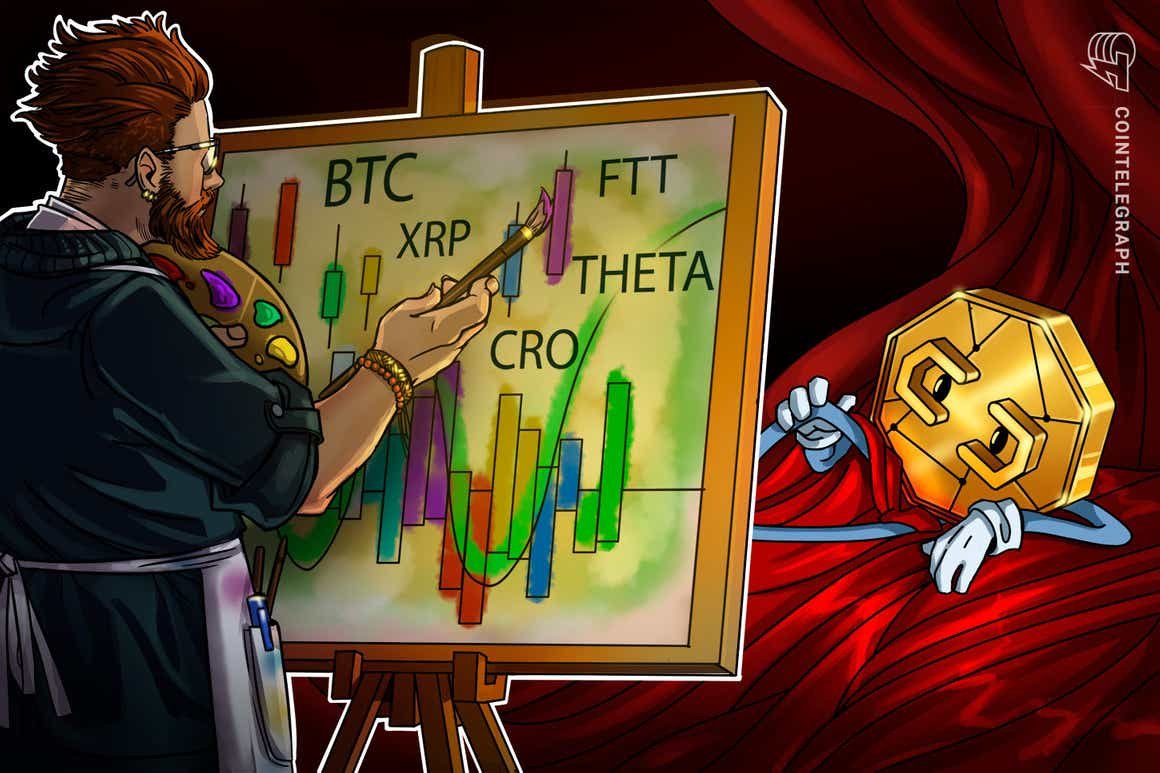
Could Bitcoin and altcoins stage a recovery after the recent pullback? Let’s study the charts of the top-5 cryptocurrencies that may attract investor attention in the short term.
Bitcoin turned down from the overhead resistance at $45,456 but a minor positive is that the bulls have not allowed the price to break below the 20-day exponential moving average ($41,383).

If the price rebounds off the current level, the bulls will try to propel the BTC/USDT pair above $45,456. A close above this level will complete a bullish inverse head and shoulders pattern.
The pair could then rally to $52,088 where the bears are likely to mount a strong challenge. If bulls thrust the price above this level, the pair could start its northward march toward the pattern target at $56,904.
This positive view will be negated if the price breaks and sustains below $39,600. Such a move could open the doors for a possible drop to $36,250.

The pair turned down from $45,456 and broke below the moving averages. The bulls are currently attempting to defend the minor support at $41,688.88 but are facing stiff resistance at the moving averages.
If the price turns down from the current level and breaks below $41,688.88, the pair could slide to $39,600. If the price rebounds off this level, then the pair could remain range-bound between $39,600 and $45,456 for a few days.
On the upside, a break and close above the moving averages will be the first indication that bulls have a slight edge. The pair could then rise to $43,920 and later to $45,456.
Ripple (XRP) broke and closed above the moving averages on Feb. 7, indicating that the downtrend could be coming to an end. The bears tried to pull the price back below the breakout level at $0.75 but the bulls thwarted their attempt.

The price rebounded off $0.75 and the bulls are trying to push the XRP/USDT pair toward the overhead resistance at $1. A break and close above this resistance could open the doors for a possible rally to $1.41.
The moving averages are on the verge of a bullish crossover and the relative strength index (RSI) is in the positive zone, indicating that buyers have the upper hand. This positive view will invalidate on a break and close below $0.75. Such a move will indicate that bears continue to sell on rallies.

The 4-hour chart shows that the bulls and the bears are battling it out near the $0.82 mark. The bulls pushed the price above this level but the bears stalled the rally at $0.85 and have pulled the pair back below $0.82.
A minor positive is that bulls are buying the dips to the 50-SMA. If the price rebounds off this support, the bulls will try to drive the pair above $0.85 and challenge the resistance at $0.91. Conversely, a break and close below the 50-SMA could pull the pair to $0.75. A break and close below this support could indicate the start of a deeper correction.
Crypto.com’s native coin (CRO) broke above the 50-day SMA ($0.47) on Feb. 7, suggesting that the corrective phase could be over. The price rallied to $0.54 on Feb. 10 where the bears are mounting a strong defense.

The moving averages are on the verge of a bullish crossover and the RSI is in the positive territory, indicating that the buyers have a slight edge. If the current rebound off the moving averages sustains, it will suggest that bulls are buying on dips. The bulls will then attempt to push the price above $0.54 and resume the uptrend.
If they can pull it off, the CRO/USDT pair could rise to $0.60 and then to $0.68. Contrary to this assumption, if the price turns down and breaks below the 20-day EMA, the pair could drop to $0.39.

The 4-hour chart shows the pair is rising inside an ascending channel pattern. The bulls tried to push the price above the channel but the bears had other plans. They pulled the price back into the channel, trapping the aggressive bulls.
The buyers are attempting to defend the 50-SMA. If the price sustains above the 20-EMA, the bulls will again try to push the pair above the resistance line of the channel. This positive view will invalidate if the price turns down and plummets below the support line of the channel.
Related: Can XRP price reach $1 after 25% gains in one week? Watch this key support level
FTX Token (FTT) has been volatile inside a broadening formation. The failure of the buyers to propel the price above the resistance line indicates that bears are selling the rallies to this level.

However, a minor positive is that bulls are buying the dips in the zone between the 20-day EMA ($43.85) and the 50-day SMA ($41.50). If the price rebounds off the current level, the buyers will make one more attempt to clear the overhead hurdle.
If they manage to do that, the FTT/USDT pair could start a new uptrend. The pair could then rally to $53.50 where the bears may again pose a strong challenge but if this resistance is crossed, the rally could extend to $65.
This bullish view will invalidate if the price turns down and plummets below the 50-day SMA. That will indicate that the pair could extend its stay inside the broadening pattern for a few more days.

The failure of the bulls to push the price above the $48 to $50 overhead resistance zone may have attracted profit-booking from short-term traders. The pair has broken below both moving averages and could drop to the 38.2% Fibonacci retracement levels at $41.99.
If the price rises from the current level or $41.99, it will suggest that buyers are accumulating on dips. The bulls will then again try to push the price above the 50-SMA. If they succeed, the pair could challenge the overhead resistance.
On the downside, a break and close below $41.99 could signal the start of a deeper correction to the 50% retracement level at $39.95.
Theta Network (THETA) broke and closed above the downtrend line on Feb.10, indicating that the downtrend could be coming to an end. Generally, a rally above a stiff resistance tends to turn back and retest the breakout level.

If bulls succeed in flipping the breakout level into support, it suggests a change in sentiment from sell on rallies to buy on dips. The 20-day EMA ($3.49) has started to turn up and the RSI is in the positive territory, suggesting advantage to buyers.
If the price rebounds off the downtrend line, the bulls will attempt to start a new uptrend. A break and close above $4.39 could attract further buying and the THETA/USDT pair could rise toward $6.
This bullish view will invalidate if the price turns down from the current level and plummets below the downtrend line. Such a move will suggest that the break above the downtrend line could have been a bull trap.

The pair has been rising inside an ascending channel pattern. The bulls tried to push the price above the resistance line of the channel but the bears did not relent. This may have led to profit-booking by the short-term bears, pulling the price toward the support line.
The price has bounced off the support line on three previous occasions hence, the bulls will again try to defend it. If the price rebounds off the level and rises above the downtrend line, it will signal the resumption of the uptrend.
Alternatively, a break and close below the support line of the channel could signal a deeper correction to $3.20.
The views and opinions expressed here are solely those of the author and do not necessarily reflect the views of Cointelegraph. Every investment and trading move involves risk, you should conduct your own research when making a decision.
[ad_2]
Source link

[ad_1]
The institutional crypto inflows rebounded last week after Bitcoin-related products attracted significant investment. In total, investors poured nearly $71 million into BTC investment products.
Last week, digital asset investment products saw inflows worth $85 million. In the past three weeks, total institutional inflows in crypto products have reached $133 million. Apart from Bitcoin, a wide range of altcoins have gained the attention of institutional investors recently.
Solana, Polkadot and Cardano witnessed inflows totaling $2.4 million, $2.2 million and $1.1 million, respectively. Digital asset Terra saw a massive spike in inflows last week. Despite the rising popularity of BTC, SOL, DOT, ADA and LUNA among institutional investors, Ethereum saw a bearish trend with outflows totaling $8.5 million in the previous week.
“Digital asset investment products saw inflows totaling US$85m last week, marking the 3rd week of inflows totaling US$133m, suggesting continued positive sentiment amongst investors. Total assets under management (AuM) now total US$52.4bn with January 24th marking the low point in the most recent run of negative sentiment. While Europe has seen inflows (US$10.3m), the majority has been from the Americas, particularly Brazil and Canada (US$75m),” CoinShares noted in its report.
Due to the market dip in December 2021 and January 2022, the overall value of global Bitcoin assets under management have declined substantially. According to the report from CoinShares, the total value of global BTC AUM reached $34.4 billion last week. Ethereum came in the second spot with almost $13 billion worth of assets under management.
“Bitcoin continues to lead the inflows with US$71m last week, the largest since early December with this 3-week run of inflows totaling US$108m. Volumes in Bitcoin investment products remained low last week at US$1.8bn versus US$3.4bn the previous week,” CoinShares added.
Yesterday, BTC jumped above the price level of $44,300 for the first time since 13 January 2022.
The institutional crypto inflows rebounded last week after Bitcoin-related products attracted significant investment. In total, investors poured nearly $71 million into BTC investment products.
Last week, digital asset investment products saw inflows worth $85 million. In the past three weeks, total institutional inflows in crypto products have reached $133 million. Apart from Bitcoin, a wide range of altcoins have gained the attention of institutional investors recently.
Solana, Polkadot and Cardano witnessed inflows totaling $2.4 million, $2.2 million and $1.1 million, respectively. Digital asset Terra saw a massive spike in inflows last week. Despite the rising popularity of BTC, SOL, DOT, ADA and LUNA among institutional investors, Ethereum saw a bearish trend with outflows totaling $8.5 million in the previous week.
“Digital asset investment products saw inflows totaling US$85m last week, marking the 3rd week of inflows totaling US$133m, suggesting continued positive sentiment amongst investors. Total assets under management (AuM) now total US$52.4bn with January 24th marking the low point in the most recent run of negative sentiment. While Europe has seen inflows (US$10.3m), the majority has been from the Americas, particularly Brazil and Canada (US$75m),” CoinShares noted in its report.
Due to the market dip in December 2021 and January 2022, the overall value of global Bitcoin assets under management have declined substantially. According to the report from CoinShares, the total value of global BTC AUM reached $34.4 billion last week. Ethereum came in the second spot with almost $13 billion worth of assets under management.
“Bitcoin continues to lead the inflows with US$71m last week, the largest since early December with this 3-week run of inflows totaling US$108m. Volumes in Bitcoin investment products remained low last week at US$1.8bn versus US$3.4bn the previous week,” CoinShares added.
Yesterday, BTC jumped above the price level of $44,300 for the first time since 13 January 2022.
[ad_2]
Source link

[ad_1]
Despite price challenges and a surge in regulations around Bitcoin mining, the BTC hash rate is making new records every week. In January 2022, the mean hash rate breached the level of 183 Exahash, the highest level on record. BTC network witnessed a sooner-than-expected recovery in the mining sector after China announced a crackdown on the mining of digital assets in the region.
Overall, the hash rate plummeted as much as 54% in May 2021. However, leading Bitcoin mining companies shifted to other global locations due to the mining-friendly approach by the relevant governments and cheap electricity. With mining rewards getting less amid Bitcoin halving events, rising competition, and energy issues, there is one key question that comes into the mind of every individual interested in this sector, is BTC mining still profitable?
Well, analysts believe it is, and they have some strong numbers to back their claims. According to Paolo Ardoino, CTO of Bitfinex, large institutions will take more interest in Bitcoin mining in the coming months. “I expect the bitcoin hash rate to continue to rise as competition in the bitcoin mining space increases. In fact, bitcoin mining is demonstrating a strong degree of anti-fragility. Notably, the China ban in the summer of 2021 demonstrated the resilience of the sector. Businesses will continue to be attracted to the space and this in itself is a testament to the profitability of the space as a whole,” Ardoino said.
According to Maria Stankevich, Chief Business Development Officer at EXMO UK, the cost of energy plays an important role in the profitability of Bitcoin mining and the reason behind leading mining players moving to locations like the US and Europe is that the price of electricity for mining is very low in the mentioned regions.
“Bitcoin mining is still profitable in 2022. If we are going into the details, then let’s look at the different aspects of mining that we should take into consideration when we talk about its profitability. Cost of electricity, the electricity prices are very different from country to country. Russia, for example, has very low prices for electricity compared to some areas (like Siberia), so it charges a lower price for industrial electricity in order to encourage economic growth. This means that a mining farm in Siberia will pay 50% as much for the electricity you would mine at home in Germany or the USA,” Maria said.
“Secondly, the mining hardware. There are plenty of different mining machines today, but according to different studies, the majority of the most modern machines could remain profitable at a bitcoin price between $5000 and $6000. Thirdly, reliable mining pool and fees while selling BTC. Today, there are a few very big mining pools that provide certain security to the miners. Sometimes, they have referral partnerships with some exchanges that lower commissions. But even without this mechanism, fees on the exchanges dropped significantly over the past few years, so from this point of view mining also looks profitable,” she added.
Ilman Shazhaev, Executive Chairman of OneBoost, believes that the current dynamics of the crypto market facilitate Bitcoin mining, even at a low BTC price.
“As for BTC mining profitability, I can confidently say that it is still profitable. Bitcoin mining is especially profitable because, despite the current situation with the all-time-high hash rate (around 200 exahashes) and the price fluctuations below $40,000 (which are the least favorable conditions), the top-end devices are so energy-efficient that just around 40% of the mined Bitcoin covers the company’s expenditure, the rest is pure profit. If you compare it with a similar situation in 2018 and 2019, the expenditure back then constituted 70–80 percent with 14 nm chips,” Shazhaev noted.
“So, without a shadow of a doubt, Bitcoin mining is profitable at the moment, and despite all the price swings during 2021, analytical reports from our data centers alone show the average statistics of an 80% profitability rate. Respectively, even taking into account all the complications for mining due to the low price and the high Bitcoin mining difficulty, mining of the first cryptocurrency clearly remains profitable,” the Executive Chairman of OneBoost, highlighted.
The BTC mining sector has recovered quickly from the recent setbacks like China’s ban, Russia’s crypto rumors, Kazakhstan’s shutdown, and energy consumption-related problems. Farah Mourad, the Senior Market Analyst at XTB MENA, outlined that the recovery indicates strong Bitcoin mining fundamentals.
“Since its crash back in June, Bitcoin mining difficulty indicator recovered from China’s crackdowns effect reaching a new all-time high. Since then, the markets expected the mining hash rate to remain in an uptrend, until the potential Russian crackdown on bitcoin mining. Would this change the expectations? It is important to note that a potential Russian crackdown on bitcoin mining, would result in a lower hash rate, which doesn’t necessarily mean more profit for miners,” Farah said.
“The direct effect would be seen over bitcoin value and revenue. As we’ve seen post-China crackdown, miners managed to recover fast. Any potential profit for individual mining might be short-lived with the challenge of having access to extremely low-cost electricity. We continue to see a significant accumulation trend since 2021. Putin backing crypto mining might be supporting the trend for the short term as well. A potential migration is still on the table which would lead to changes in trends. Mining spreading over different jurisdictions might potentially bring more stability to hash rates,” she added.
Despite price challenges and a surge in regulations around Bitcoin mining, the BTC hash rate is making new records every week. In January 2022, the mean hash rate breached the level of 183 Exahash, the highest level on record. BTC network witnessed a sooner-than-expected recovery in the mining sector after China announced a crackdown on the mining of digital assets in the region.
Overall, the hash rate plummeted as much as 54% in May 2021. However, leading Bitcoin mining companies shifted to other global locations due to the mining-friendly approach by the relevant governments and cheap electricity. With mining rewards getting less amid Bitcoin halving events, rising competition, and energy issues, there is one key question that comes into the mind of every individual interested in this sector, is BTC mining still profitable?
Well, analysts believe it is, and they have some strong numbers to back their claims. According to Paolo Ardoino, CTO of Bitfinex, large institutions will take more interest in Bitcoin mining in the coming months. “I expect the bitcoin hash rate to continue to rise as competition in the bitcoin mining space increases. In fact, bitcoin mining is demonstrating a strong degree of anti-fragility. Notably, the China ban in the summer of 2021 demonstrated the resilience of the sector. Businesses will continue to be attracted to the space and this in itself is a testament to the profitability of the space as a whole,” Ardoino said.
According to Maria Stankevich, Chief Business Development Officer at EXMO UK, the cost of energy plays an important role in the profitability of Bitcoin mining and the reason behind leading mining players moving to locations like the US and Europe is that the price of electricity for mining is very low in the mentioned regions.
“Bitcoin mining is still profitable in 2022. If we are going into the details, then let’s look at the different aspects of mining that we should take into consideration when we talk about its profitability. Cost of electricity, the electricity prices are very different from country to country. Russia, for example, has very low prices for electricity compared to some areas (like Siberia), so it charges a lower price for industrial electricity in order to encourage economic growth. This means that a mining farm in Siberia will pay 50% as much for the electricity you would mine at home in Germany or the USA,” Maria said.
“Secondly, the mining hardware. There are plenty of different mining machines today, but according to different studies, the majority of the most modern machines could remain profitable at a bitcoin price between $5000 and $6000. Thirdly, reliable mining pool and fees while selling BTC. Today, there are a few very big mining pools that provide certain security to the miners. Sometimes, they have referral partnerships with some exchanges that lower commissions. But even without this mechanism, fees on the exchanges dropped significantly over the past few years, so from this point of view mining also looks profitable,” she added.
Ilman Shazhaev, Executive Chairman of OneBoost, believes that the current dynamics of the crypto market facilitate Bitcoin mining, even at a low BTC price.
“As for BTC mining profitability, I can confidently say that it is still profitable. Bitcoin mining is especially profitable because, despite the current situation with the all-time-high hash rate (around 200 exahashes) and the price fluctuations below $40,000 (which are the least favorable conditions), the top-end devices are so energy-efficient that just around 40% of the mined Bitcoin covers the company’s expenditure, the rest is pure profit. If you compare it with a similar situation in 2018 and 2019, the expenditure back then constituted 70–80 percent with 14 nm chips,” Shazhaev noted.
“So, without a shadow of a doubt, Bitcoin mining is profitable at the moment, and despite all the price swings during 2021, analytical reports from our data centers alone show the average statistics of an 80% profitability rate. Respectively, even taking into account all the complications for mining due to the low price and the high Bitcoin mining difficulty, mining of the first cryptocurrency clearly remains profitable,” the Executive Chairman of OneBoost, highlighted.
The BTC mining sector has recovered quickly from the recent setbacks like China’s ban, Russia’s crypto rumors, Kazakhstan’s shutdown, and energy consumption-related problems. Farah Mourad, the Senior Market Analyst at XTB MENA, outlined that the recovery indicates strong Bitcoin mining fundamentals.
“Since its crash back in June, Bitcoin mining difficulty indicator recovered from China’s crackdowns effect reaching a new all-time high. Since then, the markets expected the mining hash rate to remain in an uptrend, until the potential Russian crackdown on bitcoin mining. Would this change the expectations? It is important to note that a potential Russian crackdown on bitcoin mining, would result in a lower hash rate, which doesn’t necessarily mean more profit for miners,” Farah said.
“The direct effect would be seen over bitcoin value and revenue. As we’ve seen post-China crackdown, miners managed to recover fast. Any potential profit for individual mining might be short-lived with the challenge of having access to extremely low-cost electricity. We continue to see a significant accumulation trend since 2021. Putin backing crypto mining might be supporting the trend for the short term as well. A potential migration is still on the table which would lead to changes in trends. Mining spreading over different jurisdictions might potentially bring more stability to hash rates,” she added.
[ad_2]
Source link

[ad_1]
Bitcoin (BTC) climbed down from multi-day highs on Jan. 27 as the aftermath of the latest United States Federal Reserve meeting saw bulls taper their enthusiasm.

Data from Cointelegraph Markets Pro and TradingView showed BTC/USD walking back some of its gains, which had topped out at $38,950 on Bitstamp.
The pair then refocused on $36,000, the level where it was trading at the time of writing.
As momentum gathered pace, market commentators began hoping for a stronger weekly close, possibly including a challenge of the $40,000 mark. Now, however, the mood was markedly less euphoric.
“Bitcoin rejected at $38K and hit the first important level of support at $36K here,” Cointelegraph contributor Michaël van de Poppe summarized to Twitter followers.
“Might have a short-term bounce, but anything sub $37.5K isn’t shouting for bullishness.”

Van de Poppe joined others in voicing dissatisfaction with the outcome of the Fed’s meeting, in particular with a lack of new insight and policy information from Fed Chair Jerome Powell.
“With inflation well above 2 percent and a strong labor market, the Committee expects it will soon be appropriate to raise the target range for the federal funds rate,” a statement by the Federal Open Market Committee read.
“The Committee decided to continue to reduce the monthly pace of its net asset purchases, bringing them to an end in early March.”
With that, crypto markets had few macro cues to react to, a paradigm shift in price behavior yet to make an appearance.
Altcoins followed Bitcoin in step to shed several percentage points on the day, once more adding to the week’s overall losses.
Related: Bitcoin pundits split over BTC floor as Bloomberg analyst eyes bounce
Ether (ETH) fell back below $2,500, still down 22% over the past seven days.

Others fared somewhat better, with Dogecoin (DOGE) retaining most of its previous progress and Cardano (ADA) trading flat at $1.06.
Not everyone escaped unscathed post-Fed, however, with total cross-crypto liquidations passing $320 million, data from on-chain monitoring resource Coinglass confirmed.

[ad_2]
Source link

[ad_1]
In addition to a sharp plunge in its price, BTC saw a spike in its mining difficulty level. The number increased by almost 9% within 24 hours yesterday. Earlier this month, the Bitcoin hash rate topped the level of 183 Exahash, the highest level on record.
“BTC mining difficulty increased by +9.3% today, hitting a new ATH,” crypto analytics platform Glassnode noted. Finance Magnates recently highlighted a sharp jump in old Bitcoin supply.
Bitcoin hash rate dropped by nearly 54% in May 2021 after China imposed a ban on the mining of digital currencies in the region. While the hash rate has recovered substantially, the mining difficulty has climbed as well.
BTC is currently going through a major correction. The digital asset reached a low of almost $34,000 on Saturday. One of the biggest reasons behind Bitcoin’s recent dip is an enormous rise in exchange inflows. According to Glassnode’s data, Bitcoin exchange inflow volume reached its highest level in 4 weeks today. “Bitcoin Exchange Inflow Volume (7d MA) just reached a 1-month high of 1,279.853 BTC. The previous 1-month high of 1,277.577 BTC was observed on 12 January 2022,” the data shows.
Earlier this week, reports emerged about Russia’s potential ban on crypto mining in the country. Being one of the top destinations for global crypto mining companies, Russia holds a significant place in the international digital asset ecosystem.
“The Bank of Russia has hinted at the possibility of a sweeping ban on crypto many times before so this recent development is hardly surprising. Importantly, the ban will also outlaw any crypto mining activities. As this would negatively affect Bitcoin’s hash rate, some investors may be wondering whether the ban, when enforced, could result in more selling pressure on the price of this asset. This, however, is unlikely to happen. Russia hosts a little more than 10% of Bitcoin’s current mining power,” Anto Paroian, Chief Operating Officer at ARK36, said.
In addition to a sharp plunge in its price, BTC saw a spike in its mining difficulty level. The number increased by almost 9% within 24 hours yesterday. Earlier this month, the Bitcoin hash rate topped the level of 183 Exahash, the highest level on record.
“BTC mining difficulty increased by +9.3% today, hitting a new ATH,” crypto analytics platform Glassnode noted. Finance Magnates recently highlighted a sharp jump in old Bitcoin supply.
Bitcoin hash rate dropped by nearly 54% in May 2021 after China imposed a ban on the mining of digital currencies in the region. While the hash rate has recovered substantially, the mining difficulty has climbed as well.
BTC is currently going through a major correction. The digital asset reached a low of almost $34,000 on Saturday. One of the biggest reasons behind Bitcoin’s recent dip is an enormous rise in exchange inflows. According to Glassnode’s data, Bitcoin exchange inflow volume reached its highest level in 4 weeks today. “Bitcoin Exchange Inflow Volume (7d MA) just reached a 1-month high of 1,279.853 BTC. The previous 1-month high of 1,277.577 BTC was observed on 12 January 2022,” the data shows.
Earlier this week, reports emerged about Russia’s potential ban on crypto mining in the country. Being one of the top destinations for global crypto mining companies, Russia holds a significant place in the international digital asset ecosystem.
“The Bank of Russia has hinted at the possibility of a sweeping ban on crypto many times before so this recent development is hardly surprising. Importantly, the ban will also outlaw any crypto mining activities. As this would negatively affect Bitcoin’s hash rate, some investors may be wondering whether the ban, when enforced, could result in more selling pressure on the price of this asset. This, however, is unlikely to happen. Russia hosts a little more than 10% of Bitcoin’s current mining power,” Anto Paroian, Chief Operating Officer at ARK36, said.
[ad_2]
Source link

[ad_1]
One of the fastest-growing crypto exchanges in Australia, BTC Markets recently announced a partnership with Ajla Tomljanovic, a prominent tennis player in the country. According to the latest female tennis player rankings, Ajla currently stands at 45th position worldwide. In Australia, Ajla holds the second position.
BTC Markets is the only female-led digital exchange in Australia. Due to the rising interest of retail and institutional Australian clients in digital currencies, BTC Markets experienced a strong surge in demand for its crypto trading products during 2021.
“We’re excited to announce our sponsorship of rising tennis star and 2021 Wimbledon Quarter-Finalist, Ajla Tomljanović. Crypto moves fast on our exchange, just like Ajla on the court, & she encapsulates the promise and potential of Australia,” BTC Markets highlighted in a recent announcement.
In addition, the tennis star expressed her happiness on the latest collaboration and mentioned that the clients of BTC Markets will have an opportunity to meet her in person. “I’m really excited to be partnering with BTC Markets, Australia’s largest crypto exchange. To celebrate, we’re giving away some prizes including the chance to meet me in person,” Ajla said.
Crypto adoption in Australia is on the rise. In November last year, Perth Heat, one of the most successful baseball teams in Australia, announced that the club has decided to pay its players in Bitcoin. Furthermore, Perth Heat is holding BTC on its balance sheet. The Commonwealth Bank of Australia is planning to expand its presence in the global crypto market.
“We are so proud to support the next wave of Australian talent with Ajla,” said the Chief Executive of BTC Markets, Caroline Bowler. “Cryptocurrency on BTC Markets is fast-moving, just like Ajla on the tennis court. We know our clients will be proud to cheer her on this summer.”
One of the fastest-growing crypto exchanges in Australia, BTC Markets recently announced a partnership with Ajla Tomljanovic, a prominent tennis player in the country. According to the latest female tennis player rankings, Ajla currently stands at 45th position worldwide. In Australia, Ajla holds the second position.
BTC Markets is the only female-led digital exchange in Australia. Due to the rising interest of retail and institutional Australian clients in digital currencies, BTC Markets experienced a strong surge in demand for its crypto trading products during 2021.
“We’re excited to announce our sponsorship of rising tennis star and 2021 Wimbledon Quarter-Finalist, Ajla Tomljanović. Crypto moves fast on our exchange, just like Ajla on the court, & she encapsulates the promise and potential of Australia,” BTC Markets highlighted in a recent announcement.
In addition, the tennis star expressed her happiness on the latest collaboration and mentioned that the clients of BTC Markets will have an opportunity to meet her in person. “I’m really excited to be partnering with BTC Markets, Australia’s largest crypto exchange. To celebrate, we’re giving away some prizes including the chance to meet me in person,” Ajla said.
Crypto adoption in Australia is on the rise. In November last year, Perth Heat, one of the most successful baseball teams in Australia, announced that the club has decided to pay its players in Bitcoin. Furthermore, Perth Heat is holding BTC on its balance sheet. The Commonwealth Bank of Australia is planning to expand its presence in the global crypto market.
“We are so proud to support the next wave of Australian talent with Ajla,” said the Chief Executive of BTC Markets, Caroline Bowler. “Cryptocurrency on BTC Markets is fast-moving, just like Ajla on the tennis court. We know our clients will be proud to cheer her on this summer.”
[ad_2]
Source link

[ad_1]
Bitcoin (BTC) and the U.S. equity markets fell sharply on Jan. 5, reacting negatively to the minutes from the Federal Reserve’s December FOMC meeting, which showed that the members expect the balance sheet reduction to start after the Fed begins hiking interest rates in early 2022.
Adding to the negative sentiment was the shutdown of the world’s second-biggest Bitcoin mining hub in Kazakhstan, where the internet has been shut down following massive protests by citizens. This caused a dip of about 13.4% in the Bitcoin network’s overall hash rate from 205,000 petahash per second (PH/s) to 177,330 PH/s.

According to Galaxy Digital Holdings CEO Mike Novogratz, the current decline was with low volumes and he believes that the markets will be volatile in the next few days. Novogratz suggests that a huge amount of “institutional demand” was waiting on the sidelines and he expects Bitcoin to bottom out in the $38,000 to $40,000 zone.
Could Bitcoin and major altcoins continue to face selling or will they bounce off strong support levels? Let’s study the charts of the top-10 cryptocurrencies to find out.
The range-bound action in Bitcoin resolved to the downside on Jan. 5 when bears pulled the price below the strong support at $45,456. This suggests that supply exceeds demand.

There was a meek attempt to defend the $42,500 support on Jan. 6 but sustained selling has pulled the price close to the next support at $39,600. This leg down has invalidated the positive divergence that was forming on the relative strength index (RSI).
The downsloping moving averages and the RSI near the oversold zone suggest that bears are in control. If bears sink and sustain the price below $39,600, the BTC/USDT pair could nosedive to $30,000.
On the contrary, if the price rebounds off $39,600, the bulls will again try to push the pair above the 20-day exponential moving average ($46,811). Such a move will be the first indication that the downtrend could be ending.
The bullish momentum could pick up on a break and close above the 50-day simple moving average ($50,610).
Ether (ETH) turned down from the 20-day EMA ($3,756) on Jan. 5 and plunged below the Dec. 4 intraday low at $3,503.68. This suggests that bears have reasserted their supremacy.

The downsloping moving averages and the RSI in the oversold zone suggest that bears are in command. If bears sustain the price below $3,250, the decline could extend to the support line of the channel.
The bulls will attempt to defend this level and push the price to the resistance line of the channel. A break and close above the channel will signal a change in trend.
Alternatively, if bears sink the price below the channel, the ETH/USDT pair could decline to the strong support at $2,652.
Binance Coin (BNB) broke below the strong psychological support at $500 on Jan. 5. Follow-up selling has pulled the price to the next support at $435.30.

If the price bounces off the current level, the BNB/USDT pair could rally to $500 where the bears are likely to mount a stiff resistance. The downsloping moving averages and the RSI in the oversold zone suggest that bears are in control.
If the $435.30 support gives way, the pair could extend its decline to $392.20 and later to $320. This negative view will be negated if the price breaks and sustains above the channel. Such a move could open the doors for a possible move to $575.
Solana (SOL) plummeted below $167.88 and the Dec. 13 intraday low at $148.04 on Jan. 5. This indicated that bears have reasserted their dominance.

The selling has continued and the bears will now try to pull the SOL/USDT pair to the strong support at $116. This level could attract strong buying from the bulls but the relief rally is likely to face selling near the 20-day EMA ($170).
Such a move will indicate that the sentiment remains negative and traders are selling on rallies. That could increase the likelihood of a break below $116. The next stop may be the support line of the channel.
The buyers will have to push and sustain the pair above the resistance line of the channel to signal that the downtrend could be ending.
Cardano (ADA) turned down from the 20-day EMA ($1.33) on Jan. 5 and dropped to the strong support at $1.18. The bulls have successfully defended this level but have failed to push the price above the 20-day EMA.

If bears pull the price below $1.18, the ADA/USDT pair could drop to the critical support at $1. This is an important support to watch out for because if it cracks, the selling momentum could pick up and the pair could slide to $0.68.
On the contrary, if bulls drive the price above the moving averages, the pair could rise to the resistance line of the channel. A break and close above the channel will signal a possible change in trend. The pair could then rally to $1.87.
XRP broke below the $0.75 support on Jan. 5 but the long tail on the candlestick suggests that bulls purchased this dip. However, a minor negative is that the buyers have not been able to build upon the rebound.

The XRP/USDT pair formed a Doji candlestick pattern on Jan. 8 and the bulls are currently attempting to sink the price below $0.75. If that happens, the downtrend could resume and the pair may drop to $0.60.
The downsloping moving averages and the RSI in the negative zone indicate that bears are in command. Contrary to this assumption, if the price rebounds off the current level, the bulls will attempt to push the pair above the moving averages.
If they succeed, it will suggest that the selling pressure may be reducing. The pair could then rise to $1.
Terra’s LUNA token plummeted below the 20-day EMA ($81) on Jan. 5, indicating that short-term traders may have booked profits after bulls failed to clear the hurdle at $93.81.

The bears have pulled the price to the 50-day SMA ($69), which may act as a strong support. If the price rebounds off the current level, the bulls will try to push the LUNA/USDT pair to the downtrend line of the descending channel.
A break and close above the channel will indicate that the correction may be over. The bulls will then try to push the price to $93.81. On the contrary, a break and close below the 50-day SMA could intensify selling and the pair may drop to the psychological support at $50.
Related: Bitcoin and Ether heading $100K and $5K in 2022: Bloomberg Intelligence
Polkadot (DOT) is range-bound in a downtrend. The price has been oscillating between $22.66 and $32.78 for the past few days.

The 20-day EMA ($28) has started to turn down and the RSI has dipped into the negative territory, suggesting that bears have the upper hand. If sellers sink and sustain the price below $22.66, the DOT/USDT pair could plunge to $16.81.
Contrary to this assumption, if the price rebounds off $22.66, the bulls will try to push the pair to $32.78. A break and close above this level could signal a possible change in trend. The pair could first rise to $40 and later to $44.
Avalanche (AVAX) broke below the $98 support on Jan. 5 and has dropped to the uptrend line of the symmetrical triangle today. The bulls will attempt to defend this level and push the price back to the downtrend line.

The 20-day EMA ($104) has turned down and the RSI is below 38, indicating that rallies are likely to be sold into. If the bounce off the current level turns down either from $98 or from the 20-day EMA, the possibility of a break below the triangle increases.
The AVAX/USDT pair could then decline to the $75.50 support where the bulls will try to arrest the decline. This negative view will invalidate if the price turns up and breaks above the triangle. The pair could then rise to $128.
Dogecoin (DOGE) dipped below the $0.15 support on Jan. 5 but the long tail on the candlestick shows that bulls defended this level. That was followed by a Doji candlestick pattern on Jan. 6, indicating indecision among the bulls and the bears.

The bears tried to resolve the uncertainty to the downside today but the bulls are not willing to relent. However, unless buyers quickly push the DOGE/USDT pair above the 20-day EMA ($0.17), the risk of a break and close below $0.15 increases.
If that happens, the pair could slide to $0.13 and then to $0.10. Alternatively, if bulls push the price above the 20-day EMA, it will suggest that buyers are attempting a comeback. The pair could then rise to $0.19 and if bulls clear this hurdle, the rally may extend to $0.22.
The views and opinions expressed here are solely those of the author and do not necessarily reflect the views of Cointelegraph. Every investment and trading move involves risk. You should conduct your own research when making a decision.
Market data is provided by HitBTC exchange.
[ad_2]
Source link

[ad_1]
Bitcoin’s (BTC) price action hasn’t been bullish despite the $69,000 all-time high on Nov. 10. Some argue that that descending channel formed 40 days ago is the dominant trend, and $56,000 marks its current resistance.

Such bearishness follows scrutiny from United States regulators, after a Nov. 1 report from the President’s Working Group on Financial Markets suggested that stablecoin issuers in the U.S. should be subject to “appropriate federal oversight,” similar to banks and savings associations.
On Nov. 12, the Bitcoin-backed exchange-traded fund (ETF) request was rejected by the U.S. Securities and Exchange Commission. To justify the denial, the regulator cited the lack of ability of its participants to deter fraud and market manipulation in Bitcoin trading.
More recently, on Nov. 23, the chair of the U.S. Senate Committee on Banking, Housing and Urban Affairs sent notices to multiple exchanges and stablecoin issuers. The questions on consumer and investor protection on stablecoins suggest that lawmakers may be preparing a hearing on the subject.
Still, bulls might have a different take on such news as stablecoins are by no means necessary for Bitcoin to work. Furthermore, there’s not much that the U.S. government can do to suppress projects and developers willing to relocate outside its jurisdiction.
Despite the 17% pullback over the past 14 days from the $69,000 all-time high, the Bitcoin call (buy) options vastly dominate Friday’s expiry.

At first sight, the $1.9 billion in call (buy) options dominate the weekly expiry by 113% compared with the $885 million in put (sell) instruments. But the 2.13 call-to-put ratio is deceptive because the recent drop will likely wipe out 90% of the bullish bets.
For example, if Bitcoin’s price remains below $58,000 at 8:00 am UTC on Nov. 26, only $150 million worth of those call (buy) options will be available at the expiry. There is no value in the right to buy Bitcoin at $60,000 or $70,000 if it’s trading below that price.
Below are the four most likely scenarios based on the current price action. For example, the data shows how many contracts will be available on Friday for both bulls (call) and bear (put) instruments. The imbalance favoring each side represents the theoretical profit:
This crude estimate considers the call options used in bullish bets and put options exclusively in neutral-to-bearish trades. However, a trader could have sold a call option, effectively gaining a negative exposure to Bitcoin above a specific price. Unfortunately, there’s no easy way to estimate this effect.
As displayed by the 40-day descending channel, bulls need to keep the $56,000 resistance to avoid further losing momentum. One must keep in mind that it took less than two weeks to bring Bitcoin from $41,500 to $56,000 back on Oct. 10. Therefore, maintaining this level is crucial to validate Nov. 10’s all-time high.
Moreover, if bulls manage to push Bitcoin’s price above $58,000, that will save them from a potential $365 million loss if BTC bears gain the upper hand on the back of the regulatory winds. A mere 1.5% drop from the current $56,800 might give bears just enough confidence to instill even more pain.
The views and opinions expressed here are solely those of the author and do not necessarily reflect the views of Cointelegraph. Every investment and trading move involves risk. You should conduct your own research when making a decision.
[ad_2]
Source link

[ad_1]
Bitcoin (BTC) is witnessing a tough tussle near the $58,000 mark but that has not stopped select altcoins from hitting a new all-time high. This shows that traders are watching the fundamental developments on individual coins.
One of the recent top performing major altcoins has been Avalanche (AVAX), which has soared more than 120% in November. The coin caught traders’ attention leading up to the announcement by accounting firm Deloitte which plans to build its disaster relief platforms on the Avalanche blockchain.

In another step that shows growing crypto adoption, El Salvador’s President Nayib Bukele announced the launch of Bitcoin city, which will be powered by geothermal energy and initially funded by $1 billion worth of Bitcoin bonds.
Could strong buying at lower levels boost Bitcoin above $60,000 and will altcoins participate in the recovery? Let’s study the charts of the top-5 cryptocurrencies that could attract traders’ attention in the short term.
Bitcoin reversed direction from $55,600 on Nov. 19 but the recovery is facing resistance at the 50-day simple moving average ($60,187). The moving averages are on the verge of a bearish crossover and the relative strength index (RSI) is in the negative area, indicating that bears are making a strong comeback.

If the price turns down from the current level, the bears will attempt to extend the correction by pulling the BTC/USDT pair below $55,600. If that happens, the next stop could be the strong support zone at $52,500 to $50,000.
If the price rebounds off this zone, the bulls will try to push the pair above the moving averages and the downtrend line. Such a move will indicate that the corrective phase may be over. The bulls will then try to drive the price above the all-time high at $69,000.
Alternatively, a break below the psychological support at $50,000 could intensify selling as traders rush to the exit. The pair could then drop to $45,000 and later to $40,000.

The 4-hour chart shows that bears pulled the price below the strong support at $58,000 but they could not build upon this advantage. The bulls bought the dip and have pushed the price back above the 20-exponential moving average.
If the price sustains above $58,000, the pair could rally to the downtrend line. A break and close above this resistance could indicate that bulls have the upper hand. The pair could then rally to $62,000 and later to $67,000.
Conversely, if the price turns down from the current level and breaks below $55,600, it will signal the possible start of a deeper correction.
Avalanche is in a strong uptrend and has consistently been making new highs for the past few days. The bulls pushed the price above the 200% Fibonacci extension level at $146.18 today but the long wick on the day’s candlestick shows profit-booking at higher levels.

The rising 20-day EMA (96) indicates that bulls are in command but the RSI near 80 suggests that the rally may be overheated in the near term. This could result in a minor correction or consolidation in the next few days.
If the price turns down from the current level, $110 and then the 20-day EMA may act as a strong support. A sharp rebound off either level will suggest that the bulls are viewing the dips as a buying opportunity. The pair could then march toward the 261.8% Fibonacci extension level at $175.58.
Contrary to this assumption, if the price breaks below the 20-day EMA, it will suggest that traders are rushing to the exit. That may pull the AVAX/USDT pair to $81.

The pair has turned down from $147, indicating aggressive profit-booking at higher levels. The bears will now attempt to pull the price to the 20-EMA, which is likely to act as a strong support.
If the price rebounds off the 20-EMA, it will indicate strong buying on dips. The bulls will then try to resume the uptrend by pushing the pair above $147.
Contrary to this assumption, if the price breaks below the 20-EMA, the selling could accelerate and the pair may drop to $110. Such a move will suggest that the bulls may be losing their grip. The pair could thereafter drop to the 50-SMA.
Polygon (MATIC) has been trading inside an ascending channel pattern for the past few days. The bulls pushed the price above the resistance line of the channel on Oct. 28 and 29 but failed to sustain the breakout. This may have prompted selling from short-term traders.

The bears again successfully defended the resistance line on Nov. 3. This started the downward journey toward the trendline of the channel. The downsloping 20-day EMA ($1.69) and the RSI just below the midpoint indicate a minor advantage to sellers.
If the price turns down from the current level, the MATIC/USDT pair could drop to the trendline. The bulls are expected to defend this level aggressively. If the price rebounds off the trendline and rises above the 20-day EMA, it will indicate that the selling pressure may be reducing. That may signal the start of the northward journey toward the resistance line.
Contrary to this assumption, if bears sink the price below the trendline, it could result in a decline to the psychological support at $1.

The 4-hour chart shows that bulls are attempting to stage a relief rally from the strong support zone at $1.50 to $1.40. The 20-EMA has started to turn up and the RSI is near the center, indicating that the selling pressure may be reducing.
If bulls drive the price above $1.70, the pair could rise to $1.80. A break and close above this level will indicate strength. The pair could then start its up-move toward $2.15. On the downside, the selling may accelerate if the bears pull the price below $1.40.
Related: Seeing red? FUD that! Here’s what you should have bought instead of Bitcoin last week
The bears tried to pull Elrond (EGLD) below the breakout level at $303.03 from Nov. 16 to 18 but the bulls bought the dips as seen from the long tail on the candlesticks. Strong buying on Nov. 19 pushed the price above the overhead resistance at $338.70.

This resumed the uptrend and the EGLD/USDT pair has reached near its pattern target at $427. The sharp rally has pushed the RSI deep into the overbought zone, suggesting that a minor consolidation or correction could be around the corner.
The first support on the downside is the breakout level at $338.70 and then the 20-day EMA ($325). If the price rebounds off either level, it will suggest that traders continue to buy on dips. The bulls will then try to resume the uptrend with the next target objective at $500.
This positive view will be invalidated if the price turns down and plummets below the breakout level at $303.

The 4-hour chart shows that bears tried to stall the up-move at $400 but the bulls were in no mood to relent. Sustained buying at higher levels pushed the pair above the psychological barrier. The rising 20-EMA and the RSI in the overbought zone indicate that bulls are firmly in the driver’s seat.
The first important level to watch on the downside is $380. If bears pull the price below this support, the pair may drop to the 20-EMA. A strong rebound off this support could keep the uptrend intact but a break below it will suggest that the bullish momentum may be weakening.
Decentraland (MANA) turned down from the 78.6% Fibonacci retracement level at $4.35 on Nov. 20. This indicates that traders may be selling on rallies.

The MANA/USDT pair could now drop to the immediate support at $3.50 and if this level gives way, the correction could deepen to the 20-day EMA ($3.11). If the price rebounds off either support, it will suggest that sentiment remains positive and traders are buying on dips.
The bulls will then attempt to push the price to $4.36. A break and close above this resistance could open the doors for a rally to $4.94. This positive view will invalidate if the price continues lower and breaks below the 20-day EMA.

The pair has been rising inside an ascending channel pattern. The failure of the bulls to push the price above the resistance line may have prompted selling from traders, pulling the price below the 20-EMA.
Both moving averages have flattened out and the RSI has dipped near the midpoint, suggesting that the bullish momentum may be weakening. The pair could now drop to the trendline of the channel where buying may emerge.
If the price rebounds off the trendline, the pair could continue its up-move inside the channel. The buyers will then try to push the price to the resistance line. The bullish momentum could pick up on a break and close above the channel.
The views and opinions expressed here are solely those of the author and do not necessarily reflect the views of Cointelegraph. Every investment and trading move involves risk, you should conduct your own research when making a decision.
[ad_2]
Source link