[ad_1]
 According to the latest data, we are now less than 1,400 blocks away from the anticipated Bitcoin halving event, which will decrease the block reward from 6.25 bitcoin to 3.125 bitcoin. Bitcoin’s value soared to a new all-time high on March 14, reaching $73,794 per bitcoin, but has since seen a 6.5% decline. Observers are […]
[ad_2]
Source link
Tag: blocks
-
Anticipation Builds as Bitcoin Stands Less Than 1,400 Blocks From Monumental Halving
-
Bitcoin Halving Inches Closer With Less Than 2,900 Blocks Left
[ad_1]
The Bitcoin Halving is fast approaching, with less than 2,900 blocks left before miners’ rewards are cut in half. This event, projected to take place sometime in April, is significant as Bitcoin’s price could enjoy a parabolic move to the upside after it takes place.
Bitcoin Halving Set For April 19
Data from Coinwarz shows that the Bitcoin Halving is set to take place on April 19 at Block 840,000. This projection is based on Bitcoin’s current block time average, which means the Halving can come a little earlier or sometime after April 19. However, the main focus remains that miners’ supply will be cut in half.
The Halving event is a deflationary measure that Bitcoin’s founder, Satoshi Nakamoto, encoded in the flagship crypto and takes place after every 210,000 blocks. Three halving events have occurred since the Genesis block in 2009, when Bitcoin’s first block was mined. The first was on November 28, 2012, when miners’ rewards were cut from 50 BTC to 25 BTC.
The next Halving event took place on July 9, 2016, cutting miners’ rewards to 12.5 BTC. The third one happened on May 11, 2020, reducing the reward to 6.25 BTC. Now, Miners’ rewards are set to be cut in half again, reducing them to 3.125 BTC.
This reward is the amount of BTC miners receive for validating each block of new transactions on the blockchain. Although this event mainly affects miners, the crypto community closely monitors it due to the ripple effects it could have on the market. Bitcoin’s supply comes through these miners’ rewards, and a reduction in them usually drives Bitcoin’s value higher.
Bitcoin’s Performance After Each Halving
The Halving has historically always led to a price appreciation for Bitcoin. Ninety days after the first Halving on November 28, 2012, Bitcoin’s price increased to $1,000 from $12 at the time of Halving. Subsequently, Bitcoin’s price saw a gain of over 8,000% one year after that Halving.
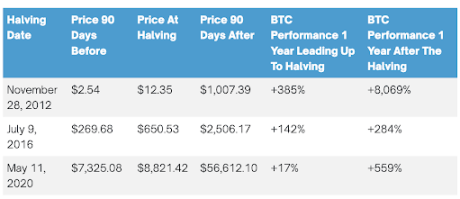
Source: MilkRoadThis parabolic price surge also occurred after the second and third Halving events, with Bitcoin’s price rising from $650 and $8,821 (at the time of the Halving) to $2,506 and $56,612 (90 days after the Halving) in 2016 and 2020 respectively. Bitcoin also gained 284% and 559% one year after the event.
This time isn’t expected to be different as Bitcoin is again predicted to experience a massive move to the upside after April. This bullish sentiment is further strengthened by Bitcoin’s demand, which has continued to skyrocket in the face of a dwindling supply.
At the time of writing, Bitcoin is trading at around $70,400, up in the last 24 hours according to data from CoinMarketCap.
BTC price struggles ahead of halving | Source: BTCUSD on Tradingview.com
Featured image from 99Bitcoins, chart from Tradingview.com
Disclaimer: The article is provided for educational purposes only. It does not represent the opinions of NewsBTC on whether to buy, sell or hold any investments and naturally investing carries risks. You are advised to conduct your own research before making any investment decisions. Use information provided on this website entirely at your own risk.
[ad_2]
Source link -

Apple app store reportedly blocks Gnosis Safe wallet update for hosting NFTs
[ad_1]

The Apple App Store reportedly blocked a Gnosis Safe crypto wallet app update due to it hosting NFTs that weren’t purchased inside the app.
Lukas Schor —a product developer at Ethereum-based crypto wallet provider Gnosis Safe — revealed the firm ran into trouble when it submitted an updated version of its app to the IOS app store earlier this month.
Schor noted on Sept. 14 that despite the update having nothing to do with non-fungibles, the App Store flagged a sample image that displayed an NFT in the app’s description section, even though it had been up for “many months.”
Apple is blocking a release of our @gnosissafe mobile app because we display NFTs in it. After 2 weeks of back-and-forth, I felt that we need to talk publicly about this to raise awareness.
See the thread for details and why this might affect other wallets and apps as well.
— Lukas Schor | Gnosis Safe (@SchorLukas) September 14, 2021
While the app is still listed in the store along with the image displaying the NFT, it appears that Apple is blocking the update due to its guidelines around digital content.
According to screenshots he shared of Gnosis’ correspondence with Apple support over email, the tech giant stated that while “NFTs are not mentioned specifically” in its guidelines, apps are not allowed to provide access to “previously purchased digital content” bought outside of the app store.
This essentially means that apps cannot provide any NFT-related services unless they are integrated with Apple payment methods.
“If you choose not to implement in-app purchase, it would be appropriate to revise your app so that does not access previously purchased digital content,” the email concluded.
⛔️ This shows how access to Web3 still relies heavily on gatekeepers like Apple
❗️ It’s an industry problem, as the same arguments apply to any wallet displaying NFTs or games making use of NFTs
We need to find better ways to make Web3 accessible on mobile permissionlessly— Lukas Schor | Gnosis Safe (@SchorLukas) September 14, 2021
Schor stated that Gnosis will submit an appeal over the decision as he called on Apple to clarify its guidelines around NFTs. He also suggested that the firm has no plans to walk back its NFT support in its app:
“Permissionless access to Web3 is core to our values, so we are willing to go the extra mile to clear this up. Simply removing NFTs from our app is definitely not an option for us.”
Apple currently prohibits the inclusion of payment rails beyond those offered by the firm in apps listed in its store. While Gnosis doesn’t sell NFTs in its app, Apple charges a flat 30% commission of in-app purchases of digital goods and services.
This policy may not last for much longer however, as Judge Yvonne Gonzalez Rogers issued a permanent injunction in the Epic Games vs Apple case on Sept.10 that will potentially see a major change to the app store.
Epic Games, the creators of widely popular online game Fortnite built its own in-game payment system last year to circumvent Apple’s in-app payment system, which resulted in the game being delisted from the App-store.
In August 2020, Epic took legal action against Apple and specifically took aim against the firm’s in-app payments policies.
In Judge Rogers’ first ruling on the case on Friday, she issued an order for Apple to allow alternate payment options in apps listed on its store, with the injunction set to go into effect on Dec. 9, 2021 — unless it is enjoined by a higher court.
[ad_2]
Source link