The Grayscale Bitcoin Trust (GBTC) is echoing bullish sentiment in Bitcoin (BTC) as its premium over spot price rises to its highest since May.
Data from analytics resource Bybt shows that on July 27, the so-ca Grayscale premium stood at -5.88%. The last time it was closer to zero was on May 25.
GBTC premium slips above -6%
That was a week after Bitcoin began a major price drawdown which this week has finally shown signs of abating.
GBTC has been the subject of intense speculation since Bitcoin’s 55% price dip, with unlocking of GBTC shares allegedly capable of adding to selling pressure.
As Cointelegraph reported, such a premise is false by default, given restrictions in place on GBTC holders.
Nonetheless, interest in purchasing has resurfaced this month in particular, with conspicuous names adding to their tranche and increasing their Bitcoin exposure.
The Grayscale premium — the trading price of GBTC relative to the net asset value (NAV) of its BTC holdings — has increased in step, trending back to zero after an extended stay in negative territory.
With unlockings all but complete, the narrative surrounding Bitcoin price suppression has all but disappeared.
“$GBTC premium has gone from -15% to -5% in 5 days,” trader and analyst Nick Hellman commented on the latest changes.
“If $BTC can maintain these levels and have Grayscale premiums flip positive that will add fuel to this Bitcoin fire.”
GBTC premium chart. Source: Bybt
Purpose Bitcoin ETF holdings hit pre-crash levels
Despite mixed perceptions over GBTC, one figure decidedly not at all bearish on any timeframe is Grayscale CEO, Michael Sonnenshe
In the company’s latest midyear shareholder letter, Sonnenshein reiterated previous public statements about his intent to turn GBTC, along with its altcoin-focused equivalents, into exchange-traded funds (ETFs).
“We are 100% committed to converting Grayscale Bitcoin Trust (symbol: GBTC), Grayscale Ethereum Trust (symbol: ETHE), and our other investment products into ETFs,” the letter reads
With United States yet to approve a single Bitcoin ETF, neighboring Canada, which gave the green light to the first player, the Purpose Bitcoin ETF, has never looked back.
On Tuesday, Purpose’s assets under management jumped from $900 million CAD to $1.1 billion CAD — its highest since May 13.
Purpose Bitcoin ETF assets under management chart. Source: Bybt
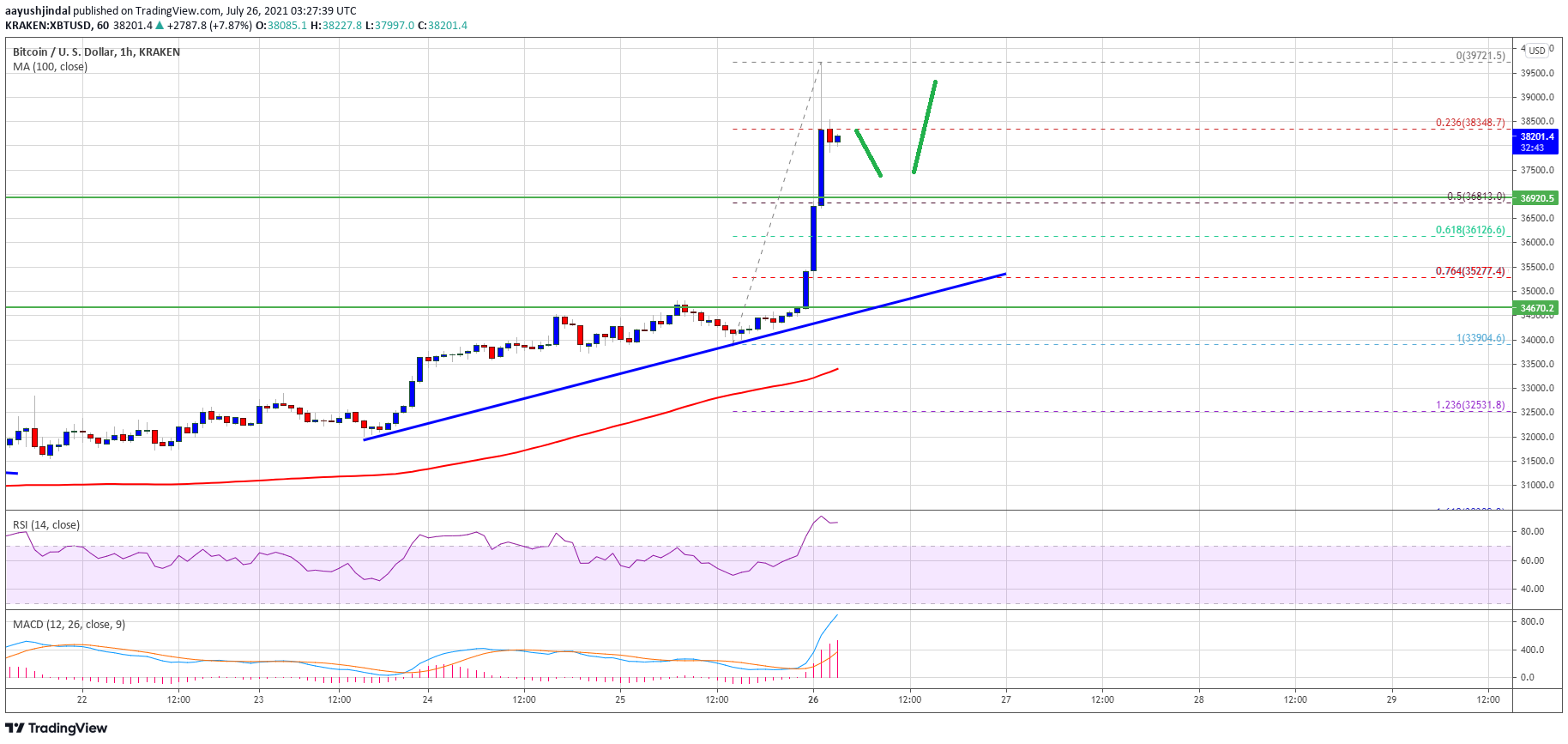
Bitcoin price started a strong upward move above the $35,000 resistance against the US Dollar. BTC is showing positive signs and it could rally further above $40,000.
Bitcoin started a strong increase above the $33,000 and $35,000 resistance levels.
The price is now trading well above $35,000 and the 100 hourly simple moving average.
There is a key bullish trend line forming with support near $35,500 with resistance near $31,250 on the hourly chart of the BTC/USD pair (data feed from Kraken).
The pair could correct gains, but the bulls are likely to remain active near $37,000.
Bitcoin Price Surges above $38,000
Bitcoin price found a strong buying interest near the $32,000 zone. BTC formed a support base near the $32,000 and it started a major upward move.
The price surged above the $32,000 and $35,500 resistance levels. There was a clear break above the $38,000 resistance level. The upward move gained strength and the price even traded close to the $40,000 resistance zone.
A high was formed near $39,721 and the price is now correcting gains. It is trading near the 23.6% Fib retracement level of the recent rally from the $33,904 swing low to $39,723 high. Bitcoin is now trading well above $35,000 and the 100 hourly simple moving average.
There is also a key bullish trend line forming with support near $35,500 with resistance near $31,250 on the hourly chart of the BTC/USD pair. It is showing a lot of positive signs near the $38,000 level. On the upside, an initial resistance is near the $39,000 level.
Source: BTCUSD on TradingView.com
The first major resistance is near the $39,500 level. The main resistance sits near $40,000. A successful break and close above the $40,000 level could initiate a fresh rally in the near term. In the stated case, the price is likely to move towards the $42,500 level in the near term.
Dip Supported in BTC?
If bitcoin fails to climb above the $39,500 and $40,000 resistance levels, it could start a downside correction. An initial support on the downside is near the $37,500 level.
The first major support is now near the $36,800 zone. A clear downside break below the $36,800 support may possibly push the price towards the $36,000 support zone in the near term.
Technical indicators:
Hourly MACD – The MACD is now losing pace in the bullish zone.
Hourly RSI (Relative Strength Index) – The RSI for BTC/USD is now well in the overbought zone.
Major Support Levels – $37,500, followed by $36,800.
Major Resistance Levels – $39,000, $39,500 and $40,000.
In the past two decades, index and exchange-traded funds (ETF) have become some of the most popular forms of investing because they offer investors a passive way to gain exposure to a basket of stocks as opposed to investing in individual stocks which increases risk of loss.
Since 2018, this trend has extended to the crypto sector and products like the Bitwise 10 Large Cap Crypto Index (BITX) tracks the total return of Bitcoin (BTC), Ether (ETH), Cardano (ADA), Bitcoin Cash (BCH), Litecoin (LTC), Solana (SOL), Chainlink (LINK), Polygon (MATIC), Stellar (XLM) and Uniswap (UNI).
The ability to access multiple top projects through one weighted average market cap index sounds like a great way to spread out risk and gain exposure to a wider range of assets, but do these products offer investors a better return in terms of profit and protection against volatility when compared to the top-ranking cryptocurrencies?
Hodling versus crypto baskets
Delphi Digital took a closer look at the performance of the Bitwise 10 and compared it to the performance of Bitcoin following the December 2018 market bottom. The results show that investing in BTC was a more profitable strategy even though BITX was slightly less volatile.
Bitcoin price vs. Bitwise 10. Source: Delphi Digital
According to the report, “indices aren’t meant to outperform individual assets, they’re meant to be lower-risk portfolios compared to holding an individual asset,” so it’s not surprising to see BTC outperform BITX on a purely cost basis.
The index did offer less downside risk to investors as the market sold-off in May but the difference was “trivial” as “BTC’s max drawdown was 53% and Bitwise’s was 50%.”
Overall, the benefits of investing in an index versus Bitcoin are not that great because the volatile nature of the crypto market and frequent large drawdowns often have a larger effect on altcoins.
Delphi Digital said:
“Crypto indices continue to be a work-in-progress. Choosing assets, allocations, and re-balancing thresholds is a difficult task for an emerging asset class like crypto. But as the industry matures, we expect more efficient indices to pop up and gain traction.”
Ethereum also outperforms DeFi baskets
Decentralized finance (DeFi) has been one of the hottest crypto sectors in 2021 led by decentralized exchanges like Uniswap (UNI) and SushiSwap (SUSHI) and lending platforms like AAVE and Compound (COMP).
The DeFi Pulse Index (DPI) aims to tap into this rapid growth and the DPI token has allocations to 14 of the top DeFi tokens, including UNI, SUSHI, AAVE, COMP, Maker (MKR), Synthetic (SNX) and Yearn.finance (YFI).
When comparing the performance of DPI to Ether since the inception of the index, Ether significantly outperformed in terms of profitability and volatility, as evidenced by a 57% drawdown on Ether versus 65% for DPI.
Ether price vs. DeFi Pulse Index price. Source: Delphi Digital
While this is an “imperfect comparison” according to Delphi Digital due to the fact that “the risk and volatility of DeFi tokens are higher than Ether’s,” it still highlights the point that the traditional benefits seen from indices are not mirrored by crypto-based baskets.
Delphi Digital said:
“You could’ve just HODL-ed ETH for a superior risk-return profile.”
For the time being, Bitcoin and Ether have proven to be two of the lower-risk cryptocurrency plays available when compared to crypto index funds that offer exposure to a larger number of assets.
The views and opinions expressed here are solely those of the author and do not necessarily reflect the views of Cointelegraph.com. Every investment and trading move involves risk, you should conduct your own research when making a decision.
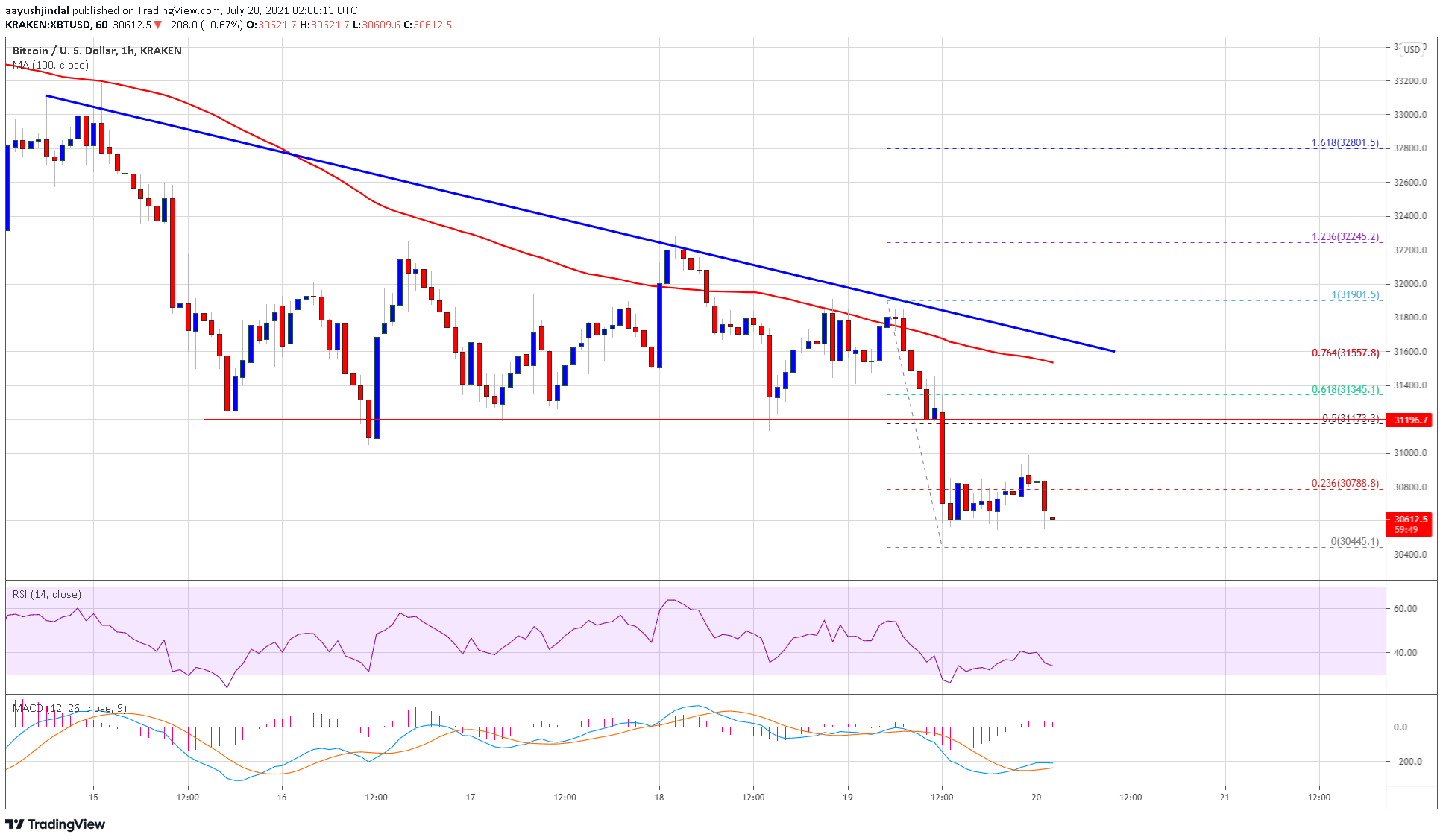
Bitcoin price extended its decline below the $31,200 support against the US Dollar. BTC remains at a risk of a larger decline below the $30,000 support zone.
Bitcoin remains in a bearish zone and it even broke the $31,000 support zone.
The price is now trading well below $32,000 and the 100 hourly simple moving average.
There is a major bearish trend line forming with resistance near $31,550 on the hourly chart of the BTC/USD pair (data feed from Kraken).
The pair is likely to accelerate lower below the $30,500 and $30,000 levels in the near term.
Bitcoin Price Extends Losses
Bitcoin price remains in a downtrend and it is now trading well below the $33,000 pivot zone. BTC extended its decline below the $31,200 support zone and it settled well below the 100 hourly simple moving average.
The price extended its decline and it even traded below $30,650. A low is formed near $30,445 and the price is now consolidating losses. It corrected a few points above the $30,500 level. However, there was no proper follow through above the 23.6% Fib retracement level of the recent drop from the $31,901 swing high to $30,445 low.
An immediate resistance on the upside is near the $31,200 level (the recent breakdown zone). It is near the 50% Fib retracement level of the recent drop from the $31,901 swing high to $30,445 low.
The next key resistance is near the $31,500 level. There is also a major bearish trend line forming with resistance near $31,550 on the hourly chart of the BTC/USD pair. The trend line resistance at $31,500 is also close to the 100 hourly SMA.
Source: BTCUSD on TradingView.com
A close above the trend line resistance could initiate a decent recovery above $32,000. Besides, a proper break above the $32,000 level may push the price towards $33,000.
More Losses in BTC?
If bitcoin fails to recover above the $31,200 and $31,500 resistance levels, there is a risk of more losses. An initial support on the downside is near the $30,500 level.
The first major support is now near the $30,200 zone. The main support is now near the $30,000 level. A close below the $30,000 level could spark a steady decline in the near term.
Technical indicators:
Hourly MACD – The MACD is slowly gaining pace in the bearish zone.
Hourly RSI (Relative Strength Index) – The RSI for BTC/USD is now well below the 50 level.
Major Support Levels – $30,500, followed by $30,000.
Major Resistance Levels – $31,200, $31,500 and $32,000.
In the last 29 days, Bitcoin (BTC) has been ranging from $31,000 to $36,000 as the impact of the recent China ban and a $1.4 billion Grayscale GBTC share unlocking continue to pressure markets.
China’s government implemented a series of measures to curb cryptocurrency mining and trading by ordering the immediate shut down of some operations and instructing domestic banks to suspend the bank accounts of entities involved in the industry.
Meanwhile, the $21 billion trust fund Grayscale and its GBTC security is facing a troublesome period as institutional investors’ 6-month lock up comes to an end, creating a potential $1.4 billion sell-off. However, it’s worth noting that the 654,000 BTC tokens under management will not be moved on the market.
As a result of these factors, Bitcoin price has been stuck in a range for months and generally traders appear to be sitting on their hands until clarity on the entire situation clears up.
While traders are skilled at using perpetual futures contracts, most are unaware of additional instruments that can be used to maximize their gains. This holds especially true when markets range sideways and creates a perfect scenario for trading options.
For example, one can build an options strategy that maximizes gains even when there is not much price action.
By using both call (buy) and put (sell) options, a trader can create strategies to generate gains in sideways markets. These can be used in bullish and bearish circumstances, and most derivatives exchanges offer accessible options platforms.
The Iron Condor strategy favors a tight range
The Iron Condor is a neutral strategy that consists of selling a $32,000 put to create positive exposure to Bitcoin while simultaneously selling a $34,000 call to reduce gains above that level. These trades were modelled from Bitcoin price at $31,750 and this trade uses an Aug. 27 expiry (40 days).
Profit / Loss estimate. Source: Deribit Position Builder
Two out-of-the-money (small odds) positions are needed to protect from the possible price crashes below $28,000 or Bitcoin appreciation above $38,000. These additional trades will give the trader peace of mind while also reducing the margin (collateral) requirements.
Any outcome on Aug. 27 between $29,200 (down 8%) and $36,660 (up 15%) yields a positive result. The maximum gain happens between $31,800 and $34,200, resulting in a 0.09 Bitcoin profit. On the other hand, the worst outcome is a 0.045 Bitcoin loss.
A similar structure could be deployed for Ethereum (ETH) options but traders should account for the London hard fork on Aug. 4, which could potentially induce sharper volatility.
The views and opinions expressed here are solely those of the author and do not necessarily reflect the views of Cointelegraph.com. Every investment and trading move involves risk, you should conduct your own research when making a decision.
Bitcoin and other cryptocurrencies, such as Ethereum, are becoming more popular as an investment alternative. In early 2021, the price of bitcoin skyrocketed to all-time highs. Bitcoin is currently worth $33,225.90.
In 2020, Bitcoin and other cryptocurrencies outpaced the majority of traditional investments.
Bitcoin and other cryptocurrency investments are well-known for yielding huge profits at high risk. Almost every investor understands the volatility of cryptocurrency, whether they invest with personal assets or retirement funds. If you are going to dabble in crypto investing, you must be informed of your acceptable loss.
Should you include bitcoin in your 401(k)?
Begman of IRA Financial stated – “Just like stocks, Bitcoin can be purchased in an IRA or 401(k). However, from a practical standpoint, an employer-adopted 401(k) plan with employees will likely not allow for any alternative investment options because of ERISAfiduciary rules.”
Even so, people who want to add cryptocurrency to their 401(k) should think about a few things first.
According to Leanna Haakons, the Founder of Black Hawk Financial, the biggest benefit would be that people interested in crypto could invest pre-tax money, something they cannot do through a brokerage account at this time. This is something long-term investors will benefit from. However, some self-directed IRAs do offer bitcoin as an investment option.
In addition, Haakons added that because retirement plan providers cap crypto contributions at 5% of an account’s total value, it is a smart way to get engaged in crypto investing without risking too much of your money, as you might if you invested on your own and went all in.
Lyle D Solomon
Haakons added that the at-home investor who is not going to be monitoring the market every day is a better option. They should be given the exposure and the chance to make some of those big potential gains but restrict them to follow the guidelines.
Cryptocurrencies, like bitcoin, are extraordinarily volatile assets. A 401(k) or individual retirement plan should be made up of stable, low-cost investments you feel will grow in value over time. That means index funds are one of the best choices for most average investors.
With a few exceptions, you will not be able to take money out of your 401(k) until you are above the age of 59, at which point you will be subject to taxes and penalties.
So, according to Haakons, you need to think about your investment timeframe and priorities. Bitcoin’s value could skyrocket tomorrow, but it will not help you if you are decades away from retirement. If you are thinking of a short-term investment, a brokerage account with more buying and selling flexibility might be a better choice.
It is also important to understand where you are investing your money. Dan Kemp, Chief Investment Officer of Morningstar Investment Management, recently cautioned against buying bitcoin or any digital currency just because it is what your friends are talking about.
Understand the differences between crypto-assets and bitcoin, and why they are seen as superior long-term prospects by some investors. Also, keep in mind that there is always some hot new investment that promises to turn the average person into a millionaire quickly. But, practically, things are not always so easy.
According to Haakons, investing in safe bets like index funds, and committing only 5% of your portfolio to bitcoin wagers are not always a bad idea. It all boils down to how much you are willing to take a chance. You should only invest money you can afford to lose in something unproven like bitcoin or other cryptocurrencies.
Haakons commented that it will not be a massive risk if you keep it to the maximum of 5% of your retirement savings unless you have a lot of money in there. You will still have a strong foundation thanks to mutual funds and exchange-traded funds (ETFs). an investment that promises to turn the regular individual into a millionaire quickly. But, practically, things are not so easy after all.
How Much Is It Worth to Invest in Bitcoin IRAs?
The Internal Revenue Service (IRS) does not have a cryptocurrency-specific account. As a result, when investors talk about ‘Bitcoin IRA’, they’re referring to an IRA that contains bitcoin or other digital currency within its holdings.
A self-directed IRA is sometimes known as a Bitcoin IRA. Self-directed individual retirement accounts (SDIRAs) allow you to invest in assets such as real estate, precious metals and cryptocurrency that are not allowed in traditional IRAs.
Suggested articles
FMTV Interview: Marketing in FintechGo to article >>
Investing in Bitcoin for retirement may increase your investment returns and diversify your portfolio, but it also adds a significant amount of risk to your retirement portfolio. If you are self-employed or operate a small business, SEP and Simple IRAs, as well as solo 401(k)s, offer significantly larger contribution limits.
Additionally, you can transfer money from a traditional IRA to a self-directed IRA. The IRS has treated bitcoin and other cryptocurrencies in retirement plans as property since 2014, which means coins are taxed similarly to equities and bonds.
According to the Retirement Industry Trust Association (RITA), between 2 and 5% of all IRAs are currently invested in alternative assets.
You will need to keep three things in mind:
Your IRA is held by a custodian, who handles its safekeeping as well as ensuring that your account complies with IRS and government rules. With traditional IRAs, banks and other financial entities often fulfil this function.
Your cryptocurrency trades are managed by an exchange. A crypto exchange (sometimes referred to as a DCE or digital currency exchange) is equivalent to a stock exchange. It is a marketplace for digital currencies, and it is where you will get your Bitcoin, Ethereum, or any cryptocurrency.
Your cryptocurrency is safe with a secure storage solution. Most Bitcoin IRA providers feature patented secure storage mechanisms to help protect your digital assets from theft after you buy them.
A custodian is required for IRA participants who want to include digital tokens in their retirement funds. Many investors have discovered that finding a custodian who accepts bitcoin in an IRA might be difficult. Custodians and other companies that let investors include bitcoin in their IRAs have grown in popularity recently.
Self-directed IRAs (SDIRAs) are increasingly allowing for alternative assets like cryptocurrencies, which is beneficial for consumers who want to include bitcoin in their IRAs. Some of the early leaders in this area are companies like BitIRA, Equity Trust, and Bitcoin IRA.
Let’s analyze the pros and cons of Bitcoin IRA:
Pros:
Tax benefits – Tracking trades and calculating taxes owed is the single biggest problem for Bitcoin investors. Because you owe taxes every time you sell cryptocurrencies for a profit, keeping track of multiple purchase prices and gains can be an accounting problem. Investing in a tax-advantaged account, such as a regular or Roth IRA, relieves this burden because it does not tax you on anything as long as the funds and assets remain in the account. Furthermore, you will benefit from the compounding growth of value that you will not lose due to taxes.
High-return potential – Bitcoin is extremely volatile, yet with volatility comes the potential for massive gains. For example, the value of Bitcoin was at $5,200 on March 15, 2020, and completed the year at $30,000, while Ethereum, the second most popular cryptocurrency, increased by almost 400% in 2020. Bitcoin’s massive potential is definitely worth the risk, especially if you are only investing a small portion of your IRA’s total value.
Diversification – Cryptocurrency is an asset class that is different from stocks and bonds, which are the most commonly held assets in retirement accounts in the United States. Even while crypto is risky in its own way, this could help secure your retirement funds.
Cons:
Volatility – The price of Bitcoin has fluctuated from close to $20,000 in December 2017 to as low as $3,400 in December 2018. Such volatility poses significant danger to an IRA, particularly for those nearing retirement.
Fees – Unlike traditional IRAs, self-directed IRAs usually have a higher charge structure. Make sure you understand all the charges associated with investing in cryptocurrency for retirement, from setup fees to trading and account administration fees.
Exchange restrictions – Some Bitcoin IRA providers will only let you trade on affiliated currency exchanges. Others provide you with the option of selecting your favorite exchange. If you want to invest with a certain crypto exchange, make sure your Bitcoin IRA provider enables it.
Complexity – When you invest in a Bitcoin IRA, you will almost certainly need to maintain at least one additional retirement account in addition to dealing with the moving parts of custodians, exchanges and secure storage. This is because Bitcoin IRAs are not set up to allow traditional assets like equities, bonds and mutual funds. This can make retirement planning even more difficult.
Final Takeaway – Should You Include Bitcoin in Your Retirement Portfolio?
Diversification is an important factor. Bitcoin is a very volatile investment, but some industry professionals believe it is an excellent one to have in your portfolio.
Before including it, though, you must be aware of the risk. Consult your financial advisor about the percentage of your portfolio that you should allocate to Bitcoin.
Bitcoin’s price decreased by about 85% between December 2017 and December 2018. However, it has increased tenfold since that low point, showing that volatility cuts both ways.
The higher the volatility of an investment, the higher the losses, but it also increases the potential gains. Whatever amount you invest, make sure you do your homework by understanding not only digital currencies but also the blockchain technology that powers them.
If you decide to invest in Bitcoin, be sure you are in it for the long haul and that you know you could lose all of your money. This is what experts refer to as an ‘acceptable loss’.
You do not have to buy coins directly because there are crypto-focused mutual funds. You should not invest in these types of assets if you do not understand how premiums and discounts work. Also, keep in mind the tax implications for this form of investment in the funds where you put it.
Given the volatility of cryptocurrencies, it is probably not the best idea for individuals closer to retirement to incorporate Bitcoin in their portfolio. On the other hand, those with a longer time frame and a higher risk tolerance may find that investing a modest portion of their retirement savings in alternative assets, such as Bitcoin or other cryptos, might provide an upside and protect them from losses in their traditional holdings.
Make sure you understand the fees structure before investing. Lastly, and perhaps most significantly, consider using Bitcoin and other cryptocurrencies as a minor portion of your total retirement plan, rather than the entire strategy.
Lyle Solomon serves as a principal attorney for the Oak View Law Group in Los Altos, California.
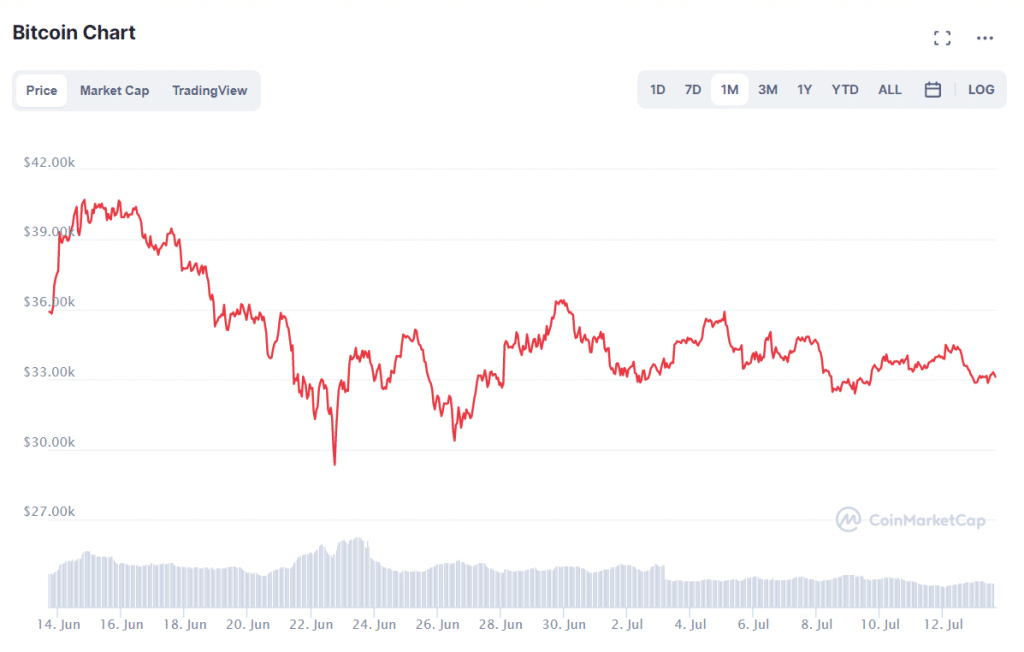
Bitcoin, the world’s most valuable digital asset, is currently struggling around the price level of $33,000 amid negative market sentiment. BTC has lost nearly 5% of its value since 7 July 2021.
According to the latest data published by Coinmarketcap, the overall market cap of digital currencies dropped by approximately $50 billion in the last 24 hours led by a correction in Bitcoin, Ethereum, Cardano, and Binance Coin. Ethereum remained the worst performer among the top 5 digital currencies with a drop of more than 5%.
Bitcoin’s total market cap dipped below $620 billion on 13 July 2021. The world’s largest cryptocurrency now has a market dominance of 45.6%. The price of BTC has remained below $40,000 since 16 June.
Suggested articles
EuropeFX Expands its CFD Portfolio with 14 New CryptocurrenciesGo to article >>
BTC Chart (coinmarketcap)
“Bitcoin’s average return for 6-month investors is sitting at a very low -27.81%. When traders are this underwater, FUD typically arises in the form of negative-driven posts. Keep this negative bias in mind & take crowd takes with a grain of salt,” crypto analytics platform Santiment mentioned on Twitter.
Quiet Week for Bitcoin
Last week remained very quiet for Bitcoin as the volatility decreased significantly. BTC’s on-chain activity also dropped sharply in the last few days. “It has been an impressively quiet week in the Bitcoin market as volatility continues to seep out, and prices squeeze into a tight consolidation range. The week opened at a high of $35,128 and traded down to a low of $32,227. It is starting to feel like the calm before the storm as muted and quiet activity appears across both spot, derivative, and on-chain metrics,” on-chain analysis firm Glassnode mentioned in its latest weekly report.
Last week, Meitu, one of the leading technology firms in Asia, revealed that the fair value of the company’s Bitcoin holdings decreased by more than $17 million due to the latest correction in the price of BTC. The company purchased nearly $100 million worth of Bitcoin and Ethereum (ETH) in March 2021.
Data from Cointelegraph Markets Pro and TradingView tracked Bitcoin as it reversed weekend gains on Monday after a disappointing weekly close.
The largest cryptocurrency had maintained its familiar trading range with $33,000 as support through Saturday and Sunday, but the new week dampened momentum.
For popular trader and analyst Rekt Capital, unless progress can be made, Bitcoin bulls may not have long to last before fresh losses hit.
“The blue 50-week EMA is still holding as support,” he summarized in a series of tweets.
“If this HL isn’t reclaimed as support soon, the sell-side pressure on the 50 WEMA may be too much for $BTC to hold here.”
Others were more upbeat. In his latest video update, fellow trader Michaël van de Poppe went as far as to call a BTC price breakout within days.
“I believe that Bitcoin is going to make a breakout to the upside,” he forecast.
“I would not be surprised if Bitcoin is going to trade around $38,000 during the days of this week.”
A look at buy and sell levels at major exchange Binance showed resistance forming at $35,000, with $30,000 remaining in place as overall support.
BTC/USD buy and sell levels (Binance) chart. Source: Material Indicators/Twitter
Altcoins lurk ahead of market decision
Van de Poppe added that this movement might be good for altcoins, which could start capitalizing on bullish sentiment. He had previously argued that altcoins would outperform the speed of Bitcoin’s gains in the coming months.
“I think the altcoins are close to a bottom too,” he said on Friday.
Related: Top 5 cryptocurrencies to watch this week: BTC, LUNA, ATOM, CAKE, FTT
Most altcoins saw flat performance on the day, little changed over the past 24 hours.
With little by way of strong sentiment in either direction, as Cointelegraph reported, concerns remain that external factors may unduly influence price action across cryptocurrencies.
This comes in the form of the Grayscale unlocking series, which involves around 42,000 BTC over the month of July.
Bitcoin price has been trapped in a tightening trading range and has barely moved in weeks. The top cryptocurrency by market cap has been boring compared to its characteristically volatile self.
Looking back at the asset’s historic volatility, a fractal pattern could be forming that suggests the price per BTC is about to blast off to unprecedented heights.
Fractals And How History Doesn’t Rhyme But It Often Repeats
Mark Twain said that “history doesn’t repeat, but if often rhymes.” The statement best explains the theory behind repeating price patterns called fractals.
Related Reading | Bitcoin Ready For Display Of Strength, But Which Direction Will It Break
These fractals appear similar to another point in historic price action, and help analysts to predict and anticipate future market behavior. The results can be mixed, as rarely do things play out exactly the same. This fact has earned fractals a negative reputation, however, even in Bitcoin there is some specific behavior that can be expected.
Every cycle looks similar by comparison when zooming out | Source: BLX on TradingView.com
For example, each major breakout past all-time high resulted in a parabolic uptrend and the visual comparisons are undeniable. The most recent uptrend of which has come to a screeching halt, turning a stumble into a full-on 50% or more collapse.
While the market ponders if the bull trend is kaput, even technicals have become mixed. There is a handful of doji candles on the weekly, a tight trading range, and volatility has dropped to an important level. All of these signs point to a potential reaction, and if “history” has anything to do with it, the volatility should be released to the upside.
What Historical Volatility Says About The Bitcoin Bull Run Finale
All throughout nature there are fractal-like patterns that repeat again and again. Price action in financial assets commonly exhibit such repeating behavior, such as cycling between bear and bull markets.
Bitcoin is no different, and is known for patterns that appear again and again. Looking back at the Historical Volatility indicator on weekly timeframes, we may have one of those instances brewing.
Mid-cycle consolidation then kicks volatility into high gear | Source: BTCUSD on TradingView.com
During the previous bull market, which is clear the current cycle isn’t quite following in terms of “only up” price action, after one of the largest shakeouts, volatility finally held above a key level and kickstarted the last leg of the bull market.
Anyone who had assumed it was the peak of the cycle, would have been left in the dust as Bitcoin churned out another 900%+ of bull market ROI and volatility went parabolic.
Related Reading | Bitcoin Trend Strength Indicator Suggests Bull Run Isn’t Yet Over
Bitcoin is back and trying to hold above a very similar support line, and if successful, should send volatility back along a parabolic curve along with price action. That would put the top of the current bull cycle at around December, which – historically – has marked a significant top or bottom every year since 2017.
Still think history doesn’t rhyme?
Follow @TonySpilotro on Twitter or via the TonyTrades Telegram. Content is educational and should not be considered investment advice.
Featured image from iStockPhoto, Charts from TradingView.com
Paraguayan Congressman Carlitos Rejala and Senator Fernando Silva Facetti are planning to introduce a Bitcoin (BTC) bill to Congress on Wednesday, July 14, underscoring the lawmakers’ urgency in formulating a coherent digital asset strategy for their country.
“I am here to unite Paraguay,” Rejala tweeted Friday, adding that he and his fellow lawmaker are planning a “mega surprise for Paraguay and the world.”
I am here to unite Paraguay , that is why we decided with Senator @FSilvaFacetti to present together the bill #bitcoin on Wednesday, July 14! Stay tuned since there will be a mega surprise for Paraguay and the world. Something GIANT is coming #Bitcoin#btc
Although Rejala didn’t specify what the bill would entail, some lawmakers in the country want to follow El Salvador’s lead in making Bitcoin legal tender. On June 6, Rejala informed his more than 50,000 Twitter followers that digital assets would be connected to “an important project to innovate Paraguay in front of the world.”
Como ya lo decía hace un buen tiempo, nuestro país necesita avanzar de la mano de la nueva generación. Llegó el momento, nuestro momento. Esta semana empezamos con un proyecto importante para innovar a Paraguay frente al mundo!
Based on Rejala’s previous statements, the forthcoming bill will introduce measures to make Paraguay a leading center for foreign cryptocurrency investors, businesses and perhaps even Bitcoin miners. Potentially, this will include provisions to accept BTC as legal tender.
Like other Latin American lawmakers, Rejala added laser eyes to his profile picture on Twitter, a symbolic way of showing his bullish outlook on BTC.
Related: What is really behind El Salvador’s ‘Bitcoin Law’? Experts answer
Latin America has emerged as a potential hotbed for cryptocurrency adoption due to local economic and fiscal pressures, especially in countries like Argentina, Venezuela and Mexico. As Cointelegraph reported, Latin America is now home to at least two cryptocurrency unicorns, a term used in the venture capital industry to describe startups with a valuation of $1 billion or more.
2TM Group, the parent company behind Brazilian cryptocurrency exchange Mercado Bitcoin, recently completed a $200 million funding round with SoftBank, bringing its total valuation to an estimated $2.1 billion. Meanwhile, Mexican crypto exchange Bitso is valued at $2.1 billion after concluding a Series C funding round.