hacklink hack forum hacklink film izle hacklink mamibet loginmamibetmamibet loginqqmamibetjojobetbetciobetcioholiganbetmegabahis

Tag: Big

  • XRP ETF Premium Primed For Big Leap: Eyes Set On $500

    XRP ETF Premium Primed For Big Leap: Eyes Set On $500

    [ad_1]

    XRP enthusiasts are in a frenzy after prominent community figure Chad Steingraber proposed a scenario where an XRP exchange-traded fund (ETF) could trade at a staggering 100x premium.

    Steingraber, a seasoned game designer, laid out his thoughts in a recent post, igniting discussions about the potential trajectory of an XRP ETF, particularly in light of the ongoing push for institutional adoption of the altcoin.

    Targeting A $500 XRP ETF Share Price

    Steingraber’s speculation centers around the price at which an XRP ETF’s shares might trade. His hypothesis hinges on the crypto reaching an unprecedented price of $5 per coin. In this scenario, he theorizes that the corresponding ETF could soar to equally unprecedented heights, potentially reaching a solid $500 per share.

    This hefty premium, according to Steingraber, would be fueled by a surge in institutional interest in the ETF. He cites the Grayscale Litecoin Trust (LTCN) as a prime example.

    Similar to his proposed XRP ETF, LTCN trades at a significant premium over Litecoin’s current market price. Despite Litecoin hovering around $95, investors in LTCN are currently paying a premium of over $250 per Litecoin equivalent within the trust.

    Can Arbitrage Opportunities Emerge?

    The prospect of such a high premium has sparked discussions about potential arbitrage opportunities. X user Zack, in response to Steingraber’s post, questioned whether individuals holding XRP could exploit this price disparity. Steingraber acknowledged the possibility, particularly if the issuing ETF allows for in-kind deposits, where investors can directly exchange their token for ETF shares.

    XRP market cap currently at $34 billion. Chart: TradingView.com

    However, he cautioned that in-kind deposits are still a rarity in the ETF market. While Steingraber expressed optimism about the future adoption of this practice, its absence presents a hurdle for immediate arbitrage opportunities.

    The XRP community has long advocated for asset managers, especially industry giant BlackRock, to launch an XRP ETF. They believe such a product would significantly bolster the value of XRP by increasing its accessibility to institutional investors.

    XRP up in the last seven days. Source: Coingecko

    A Speculative Outlook With Underlying Uncertainties

    It’s crucial to remember that Steingraber’s vision is entirely speculative. As of today, no asset manager has taken concrete steps towards applying for an XRP ETF. Furthermore, the justification for such a high premium rests heavily on the assumption of substantial institutional demand, a factor that remains uncertain.

    The applicability of the Grayscale Litecoin Trust comparison also requires further scrutiny. The specific structure and features of an XRP ETF would significantly influence whether a similar premium dynamic would emerge.

    A Reality Check For Investors

    While Steingraber’s prediction has certainly captured the community’s imagination, investors are advised to approach it with a healthy dose of caution. The approval timeline for an XRP ETF hinges on the US Securities and Exchange Commission’s stance on cryptocurrency ETFs.

    Additionally, competition from other potential ETFs could play a role in determining the premium, if any.

    Featured image from Freepik, chart from TradingView

    Disclaimer: The article is provided for educational purposes only. It does not represent the opinions of NewsBTC on whether to buy, sell or hold any investments and naturally investing carries risks. You are advised to conduct your own research before making any investment decisions. Use information provided on this website entirely at your own risk.


    [ad_2]

    Source link

  • Big Reaction From Bulls Imminent

    Big Reaction From Bulls Imminent

    [ad_1]

    Bitcoin gained pace above the $47,000 resistance against the US Dollar. BTC is showing positive signs and might rally towards the $50,000 resistance zone.

    • Bitcoin saw a major technical breakout above the $45,500 resistance zone.
    • The price is trading above $46,500 and the 100 hourly simple moving average.
    • There is a crucial bullish trend line forming with support near $46,200 on the hourly chart of the BTC/USD pair (data feed from Kraken).
    • The pair could continue to rise and might trade towards the $50,000 resistance zone.

    Bitcoin Price Breaks $48K

    Bitcoin price remained strong above the $45,500 resistance zone. BTC started a fresh increase and was able to clear the $46,500 resistance zone.

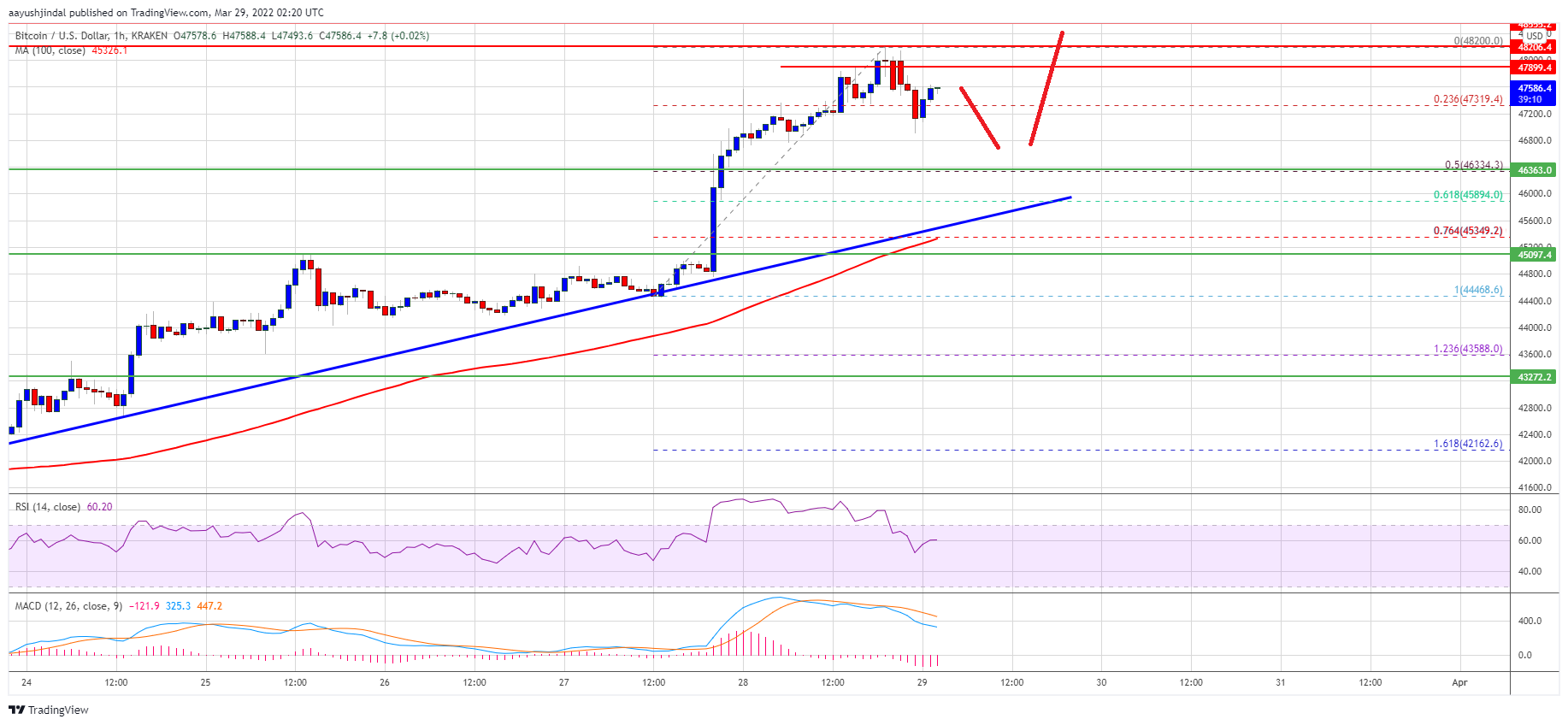
    The upward move gained pace above the $46,500 level and the price settled above the 100 hourly simple moving average. Finally, it spiked above the $48,000 level. A high was formed near $48,200 and the price is now consolidating gains.

    There was a minor drop below the $48,000 level. Bitcoin traded below the 23.6% Fib retracement level of the upward move from the $44,470 swing low $48,200 high. Besides, there is a crucial bullish trend line forming with support near $46,200 on the hourly chart of the BTC/USD pair.

    On the upside, the price is facing resistance near the $48,000 level. The next major resistance could be near the $48,200 zone. A successful break and close above the $48,200 level might push the price towards $49,000.

    Bitcoin Price

    Source: BTCUSD on TradingView.com

    The next major resistance could be near the $49,500 level. Any more gains could open the doors for a move towards the $50,000 level.

    Dips Limited in BTC?

    If bitcoin fails to clear the $48,200 resistance zone, it could start a downside correction. An immediate support on the downside is near the $47,000 zone.

    The next major support is seen near the $46,350 level. It is near the 50% Fib retracement level of the upward move from the $44,470 swing low $48,200 high. The main support is near the $46,000 level and the trend line. A downside break below the $46,000 support zone could send the price to $45,000.

    Technical indicators:

    Hourly MACD – The MACD is slowly gaining pace in the bearish zone.

    Hourly RSI (Relative Strength Index) – The RSI for BTC/USD is now above the 50 level.

    Major Support Levels – $47,000, followed by $46,000.

    Major Resistance Levels – $48,200, $49,000 and $50,000.

    [ad_2]

    Source link

  • Central banks generate trust, not big techs or “anonymous ledgers”

    Central banks generate trust, not big techs or “anonymous ledgers”

    [ad_1]

    In a speech entitled “Digital currencies and the soul of money,” Agustín Carstens, the general manager of the Bank of International Settlements,’ criticized private stablecoins and decentralized finance (DeFi), touting central bank-led financial innovation as the best possible path to the future of money.

    Carstens, who served as governor of the Bank of Mexico between 2010 and 2017, delivered his remarks at the conference on “Data, Digitalization, the New Finance and Central Bank Digital Currencies: The Future of Banking and Money” at the Goethe University in Frankfurt.

    The economist’s argument revolved around the institutional foundations of money and how, even in the digital age, central banks remain in a position to provide trust in money and ensure “an efficient and inclusive financial system to the benefit of all.” Alternative designs of monetary systems that emerged throughout history, according to the BIS’ top official, “have often ended badly.”

    To advance his point, Carstens discussed three plausible scenarios of financial innovation. In addition to the global monetary system led by central banks, he envisioned a world where big tech-powered stablecoins are the dominant form of money, and another where the bulk of financial activity is decentralized and runs on distributed ledgers.

    The stablecoin scenario, Carstens maintained, is fraught with market power and data concentration at the hands of a few dominant private money issuers. National and global monetary systems would become fragmented, while the disintermediation of incumbent banks would threaten financial stability.

    Speaking of DeFi, the BIS boss claimed that the reality that DeFi applications are delivering is at odds with their proclaimed foundational principles of disintermediation. Carstens said:

    To date, the DeFi space has been used primarily for speculative activities. Users invest, borrow and trade cryptoassets in a largely unregulated environment. The absence of controls such as know-your-customer (KYC) and anti-money laundering rules, might well be one important factor in DeFi’s growth.

    Furthermore, echoing BIS researchers’ recent claims, Carstens stated that “there is a lot of centralization in DeFi.” He also cited scalability issues and liquidity mismatches as problematic aspects of decentralized finance.

    In the vision of the monetary future that the economist extolled, central banks are at the core of the financial system, facilitating innovation such as building a global network of CBDCs. Because they are not profit-driven, central banks would act to advance the interests of the public, according to Carstens.

    These statements come as no surprise when voiced by a chief officer of an institution that is often called a bank for central banks. As Cointelegraph reported earlier, the BIS’ innovation arm is actively engaged in several CBDC trials, including the cross-border settlement initiative ran jointly by central banks of France and Switzerland.

    [ad_2]

    Source link

  • Bitcoin Indicators Now Look Similar To Q4 2020, Big Move Ahead?

    Bitcoin Indicators Now Look Similar To Q4 2020, Big Move Ahead?

    [ad_1]

    Quant says some Bitcoin indicators show the same trend as in during Q4 2020, suggesting that BTC could make a similar move up.

    Bitcoin Netflow And Stablecoins Supply Ratio Trends Look Similar To Q4 2020

    As explained by an analyst in a CryptoQuant post, two BTC indicators: the netflow and the stablecoins supply ratio, are both trending similarly to how they did during the last quarter of 2020.

    The Bitcoin netflow indicator shows the net number of coins entering or exiting exchanges. Its value is calculated by taking the difference between the outflows and the inflows.

    When the metric observes positive values, it means exchanges are experiencing more inflows than the outflows, and so more investors have started sending their BTC to exchanges for selling purposes.

    Similarly, negative values imply just the opposite; investors are withdrawing their Bitcoin from exchanges either to hodl in personal wallets or to sell them through OTC deals.

    The other metric of relevance is the stablecoins supply ratio, which is defined as the market cap of BTC divided by the market cap of all stablecoins.

    When the indicator’s values are on the lower end, it means there is an abundance of stablecoins supply in the market. High supplies can imply a potentially bullish sentiment among the market as investors use these coins for picking up other crypto like BTC.

    Related Reading | China’s Ban On Crypto-Assets Forces Huobi Mining Pool To Rotate 100k Bitcoin

    On the other hand, higher values of the ratio indicate a low supply of stablecoins, which implies a lack of buying pressure in the market. This could lead to a potentially bearish trend or sideways movement for BTC.

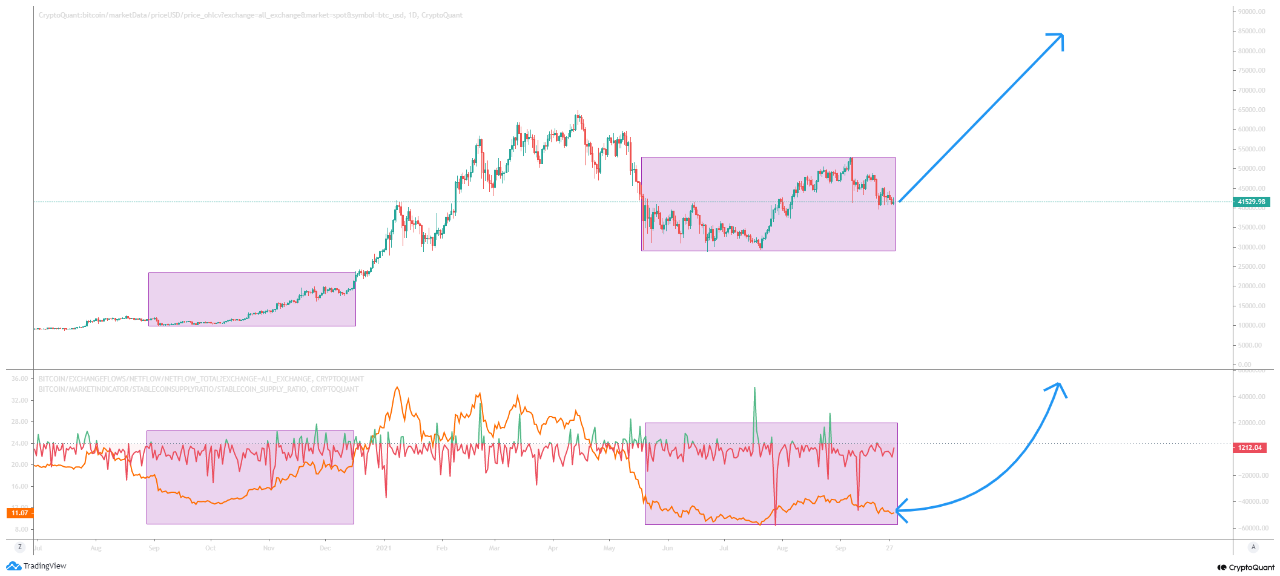
    Now, here is a chart showing the trend of these two Bitcoin indicators vs the price:

    Bitcoin Netflow, Stablecoins Supply Ratio

    The similarity between Q4 2020 and the current period | Source: CryptoQuant

    As the above chart shows, the netflows seem to have been negative for a while now and the stablecoins supply ratio is also assuming low values.

    Related Reading | Bitcoin Bearish Signal: On-Chain Data Shows Whales Have Started Selling

    This trend looks to be similar to how it was during Q4 2020. What followed it was a big bull rally, and so the quant believes we may see BTC blow up similarly soon.

    BTC Price

    At the time of writing, Bitcoin’s price floats around $43k, down 2% in the last seven days. Over the past month, the crypto has lost 9% in value.

    Over the last few days, BTC has only shown sideways movement as the crypto fails to make a move above $45k. The below chart shows the trend in the price of the coin over the last five days:

    Bitcoin Price Chart

    BTC's price continues to consolidate between the $40k and $45k levels | Source: BTCUSD on TradingView
    Featured image from Unsplash.com, charts from CryptoQuant.com, TradingView.com

    [ad_2]

    Source link

  • How Big Is Bitcoin’s Lightning Network? The Answer Will Surprise You

    How Big Is Bitcoin’s Lightning Network? The Answer Will Surprise You

    [ad_1]

    The Lightning Network is one of the most bullish developments that the Bitcoin ecosystem has seen so far. And all the available metrics point up, a healthy and vibrant network is brewing. However, investor Kevin Rooke took a deeper look and found out that the Lightning Network is probably even bigger than previously thought. “Inaccurate comparisons and privacy preserving features make it hard to truly understand how big the Lightning Network is.

    Related Reading | Bitcoin Lightning Network Reaches Record Capacity

    What does Rooke mean by that? Let’s find out.

    The Lightning Network By The Numbers

    A casual look at popular analytics platform 1ml tells us that, at the time of writing, The Lightning Network is composed of 24,688 nodes, 64,577 channels, and the network capacity is 2,272.89 BTC. All of those numbers are up. However, “The Lightning Network is not a borrowing protocol, an AMM, or a store of value. Furthermore, the idea that Bitcoin is “locked” on the Lightning Network is misleading at best.

    There are a number of DeFi protocols that have a much higher number of BTC “locked,” and people mistakenly compare that number to the Lightning Network ‘s capacity. In DeFi, usually, the funds are in fact locked and can’t be touched until the contract in question runs its course. In Lightning, things are quite different: 

    As explained in the book Mastering the Lightning Network, funds that are added to the Lightning Network are not locked, they are unleashed. As soon as a new Lightning channel is opened, those funds can be sent anywhere on the Lightning Network in an instant, and for almost no cost.

    And speaking about channels, Kevin Rooke talked about them in an “investor letter” dated June 28th:

    There are currently over 51,800 channels routing payments between 22,000 nodes, and 21% of those Lightning Network channels were created in the last 30 days.

    On the surface, 21% monthly channel growth seems impressive, but new channel creation is a slightly misleading metric as nodes frequently open and close new channels.

    A more accurate measure of growth is that the total number of channels on the Lightning Network is up by 10.8%, or over 5,000 channels in the last month.

    Compare that to the more recent figure that we gave you at the beginning of the section and note how the number of channels grew in just a month and a half. That’s not all, take into account that:

    Some nodes don’t want their channels to be included in the public Lightning Network graph, and instead choose to open ‘unadvertised’ or ‘private’ channels.

    BTCUSD price chart for 08/13/2021 - TradingView

    BTC price chart for 08/13/2021 on FTX | Source: BTC/USD on TradingView.com

    Privacy Doesn’t Let Us See How Much Money Goes Through Lightning

    Most of the transactions that take place inside the Lightning Network are private. Only at the time of settlement between two parties are the final numbers forever registered into the Bitcoin blockchain. That means it’s impossible to know exactly how much money is going through Lightning on any given day. Or in total. 

    Related Reading | Bitcoin Community Celebrates as Crucial Lightning Network Project Launches

    However, Rooke estimates that “annual on-chain volume is almost 6x higher than the value locked into the Bitcoin network, despite the relatively high transaction fees and slow block times that make payments cumbersome.” That’s on the main Bitcoin blockchain.  On the other hand:

    The Lightning Network is designed for making fast and inexpensive payments, so if $85 million of Bitcoin is already on the Lightning Network, it would make sense for annual payment volume to be at least 6x higher, or at least $510M.

    That’s a bare minimum. And things are just getting started. In September, El Salvador’s Bitcoin Law goes into effect and the whole country will start using the Lightning Network. And take into account that roughly a quarter of El Salvador’s GDP comes from remittances, so it’s not a stretch to think that Salvadoreans all over the world will start using it as well. Add to that Jack Dorsey’s projects, both Square and Twitter are looking into Lightning integration.

    In fact, Dorsey published this tweet yesterday:

    And this is just the tip of the iceberg. For more impressive numbers and deductions, be sure to read “The Lightning Network Is Bigger Than You Think.

    Featured Image by Anuraj SL from Pixabay - Charts by TradingView


    [ad_2]

    Source link