Tag: Apr

  • The State of ApeX: A Decentralized Perpetual Swap Protocol | by Bit Media Buzz | Apr, 2022

    The State of ApeX: A Decentralized Perpetual Swap Protocol | by Bit Media Buzz | Apr, 2022

    [ad_1]

    Positioned as a stable ecosystem that prioritizes decentralized governance, disintermediation and provides a self-adjusting interest rate mechanism, ApeX is a revolutionary protocol that has the potential to become the standard for all crypto derivatives platforms.

    In the last few years, the future of finance has been riding the decentralization wave, at speeds which would heretofore been unimaginable. In line with a fundamental rethinking of the way money works, with a focus on open-source code and permissionless networks, ApeX is a decentralized, permissionless and non-custodial platform that allows for the creation of perpetual swap (funding) markets on any token pair. Perpetual swaps are derivative contracts that allow two counterparties to conduct a margin trade, where settlement does not occur until one party terminates the contract.

    The State of ApeX

    It has been an eventful beginning for ApeX, having successfully launched a beta version of the protocol on the Arbitrum mainnet, completed their seed round fundraising and sold out a total of 4,580 unique NFTs to their users. With a pre-mined fixed total supply of 1 billion tokens, $APEX represents value and utilities such as governance, protocol incentives, and staking to its users.

    Across crypto and beyond, the key question being asked by many is: What is more profitable in the long run — holding, or trading? In tandem with this question is another that follows — which investment is more secure, staking or NFTs? ApeX contends that there is no one-size-fits-all investment advice in today’s world of DeFi — ROI depends on the platform used.

    The 3 core pillars of ApeX’s value proposition

    The core of ApeX’s protocol is to create a fully permissionless and globally accessible perpetual contract protocol. The ability to trade on the ApeX protocol without the need for an account or verification opens up the world of trading to anyone with internet access.

    ApeX operates on three pillars:

    Fully Permissionless — No KYC or AML restrictions. Most DeFi platforms require some form of KYC/AML verification before users can use their services. Believing that this creates unnecessary friction for end users and goes against the ethos of a truly permissionless system, ApeX has taken a stance against having KYC/AML restrictions.

    Liquidity in Perpetuity — A protocol designed as a foundation for future applications in multiple financial verticals, ApeX believes it is essential to provide an avenue for users to profit from liquidity provision without any time constraints or limitations.

    Full-spectrum Asset Support — As a way to transact value across borders and economies by leveraging blockchain technology, crypto-assets are more than just tokens. The ultimate goal of ApeX is to become a one-stop shop for every swap need.

    ApeX Protocol is funded and backed by global investors

    More than just providing decentralized solutions, ApeX also prioritizes being able to deliver stable liquidity and support the development of the ApeX protocol. ApeX is backed by global partners that include Dragonfly Capital Partners, Jump Trading and Tiger Global Management, who will support the development of the solutions that will transform the state of DeFi.

    What makes ApeX different from other perpetual swap protocols

    ApeX contends that the most important features of a perpetual swap protocol are the market maker design, pricing formula, and risk management system. All three areas need to work together seamlessly to ensure fair pricing, efficient price discovery, and low risk. Two core features of ApeX protocol make it different from other protocols in the market.

    1. Elastic Automated Market Maker (eAMM)

    Elastic Automated Market Maker (eAMM) is a self-balancing system that enables the creation of on-chain derivatives. It has a pool of liquidity that is used as collateral to back all positions taken by traders. This allows traders to take leveraged long or short positions without the need for counterparties, unlike traditional centralized exchanges that offer spot and futures trading. The eAMMs are elastic because they expand and contract based on the amount of funding needed for the derivative markets at any given time, so more liquid markets will have larger eAMMs than less liquid ones.

    2. Protocol Controlled Value

    ApeX provides a Protocol Controlled Value (PCV) system which means that the protocol keeps track of all open positions for each user and maintains a record of their collateral status. PCV also makes sure that all users have enough collateral to back their positions and also incentivizes traders to under-collateralize their positions to maximize profits. This model works well for ApeX as it does not require any liquidations to be done by an outside party or third party.

    The future of ApeX

    Over the past three months, the ApeX protocol has undergone rapid growth and change to its platform. Each week, new users join the ApeX protocol as token holders, members of the community, and traders on the exchange. Planning for the V1 launch of the ApeX protocol in the first half of 2022, the project’s focus is on creating a bonding program and to launch an advanced trading experience on a multi-chain platform.

    ApeX operates on an elastic Automated Market Maker (eAMM) model with the Constant Product Formula being the core of price discovery. The design philosophy of the eAMM is novel and should reduce some of the friction present in creating decentralized liquidity pools. By creating a protocol that supports true decentralized trading with collateralized assets, ApeX offers traders full custody of their funds and protection from market crashes, making it an attractive choice for current and future users.

    In the coming months, ApeX has also prepared different programs to incentivize their users, for example, liquidity mining programs, referral programs, staking programs and others. NFT holders can enjoy an 8% life-time transaction fee discount and are entitled to participate in their NFT game competition to win up to more than 120K $APEX.

    ApeX is positioned to be a stable protocol and ecosystem due to the following reasons: the incentive structure, which rewards $APEX holders for participating in governance; disintermediation — no custodians, no trusted third parties; and a self-adjusting interest rate mechanism. The potential of this protocol can be seen in the numerous use cases, such as tokenized fiat onramps, price arbitrage, synthetic short selling, and hedged wagers. Overall, ApeX is a well-built and revolutionary protocol that has the potential to become the standard for all crypto derivatives platforms.

    ApeX Official Links

    Website: https://app.apex.exchange/trade

    Twitter: https://twitter.com/OfficialApeXdex

    Telegram: https://t.me/ApeXdex


    [ad_2]

    Source link

  • MRHB’s Khalid Howladar to Debut the INVEST SHARIAH Series Organized by Bursa Malaysia | by Bit Media Buzz | Apr, 2022

    MRHB’s Khalid Howladar to Debut the INVEST SHARIAH Series Organized by Bursa Malaysia | by Bit Media Buzz | Apr, 2022

    [ad_1]

    Event Details

    Date and Time: Wednesday, April 13th, 2022 at 2.30 PM Malaysia Time

    Registration Link: https://event.on24.com/wcc/r/3700912/F48D1BA9D72562FACC1831E7C5454165

    Coming up onWednesday is the first instalment of the Invest Shariah Dialogue Series 2022, an annual four-part series organized by Bursa Malaysia that provides a platform for industry experts to discuss the Islamic capital market and Shariah investing-related topics.

    Dubai-based Khalid Howladar will speak on the topic of Millenials and Gen Z: Embracing the Future of Investing. Howladar is Chairman of the Advisory Board at MRHB.Network, a landmark DeFi project in Islamic Finance, offering halal and ethical decentralized finance solutions.

    Talking points include:

    • The debate on whether crypto is halal vs haram and whether the next generation should participate or avoid this space, Millennials and Gen Z being the biggest adopters of crypto, a sector now worth about US$2 trillion
    • The opportunities and use cases of decentralized finance (DeFi) and its role — if any — in Islamic finance and supporting sustainability goals.
    • Clarity on these terms — blockchain and cryptocurrencies. Is there a misconception on these digital innovations — do they have any value or are they just pure speculation.
    • How MRHB is raising the bar on safe investing amongst Millenials and Gen Z and how the platform is envisaged to create future investment opportunities.

    About MRHB DeFi

    MRHB (pronounced ‘Marhaba’) DeFi is a decentralised finance platform built to bring ethics to the DeFi space with an approach that supports the inclusion of faith-based and other excluded communities in addition to existing crypto-natives so that everyone can benefit from the full empowerment potential of DeFi to help build a true peer-to-peer financial and economic value system.

    Based on the tenets of blockchain such as trust, transparency, and security, MRHB DeFi has encapsulated universally applicable principles of Islamic Finance into those tenets of blockchain to render a suite of offerings that are also ESG compliant.

    The project is backed by a diverse and strong team with backgrounds spanning crypto, technology, faith-compliant investing, finance and seasoned institutional veterans of industry.

    MRHB DeFi Official Channels

    Website | Twitter | Telegram Chat | Telegram Announcements | Medium | Documents | Facebook | LinkedIn | Telegram Arabic Community | Russian Community | Turkish Community |Persian Community | Urdu/Hindi Community


    [ad_2]

    Source link

  • Part 1: Quantitative Crypto Insight: Stablecoins and Risk-Free Rate | by Coinbase | Apr, 2022

    Part 1: Quantitative Crypto Insight: Stablecoins and Risk-Free Rate | by Coinbase | Apr, 2022

    [ad_1]

    By George Liu and Matthew Turk

    Coinbase Logo

    In part one of this quant research piece, we introduce the decentralized finance (DeFi) collateralized lending platform known as Compound Finance and discuss its use case for stablecoins, in comparison to the notion of a “risk-free” interest rate from traditional finance (TradFi). Our goal is to tie these concepts together to educate on how different types of low-risk investment work within the TradFi and crypto markets.

    This introduction examines stablecoin lending yield and shares insights on yield performance, volatility, and the factors driving lending yield. Part two of this piece will examine the factors that drive lending yield in more detail.

    Stablecoins are a niche part of the ever-growing crypto ecosystem, primarily used by crypto investors as a practical and cost-efficient way to transact in cryptocurrency. The invention of stablecoins in the crypto ecosystem is brilliant because of the following properties:

    • Similar to the fiat currencies used in model economies, stablecoins provide stability in price for people transacting across digital currencies or between fiat and digital currencies.
    • Stablecoins are native crypto tokens that can be transacted on-chain in a decentralized manner without involvement of any central agency.

    With the growing adoption of cryptocurrencies by investors from the TradFi world, stablecoins have become a natural exchange medium between the traditional and crypto financial worlds.

    Two of the shared core concepts in the traditional and crypto financial worlds are the concepts of risk and return. Expectedly, investors are likely to demand higher return for higher risk. During the current Russia-Ukraine war, the Russian interest rate increased from an average of approximately 9% to 20% in 2 weeks, which is a clear indication of how the financial market reacts to risk.

    Central to the framework of risk and return is the notion of a “risk-free” rate. In TradFi, this rate serves as a baseline in judging all investment opportunities, as it gives the rate of return of a zero-risk investment over a period of time. In other words, an investor generally considers this baseline rate as a minimum rate of return he or she expects for any investment, because rational investors would not take on additional risk for a return lower than the “risk-free” rate.

    One example of a “risk-free” asset is the U.S. Treasury debt asset (treasury bonds, bills, and notes), which is a financial instrument issued by the U.S. government. When you buy one of these instruments, you are lending the U.S. government your money to fund its debt and pay the ongoing expenses. These investments are considered “risk-free” because their payments are guaranteed by the U.S. government, and the chance of default is extremely low.

    A “risk-free” rate is always associated with a corresponding period/maturity. In the example above, treasury debt assets could have different maturities, and the corresponding risk-free rate (also called treasury yield) are different as well.

    The duration could be as short as one day, in which case we call it overnight risk-free rate or general collateral rate. This rate is associated with the overnight loan in the money market and its value is decided by the supply and demand in this market. The loans are typically collateralized by highly rated assets like treasury debt, and are thus deemed risk-free as well.

    Source: WallStreetMojo

    With the growth in acceptance of crypto assets and the corresponding market globally, crypto based investing has become a popular topic for people who have been previously exposed only to the traditional financial market. When entering into a new financial market like this, the first thing these investors generally observe is the risk-free rate, as it will be used as the anchor point for evaluating all other investment opportunities.

    There is no concept of treasury debt in the crypto world, and as such, the “low-risk” (rather than risk-free) interest rate is achieved in DeFi collateralized lending platforms such as Compound Finance. We use the term “low-risk” here, because Compound Finance, along with many other DeFi collateralized lending platforms, are not risk-free, but rather subject to certain risks such as smart contract risk and liquidation risk. In the case of liquidity risk, a user who has negative account liquidity is subject to liquidation by other users of the protocol to return his/her account liquidity back to positive (i.e. above the collateral requirement). When a liquidation occurs, a liquidator may repay some or all of an outstanding loan on behalf of a borrower and in return receive a discounted amount of collateral held by the borrower; this discount is defined as the liquidation incentive. To summarize risk in DeFi, the closest we can get to risk-free is low-risk.

    To clarify, for the sake of this post (and part two), we are looking into Compound V2. On Compound, users interact with smart contracts to borrow and lend assets on the platform. As shown in the example diagram above:

    • Lenders first supply stablecoins (or other supported assets) such as DAI to liquidity pools on Compound. Contributions of the same coin form a large pool of liquidity (a “market”) that is available for other users to borrow.
    • The borrower can borrow stablecoins (take a loan) from the pool by providing other valuable coins like ETH as collateral in the above diagram. The loans are over-collateralized to protect the lenders such that for each $1 of the ETH used as the collateral, only a portion of it (say 75 cents) can be borrowed in stablecoins.
    • Lenders are issued cTokens to represent their corresponding contributions in the liquidity pool.
    • Borrowers are also issued cTokens for their collateral deposits, because these deposits will form their own liquidity pools for other users to borrow as well.

    How much interest a borrower needs to pay on their loans, and how much interest a lender can receive in return, is determined by the protocol formulas (based on supply/demand). It is not the intention of this blog to give a comprehensive introduction to the Compound protocol and the many formulas involved (interested parties please refer to the whitepaper for an in-depth education). Rather, we would like to focus on the yield that an investor can generate by providing liquidity to the pool, which will facilitate our yield comparison between the two financial worlds.

    A Compound user receives cTokens in exchange for providing liquidity to the lending pool. While the amount of cTokens he holds stays the same through the process, the exchange rate that each unit of cToken can be redeemed with to get the fund back keeps going up. The more loans are taken out of the pool, the more interest rate will be paid by the borrowers, and the quicker the exchange rate will go up. So in this sense, the exchange rate is an indication of the value of the asset that a lender has invested over time, and the return from time T1 to T2 can be simply obtained as

    R(T1,T2)=exchangeRate(T2)/exchangeRate(T1)-1.

    Additionally, annualized yield for this investment (assuming continuous compounding) can be calculated as

    Y(T1,T2)=log(exchangeRate(T2)) — log(exchangeRate(T1))/(T2-T1)

    While the Compound pools support many stablecoin assets such USDT, USDC, DAI, FEI etc, we are only going to analyze the yields on collateralized lending for the top 2 stablecoins by market cap, i.e. USDT and USDC, with market capitalizations of $80B and $53B respectively. Together, they make up over 70% of the total market for stablecoins.

    Here below are the plots of the annualized daily, weekly, monthly, and biannual yields generated according to the formulas in the previous section. As one can see, the daily yield is pretty volatile, while the weekly, monthly, and biannual yields are respectively the smoothed version of the prior granular plot. USDT and USDC have pretty similar patterns in the plot, as lending of both of these assets experienced high yield and high volatility for the start of 2021. This indicates there are some systematic factors there that are affecting the DeFi lending market as a whole.

    Source: The Graph

    One hypothesis of the systemic factors that could affect the lending yield involves crypto market data such as BTC/ETH prices and their corresponding volatilities. To illustrate an example (higher risk in this case), when BTC and ETH are in an ascending trend, it is believed that many bull-chasing investors will borrow from the stablecoin pools to buy BTC/ETH and then use the purchased BTC/ETH as collateral to borrow more stablecoins, and then repeat this cycle until the leverage is at a satisfying high level. This leverage effect helps the investors to magnify their returns as BTC/ETH keeps going up. We will explore this analysis more in part two of this blog post.

    Future Directions

    This blog has given a broadly applicable introduction to DeFi collateralized lending through the lens of Compound Finance and how it compares to “risk-free” rates from TradFi. As mentioned above, in part two of this blog post, we will further examine collateralized lending yields and share our insights on yield performance, volatility, and driving factors.

    We, as part of the Data Science Quantitative Research team, aim to get a good holistic understanding of this space from a quantitative perspective that can be used to drive new Coinbase products. We are looking for people that are passionate in this effort, so if you are interested in Data Science and in particular Quantitative Research in crypto, come join us.

    The analysis makes use of the Compound v2 subgraph made available through the Graph Protocol. Special thanks to Institutional Research Specialist, David Duong, for his contribution and feedback.

    [ad_2]

    Source link

  • NFT GameFi Paladin Pandas Raises USD 4 Million in Funds and Launch $BAMB Token | by Bit Media Buzz | Apr, 2022

    NFT GameFi Paladin Pandas Raises USD 4 Million in Funds and Launch $BAMB Token | by Bit Media Buzz | Apr, 2022

    [ad_1]

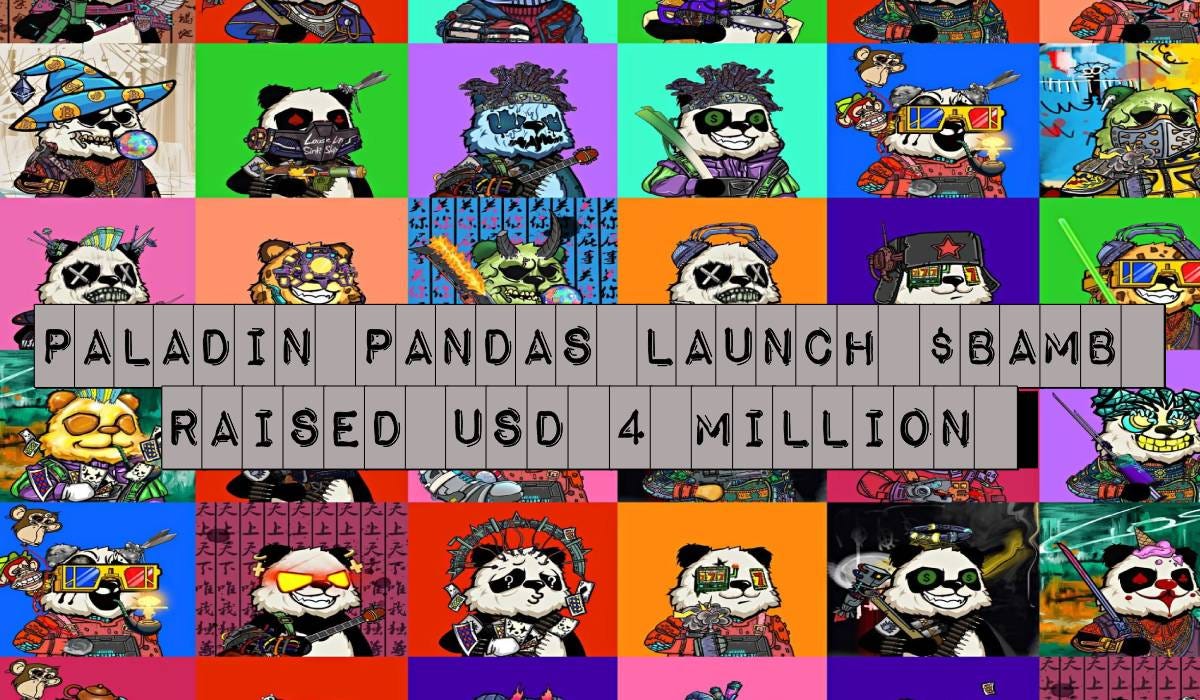
    OHDAT-affiliated NFT Game Project Paladin Pandas launched their ERC-20 Token $BAMB on the Ethereum chain on April 6th 2022. This established Paladin Pandas as one of the first NFT projects that has completed both the launch of their play-to-earn game and their token.

    A hand-drawn 10K NFT collection launched on Opensea on September 28th 2021, Paladin Pandas sold out in 32 minutes. It was ranked №6 on the daily volume leaderboard, №13 on the weekly volume leaderboard and featured on the OpenSea homepage.

    NFT whale owners including influencer and top collector, Zeneca_33, COLE, co-founder of Pudgy Penguins, and NFT influencers Josh Ong and NFT Girl, as well as crypto artist JN Silva, all added Paladin Pandas to their collection.

    This led to recognition from established VCs and other institutions and angel investors and OHDAT raised funding totalling US$4M from Future Capital, Hashkey Capital, Innoangel, Y2Z Capital, Vincent Niu, the founder of Sky9 Capital and Mandy Wang, the founder of Odaily. The funds raised were to go towards launching new projects and implementing the Open World social simulation game and MMORPG game, highlighted on their Roadmap 2.0.

    On January 25th, Paladin Pandas launched ‘PvE game Space Expedition’, where players send their Pandas to planets on an expedition (with 15 stages each) while strategically putting the Pandas into teams of 3 to retrieve the lost $BAMB (Bamboonium) through battles and mini-games. Since categories like element, class, weapon all matter in the gameplay, players need to select the right pandas to buy and be sent to battle, involving strategy gameplay.

    All $BAMB earned from the PvE game is locked in the players’ $BAMB balance, to be unlocked and claimable at a weekly rate of 15%. The lockup can be lifted if players manage to get on the PvP daily/weekly leaderboard.

    On March 9th, PvP: ‘Panda v. Panda’ open demo was officially released, a 1V1 3D combat game for true gamers. Players pay $BAMB to enter the arena and loot more $BAMB from other players. With 48 weapons, 7 basic moves and 21 stages, the gameplay is not limited to a ‘Stake-to-Earn’ mechanism; it is an actual ‘Play-to-Earn’ NFT game with delightful strategy gaming, which is a stab at revolutionizing NFT gaming. Up to now, which can be quite monotonous when the focus is only on the earnings. The PvP open demo initiated the “Clean the rugs’ campaign and airdropped 40K $BAMB tokens to the gamefi project holdlers.

    Giving perks to all NFT holders was taken into account when devising the Paladin Pandas ecosystem. Mandatory to use a Paladin Panda to enter the game, so as to extend the user base to more NFT gamers, non-holders can also rent Pandas by paying $BAMB. The rental limit for each Panda is 2x for PvE and 3x for PvP.

    Besides being an in-game currency, $BAMB has several utilities. First, $BAMB can be staked along with LP tokens to mine 5% of the overall supply, a total of 25M $BAMB. Second, $BAMB can be swapped to Power Raffle tickets, which is a WEB3 raffle machine to win blue chip NFT projects with minimum entry fees. Third, $BAMB holders are able to access exclusive online store merchandise, in-game marketplace boosts, and also the whitelist marketplace to consume their tokens.

    To celebrate the $BAMB launch, the OHDAT team will incentivize Panda owners with 2 airdrops. First, 60 Rent Tickets will be dropped to 30K new addresses for mining the game, for their first run. Second, 1.5% of the overall supply, totaling 7.5M $BAMB will be airdropped to all Panda holders. Prioritizing fun gaming features, Paladin Pandas aims for $BAMB to be a “blue chip token” in the NFT market over the long term.

    Paladin Pandas Links

    Opensea: https://opensea.io/collection/paladin-pandas

    Twitter: https://twitter.com/Paladin_Pandas

    Discord: http://discord.gg/paladin-pandas

    Website: https://paladinpandas.com

    Tokenomics: https://paladin-pandas.gitbook.io/usdbamb-tokenomics/


    [ad_2]

    Source link

  • Increasing transparency for new asset listings on Coinbase | by Coinbase | Apr, 2022

    Increasing transparency for new asset listings on Coinbase | by Coinbase | Apr, 2022

    [ad_1]

    Starting immediately and as part of an effort to increase transparency by providing as much information symmetry as possible, Coinbase will be using this blog post as a pilot to communicate assets under consideration for listing in Q2 2022 (April 1st, 2022 to June 30th, 2022).

    April 1 — June 30 2022 Roadmap

    The following assets are under consideration for listing on Coinbase in the 2nd quarter of 2022. Transfers and trading are not supported for these or any other assets until a listing is officially announced. Depositing these assets into your Coinbase account before an official announcement may lead to permanent loss of funds.

    ERC-20 tokens on the Ethereum network

    1. Aleph.im (ALEPH) — Contract Address: 0x27702a26126e0b3702af63ee09ac4d1a084ef628
    2. Arcblock (ABT) — Contract Address: 0xb98d4c97425d9908e66e53a6fdf673acca0be986
    3. BiFi (BIFI) — Contract Address: 0x2791bfd60d232150bff86b39b7146c0eaaa2ba81
    4. Big Data Protocol (BDP) — Contract Address: 0xf3dcbc6D72a4E1892f7917b7C43b74131Df8480e
    5. Binance USD (BUSD) — Contract Address: 0x4Fabb145d64652a948d72533023f6E7A623C7C53
    6. BitDAO (BIT) — Contract Address: 0x1A4b46696b2bB4794Eb3D4c26f1c55F9170fa4C5
    7. Botto (BOTTO) — Contract Address: 0x9dfad1b7102d46b1b197b90095b5c4e9f5845bba
    8. Chrono.tech (TIME) — Contract Address: 0x485d17A6f1B8780392d53D64751824253011A260
    9. Coin98 (C98) — Contract Address: 0xae12c5930881c53715b369cec7606b70d8eb229f
    10. DappRadar (RADAR) — Contract Address: 0x44709a920fccf795fbc57baa433cc3dd53c44dbe
    11. DEXTools (DEXT) — Contract Address: 0xfb7b4564402e5500db5bb6d63ae671302777c75a
    12. DFX Finance (DFX) — Contract Address: 0x888888435fde8e7d4c54cab67f206e4199454c60
    13. Dope Wars Paper (PAPER) — Contract Address: 0x7ae1d57b58fa6411f32948314badd83583ee0e8c
    14. Drep [new] (DREP) — Contract Address: 0x3Ab6Ed69Ef663bd986Ee59205CCaD8A20F98b4c2
    15. Elastos (ELA) — Contract Address: 0xe6fd75ff38adca4b97fbcd938c86b98772431867
    16. Gemini USD (GUSD) — Contract Address: 0x056Fd409E1d7A124BD7017459dFEa2F387b6d5Cd
    17. Honey (HNY) — Contract Address: 0xc3589f56b6869824804a5ea29f2c9886af1b0fce
    18. Hopr Token (HOPR) — Contract Address: 0xf5581dfefd8fb0e4aec526be659cfab1f8c781da
    19. Index Cooperative (INDEX) — Contract Address: 0x0954906da0Bf32d5479e25f46056d22f08464cab
    20. Indexed Finance (NDX) — Contract Address: 0x86772b1409b61c639eaac9ba0acfbb6e238e5f83
    21. Jupiter (JUP) — Contract Address: 0x4b1e80cac91e2216eeb63e29b957eb91ae9c2be8
    22. Kromatika (KROM) — Contract Address: 0x3af33bef05c2dcb3c7288b77fe1c8d2aeba4d789
    23. LockTrip (LOC) — Contract Address: 0x5e3346444010135322268a4630d2ed5f8d09446c
    24. MATH (MATH) — Contract Address: 0x08d967bb0134f2d07f7cfb6e246680c53927dd30
    25. Monavale (MONA) — Contract Address: 0x275f5Ad03be0Fa221B4C6649B8AeE09a42D9412A
    26. Morpheus Labs (MITX) — Contract Address: 0x4a527d8fc13c5203ab24ba0944f4cb14658d1db6
    27. mStable Governance Token: Meta (MTA) — Contract Address: 0xa3bed4e1c75d00fa6f4e5e6922db7261b5e9acd2
    28. Muse (MUSE) — Contract Address: 0xb6ca7399b4f9ca56fc27cbff44f4d2e4eef1fc81
    29. Nest Protocol (NEST) — Contract Address: 0x04abeda201850ac0124161f037efd70c74ddc74c
    30. Opacity (OPCT) — Contract Address: 0xdb05ea0877a2622883941b939f0bb11d1ac7c400
    31. OpenDAO (SOS) — Contract Address: 0x3b484b82567a09e2588a13d54d032153f0c0aee0
    32. PARSIQ (PRQ) — Contract Address: 0x362bc847A3a9637d3af6624EeC853618a43ed7D2
    33. PolkaFoundry (PKF) — Contract Address: 0x8b39b70e39aa811b69365398e0aace9bee238aeb
    34. Polychain Monsters (PMON)— Contract Address: 0x1796ae0b0fa4862485106a0de9b654eFE301D0b2
    35. RAC (RAC) — Contract Address: 0xc22b30e4cce6b78aaaadae91e44e73593929a3e9
    36. SelfKey (KEY) — Contract Address: 0x4cc19356f2d37338b9802aa8e8fc58b0373296e7
    37. StackOS (STACK) — Contract Address: 0x56a86d648c435dc707c8405b78e2ae8eb4e60ba4
    38. StaFi (FIS) — Contract Address: 0xef3a930e1ffffacd2fc13434ac81bd278b0ecc8d
    39. Strike (STRK) — Contract Address: 0x74232704659ef37c08995e386a2e26cc27a8d7b1
    40. Student Coin (STC) — Contract Address: 0x15b543e986b8c34074dfc9901136d9355a537e7e
    41. SwftCoin (SWFTC) — Contract Address: 0x0bb217E40F8a5Cb79Adf04E1aAb60E5abd0dfC1e
    42. Sylo (SYLO) — Contract Address: 0xf293d23bf2cdc05411ca0eddd588eb1977e8dcd4
    43. TE-Food (TONE) — Contract Address: 0x2Ab6Bb8408ca3199B8Fa6C92d5b455F820Af03c4
    44. UnMarshal (MARSH) — Contract Address: 0x5a666c7d92E5fA7Edcb6390E4efD6d0CDd69cF37
    45. Wrapped Ampleforth (WAMPL) — Contract Address: 0xedb171c18ce90b633db442f2a6f72874093b49ef

    SPL tokens on the Solana network

    1. Apricot Finance (APT) — Contract Address: APTtJyaRX5yGTsJU522N4VYWg3vCvSb65eam5GrPT5Rt
    2. Bitspawn (SPWN) — Contract Address: 5U9QqCPhqXAJcEv9uyzFJd5zhN93vuPk1aNNkXnUfPnt
    3. Green Satoshi Token (GST) — Contract Address: AFbX8oGjGpmVFywbVouvhQSRmiW2aR1mohfahi4Y2AdB
    4. Media Network (MEDIA) — Contract Address: ETAtLmCmsoiEEKfNrHKJ2kYy3MoABhU6NQvpSfij5tDs
    5. Realy (REAL) — Contract Address: AD27ov5fVU2XzwsbvnFvb1JpCBaCB5dRXrczV9CqSVGb

    *This is not an exhaustive list of all assets under consideration. Any asset not referenced in the list does not preclude any such asset from potential listing.

    As a reminder, Coinbase recently introduced an Experimental label that may be applied to newly listed assets. Some of the assets mentioned above may be listed with this Experimental label.

    Disclaimer & Risks: There will be times when an asset is delayed or removed from consideration for listing for any number of factors. While we will try to make every reasonable effort to minimize this risk of occurrence, it should be understood that all information in this blog is in no way intended to be relied upon as a promise or guarantee of listing. Coinbase reserves the right to discontinue this blog post.

    Changelog

    Changes to our roadmap will be updated and communicated here regularly.

    • 4/12 Change name from Polkamon (PMON) to Polychain Monsters (PMON)

    Why are you considering listing these assets?

    As mentioned during our launch of Asset Hub, our goal is to list every asset possible that meets our standards for legal, compliance and technical security. These standards do not take into account the market cap or popularity of a project. This means there are assets that we have concluded do not meet our standards and thus will not be listed on Coinbase at this time.

    If we haven’t yet listed a popular asset, it is likely due to various reasons including:

    1. We have concluded that the asset does not meet our minimum listing standards across legal, compliance and technical security
    2. We do not have enough information about the asset
    3. Technical integration work is required

    Our review process is outlined in greater detail here.

    How do you choose which “types” of assets to support?

    We are working to add support for additional networks and ecosystems as we aim to provide the greatest inventory of assets to our users.

    Today we support 3 “types” of assets for trading on Coinbase:

    1. Native assets on their own network (recent examples include MINA and STX)
    2. ERC-20 tokens on the Ethereum network (recent examples include APE and GALA)
    3. SPL tokens on the Solana network (recent examples include ORCA and FIDA)

    Resources on listing criteria

    NOT INVESTMENT ADVICE

    The content is for informational purposes only, is general in nature and should not be relied upon or construed as legal, tax, investment, financial, a promise, guarantee, or other advice. Nothing contained herein constitutes a solicitation, recommendation, endorsement, or offer by Coinbase or its affiliates to buy or sell any cryptocurrency or other instruments in any jurisdiction in which such solicitation or offer would be unlawful under the laws of such jurisdiction. Additionally, Coinbase Ventures may be an investor in the crypto projects mentioned here, and additionally, Coinbase may hold such tokens on its balance sheet for operational purposes. A list of Coinbase Ventures investments is available at https://ventures.coinbase.com/. Finally, Coinbase has a conflict of interest policy that prevents board members or Coinbase employees from being involved in a listing decision where they have a financial interest.

    [ad_2]

    Source link

  • 2 Million $MRHB for Liquidity Providers on Pancakeswap Pool! | by Bit Media Buzz | Apr, 2022

    2 Million $MRHB for Liquidity Providers on Pancakeswap Pool! | by Bit Media Buzz | Apr, 2022

    [ad_1]

    MRHB DeFi, the world’s first halal and ethical decentralized finance (DeFi) platform, launched their $MRHB token on the popular PancakeSwap DEX in December 2021. To promote the listing, the company set aside a pool of 5 million MRHB tokens to reward liquidity providers (LPs) with through to the end of March. MRHB has now decided to extend the LP reward period until June 30, and is adding an additional 2 million MRHB tokens to the reward pool.

    For anyone unaware of this opportunity, the details are as follows: LPs must supply liquidity to the USDT/MRHB liquidity pool on PancakeSwap to qualify for rewards. A total of 2 million MRHB tokens will be divided between all participating LPs over a three-month period. This reward is provided by MRHB DeFi as a third party offering a conditional gift (‘hibah muallaqah bi al-sharth’), which is permissible according to Islamic Fiqh.

    By providing liquidity on PancakeSwap, LP’s help to support the MRHB token, whose mission of bringing ethical finance to faith-based communities and others. It has been years of non-regulation and uncertainty about crypto; it is time to carve out a safe space in the cryptoverse where ethics-conscious people can manage their finances with peace of mind.

    Additional Information for LPs

    Providing liquidity on a DEX is not without risk. All prospective LPs must first understand about a concept known as ‘impermanent loss’. If you are unfamiliar with the term, please refer to this article to get a firm understanding of the risks involved.

    Here are a couple of videos that will be useful for LPs:

    Alternatively, check out the MRHB blog post for the step-by-step slideshow walkthrough on how to add liquidity on Pancakeswap: https://mrhbdefi.medium.com/how-mrhb-token-holders-can-earn-passive-income-from-trading-fees-and-5-million-pool-of-mrhb-6848152d51c7

    Lastly, the importance of staying vigilant on the internet cannot be stressed enough — scammers abound. Never give your wallet password out to anyone. When sending funds to a liquidity pool, do so on the exchange itself — do not send to addresses given to you by strangers.

    MRHB DeFi will never ask you for funds. The only links and information that can be trusted are those shared on their official channels below.

    MRHB.Network Official Channels

    Website: https://mrhb.network

    MRHB Reward Dashboard: https://rewards.mrhb.network

    Twitter: https://twitter.com/marhabadefi

    Telegram: https://t.me/mdf_official

    Telegram Announcements: https://t.me/marhabadefi_ANN

    YouTube: https://www.youtube.com/c/MarhabaDeFi

    Medium: https://medium.com/@mrhbdefi

    LinkedIn: https://www.linkedin.com/company/marhabadefi

    Discord: https://discord.com/invite/DubSjKmkBX

    Facebook: https://www.facebook.com/MRHBDeFi

    Telegram (Arabic): https://t.me/mdf_arabic

    Telegram (Russian): https://t.me/marhabadefi_russia

    Telegram (Turkish): https://t.me/MarhabaDefiTR


    [ad_2]

    Source link