Tag: amp

  • Scaling Ethereum & crypto for a billion users

    Scaling Ethereum & crypto for a billion users

    [ad_1]

    A guide to the multi-chain future, sidechains, and layer-2 solutions
    Around the Block from Coinbase Ventures sheds light on key trends in crypto. Written by Justin Mart & Connor Dempsey.

    As of late 2021, Ethereum has grown to support thousands of applications from decentralized finance, NFTs, gaming and more. The entire network settles trillions of dollars in transactions annually, with over $170 billion locked on the platform.

    But as the saying goes, more money, more problems. Ethereum’s decentralized design ends up limiting the amount of transactions it can process to just 15 per second. Since Ethereum’s popularity far exceeds 15 transactions per second, the result is long waits and fees as high as $200 per transaction. Ultimately, this prices out many users and limits the types of applications Ethereum can handle today.

    If smart-contract based blockchains are to ever grow to support finance and Web 3 applications for billions of users, scaling solutions are needed. Thankfully, the cavalry is beginning to arrive, with many proposed solutions coming online recently.

    In this edition of Around The Block, we explore the crypto world’s collective quest to scale.*

    To compete or to complement?

    The goal is to increase the number of transactions that openly accessible smart contract platforms can handle, while retaining sufficient decentralization. Remember, it would be trivial to scale smart contract platforms through a centralized solution managed by a single entity (Visa can handle 45,000 transactions per second), but then we’d be right back to where we started: a world owned by a handful of powerful centralized actors.

    The approaches being taken to fix this problem come twofold: (1) build brand new networks competitive to Ethereum that can handle more activity, or (2) build complementary networks that can handle Ethereum’s excess capacity.

    Broadly, they break out across a few categories:

    • Layer 1 blockchains (competitive to Ethereum)
    • Sidechains (somewhat complementary to Ethereum)
    • Layer 2 networks (complementary to Ethereum)

    While each differs in architecture and approach, the goal is the same: let users actually use the networks (eg, interact with DeFi, NFTs, etc) without paying exorbitant fees or experiencing long wait times.

    Layer 1s

    Ethereum is considered a layer 1 blockchain — an independent network that secures user funds and executes transactions all in one place. Want to swap 100 USDC for DAI using a DeFi application like Uniswap? Ethereum is where it all happens.

    Competing layer 1s do everything Ethereum does, but in a brand new network, soup to nuts. They’re differentiated by new system designs that enable higher throughput, leading to lower transaction fees, but usually at the cost of increased centralization.

    New layer 1s have come online in droves over the last 10 months, with the aggregate value on these networks rocketing from $0 to ~$75B over the same time period. This field is currently led by Solana, Avalanche, Terra, and Binance Smart Chain, each with growing ecosystems that have reached over $10 billion in value.
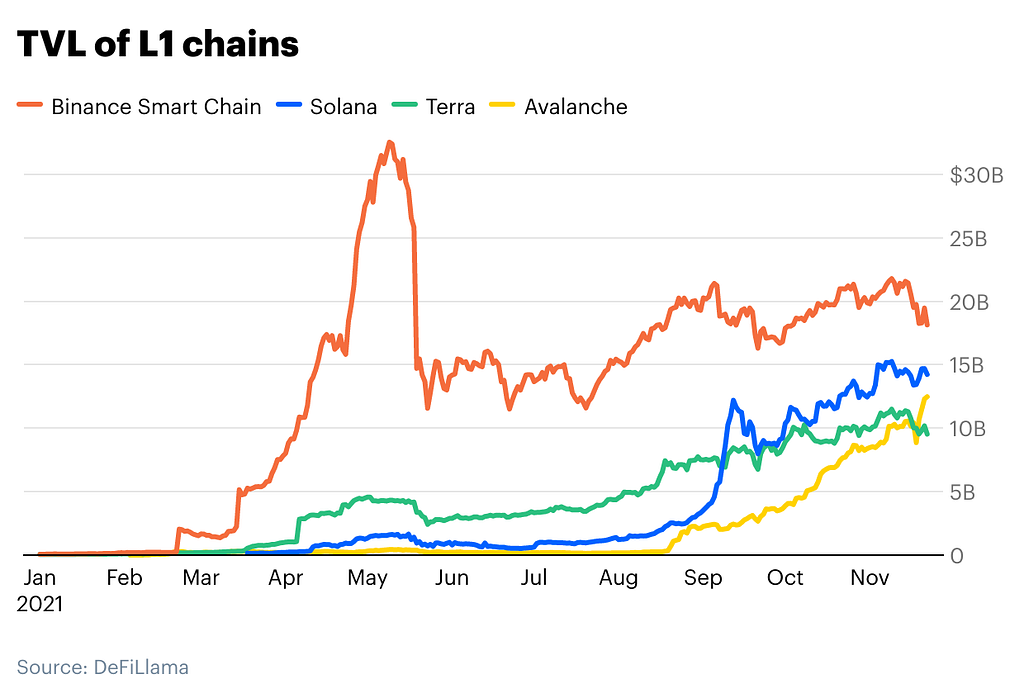
    Leading non-ETH L1s by TVL

    All layer 1s are in competition to attract both developers and users. Doing so without any of Ethereum’s tooling and infrastructure that make it easy to build and use applications, is difficult. To bridge this gap, many layer 1s employ a tactic called EVM compatibility.

    EVM stands for the Ethereum Virtual Machine, and it’s essentially the brain that performs computation to make transactions happen. By making their networks compatible with the EVM, Ethereum developers can easily deploy their existing Ethereum applications to a new layer 1 by essentially copying and pasting their code. Users can also easily access EVM compatible layer 1s with their existing wallets, making it simple for them to migrate.

    Take Binance Smart Chain (BSC) as an example. By launching an EVM compatible network and tweaking the consensus design to enable higher throughput and cheaper transactions, BSC saw usage explode last summer across dozens of DeFi applications all resembling popular Ethereum apps like Uniswap and Curve. Avalanche, Fantom, Tron, and Celo have also taken the same approach.

    Conversely, Terra and Solana do not currently support EVM compatibility.
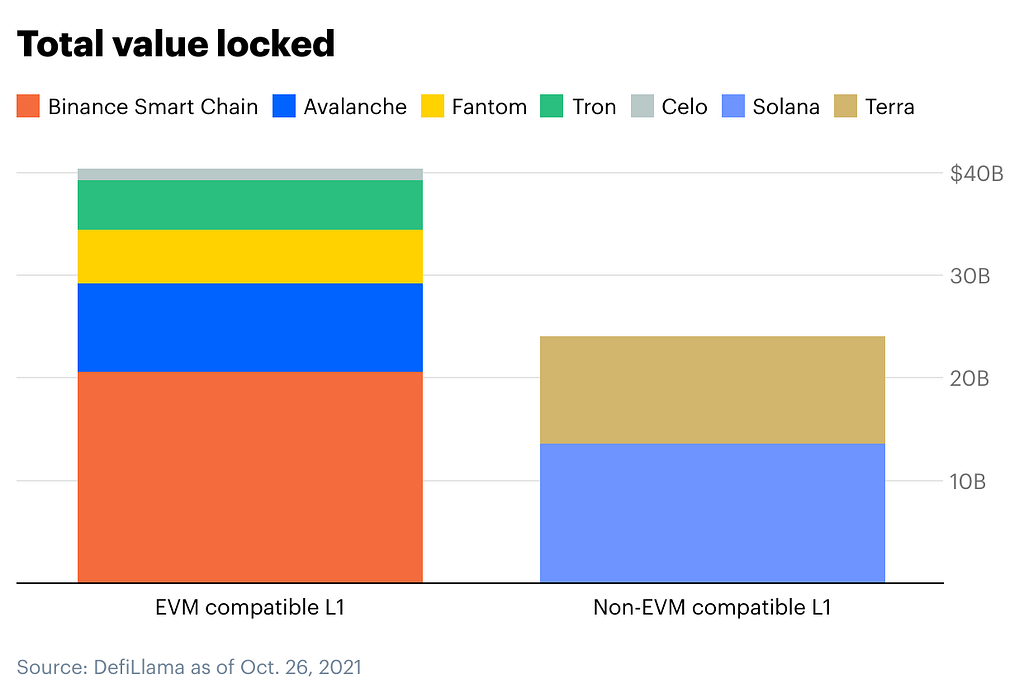
    TVL of EVM compatible vs non-EVM compatible L1s

    Interoperable Chains

    In a slightly different layer 1 bucket are blockchain ecosystems like Cosmos and Polkadot. Rather than build new stand-alone blockchains, these projects built standards that let developers create application specific blockchains capable of talking to each other. This can allow, for example, tokens from a gaming blockchain to be used within applications built on a separate blockchain for social networking.

    There is currently over $100B+ sitting on chains built using Cosmos’ standard that can eventually interoperate. Meanwhile, Polkadot recently reached a milestone that will similarly unite its ecosystem of blockchains.

    In short, there’s now a diverse landscape of direct Ethereum competitors, with more on the way.

    Sidechains

    The distinction between sidechains and new layer 1s is admittedly a fuzzy one. Sidechains are very similar to EVM-compatible layer 1s, except that they’ve been purpose built to handle Ethereum’s excess capacity, rather than compete with Ethereum as a whole. These ecosystems are closely aligned with the Ethereum community and host Ethereum apps in a complementary fashion.

    Axie Infinity’s Ronin sidechain is a prime example. Axie Infinity is an NFT game originally built on Ethereum. Since Ethereum fees made playing the game prohibitively expensive, the Ronin sidechain was built to allow users to move their NFTs and tokens from Ethereum to a low fee environment. This made the game affordable to more users, and preceded an explosion in the game’s popularity.
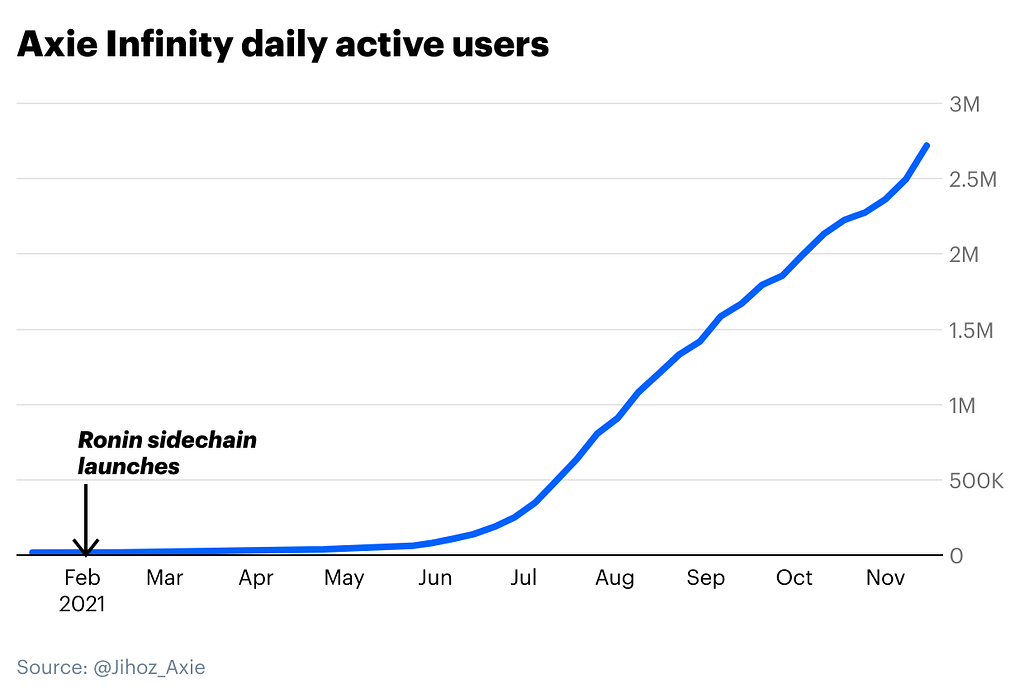
    As of this writing, users have moved over $7.5B from Ethereum to Ronin to play Axie Infinity.

    Polygon POS

    Where sidechains like Ronin are application specific, others are suited for more general purpose applications. Right now, Polygon’s proof-of-stake (POS) sidechain is the industry leader with nearly $5B in value deployed over 100 DeFi and gaming applications including familiar names like Aave and Sushiswap, as well as a Uniswap clone called Quickswap.

    Again, Polygon POS really doesn’t look that different from an EVM compatible layer-1. However, it’s been built as part of a framework to scale Ethereum rather than compete with it. The Polygon team sees a future where Ethereum remains the dominant blockchain for high value transactions and value storage, while everyday transactions move to Polygon’s lower-cost blockchains. (Polygon POS also maintains a special relationship with Ethereum through a process known as checkpointing).

    With transaction fees of less than a penny, Polygon’s vision of the future looks plausible. And with the help of incentive programs, users have flocked to Polygon POS with daily transactions surpassing Ethereum (though spam transactions inflate this number).

    Layer 2s (Rollups)

    Layer 1s and sidechains both have a distinct challenge: securing their blockchains. To do so, they must pay a new cohort of miners or proof of stake validators to verify and secure transactions, usually in the form of inflation from a base token (e.g. Polygon’s $MATIC, Avalanche’s $AVAX).

    However, this brings notable downsides:

    • Having a base token naturally makes your ecosystem more competitive rather than complementary to Ethereum
    • Validating and securing transactions is a complex and challenging task that your network is responsible for indefinitely

    Wouldn’t it be nice if we could create scalable ecosystems that borrowed from Ethereum’s security? Enter layer 2 networks, and “rollups” in particular. In a nutshell, layer 2s are independent ecosystems that sit on top of Ethereum in such a way that relies on Ethereum for security.

    Critically, this means that layer 2s do not need to have a native token — so not only are they more complementary to Ethereum, they are essentially part of Ethereum. The Ethereum roadmap even pays homage to this idea by signaling that Ethereum 2.0 will be “rollup centric.”

    How rollups work

    Layer 2s are commonly called rollups because they “rollup” or bundle transactions together and execute them in a new environment, before sending the updated transaction data back to Ethereum. Rather than have the Ethereum network process 1,000 Uniswap transactions individually (expensive!), the computation is offloaded on a layer 2 rollup before submitting the results back to Ethereum (cheap!).

    However, when results are posted back to Ethereum, how does Ethereum know that the data is correct and valid? And how can Ethereum prevent anyone from posting incorrect information? These are critical questions that differentiate the two types of rollups: Optimistic rollups, and Zero Knowledge rollups (ZK rollups).

    Optimistic Rollups

    When submitting results back to Ethereum, optimistic rollups “optimistically” assume that they’re valid. In other words, they let the operators of the rollup post any data they want (including potentially incorrect / fraudulent data), and just assume it’s correct — an optimistic outlook no doubt! But there are ways to fight fraud. As a check and balance, there is a window of time after any withdrawal where anyone watching can call out fraud (remember blockchains are transparent, anyone can watch what’s happening). In the event that one of these watchers can mathematically prove that fraud occurred (by submitting a fraud proof), the rollup reverts any fraudulent transactions and penalizes the bad actor and rewards the watcher (a clever incentive system!).

    The drawback is a brief delay when you move funds between the rollup and Ethereum, waiting to see if any watchers catch any fraud. In some cases this can be up to a week, but we expect these delays to come down over time.

    The key point is that optimistic rollups are intrinsically tied to Ethereum and ready to help Ethereum scale today. Accordingly, we’ve seen strong nascent growth with many leading DeFi projects moving to the leading optimistic rollups — Arbitrum and Optimistic Ethereum.

    Arbitrum & Optimistic Ethereum

    Arbitrum (by Off-chain Labs) and Optimistic Ethereum (by Optimism) are the two main projects implementing optimistic rollups today. Notably, both are still in their early stages, with both companies maintaining levels of centralized control but with plans to decentralize over time.

    It’s estimated that once mature, optimistic roll ups can offer anywhere from a 10–100x improvement in scalability. Even in their early days, DeFi applications on Arbitrum and Optimism have already accrued billions in network value.

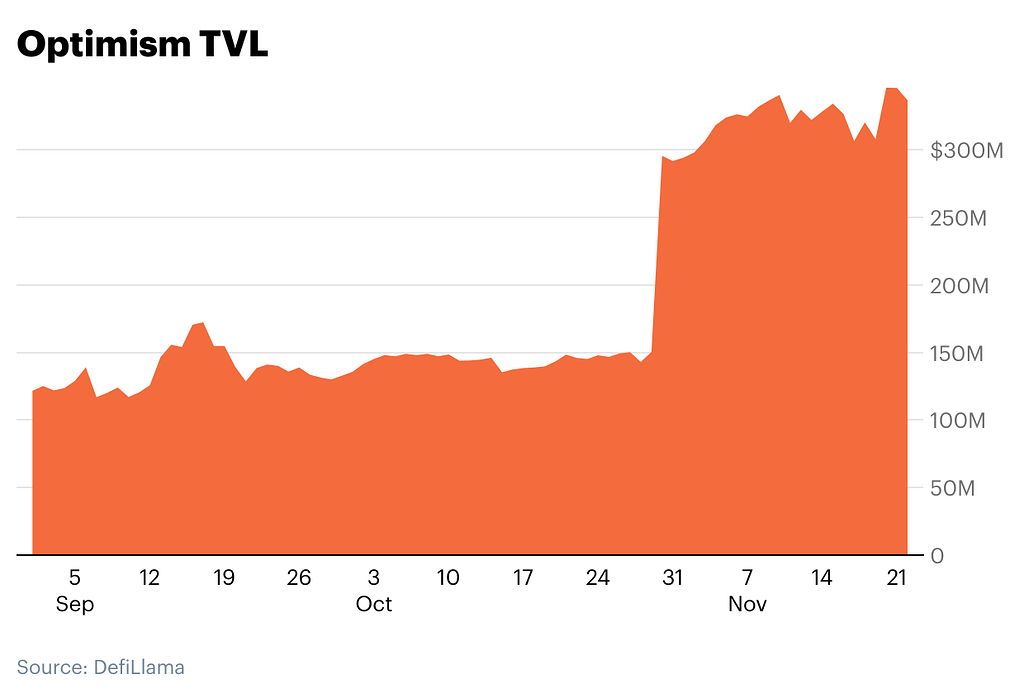
    Optimism is earlier in its adoption curve with over $300M in TVL deployed across 7 DeFi applications, most notably Uniswap, Synthetix, and 1inch.
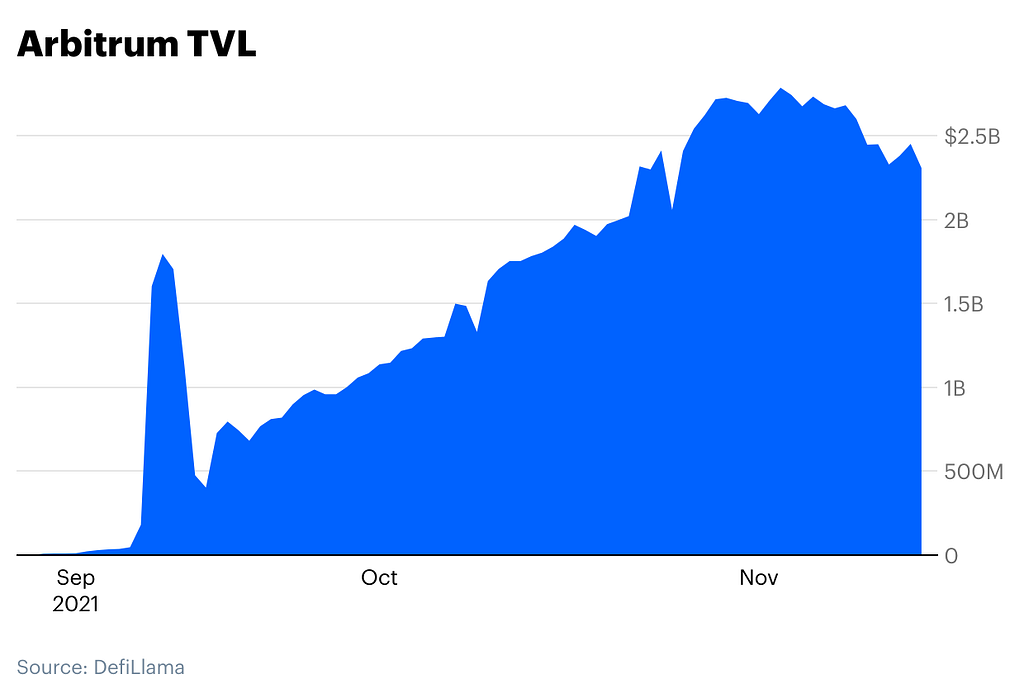
    Arbitrum is further along, with around $2.5B in TVL across 60+ applications including familiar DeFi protocols like Curve, Sushiswap, and Balancer.
    Aribtrum has also been selected as Reddit’s scaling solution of choice for their long awaited efforts to tokenize community points for the social media platform’s 500 million monthly active users.

    ZK Rollups

    Where optimistic rollups assume the transactions are valid and leave room for others to prove fraud, ZK rollups do the work of actually proving to the Ethereum network that transactions are valid.

    Along with the results of the bundled transactions, they submit what’s called a validity proof to an Ethereum smart contract. As the name suggests, validity proofs let the Ethereum network verify that the transactions are valid, making it impossible for the relayer to cheat the system. This eliminates the need for a fraud proof window, so moving funds between Ethereum and ZK-rollups is effectively instant.

    While instant settlement and no withdrawal times sound great, ZK rollups are not without tradeoffs. First, generating validity proofs is computationally intensive, so you need high powered machines to make them work. Second, the complexity surrounding validity proofs makes it more difficult to support EVM compatibility, limiting the types of smart contracts that can be deployed to ZK-rollups. As such, optimistic rollups have been first to market and are more capable of addressing Ethereum’s scaling woes today, but ZK-rollups may become a better technical solution in the long run.

    ZK Rollup Adoption

    The ZK rollup landscape runs deep, with multiple teams and implementations in the works and in production. Some prominent players include Starkware, Matter Labs, Hermez, and Aztec. Today, ZK-rollups mainly support relatively simple applications such as payments or exchanges (owing to limitations on what types of applications ZK-rollups can support today). For example, derivatives exchange dYdX employs a ZK rollup solution from Starkware (StarkEx) to support nearly 5 million weekly transactions and $1B+ in TVL.
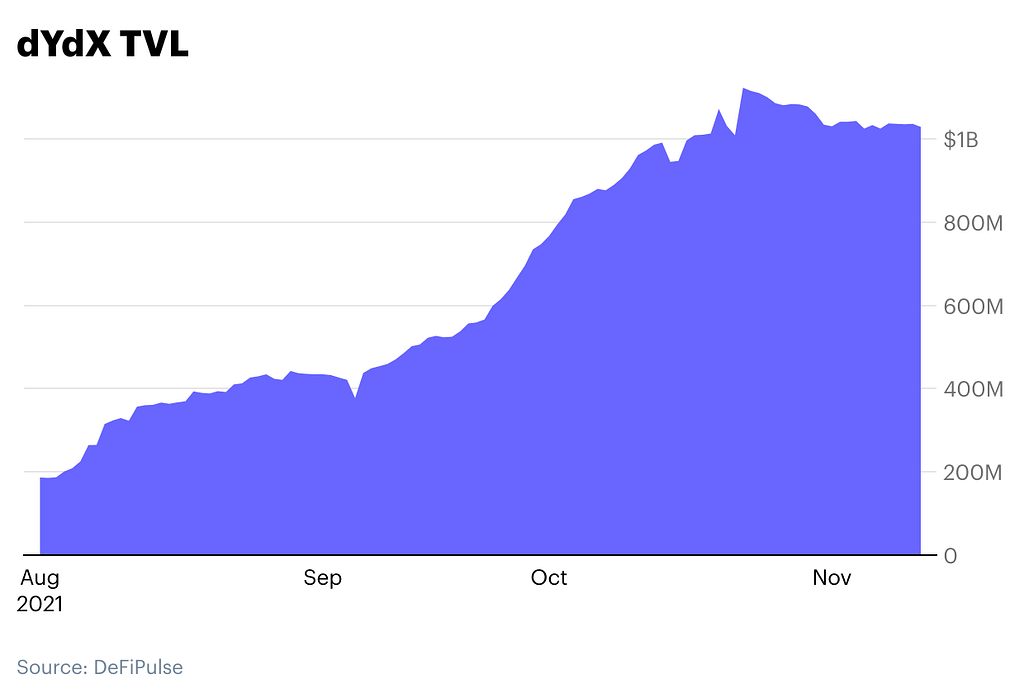
    The real prize however, is ZK rollup solutions that are fully EVM compatible and thus capable of supporting popular general applications (like the full suite of DeFi apps) without the withdrawal delays of optimistic rollups. The main players in this realm are MatterLab’s zkSync 2.0, Starkware’s Starknet, Polygon Hermez’s zkEVM, and Polygon Miden, which are all currently working towards mainnet launch. (Aztec, meanwhile, is focused on applying zk proofs to privacy).

    Many in the industry (Vitalik included) are looking at ZK rollups in conjunction with Ethereum 2.0 as the long term solution to scaling Ethereum, mainly stemming from their ability to fundamentally handle hundreds of thousands of transactions per second without compromising on security or decentralization.The upcoming rollouts of fully EVM compatible ZK rollups will be one of the key things to watch as the quest to scale Ethereum progresses.

    A fragmenting world

    In the long run, these scaling solutions are necessary if smart contract platforms are to scale to billions of users. In the near term, these solutions, however, may present significant challenges for users and crypto operators alike. Navigating from Ethereum to these networks requires using cross-chain bridges, which is complex for users and carries latent risk. For example, several cross-chain bridges have already been the target of $100+ million dollar exploits.

    More importantly, the multi-chain world fragments composability and liquidity. Consider that Sushiswap is currently implemented on Ethereum, Binance Smart Chain, Avalanche, Polygon, and Arbitrum. Where Sushiswap’s liquidity was once concentrated on one network (Ethereum), it’s now spread across five different networks.

    Ethereum applications have long benefited from composability — i.e. Sushiswap on Ethereum is plug-and-play with other Ethereum apps like Aave or Compound. As applications spread out to new networks, an application implemented on one layer 1/sidechain/layer 2 is no longer composable with apps implemented on another, limiting usability and creating challenges for users and developers.

    An uncertain future

    Will new layer 1s like Avalanche or Solana continue to grow to compete with Ethereum? Will blockchain ecosystems like Cosmos or Polkadot proliferate? Will sidechains continue to run in harmony with Ethereum, taking on its excess capacity? Or will rollups in conjunction with Ethereum 2.0 win out? No one can say for sure.

    While the future is uncertain, everyone can take solace in the knowledge that there are so many smart teams dedicated to tackling the most challenging problems that open, permissionless networks face. Just as broadband ultimately helped the internet support a host of revolutionary applications like YouTube and Uber, we believe that we’ll eventually look at the winning scaling solutions in the same light.

    * This post focuses on scaling smart-contract based blockchains. Bitcoin scaling is best saved for a future post.


    Scaling Ethereum & crypto for a billion users was originally published in The Coinbase Blog on Medium, where people are continuing the conversation by highlighting and responding to this story.


    [ad_2]

    Source link

  • Axie Infinity, Yield Guild Games & the play-to-earn economy

    Axie Infinity, Yield Guild Games & the play-to-earn economy

    [ad_1]

    Around the Block from Coinbase Ventures sheds light on key trends in crypto. In this edition, Justin Mart, Connor Dempsey, and Hassan Ahmed explore the growth of NFT games and the play-to-earn economy. Plus, a look at NFT marketplace activity and the Poly Network exploit.

    We’re at an exciting time in crypto: one in which cryptonetworks are blossoming into full-fledged virtual economies. Nowhere is this more on display than with NFT gaming.

    At the forefront of NFT gaming sits Axie Infinity and its play-to-earn model: a model that pays people in crypto to play a fun video game. With over one million daily active users, Axie Infinity has exploded in popularity in emerging markets and is showing the potential to be a trojan horse for on-boarding the next generation of crypto users.

    On top of that, Axie Infinity and play-to-earn gaming has spawned its own thriving financial services sector.

    The rise of Axie Infinity

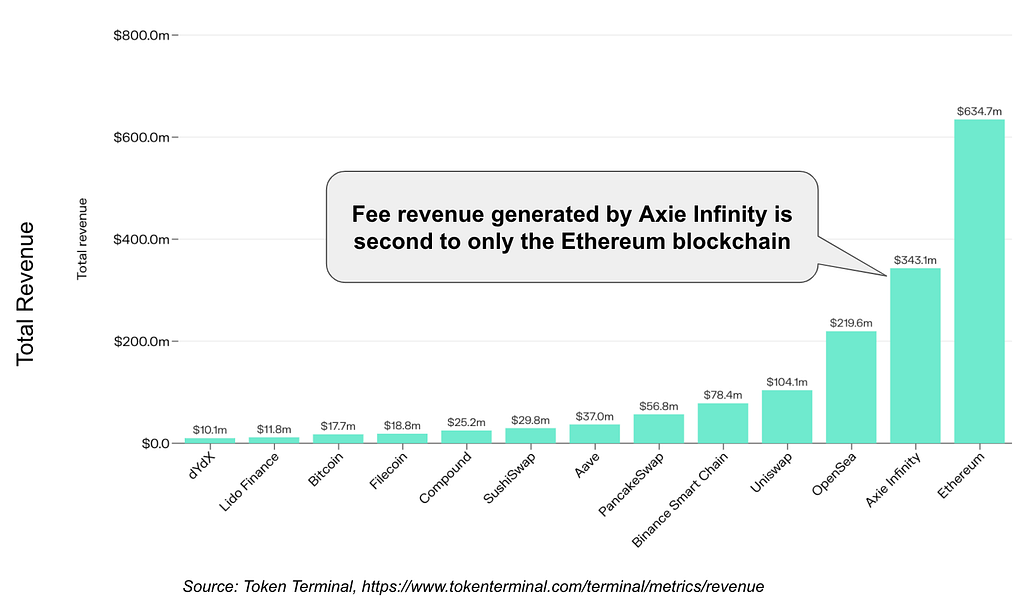
    Over the last 30 days, Axie Infinity generated a head turning $343M in fee revenue. This is more than any app or protocol in crypto aside from the Ethereum blockchain, according to Token Terminal.

    So where’s that revenue coming from?

    How Axie Infinity generates revenue

    The Axie Infinity economy consists of a governance token (AXS) and a second token called Smooth Love Potion (SLP) that serves as an in-game currency, along with NFTs that represent both game characters and virtual real estate.

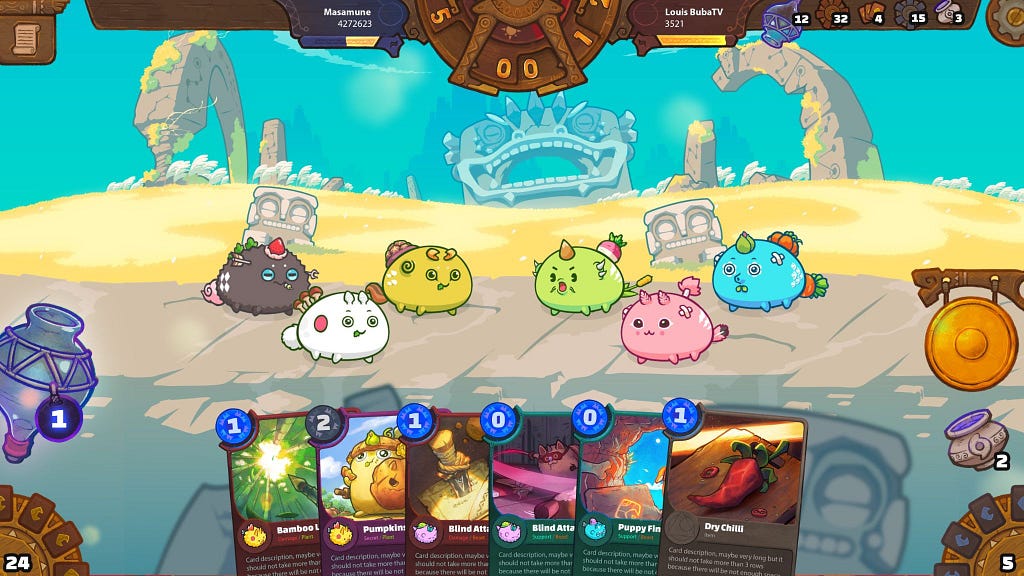
    The gameplay itself is often compared to Pokemon, where players battle “Axies” (pictured below) against those of other players. Different Axies have different strengths and weaknesses, and the strategy of the game comes down to playing to your Axies strengths better than your opponent. Players get paid in SLP for defeating opponents. Additionally, players can compete daily quests to earn additional SLP. Axies can also be “bred” together to create new Axies which can in turn be sold to other players for profit.

    Every time an Axie is traded, a plot of real estate is sold, or two Axies are bred, the protocol takes a fee priced in a combination of AXS and SLP. Rather than go to the developers, this revenue is placed in the Axie treasury, which has ballooned to nearly $600 million.

    https://medium.com/media/a5881a034e856752cd2d7fe775bd476d/href

    An emerging markets phenomenon

    While the protocol revenue numbers alone depict the emergence of a new breakout crypto application, what’s more exciting is where Axie Infinity is taking off: in developing nations where players can often earn more playing the game and selling SLP for their native currencies than they can with a typical day job.

    With an estimated 50% of daily active users (DAUs) coming from the Philippines, the game is also picking up steam in other emerging markets like Indonesia, Brazil, Venezuela, India, and Vietnam.

    Created by game developer Sky Mavis in 2018, Axie started picking up organic traction in the Philippines in early 2020 after a few players realized they could make legitimate incomes by playing. When Covid lockdowns hit and many were put out of work, more were encouraged to give it a try. A documentary on the game’s growth called PLAY-TO-EARN went viral in May 2021 and DAUs went vertical soon after.

    Business models of the metaverse

    Unlike many mobile games, Axie Infinity is not free to play. To get started, players need to obtain 3 Axie Infinity characters. In the earlier days of the game, the average Axie was selling for under $10. With the game’s rapid growth and the broader NFT rally, the average Axie is now selling for nearly $500 according to CryptoSlam.

    Given Axie’s base within the Philippines and other emerging markets, a $1,500 entry tag is a non-starter for most would-be players. To mitigate this barrier to entry, an informal market emerged in which NFT owners began lending players the NFTs needed to play the game in exchange for a cut of their winnings. This is done through QR codes that let players use Axie NFTs in game without the lender having to cede ownership on-chain.

    This informal market has blossomed into a formal play-to-earn financial services sector. The largest and most prominent player is a project called Yield Guild Games.

    Yield Guild Games (YGG)

    Founder Gabby Dizon likes to say that Yield Guild Games is one part Berkshire Hathaway and one part Uber.

    Just as Berkshire Hathaway is a holding company for a multitude of businesses, YGG is essentially a holding company for play-to-earn gaming assets. Starting in 2020, they’ve been buying up yield producing NFTs, governance tokens, and ownership stakes in promising gaming projects and protocols.

    Similar to how Uber pairs people who want to earn money driving with people who need rides, YGG pairs people who want to make money gaming with the NFTs they need to earn in play-to-earn games. In many parts of the world, people are opting to work with YGG over Uber simply because it pays more.

    YGG recently released its July Asset & Treasury Report that offers an interesting glimpse into the new kinds of business models NFTs and play-to-earn games are creating.

    YGG by the numbers

    Within YGG, there are scholars and community managers. Scholars receive NFTs that they in turn put to work earning crypto. Community managers recruit and train new scholars. 70% of winnings go to scholars, 20% to community managers, and 10% to the Yield Guild Games treasury.

    According to the report, 2,058 new scholars joined YGG in July bringing the total to 4,004. In the same month, YGG scholars generated 11.7M SLP by playing Axie Infinity, which equated to over $3.25M in direct revenue. From April through July, scholars and community managers have earned a cumulative of $8.93M.

    From its cut of all SLP earned by scholars, YGG earned $329,500 in July and a total of $580,000 since April. YGG’s expenses currently outstrip revenue, as they spent $1.62M in July alone “breeding” new Axie’s to meet scholar demand (breeding can cost anywhere from $200 to $1,200 per Axie).

    The YGG Treasury

    The YGG treasury consists of tokens and stablecoins held in a wallet, NFTs, and venture investments made in various play-to-earn games. The project has been funded by a $1.325M seed round led by Delphi Digital and another $4.6M round from a16z. They also raised $12.49M from the sale of the YGG governance token, while holding 13.3% of its outstanding supply.

    As of the end of July, the YGG wallet’s holdings stood at $415M, with the majority stemming from the YGG token ($373M). The YGG token is part of Yield Guild Game’s plan to transition into a community-governed DAO.

    https://medium.com/media/62856357da8af3813154056ea8ff43ab/href

    The price of YGG has tripled in August, meaning their treasury currently stands at over $1B.

    https://medium.com/media/ad2c70e2ac461dd1cfc6d0faaf9bc986/href

    Much of YGG’s capital has been put to work buying NFTs that can earn yield from play-to-earn games. By the end of July, the YGG treasury had amassed 19,460 NFTs valued at over $10M across 12 play-to-earn games. Axie Infinity NFTs comprised close to 90% of that value.

    https://medium.com/media/df13de155b6354a002f814bf13a0e5d8/href

    YGG has also made early stage investments across 8 play-to-earn games via SAFT (Simple Agreement for Future Tokens), and locked in ~$1M for yield farming in blue-chip DeFi projects.

    https://medium.com/media/98e46ab915bf0e874d9c866897c36252/href

    Play-to-earn in the real world

    A key element of the YGG model is that players are lent NFTs with zero downside risk and without having to put down any upfront capital. In return, they surrender 30% of their winnings but retain the majority — a critical hook to onboarding a new class of crypto users that have historically been priced out.

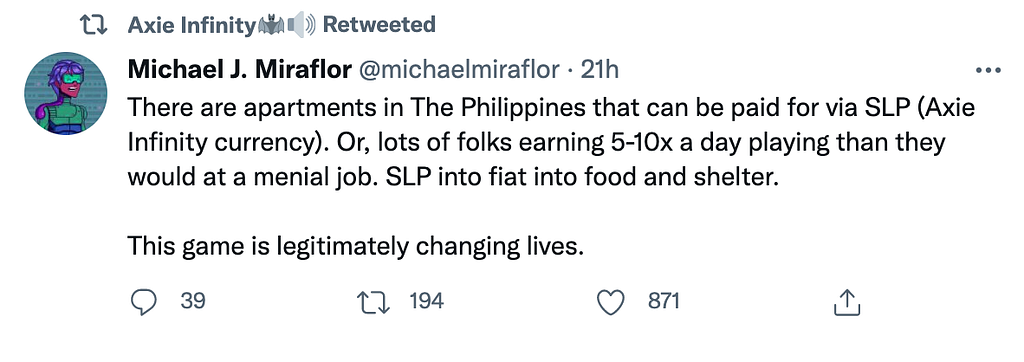
    In fact, some players in the Philippines are earning 5–10x what they were making from their previous jobs. New homes have been purchased, charitable acts have been made, and even shops are accepting SLP as payment.

    Beyond the wealth Axie Infinity has created, the game’s popularity has served as a means for getting a large new class of users comfortable using crypto applications. As these 1 million users interface with cryptocurrencies, NFTs, digital wallets, and DEXs, it’s not hard to see this new cohort as natural users of other DeFi and Web3 applications.

    Play-to-earn sustainability

    If Axie Infinity is its own digital nation, game developer Sky Mavis serves as its Federal Reserve. Where the Fed has various tools it uses to influence the economy, Sky Mavis can adjust the SLP issuance rate and breeding fees with the aim of keeping the Axie economy healthy. Just like a real economy, digital economies have to consider the effects of inflation.

    ETH has been flowing into the Axie economy due to high demand for Axie NFTs. Increased demand for Axie NFTs has led to rising Axie NFT prices. Higher NFT prices have made breeding more profitable. Breeding requires fees paid in SLP & AXS, leading to a rise in token prices. With rising SLP prices, playing becomes more profitable, encouraging others to join. A powerful positive feedback loop no doubt — but what if market conditions change?

    Winning Axie Infinity battles and quests yields SLP, inflating the SLP supply. And since breeding is priced in SLP, additional supply of SLP equates to cheaper breeding fees to create new Axie NFTs, inflating Axie NFT supply. These dynamics could have an impact on NFT market prices, which in turn may have a direct effect on the economics for players — a possible negative feedback loop.

    Ultimately, Sky Mavis has to keep the SLP supply in-check while improving overall gameplay to keep its player economy and ETH deposits growing. They must also offset the number of players seeking to extract a profit with players who are pure consumers — i.e. playing for the fun of it.

    Playing the Long Game

    While Sky Mavis works to keep the Axie economy strong, Yield Guild Games is banking on the continued growth of play-to-earn gaming as a whole. By replicating its model for Axie Infinity across new games, it seeks to build a play-to-earn empire. Over the long run, founder Gabby Dizon sees YGG as the “recruitment agency of the metaverse” that ultimately competes with the Ubers of the world for labor. A future straight out of Ready Player One in which millions of people earn a living in the digital world in order to cover expenses in the physical one.

    Final word

    With the exploding revenue of Axie Infinity, the emergence of DAOs like Yield Guild Games, and the multitude of play-to-earn games on the horizon, it’s clear that this trend has legs. With DeFi, NFTs, and now crypto gaming, we’re rapidly evolving past the original crypto killer app of speculative trading and into a universe of expressive new apps and models. We’re in fascinating times as crypto’s utility phase marches forward with a full head of steam.

    Quick Hits

    OpenSea Hits $3B monthly volume

    In the month of August, NFT exchange OpenSea hit $3B in monthly volume as over 1.5 million NFTs changed hands. Its August volume alone exceeds that of every other month in its history, combined.

    https://medium.com/media/094a28282f83142b39aee985b760ecd3/href

    OpenSea’s August volume is on par with $3B in gross sales Etsy put up in all of Q2: another sign of just how big the NFT market has grown relative to other online marketplaces in a very short timespan.

    Data from The Block shows how dominant OpenSea’s dominance over the NFT landscape really is.

    https://medium.com/media/65a33b506b8871ddaa65ed0389cf023c/href

    Notably absent from this exchange landscape are any kind of decentralized venues for trading NFTs. This follows past market cycles in which centralized exchanges found product market fit first, before ultimately paving the way for decentralized alternatives (think Uniswap during the DeFi summer).

    The DEX market for NFTs is still nascent but one we’re watching is the recently launched Punks.house which is a permissionless venue for trading CryptoPunks made by Zora. We’re also seeing NFT markets begin to decentralize themselves, with NFT art marketplace Super Rare making the first move with the introduction of its RARE governance token. Many suspect OpenSea will eventually take this route as well.

    Lastly, while OpenSea is a centralized for profit entity, its code is open source. It wouldn’t surprise us to see a low-fee competitor forked from OpenSea emerge in the coming months.

    $611M whitehat hack?

    In the largest DeFi hack to date, an attacker drained over $611M from the Ethereum, Binance Smart Chain, and Polygon blockchains. Then in a surprise move, he returned almost all of it.

    The hack was done by exploiting vulnerabilities on the Poly Network, a cross-chain interoperability protocol that connects different blockchains. These types of networks are usually among the most complex, owing to challenges in getting two different blockchains to talk to each other in a secure, safe fashion (it’s hard enough getting one blockchain to be secure!). And complexity is the enemy of security because added complexity increases the surface area for attackers to find exploits.

    In this case, the hacker tricked Poly Network’s smart contracts into thinking that the hacker’s address had permission to unlock the $611M+ across chains (detailed technical analysis here, simple explainer here). But in an odd turn of events, the hacker ended up returning nearly all of it to the Poly Network team (sans $33M USDT frozen by Tether).

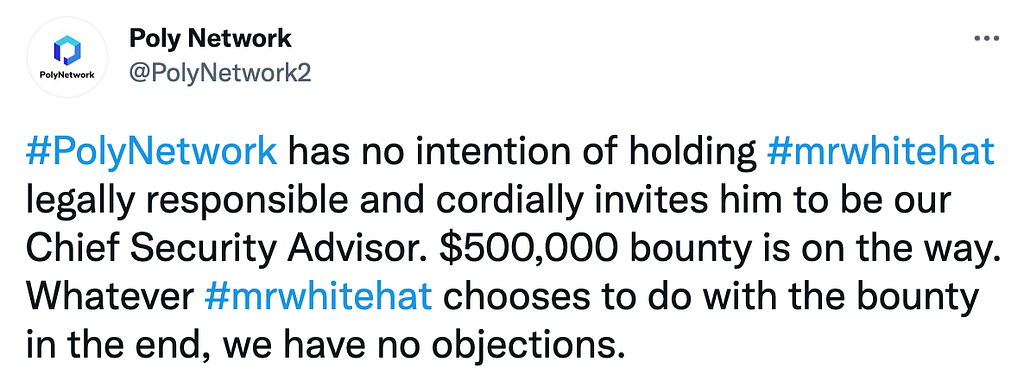
    There remains speculation around the hacker’s motives to return the funds. Security firm SlowMist stated that they were able to identify the hacker’s IP and email addresses, so some think the funds were returned because the hacker knew they wouldn’t be able to launder that much money undetected. The hacker, on the other hand, conducted an AMA and stated that they did it, “for fun.” And in a separate twist, the Poly Network team offered the hacker a job as their Chief Security Officer in addition to sending a $500,000 bounty for returning some of the funds.

    What’s going on here? We can’t know for sure, but it is rare for a hacker to return funds, especially in such a public fashion. Occam’s razor suggests that the repercussions involved with getting caught (if their info was truly identified) were too great to bear.

    While it’s disconcerting to see more hacks happening, we should note that this is simply an evolutionary fitness-function in action. Each hack teaches us how to improve, and we learn, adapt, and improve. While bleeding edge crypto protocols pioneering new use cases will inevitably carry more risk, the space hardens over time.

    And Poly Network is not alone. Note the other week when Paradigm’s samczsun discovered and reported a vulnerability in SushiSwap’s MISO platform that would have left $350M ETH at risk. Most recently, Cream Finance was exploited in a flashloan attack for $25M.

    But for crypto to really succeed, we need security guarantees. Insurance markets are critical.

    Retail news

    • Binance Tightens KYC Requirements — Leans into Compliance
    • The 2021 Global Crypto Adoption Index: Worldwide Adoption Jumps Over 880% With P2P Platforms Driving Cryptocurrency Usage in Emerging Markets
    • Crypto grows from 2% to 41% of Robinhood’s total revenue in past year
    • Japan’s Liquid Global Exchange Hacked; $90M in Crypto Siphoned Off
    • ‘Novi is ready to come to market,’ says David Marcus as Diem’s future remains uncertain
    • Facebook Considering NFT Support in Novi Digital Wallet
    • Austrian crypto unicorn Bitpanda raises another $263 million

    Institutional news

    • US Mortgage Lender UWM Plans to Accept Bitcoin Payments
    • Galaxy files for ETF that provides indirect exposure to bitcoin
    • Bloomberg and Galaxy team up on decentralized finance index
    • Former SEC chair Clayton joins Fireblocks advisory board
    • Galaxy reports losing $175 million during the last quarter in recent earnings call
    • Wells Fargo Launches Passive Bitcoin Fund for Wealthy Clients

    Ecosystem news

    • Visa Enters Metaverse With First NFT Purchase
    • Budweiser buys Beer.ETH domain and a rocket NFT
    • Twitter taps crypto developer to lead decentralized social media initiative Bluesky
    • TikTok Picks Streaming Service Audius to Power New ‘Sounds’ Library
    • DeFi projects could come under SEC’s oversight, says chairman Gensler
    • a16z announces $4.6 million financing round in Yield Guild Games
    • Avalanche launches $180 million DeFi incentive scheme with Aave and Curve
    • Walmart is looking for a crypto product lead
    • Polygon acquires Hermez in $250 million deal that includes first-ever token ‘merger’
    • Ethereum 2.0 Staking Contract Now Holds the Most Ether: $21.3B

    Tweets

    This website does not disclose material nonpublic information pertaining to Coinbase or Coinbase Venture’s portfolio companies.

    Disclaimer: This material is the property of Coinbase, Inc., its parent and affiliates (“Coinbase”). The views and opinions expressed herein are those of the author and do not necessarily reflect the views of Coinbase or its employees and summarizes information and articles with respect to cryptocurrencies or related topics that the author believes may be of interest. This material is for informational purposes only, and is not (i) an offer, or solicitation of an offer, to invest in, or to buy or sell, any interests or shares, or to participate in any investment or trading strategy, (ii) intended to provide accounting, legal, or tax advice, or investment recommendations or (iii) an official statement of Coinbase. No representation or warranty is made, expressed or implied, with respect to the accuracy or completeness of the information or to the future performance of any digital asset, financial instrument or other market or economic measure. The information is believed to be current as of the date indicated on the materials. Recipients should consult their advisors before making any investment decision. Coinbase may have financial interests in, or relationships with, some of the entities and/or publications discussed or otherwise referenced in the materials. Certain links that may be provided in the materials are provided for convenience and do not imply Coinbase’s endorsement, or approval of any third-party websites or their content. Coinbase, Inc. is not registered or licensed in any capacity with the U.S. Securities and Exchange Commission or the U.S. Commodity Futures Trading Commission.


    Axie Infinity, Yield Guild Games & the play-to-earn economy was originally published in The Coinbase Blog on Medium, where people are continuing the conversation by highlighting and responding to this story.


    [ad_2]

    Source link