[ad_1]
 In March, bitcoin miners amassed an unprecedented level of revenue not seen in the previous 12 months, hitting a high of $2.01 billion from rewards and transfer fees. Of this total, $85.81 million was earned from transaction fees over the past month. Historic Month for Bitcoin Miners — Income Peaks at $2 Billion As we […]
[ad_2]
Source link
Tag: Ahead
-

Bitcoin Miners’ Earnings Hit Record $2 Billion in March Ahead of Halving Event
-

Bitcoin Technical Analysis: BTC Consolidation Points to Potential Shifts Ahead
[ad_1]
 On March 29, 2024, with a trading price of $70,075, and oscillating within a 24-hour range of $68,362 to $71,754, bitcoin’s current market behavior reveals significant consolidation and neutrality. Bitcoin Bitcoin’s 1-hour chart reveals recent volatility, with a significant bounce from a low of approximately $68,362, suggesting a strong support level. Conversely, the resistance near […]
[ad_2]
Source link -

Making your voice heard ahead of Thursday’s critical EU vote | by Coinbase | Mar, 2022
[ad_1]
By Paul Grewal, Chief Legal Officer

Bad facts make bad law. We see this in jurisdictions all over the world, especially when it comes to digital assets. Unfortunately, we are about to see this again — this time in the European Union — in the form of a revision to the Transfer of Funds Regulation. If adopted, this revision would unleash an entire surveillance regime on exchanges like Coinbase, stifle innovation, and undermine the self-hosted wallets that individuals use to securely protect their digital assets. The vote will likely take place this week so time is running out.
Here are the bad “facts”:
(1) digital assets like Bitcoin, Ethereum and others are a primary way criminals hide and move money
(2) law enforcement has no way to track these movements
(3) requiring collection and verification of personal information associated with self-hosted is not a violation of their privacy
State of play
The truth is that digital assets are in general a markedly inferior way for criminals to hide their illicit financial activity. That’s why, according to the best research available, by far the most popular way to hide illicit financial activity remains cash. Unlike with cash, law enforcement can track and trace digital asset transfers with advanced analytics tools. None of this requires upsetting the settled privacy expectations of wallet holders because the open architecture underlying digital assets is public and offers unprecedented transparency into transaction details. The records are also permanent — no one (not crypto companies, not governments, not even bad actors) can destroy or alter information. In short, digital assets and the immutable nature of their blockchain technology actually enhances the ability to detect and deter illicit activity. But rather than embracing and leveraging the benefits that arise from the increasing use of digital assets, the EU’s proposal would cast them aside and impose a host of new privacy invasions on wallet users.
For example, all crypto transactions will be deemed “travel rule eligible”. This means crypto is treated differently to fiat (which has a 1,000 EUR threshold), which establishes a clear advantage for traditional financial service providers over new technology, with significant anti-competition and anti-innovation implications.
Among the worst of the proposed provisions are new obligations on exchanges to collect, verify and report information on non-customers using self-hosted wallets. For instance, one provision requires exchanges to not only collect personal data about wallet users who are not their customers, but to also verify the data’s accuracy before allowing a transfer to one of their customers. In fiat terms, this would basically mean you cannot take money out of your bank account to send to someone else until you share personal data with your financial institution about that person and verify their identity. Not only is this verification requirement nearly impossible to do but requiring exchanges to engage in extensive data collection, verification, and retention about non-customers runs against core EU data protection principles of data minimization and proportionality.
Another dangerous provision would require exchanges to inform “competent authorities” of every single transfer from a non-customer’s self-hosted wallet equal to or greater than 1,000 EUR — regardless of any suspicion of bad activity. The proposal even leaves the door open to a total ban on transfers to self-hosted wallets even though there is no evidence that such a ban would have any impact on illicit activity at all. Like we said, bad facts make bad policy.
Make your voice heard
There’s precious time to act and we need to make our voices heard. A vote on Parliament’s draft proposal could come as early as Thursday, March 31st. If you care about protecting the privacy of individuals, and focusing the law on solutions that actually address legitimate concerns about the illicit use of digital assets, now is the time to speak up and be heard. We must speak with one, strong voice against this proposal before it’s too late.
[ad_2]
Source link -

82% Of Bitcoin Short-Term Holder Supply Now In Loss, Capitulation Ahead?
[ad_1]
On-chain data shows around 82% of the Bitcoin short-term holder supply is currently in loss, suggesting that capitulation may occur soon.
82% Of Bitcoin Short-Term Holder Supply Now In Loss, While Total STH Supply Declines
According to the latest weekly report from Glassnode, the BTC STH supply is nearing all-time lows at the moment. However, 82% of it is being held at a loss.
The “BTC short-term holder supply” is that part of the total Bitcoin supply that has been held for less than 155 days.
The investors holding this supply are usually the likeliest to sell their coins off during market volatility, and especially when a capitulation flush out occurs.
An on-chain indicator, the Bitcoin STH supply in profit/loss, tells us the percentage distribution between these coins being held at a profit and those being held at a loss.
When a high amount of this supply is in loss, there may be more sell-side pressure in the market as short-term holders capitulate easily.
Related Reading | Bitcoin MPI Rises To Highest Value Since March 2021, Bull Rally Soon?
Now, here is a chart that shows the trend in the BTC STH supply over the history of the coin:
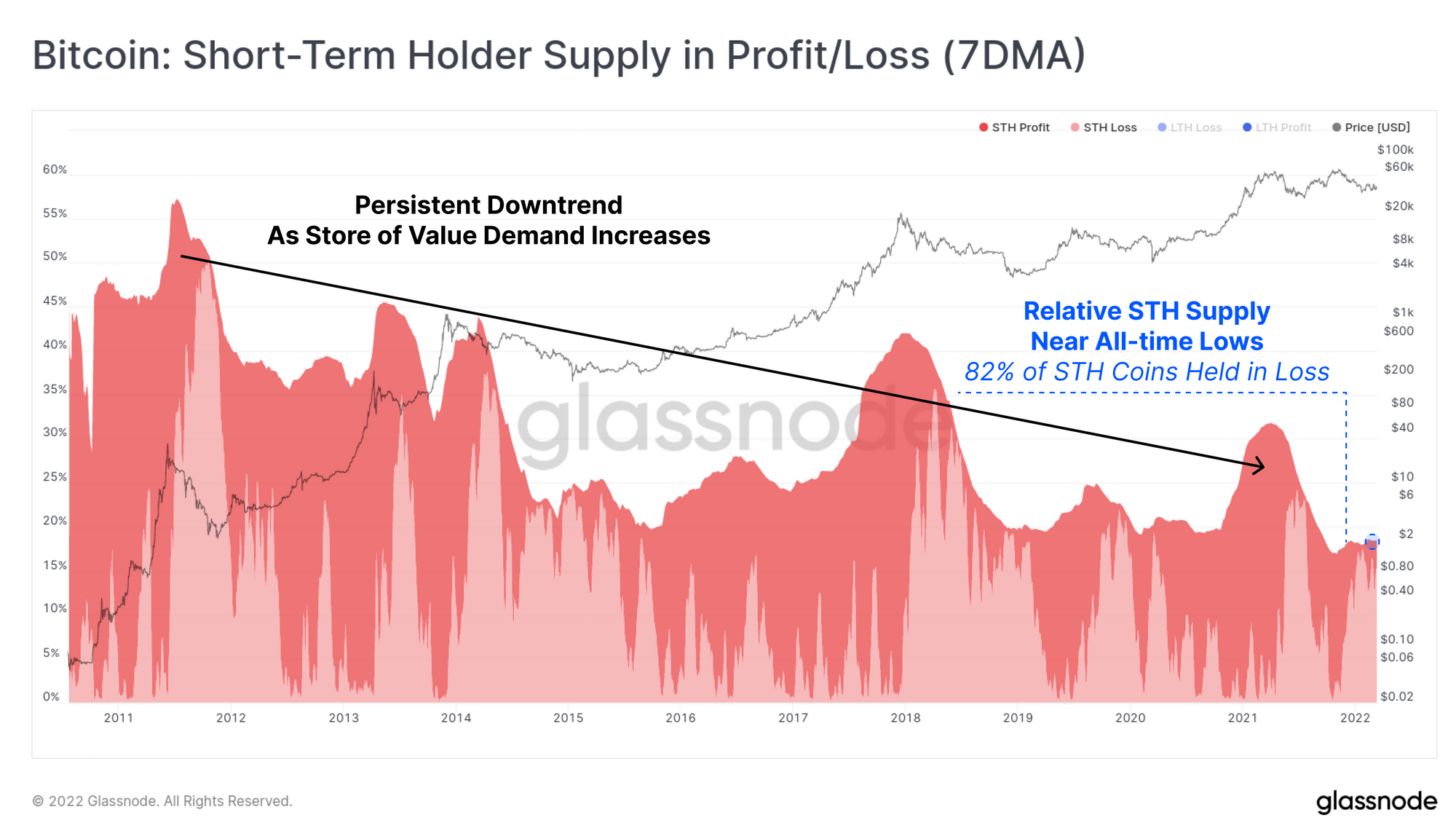
Looks like the value of the indicator has declined over the years | Source: Glassnode's The Week Onchain - Week 11, 2022
As you can see in the above graph, the Bitcoin STH supply has been observing a constant downtrend over much of the history of the coin, and is currently near all-time low values. The decrease in this supply happens when some of the coins mature beyond the 155-day cutoff, thus becoming part of the “long-term holder supply” instead.
Since short-term holders can be a big source of sell-side pressure, the number of coins held by them severely going down can be bullish for the price of the crypto.
Related Reading | Bitcoin Hashrate Swells 15% Since Last Week As Analysts Expect Mining Difficulty To Increase
However, while the supply is low right now, around 82% of it is currently in loss. So despite the decline in total supply, these coins in loss still amount to around 2.5 million BTC, and thus they can add quite significant sell pressure to the market.
As macro uncertainties like the Russian invasion of Ukraine continue to loom over the Bitcoin market, these short-term holders may finally break and capitulate in case their coins remain in the red or go even deeper.
BTC Price
At the time of writing, Bitcoin’s price floats around $38.5k, down 1% in the last seven days. Over the past month, the crypto has lost 10% in value.
The below chart shows the trend in the price of BTC over the last five days.

BTC's price seems to have been in consolidation for a few days now | Source: BTCUSD on TradingView
Featured image from Unsplash.com, charts from TradingView.com, Glassnode.com
[ad_2]
Source link -

These 3 indicators flashed bullish ahead of the recent Bitcoin price pump
[ad_1]
In stock markets and the crypto sector, traders are always looking for a definite reason to explain an asset’s price action, which means it’s important to stress that correlation doesn’t imply causation.
While it may be easy to connect a regulatory statement or pending legislation to the outcome of an asset’s price, there’s not always hard proof that these were the exact drivers. Some indicators described below may have happened due to pure luck, even if the coincidence continues throughout history.
For example, Bitcoin’s (BTC) pump to $48,200 on Oct. 1 could have been related to the Sept. 30 remarks by the U.S. Federal Reserve chairman Jerome Powell. When asked to clarify his comments on Central Bank Digital Currencies (CBDC), Powell affirmed that the FED has no intentions to ban cryptocurrencies.
Another plausible reason for the current rally is Bitcoin’s 7-day average hash rate jumping to 145 exahashes per second (EH/s), its highest level since the abrupt crash in early June when China’s mining crackdown intensified.
Finally, increasing expectations of a Bitcoin exchange-traded fund (ETF) approval by the U.S. Securities and Exchange Commission (SEC) might have played an essential part in traders’ recent bullish bets.
What is clear is that multiple factors could have led last week’s pump to $49,000, and today bulls appear to be making an effort to recapture $50,000. So let’s take a look at 3 indicators that flashed a ‘buy’ signal ahead of the recent price move.
UNI caught a bid after traders turned their attention to DeFi

Uniswap (UNI, left) vs. Bitcoin (BTC, right). Source: TradingView UNI, the decentralized exchange token for Uniswap, pumped a few hours ahead of the Oct. 1 market rally. The altcoin began its price increase right as the UTC monthly close happened, initially by 5% to $24.20 from $23. This move was followed by another 4% pump to $25.20 three hours ahead of Bitcoin’s breakout above $45,000.
Curiously, DEX volumes started to soar after China imposed additional restrictions on Bitcoin in the previous week. A reasonable explanation for the move could be investors beginning to understand that China’s action would not impact the trading volume. By migrating to DEX, the possibility for governments to control or limit cryptocurrency adoption goes down significantly.
Shorts on derivatives exchanges saw an uptick
Some exchanges provide useful information on clients’ net exposure by measuring their positions or consolidating data from spot and derivatives markets. For example, the OKEx Bitcoin traders’ long-to-short ratio dropped from 1.25 (favoring longs) to 0.72 (favoring shorts) by 28% in less than two days.
That might sound counterintuitive at first, showing whales increasing bearish bets, but when market expectations are broken, extreme price moves tend to happen. Had most traders expected a positive price swing, the result would likely have been priced in already.

OKEx Bitcoin derivatives long-to-short ratio. Source: OKEx Binance futures open interest grew suddenly
Regardless of the underlying asset, a futures contract has longs (buyers) and shorts (sellers) matched at all times. This means there is no way to anticipate whether those investors are skewed to either side.
However, sudden increases in the open interest, which reflects the aggregate number of contracts still in play, reflects confidence. The higher the notional involved, the bigger the stakes.

Binance Bitcoin futures open interest. Source: Binance Notice how, during the 4 hours ahead of the 6:00 am UTC bull run, the spike on both the USDT perpetual and the coin-based contract open interest. Interestingly, even with the $400 million additional bets, Bitcoin price was only noticeably impacted after the open interest peaked.
The truth is one might never uncover what exactly triggered the rally, but by monitoring similar patterns in the future, traders may be able to predict price pumps. Of course, there’s no guarantee that all three indicators will repeat themselves, but the cost of monitoring the data is minimal.
The views and opinions expressed here are solely those of the author and do not necessarily reflect the views of Cointelegraph. Every investment and trading move involves risk. You should conduct your own research when making a decision.
[ad_2]
Source link -

Bitcoin Indicators Now Look Similar To Q4 2020, Big Move Ahead?
[ad_1]
Quant says some Bitcoin indicators show the same trend as in during Q4 2020, suggesting that BTC could make a similar move up.
Bitcoin Netflow And Stablecoins Supply Ratio Trends Look Similar To Q4 2020
As explained by an analyst in a CryptoQuant post, two BTC indicators: the netflow and the stablecoins supply ratio, are both trending similarly to how they did during the last quarter of 2020.
The Bitcoin netflow indicator shows the net number of coins entering or exiting exchanges. Its value is calculated by taking the difference between the outflows and the inflows.
When the metric observes positive values, it means exchanges are experiencing more inflows than the outflows, and so more investors have started sending their BTC to exchanges for selling purposes.
Similarly, negative values imply just the opposite; investors are withdrawing their Bitcoin from exchanges either to hodl in personal wallets or to sell them through OTC deals.
The other metric of relevance is the stablecoins supply ratio, which is defined as the market cap of BTC divided by the market cap of all stablecoins.
When the indicator’s values are on the lower end, it means there is an abundance of stablecoins supply in the market. High supplies can imply a potentially bullish sentiment among the market as investors use these coins for picking up other crypto like BTC.
Related Reading | China’s Ban On Crypto-Assets Forces Huobi Mining Pool To Rotate 100k Bitcoin
On the other hand, higher values of the ratio indicate a low supply of stablecoins, which implies a lack of buying pressure in the market. This could lead to a potentially bearish trend or sideways movement for BTC.
Now, here is a chart showing the trend of these two Bitcoin indicators vs the price:
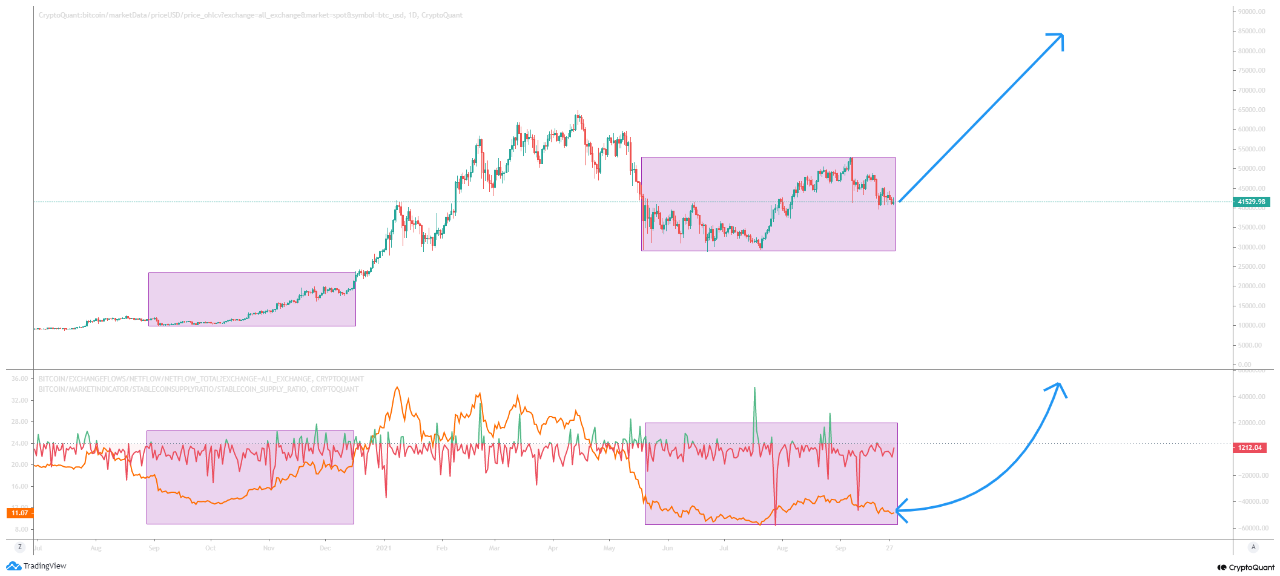
The similarity between Q4 2020 and the current period | Source: CryptoQuant
As the above chart shows, the netflows seem to have been negative for a while now and the stablecoins supply ratio is also assuming low values.
Related Reading | Bitcoin Bearish Signal: On-Chain Data Shows Whales Have Started Selling
This trend looks to be similar to how it was during Q4 2020. What followed it was a big bull rally, and so the quant believes we may see BTC blow up similarly soon.
BTC Price
At the time of writing, Bitcoin’s price floats around $43k, down 2% in the last seven days. Over the past month, the crypto has lost 9% in value.
Over the last few days, BTC has only shown sideways movement as the crypto fails to make a move above $45k. The below chart shows the trend in the price of the coin over the last five days:

BTC's price continues to consolidate between the $40k and $45k levels | Source: BTCUSD on TradingView
Featured image from Unsplash.com, charts from CryptoQuant.com, TradingView.com
[ad_2]
Source link