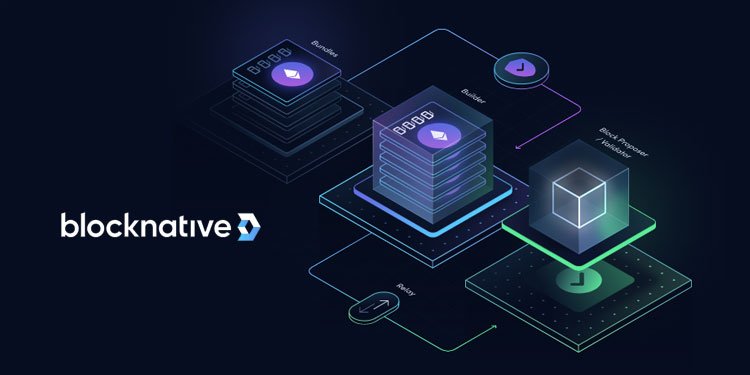
Blocknative, a real-time Ethereum (ETH) infrastructure platform, has newly introduced features including transaction bundle send, cancellation, and replacement support for the Blocknative Builder.
Searchers can now submit MEV bundles privately to the Blocknative Builder to be included on-chain.
This market utility builds upon Blocknative’s reliable, real-time infrastructure that is systematically important to the Ethereum ecosystem.
“MEV bundle control is an important element of our block-building capabilities. As Ethereum evolves, we remain committed to providing real-time infrastructure that supports transparency, accessibility, and decentralization block by block. To reduce friction and facilitate adoption, we have prioritized ease of use by ensuring that our API-level implementation is cross-compatible with the broader builder ecosystem.” – Matt Cutler, CEO & Co-Founder of Blocknative
Searchers can quickly add the Blocknative Builder to their bundle workflow. The bundle RPC endpoint uses direct payments instead of gas prices to make payments conditional on their transaction succeeding, thus avoiding having to pay for failed bids.
With over 269,000 validators connected to the Blocknative Relay via MEV-Boost, searchers can use the Blocknative bundle RPC endpoint to increase their Builder reach and increase the likelihood that their bundles successfully get on-chain.
Searchers can learn more here or interact with the RPC endpoint here.
Algorand, a next-gen blockchain application network, today announced a major release that will empower the creation of more sophisticated apps while marking a milestone for its cross-chain interoperability.
Developers are now able to build complex dapps for the Algorand ecosystem with smart contract-to-contract calling, and network participants can take their first step towards trustless cross-chain interoperability with quantum-secure keys for the upcoming State Proof technology.
These upgrades come on the heels of a $20 million incentive program from the Algorand Foundation focused on developer tooling and EVM compatibility, putting Algorand at the forefront of blockchain interoperability and post-quantum security while providing features advanced decentralized applications.
“With this latest upgrade, Algorand continues its leadership position when it comes to ongoing delivery of highly sophisticated blockchain technology. We’ve received overwhelmingly positive feedback from developers during the beta testing and are excited to roll out these enhancements to the broader blockchain developer ecosystem.” – Paul Riegle, Chief Product Officer at Algorand
Core elements of this release include:
Smart contract compatibility with contract-to-contract calls: Allows complex dApps that can efficiently and trustlessly interact with other smart contract-based dApps to extend functionality and usability.
Post-quantum secure Falcon Keys: These keys will, in the near future, be used to generate State Proofs, a new blockchain infrastructure that will allow Algorand to be trustlessly accessed in low-power environments like mobile phones, smartwatches, and on other blockchains.
These features add to Algorand’s already advanced tech, high performance, and rich developer resources. Accessible to all types of developers, smart contracts on Algorand can be written in Python or Reach.
Since its launch, Algorand has experienced zero downtime, the highly scalable blockchain supports the creation of DeFi protocols, NFTs, payment solutions, regulated digital assets, and more.
Swing, a cross-chain infrastructure platform to trade and move crypto between blockchains, has announced that its cross-chain liquidity and bridging protocol, is now live on Binance Smart Chain (BSC).
Originally built on the Polkadot blockchain, Swing has recently expanded to several different blockchain networks, including Avalanche, Polygon, and Solana.
Acting as liquidity and bridging aggregator of the most popular decentralized finance platforms and DEXs (decentralized exchanges), with Swing, users can access the full range of popular DeFi platforms and trade seamlessly across them all without surrendering control of their funds to any third party.
Integration of Binance Smart Chain will broaden Swing’s access DeFi apps, and specifically, will allow the platform to aggregate liquidity and bridging opportunities across the most popular DEXs on BSC, including PancakeSwap, BurgerSwap, BiSwap, and more.
Binance Smart Chain is the Ethereum Virtual Machine (EVM) compatible dApp and smart contract platform from the world’s largest crypto exchange, Binance. Although created by a centralized exchange, Binance Smart Chain is a decentralized platform that hosts a number of decentralized applications.
“We are thrilled to become a part of the Binance Smart Chain (BSC) network. The number and variety of decentralized applications on Binance Smart Chain gives our protocol a chance to show what it can do. Users and traders will feel an immediate benefit by having all of the best liquidity and bridging options available in one place.” – Swing Founder, Viveik Vivekanantha
The Swing protocol is currently live on Ethereum, Polygon, Avalanche, Fantom, xDai, and now Binance Smart Chain, where it aggregates bridges and liquidity sources to find the lowest slippage on cross-chain token swaps and liquidity transfers.
Israel-based developer of blockchain applications, Kirobo, announced its integration with the well-known Binance Smart Chain (BSC) and the addition of blockchain guru Dr W. Scott Stornetta to its advisory board today. The company highlighted its plan to expand services in the future through the creation of a multi-chain service suite.
The integration with the hugely popular Binance Smart Chain will enhance the reach of Kirobo’s Defi applications. Moreover, Kirobo’s collaboration will facilitate the company’s goal of providing efficient services to users in the global crypto ecosystem.
The integration will provide several opportunities to the Binance Smart Chain users as they will be able to take advantage of Kirobo’s innovative products for cryptocurrency management.
Kirobo’s Undo Button has been making considerable waves in the crypto community, Having safely processed $1.7 billion worth of crypto transactions, its revolutionary ‘undo button’ is believed to have rescued $7 million in recalled transactions on the Ethereum network. In addition, the company’s P2P Swap Button provides a high level of security to direct token Swaps.
Launched in September 2020, BSC is one of the most popular services of cryptocurrency exchange Binance. BSC has already overtaken Ethereum in terms of the number of transactions per day. The integration connects Kirobo services with WBNB and BUSD, the two main gateway tokens to the BSC network. Moreover, the users of BSC can now use Kirobo’s services with a wide range of digital currencies.
Suggested articles
FXTRADING.com Caps Successful Q3 with Marquee PartnershipsGo to article >>
“Ethereum is a powerful platform, but as it struggles with throughput, exciting alternatives have appeared. People want to take advantage of them safely and effectively,” said Asaf Naim, Co-Founder and CEO of Kirobo. “By integrating with arguably the world’s most promising smart contract-capable blockchain, we’ve extended the reach of our services to a much broader section of the crypto ecosystem. It’s just one milestone in our roadmap towards multi-chain support for all our current and future products.”
Addition of Scott Stornetta
In the latest press release exclusively shared with Finance Magnates, Kirobo announced that the company has added Dr W. Scott Stornetta, known as one of the founding fathers of blockchain technology and cryptocurrency, to its advisory board. In the last few years, Stornetta contributed considerably towards the development of the cryptocurrency market through research and consultation. “We are honored to welcome Dr Stornetta to our team. His importance to the cryptocurrency ecosystem can’t be overstated,” said Tal Asa, Co-Founder and CTO of Kirobo.
Scott Stornetta and the Kirobo Team
“I’m delighted to be joining the Kirobo advisory board, and I’m very much looking forward to advising the team on the development of its products and services. I’ve had a front-row seat to the evolution of the blockchain industry and been fortunate to work with some incredibly talented and dedicated individuals over the course of the last 30 years, so when I met Asaf and the Kirobo team I immediately knew that they were doing something special. Kirobo’s offering is innovative and unique, and I’m excited to be part of its journey,” Stornetta said.
Kirobo also welcomed Nir Geffen Shimoni, Co-Founder and Managing Partner of Better Alternatives, to its advisory board.
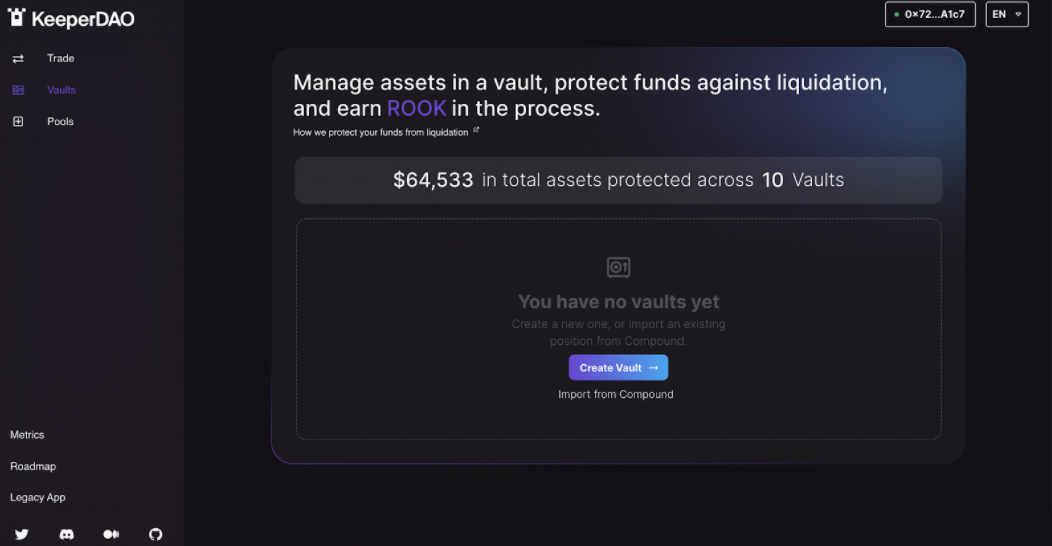
KeeperDAO, an MEV protection protocol on Ethereum, announced today a major update to its DeFi platform. KeeperDAO has introduced a smart contract-based borrowing and liquidation protection service; that gives borrowers the most profitable way to open or upgrade a borrow position on Compound.
The KeeperDAO borrowing platform is composed of three unique products that form the pillars of their engine: a smart contract NFT that can be used with any activated borrowing platform, a collateral booster that helps stave off unnecessary liquidations, and a wrapped version of an underlying borrowing protocol.
To begin interacting with KeeperDAO’s platform, users mint a Hiding Vault, a modular smart contract NFT that allows them to open or migrate borrow positions from any protocol that KeeperDAO supports.
Feature: Hiding Vaults
Hiding Vaults also allow users to easily transfer positions between different addresses; as well as isolate riskier loans from each other while still using the same Ethereum address. This is a major improvement compared to other liquidation protection services, which spread out the risk across all users, which may result in a user losing funds due to someone else’s risky behavior.
When a loan approaches liquidation, KeeperDAO’s new Just-In-Time Underwriter (JITU) activates. JITU will borrow liquidity from one of KeeperDAO’s deep liquidity pools to protect at-risk Hiding Vault positions.
Providing a temporary loan to buffer a borrower’s position makes the loan appear healthier and prevents an outside liquidation. JITU is able to remove the buffer if the health of the loan improves or the borrower deposits additional collateral. If the loan’s health continues to decline, JITU will perform a liquidation.
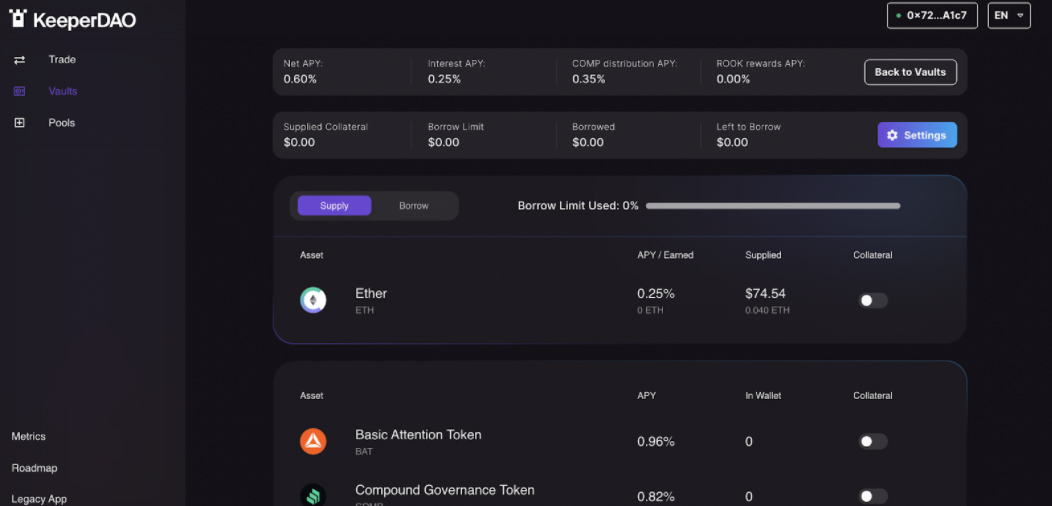
The first enabled borrowing protocol for the Hiding Vault is a wrapped version of Compound, which KeeperDAO calls kCompound.
kCompound lets users deposit collateral and borrow assets as they normally would on Compound to create a position, or simply migrate their entire Compound position over to a Hiding Vault. kCompound gives users all the benefits of Compound, including APYs and COMP rewards, while also rewarding open loans with a tertiary yield, paid out in ROOK.
Roadmap Ahead
The KeeperDAO team is also developing borrowing protection for additional protocols beyond kCompound for the Hiding Vault. They recently announced the successful completion of their kAave Solidity Competition. Two community members were able to successfully simulate the liquidation call function in Aave; a key step in the Hiding Vault’s functionality.
KeeperDAO, with their Hiding Vault borrowing engine and gas-free limit order exchange, aims to increase offering back user’s MEV that is created by their trades and loans and will continue to advance the MEV protection space. Moreover, KeeperDAO is currently designing ways for market makers to coordinate in redistributing MEV from miners through their upcoming Coordination Game.
“Prior to KeeperDAO’s inception, there was no solution for Ethereum users losing MEV. We are providing the infrastructure to align incentives between users, keepers, borrowers, DeFi products, and liquidity providers. We are leading the charge in protecting and bringing MEV back to users. So far it is greatly succeeding at improving the quality of life for the ecosystem.” – Joey Zacherl, Founding Partner at KeeperDAO
Shiba Inu, a famed meme coin, has recently unveiled its DEX ShibaSwap. This comes on the heels of the growing popularity of SHIB as holders continue to show faith in the coin.
The coin which was started as a joke has seen a lot of growth and seems to be taking a more serious tone as time goes by. The developers are bent on showing the market that Shiba Inu has moved on from meme coin territory into serious coin territory.
Related Reading | Coinbase Pro To List Shiba Inu, The “Dogecoin Killer” Price Soars
One of the ways the project has shown this newfound seriousness is in the release of its very own DEX named ShibaSwap. ShibaSwap works like any other DEX, the likes of Pancakeswap, SushiSwap, and Uniswap. With the launch of ShibaSwap has come a lot of possibilities for the holders of Shiba Inu tokens.
So far, the total value locked (TVL) of coins on ShibaSwap has exceeded $1.5 billion. Getting over $1 billion TVL in just two days after the launch.
What ShibaSwap Offers
On the website are various ways that Shiba Inu holders can get rewards for staking their SHIB coins on the platform. On the back of this has been the release of two new tokens; LEASH and BONE.
These tokens were not made available to buy until the ShibaSwap DEX was launched. Holders can “dig” on the platform to earn BONE tokens. The term “dig” in this context just refers to SHIB holders providing liquidity on the platform.
Holders can also “fetch” on ShibaSwap. This is done by migrating UNI V2-LP or SLP tokens and holders get BONE coins in return for fetching.
Continuing on this path, holders of Shiba Inu tokens can also “bury” tokens. “Bury” refers to staking SHIB tokens in order to get rewards on your staked coins. Holders can alternatively bury their SHIB tokens, LEASH, or BONE tokens using this feature. Burying is not yet live on ShibaSwap and is slated to be coming soon to the DEX.
Price of SHIB down 2% in the last 24 hours | Source: SHIBUSD on TradingView.com
The ShibaSwap DEX also provides swapping features for holders. Here, holders can swap their coins for any token listed on the platform. The tokens that can be swapped on ShibaSwap are not just limited to SHIB tokens. Users can swap a wide variety of tokens for other tokens. Eth being one of the most prominent that can be swapped on the DEX.
“Woof” is a feature that enables holders to get returns when they stake their SSLP tokens. It allows holders to farm for coins with their staked tokens.
The Bonefolio featured which has not yet launched will allow holders to track their token activities across the DEX, referred to as dogalytics on the SHIB website.
Three New Token Pairs
A recent announcement revealed that Shiba Inu would be adding three new pairs on their DEX ShibaSwap. This comes a week after the decentralized exchange had launched to much anticipation from the token holders.
The official Twitter account of Shiba Inu announced the three new token pairs and these included an ETH-USDT pair (300 AP), a LEASH-BONE pair ( 900AP), and a SHIB-BONE pair (600 AP).
The price of SHIB saw a small uptick in response to the announcement but this did not last long as the price of the coin took a nosedive shortly after the uptick.
Related Reading | Dog Eat Dog: Elon Musk Leaving Doge Behind For New Dog Coin?
Regardless of the price reaction to the news, the new pair additions have been strongly encouraged, with the official SHIB account stating that they believe the additional pairs with help to build the momentum behind ShibaSwap. They hope to achieve this by “incentivizing our ecosystem, widening their reach to external users, and providing more USDT liquidity, (which will help #ShibaSwap run smoothly with more and more rewards).”
SHIB is currently trading at $0.00000770, and BONE and LEASH are listed on SHIB’s website at $5.38 and $2587.2 at the time of this writing.
Featured image from Currency.com, chart from TradingView.com