Crypto trading platform, Gemini confirmed the availability of its crypto rewards credit card in the US yesterday. According to the exchange, users will be able to earn crypto rewards on purchases.
Dubbed ‘Gemini Credit Card’, the product has been issued by WeBank and features Mastercard, the US-based financial services provider, as the exclusive card network. Gemini noted that its crypto rewards credit card received more than 500,000 sign-ups since the launch of its waitlist.
“Last year, the crypto industry had its breakout moment with 44% of crypto owners in the U.S. reported first buying crypto in the last year. Gemini is committed to helping drive more education and offer innovations that remove barriers of entry for consumers who want access to crypto such as bitcoin,” said Pravjit Tiwana, the Chief Technology Officer (CTO) of Gemini. “In partnership with Mastercard and WebBank, we developed the Gemini Credit Card to offer a simplified way to invest in crypto without asking consumers to change their daily behavior.”
Gemini is one of the most valuable digital exchanges in the world. In November last year, the crypto trading platform raised $400 million in growth equity funding and reached a valuation of more than $7 billion.
Crypto Rewards
Sherri Haymond, the Executive Vice President of Digital Partnerships at Mastercard, said that the latest partnership with Gemini will provide an efficient crypto reward experience to the users. Furthermore, Haymond highlighted the growing global popularity of the cryptocurrency ecosystem.
“Mastercard and Gemini share in the belief that providing relevant and innovative crypto rewards experiences will not only empower consumers but also unlock access to the digital currencies ecosystem. We’re honored to work hand in hand with Gemini to deliver these one-of-a-kind rewards offering and make it even easier for consumers to experience crypto,” Haymond added in the press release.
Crypto trading platform, Gemini confirmed the availability of its crypto rewards credit card in the US yesterday. According to the exchange, users will be able to earn crypto rewards on purchases.
Dubbed ‘Gemini Credit Card’, the product has been issued by WeBank and features Mastercard, the US-based financial services provider, as the exclusive card network. Gemini noted that its crypto rewards credit card received more than 500,000 sign-ups since the launch of its waitlist.
“Last year, the crypto industry had its breakout moment with 44% of crypto owners in the U.S. reported first buying crypto in the last year. Gemini is committed to helping drive more education and offer innovations that remove barriers of entry for consumers who want access to crypto such as bitcoin,” said Pravjit Tiwana, the Chief Technology Officer (CTO) of Gemini. “In partnership with Mastercard and WebBank, we developed the Gemini Credit Card to offer a simplified way to invest in crypto without asking consumers to change their daily behavior.”
Gemini is one of the most valuable digital exchanges in the world. In November last year, the crypto trading platform raised $400 million in growth equity funding and reached a valuation of more than $7 billion.
Crypto Rewards
Sherri Haymond, the Executive Vice President of Digital Partnerships at Mastercard, said that the latest partnership with Gemini will provide an efficient crypto reward experience to the users. Furthermore, Haymond highlighted the growing global popularity of the cryptocurrency ecosystem.
“Mastercard and Gemini share in the belief that providing relevant and innovative crypto rewards experiences will not only empower consumers but also unlock access to the digital currencies ecosystem. We’re honored to work hand in hand with Gemini to deliver these one-of-a-kind rewards offering and make it even easier for consumers to experience crypto,” Haymond added in the press release.
Positioned as a stable ecosystem that prioritizes decentralized governance, disintermediation and provides a self-adjusting interest rate mechanism, ApeX is a revolutionary protocol that has the potential to become the standard for all crypto derivatives platforms.
In the last few years, the future of finance has been riding the decentralization wave, at speeds which would heretofore been unimaginable. In line with a fundamental rethinking of the way money works, with a focus on open-source code and permissionless networks, ApeX is a decentralized, permissionless and non-custodial platform that allows for the creation of perpetual swap (funding) markets on any token pair. Perpetual swaps are derivative contracts that allow two counterparties to conduct a margin trade, where settlement does not occur until one party terminates the contract.
The State of ApeX
It has been an eventful beginning for ApeX, having successfully launched a beta version of the protocol on the Arbitrum mainnet, completed their seed round fundraising and sold out a total of 4,580 unique NFTs to their users. With a pre-mined fixed total supply of 1 billion tokens, $APEX represents value and utilities such as governance, protocol incentives, and staking to its users.
Across crypto and beyond, the key question being asked by many is: What is more profitable in the long run — holding, or trading? In tandem with this question is another that follows — which investment is more secure, staking or NFTs? ApeX contends that there is no one-size-fits-all investment advice in today’s world of DeFi — ROI depends on the platform used.
The 3 core pillars of ApeX’s value proposition
The core of ApeX’s protocol is to create a fully permissionless and globally accessible perpetual contract protocol. The ability to trade on the ApeX protocol without the need for an account or verification opens up the world of trading to anyone with internet access.
ApeX operates on three pillars:
Fully Permissionless — No KYC or AML restrictions. Most DeFi platforms require some form of KYC/AML verification before users can use their services. Believing that this creates unnecessary friction for end users and goes against the ethos of a truly permissionless system, ApeX has taken a stance against having KYC/AML restrictions.
Liquidity in Perpetuity — A protocol designed as a foundation for future applications in multiple financial verticals, ApeX believes it is essential to provide an avenue for users to profit from liquidity provision without any time constraints or limitations.
Full-spectrum Asset Support — As a way to transact value across borders and economies by leveraging blockchain technology, crypto-assets are more than just tokens. The ultimate goal of ApeX is to become a one-stop shop for every swap need.
ApeX Protocol is funded and backed by global investors
More than just providing decentralized solutions, ApeX also prioritizes being able to deliver stable liquidity and support the development of the ApeX protocol. ApeX is backed by global partners that include Dragonfly Capital Partners, Jump Trading and Tiger Global Management, who will support the development of the solutions that will transform the state of DeFi.
What makes ApeX different from other perpetual swap protocols
ApeX contends that the most important features of a perpetual swap protocol are the market maker design, pricing formula, and risk management system. All three areas need to work together seamlessly to ensure fair pricing, efficient price discovery, and low risk. Two core features of ApeX protocol make it different from other protocols in the market.
1. Elastic Automated Market Maker (eAMM)
Elastic Automated Market Maker (eAMM) is a self-balancing system that enables the creation of on-chain derivatives. It has a pool of liquidity that is used as collateral to back all positions taken by traders. This allows traders to take leveraged long or short positions without the need for counterparties, unlike traditional centralized exchanges that offer spot and futures trading. The eAMMs are elastic because they expand and contract based on the amount of funding needed for the derivative markets at any given time, so more liquid markets will have larger eAMMs than less liquid ones.
2. Protocol Controlled Value
ApeX provides a Protocol Controlled Value (PCV) system which means that the protocol keeps track of all open positions for each user and maintains a record of their collateral status. PCV also makes sure that all users have enough collateral to back their positions and also incentivizes traders to under-collateralize their positions to maximize profits. This model works well for ApeX as it does not require any liquidations to be done by an outside party or third party.
The future of ApeX
Over the past three months, the ApeX protocol has undergone rapid growth and change to its platform. Each week, new users join the ApeX protocol as token holders, members of the community, and traders on the exchange. Planning for the V1 launch of the ApeX protocol in the first half of 2022, the project’s focus is on creating a bonding program and to launch an advanced trading experience on a multi-chain platform.
ApeX operates on an elastic Automated Market Maker (eAMM) model with the Constant Product Formula being the core of price discovery. The design philosophy of the eAMM is novel and should reduce some of the friction present in creating decentralized liquidity pools. By creating a protocol that supports true decentralized trading with collateralized assets, ApeX offers traders full custody of their funds and protection from market crashes, making it an attractive choice for current and future users.
In the coming months, ApeX has also prepared different programs to incentivize their users, for example, liquidity mining programs, referral programs, staking programs and others. NFT holders can enjoy an 8% life-time transaction fee discount and are entitled to participate in their NFT game competition to win up to more than 120K $APEX.
ApeX is positioned to be a stable protocol and ecosystem due to the following reasons: the incentive structure, which rewards $APEX holders for participating in governance; disintermediation — no custodians, no trusted third parties; and a self-adjusting interest rate mechanism. The potential of this protocol can be seen in the numerous use cases, such as tokenized fiat onramps, price arbitrage, synthetic short selling, and hedged wagers. Overall, ApeX is a well-built and revolutionary protocol that has the potential to become the standard for all crypto derivatives platforms.
Bitcoin sank to an intraday low of $39,714.69 on Friday, following a late surge above Wednesday’s critical resistance level of $41,500. BTC was down as traders braced themselves for the lengthy Easter weekend.
Bitcoin – the world’s most sought-after digital asset – has fallen about $10,000 from a two-week high of $48,220, its highest level in over four months.
However, following weeks of retreats, it looks as though market analysts have identified a stable floor at $39,300, with bulls now attempting to drive prices higher once more.
Related Article | Bitcoin Price Plummets Below $40,000 As Crypto Market Tallies $440 Million In Liquidations
Bitcoin Feeling The Pressure
Concerns about macroeconomic and geopolitical concerns have lingered, keeping some investors away.
Russian President Vladimir Putin stated during a news conference on Thursday that peace talks with Ukraine have reached a stalemate.
Putin further vowed that Russia’s “military operation” will continue indefinitely.
On a technical level, Bitcoin’s 200-day moving average significantly stymied the recent bull run, resulting in a large price fall.
Bears currently control the market, and the price is rapidly declining, resulting in a break below the 50-day and 100-day moving averages.
The $37K and $34K demand zones represent the next levels of Bitcoin support. If the price holds the short-term significant support level around $37K, it may resume its climb toward the significant resistance level at $45K.
BTC total market cap at $752.41 billion on the daily chart | Source: TradingView.com
BTC Could Touch $33K
If this level is not maintained, Bitcoin’s next stop could be the $33K important demand zone.
Bitcoin has lost more than 15% in the last week, prompting one indicator to declare that the market has entered a time of “severe anxiety.”
The price decline occurs in the context of a broader downturn in global financial markets, prompted by geopolitical crises and uncertainty over the prospect of the US Federal Reserve tightening monetary policy.
Related Article | Price Of Bitcoin Retreats Under $42,000 As Enthusiasm From Miami Event Fizzles
Future Still Looks Bright
Despite the current dismal performance of Bitcoin, a prominent trader believes that the cryptocurrency’s price might potentially double in the next two years.
Peter Brandt made a prediction in response to a tweet from Tuur Demeester, a long-time Bitcoin supporter.
According to the latter, following extended periods of consolidation, Bitcoin tends to erupt “like nothing else on this earth.”
According to Brandt’s forecasts, Bitcoin may either double in value in two years or continue its streak of sideways trading for an extended length of time.
A seasoned trader previously predicted that Bitcoin’s next “rocket stage” will begin in 2024, based on how prior market cycles have unfolded.
Featured image from DataDriveInvestor, chart from TradingView.com
Cointelegraph’s Joseph Hall sat down with Silvio Micali, founder of Algorand, as part of its on-the-ground coverage of Paris Blockchain Week Summit. Algorand is a blockchain that uses a pure proof-of-stake (PPoS) protocol, and the company was one of the main sponsors of the summit.
Micali started by explaining that the blockchain trilemma — which claims that no blockchain can be both secure, scalable and decentralized — is false. He affirmed that Algorand is actively working to solve this so-called trilemma by pushing the limits of scalability via its PPoS algorithm.
With Ethereum set to transition from proof-of-work to proof-of-stake later this year, Algorand will stand in direct competition with Ethereum. It was originally Ethereum co-founder Vitalik Buterin who coined the concept of the trilemma, and Micali recognized that “perhaps scalability was sacrificed for security” in Ethereum’s case. However, since it’s not yet known exactly which type of proof-of-stake Ethereum will take on, Micali welcomes the competition.
“Competition is always good. I believe in democratization and meritocracy. There is room to collaborate.”
Appropriate to the setting of the conversation — the former home to the Paris stock exchange —Micali and Hall also discussed the role of institutions and regulation.Micali stated that “Good regulations make for better markets” and asserted that large institutions are slowly understanding that cryptocurrency can be “a much more secure way to transact.”
Related:What is Binance CEO most excited about in 2022? | Interview with CZ
When asked about Algorand’s future, Micali said to expect more tech and increased scalability. He added that within the next year, “Speculation will disappear, and real-world use cases of the blockchain will start.”
He also admitted to looking forward to the democratization of finance. To him, this means that not just the elite but the common person on the street has the same access to sophisticated financial tools at a fraction of the actual cost. He added that “We are getting sick and tired of the concentration of our wealth” and that he believes blockchain technology can level the playing field.
The Wiki Community has voted against accepting cryptocurrency donations and unveiled at least three reasons to take such a decision. According to The Register, the proposal was made by Wikipedia administrator checkuser, who encouraged to Wikimedia Foundation to stop accepting crypto donations.
The vote was based on three points, the media outlet noted: it could be seen as an endorsement of cryptocurrency by the organization; the tech is not environmentally sustainable; and, last of all, accepting crypto could damage the Foundation’s reputation.
As of press time, the Wikimedia Foundation accepts donations in Bitcoin (BTC), Bitcoin Cash (BCH), and Ether (ETH), among other traditional payment methods in fiat currencies. However, crypto donations only represent a small amount in terms of revenues, only having a 0.08% of 2021 revenue, which is $130,100. Total revenue for the Foundation during that period was around $162 million.
“We never should have started accepting them in the first place. Many years later, they represent not even 1 percent of annual donations. Wikimedia is legitimizing a series of environmentally unfriendly Ponzi schemes by accepting Bitcoin and is getting almost nothing back financially in return,” one community member commented at the time of voting.
According to the Foundation’s policy, it converts crypto to US dollars immediately through the bitcoin payment service provider BitPay, a practice that has also raised concerns since it may be interpreted as an endorsement of the vendor.
71% (232) of the 326 votes cast between January 10 and April 12 this year supported the proposal to stop accepting cryptocurrency, while roughly 29% wanted to continue. However, the results are not binding.
Republican Congressional Committee and Cryptos
Last year, the National Republican Congressional Committee (NRCC) decided to accept cryptocurrency donations to support its candidates for the next year’s elections. The committee has become the first national party to take contributions in digital assets such as Bitcoin (BTC) in the midst of growing adoption in different sectors.
The Wiki Community has voted against accepting cryptocurrency donations and unveiled at least three reasons to take such a decision. According to The Register, the proposal was made by Wikipedia administrator checkuser, who encouraged to Wikimedia Foundation to stop accepting crypto donations.
The vote was based on three points, the media outlet noted: it could be seen as an endorsement of cryptocurrency by the organization; the tech is not environmentally sustainable; and, last of all, accepting crypto could damage the Foundation’s reputation.
As of press time, the Wikimedia Foundation accepts donations in Bitcoin (BTC), Bitcoin Cash (BCH), and Ether (ETH), among other traditional payment methods in fiat currencies. However, crypto donations only represent a small amount in terms of revenues, only having a 0.08% of 2021 revenue, which is $130,100. Total revenue for the Foundation during that period was around $162 million.
“We never should have started accepting them in the first place. Many years later, they represent not even 1 percent of annual donations. Wikimedia is legitimizing a series of environmentally unfriendly Ponzi schemes by accepting Bitcoin and is getting almost nothing back financially in return,” one community member commented at the time of voting.
According to the Foundation’s policy, it converts crypto to US dollars immediately through the bitcoin payment service provider BitPay, a practice that has also raised concerns since it may be interpreted as an endorsement of the vendor.
71% (232) of the 326 votes cast between January 10 and April 12 this year supported the proposal to stop accepting cryptocurrency, while roughly 29% wanted to continue. However, the results are not binding.
Republican Congressional Committee and Cryptos
Last year, the National Republican Congressional Committee (NRCC) decided to accept cryptocurrency donations to support its candidates for the next year’s elections. The committee has become the first national party to take contributions in digital assets such as Bitcoin (BTC) in the midst of growing adoption in different sectors.
With the recent crypto market decline, investors have become more fearful of the market. Recorded on the Fear & Greed Index, it shows that this remains an incredibly frightening time for users of cryptocurrencies. In times like these when the prices of digital assets continue to slide down, it is expected that investors become warier. However, this time around, the market had quickly gone into “Extreme Fear” territory with no sign of emerging anytime soon.
Scared Of Investing?
At the start of the month, top cryptocurrencies such as Bitcoin and Ethereum had begun a recovery trend that would eventually wash over the rest of the market. As prices rose, so did positive sentiment among investors who had flooded back into the market. Not long after though, the market had started one of its signature correction trends that comes with the bull rally and now investors have chosen to retreat instead of risk further downside.
Related Reading | CeFi Platform Celsius Restricts Yield Rewards To Only Accredited Investors In U.S.
The Fear & Greed Index shows that the market had been on a downward sliding scale since coming out of last week which had ended with a neutral sentiment from both sides of the market. By Monday however, this had quickly turned into fear with bitcoin finally falling to the $43K territory. Tuesday in itself proved to be worse as the market had indeed fallen into extreme fear, leading to a low score of 20.
Now, while Wednesday is starting out better than what Tuesday ended with at a score of 25, it still does not spell good news for the short term. When investors are scared of the market, they tend to not put any money into it for fear of losing more. This also triggers people taking profits from the market due to fear of their coins dropping further in value. With such low momentum, prices can suffer more instead of staging another recovery.
Is Fear Good For Crypto?
When it comes to how the market is feeling towards cryptocurrencies, it can often be a matter of personal perspective. There are those who believe that steering clear of the market while it is fearful is the best bet and to only invest once the prices start recovering. However, there are those who believe the opposite.
Related Reading | The Ronin Hack Aftermatch: Axie Infinity’s $1M Bug Bounty
Those who subscribe to the “buy the blood” school of thought often welcome downtrends like these since it gives them the opportunity to purchase coins at a “discount.” This mainly comes down to the risk appetite of the investor.
Nevertheless, it still stands to reason that some of the largest rallies have come after the market has consolidated from a price drop. This was the case in late February/early March which had seen the market in extreme fear turn greedy very fast as prices began to recover.
Total market cap falls to $1.8 trillion | Source: Crypto Total Market Cap on TradingView.com
Featured image from Psychology Today, chart from TradingView.com
Facebook whistleblower Frances Haugen has taken aim at Meta in a new interview, suggesting that its version of the Metaverse will simply repeat all of its past mistakes.
In an interview with Politico, Haugen said:
“They’ve made very grandiose promises about how there’s safety-by-design in the Metaverse. But if they don’t commit to transparency and access and other accountability measures, I can imagine just seeing a repeat of all the harms you currently see on Facebook.”
In 2021 Huagen leaked thousands of internal documents from Facebook to the Securities and Exchange Commission and The Wall Street Journal. Her experience working for the company has left her with concerns about privacy issues and about letting the corporation amass data about every aspect of user’s interactions in the Metaverse.
“I’m super concerned about how many sensors are involved. When we do the Metaverse, we have to put lots more microphones from Facebook; lots more other kinds of sensors into our homes,” she said.
“You don’t really have a choice now on whether or not you want Facebook spying on you at home. We just have to trust the company to do the right thing.”
Haugen isn’t the only one concerned. According to a recent survey, 70% of people don’t trust Meta to handle privacy properly.
Andy Yen, CEO of encrypted email service ProtonMail is also concerned with the unilateral powers of Big Tech giants like Meta. Last week, he said in an interview, that his own company, Proton, will only be able to survive based on the goodwill of tech giants.
“Tech giants could today remove us from the Internet with zero legal or financial repercussions,” he said.
Yen has also raised concerns about Big Tech controlling the Metaverse in the past, telling Newsweek last year that Meta was “building a new infrastructure where they control everything. They control the device, they have the VR headsets, you’re now in their world, on their devices, on their platform.”
Yen said that given their track record, he doesn’t believe we should trust Meta with power like that and that promises around privacy in the Metaverse are useless unless its business model changes.
“At the end of the day, their business model revolves on taking your data and monetizing it. So, there is fundamentally always going to be a conflict between what they say and what they actually have to do to make money.”
Data collection
The Electronic Frontier Foundation (EFF) is a nonprofit organization defending civil liberties in the digital world. Like Yen, it believes that VR headsets and AR glasses, and other wearables, will make data collection and surveillance easier than ever before. In December they stated:
“This data harvesting, sometimes done by companies with a history of putting profit before protections, sets the stage for unprecedented invasions into our lives, our homes, and even our thoughts.”
The EFF is concerned that data collected and used for targeted advertising will generate “biometric psychography” and that our deepest desires and inclinations will be up for sale. Once the information has been collated, the data could be monetized by third parties, even without our knowledge or agreement.
The China syndrome
While the Metaverse may seem like an issue for the distant future, in China, citizens are living it every day, in a different way.
WeChat is the social media platform of choice in China. It has a mind-boggling user base of over one billion. Of those, 850 million are active users. The app is amassing data about users in China on a scale never seen before. And, the Chinese government can monitor every word, picture and video on it.
WeChat came under heavy criticism from Reporters Without Borders (RSF) before the Winter Olympic Games earlier this year. RSF urged journalists to protect themselves against Chinese surveillance while reporting in-situ. They said, “RSF recommends journalists who travel to China to avoid downloading applications that could allow the Chinese authorities to monitor them.” These included WeChat and TikTok.
Coming up onWednesday is the first instalment of the Invest Shariah Dialogue Series 2022, an annual four-part series organized by Bursa Malaysia that provides a platform for industry experts to discuss the Islamic capital market and Shariah investing-related topics.
Dubai-based Khalid Howladar will speak on the topic of Millenials and Gen Z: Embracing the Future of Investing. Howladar is Chairman of the Advisory Board at MRHB.Network, a landmark DeFi project in Islamic Finance, offering halal and ethical decentralized finance solutions.
Talking points include:
The debate on whether crypto is halal vs haram and whether the next generation should participate or avoid this space, Millennials and Gen Z being the biggest adopters of crypto, a sector now worth about US$2 trillion
The opportunities and use cases of decentralized finance (DeFi) and its role — if any — in Islamic finance and supporting sustainability goals.
Clarity on these terms — blockchain and cryptocurrencies. Is there a misconception on these digital innovations — do they have any value or are they just pure speculation.
How MRHB is raising the bar on safe investing amongst Millenials and Gen Z and how the platform is envisaged to create future investment opportunities.
About MRHB DeFi
MRHB (pronounced ‘Marhaba’) DeFi is a decentralised finance platform built to bring ethics to the DeFi space with an approach that supports the inclusion of faith-based and other excluded communities in addition to existing crypto-natives so that everyone can benefit from the full empowerment potential of DeFi to help build a true peer-to-peer financial and economic value system.
Based on the tenets of blockchain such as trust, transparency, and security, MRHB DeFi has encapsulated universally applicable principles of Islamic Finance into those tenets of blockchain to render a suite of offerings that are also ESG compliant.
The project is backed by a diverse and strong team with backgrounds spanning crypto, technology, faith-compliant investing, finance and seasoned institutional veterans of industry.
MRHB DeFi Official Channels
Website | Twitter | Telegram Chat | Telegram Announcements | Medium | Documents | Facebook | LinkedIn | Telegram Arabic Community | Russian Community | Turkish Community |Persian Community | Urdu/Hindi Community
In part one of this quant research piece, we introduce the decentralized finance (DeFi) collateralized lending platform known as Compound Finance and discuss its use case for stablecoins, in comparison to the notion of a “risk-free” interest rate from traditional finance (TradFi). Our goal is to tie these concepts together to educate on how different types of low-risk investment work within the TradFi and crypto markets.
This introduction examines stablecoin lending yield and shares insights on yield performance, volatility, and the factors driving lending yield. Part two of this piece will examine the factors that drive lending yield in more detail.
Stablecoins are a niche part of the ever-growing crypto ecosystem, primarily used by crypto investors as a practical and cost-efficient way to transact in cryptocurrency. The invention of stablecoins in the crypto ecosystem is brilliant because of the following properties:
Similar to the fiat currencies used in model economies, stablecoins provide stability in price for people transacting across digital currencies or between fiat and digital currencies.
Stablecoins are native crypto tokens that can be transacted on-chain in a decentralized manner without involvement of any central agency.
With the growing adoption of cryptocurrencies by investors from the TradFi world, stablecoins have become a natural exchange medium between the traditional and crypto financial worlds.
Two of the shared core concepts in the traditional and crypto financial worlds are the concepts of risk and return. Expectedly, investors are likely to demand higher return for higher risk. During the current Russia-Ukraine war, the Russian interest rate increased from an average of approximately 9% to 20% in 2 weeks, which is a clear indication of how the financial market reacts to risk.
Central to the framework of risk and return is the notion of a “risk-free” rate. In TradFi, this rate serves as a baseline in judging all investment opportunities, as it gives the rate of return of a zero-risk investment over a period of time. In other words, an investor generally considers this baseline rate as a minimum rate of return he or she expects for any investment, because rational investors would not take on additional risk for a return lower than the “risk-free” rate.
One example of a “risk-free” asset is the U.S. Treasury debt asset (treasury bonds, bills, and notes), which is a financial instrument issued by the U.S. government. When you buy one of these instruments, you are lending the U.S. government your money to fund its debt and pay the ongoing expenses. These investments are considered “risk-free” because their payments are guaranteed by the U.S. government, and the chance of default is extremely low.
A “risk-free” rate is always associated with a corresponding period/maturity. In the example above, treasury debt assets could have different maturities, and the corresponding risk-free rate (also called treasury yield) are different as well.
The duration could be as short as one day, in which case we call it overnight risk-free rate or general collateral rate. This rate is associated with the overnight loan in the money market and its value is decided by the supply and demand in this market. The loans are typically collateralized by highly rated assets like treasury debt, and are thus deemed risk-free as well.
Source: WallStreetMojo
With the growth in acceptance of crypto assets and the corresponding market globally, crypto based investing has become a popular topic for people who have been previously exposed only to the traditional financial market. When entering into a new financial market like this, the first thing these investors generally observe is the risk-free rate, as it will be used as the anchor point for evaluating all other investment opportunities.
There is no concept of treasury debt in the crypto world, and as such, the “low-risk” (rather than risk-free) interest rate is achieved in DeFi collateralized lending platforms such as Compound Finance. We use the term “low-risk” here, because Compound Finance, along with many other DeFi collateralized lending platforms, are not risk-free, but rather subject to certain risks such as smart contract risk and liquidation risk. In the case of liquidity risk, a user who has negative account liquidity is subject to liquidation by other users of the protocol to return his/her account liquidity back to positive (i.e. above the collateral requirement). When a liquidation occurs, a liquidator may repay some or all of an outstanding loan on behalf of a borrower and in return receive a discounted amount of collateral held by the borrower; this discount is defined as the liquidation incentive. To summarize risk in DeFi, the closest we can get to risk-free is low-risk.
To clarify, for the sake of this post (and part two), we are looking into Compound V2. On Compound, users interact with smart contracts to borrow and lend assets on the platform. As shown in the example diagram above:
Lenders first supply stablecoins (or other supported assets) such as DAI to liquidity pools on Compound. Contributions of the same coin form a large pool of liquidity (a “market”) that is available for other users to borrow.
The borrower can borrow stablecoins (take a loan) from the pool by providing other valuable coins like ETH as collateral in the above diagram. The loans are over-collateralized to protect the lenders such that for each $1 of the ETH used as the collateral, only a portion of it (say 75 cents) can be borrowed in stablecoins.
Lenders are issued cTokens to represent their corresponding contributions in the liquidity pool.
Borrowers are also issued cTokens for their collateral deposits, because these deposits will form their own liquidity pools for other users to borrow as well.
How much interest a borrower needs to pay on their loans, and how much interest a lender can receive in return, is determined by the protocol formulas (based on supply/demand). It is not the intention of this blog to give a comprehensive introduction to the Compound protocol and the many formulas involved (interested parties please refer to the whitepaper for an in-depth education). Rather, we would like to focus on the yield that an investor can generate by providing liquidity to the pool, which will facilitate our yield comparison between the two financial worlds.
A Compound user receives cTokens in exchange for providing liquidity to the lending pool. While the amount of cTokens he holds stays the same through the process, the exchange rate that each unit of cToken can be redeemed with to get the fund back keeps going up. The more loans are taken out of the pool, the more interest rate will be paid by the borrowers, and the quicker the exchange rate will go up. So in this sense, the exchange rate is an indication of the value of the asset that a lender has invested over time, and the return from time T1 to T2 can be simply obtained as
R(T1,T2)=exchangeRate(T2)/exchangeRate(T1)-1.
Additionally, annualized yield for this investment (assuming continuous compounding) can be calculated as
While the Compound pools support many stablecoin assets such USDT, USDC, DAI, FEI etc, we are only going to analyze the yields on collateralized lending for the top 2 stablecoins by market cap, i.e. USDT and USDC, with market capitalizations of $80B and $53B respectively. Together, they make up over 70% of the total market for stablecoins.
Here below are the plots of the annualized daily, weekly, monthly, and biannual yields generated according to the formulas in the previous section. As one can see, the daily yield is pretty volatile, while the weekly, monthly, and biannual yields are respectively the smoothed version of the prior granular plot. USDT and USDC have pretty similar patterns in the plot, as lending of both of these assets experienced high yield and high volatility for the start of 2021. This indicates there are some systematic factors there that are affecting the DeFi lending market as a whole.
Source: The Graph
One hypothesis of the systemic factors that could affect the lending yield involves crypto market data such as BTC/ETH prices and their corresponding volatilities. To illustrate an example (higher risk in this case), when BTC and ETH are in an ascending trend, it is believed that many bull-chasing investors will borrow from the stablecoin pools to buy BTC/ETH and then use the purchased BTC/ETH as collateral to borrow more stablecoins, and then repeat this cycle until the leverage is at a satisfying high level. This leverage effect helps the investors to magnify their returns as BTC/ETH keeps going up. We will explore this analysis more in part two of this blog post.
Future Directions
This blog has given a broadly applicable introduction to DeFi collateralized lending through the lens of Compound Finance and how it compares to “risk-free” rates from TradFi. As mentioned above, in part two of this blog post, we will further examine collateralized lending yields and share our insights on yield performance, volatility, and driving factors.
We, as part of the Data Science Quantitative Research team, aim to get a good holistic understanding of this space from a quantitative perspective that can be used to drive new Coinbase products. We are looking for people that are passionate in this effort, so if you are interested in Data Science and in particular Quantitative Research in crypto, come join us.
The analysis makes use of the Compound v2 subgraph made available through the Graph Protocol. Special thanks to Institutional Research Specialist, David Duong, for his contribution and feedback.
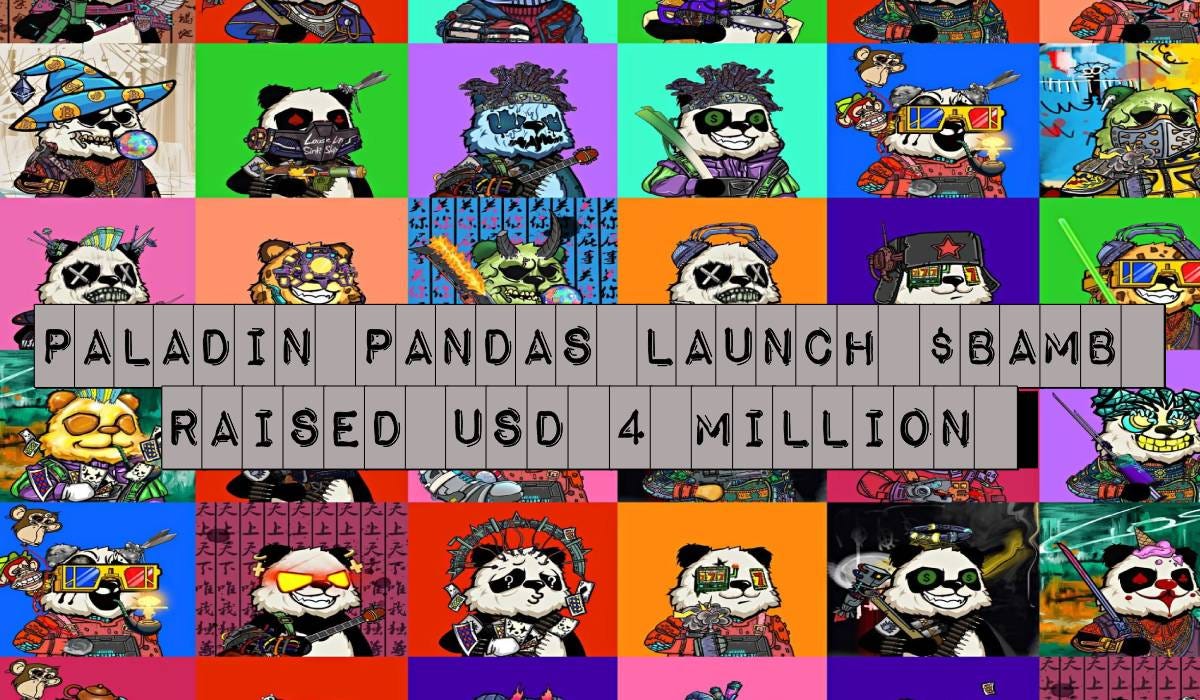
OHDAT-affiliated NFT Game Project Paladin Pandas launched their ERC-20 Token $BAMB on the Ethereum chain on April 6th 2022. This established Paladin Pandas as one of the first NFT projects that has completed both the launch of their play-to-earn game and their token.
A hand-drawn 10K NFT collection launched on Opensea on September 28th 2021, Paladin Pandas sold out in 32 minutes. It was ranked №6 on the daily volume leaderboard, №13 on the weekly volume leaderboard and featured on the OpenSea homepage.
NFT whale owners including influencer and top collector, Zeneca_33, COLE, co-founder of Pudgy Penguins, and NFT influencers Josh Ong and NFT Girl, as well as crypto artist JN Silva, all added Paladin Pandas to their collection.
This led to recognition from established VCs and other institutions and angel investors and OHDAT raised funding totalling US$4M from Future Capital, Hashkey Capital, Innoangel, Y2Z Capital, Vincent Niu, the founder of Sky9 Capital and Mandy Wang, the founder of Odaily. The funds raised were to go towards launching new projects and implementing the Open World social simulation game and MMORPG game, highlighted on their Roadmap 2.0.
On January 25th, Paladin Pandas launched ‘PvE game Space Expedition’, where players send their Pandas to planets on an expedition (with 15 stages each) while strategically putting the Pandas into teams of 3 to retrieve the lost $BAMB (Bamboonium) through battles and mini-games. Since categories like element, class, weapon all matter in the gameplay, players need to select the right pandas to buy and be sent to battle, involving strategy gameplay.
All $BAMB earned from the PvE game is locked in the players’ $BAMB balance, to be unlocked and claimable at a weekly rate of 15%. The lockup can be lifted if players manage to get on the PvP daily/weekly leaderboard.
On March 9th, PvP: ‘Panda v. Panda’ open demo was officially released, a 1V1 3D combat game for true gamers. Players pay $BAMB to enter the arena and loot more $BAMB from other players. With 48 weapons, 7 basic moves and 21 stages, the gameplay is not limited to a ‘Stake-to-Earn’ mechanism; it is an actual ‘Play-to-Earn’ NFT game with delightful strategy gaming, which is a stab at revolutionizing NFT gaming. Up to now, which can be quite monotonous when the focus is only on the earnings. The PvP open demo initiated the “Clean the rugs’ campaign and airdropped 40K $BAMB tokens to the gamefi project holdlers.
Giving perks to all NFT holders was taken into account when devising the Paladin Pandas ecosystem. Mandatory to use a Paladin Panda to enter the game, so as to extend the user base to more NFT gamers, non-holders can also rent Pandas by paying $BAMB. The rental limit for each Panda is 2x for PvE and 3x for PvP.
Besides being an in-game currency, $BAMB has several utilities. First, $BAMB can be staked along with LP tokens to mine 5% of the overall supply, a total of 25M $BAMB. Second, $BAMB can be swapped to Power Raffle tickets, which is a WEB3 raffle machine to win blue chip NFT projects with minimum entry fees. Third, $BAMB holders are able to access exclusive online store merchandise, in-game marketplace boosts, and also the whitelist marketplace to consume their tokens.
To celebrate the $BAMB launch, the OHDAT team will incentivize Panda owners with 2 airdrops. First, 60 Rent Tickets will be dropped to 30K new addresses for mining the game, for their first run. Second, 1.5% of the overall supply, totaling 7.5M $BAMB will be airdropped to all Panda holders. Prioritizing fun gaming features, Paladin Pandas aims for $BAMB to be a “blue chip token” in the NFT market over the long term.