2

Blog

  • Ransomware is a scourge, but eliminating cryptocurrencies won’t make it go away

    Ransomware is a scourge, but eliminating cryptocurrencies won’t make it go away

    [ad_1]

    By Philip Martin, Chief Security Officer, Coinbase

    The recent high profile ransomware attacks on Colonial Pipeline and food processing giant JBS have led to knee jerk calls to ban cryptocurrencies because the attackers demanded to be paid in Bitcoin. But if cryptocurrency went away tomorrow would ransomware end? In a word, no. Ransomware existed before cryptocurrency was popular and, if cryptocurrency was outlawed tomorrow, criminals would simply seek alternative payment methods, of which there are many.

    The rise of ransomware has been horrible to behold. It is one of the rare online crimes where the impact is felt broadly by everyone. Hospitals unable to service patients. Local governments unable to support citizens. Workers losing jobs because their employers go bankrupt.

    But blaming crypto for ransomware is like holding email accountable for ransomware because that’s a vector criminals use to infect victims. Neither are the cause of ransomware. What we need to eradicate this scourge is a more nuanced, multi-pronged strategy that gets to the root cause of the problem.

    Why it’s getting worse

    The growth of ransomware can be attributed to the rate at which companies are shifting critical systems online and the poor level of controls many companies have over their IT systems. When you couple those factors with ransomware gangs operating from foreign jurisdictions with relative impunity and little ability for law enforcement to drive an international response, you get a recipe for trouble.

    This has led some pundits to throw up their hands and conclude the only way to fight back is to ban cryptocurrencies. But if cryptocurrencies are banned, attackers will simply fall back to traditional money laundering methods like prepaid gift cards, money-mules, bulk cash smuggling, funnel accounts or requiring air-dropped cash payments.

    What’s more, there are many reasons cryptocurrency is good for law enforcement. Talk to law enforcement agents and those prosecuting crimes like this and they’ll tell you that cryptocurrencies are much easier to track than traditional, harder to trace forms of payment, such as cash.

    In the world of Bitcoin, while you might not be able to immediately attach a name to a transfer, the whole history of transfers, for every address on the cryptocurrency network, is preserved forever and accessible to all. Law enforcement can use these “digital breadcrumbs” to track spending patterns. Where that cryptocurrency touches an exchange like Coinbase, which collects KYC (Know Your Customer) data for customers, a subpoena or a warrant will get them a real-world identity. That stands in stark contrast to traditional money laundering using cash or commodities.

    What we should be doing

    If banning use of cryptocurrency isn’t the answer, what is?

    1. Increase global law enforcement focus on ransomware and aggressively prosecute criminals — in the US or overseas — to create a real disincentive for criminals to use ransomware. The creation of a Ransomware and Digital Extortion Task Force by the DOJ was a positive step forward, but genuine investment in prosecutorial resources and continued engagement with our international partners will be key in the fight to ensure there are no safe haven countries for criminals.
    2. In the wake of the Enron scandal, Congress created incentives for public companies to clean up financial controls and reporting via the Sarbanes-Oxley Act. Earlier this year Congress passed the Anti-Money Laundering Act, setting a framework for financial institutions to modernize their technology and improve the sharing of information to combat money laundering and terrorist financing. Congress must play a similar role in creating minimum standards for corporate security reporting and transparency, creating accountability for malfeasance and creating safe harbors for cooperation and information sharing among companies.
    3. Ensure common sense, existing regulations are applied evenly so that certain exchanges aren’t allowed to use jurisdictional arbitrage to avoid implementing KYC/AML programs. Research shows that the majority of illicit Bitcoin flows through a small group of exchanges. Law enforcement and regulators could curb the flow of ransomware-proceeds by enforcing existing regulations on these venues.

    That will take time, of course, so in the meantime companies in the trenches should actively review their own security posture and figure out if and how they could recover if attacked. Most companies have backup policies, but few organizations have restore policies or regularly test their ability to restore in a real-world scenario.

    Ransomware isn’t going away even if cryptocurrencies are banned. So don’t be tempted by the “easy answer” given it isn’t really an answer at all. Let’s take the bull by the horns and focus on the hard work of putting ransomware in its place.

    This piece originally appeared in Morning Consult.


    Ransomware is a scourge, but eliminating cryptocurrencies won’t make it go away was originally published in The Coinbase Blog on Medium, where people are continuing the conversation by highlighting and responding to this story.

    [ad_2]

    Source link

  • Crypto Ban Is Finally Lifted in Vanuatu after Lobbying Efforts of Lawyers

    Crypto Ban Is Finally Lifted in Vanuatu after Lobbying Efforts of Lawyers

    [ad_1]

    Tal Itzhak Ron

    For a very long time Vanuatu, always the most popular offshore licensing jurisdiction for self-regulated FX/CFD operations, disapproved dealing with Cryptocurrencies in all forms for its VFSC licenses, to the extent that if a small reference to crypto was made on the licensee’s website, regardless whether as a means for payment, a traded commodity or a CFD, the license could have been revoked and the 50K$ bond forfeited. Seemingly all of it is about to change.

    We sat down with Advocate & Notary Tal Itzhak Ron, Chairman and CEO, and Advocate Genia Gurevitz, Head of Banking and Payments Services, from leading legal and banking firm, Tal Ron, Drihem & Co. to shed some light on what measures are taking effect in Vanuatu this week, and if there is anything groundbreaking about it (Hint: There is, indeed, and Finance Magnates are the first to reveal it!).

    Tal explains that as of July 22nd, the amendment to the Financial Dealers Licensing Act, without any preliminary announcement, surprisingly went into effect which allows the “distribution, secondary trading, custodial storage and provision of investment advice or other services in relation to digital assets.” This comes after years that any engagement with cryptocurrencies would be restricted and seen as illegal by the regulators in Vanuatu, making anyone who wished to deal with Crypto go other ways.

    Suggested articles

    Axia Investments – Take Your Trading to the Next LevelGo to article >>

    Tal Ron, Drihem & Co., Law Firm lobbied massively for that change to happen, prepared for the announcement, and built the payments infrastructure 1.5 years in advance to facilitate the needs of those wishing to enrich their services offered and give their business a competitive edge, Genia continues. This amendment placed Vanuatu in the major league, with other, more established, jurisdictions that Tal Ron, Drihem & Co. have already been using since 2017 to represent clients in issuing coins and engage with other blockchain crypto activities, such as Gibraltar, Switzerland, Singapore, Malta, and Estonia. The amendment seeks to expand the possibilities for already-licensed companies in Vanuatu (for which Tal and Genia’s firm are responsible for a large percentage of those), as well as to attract new digital asset companies for which the most important part is to know how to bank them properly and protect their interests while staying fully compliant and socially responsible.

    Genia Gurevitz

    The novelty about the new legislation is not about brokers being able to use Crypto deposits or trade or offer Crypto for themselves or at their business, which is great in itself, but now they are finally able, if play their card right and found adequate, to open a bank account in exceptional brick-and-mortar banks such as Bank Frick in Liechtenstein, which our firm partners with, Genia explains.

    Genia discloses that this type of legislation is similar to what they have already dealt with in the past in Gibraltar, one that effectively allows (or does not prevent) crypto-entrepreneurs to launch their own digital currencies. Therefore, Tal’s team has already gathered the knowledge and infrastructure to facilitate the growing demand for Vanuatu companies from all aspects and built a complex network of payment companies accepting the Vanuatu license, thus allowing companies regulated there to issue coins and collect payments, aside of operating FX sites.


    [ad_2]

    Source link
  • Bitcoin Surges To $40K, Why BTC Could Rally Further

    Bitcoin Surges To $40K, Why BTC Could Rally Further

    [ad_1]

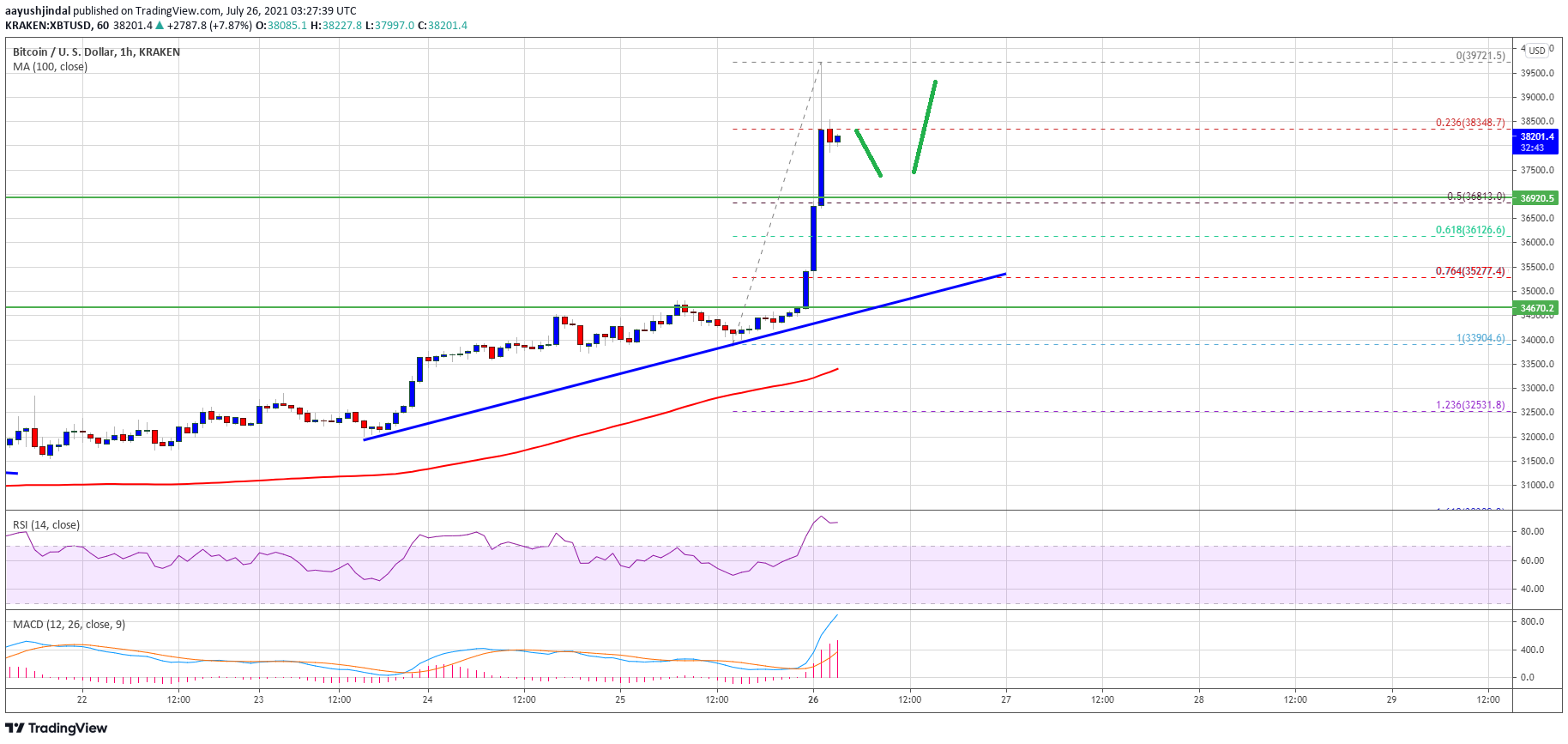
    Bitcoin price started a strong upward move above the $35,000 resistance against the US Dollar. BTC is showing positive signs and it could rally further above $40,000.

    • Bitcoin started a strong increase above the $33,000 and $35,000 resistance levels.
    • The price is now trading well above $35,000 and the 100 hourly simple moving average.
    • There is a key bullish trend line forming with support near $35,500 with resistance near $31,250 on the hourly chart of the BTC/USD pair (data feed from Kraken).
    • The pair could correct gains, but the bulls are likely to remain active near $37,000.

    Bitcoin Price Surges above $38,000

    Bitcoin price found a strong buying interest near the $32,000 zone. BTC formed a support base near the $32,000 and it started a major upward move.

    The price surged above the $32,000 and $35,500 resistance levels. There was a clear break above the $38,000 resistance level. The upward move gained strength and the price even traded close to the $40,000 resistance zone.

    A high was formed near $39,721 and the price is now correcting gains. It is trading near the 23.6% Fib retracement level of the recent rally from the $33,904 swing low to $39,723 high. Bitcoin is now trading well above $35,000 and the 100 hourly simple moving average.

    There is also a key bullish trend line forming with support near $35,500 with resistance near $31,250 on the hourly chart of the BTC/USD pair. It is showing a lot of positive signs near the $38,000 level. On the upside, an initial resistance is near the $39,000 level.

    Bitcoin Price

    Source: BTCUSD on TradingView.com

    The first major resistance is near the $39,500 level. The main resistance sits near $40,000. A successful break and close above the $40,000 level could initiate a fresh rally in the near term. In the stated case, the price is likely to move towards the $42,500 level in the near term.

    Dip Supported in BTC?

    If bitcoin fails to climb above the $39,500 and $40,000 resistance levels, it could start a downside correction. An initial support on the downside is near the $37,500 level.

    The first major support is now near the $36,800 zone. A clear downside break below the $36,800 support may possibly push the price towards the $36,000 support zone in the near term.

    Technical indicators:

    Hourly MACD – The MACD is now losing pace in the bullish zone.

    Hourly RSI (Relative Strength Index) – The RSI for BTC/USD is now well in the overbought zone.

    Major Support Levels – $37,500, followed by $36,800.

    Major Resistance Levels – $39,000, $39,500 and $40,000.

    [ad_2]

    Source link
  • Countries representing over 90% of global GDP are exploring CBDCs

    Countries representing over 90% of global GDP are exploring CBDCs

    [ad_1]

    The quest to understand the opportunities and challenges of a central bank digital currency, or CBDC, is underway in 81 countries, with five nations fully implementing a digital version of their currency, according to a new tracker from the Atlantic Council. 

    The Caribbean region is home to all five CBDCs that are currently in use, with The Bahamas, Saint Kitts and Nevis, Antigua and Barbuda, Saint Lucia and Grenada all implementing their digital cash systems.

    CBDCs are in their pilot stage in 14 other countries, including South Korea and Sweden, the tracker shows.

    Established in 1961, the Atlantic Council describes itself as a nonpartisan organization that seeks to promote U.S. leadership on various world issues. The CBDC tracker, which was unveiled July 22, currently monitors 83 countries and currency unions.

    Among the countries with the four largest central banks — United States Federal Reserve, European Central Bank, Bank of Japan and Bank of England — the U.S. is furthest behind in terms of CBDC development.

    Related: Reserve Bank of India mulls first steps toward an eventual CBDC

    The Federal Reserve has been researching CBDCs for several years now, with Chairman Jerome Powell indicating in January that digital-dollar development is a “very high priority” to combat financial crime. Meanwhile, New York Fed Bank President John Williams believes that the emergence of cryptocurrencies raises challenging questions for central banks.

    Related: Fed and Yale researchers lay out 2 regulatory frameworks for stablecoins

    China recently indicated that foreign visitors will be allowed to use the digital yuan during the 2022 Winter Olympics — provided they share their passport information with the central bank. A group of U.S. senators that includes Bitcoin proponent (BTC) Cynthia Lummis has urged American Olympians to boycott the digital yuan. According to the South China Morning Post, Beijing responded by telling the U.S. senators to “stop making trouble.”

    The People’s Bank of China claims that nearly 21 million people have already opened a virtual wallet for the purpose of using the digital yuan.