2

Blog

  • DeFi’s potential means more institutional demand for next-gen tokens | by Bit Media Buzz | Sep, 2021

    DeFi’s potential means more institutional demand for next-gen tokens | by Bit Media Buzz | Sep, 2021

    [ad_1]

    Bit Media Buzz

    Ether’s impressive YTD gains have largely been overshadowed by the profits accrued by other smart contract-enabled projects.

    There’s no denying that the last couple of years have seen the altcoin sector blossom and have a major impact on the crypto market at large. In fact, a quick look at data available on Google Trends shows us that searches related to the term “Ethereum killer” have been soaring over the past 90-days, signaling a growing interest among investors in various altcoins.

    In this regard, a few cryptocurrencies — such as Cardano (ADA), Solana (SOL), Polkadot’s DOT and Terra (LUNA) — have made a major market push recently. SOL, in particular, has been turning a lot of heads among investors, thanks in large part to its most recent rally, which saw the cryptocurrency surge despite the market experiencing a massive selloff.

    In addition, there are several other networks that have shown a lot of promise. For example, following the completion of its much-hyped Alonzo hard fork, Cardano, too, has been able to record substantial profits, posting numbers of +70% and +1,200% over the last 90 and 180 days, respectively.

    To gain a better idea of what the aforementioned developments mean for the market at large, Cointelegraph reached out to Antoni Trenchev, managing partner and co-founder of lending platform Nexo. In his view, there is growing institutional demand for coins such as Solana’s SOL and Terra’s LUNA, something that is made evident by the fact that both assets have been able to make their way into the list of top 15 cryptocurrencies by total market capitalization. Trenchev told Cointelegraph:

    “This is a reflection of companies going deeper into crypto. Over the first two months of 2021, major institutions like BlackRock, Square and MicroStrategy were only just dipping their toes into Bitcoin. Now they’ve tasted its benefits and are looking to harness the untapped potential of up-and-coming blockchains and DeFi coins that could yield higher returns.”

    Trenchev highlighted that such developments suggest that the crypto market may currently be in the midst of an alt-season; however, what’s different this time around is that established coins such as ETH and Bitcoin (BTC) are showing a higher level of stability in comparison to some of these newer assets. “Think of the current situation as alt season meets institutional interest, and yes, I think we will see more and more trends like this in the future,” he said.

    The stability these institutions bring became fairly evident on Sept. 16 when Solana experienced a major outage wherein instead of going into a panic-induced sell frenzy, SOL barely lost any of its value, dropping less than 10%.

    Earlier this month, institutional traders flocked to Solana as demand for Ether and Bitcoin (BTC) exposure seemed to plateau. In this regard, over the first week of September, SOL-centric investment products represented a whopping 86.6% of the total weekly inflows into the crypto investment market.

    More specifically, per data made available by digital asset management firm CoinShares recently, SOL’s combined investment products witnessed inflows in excess of $49.4 million between Sept. 6 and 10. Not only that, for the week, SOL saw a 275% week-over-week increase in its value, representing 86.6% of total capital inflow into the crypto investment sector.

    Lastly, other digital asset products have also continued to see major cash inflows for the fourth consecutive week, with demand for different altcoins quite easily exceeding that of BTC products, with the latter only witnessing minimal inflows of $200,000. For example, it is worth highlighting that during the first half of September, multi-asset products, XRP, Polkadot’s DOT and Bitcoin Cash (BCH) were able to register sizable financial inflows of fa$3.2 million, $3.1 million, $1.7 million and $600,000, respectively.

    Kadan Stadelmann, chief technical officer of end-to-end blockchain infrastructure solutions provider Komodo, told Cointelegraph that rising demand for undiscovered projects is nothing new for the crypto market. However, what separates this time from previous cycles is the sheer amount of capital flowing in from institutions. He said:

    “The risk is that this will lead to faster market cycles for specific cryptocurrencies that are outliers from overall market movements. We see extreme FOMO and price increases, followed by a large sell-off and price declines. With SOL, in particular, prices are down 20% this week. That doesn’t mean it won’t quickly return back to its all-time high. It’s just that people who are new to crypto should be aware that volatility is par for the course.”

    Lastly, echoing Trenchev’s view, Stadelmann believes that as we move into an increasingly decentralized future, it will become more common to see a sharp increase in the price of different altcoins. “Hundreds of DeFi projects are flying under the radar. Many of these projects have solid technology and can gain upward price momentum once institutions recognize their potential,” he said.

    One of the core reasons underlying the rise of many of the above-stated altcoins has been the lack of scalability offered by the Ethereum network. In this regard, despite all of its recent highly touted functional updates, the platform is only able to process around 15–25 transactions per second in its current state — all while offering an extremely low throughput capacity.

    Not only that, even though the recently concluded London hard fork was designed to help regulate Ether’s rising gas fees — after rates rose as high as $40 and $70 earlier this year during Q1 and Q2, respectively — the figure still seems to be hovering around the $15–$20 range, which is quite high for the average Ethereum customer.

    Furthermore, during peak traffic hours, minting a nonfungible token (NFT) on the Ethereum network can cost up to 3 ETH, which, in many cases, may actually work out to a price point that is more than the actual NFT itself. On the other hand, Solana, as well as many other projects, not only offer faster transaction speeds but far lower gas prices, allowing for the more economical issuance of NFTs.

    With Ethereum gearing up to make its transition to a proof-of-stake framework, it is expected that once the move is finally done, the platform will be able to process up to 100,000 transactions per second. However, until that day comes, it looks as though a growing list of smart contract-enabled platforms may continue to eat into Ethereum’s mammoth market share.

    Ethereum’s most recent overhaul, the all-important London hard fork — which incidentally contained crucial updates such as the Ethereum Improvement Proposal 1559 — was supposed to deploy a new transaction pricing mechanism for the network, resulting in the ecosystem becoming deflationary in nature.

    Available data suggests that over 336,000 ETH tokens have already been burned, with the current burn rate currently sitting at 4.9 ETH per second or about 2.7 million ETH tokens per year, which would basically take the project’s yearly supply growth rate to 2.3% while taking its issuance to around 5.3 million tokens per annum.

    Moreover, Ethereum is not the only project to make use of such a deflationary setup, since Solana is also known to burn 50% of its transaction fees to regulate the supply of its native SOL token. Khalid Howladar, chairman of MRHB DeFi — a Shariah-compliant decentralized finance (DeFi) platform — told Cointelegraph:

    “While it’s clear that Ethereum is the current smart contract backbone of the DeFi ecosystem, Solana is emerging as a solid competitor with potentially more upside to come. Key factors such as cost and speed mean that Solana has become a solid challenger to Ethereum’s position both within the realm of programmable money (DeFi) and programmable media (NFTs).”

    In Howladar’s view, institutions are only just getting their toes wet when it comes to DeFi, and therefore, the next few months could be extremely interesting in terms of how they become further involved. “If DeFi platforms can somehow ensure basic things like consumer protection using decentralized KYC and AML, they will take vast chunks out of banks’ market share, especially as peer-to-peer economic systems take hold,” he said.

    Moving forward, it will be interesting to see whether Ethereum is able to maintain its current dominance levels, especially as a growing list of smart contract-enabled alternatives continues to garner mainstream market traction.

    Source

    [ad_2]

    Source link

  • How SEC Chair Gary Gensler’s Views on Crypto Have Changed Since His MIT Days

    How SEC Chair Gary Gensler’s Views on Crypto Have Changed Since His MIT Days

    [ad_1]

    Nik De, managing editor for global policy and regulation at CoinDesk, stops by Unconfirmed to discuss the current state of crypto regulation, including recent comments by SEC Chair Gary Gensler on stablecoins and why Coinbase decided to sideline its Lend product. Highlights:

    • Nik’s biggest takeaway from Gary Gensler’s interview with the Washington Post 
    • why Nik thinks Gensler has escalated his rhetoric regarding stablecoins and DeFi 
    • how crypto exchanges are currently regulated and how that might change
    • what it would take to convince crypto exchanges to register with the SEC
    • whether the SEC has the purview to regulate stablecoins
    • Nik’s thoughts on Coinbase’s Lend product and the SEC’s stance on lending products
    • what the overall picture of crypto lending is in the US
    • whether the SEC will go after DeFi protocols
    • what to expect from the SEC going forward, especially with the end of its fiscal year coming up next week

    Thank you to our sponsors!

    Crypto.com: https://crypto.onelink.me/J9Lg/unconfirmedcardearnfeb2021      

    Digital Asset Research: https://digitalassetresearch.com   

    Sorare: https://sorare.com       

    Episode Links

    Nikhilesh De

    Content

    • Coinbase blogs regarding Lend
    • SEC Chair Gary Gensler Washington Post Q&A
    • Brian Armstrong tweet storm
    • BlockFi and Celsius overview

    Read my latest Medium post, “The Reason Crypto Regulation Is Turning Out to Be So Difficult,” which takes take a deeper dive into some of the topics addressed in this pod 🙂


    [ad_2]

    Source link

  • September Leaves Behind Trail Of Blood, Bitcoin Long Liquidations

    September Leaves Behind Trail Of Blood, Bitcoin Long Liquidations

    [ad_1]

    After what looked to be a month of prosperity following the August bull run, Bitcoin has now entered into an era of increasingly bearish signals. The asset had seen a number of rallies that pushed it over two-month highs, successfully breaking above the $52K resistance range on a number of occasions. Throwing the entire market into a stretched-out period of positive sentiment.

    September has now come with its own unique set of problems for the digital asset. Bitcoin price has been suffering since the beginning of the month, ushered in with a flash crash that rocked the market only a week into September. The market continues to suffer from the aftershock of this flash crash, which has left a trail of blood in the market, and led to massive liquidations.

    Related Reading | Just 10 Days After El Salvador’s “Bitcoin Day”, President Bukele Confirms 1.1 Million Citizens Have Chivo Wallet

    Bitcoin Price Crash Leads To Sell-Offs

    In only a matter of days, the price of bitcoin has fallen from $47,000 to $40,000, which triggered liquidations in the market. The long liquidations totaled up to the tune of $860 million across exchanges. The liquidations took place over two days when the price of the digital asset had inevitably fallen to $40,000 on Tuesday, September 21st. Although significant, the liquidations, which were spread across two days, still sat below the sell-offs seen following the September 7th crash.

    Related Reading | Did Bitcoin Really Experience A Flash Crash Down To $5,400?

    Monday marked the beginning of the liquidations as the market saw $470 million long positions liquidated. And the following Tuesday, a total of $390 million long positions were liquidated as well. At this point, the price of bitcoin had hit levels not seen since mid-August. And as market sentiment shifted into the negative, the price continued to plunge.

    Chart showing bitcoin long liquidations

    BTC longs liquated on Monday and Tuesday add up to $860 million | Source: Arcane Research

    Current sell-off volumes have remained beneath the $1.2 billion sell-off in early September, suggesting that this current sell-off is more organic than previous ones. Also, it shows that the current market is more influenced by spot activity compared to the derivatives market.

    September And Its Chokehold On The Market

    September has historically come with challenges for the crypto market. So the crash that rocked bitcoin and the entire market at the beginning of the month is on-brand. Crashes with at least a 17% value loss have happened in September for the past four years and it looks like 2021 has fallen in line with this trend.

    However, the end of September has always come with better forecasts for the following month. Chart analysis show crashes in the month precede recoveries that put the market on course to regain its lost value. Setting the market up for another bull run.

    Bitcoin price chart from TradingView.com

    BTC price trading north of $43K | Source: BTCUSD on TradingView.com

    The price of BTC has now recovered above its Tuesday’s lows, which saw the digital asset plunge below $40K. Bitcoin is currently trading above $42,000 at the time of writing. While the total market cap has fallen below $800 billion.

    Featured image from Bitcoin News, charts from Arcane Research and TradingView.com

    [ad_2]

    Source link

  • How crypto enables economic freedom

    How crypto enables economic freedom

    [ad_1]

    The following is an internal memo that I shared with Coinbase employees this week and would also like to share publicly to help people see how we’re working toward our mission of increasing economic freedom in the world.

    Tl;dr: Our core thesis is that greater adoption and usage of cryptocurrency will increase economic freedom in the world, because crypto solves many of the shortcomings of the current financial system that hinder economic freedom.

    Team,

    Every quarter at our company All Hands, we review our Mission (what we’re trying to achieve) and our Strategy (how we’re going to get there). One question I often hear from employees is: “How does cryptocurrency create more economic freedom in the world?” This is a great question, so I wanted to share my thoughts with all of you.

    First, a refresher: Economic freedom is a composite measure of 12 factors. It quantifies the rights of people to control their own labor and property in each country and globally. Economic freedom varies dramatically across the world, and while our economy is increasingly global, the government of any single country has significant control over the financial and economic freedoms of its people. Low economic freedom in a given country isn’t always due to malicious activity (e.g, fraud, oppression, etc) — it’s often due to mismanagement (poor monetary and fiscal policy) or simply bad infrastructure.

    Crypto and economic freedom

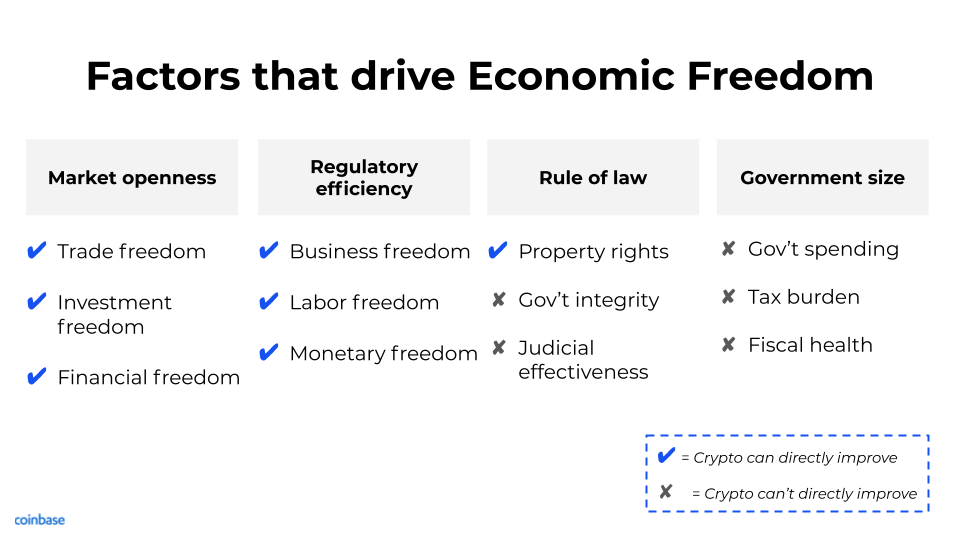
    The question to ask is: How can we build a global economy where anyone with an internet connection can participate, where property rights are enforced, and where money preserves its value? Crypto is the solution. Crypto can’t directly improve every facet of economic freedom (e.g., tax policies and government spending), but it can improve most of the underlying drivers (see below).

    Read more about each of the factors here.

    Why is crypto so uniquely positioned to increase economic freedom? Because it has these inherent properties:

    Crypto is an open, global network

    Crypto networks are open, removing the barriers of borders. It allows every person in the world to transact on shared networks, in the same way they communicate on a shared network (the internet). More importantly these networks themselves are not controlled by governments that can use their monetary systems to hinder economic freedom (and prosperity). This design principle leads to more open markets and increases trade freedom, investment freedom, financial freedom, and monetary freedom.

    Crypto enforces property rights

    Property rights allow people to save their income, grow their wealth, and plan for the long term because they know the fruits of their labor are safe from unfair seizure or theft. Before crypto, your confidence in property rights was a function of the trust you had in your government and its respect for the rule of law. With crypto, anyone can acquire and grow their wealth without intervention from trusted 3rd parties like a government or a bank, or fear that their wealth could easily be seized. Property rights are also about the ability to enter contractual agreements. In some areas around the world, a contract has little value, because you can’t be confident in its enforcement. Smart contracts move enforcement from the courts to the blockchain, enabling gains from specialization and commercial exchange.

    Crypto is unbiased

    Crypto networks are often pseudonymous (or even anonymous). They don’t care where you live, what your race or gender is, or who you voted for in the last election. Unlike the current financial system they are inherently open and unbiased. Anyone with an internet connection can create a wallet, get paid in crypto, spend in crypto and accrue wealth in crypto. Service providers like Coinbase do have compliance programs as required by law, but we don’t control access to all crypto and we don’t own the network. Anyone can access crypto networks through other providers if we make a bad decision, or are forced into bad regulation. In addition, self custody wallets like Coinbase Wallet provide an ever greater degree of freedom when it comes to financial inclusion.

    Crypto enables mobility

    As I mentioned above, there are important components of economic freedom that cryptocurrency can’t directly benefit (e.g., government integrity, tax policies, fiscal health, etc.). However, cryptocurrency does provide the conditions for mobility by reducing switching costs, allowing people to both accrue wealth and bring it across borders. Cryptocurrency is the ultimate embodiment of the power of the individual, by significantly reducing the barriers to emigration / exit, and thus increasing economic freedom.

    Conclusion

    As you can see, cryptocurrency can impact many of the factors that lead to more economic freedom. It can both help build better-functioning economies in countries with less economic freedom, and make it easier to emigrate to a better life. This is why our core thesis as a company is that greater adoption and usage of cryptocurrency will increase economic freedom in the world.

    Technology is the longest lever we can pull to improve the human condition. At its core, cryptocurrency is a technology breakthrough that allows us to build a more free and open financial system that enables the rights of people to control their own labor and property. It is the best tool that exists to advance our mission of increasing economic freedom in the world.

    What does this mean for Coinbase? Crypto is in many ways still nascent. It’s still hard to use, crypto networks are plagued with scaling challenges, and the economy built on top of crypto infrastructure is in its early days. Our strategy and roadmap is geared towards solving these challenges: We’re focused on building easy-to-use products that abstract away the complexity of blockchains, and we’re building the primitives of a functioning financial system. We still have a long way to go, but the future is bright.


    How crypto enables economic freedom was originally published in The Coinbase Blog on Medium, where people are continuing the conversation by highlighting and responding to this story.

    [ad_2]

    Source link

  • Liti Capital Launches ScamBusters to tackle Crypto Fraud | by Bit Media Buzz | Sep, 2021

    Liti Capital Launches ScamBusters to tackle Crypto Fraud | by Bit Media Buzz | Sep, 2021

    [ad_1]

    Bit Media Buzz

    Devoted to fighting fraud

    Fraud within cryptocurrency and blockchain is rife. This year will be a record for investment fraud: 14,079 investment scams were reported to the FTC in the first quarter of 2021, and victims lost $215 million in this quarter alone. Liti Capital is bringing its expertise in picking, funding and winning court cases and inviting consumers to vote on which scams it should pursue in court next.

    “The idea that scammers can freely operate in the crypto sphere without facing the consequences of their actions must end to bring trust and change the perception blockchain and crypto projects have in our society”, says Andy Christen, CVO/COO at Liti Capital.

    Liti Capital commits to allocating between 5% and 10% of its yearly investment budget to finance cases that have affected its community members. Any LITI or wLITI token holder can report a purported fraud to the company.

    How ScamBusters works

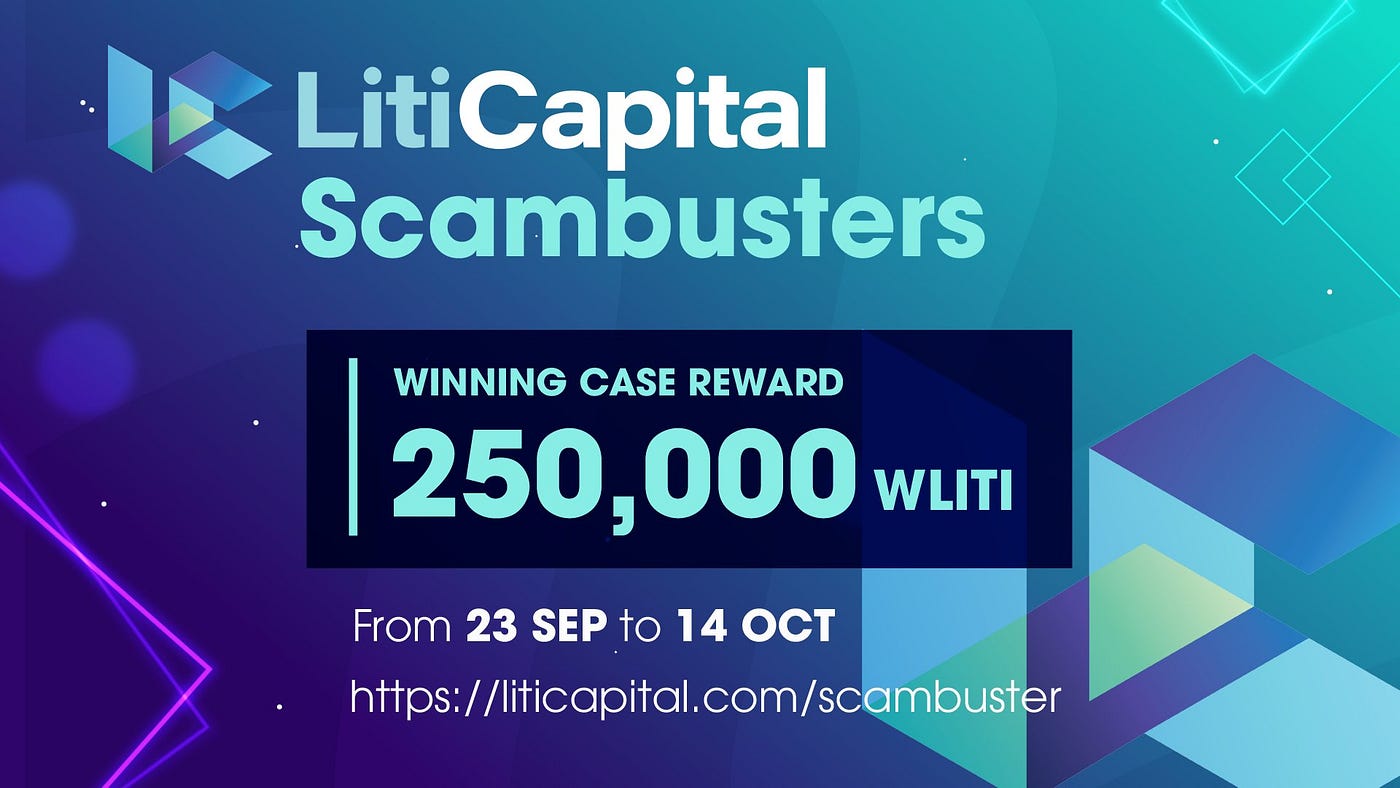
    ScamBusters is a community voting event to select which crypto scam cases Liti Capital will sue. LITI and wLITI token holders can use their tokens without spending them to vote for the case(s) they think have the most merit. The more tokens they have, the more voting power they can exercise. Voters of the winning case will share an award up to 250,000 wLITI, distributed pro-rata to their votes.

    Once members of the community have submitted cases on the ScamBusters website, Liti Capital instructs its team of legal experts based in 140 countries across the world to explore details of the case.

    A selection of cases are then presented back to community members, with the case collecting the highest number of votes being added to Liti Capital’s portfolio. Community voting begins on September 23, 2021, with the first winning case announced on October 15, 2021.

    “If cryptocurrency is going to become the de facto way people take part in the Web3 world, trust, regulation and a robust legal system are all parts of that puzzle,” says Jonas Rey, CEO at Liti Capital.

    About Liti Capital

    Liti Capital is bringing the litigation asset class to everyone through Blockchain technology with LITI tokens, an equity token that is a share of stock in Liti Capital SA. The launch of LITI and wLITI tokens allows any investor to engage in the high-performing litigation finance market previously only available to elite investors.

    For project information, please read the Whitepaper.

    For token distribution, please read Tokenomics.

    Liti Capital Official Channels

    Liti Capital Website: https://liticapital.com

    Liti Capital Telegram: https://t.me/Liti_Capital_Official

    Liti Capital Telegram Announcements: https://t.me/Liti_Capital_Official_ANN

    Liti Capital LinkedIn: https://www.linkedin.com/company/liti-capital

    Liti Capital Twitter: https://twitter.com/liticapital

    Liti Capital Medium: https://medium.com/@liticapital

    Liti Capital Reddit: https://www.reddit.com/r/liticapital

    Binance Claim: https://binanceclaim.com


    [ad_2]

    Source link

  • New decentralized stablecoin in China targets international trade

    New decentralized stablecoin in China targets international trade

    [ad_1]

    As financial authorities around the globe become increasingly concerned about stablecoin regulation, a jurisdiction in China is preparing to pilot a new yuan-pegged stablecoin for international trade.

    Chris Banbury, head of global operations at permissionless blockchain project Conflux, told Cointelegraph on Sept. 21 that the firm will provide its technology to launch an offshore renminbi (RMB) stablecoin pegged to China’s central bank digital currency (CBDC), the digital yuan.

    “This is going to be pegged to the digital yuan in price only with no formal integration,” Banbury noted, adding that the project will be exploring how the token trades against other currencies.

    The new stablecoin project will facilitate international trade in Shanghai’s Lin-gang Special Area after the Chinese government granted the free economic zone permission to explore free trade with an offshore RMB stablecoin in July.

    “While the use case for the offshore RMB stablecoin has been approved by the government of China and Shanghai, the pilot program is not endorsed by or connected with the government,” Banbury noted.

    In contrast to popular stablecoins like Tether (USDT) and USD Coin (USDC), the upcoming offshore RMB stablecoin will not be a private stablecoin because it is fully decentralized, Banbury said. The executive said that the new stablecoin is called the “offshore RMB stablecoin” because its functionality will be limited to global trading:

    “The term ‘offshore’ refers to the RMB’s use for international trading purposes — not domestic trading. The digital yuan is used exclusively for domestic purposes. As such, the offshore RMB is not an ‘offshore yuan.’ The digital yuan is for domestic purposes overseen by the People’s Bank of China.”

    Related: Chinese banks explore e-yuan for selling investment funds and insurance

    According to Banbury, the offshore RMB stablecoin is being held through the Shanghai ShuTu Blockchain Research Institute, a branch of the Conflux Tree-Graph Institute for blockchain research and development. The stablecoin has not yet received a dedicated ticker as the development team is still determining when to launch, he added.

    One of the world’s first nations to debut a CBDC, China has continued to crack down on cryptocurrency trading and mining, with local authorities shutting down multiple mining farms and suspending crypto trading transactions this year.