In a world where money is power, power is centralized in the hands of those who control money. Dependent on them, the people of the world suffer, slowly watching their financial opportunities vanish. If individuals are to determine their own financial futures – and thus their lives – power must be decentralized and returned to them.
Failures of Fintech and Traditional Finance
In a panic to uphold their economies, world governments printed tens of trillions of dollars during the COVID-19 pandemic, consequently diluting the buying power of citizens globally. Now, inflation is on the rise – 6.8% in the United States, 4.48% in India, and 3.8% in the UK. World governments have made it very clear that they can print as much money as they like, regardless of the cost. People are tired of their fates being dependent on the state’s policies – money printing, bank bailouts, trade wars, and business subsidies – policies that rob them of financial opportunities.
Fintech does as much to reduce access to financial services as it does to increase it. Inhumane automated systems determine insurance rates, big players on Wall Street manipulate the markets, financial institutions harvest people for their data, and governments take a piece of every dollar that citizens earn before they’re even paid.
But that’s only for those lucky enough to have access to financial services in the first place. While bank accounts and loans are common in Western countries, many people have no financial access at all. To the unbanked, college loans, homeownership, insurance coverage, investing opportunities, and stable pay are all unfamiliar privileges.
A New Financial System
DeFi stands for Decentralized Finance, a new type of financial system in which individuals use cryptocurrency technologies to provide financial services to each other, without the need for centralized authorities or middlemen (like banks and escrow services).
DeFi is powered by blockchains, decentralized records of transactions; smart contracts, bits of software that run on decentralized computers and enforce agreements in cyberspace. Together, blockchains and smart contracts enable trustless financial cooperation, in which all financial agreements are automatically enforced. This eliminated the need for banks, credit agencies, loan officers, and escrow accounts. Blockchain and smart contracts replace them all, removing middlemen, making finance more efficient, and lowering barriers to entry.
Because DeFi is decentralized, nobody can prevent others from joining. Anybody can visit a DeFi platform in their browser and instantly gain access to cryptocurrency trading, Peer-to-Peer loans, and high-yield saving programs. Here are some additional benefits of DeFi:
The unbanked can use DeFi to bank themselves.
DeFi allows individuals to earn passive income by providing services to others.
There are no credit scores, meaning that all people have equal access.
Growing DeFi ecosystems themselves act as major investment opportunities.
So then, why hasn’t DeFi caught on? The truth is that DeFi is new, and some of the kinks are yet to be worked out. While the engineering behind DeFi platforms is safe and secure, most are difficult to understand and use. This is where DeFiChain, a people-oriented DeFi platform, can help.
DeFiChain believes in empowering individuals and understands the needs of users. This pushes them to create fast, intelligent and transparent decentralized financial services that are accessible to everyone. Let’s look at a few things they’re working on that make DeFi easy:
A secure platform built on Bitcoins principles
A thorough learning platform with easy-to-understand DeFi guides and educational videos.
A fully-fledged mobile app that can be used to exchange tokens and liquidity mine for up to 200%+ APR rewards.
An innovative platform for users to mint stock-based tokens, providing users with exposure to securities.
Little Victories of DeFi
While it hasn’t hit mass adoption quite yet, DeFi is making waves and generating buzz. Brands like Adidas, Coca-Cola, and several others entered the DeFi NFT space. Bitcoin ETFs have seen a few successful launches around the world. Homes are selling through the blockchain. Sports teams score sponsorships from cryptocurrency projects. And El Salvador adopted Blockchain as legal tender. DeFi victories pop up everywhere, and the world slowly becomes a freer place.
Billion-dollar companies are taking the Metaverse by storm as consumers have shown heightened interest in virtual, interactive, three-dimensional experiences that take place online.
While the “Metaverse” is still a new concept, research firm Strategy Analytics found that the global Metaverse market is forecasted to hit nearly $42 billion by 2026. This very well may be the case, as a handful of businesses including Nike and Walmart have begun exploring consumer experiences in metaverse environments.
NFT utility for brands launching in the Metaverse
To understand how and why brands are leveraging the Metaverse, it’s key to point out the role that NFTs, or nonfungible tokens, play within these ecosystems. While the year 2021 saw an influx of NFTs, the rise of the Metaverse is predicted to highlight the importance of utility behind NFTs.
Adrian Baschuk, founding partner at Ethernity Chain — an authenticated and licensed NFT platform — told Cointelegraph that every brand, company and notable figure will eventually have a metaverse and NFT integration:
“This is the “Myspace days” of the NFT-metaverse interactivity layer. Just as every company and individual has adopted some form of social media, this will also be the case for NFTs and the Metaverse.”
Given this, Baschuk shared that Ethernity recently brought its IP to The Sandbox, a blockchain-based metaverse ecosystem. Specifically speaking, Ethernity has acquired a desirable plot of land in The Sandbox to host a gallery and fully licensed NFT store. Baschuk explained that this will allow The Sandbox users to purchase Ethernity NFT wearables and collectibles.
According to Baschuk, these wearable NFTs include athlete jerseys, which will be used to dress and provide special powers to The Sandbox avatars. “Dallas Cowboys’ Zeke and Dak will kick this off, as the players’ wearable jerseys and shoulder pads will boost a user’s avatars’ skills and powers,” he said.
While this specific example may appeal to The Sandbox gaming community, the concept behind it is universal for brands entering the Metaverse. For instance, Baschuk explained that NFTs within virtual ecosystems allow for companies to monetize assets across a blockchain network, enhancing interactivity for consumers and fans.
To put this in perspective, consumer electronics giant Samsung recently announced that it will have a virtual replica of its New York physical store located within Decentraland, another leading metaverse ecosystem. The store, known as the “Samsung 837X shop,” will be accessible in Decentraland for a limited time.
Samsung 837X shop in Decentraland. Source: Samsung
A Samsung spokesperson told Cointelegraph that establishing Samsung 837X as a metaverse brand will provide limitless possibility for consumers to connect with Samsung and its products in an immersive way:
“In our metaverse, the brand pillars of sustainability, customization and connectivity will come to life in experiences that showcase the cutting-edge technology embedded in the Samsung family of products. This virtual hub will become a place for our community to celebrate the convergence of technology, art, culture, fashion and music.”
Samsung’s spokesperson further mentioned that Decentraland specifically gave the company a platform to enable a true Web3 metaverse experience. They noted that the Samsung community wanted a metaverse store to feature interactive quests that would allow participants to earn wearables like NFT badges or opportunities to win exclusive Samsung branded clothing for avatars.
Samsung 837X wearables in Decentraland. Source: Samsung
Overall, Samsung explained that its 837X store will serve as a foundation for the future, which will offer significant utility to its visitors. In turn, the company is looking at ways in which badges earned at 837X will offer access and utility for future events and experiences in its virtual space. “In the future, it’s our hope that everyone who visits our world will be able to enhance their online experience in the metaverse and their real-world experience with Samsung products,” commented Samsung’s spokesperson.
While Samsung was one of the first major brands to launch a virtual store in Decentraland this year, other organizations are following suit. Most recently Tennis Australia, the organizer of the Australian Open (AO), partnered with Decentraland to host the AO in the metaverse. This virtual environment contains key areas in Melbourne Park, including the Rod Laver Arena and Grand Slam Park. AO Decentraland 2022 will take place Jan. 17–30, mirroring the in-real-life tournament schedule.
An avatar watching the Welcome Address at the AO in Decentraland. Source: Decentraland
Ridley Plummer, Tennis Australia NFT and metaverse project lead, told Cointelegraph that it was a natural progression for the event to expand into the metaverse. Plummer shared that this was also the case due to border closures brought about by the COVID-19 pandemic, which has made it more difficult for fans to attend the event in person:
“We can only have a certain number of people in the area and the arenas, so we are bringing the AO to the world by allowing fans to partake in a virtual, interactive experience on Decentraland. This will enhance our fans’ viewing experience at home from their television by providing users with a more voyeuristic look at what’s happening at Melbourne Park.”
Plummer elaborated that AO’s metaverse environment features entertainment hubs where fans can watch replays of tennis matches, along with historical footage of past tournaments. He noted that during the final weekend of the event, fans will have access to behind-the-scenes footage that will show players during practice sessions and more.
Ariel image of the AO arena in Decentraland. Source: Decentraland
Plummer added that users on Decentraland can walk around Melbourne Park with their avatars to collect wearables and play virtual games to earn NFTs. “There are items and branding we can add within Decentraland that enhance experiences for our partners as well from a play-to-earn perspective. We have a series of gamification within Decentraland.”
Blockchain-based metaverse offers more, but will the mainstream catch on?
Given the unique experiences NFTs can bring to consumers and fans, it’s equally important to highlight the benefits offered by a blockchain-based metaverse ecosystem. For instance, while many brands have started to engage users through connected environments, blockchain networks enable digital asset ownership while demonstrating the true power of Web3.
Elaborating on this, Adam De Cata, head of partnerships at Decentraland, told Cointelegraph that the difference between a blockchain-based metaverse and a non-blockchain metaverse is interoperability:
“When it comes to interoperability and what this means to users in blockchain, it can provide countless utilities and benefits. You can buy your digital garments, trade and sell them and receive these funds via crypto (that can be transferred into fiat if need be). As a creator, you can receive a trailing commission on wearable sales too.”
De Cata added that open source platforms like Decentraland further allow users to connect their digital wallets to the platform to access particular builds and scenes that might be exclusive to a particular NFT they already hold: “We are still in the infancy of exploration, and it’s exciting to think of the possibilities moving forward with Web3.”
In regards to interoperability, Sebastien Borget, co-founder of The Sandbox, told Cointelegraph that the Metaverse enables a digital economy, noting that a true virtual ecosystem should allow for an avatar to be used across a variety of platforms: “The Metaverse means that your avatar can function across a myriad of virtual worlds, with the same identity. This is only possible through blockchain technology, which puts the users in control of their identity, data and currency.”
Borget further remarked that virtual worlds have existed for over 20 years, adding that many current metaverses are just centralized platforms:
“The value centralized platforms bring by creating or being present is locked into the platform, and even worse, captured mostly by the platform rather than going back to the users. For me, the Metaverse’ true potential can only happen if there is a technology that supports this digital economy and users’ sovereignty.”
Yet while blockchain-based metaverse environments are capable of offering more to both companies and their users, the question as to whether this concept will catch on with the mainstream remains. De Cata remarked that he is optimistic about mainstream adoption, noting that Decentraland has seen an almost equal number of guest wallets and users with existing digital wallets utilize the platform. He shared that he is looking forward to the feedback from the AO event. “I’m keen to see what happens during the course of the AO on Decentraland. There is just enough market research to find out the retention rate and user experience for events like the AO, and if these users are crypto native or not.”
It’s also notable to point out that Samsung shared that the company has had an overwhelmingly positive response from visitors coming to Samsung 837X. “Based on the response we’ve received, we’ve seen attendance to Samsung 837X from both experienced users and new explorers alike. For us, that’s very exciting.”
Will metaverse experiences replace real life?
Metaverse experiences may be the next big innovation for brands and users, but some may be wondering if virtual environments will replace real-life experiences entirely. After all, this could very well be the case due to the advanced capabilities provided within blockchain-based metaverse environments.
For instance, while NFT utility has been brought to life through the Metaverse, the trillion-dollar e-commerce sector is being disrupted overall. To understand the scope of this, Justin Banon, co-founder of Boson Protocol — a decentralized commerce protocol — told Cointelegraph that brands are ultimately seeking commerce opportunities. “The whole point of the Metaverse is that it’s programmable and gameable, therefore offering full capabilities for a new wave of commerce.”
In turn, Banon explained that Boson Protocol has purchased one of the largest plots of land in Decentraland to host virtual shops that allow for NFT wearables to be purchased and then redeemed for physical items either online or at store locations. For example, Boson Protocol recently launched a virtual store with DressX, a retailer for digital fashion clothing, allowing the company to sell items to users in the metaverse that can be redeemed for physical versions. “We are getting more demand for Web3 features, like “digiphysical” offerings. There is no longer the demand for vanilla e-commerce,” he remarked.
Boson Protocol’s DressX shop in Decentraland. Source: Boson Protocol
While this may be, De Cata commented that time spent in the Metaverse depends on individual users:
“Metaverse events will be complementary to real-life events and experiences. We are already seeing a blended mix of both. Social content is key in the digital age we live in. I draw from the tech adoptions curves — the early adopters may spend increasingly more time in the Metaverse whereas the late majority less time.”
Although it’s hard to predict the future traction of the Metaverse, industry experts remain confident that all brands will eventually adopt a metaverse model. Borget commented that he expects this trend to accelerate because brands are looking for new ways to engage with users digitally. “It makes sense for brands to give more value back to the users directly, rather than spending on advertising,” he remarked. And De Cata added that although “the Metaverse” is trending as a topic, he believes that these virtual worlds are just an extension of social media platforms:
“The Metaverse allows us to connect with like minded individuals in a way that we don’t currently get from swiping up and down in a mobile app. For the crypto community, interoperability is key. For non-crypto users entering these environments, it’s clear that they are enjoying them now more than YouTube.”
In addition to a sharp plunge in its price, BTC saw a spike in its mining difficulty level. The number increased by almost 9% within 24 hours yesterday. Earlier this month, the Bitcoin hash rate topped the level of 183 Exahash, the highest level on record.
“BTC mining difficulty increased by +9.3% today, hitting a new ATH,” crypto analytics platform Glassnode noted. Finance Magnates recently highlighted a sharp jump in old Bitcoin supply.
Bitcoin hash rate dropped by nearly 54% in May 2021 after China imposed a ban on the mining of digital currencies in the region. While the hash rate has recovered substantially, the mining difficulty has climbed as well.
BTC is currently going through a major correction. The digital asset reached a low of almost $34,000 on Saturday. One of the biggest reasons behind Bitcoin’s recent dip is an enormous rise in exchange inflows. According to Glassnode’s data, Bitcoin exchange inflow volume reached its highest level in 4 weeks today. “Bitcoin Exchange Inflow Volume (7d MA) just reached a 1-month high of 1,279.853 BTC. The previous 1-month high of 1,277.577 BTC was observed on 12 January 2022,” the data shows.
Russia’s Potential Crypto Mining Ban
Earlier this week, reports emerged about Russia’s potential ban on crypto mining in the country. Being one of the top destinations for global crypto mining companies, Russia holds a significant place in the international digital asset ecosystem.
“The Bank of Russia has hinted at the possibility of a sweeping ban on crypto many times before so this recent development is hardly surprising. Importantly, the ban will also outlaw any crypto mining activities. As this would negatively affect Bitcoin’s hash rate, some investors may be wondering whether the ban, when enforced, could result in more selling pressure on the price of this asset. This, however, is unlikely to happen. Russia hosts a little more than 10% of Bitcoin’s current mining power,” Anto Paroian, Chief Operating Officer at ARK36, said.
In addition to a sharp plunge in its price, BTC saw a spike in its mining difficulty level. The number increased by almost 9% within 24 hours yesterday. Earlier this month, the Bitcoin hash rate topped the level of 183 Exahash, the highest level on record.
“BTC mining difficulty increased by +9.3% today, hitting a new ATH,” crypto analytics platform Glassnode noted. Finance Magnates recently highlighted a sharp jump in old Bitcoin supply.
Bitcoin hash rate dropped by nearly 54% in May 2021 after China imposed a ban on the mining of digital currencies in the region. While the hash rate has recovered substantially, the mining difficulty has climbed as well.
BTC is currently going through a major correction. The digital asset reached a low of almost $34,000 on Saturday. One of the biggest reasons behind Bitcoin’s recent dip is an enormous rise in exchange inflows. According to Glassnode’s data, Bitcoin exchange inflow volume reached its highest level in 4 weeks today. “Bitcoin Exchange Inflow Volume (7d MA) just reached a 1-month high of 1,279.853 BTC. The previous 1-month high of 1,277.577 BTC was observed on 12 January 2022,” the data shows.
Russia’s Potential Crypto Mining Ban
Earlier this week, reports emerged about Russia’s potential ban on crypto mining in the country. Being one of the top destinations for global crypto mining companies, Russia holds a significant place in the international digital asset ecosystem.
“The Bank of Russia has hinted at the possibility of a sweeping ban on crypto many times before so this recent development is hardly surprising. Importantly, the ban will also outlaw any crypto mining activities. As this would negatively affect Bitcoin’s hash rate, some investors may be wondering whether the ban, when enforced, could result in more selling pressure on the price of this asset. This, however, is unlikely to happen. Russia hosts a little more than 10% of Bitcoin’s current mining power,” Anto Paroian, Chief Operating Officer at ARK36, said.
The first computer games were developed in the late 20th century with the sole purpose of entertaining their audience. One of the first goals was to distract players from their routine work and provide them access to a fantasy world. Very soon, games began to compete for users’ time against traditional forms of entertainment, such as movies, circuses, theater performances, zoos, etc.
Planet Earth entered the new millennium with a population of over 6 billion people, and the forecast is that this number will reach 8 billion as early as 2023. If we assume that computer games will cease to be an alternative to work and become complementary to it, there will be 4 billion gamers in the world by then.
Not surprisingly, the traditional boundaries between games, media, sports and communication are rapidly disappearing, creating new business partnerships and causing more and more mergers and acquisitions around the world.
The still-active virtual world Second Life, which represented a first attempt at a portal to the metaverse with its own in-platform virtual currency, was an important example of this process between 2003 and 2006, during its most rapid period of growth. Players in many countries quit their jobs and dedicated 100% of their time to the virtual world.
But why is the use of blockchain in games causing a real revolution in the gaming industry? That is what this article seeks to answer.
The gaming markets
According to data from mid-2021, there were 3.2 billion people playing computer games, and as a report by Newzoo states, the global gaming revenues in 2021 were about $180.3 billion — 20% more than before the pandemic began in 2019.
Digital distribution channels are responsible for most of this revenue. Mobile games act as the main growth engine for the games industry, driving this segment to $93.2 billion dollars.
The game development industry has experienced a profound transformation over the past five years. With the emergence of mobile app stores and digital distribution platforms, even smaller studios have gained the ability to create games for the global market.
China remains the largest regional segment in terms of both revenue and number of players, accounting for more than a quarter of all sales. The Asia-Pacific region as a whole holds 55% of all players and offers the highest profits and fastest growth rates.
The introduction of new technologies, such as artificial intelligence (AI), virtual reality (VR) and blockchain, has become a major trend in the market. In recent years, numerous blockchain-enabled gaming apps and services have emerged, and the number of such projects promises to cause a boom in the market by 2022.
The evolution of business models in the games industry
Pay-to-play (P2P) model
From the 1970s until the 2000s, the most prevalent business model for the games industry was “pay-to-play.” In this model, development studios and publishers generate revenue from initial game sales and, in some cases, subscriptions. Collaborations with advertisers for in-game ads were few and far between.
In this model, players have little or no opportunity to extract value from games, except the satisfaction and enjoyment gained from the in-game experience.
Free-to-play (F2P) model
In the late 2000s and early 2010s, the “free-to-play” gaming model gained traction. This model was once considered a disastrous business model that would, at best, bring in lower revenues for a given game and, at worst, cannibalize the entire gaming industry. However, it has instead proven to be the best way to monetize, as well as being a main reason behind the cultural rise of games.
In the free-to-play model, games are offered to players at no upfront cost. In this type of model, in-game purchases (items and upgrades that improve features in the game) and ads make up the vast majority of the publishing studios’ revenues. Streaming and esports services act as monetization levers for players, while allowing “elite” players to receive rewards.
A perfect example of how some of these free-to-play business models have become successful is Fortnite. The game, launched in July 2017, generated over $5 billion in revenue in its first year of production. In addition, its userbase climbed to approximately 80 million monthly active users in 2018.
Play-to-earn (P2E) model
The “play-to-earn” model is exactly what the name suggests: A model where users can play and earn tokens or crypto while playing. This model has a very powerful psychological incentive, because it combines two activities that have driven humanity since the beginning of time: reward and entertainment.
The main idea in P2E is that players are rewarded as they invest more time and more effort in the game, and thus become part of the in-game economy (tokenomics), creating value for themselves, for other participants in the game ecosystem, and also for the developers. They receive an incentive/reward for their participation and playing time in the form of digital assets with potential appreciation over time.
Note that the use of blockchain technology in such assets has brought scarcity to digital assets in games, which can take the form of NFTs and can represent absolutely anything from characters like the kittens in CryptoKitties to cryptocurrencies like Bitcoin (BTC) or Ether (ETH).
Related: The Metaverse, play-to-earn and the new economic model of gaming
Along these lines, the key component in this model is to give players “ownership” over certain “digital assets” in the game, allowing them to increase their value by actively participating. This is where blockchain technology has become decisive for gaming business models.
Many concepts come from traditional games
The blockchain-based gaming industry is still in its early stages and it is still centered around many concepts coming from traditional gaming. NBA Top Shot, for example, is building on the “collect and trade model” that has prevailed in baseball cards and other collectibles for decades.
Axie Infinity, currently the most famous blockchain-based game, uses the “breed and battle” game model that Pokémon launched in the 1990s.
Related: How blockchain technology might bring triple-A games to metaverses
Sorare, on the other hand, a game in which players buy and trade soccer cards and build competing soccer teams, is based on the “recruit and compete” model. Similarly, virtual worlds like Decentraland and Somnium Space are immersing people in alternative realities, like Second Life and The Sims before them.
Thus, although many games that use blockchain technology (such as The Sandbox, Gods Unchained and Star Atlas) often fall into the same categories as games that do not use such technology, the most important feature that distinguishes them from their counterparts in the traditional market is the use of blockchain-based cryptocurrency support.
Overview of blockchain gaming
Advantages of blockchain games for players
With the introduction of blockchain technology, native game assets go to global, non-permitted blockchain platforms, rather than being tied up and locked in the particular game’s platform or in local environments controlled by video game development companies. We’ve talked about this before, when we covered the role of blockchain in NFTs in this column.
Here, it is important to highlight how blockchain technology has enabled digital assets, such as nonfungible tokens, to be interoperable and immediately viewable across dozens of different wallet providers, tradable on other gaming platforms and required in various virtual worlds of the Metaverse. And interoperability, in turn, has extended the negotiability of digital assets by enabling their free trade on other gaming platforms, thanks to blockchain technology. This puts users in direct ownership of their in-game items, giving them full and irrevocable control over their use.
That is, blockchain game players can access NFT marketplaces and crypto-active brokers and extract value from their in-game experiences by buying and trading digital assets obtained in games, 24/7, globally. In addition, tokenization of in-game assets opens up numerous other opportunities.
Related: Ready Player Earn: Where NFT gaming and the virtual economy coincide
The decentralized finance marketplace is a place where some players can put their acquired in-game assets to yield. Platforms like Yield Guild Games facilitate, for example, the lending and borrowing activities of in-game assets, so that players who do not have the initial capital needed to purchase in-game items can, through DeFi, participate in a given game by ceding a portion of the monetization and their earnings to “in-game item lenders.”
The advantage of blockchain games for developers
In addition to increasing monetization opportunities for gamers, the use of blockchain-based assets can also be beneficial for game developers.
Under the current structure of in-game item exchange, the practice known as “gold mining” has become prevalent. Gold mining involves players selling accounts or game “coins” on dark markets or over-the-counter markets, limiting secondary market monetization opportunities for developers and making players vulnerable to fraud.
With the expansion of marketplaces for digital assets obtained in blockchain games, developers can obtain information about the trading volumes of these assets and encode royalties into NFTs, so that with each subsequent sale, they receive a portion of the sale price as a royalty fee. This represents a real evolution in the way intellectual property and copyrights are thought of in the digital world.
The game industry and the property dispute
Games that use blockchain are fundamentally different from traditional games because of the way they approach ownership. Blockchain games give players full control over the digital assets they earn or acquire through their participation in the games.
In traditional games, even though players pay real money for their digital assets, they can no longer access them if the server is down. That is, in traditional games, the money and assets remain the property of the publisher or developer.
Ultimately, blockchain game players retain full ownership of their digital assets, allowing them to trade them freely with other players, sell them for real money, and potentially use them in other games or virtual worlds in the Metaverse.
Related: Nonfungible tokens from a legal perspective
The trend in the games industry is towards the adoption of blockchain in games as a path of no return, and at the moment, the P2E model is the driver of this adoption. However, over time, the use of blockchain in games will likely span a variety of use cases beyond the play-to-earn model. This is because the technology enables a myriad of combinations and incentives.
Against this backdrop, it’s no wonder that, in the last four months alone, hundreds of millions of dollars have flowed into blockchain or NFT-centric games, with investors allocating large amounts of funds to startups that, in turn, are looking for expert developers to build their teams.
Parallel to this, governments are already considering taxing the profits made by the more than two million players of Axie Infinity, currently the most popular game on blockchain and using the P2E model.
What about you? Would you invest your time to compete and be rewarded with digital assets in a game, including it as work experience on your resume?
This article does not contain investment advice or recommendations. Every investment and trading move involves risk, and readers should conduct their own research when making a decision.
The views, thoughts and opinions expressed here are the author’s alone and do not necessarily reflect or represent the views and opinions of Cointelegraph.
Tatiana Revoredo is a founding member of the Oxford Blockchain Foundation and is a strategist in blockchain at Saïd Business School at the University of Oxford. Additionally, she is an expert in blockchain business applications at the Massachusetts Institute of Technology and is the chief strategy officer of The Global Strategy. Tatiana has been invited by the European Parliament to the Intercontinental Blockchain Conference and was invited by the Brazilian parliament to the public hearing on Bill 2303/2015. She is the author of two books: Blockchain: Tudo O Que Você Precisa Saber and Cryptocurrencies in the International Scenario: What Is the Position of Central Banks, Governments and Authorities About Cryptocurrencies?
Bitcoin and Ethereum have led the market in the recent downturns that have rocked the market. These two digital assets are no doubt market movers in their own right and as such, uptrends or downtrends begin with them. It has raised concern among investors who believe that the market is finally heading into a stretched-out bear market. However, not everyone believes this as some believe the current downtrend is only temporary.
Mike McGlone On Bitcoin And Ethereum
Mike McGlone is one of the leading Bloomberg analysts. Focused on the financial market, he authors a newsletter that shares his thoughts around various markets, including stocks and the crypto market. McGlone is currently one of the people with the most optimistic view of the market despite the various dips that have rocked the space. Most especially on the top digital assets in the crypto market.
Related Reading | Solo Ethereum Miner Hits The Jackpot With 170 ETH For Mining A Block
McGlone who was on The Wolf of all Streets podcast shared some interesting thoughts on the market, putting the analyst at an overall bullish position for bitcoin and ethereum.
BTC down to $38K | Source: BTCUSD on TradingView.com
The analysts point to the correlation with the stock market. This, he explains, is getting ready for a pullback and when this happens, bitcoin and by extension, ethereum, would benefit from this correction.
“Here’s my prediction: the markets pull back,” said Mike McGlone. “We finally get a 10%, maybe 20%, correction in the stock market. All correlations are one, which is usually the way it works. Bitcoin comes out better off for it. Ethereum, potentially too.”
This pullback though is only reflected on the top two cryptos which McGlone expects to recover after this.
Other Cryptos May Not Fare Well
Talking about other cryptocurrencies, the analyst took a more bearish stance on them. The positivity displayed in the podcast towards top coins bitcoin and ethereum did not translate to the rest of the market which he does not expect to fare well despite the pullback.
McGlone especially focused on dog coins which were arguably the winners of 2021. The craze which saw various meme tokens with no utility whatsoever soar to billions of dollars in valuation was referred to as “stupid” by the Bloomberg analyst.
“The rest of the space, we do have to admit, the speculation you saw in the dog coins last year was indicative of this. It’s just stupid and we’re going to tell the story to our grandkids,” he said.
Even for a digital asset like Solana which had a largely successful year, McGlone did not seem excited about it. He lumped SOL in with the dog coins, which he said were the riskiest of assets. “The bottom line is they are the riskiest of assets,” said McGlone. “There’s massive speculation. I mean the dog coins and even in things like Solana,” he added.
Featured image from Bitcoin news, chart from TradingView.com
Shakepay, a Canadian-based exchange platform for bitcoin (BTC) and ether (ETH), announced it closed $44 million in Series A funding. The round was led by QED Investors, a US-based venture capital firm.
“We love our devoted community of shakers, and this funding is going right to work to bring you more products and services to help you earn, access, and build wealth in bitcoin. In 2021, we grew 381% to more than 900,000 shakers with $6B in total volume and grew our team from around 20 people to 75 across Canada. Just imagine what this funding could mean for 2022 and the future beyond.” – The Shakepay Team
As part of the capital raise, Matt Burton, Partner at QED Investors, will join Shakepay’s board of directors, alongside founders, Jean Amiouny, CEO, and Roy Breidi, CTO.
Ongoing participation also came from Boost VC and BoxOne Ventures, while Series A newly included participation from Golden Ventures, Broadhaven, Henri Machalani, Mike Murchison, Jevon MacDonald, Mark MacLeod, Dan Debow, Farhan Thawar, and several product leaders from Shopify.
On Thursday January 20, the Bank of Russia published a report that proposes ban of the use and mining of cryptocurrencies within Russian territory. In the report, the Central Bank of the Russian Federation stated that
cryptocurrencies
Cryptocurrencies
By using cryptography, virtual currencies, known as cryptocurrencies, are nearly counterfeit-proof digital currencies that are built on blockchain technology. Comprised of decentralized networks, blockchain technology is not overseen by a central authority.Therefore, cryptocurrencies function in a decentralized nature which theoretically makes them immune to government interference. The term, cryptocurrency derives from the origin of the encryption techniques that are employed to secure the networks which are used to authenticate blockchain technology. Cryptocurrencies can be thought of as systems that accept online payments which are denoted as “tokens.” Tokens are represented as internal ledger entries in blockchain technology while the term crypto is used to depict cryptographic methods and encryption algorithms such as public-private key pairs, various hashing functions, and an elliptical curve. Every cryptocurrency transaction that occurs is logged in a web-based ledger with blockchain technology.These then must be approved by a disparate network of individual nodes (computers that maintain a copy of the ledger). For every new block generated, the block must first be authenticated and confirmed ‘approved’ by each node, which makes forging the transactional history of cryptocurrencies nearly impossible. The World’s First CryptoBitcoin became the first blockchain-based cryptocurrency and to this day is still the most demanded cryptocurrency and the most valued. Bitcoin still contributes the majority of the overall cryptocurrency market volume, though several other cryptos have grown in popularity in recent years.Indeed, out of the wake of Bitcoin, iterations of Bitcoin became prevalent which resulted in a multitude of newly created or cloned cryptocurrencies. Contending cryptocurrencies that emerged after Bitcoin’s success is referred to as ‘altcoins’ and they refer to cryptocurrencies such as Bitcoin, Peercoin, Namecoin, Ethereum, Ripple, Stellar, and Dash. Cryptocurrencies promise a wide range of technological innovations that have yet to be structured into being. Simplified payments between two parties without the need for a middle man is one aspect while leveraging blockchain technology to minimize transaction and processing fees for banks is another. Of course, cryptocurrencies have their disadvantages too. This includes issues of tax evasion, money laundering, and other illicit online activities where anonymity is a dire ingredient in solicitous and fraudulent activities.
By using cryptography, virtual currencies, known as cryptocurrencies, are nearly counterfeit-proof digital currencies that are built on blockchain technology. Comprised of decentralized networks, blockchain technology is not overseen by a central authority.Therefore, cryptocurrencies function in a decentralized nature which theoretically makes them immune to government interference. The term, cryptocurrency derives from the origin of the encryption techniques that are employed to secure the networks which are used to authenticate blockchain technology. Cryptocurrencies can be thought of as systems that accept online payments which are denoted as “tokens.” Tokens are represented as internal ledger entries in blockchain technology while the term crypto is used to depict cryptographic methods and encryption algorithms such as public-private key pairs, various hashing functions, and an elliptical curve. Every cryptocurrency transaction that occurs is logged in a web-based ledger with blockchain technology.These then must be approved by a disparate network of individual nodes (computers that maintain a copy of the ledger). For every new block generated, the block must first be authenticated and confirmed ‘approved’ by each node, which makes forging the transactional history of cryptocurrencies nearly impossible. The World’s First CryptoBitcoin became the first blockchain-based cryptocurrency and to this day is still the most demanded cryptocurrency and the most valued. Bitcoin still contributes the majority of the overall cryptocurrency market volume, though several other cryptos have grown in popularity in recent years.Indeed, out of the wake of Bitcoin, iterations of Bitcoin became prevalent which resulted in a multitude of newly created or cloned cryptocurrencies. Contending cryptocurrencies that emerged after Bitcoin’s success is referred to as ‘altcoins’ and they refer to cryptocurrencies such as Bitcoin, Peercoin, Namecoin, Ethereum, Ripple, Stellar, and Dash. Cryptocurrencies promise a wide range of technological innovations that have yet to be structured into being. Simplified payments between two parties without the need for a middle man is one aspect while leveraging blockchain technology to minimize transaction and processing fees for banks is another. Of course, cryptocurrencies have their disadvantages too. This includes issues of tax evasion, money laundering, and other illicit online activities where anonymity is a dire ingredient in solicitous and fraudulent activities. Read this Term pose threats to financial stability, citizen’s wellbeing, and its monetary policy sovereignty. Furthermore, the regulator mentioned that the rapid growth of crypto coins was determined majorly by speculative demand and could lead to a market bubble that threatens citizens’ welfare and financial stability. The regulator further stated that crypto coins carry characteristics of a financial pyramid.
The Russian Central Bank has therefore proposed prevention of financial institutions from conducting any operations involving crypto transactions. Moreover, the central bank identified that a mechanism should be created to block transactions aimed at selling or purchasing cryptocurrencies for fiat or traditional currencies. The regulator’s proposed ban includes cryptocurrency exchanges. In the report, the central bank described Russians as active crypto users making transactions volume of around $5 billion made per year. The authority disclosed that Russia is the third largest cryptocurrency mining country in the world. According to the new report, the “potential financial stability risks associated with cryptocurrencies are much higher for emerging markets, including in Russia.”
Governments Are Strengthening Rules on Cryptocurrency
The move by the Central Bank of Russia is the latest attempt to crackdown cryptocurrencies as multiple governments have also expressed similar concerns that crypto assets are a threat to their financial systems. Governments across the globe worry that privately operated digital currencies are highly volatile and could undermine their control of their monetary and financial systems. A few days ago, Erik Thedéen, the vice chairman of the European Securities and Markets Authority, expressed concerns that Bitcoin mining has become a national issue for his native country, Sweden. Thedéen warned that
crypto mining
Crypto Mining
Cryptocurrency mining is defined as the process through which the transactions of a digital currency are authenticated then published to blockchain. For every crypto transaction conducted, a crypto miner is in charge of authenticating the information which, if approved, is then updated in the blockchain. Currently, the most popular cryptocurrencies being mined are Bitcoin, Litecoin, Ethereum Classic, Monero, and DASH. How is Cryptocurrency Mined?The process of crypto mining itself involves the solving of complex mathematical equations through the application of cryptographic hash functions. The crypto miner who can solve the solution first can authorize that cryptocurrency transaction while also receiving small cryptocurrency payments in exchange for services rendered. Crypto mining is competitive, tedious, and generally requires that miners possess advanced computers with specialized hardware, increased processing power, and an unwavering internet connection. Electricity, cost of internet, and computing hardware make up the bulk of the expenses that affect the net revenue created through crypto mining. Most cryptocurrency miners generate no than a couple of dollars per day. To perform crypto mining, miners must possess computer hardware that is accompanied by a graphical processing unit (GPU) chip or an application-specific integrated circuit (ASIC). Recommended computer brands include both Windows and Linux since non-Windows systems tend to have a difficult configuration process. Once acquired, crypto miners must ensure that they have a constant internet connection, have a means to cool-off hardware, possess a legitimate cryptocurrency mining software.Miners also often require membership with both online mining pools and cryptocurrency exchanges.
Cryptocurrency mining is defined as the process through which the transactions of a digital currency are authenticated then published to blockchain. For every crypto transaction conducted, a crypto miner is in charge of authenticating the information which, if approved, is then updated in the blockchain. Currently, the most popular cryptocurrencies being mined are Bitcoin, Litecoin, Ethereum Classic, Monero, and DASH. How is Cryptocurrency Mined?The process of crypto mining itself involves the solving of complex mathematical equations through the application of cryptographic hash functions. The crypto miner who can solve the solution first can authorize that cryptocurrency transaction while also receiving small cryptocurrency payments in exchange for services rendered. Crypto mining is competitive, tedious, and generally requires that miners possess advanced computers with specialized hardware, increased processing power, and an unwavering internet connection. Electricity, cost of internet, and computing hardware make up the bulk of the expenses that affect the net revenue created through crypto mining. Most cryptocurrency miners generate no than a couple of dollars per day. To perform crypto mining, miners must possess computer hardware that is accompanied by a graphical processing unit (GPU) chip or an application-specific integrated circuit (ASIC). Recommended computer brands include both Windows and Linux since non-Windows systems tend to have a difficult configuration process. Once acquired, crypto miners must ensure that they have a constant internet connection, have a means to cool-off hardware, possess a legitimate cryptocurrency mining software.Miners also often require membership with both online mining pools and cryptocurrency exchanges. Read this Term poses a risk to meeting climate change goals highlighted in the Paris Agreement. Recently, the Central Bank of Pakistan proposed a ban on cryptocurrency while US authorities discuss about the need for more regulations within the industry. Last year, China’s PBOC imposed a complete ban on cryptocurrencies, citing illegal activities involving cryptocurrencies (such as pyramid schemes, gambling, and money laundering) could disrupt the national economy.
On Thursday January 20, the Bank of Russia published a report that proposes ban of the use and mining of cryptocurrencies within Russian territory. In the report, the Central Bank of the Russian Federation stated that
cryptocurrencies
Cryptocurrencies
By using cryptography, virtual currencies, known as cryptocurrencies, are nearly counterfeit-proof digital currencies that are built on blockchain technology. Comprised of decentralized networks, blockchain technology is not overseen by a central authority.Therefore, cryptocurrencies function in a decentralized nature which theoretically makes them immune to government interference. The term, cryptocurrency derives from the origin of the encryption techniques that are employed to secure the networks which are used to authenticate blockchain technology. Cryptocurrencies can be thought of as systems that accept online payments which are denoted as “tokens.” Tokens are represented as internal ledger entries in blockchain technology while the term crypto is used to depict cryptographic methods and encryption algorithms such as public-private key pairs, various hashing functions, and an elliptical curve. Every cryptocurrency transaction that occurs is logged in a web-based ledger with blockchain technology.These then must be approved by a disparate network of individual nodes (computers that maintain a copy of the ledger). For every new block generated, the block must first be authenticated and confirmed ‘approved’ by each node, which makes forging the transactional history of cryptocurrencies nearly impossible. The World’s First CryptoBitcoin became the first blockchain-based cryptocurrency and to this day is still the most demanded cryptocurrency and the most valued. Bitcoin still contributes the majority of the overall cryptocurrency market volume, though several other cryptos have grown in popularity in recent years.Indeed, out of the wake of Bitcoin, iterations of Bitcoin became prevalent which resulted in a multitude of newly created or cloned cryptocurrencies. Contending cryptocurrencies that emerged after Bitcoin’s success is referred to as ‘altcoins’ and they refer to cryptocurrencies such as Bitcoin, Peercoin, Namecoin, Ethereum, Ripple, Stellar, and Dash. Cryptocurrencies promise a wide range of technological innovations that have yet to be structured into being. Simplified payments between two parties without the need for a middle man is one aspect while leveraging blockchain technology to minimize transaction and processing fees for banks is another. Of course, cryptocurrencies have their disadvantages too. This includes issues of tax evasion, money laundering, and other illicit online activities where anonymity is a dire ingredient in solicitous and fraudulent activities.
By using cryptography, virtual currencies, known as cryptocurrencies, are nearly counterfeit-proof digital currencies that are built on blockchain technology. Comprised of decentralized networks, blockchain technology is not overseen by a central authority.Therefore, cryptocurrencies function in a decentralized nature which theoretically makes them immune to government interference. The term, cryptocurrency derives from the origin of the encryption techniques that are employed to secure the networks which are used to authenticate blockchain technology. Cryptocurrencies can be thought of as systems that accept online payments which are denoted as “tokens.” Tokens are represented as internal ledger entries in blockchain technology while the term crypto is used to depict cryptographic methods and encryption algorithms such as public-private key pairs, various hashing functions, and an elliptical curve. Every cryptocurrency transaction that occurs is logged in a web-based ledger with blockchain technology.These then must be approved by a disparate network of individual nodes (computers that maintain a copy of the ledger). For every new block generated, the block must first be authenticated and confirmed ‘approved’ by each node, which makes forging the transactional history of cryptocurrencies nearly impossible. The World’s First CryptoBitcoin became the first blockchain-based cryptocurrency and to this day is still the most demanded cryptocurrency and the most valued. Bitcoin still contributes the majority of the overall cryptocurrency market volume, though several other cryptos have grown in popularity in recent years.Indeed, out of the wake of Bitcoin, iterations of Bitcoin became prevalent which resulted in a multitude of newly created or cloned cryptocurrencies. Contending cryptocurrencies that emerged after Bitcoin’s success is referred to as ‘altcoins’ and they refer to cryptocurrencies such as Bitcoin, Peercoin, Namecoin, Ethereum, Ripple, Stellar, and Dash. Cryptocurrencies promise a wide range of technological innovations that have yet to be structured into being. Simplified payments between two parties without the need for a middle man is one aspect while leveraging blockchain technology to minimize transaction and processing fees for banks is another. Of course, cryptocurrencies have their disadvantages too. This includes issues of tax evasion, money laundering, and other illicit online activities where anonymity is a dire ingredient in solicitous and fraudulent activities. Read this Term pose threats to financial stability, citizen’s wellbeing, and its monetary policy sovereignty. Furthermore, the regulator mentioned that the rapid growth of crypto coins was determined majorly by speculative demand and could lead to a market bubble that threatens citizens’ welfare and financial stability. The regulator further stated that crypto coins carry characteristics of a financial pyramid.
The Russian Central Bank has therefore proposed prevention of financial institutions from conducting any operations involving crypto transactions. Moreover, the central bank identified that a mechanism should be created to block transactions aimed at selling or purchasing cryptocurrencies for fiat or traditional currencies. The regulator’s proposed ban includes cryptocurrency exchanges. In the report, the central bank described Russians as active crypto users making transactions volume of around $5 billion made per year. The authority disclosed that Russia is the third largest cryptocurrency mining country in the world. According to the new report, the “potential financial stability risks associated with cryptocurrencies are much higher for emerging markets, including in Russia.”
Governments Are Strengthening Rules on Cryptocurrency
The move by the Central Bank of Russia is the latest attempt to crackdown cryptocurrencies as multiple governments have also expressed similar concerns that crypto assets are a threat to their financial systems. Governments across the globe worry that privately operated digital currencies are highly volatile and could undermine their control of their monetary and financial systems. A few days ago, Erik Thedéen, the vice chairman of the European Securities and Markets Authority, expressed concerns that Bitcoin mining has become a national issue for his native country, Sweden. Thedéen warned that
crypto mining
Crypto Mining
Cryptocurrency mining is defined as the process through which the transactions of a digital currency are authenticated then published to blockchain. For every crypto transaction conducted, a crypto miner is in charge of authenticating the information which, if approved, is then updated in the blockchain. Currently, the most popular cryptocurrencies being mined are Bitcoin, Litecoin, Ethereum Classic, Monero, and DASH. How is Cryptocurrency Mined?The process of crypto mining itself involves the solving of complex mathematical equations through the application of cryptographic hash functions. The crypto miner who can solve the solution first can authorize that cryptocurrency transaction while also receiving small cryptocurrency payments in exchange for services rendered. Crypto mining is competitive, tedious, and generally requires that miners possess advanced computers with specialized hardware, increased processing power, and an unwavering internet connection. Electricity, cost of internet, and computing hardware make up the bulk of the expenses that affect the net revenue created through crypto mining. Most cryptocurrency miners generate no than a couple of dollars per day. To perform crypto mining, miners must possess computer hardware that is accompanied by a graphical processing unit (GPU) chip or an application-specific integrated circuit (ASIC). Recommended computer brands include both Windows and Linux since non-Windows systems tend to have a difficult configuration process. Once acquired, crypto miners must ensure that they have a constant internet connection, have a means to cool-off hardware, possess a legitimate cryptocurrency mining software.Miners also often require membership with both online mining pools and cryptocurrency exchanges.
Cryptocurrency mining is defined as the process through which the transactions of a digital currency are authenticated then published to blockchain. For every crypto transaction conducted, a crypto miner is in charge of authenticating the information which, if approved, is then updated in the blockchain. Currently, the most popular cryptocurrencies being mined are Bitcoin, Litecoin, Ethereum Classic, Monero, and DASH. How is Cryptocurrency Mined?The process of crypto mining itself involves the solving of complex mathematical equations through the application of cryptographic hash functions. The crypto miner who can solve the solution first can authorize that cryptocurrency transaction while also receiving small cryptocurrency payments in exchange for services rendered. Crypto mining is competitive, tedious, and generally requires that miners possess advanced computers with specialized hardware, increased processing power, and an unwavering internet connection. Electricity, cost of internet, and computing hardware make up the bulk of the expenses that affect the net revenue created through crypto mining. Most cryptocurrency miners generate no than a couple of dollars per day. To perform crypto mining, miners must possess computer hardware that is accompanied by a graphical processing unit (GPU) chip or an application-specific integrated circuit (ASIC). Recommended computer brands include both Windows and Linux since non-Windows systems tend to have a difficult configuration process. Once acquired, crypto miners must ensure that they have a constant internet connection, have a means to cool-off hardware, possess a legitimate cryptocurrency mining software.Miners also often require membership with both online mining pools and cryptocurrency exchanges. Read this Term poses a risk to meeting climate change goals highlighted in the Paris Agreement. Recently, the Central Bank of Pakistan proposed a ban on cryptocurrency while US authorities discuss about the need for more regulations within the industry. Last year, China’s PBOC imposed a complete ban on cryptocurrencies, citing illegal activities involving cryptocurrencies (such as pyramid schemes, gambling, and money laundering) could disrupt the national economy.
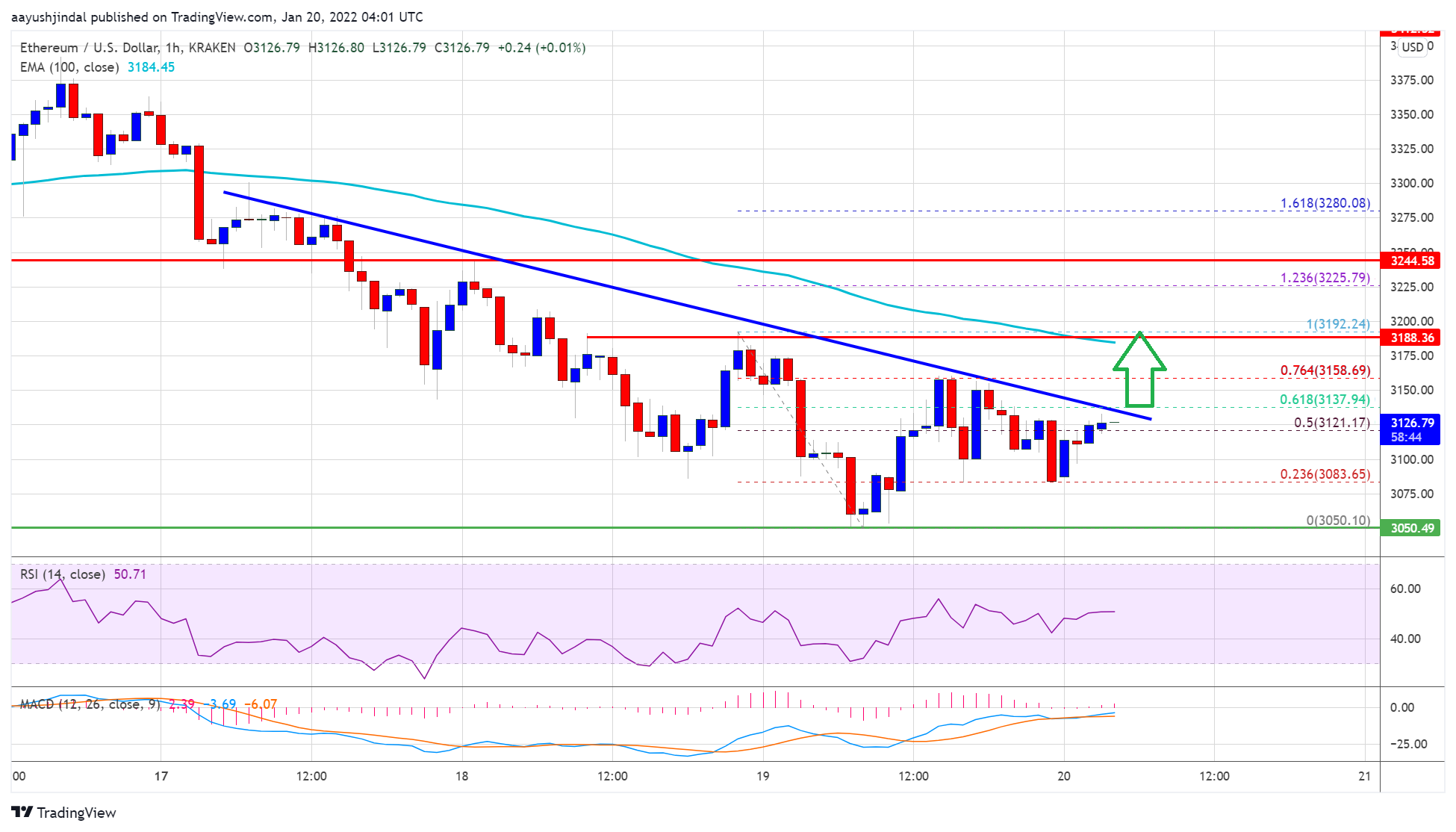
Ethereum extended decline below the $3,100 support zone against the US Dollar. ETH price must stay above $3,000 to avoid a sharp decline.
Ethereum extended decline below the $3,120 and $3,100 levels.
The price is trading below $3,150 and the 100 hourly simple moving average.
There is a key bearish trend line forming with resistance near $3,140 on the hourly chart of ETH/USD (data feed via Kraken).
The pair could start a decent increase if there is a clear move above the $3,200 resistance zone.
Ethereum Price Keeps Struggling
Ethereum failed to settle above $3,200 and extended decline below the $3,120 support zone. ETH even broke the $3,080 level and settled below the 100 hourly simple moving average.
A low is formed near $3,050 and currently correcting losses. There was a minor recovery wave above the $3,100 level. Ether price climbed above the 50% Fib retracement level of the recent decline from the $3,195 swing high to $3,050 low.
The first major resistance is near the $3,135 level. There is also a key bearish trend line forming with resistance near $3,140 on the hourly chart of ETH/USD. The trend line is near the 61.8% Fib retracement level of the recent decline from the $3,195 swing high to $3,050 low.
Source: ETHUSD on TradingView.com
If there is an upside break above the trend line, the price could rise towards the $3,190 resistance zone and the 100 hourly simple moving average. The next major resistance is near the $3,200 level, above which ether price could gain bullish momentum. In the stated case, the price could rise towards $3,300 in the near term.
More Losses in ETH?
If ethereum fails to start a fresh increase above the $3,150 level, it could continue to move down. An initial support on the downside is near the $3,080 level.
The first key support is now forming near the $3,050 level. A downside break below the $3,050 level might even spark a move below the $3,000 level. The next major support for the bulls may perhaps be near the $2,880 zone. Any more losses could push the price towards the $2,750 level.
Technical Indicators
Hourly MACD – The MACD for ETH/USD is losing pace in the bearish zone.
Hourly RSI – The RSI for ETH/USD is now near the 50 level.
In a speech entitled “Digital currencies and the soul of money,” Agustín Carstens, the general manager of the Bank of International Settlements,’ criticized private stablecoins and decentralized finance (DeFi), touting central bank-led financial innovation as the best possible path to the future of money.
Carstens, who served as governor of the Bank of Mexico between 2010 and 2017, delivered his remarks at the conference on “Data, Digitalization, the New Finance and Central Bank Digital Currencies: The Future of Banking and Money” at the Goethe University in Frankfurt.
The economist’s argument revolved around the institutional foundations of money and how, even in the digital age, central banks remain in a position to provide trust in money and ensure “an efficient and inclusive financial system to the benefit of all.” Alternative designs of monetary systems that emerged throughout history, according to the BIS’ top official, “have often ended badly.”
To advance his point, Carstens discussed three plausible scenarios of financial innovation. In addition to the global monetary system led by central banks, he envisioned a world where big tech-powered stablecoins are the dominant form of money, and another where the bulk of financial activity is decentralized and runs on distributed ledgers.
The stablecoin scenario, Carstens maintained, is fraught with market power and data concentration at the hands of a few dominant private money issuers. National and global monetary systems would become fragmented, while the disintermediation of incumbent banks would threaten financial stability.
Speaking of DeFi, the BIS boss claimed that the reality that DeFi applications are delivering is at odds with their proclaimed foundational principles of disintermediation. Carstens said:
To date, the DeFi space has been used primarily for speculative activities. Users invest, borrow and trade cryptoassets in a largely unregulated environment. The absence of controls such as know-your-customer (KYC) and anti-money laundering rules, might well be one important factor in DeFi’s growth.
Furthermore, echoing BIS researchers’ recent claims, Carstens stated that “there is a lot of centralization in DeFi.” He also cited scalability issues and liquidity mismatches as problematic aspects of decentralized finance.
In the vision of the monetary future that the economist extolled, central banks are at the core of the financial system, facilitating innovation such as building a global network of CBDCs. Because they are not profit-driven, central banks would act to advance the interests of the public, according to Carstens.
These statements come as no surprise when voiced by a chief officer of an institution that is often called a bank for central banks. As Cointelegraph reported earlier, the BIS’ innovation arm is actively engaged in several CBDC trials, including the cross-border settlement initiative ran jointly by central banks of France and Switzerland.
cryptocurrency exchange
Cryptocurrency Exchange
A cryptocurrency exchange is an online platform that supports the exchange of various currencies for a cryptocurrency or digital asset.Comparable to a generalized financial exchange, a crypto exchange’s core function is to permit and encourage the buying and selling of cryptos.This is accomplished by producing a stable trading environment suitable for traders nested through different locations around the world. Sometimes a crypto exchange may be referred to as a digital currency exchange (DCE) for short.How Does Trading Take Place on a Crypto Exchange?Cryptocurrency trading occurs over a centralized exchange, although these crypto exchanges should be used with caution given the implications that surround the custody of new assets. Similar to the banking industry, when a crypto exchange holds cryptocurrencies of users they accrue interest and are no longer classified as client money.These provide an accessible platform for not only companies, hedge funds, and retail traders for exchanging digital currencies.Additionally, crypto exchanges serve a critical role in producing stability within the cryptocurrency sector given how the sourcing and pricing of these assets are innately volatile. One could think of a crypto exchange as an intermediary who provides a service by connecting buyers and sellers from various markets under one roof. In exchange for facilitating trades and for services rendered, a digital currency exchange generally collects a fee of an outgoing transaction that averages between 0.20% to 0.25% or will request a deposit fee that has been known to be as high as 11% for credit card deposits. Crypto exchanges may also support the exchange of crypto tokens, such as the Binance Token, which is ranked as the 9th most valuable cryptocurrency in the world.
A cryptocurrency exchange is an online platform that supports the exchange of various currencies for a cryptocurrency or digital asset.Comparable to a generalized financial exchange, a crypto exchange’s core function is to permit and encourage the buying and selling of cryptos.This is accomplished by producing a stable trading environment suitable for traders nested through different locations around the world. Sometimes a crypto exchange may be referred to as a digital currency exchange (DCE) for short.How Does Trading Take Place on a Crypto Exchange?Cryptocurrency trading occurs over a centralized exchange, although these crypto exchanges should be used with caution given the implications that surround the custody of new assets. Similar to the banking industry, when a crypto exchange holds cryptocurrencies of users they accrue interest and are no longer classified as client money.These provide an accessible platform for not only companies, hedge funds, and retail traders for exchanging digital currencies.Additionally, crypto exchanges serve a critical role in producing stability within the cryptocurrency sector given how the sourcing and pricing of these assets are innately volatile. One could think of a crypto exchange as an intermediary who provides a service by connecting buyers and sellers from various markets under one roof. In exchange for facilitating trades and for services rendered, a digital currency exchange generally collects a fee of an outgoing transaction that averages between 0.20% to 0.25% or will request a deposit fee that has been known to be as high as 11% for credit card deposits. Crypto exchanges may also support the exchange of crypto tokens, such as the Binance Token, which is ranked as the 9th most valuable cryptocurrency in the world. Read this Term, announced a partnership with Mastercard, a global payment giant, to classify NFTs as digital goods in order to allow a wider group of consumers to buy non-fungible tokens. With the announcement, coming soon Coinbase will transform a new way to pay using Mastercard cards.
Coinbase recently announced ‘Coinbase NFT,’ a peer-to-peer marketplace, which enables minting, buying, showcasing, and discovering NFTs easier. The partnership with Mastercard will therefore enable Coinbase to offer a better customer experience on the Coinbase NFT marketplace. The exchange is working to find ways to bring such opportunities to the wider ecosystem through Mastercard’s global network. Coinbase applauds Mastercard’s leadership on this matter to make it as easy as possible to purchase and sell NFTs.
Prakash Hariramani, the head of
Payments
Payments
One of the bases of mediums of exchange in the modern world, a payment constitutes the transfer of a legal currency or equivalent from one party in exchange for goods or services to another entity. The payments industry has become a fixture of modern commerce, though the players involved and means of exchange have dramatically shifted over time.In particular, a party making a payment is referred to as a payer, with the payee reflecting the individual or entity receiving the payment. Most commonly the basis of exchange involves fiat currency or legal tender, be it in the form of cash, credit or bank transfers, debit, or checks. While typically associated with cash transfers, payments can also be made in anything of perceived value, be it stock or bartering – though this is far more limited today than it has been in the past.The Largest Players in the Payments IndustryFor most individuals, the payments industry is dominated currently by card companies such as Visa or Mastercard, which facilitate the use of credit or debit expenditures. More recently, this industry has seen the rise of Peer-to-Peer (P2P) payments services, which have gained tremendous traction in Europe, the United States, and Asia, among other continents.One of the biggest parameters for payments is timing, which looms as a crucial element for execution. By this metric, consumer demand incentivizes technology that prioritizes the fastest payment execution.This can help explain the preference for debit and credit payments overtaking check or money orders, which in previous decades were much more commonly utilized. A multi-billion-dollar industry, the payments space has seen some of the most innovation and advances in recent years as companies look to push contactless technology with faster execution times.
One of the bases of mediums of exchange in the modern world, a payment constitutes the transfer of a legal currency or equivalent from one party in exchange for goods or services to another entity. The payments industry has become a fixture of modern commerce, though the players involved and means of exchange have dramatically shifted over time.In particular, a party making a payment is referred to as a payer, with the payee reflecting the individual or entity receiving the payment. Most commonly the basis of exchange involves fiat currency or legal tender, be it in the form of cash, credit or bank transfers, debit, or checks. While typically associated with cash transfers, payments can also be made in anything of perceived value, be it stock or bartering – though this is far more limited today than it has been in the past.The Largest Players in the Payments IndustryFor most individuals, the payments industry is dominated currently by card companies such as Visa or Mastercard, which facilitate the use of credit or debit expenditures. More recently, this industry has seen the rise of Peer-to-Peer (P2P) payments services, which have gained tremendous traction in Europe, the United States, and Asia, among other continents.One of the biggest parameters for payments is timing, which looms as a crucial element for execution. By this metric, consumer demand incentivizes technology that prioritizes the fastest payment execution.This can help explain the preference for debit and credit payments overtaking check or money orders, which in previous decades were much more commonly utilized. A multi-billion-dollar industry, the payments space has seen some of the most innovation and advances in recent years as companies look to push contactless technology with faster execution times. Read this Term and Financial Hub at Coinbase, talked about the development and said that Coinbase’s mission is to increase economic freedom in the globe. He stated that by enabling more users to join the creator economy and profit from their work, NFTs have a vital role to play in this mission. He, however, identified that buying an NFT remains a complex experience for many users. He disclosed that Coinbase is working on simplifying the user experience to allow more people to join the NFTs community. Hariramani elaborated that just the way the exchange helped millions of people access Bitcoin in an easy and trusted manner, it is working on doing the same for NFTs.
Coinbase Is Doubling Down on NFTs Efforts
The development by Coinbase to embrace partnership with Mastercard comes at a time when NFT trading activity has been increasing substantially. Last year, NFTs demand skyrocketed significantly with around 280,000 unique sellers and buyers trending by the end of August. In October last year, Coinbase announced the launch of its Coinbase NFT marketplace to allow users to mint, buy, and showcase NFTs. The initial launch supports Ethereum-based ERC-721 and ERC-1155 standards, but the exchange has plans to enable multi-chain support in the near future.
NFT artists have revolutionized the traditional art world. Industries like music, gaming, and fashion are recognizing the power of NFTs to unlock new forms of creativity and ownership. Coinbase is therefore making NFTs more accessible by developing user-friendly interfaces that put the complexity behind the scenes. The crypto exchange added social features that open new avenues for discovery and conversation. Coinbase remains dedicated to growing the creator community exponentially, which is a win-win for artists and fans. In this way, the Coinbase NFT is positioning itself as a peer-to-peer marketplace whose filters are based on the users’ interests.
On January 18, Coinbase, the US largest
cryptocurrency exchange
Cryptocurrency Exchange
A cryptocurrency exchange is an online platform that supports the exchange of various currencies for a cryptocurrency or digital asset.Comparable to a generalized financial exchange, a crypto exchange’s core function is to permit and encourage the buying and selling of cryptos.This is accomplished by producing a stable trading environment suitable for traders nested through different locations around the world. Sometimes a crypto exchange may be referred to as a digital currency exchange (DCE) for short.How Does Trading Take Place on a Crypto Exchange?Cryptocurrency trading occurs over a centralized exchange, although these crypto exchanges should be used with caution given the implications that surround the custody of new assets. Similar to the banking industry, when a crypto exchange holds cryptocurrencies of users they accrue interest and are no longer classified as client money.These provide an accessible platform for not only companies, hedge funds, and retail traders for exchanging digital currencies.Additionally, crypto exchanges serve a critical role in producing stability within the cryptocurrency sector given how the sourcing and pricing of these assets are innately volatile. One could think of a crypto exchange as an intermediary who provides a service by connecting buyers and sellers from various markets under one roof. In exchange for facilitating trades and for services rendered, a digital currency exchange generally collects a fee of an outgoing transaction that averages between 0.20% to 0.25% or will request a deposit fee that has been known to be as high as 11% for credit card deposits. Crypto exchanges may also support the exchange of crypto tokens, such as the Binance Token, which is ranked as the 9th most valuable cryptocurrency in the world.
A cryptocurrency exchange is an online platform that supports the exchange of various currencies for a cryptocurrency or digital asset.Comparable to a generalized financial exchange, a crypto exchange’s core function is to permit and encourage the buying and selling of cryptos.This is accomplished by producing a stable trading environment suitable for traders nested through different locations around the world. Sometimes a crypto exchange may be referred to as a digital currency exchange (DCE) for short.How Does Trading Take Place on a Crypto Exchange?Cryptocurrency trading occurs over a centralized exchange, although these crypto exchanges should be used with caution given the implications that surround the custody of new assets. Similar to the banking industry, when a crypto exchange holds cryptocurrencies of users they accrue interest and are no longer classified as client money.These provide an accessible platform for not only companies, hedge funds, and retail traders for exchanging digital currencies.Additionally, crypto exchanges serve a critical role in producing stability within the cryptocurrency sector given how the sourcing and pricing of these assets are innately volatile. One could think of a crypto exchange as an intermediary who provides a service by connecting buyers and sellers from various markets under one roof. In exchange for facilitating trades and for services rendered, a digital currency exchange generally collects a fee of an outgoing transaction that averages between 0.20% to 0.25% or will request a deposit fee that has been known to be as high as 11% for credit card deposits. Crypto exchanges may also support the exchange of crypto tokens, such as the Binance Token, which is ranked as the 9th most valuable cryptocurrency in the world. Read this Term, announced a partnership with Mastercard, a global payment giant, to classify NFTs as digital goods in order to allow a wider group of consumers to buy non-fungible tokens. With the announcement, coming soon Coinbase will transform a new way to pay using Mastercard cards.
Coinbase recently announced ‘Coinbase NFT,’ a peer-to-peer marketplace, which enables minting, buying, showcasing, and discovering NFTs easier. The partnership with Mastercard will therefore enable Coinbase to offer a better customer experience on the Coinbase NFT marketplace. The exchange is working to find ways to bring such opportunities to the wider ecosystem through Mastercard’s global network. Coinbase applauds Mastercard’s leadership on this matter to make it as easy as possible to purchase and sell NFTs.
Prakash Hariramani, the head of
Payments
Payments
One of the bases of mediums of exchange in the modern world, a payment constitutes the transfer of a legal currency or equivalent from one party in exchange for goods or services to another entity. The payments industry has become a fixture of modern commerce, though the players involved and means of exchange have dramatically shifted over time.In particular, a party making a payment is referred to as a payer, with the payee reflecting the individual or entity receiving the payment. Most commonly the basis of exchange involves fiat currency or legal tender, be it in the form of cash, credit or bank transfers, debit, or checks. While typically associated with cash transfers, payments can also be made in anything of perceived value, be it stock or bartering – though this is far more limited today than it has been in the past.The Largest Players in the Payments IndustryFor most individuals, the payments industry is dominated currently by card companies such as Visa or Mastercard, which facilitate the use of credit or debit expenditures. More recently, this industry has seen the rise of Peer-to-Peer (P2P) payments services, which have gained tremendous traction in Europe, the United States, and Asia, among other continents.One of the biggest parameters for payments is timing, which looms as a crucial element for execution. By this metric, consumer demand incentivizes technology that prioritizes the fastest payment execution.This can help explain the preference for debit and credit payments overtaking check or money orders, which in previous decades were much more commonly utilized. A multi-billion-dollar industry, the payments space has seen some of the most innovation and advances in recent years as companies look to push contactless technology with faster execution times.
One of the bases of mediums of exchange in the modern world, a payment constitutes the transfer of a legal currency or equivalent from one party in exchange for goods or services to another entity. The payments industry has become a fixture of modern commerce, though the players involved and means of exchange have dramatically shifted over time.In particular, a party making a payment is referred to as a payer, with the payee reflecting the individual or entity receiving the payment. Most commonly the basis of exchange involves fiat currency or legal tender, be it in the form of cash, credit or bank transfers, debit, or checks. While typically associated with cash transfers, payments can also be made in anything of perceived value, be it stock or bartering – though this is far more limited today than it has been in the past.The Largest Players in the Payments IndustryFor most individuals, the payments industry is dominated currently by card companies such as Visa or Mastercard, which facilitate the use of credit or debit expenditures. More recently, this industry has seen the rise of Peer-to-Peer (P2P) payments services, which have gained tremendous traction in Europe, the United States, and Asia, among other continents.One of the biggest parameters for payments is timing, which looms as a crucial element for execution. By this metric, consumer demand incentivizes technology that prioritizes the fastest payment execution.This can help explain the preference for debit and credit payments overtaking check or money orders, which in previous decades were much more commonly utilized. A multi-billion-dollar industry, the payments space has seen some of the most innovation and advances in recent years as companies look to push contactless technology with faster execution times. Read this Term and Financial Hub at Coinbase, talked about the development and said that Coinbase’s mission is to increase economic freedom in the globe. He stated that by enabling more users to join the creator economy and profit from their work, NFTs have a vital role to play in this mission. He, however, identified that buying an NFT remains a complex experience for many users. He disclosed that Coinbase is working on simplifying the user experience to allow more people to join the NFTs community. Hariramani elaborated that just the way the exchange helped millions of people access Bitcoin in an easy and trusted manner, it is working on doing the same for NFTs.
Coinbase Is Doubling Down on NFTs Efforts
The development by Coinbase to embrace partnership with Mastercard comes at a time when NFT trading activity has been increasing substantially. Last year, NFTs demand skyrocketed significantly with around 280,000 unique sellers and buyers trending by the end of August. In October last year, Coinbase announced the launch of its Coinbase NFT marketplace to allow users to mint, buy, and showcase NFTs. The initial launch supports Ethereum-based ERC-721 and ERC-1155 standards, but the exchange has plans to enable multi-chain support in the near future.
NFT artists have revolutionized the traditional art world. Industries like music, gaming, and fashion are recognizing the power of NFTs to unlock new forms of creativity and ownership. Coinbase is therefore making NFTs more accessible by developing user-friendly interfaces that put the complexity behind the scenes. The crypto exchange added social features that open new avenues for discovery and conversation. Coinbase remains dedicated to growing the creator community exponentially, which is a win-win for artists and fans. In this way, the Coinbase NFT is positioning itself as a peer-to-peer marketplace whose filters are based on the users’ interests.