2

Blog

  • How A Game-Changing Decentralized Synthetic Exchange Aims to Unlock the True Value of Commodities and Digital Assets On-Chain

    How A Game-Changing Decentralized Synthetic Exchange Aims to Unlock the True Value of Commodities and Digital Assets On-Chain

    [ad_1]

    The barter system, where you trade your cow for someone else’s grains, for instance, is probably older than you think. It has its roots dating back to 6000 BC when Mesopotamian tribes first made exchanges with other groups.

    Those methods of exchange worked well before things like the Internet or decentralized technology existed. Trading was necessary not because commodities have financial value or even industrial utility, but because they were necessary for survival. Back then, societies weren’t as worried about gold or silver as they were about grains, milk, and beans.

    Today, even though society is living in a time where artificial intelligence, automation, blockchain technology and decentralization are going to make means of exchange far more democratic, and private than ever before, commodities still derive their value from the same things.

    Agricultural goods provide us with a means to nourish ourselves and survive. Energy in the form of oil, natural gas etc. allows us to keep the lights on and keep the economy moving, and precious metals provide us with industrial utility and the ability to hedge against inflation.

    Here’s the thing. The above commodities are non-fungible. They are not so easy to trade. That means no matter how valuable they are, some of that value is sucked away by old-world value chains. Thus, it remains out of the hands of the everyday individual.

    That’s why Comdex is launching a decentralized exchange (DEX) for synthetic assets. So that value can be unlocked and participants all around the world can benefit from such an unlocking event.

    What Are Synthetic Assets?

    In blockchain, a synthetic asset is a tokenized version of another asset, whether the latter is tangible or intangible. In the case of commodities, blockchain can be used to tokenize physical assets as well as their financial representations, be it oil, gold or silver. Comdex operates a DEX listing synthetic assets representing all types of commodities.

    The benefits of synthetic assets are enormous, as they allow users to trade the real-world value of a commodity without the complexities inherent in holding the non-fungible good itself.

    Comdex Alleviates the Pain Points Associated with Nonfungible Commodities Exchanges

    The Comdex Decentralized Synthetics Exchange allows participants to act as:

    • Traders (who engage in buying and selling of cAssets against CMDX using cSwap)
    • Minters (who can create and open collateralized debt positions in order to obtain a newly minted cAsset. They must maintain a minimum collateral ratio of 150% to avoid liquidation.)
    • Liquidity Providers who provide equal amounts of cAssets and CMDX so that users can facilitate trades and providers can benefit from rewards and transaction fees.)
    • Stakers (who can earn CMD tokens using Omniflix and Unagii)

    The interface itself is easy to navigate. The team and the project are mission-driven. The whole point of the launch of this product is to alleviate the pain points that come with commodities and digital assets.

    Participants get the real-world benefit of on-chain diversification of assets. The benefit from the security and transparency a decentralized synthetic asset exchange can provide. They also don’t have to worry about the cumbersome nature of the logistics and storage that typically comes with investing in physical goods and commodities.

    Why Trade Synthetic Assets?

    Comdex anticipates that demand on its platform will expand at an accelerated pace given the benefits of synthetics over trading the physical assets themselves. Synthetic assets address multiple risks, including:

    • Confiscation or ban risk – the recent decision of US President Joe Biden to ban oil and gas imports from Russia shows that the commodity market may be unpredictable and struggle with uncertainty. Sometimes governments can go even further by confiscating commodities altogether. Synthetics cannot be confiscated and trading cannot be banned as they reside on a decentralized infrastructure.
    • Theft risk – storing gold coins under your bed can make you happier, but this is not the safest approach for sure. The risk of theft is considerable, and the problem is that your home insurance policy might cover any sizable investment as most insurance packages stipulate clauses preventing cover on high-value items like gold bars. Elsewhere, synthetics can’t be stolen if you keep your private key safely.
    • Third-party risk – even if you give up storing physical items and decide to invest in futures contracts, you will most likely end up storing them with a third-party custodian like a bank or broker. Unfortunately, there is always an insolvency risk associated with any centralized organization, including banks, shipping companies, or brokers. In the case of bankruptcy, you can own your investments partially or entirely. Since synthetics are stored on the blockchain, there is no third-party risk.

    On top of that, synths come with great benefits that can help traders have peace of mind about their commodity investments:

    • Easy access – with synthetics, you can get exposure to any commodity market without any obstacle. All you need to have is an internet connection and an account with Comdex.
    • Costs – if you trade physical commodities or their futures, you have to be ready to pay broker fees, as well as storage, conversion, transportation, withdrawal, and other fees. Trading commodity synthetics reduce the costs to a minimum thanks to the efficient use of resources.
    • No Expiry of futures contracts – trading commodity futures may be problematic for investors, as in theory, they are obligated to take delivery of the physical goods once the contract expires. Synthetics function 24/7 with no expiry.

    Comdex is striving to revolutionize how people engage in commerce with commodities by merging decentralized technologies with real-world assets. The hybrid approach to this new robust decentralized synthetic asset exchange is going to change the game for good.

    The question is, are you ready for it?


    Image: Pixabay


    [ad_2]

    Source link

  • Financial markets are ‘not quite ready’ for Bitcoin bonds

    Financial markets are ‘not quite ready’ for Bitcoin bonds

    [ad_1]

    MicroStrategy CEO and Bitcoin permabull, Michael Saylor believes that traditional financial markets aren’t quite ready for Bitcoin-backed bonds. 

    Saylor told Bloomberg on Tuesday, that he’d love to see the day come where Bitcoin-backed bonds are sold like mortgage-backed securities, but warned that, “the market is not quite ready for that right now. The next best idea was a term loan from a major bank.”

    The remarks come two days after MicroStrategy’s (MSTR) Bitcoin-specific subsidiary MacroStrategy, announced that it had taken out a $205 million Bitcoin-collateralized loan to purchase even more Bitcoin. This loan was unique, as it marked MicroStrategy’s first time borrowing against its own Bitcoin reserves — which are currently valued at approximately $6 billion — to buy more of the cryptocurrency.

    Saylor’s comments also follow El Salvador’s recent


    [ad_2]

    Source link

  • Bitcoin Exchange Outflows Are Rising

    Bitcoin Exchange Outflows Are Rising

    [ad_1]

    Bitcoin held on to the price level of $47,000 on Thursday despite the pressure of profit-taking. BTC exchange flow, an indicator that highlights the difference between the supply and demand of the world’s leading cryptocurrency on trading platforms, has seen immense volatility in the past few weeks.

    Yesterday, the difference between Bitcoin exchange outflows and inflows surged substantially. According to Glassnode, a prominent on-chain analytics platform, approximately $2.1 billion worth of BTC moved away from exchanges, compared to the inflows of $1.2 billion.

    Bitcoin whale movements are playing a major role in the latest surge. Whale Alert recently highlighted the movement of 2,000 Bitcoin worth more than $94 million from Coinbase to an unknown wallet. BTC balance on prominent exchanges has been plunging since the start of 2021.

    Coinbase is one of the worst-hit digital exchanges in the recent trend. According to Glassnode, the BTC balance on Coinbase has declined by more than 36% since April 2020. During the second week of March 2022, crypto whale accounts moved nearly 30,000 Bitcoin away from Coinbase.

    Bitcoin Balance

    “Large outflows are actually part of a consistent trend in the Coinbase balance, which has been stair-stepping downwards over the last two years. As the largest exchange by BTC balance, and a preferred venue for US-based institutions, this further supports the adoption of Bitcoin as a macro asset by larger institutions,” Glassnode mentioned in a recent report.

    BTC is not the only digital currency that saw a jump in exchange outflows. Ethereum, the world’s second-most valuable cryptocurrency, also witnessed a similar trend. Earlier this week, net daily ETH exchange flows reached -$1 billion. On 29 March, ETH exchange outflows touched $1.8 billion, compared to the inflows of $793 million.

    However, net exchange flows related to Tether (USDT) have turned positive in the past 24 hours.

    Bitcoin held on to the price level of $47,000 on Thursday despite the pressure of profit-taking. BTC exchange flow, an indicator that highlights the difference between the supply and demand of the world’s leading cryptocurrency on trading platforms, has seen immense volatility in the past few weeks.

    Yesterday, the difference between Bitcoin exchange outflows and inflows surged substantially. According to Glassnode, a prominent on-chain analytics platform, approximately $2.1 billion worth of BTC moved away from exchanges, compared to the inflows of $1.2 billion.

    Bitcoin whale movements are playing a major role in the latest surge. Whale Alert recently highlighted the movement of 2,000 Bitcoin worth more than $94 million from Coinbase to an unknown wallet. BTC balance on prominent exchanges has been plunging since the start of 2021.

    Coinbase is one of the worst-hit digital exchanges in the recent trend. According to Glassnode, the BTC balance on Coinbase has declined by more than 36% since April 2020. During the second week of March 2022, crypto whale accounts moved nearly 30,000 Bitcoin away from Coinbase.

    Bitcoin Balance

    “Large outflows are actually part of a consistent trend in the Coinbase balance, which has been stair-stepping downwards over the last two years. As the largest exchange by BTC balance, and a preferred venue for US-based institutions, this further supports the adoption of Bitcoin as a macro asset by larger institutions,” Glassnode mentioned in a recent report.

    BTC is not the only digital currency that saw a jump in exchange outflows. Ethereum, the world’s second-most valuable cryptocurrency, also witnessed a similar trend. Earlier this week, net daily ETH exchange flows reached -$1 billion. On 29 March, ETH exchange outflows touched $1.8 billion, compared to the inflows of $793 million.

    However, net exchange flows related to Tether (USDT) have turned positive in the past 24 hours.


    [ad_2]

    Source link

  • Time To Be Fearful? Bitcoin Index Reaches Greediest Point Since Peak

    Time To Be Fearful? Bitcoin Index Reaches Greediest Point Since Peak

    [ad_1]

    Data shows the Bitcoin fear and greed index has now reached the highest level since the peak in November as the price of the crypto rallies up.

    Bitcoin Fear And Greed Index Now Points At “Greed”

    As per the latest weekly report from Arcane Research, the BTC fear and greed index has surged to values of greed sentiment this week.

    The “fear and greed index” is an indicator that tells us about the current general market sentiment among Bitcoin investors.

    The metric uses a numeric scale that travels from one to hundred for representing this sentiment. All values above fifty signify that investors are greedy at the moment. While those below the cutoff suggest a fearful market.

    Values above 75 and below 25, that is, the values toward the ends of the range, represent extreme greed and extreme fear, respectively.

    Now, here is a chart that shows the trend in the Bitcoin fear and greed index over the past year:

    Bitcoin Fear And Greed Index

    Looks like the value of the indicator has surged up recently | Source: Arcane Research's The Weekly Update - Week 12, 2022

    As you can see in the above graph, the Bitcoin fear and greed index has sharply risen over the past week. The indicator now has a value of 56, which shows the market is getting greedy.

    This value of the metric is now more than in any other period in the year 2022 so far, and is the highest since the peak in early November of last year.

    Related Reading | Glassnode’s RHODL Ratio May Suggest Bitcoin Market Is Near Capitulation

    Historically, Bitcoin peaks have tended to happen while the sentiment is that of extreme greed, and bottoms have formed during periods of extreme fear.

    There is a popular trading technique called “contrarian investing” that makes use of this fact. Traders following this methodology think that the best time to buy is during extreme fear, while extreme greed is when one should sell.

    Related Reading | Bitcoin Weekly Momentum Flips Bullish For First Time In 2022: What Data Says

    This famous quote by Warren Buffet sums up this philosophy: “Be fearful when others are greedy, and greedy when others are fearful.”

    So, following the line of thinking of contrarian investors, the current market sentiment turning greedy may be a sign that you should now start getting fearful instead.

    BTC Price

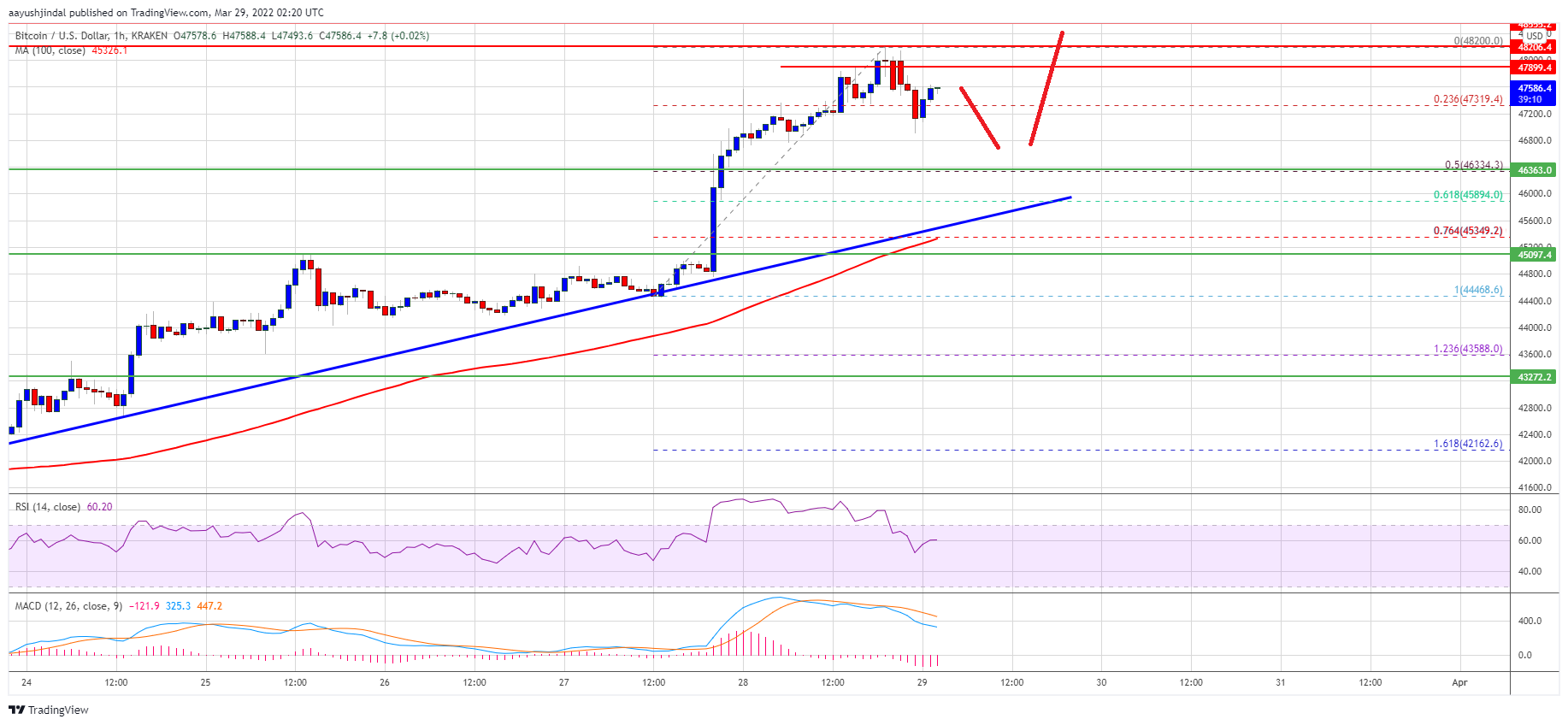
    At the time of writing, Bitcoin’s price floats around $47.3k, up 12% in the last seven days. Over the past month, the crypto has gained 26% in value.

    The below chart shows the trend in the price of the coin over the last five days.

    Bitcoin Price Chart

    The price of Bitcoin seems to have surged up over the past few days | Source: BTCUSD on TradingView
    Featured image from Unsplash.com, charts from TradingView.com, Arcane Research

    [ad_2]

    Source link

  • Opera integrates Bitcoin, Solana, Polygon and five other blockchains

    Opera integrates Bitcoin, Solana, Polygon and five other blockchains

    [ad_1]

    Opera, one of the major crypto-friendly internet browsers, announced the integration of eight blockchains in a continued effort to introduce Web3 to more than 380 million mobile and desktop users worldwide.

    In Jan. 2022, Opera launched the Crypto Browser project, a Web3-focused initiative for facilitating navigation across decentralized applications (DApp), games and metaverse platforms. As part of this initiative, the browser company added support for eight major blockchain ecosystems, including Bitcoin (BTC), Solana (SOL), Polygon (MATIC), StarkEx, Ronin, Celo, Nervos DAO and IXO.

    Opera said in the announcement that its users now have access to the Polygon and Solana DApp ecosystems, as well as “the benefits of Layer 2 DeFi via StarkWare-powered DiversiFi.”

    The latest integrations enable Opera users to access Polygon proof-of-stake (POS) blockchain and Ethereum L2 ecosystem via StarkEx.

    Opera’s Crypto Browser project. Source: Opera

    According to the company, the intention behind integrating multiple blockchains was to ensure chain agnosticism and Web3 involvement in an environment-friendly manner. Jorgen Arnesen, EVP Mobile at Opera stated:

    “Ultimately, Web3 is on its way to becoming a mainstream web technology and users won’t need to know they’re interacting with it. They need to get a superior user experience and a true benefit.”

    The announcement further highlighted the need for carbon-neutral solutions with low gas fees, which stands as one of the main reasons for choosing Polygon over the Ethereum blockchain.

    Related: Brave to integrate with Solana blockchain on its privacy-enabled browser

    Back in Nov. 2021, Opera competitor Brave browser integrated Solana blockchain to strengthen its DApps capability.

    Citing the partnership, Brendan Eich, CEO and co-founder of Brave said that:

    “With more and more users and creators requiring tools for fast and affordable access to the decentralized Web, this integration will seamlessly pave the way for the next billion crypto users to harness applications and tokens.”

    Brave is yet to announce the addition of multi-chain support to rival its growing competition.