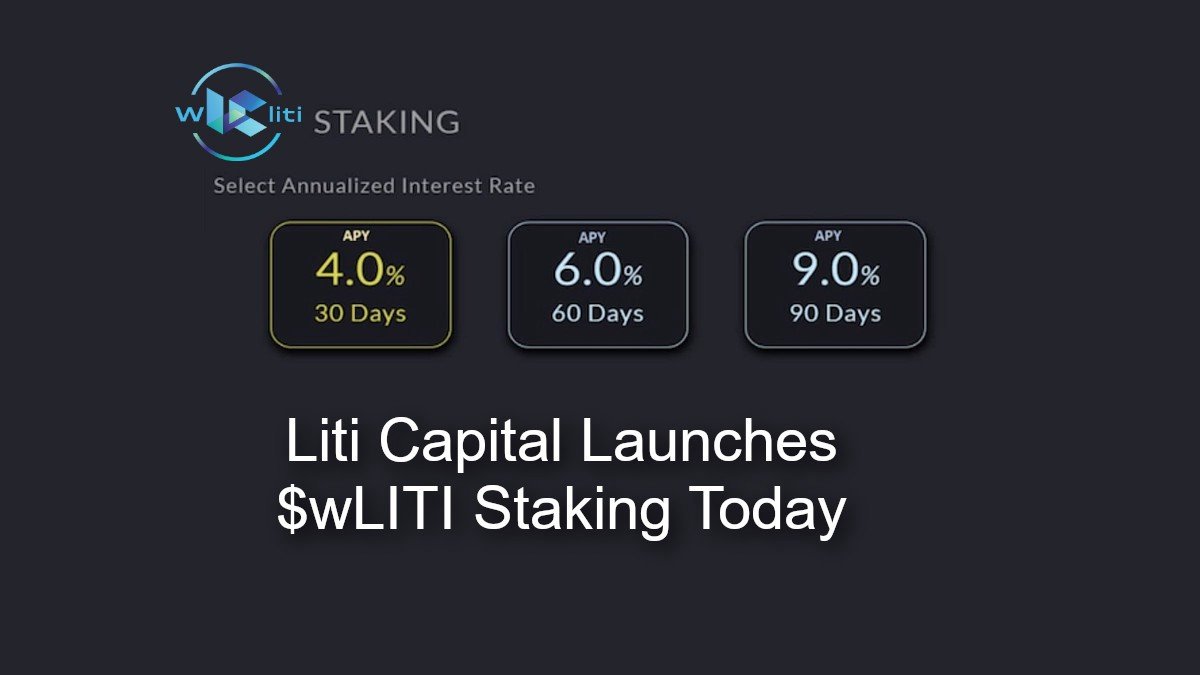
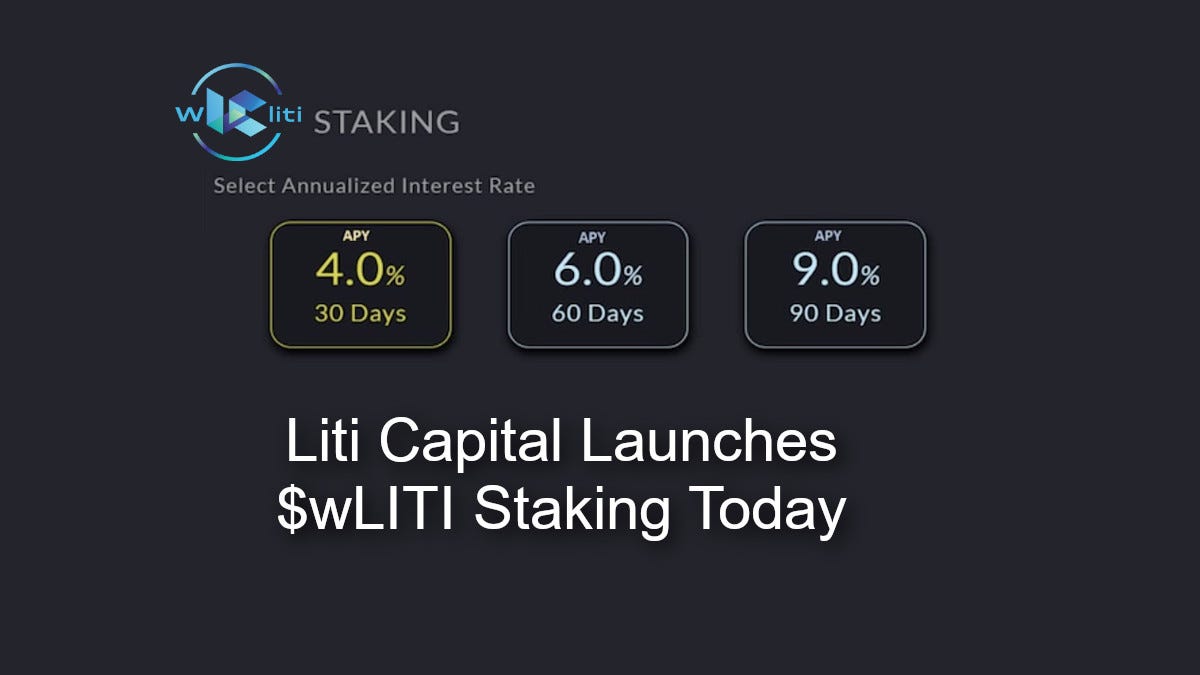
Changelly and Changelly PRO are happy to announce that wLITI has joined their family of over 200 cryptocurrencies available for exchange on Changelly. Starting today, users will be able to exchange it for other digital assets at floating rates on their platform. In fact, since Aug. 30, users have already been able to trade wLITI/BTC and wLITI/USDT on Changelly PRO.
On-chain data shows Bitcoin exchange reserves have hit the lowest value in 3 years, here’s what it might mean for BTC’s price.
Bitcoin Exchange Reserves Lowest In 3 Years As Negative Netflows Continue
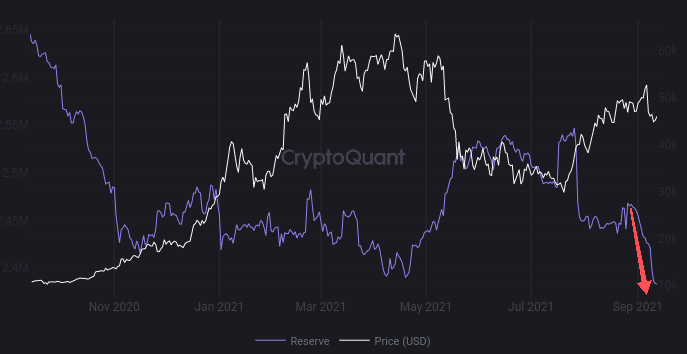
As pointed out by a CryptoQuant post, exchange reserves have been continuing their downtrend, and have now reached lows not seen since 3 years ago.
The all exchanges reserve is an indicator that shows the total amount of Bitcoin held in wallets of all centralized exchanges.
An increase in the metric’s value suggests more investors are depositing their coins for withdrawing to fiat or altcoin purchasing. On the other hand, a decrease means more buyers are moving their BTC to personal wallets for hodling or OTC deals.
Here is the latest chart for the Bitcoin all exchanges reserve:
The BTC all exchanges reserve plunges down
As the above graph shows, the value of the indicator has sharply gone down recently. The current level of the metric is the lowest it has been in the last three years.
As already mentioned before, a downtrend like this one means investors are withdrawing their coins from exchanges possibly to hodl or sell through OTC deals.
Related Reading | Indicators Show Bitcoin Might Be Gearing Up For One Last Push Up
Such values are typically bullish in the long-term as they may mean that there are more long-term holders in the market who are hodling out of exchanges.
There is another relevant indicator here, called the Bitcoin netflow, which shows the net amount of BTC entering or exiting exchanges.
A positive spike in the chart for the exchange netflows means exchanges are observing more inflows compared to the outflows. A negative value implies just the opposite.
Big spikes or a prolonged period of smaller spikes in one direction can affect the value of the exchange reserves. Naturally, positive values can increase the reserve while negative ones can decrease it.
Related Reading | Ukraine Adopts New Law To Legalize Bitcoin And Other Cryptocurrencies
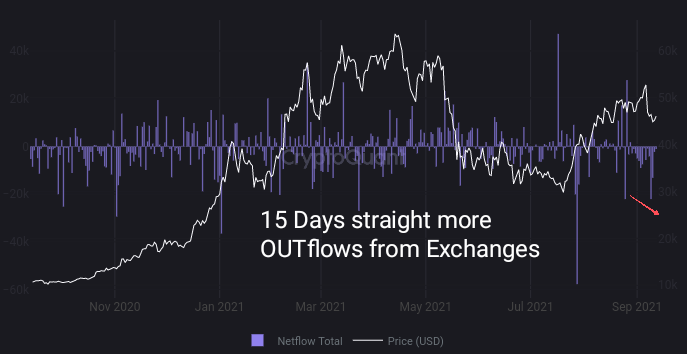
The below chart shows the current trend for the exchange netflows:
The BTC netflows show big negative spikes
As expected, the netflows have been negative recently, leading to the low values of the Bitcoin exchange reserves.
What Could It Mean for BTC’s Price?
As mentioned earlier, a downtrend in the exchange reserves can be bullish for the price in the long-term as it may imply a greater amount of long-term holdings. This has also been usually true historically, but there can be certain exceptions.
However, looking at the current Bitcoin price movement, it looks like selling has been going on. But as the exchange reserves haven’t shot up (unlike the crash from the May ATH), sales are being done likely through OTC deals.
Now, depending on if most of the outflows are being done to sell through OTC deals, a bearish picture can be there instead.
BTC's price continues to decline | Source: BTCUSD on TradingView
Featured image from Unsplash.com, charts from TradingView.com, CryptoQuant
The deadline for South Korean crypto exchanges to meet new compliance requirements is looming fast, with all operators expected to submit requests for an official license with the Financial Services Commission (FSC) no later than Sept. 24.
Industry actors and representatives for smaller exchanges have contested the new requirements for much of the past year, yet without success. Now insiders reportedly expect that close to 40 of the country’s estimated 60 crypto operators will be forced to shut down.
The crux of their objection has been the obligation that all exchanges show evidence that they are operating using real-name accounts at South Korean banks. The FSC has justified by arguing that there is a high demand from customers for more protection for their assets held at smaller crypto platforms. Yet South Korea’s banks have, for the most part, refused to engage in any risk assessment process for applicant exchanges, except for the country’s top four trading platforms.
These four exchanges – Upbit, Bithumb, Korbit and Coinone – already account for over 90% of South Korea’s total traded volume, and experts have in recent months made the case that the FSC’s new framework is poised to further cement the country’s crypto space as a monopolized market.
Moreover, estimates by Kim Hyoung-joong – a professor and head of the Cryptocurrency Research Center at Korea University – predict that the mass exchange closures will eliminate 42 “kimchi coins” – a moniker for smaller altcoins that are listed on smaller platforms and traded against the Korean won. Lee Chul-yi, head of local crypto exchange Foblgate, has told the Financial Times that:
“A situation similar to a bank run is expected near the deadline as investors can’t cash out of their holdings of ‘alt-coins’ listed only on small exchanges. […] They will find themselves suddenly poor. I wonder if regulators can handle the side-effects.”
Related: Regulations drive Korean exchanges to delist, warn against high risk coins
With altcoins estimated to account for 90% of traded volume in South Korea’s crypto markets, the FSC has reportedly advised those exchange operators who expect to shut down to notify their clients no later than Sept. 17. Cho Yeon-haeng, president of Korea Finance Consumer Federation, has claimed that customer protection is unlikely to be the priority for those exchanges facing imminent closure and that “huge investor losses” are therefore expected due to the freezing of assets and suspension of trading on smaller platforms.
The regulatory heat will also affect international exchange operators. Binance has already pre-emptively halted Korean won trading pairs this summer to ensure it does not foul Korean authorities.
The new measures have been designed to curb Koreans’ enthusiasm for crypto trading amid concerns that retail investors, especially those from younger generations, are borrowing excessively in order to trade as they struggle with suppressed wages, a frozen job market and ever-rising real-estate prices.
In the last 24-hours, Terra (LUNA), a blockchain protocol focused on building a global payments system powered by the UST stablecoin, rallied to a new all-time high at $45.
LUNA/USDT 1-day chart. Source: TradingView
Data from Cointelegraph Markets Pro and TradingView shows that since bottoming at a low of $5.61 on July 20, the price of LUNA has ripped 720% higher to a record high at $45 on Sept. 10.
The swift rally also lifted the total value locked (TVL) on the Terra protocol to a new all-time high at $7.83 billion on Sept. 5, making Terra the fourth-ranked blockchain platform by TVL according to Defi Llama.
Total value locked on Terra. Source: Defi Llama
Related: Altcoin Roundup: Layer-one protocols chip away at Ethereum’s dominance.
A new funding initiative boosts LUNA price
A scroll through the project’s Twitter feed shows that the surge in price followed the announcement of ‘Project Dawn’, a new funding initiative for the Terra ecosystem meant to help improve critical infrastructure and accelerate the growth of the ecosystem.
1/ TFL is announcing Project Dawn, a new funding initiative for critical infrastructure improvements and core technologies to supplement the accelerating growth of the Terra ecosystem.
According to Terra co-founder Do Kwon, Project Dawn has allocated $150 million to “build a core Cosmos contributor organization, invest in the ecosystem’s node infrastructure, and diversify the validator and oracle infrastructure.”
Another source of excitement for the Terra community is the upcoming launch of its Colombus-5 mainnet upgrade on Sept. 29, which is “Terra’s most significant mainnet upgrade” according to the project.
1/ The Columbus-5 mainnet deployment will be delayed ~3 weeks until a new block height of 4,724,000, roughly equivalent to the following times:
9/29 at 20:30 PST 9/30 at 03:30 UTC 9/30 at 12:30 KST
On top of developments to the main protocol, LUNA price has also benefited from the expansion of the Terra ecosystem which has seen new DeFi protocols like AlphaDeFi launch and begin to attract liquidity.
The views and opinions expressed here are solely those of the author and do not necessarily reflect the views of Cointelegraph.com. Every investment and trading move involves risk, you should conduct your own research when making a decision.
Some Bitcoin indicators show similarities between the post-ATH price action and current trend, implying that there will be one last push up before a bigger drop.
Indicators Might Show Today’s Price Action Is Similar To That After $64.5k ATH
As explained by a CryptoQuant analyst, there seem to be many similarities between the Bitcoin indicators of the post all-time-high (ATH) period and that of present day.
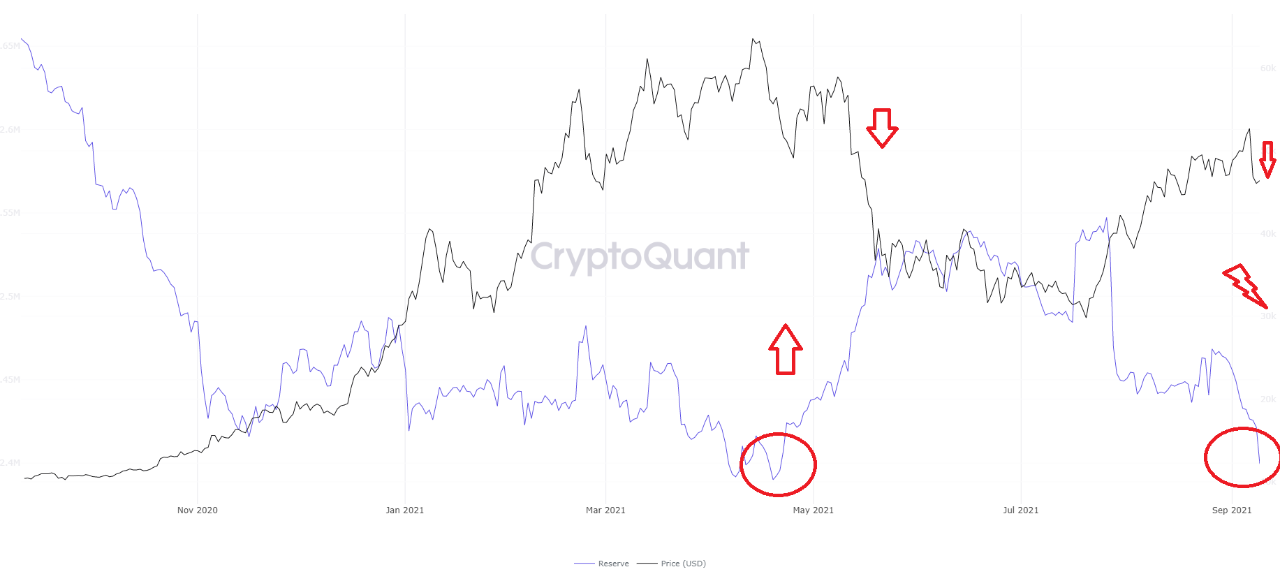
There are three main metrics of relevance here. The first is the exchange reserve, which shows the amount of BTC currently being held on centralized exchange wallets.
Here is how this indicator’s value has changed during the past year:
The BTC exchange reserve after the ATH vs today
Looking at the above graph, there does seem to be a similarity between the two periods. Both had declining prices as well as declining exchange reserves.
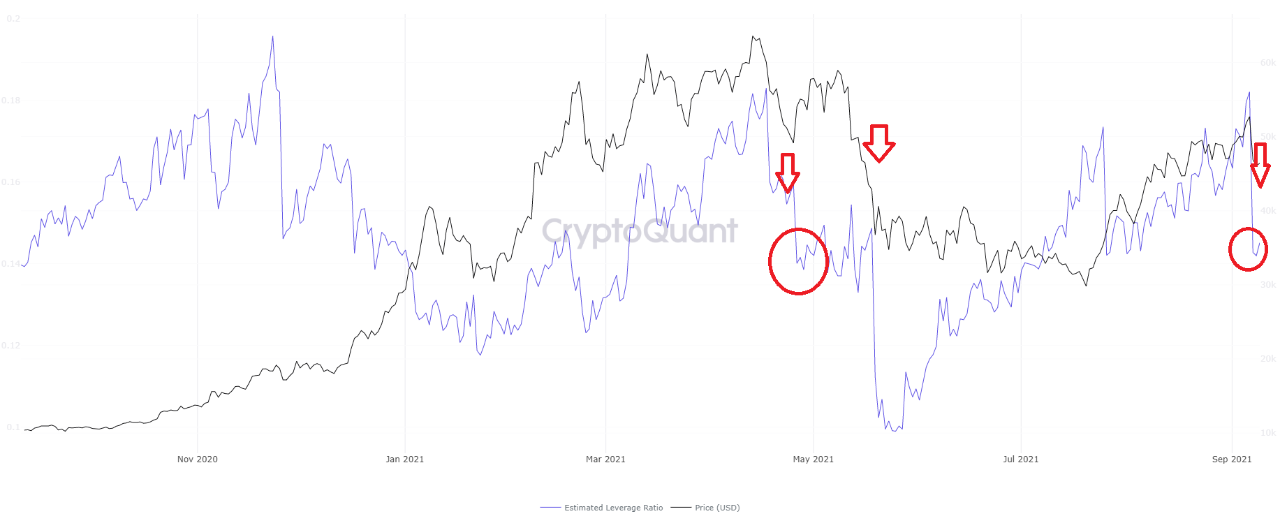
Next is the estimated leverage ratio, an indicator that shows how much leverage is used by traders on average. It’s calculated by taking the open interest divided by the exchange reserve.
The leverage ratio seems to be plunging down
Here too a similarity can be seen as the indicator seems to have sharply dropped down during both present day and the post-ATH period.
Related Reading | Why This Investor Fled His Bitcoin Position, Should You Do The Same?
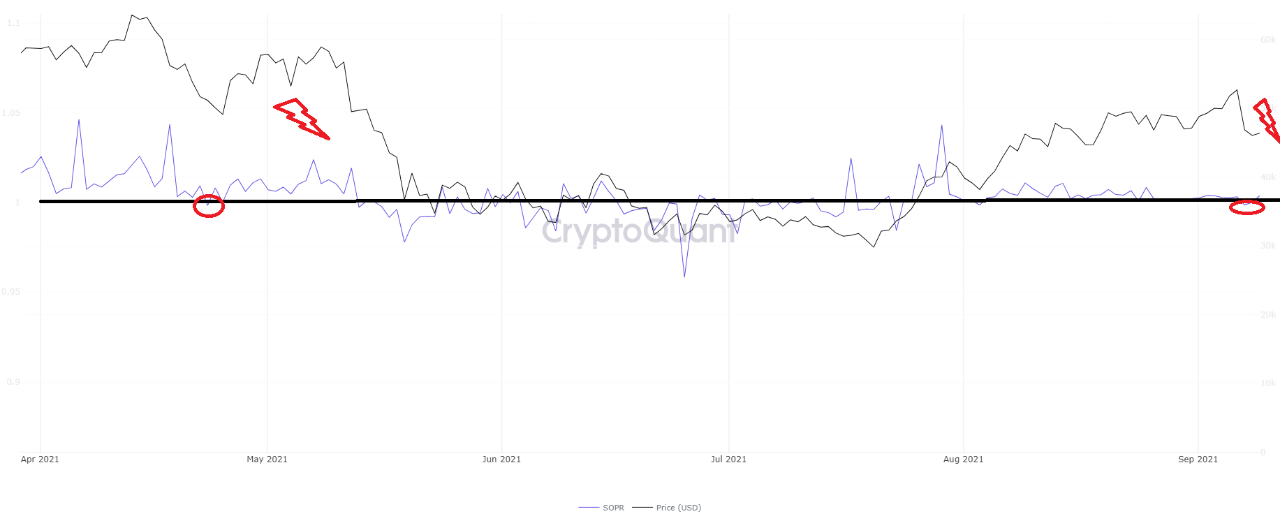
Finally, there is the Spent Output Profit Ratio (SOPR), which is calculated by taking the ratio of realized value (in USD) to the value of creation of a spent output.
In simpler terms, the indicator shows whether Bitcoin wallets are selling their coins at a profit or a loss. The below chart shows the trends for this metric.
The BTC SOPR over the past six months
Looks like the value of the SOPR dropped down below 1 during both these periods. Such a value indicates that investors have been selling BTC at a loss (while values above 1 would imply the opposite).
Related Reading | Bitcoin Price “Pitchfork Channel” Could Pin-Point The Last Dip Ever
If the current trend really is similar to the post-ATH one as these indicators would seem to imply, then it means BTC’s price might move up soon and make a local peak. And just like last time, a big drop could happen after that which takes the price to lower levels. So that this uptrend could turn out to be the last move up for a while.
BTC Price
At the time of writing, Bitcoin’s price floats around $45.7k, down 10% in the last 7 days. Over the past month, the cryptocurrency has dropped 1% in value.
Here is a chart showing the trend in the price of the coin over the last three months:
Bitcoin's price moves sideways after a big plunge downwards | Source: BTCUSD on TradingView
Featured image from Unsplash.com, charts from TradingView.com, CryptoQuant
Starting today, Rari Governance Token (RGT) and XYO Network (XYO) are available on Coinbase.com and in the Coinbase Android and iOS apps. Coinbase customers can now trade, send, receive, or store RGT and XYO in most Coinbase-supported regions, with certain exceptions indicated in each asset page here. Trading for these assets is also supported on Coinbase Pro.
Rari Governance Token (RGT) is an Ethereum token that powers Rari Capital, a decentralized protocol for lending and borrowing. The Rari Governance Token is used for fee discounts and protocol governance.
XYO Network (XYO) is an Ethereum token that powers XYO Network, a decentralized network of devices that anonymously collect and validate geospatial data. On the XYO World platform, XYO tokens can be traded for and staked against unique ERC-721 tokens representing real-world locations.
One of the most common requests we hear from customers is to be able to buy and sell more cryptocurrencies on Coinbase. We announced a process for listing assets, designed in part to accelerate the addition of more cryptocurrencies. We are also investing in new tools to help people understand and explore cryptocurrencies. We launched informational asset pages (see RGT, XYO), as well as a new section of the Coinbase website to answer common questions about crypto.
Customers can sign up for a Coinbase account here to buy, sell, convert, send, receive, or store e Coinbase Android and iOS apps. Coinbase customers can now trade, send, receive, or store RGT and XYO today.
###
Please note: Coinbase Ventures may be an investor in the crypto projects mentioned here, and additionally, Coinbase may hold such tokens on its balance sheet for operational purposes. A list of Coinbase Ventures investments is available at https://ventures.coinbase.com/. Coinbase intends to maintain its investment in these entities for the foreseeable future and maintains internal policies that address the timing of permissible disposition of any related digital assets, if applicable. All assets, regardless of whether Coinbase Ventures holds an investor or Coinbase holds for operational purposes, are subject to the same strict review guidelines and review process.
This website contains links to third-party websites or other content for information purposes only (“Third-Party Sites”). The Third-Party Sites are not under the control of Coinbase, Inc., and its affiliates (“Coinbase”), and Coinbase is not responsible for the content of any Third-Party Site, including without limitation any link contained in a Third-Party Site, or any changes or updates to a Third-Party Site. Coinbase is not responsible for webcasting or any other form of transmission received from any Third-Party Site. Coinbase is providing these links to you only as a convenience, and the inclusion of any link does not imply endorsement, approval or recommendation by Coinbase of the site or any association with its operators.
Crypto is a new type of asset. Besides potential day to day or hour to hour volatility, each crypto asset has unique features. Make sure you research and understand individual assets before you transact.
All images provided herein are by Coinbase.
Rari Governance Token (RGT) and XYO Network (XYO) are now available on Coinbase was originally published in The Coinbase Blog on Medium, where people are continuing the conversation by highlighting and responding to this story.
Singapore, Sep 10, 2021 — Bitkub Capital Group Holdings, a leading Thai blockchain & cryptocurrency company has officially partnered with Miss Universe Thailand 2021 as the world’s first blockchain & cryptocurrency firm to bring NFT and Digital Asset solutions, as well as other cryptocurrency trends to beauty pageants.
Ephrat Livni, a DealBook business and policy reporter at the New York Times, discusses Coinbase’s fight with the SEC over its Lend product and El Salvador’s adoption of Bitcoin as legal tender. Show highlights:
why Coinbase is unhappy with what it calls the SEC’s “sketchy” behavior
how Coinbase’s Lend product is structured and why it might be a security
why Ephrat considers Coinbase’s reaction to the SEC’s decision on Lend to be “trolling”
what we can learn from SEC chair Gary Gensler’s letters with Senator Elizabeth Warren
what legal precedence the SEC is leaning on in its decision about Lend
how to explain the SEC’s choice to not meet with Coinbase in Washington
why Ephrat thinks Brian Armstrong sounds entitled
Why even pro-Bitcoin groups in the US take issue with El Salvador’s adoption of Bitcoin as legal tender
why Ephrat thinks Bitcoin is not a practical payment mechanism for El Salvadorans
how El Salvadorans have reacted to the law
why Ephrat believes El Salvador’s mandate to accept BTC is philosophically problematic for Bitcoiners
Global Shipping Business Network (GSBN) has launched a new blockchain-based platform that could potentially track one-third of shipping containers across the globe.
The GSBN was founded in October 2020 by eight global national freight maritime cargo companies to build a blockchain platform that digitizes shipping processes such as document issuance, clearance and logistics data.
Members of the Hong-Kong-based non-profit consortium GSBN are said to “account for one in every three containers handled in the world,” and this may soon be verifiable on the blockchain once the platform is fully utilized.
The GSBN announced the launch of the new blockchain platform on Sept. 8 in partnership with Oracle, Microsoft Azure, AntChain and Alibaba Cloud.
“As an independent consortium, it chose a best-of-breed approach to technology to ensure the infrastructure is strong, reliable and highly scalable,” the announcement read.
GSBN noted that the partnerships were sought out for geostrategic purposes such as Oracle’s global trade operating system and Azure’s service reliability in southeast Asia. Ant Group and Alibaba Cloud will be used for deployment in China.
To ensure information control by GSBN, the data will be encrypted before being sent to the blockchain platform which means the members cannot access the data without authorization. The consortium also emphasized that blockchain technology enables it to collaborate with “disparate and often competing market participants.”
In July the GSBN launched its first blockchain-based application in China dubbed “Cargo Release,” which was designed to speed up processing time by removing paper and storing data on the blockchain.
Related: Fruits of the land: Blockchain traceability gives farmers a competitive advantage
Around the same time the GSBN was formed in October last year, two of the world’s largest container carriers in CMA CGM and MSC Mediterranean Shipping Company announced a full integration onto IBM and Maersk’s TradeLens blockchain platform.
The competing platform offers supply-chain digitizing services, and the integration with CMA CGM and MSC brought data from nearly half of the world’s ocean container cargo to the TradeLens network.