Southeast Asian based RFOX Games (a subsidiary of RedFOX Labs $RFOX) has released its free-to-play game KOGs SLAM! in closed beta. The Bitcoin News finds out more about the KOGs SLAM! digital gaming experience and the collaboration with YGG (Yield Guild Games).
Q. Please introduce yourself and what you do at RFOX Games.
I’m Fadzly Yusof, General Manager of RFOX Games, a subsidiary of Redfox Labs, a crypto and blockchain venture builder based in South East Asia.
Q. Can you tell us more about RFOX Games?
RFOX Games wasset up with the purpose of bringing people into the blockchain era through games. Our team is made up of gaming veterans and artists who want to make digital inclusion into the blockchain space easy, relevant and fun.
Q. You recently released your free-to-play play-to-earn game KOGs SLAM in closed beta. How is that going for you?
We have on-boarded a few thousand gamers to stress testers our system for bugs and issues related to gameplay. There is also an incentive program that awards players with RFOX for leaderboard rankings and an exclusive NFT slammer to be used in the game if they qualify.
Q. Care to comment on your collaboration with Yield Guild Games on this as well as the ‘inclusion’ aspect?
YGG has been very active in managing their community with play to earn opportunities in gaming to help them monetise their time and effort, with Kogs, we hope to give them another opportunity to earn financial rewards through our NFT and token once we go open beta. A lot of their members who are waiting for scholarships or sponsors can consider our content as a viable option for income. We are facilitating cash out options for them to make the experience less tedious for first time users who are not savvy with crypto yet.
Q. Would you say you are leading in this field in the SEA/APAC markets?
We are a young company hoping to expand the play-to-earn ecosystem in as many countries as possible. We are just starting so we have a lot of opportunities to grow. The space is still mostly untapped and will be a huge benefit to economies that have been affected by COVID.
Q. Thanks for your comprehensive answers! We would love to know what’s next for RFOX Games.
We will be announcing more activities and content for our communities, visit our discord channel at https://discord.io/kogs and our Facebook page at https://fb.com/kogs.gg for the latest news and updates!
About RFOX Games
RFOX Games, launched by RedFOX Labs, Southeast Asia’s first blockchain venture builder. RFOX Games is building a series of interoperable games that are PLAY TO EARN and support the KOGs NFT collection. The entire RFOX ecosystem is supported by its native currency $RFOX and users will be able to compete in head-to-head and tournament-based games to win NFT prizes and $RFOX.
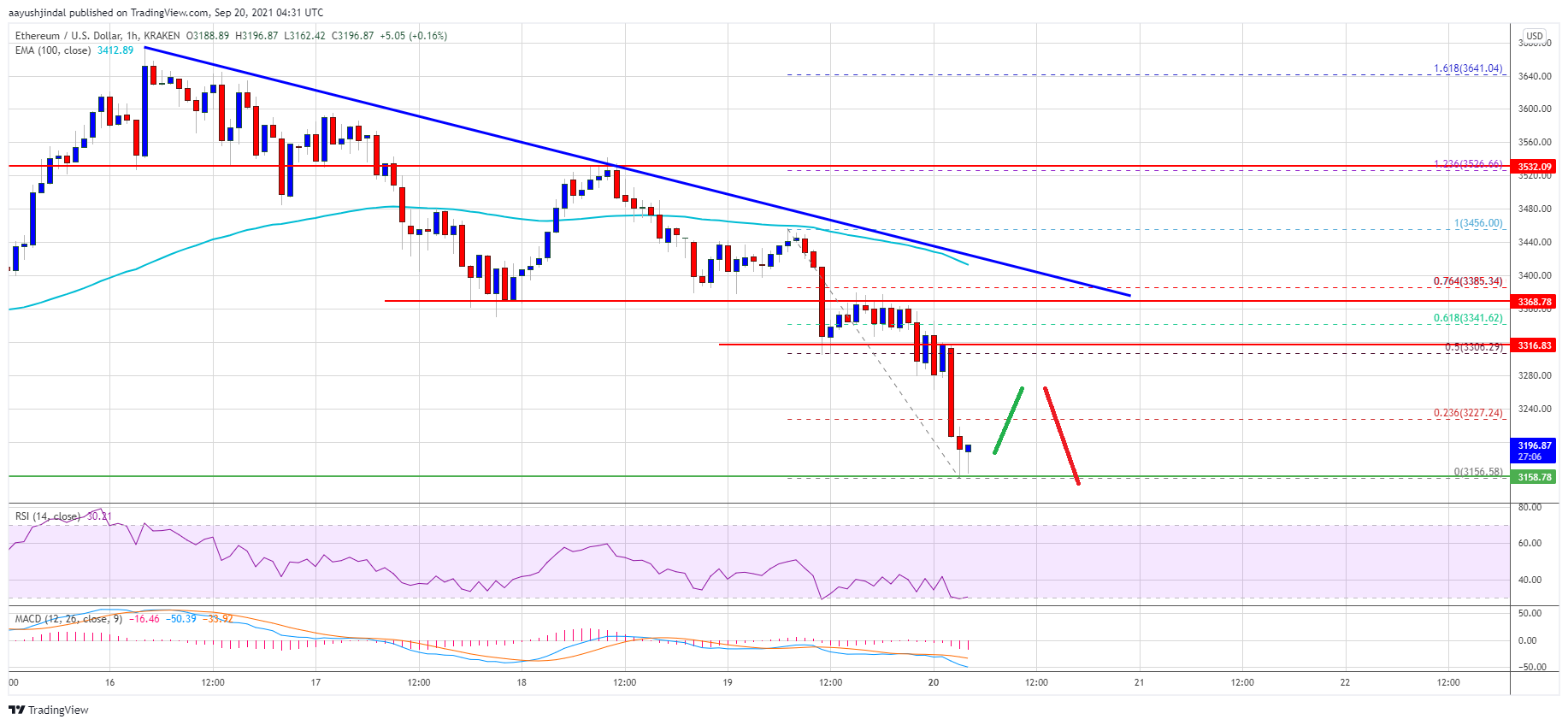
Ethereum started another decline below the $3,400 support zone against the US Dollar. ETH price must stay above $3,150 to avoid more losses in the near term.
Ethereum started a fresh decline from the $3,500 and $3,550 resistance levels.
The price is now trading below $3,300 and the 100 hourly simple moving average.
There is a major bearish trend line forming with resistance near $3,360 on the hourly chart of ETH/USD (data feed via Kraken).
The pair could a steady increase as long as it is above the $3,150 support zone.
Ethereum Price is Eyeing Decent Recovery
Ethereum failed to clear the main $3,500 resistance zone. ETH started a major decline below the $3,400 support zone and the 100 hourly simple moving average, similar to bitcoin.
The price traded below the $3,320 and $3,250 support levels. Finally, ether spiked below $3,200, but the bulls were active near the key $3,150 support zone. A low is formed near $3,156 and the price is now consolidating losses.
An immediate resistance on the upside is near the $3,230 level. It is close to the 23.6% Fib retracement level of the recent drop from the $3,456 high to $3,156 low. The first major resistance is now forming near the $3,320 level (the last key support).
Source: ETHUSD on TradingView.com
The 50% Fib retracement level of the recent drop from the $3,456 high to $3,156 low is also near $3,320. Besides, there is a major bearish trend line forming with resistance near $3,360 on the hourly chart of ETH/USD. A clear break and close above the $3,400 level could start another increase. The next major resistance sits near $3,500.
More Losses in ETH?
If ethereum fails to correct higher above the $3,250 and $3,320 resistance levels, it could start another decline. An initial support on the downside is near the $3,180 level.
The next major support seems to be forming near the $3,150 level. A downside break below the $3,150 support zone could spark a sharp decline. The next major support is near the $3,000 level, below which ether price might decline towards the $2,880 support zone in the near term.
Technical Indicators
Hourly MACD – The MACD for ETH/USD is slowly losing pace in the bearish zone.
Hourly RSI – The RSI for ETH/USD is now well below the 50 level.
One of the reasons behind Bitcoin’s (BTC) volatility, the substantial price oscillations that occur regularly, is the discrepancy of its use cases. Some pundits deem it “digital gold,” a truly scarce and perfect store of value (SoV). Others consider Bitcoin a technology project or a type of software with a corresponding network.
El Salvador’s adoption as legal tender will likely evidence the means of exchange (MoE) functionality that the Lightning Network provides. The Layer-2 scaling solution allows instant and insanely cheap transfers, although it requires regular on-chain transactions to enter or exit this parallel network.
As these narratives about Bitcoin shift over time, so does BTC’s correlation to traditional assets. For example, there have been sustained periods of a strong correlation with gold.
Bitcoin vs. gold (precious metal) in 2020. Source: TradingView
The March 2020 crash was devastating for almost every asset class, but the recovery pattern that followed those six or seven months was virtually identical for gold and Bitcoin. Curiously, the opposite movement occurred in 2021, displaying an inverse correlation between the two assets.
Is Bitcoin a tech stock proxy?
On the other hand, Bitcoin started to mimic the Hong Kong stock market, as measured by the Hang Seng Index (HSI). Among its top constituents are Tencent, Alibaba, and Meituan, which are billion-dollar Asian technology companies.
Bitcoin vs. Hang Seng Index (stocks). Source: TradingView
This shift in investors’ perspective — from tracking gold price to tech stocks — begs one the question of whether Bitcoin will succumb to the Hang Seng downward movement seen in the past 90 days. Does it make sense to decouple right now? If so, will Bitcoin continue to act as a safe haven amid a general correction?
On Sept. 14, China’s second-largest property developer, Evergrande Group, announced that a significant decline in sales forced the company to postpone payments over its debt. This single company has over $300 billion in liabilities, which and according to analysts this could severely impact the broader market.
In August, China’s retail sales disappointed at 2.5% versus the previous year, where investors expected a 7% growth rate. Obviously, growth and the economy were heavily impacted in 2020 by governments’ reaction to the Covid-19 outbreak.
However, one must consider that the most influential Central Banks have been practicing near zero or even negative interest rates since the Q1 of 2020. Thus, if the economy fails to gain momentum amid multiple trillion-dollar stimulus packages, there’s not much that can be done to prevent a generalized stock market correction and potential losses on debt markets.
The problem is: Bitcoin might be 12 years old, but it has never faced a significant economic crisis, at least nothing that puts the $250 trillion-plus global debt markets at risk. Therefore, any analysis or estimate will unlikely yield a credible assessment.
Bitcoin might be less impacted by a market meltdown
However, the cryptocurrency has an edge over traditional markets like commercial real estate, stocks, and bonds. Lenders will foreclose on these assets if clients default on their payments, and this adds further pressure because the bank or institution has no interest in keeping them.
On the other hand, generally speaking, Bitcoin and cryptocurrencies cannot be used as collateral.
Regarding the billion-dollar Bitcoin futures liquidations on derivatives markets, those are just synthetic instruments. Undoubtedly these events will impact the price, but at the end of the day, the effective BTC stays at the derivatives’ exchange. It solely moves from the long (buyer) balance to the short (seller) account.
Until Bitcoin becomes fully entrenched in financial markets and accepted as collateral and deposits, the mid-term systemic risk for the cryptocurrency is lower than the traditional market.
The views and opinions expressed here are solely those of the author and do not necessarily reflect the views of Cointelegraph. Every investment and trading move involves risk. You should conduct your own research when making a decision.
One of the familiar themes seen in previous crypto market cycles is the shifting market caps, popularity and ranking of the top 10 projects that see significant gains during bull phases, only to fade into obscurity during the bear markets. For many of these projects, they follow a recognizable boom-to-bust cycle and never return to their previous glory.
During the 2017–2018 bull market and initial coin offering (ICO) boom, which was driven by Ethereum network-based projects, all manner of small smart contract-oriented projects rallied thousands of percentage to unexpected highs.
During this time, projects like Bitcoin Cash (BCH), Litecoin (LTC), Monero (XMR) and ZCash (ZEC) also rotated in and out of the top 10 ranking, but to this day, investors still argue about which project actually presents a “useful” use case.
While all of these tokens are still unicorn-level projects with billion-dollar valuations, these large-cap megaliths have fallen far from their previous glory and now struggle to stay relevant in the current ecosystem.
Let’s take a look at a few of the current projects that threaten to unseat these dinosaur tokens from their perch.
Dollar-pegged stablecoins take the stage as the most “transactable” currency
Bitcoin’s (BTC) original use case stipulated that it would simplify the process of conducting transactions, but the network’s “slow” transaction time and the cost associated with sending funds makes it a better store of value than a medium of exchange when the other blockchain networks are considered as options.
Terra (LUNA), a protocol focused on creating a global payment structure through the use of fiat-pegged stablecoins, has emerged as a possible solution to the issues faced when trying to use the top proof-of-work (PoW) projects as payment currencies.
The main token used for transacting value on Terra aside from LUNA is TerraUSD (UST), a U.S. dollar-pegged algorithmic stablecoin that forms the basis of Terra’s decentralized finance (DeFi) ecosystem. The market cap of UST has steadily been increasing throughout 2021 as activity and the number of users in the ecosystem increased.
UST supply changes. Source: SmartStake
The recent addition of Ether (ETH) as a collateral choice for minting UST on Anchor protocol has given token holders a way of accessing the value in their Ether without having to sell and create a taxable event.
This opens the possibility for other tokens such as BTC to be utilized as collateral to mint UST that can be used in everyday purchases.
As it stands, the borrowing APR for UST on Anchor stands at 25.85%, while the distribution APR is at 40.67%, meaning users who borrow UST against their LUNA or Ether actually earn a yield while borrowing against their tokens.
From privacy coins to privacy protocols
Privacy is also a cornerstone characteristic of the cryptocurrency sector and privacy-focused projects like XMR and ZEC offer obfuscation technologies that support covert or what, for a time, were thought to be untraceable transactions.
Unfortunately, regulatory concerns have made it more challenging for users to access these tokens, as many exchanges have delisted them for fear of drawing the ire of regulators and the overall demand among crypto users has declined alongside their availability.
Their lack of smart contract capabilities has also limited what these protocols are capable of and, so far, users do not appear to be too excited about utilizing Wrapped Monero (WXMR) for use in DeFi, as the token loses its privacy capabilities in the process.
These limitations have led to the development of privacy-focused protocols such as the Secret Network, which allows users to create and use decentralized applications (DApps) in a privacy-preserving environment.
Privacy features are not common among smart contract capable platforms in the crypto ecosystem, which makes Secret something of an experimental case in the ever-evolving Web 3.0 landscape.
Decentralized applications on the Secret Network. Source: Secret
Secret is also part of the Cosmos ecosystem which means it can utilize the Inter-blockchain Communication (IBC) protocol to seamlessly interact with other protocols in the ecosystem.
The network’s native SCRT can be used as the value transfer medium on the platform as well as to interact with protocols that operate on the network, including Secret DeFi applications and the network’s NFT offering, Secret Heroes.
New enterprise solutions aren’t better but they come without controversy
One of the ways cryptocurrency projects sought to differentiate themselves from the “medium of exchange” label was to offer enterprise solutions as a way to help corporations navigate the transition to a blockchain-based infrastructure.
XRP and Stellar (XLM) are two of the veteran protocols that fit this bill, but continual controversy and slow development has resulted in these early movers now playing catch up with newer networks that also don’t have the legal controversy that has followed Ripple for years.
Hedera Hashgraph has emerged as a competitor in this field and data shows that the network is capable of processing more than 10,000 transactions per second (TPS), with an average transaction fee of $0.0001 and a time to finality of 3-5 seconds.
These statistics are comparable to both XRP and XLM, which have indicated that their ledgers reach consensus on all outstanding transactions every 3-5 seconds with an average transaction cost of 0.00001 XRP/XLM.
Hedera is also smart contract capable, meaning users can create both fungible and nonfungible tokens, and developers can build decentralized applications to accompany the network’s decentralized file storage services.
For each sector (stablecoins, privacy and enterprise solutions), the main difference between the old-school and next-generation projects has been the introduction of smart contract capabilities and plans to develop within the side-chain and DeFi sectors where the top protocols exist. This gives newer projects additional utility, allowing them to meet the demand of investors and developers, thus increasing their token values and market caps as a result.
With smart contracts, the ability to interact with the growing DeFi landscape comes built-in, whereas the legacy tokens like LTC, XMR and BCH require special wrapping services which insert middlemen and thus insert additional fees, rigor and risk into the process.
Newer protocols have also embraced the more eco-friendly proof-of-stake consensus model that aligns with the larger global shift toward environmental awareness and sustainability. A plus is that holders can also stake their tokens directly on the network for a yield.
It remains to be seen if the slow march of time will eventually lead to a capital migration from older large cap projects to the newer generation protocols or if these legacy blue-chips will find a way to evolve and survive into the future.
Want more information about trading and investing in crypto markets?
The views and opinions expressed here are solely those of the author and do not necessarily reflect the views of Cointelegraph.com. Every investment and trading move involves risk, you should conduct your own research when making a decision.
There is no greater fear for cryptocurrency investors than one day forgetting the password to their blockchain wallets, seeing how their own money is right in their hands but still locked away forever from them. If this has happened to you, however, don’t lose hope. There are ways to recover a lost blockchain wallet password, as explained by a leading expert at wallet recovery with years of experience from KeychainX.
Step by Step Guide for Recovering a Lost Blockchain Wallet Password
Blockchain has over 76 million wallets created since its inception in 2011, and many users might have lost their passwords in the passing decade. But if Blockchain.com support will not help you recover your password, what other options do you have? Luckily, Robert Rhodin, the CEO of KeychainX and an expert in the field of wallet recovery, has written a complete step by step guide to help you with the process of recovering it yourself.
Lost your blockchain wallet password?
First, if you forget your password but remember what email you used for creating your wallet, you are able to request they send you all wallets ever created with that address. The link for that service as well as all the upcoming services and software tools you will need to download are all in the guide.
If you are not able to remember the email there are several other options to recover the encrypted wallet. It is possible to use btc recover, an open source Bitcoin wallet password and seed recovery tool, to download the encrypted backup. In order to do this, you will need to install a number of python libraries and be a bit familiar with the command prompt as it has no graphical user interface. If you have a wallet.aes.json backup and do not remember the wallet ID, it is possible to import the wallet into a new Blockchain.com wallet.
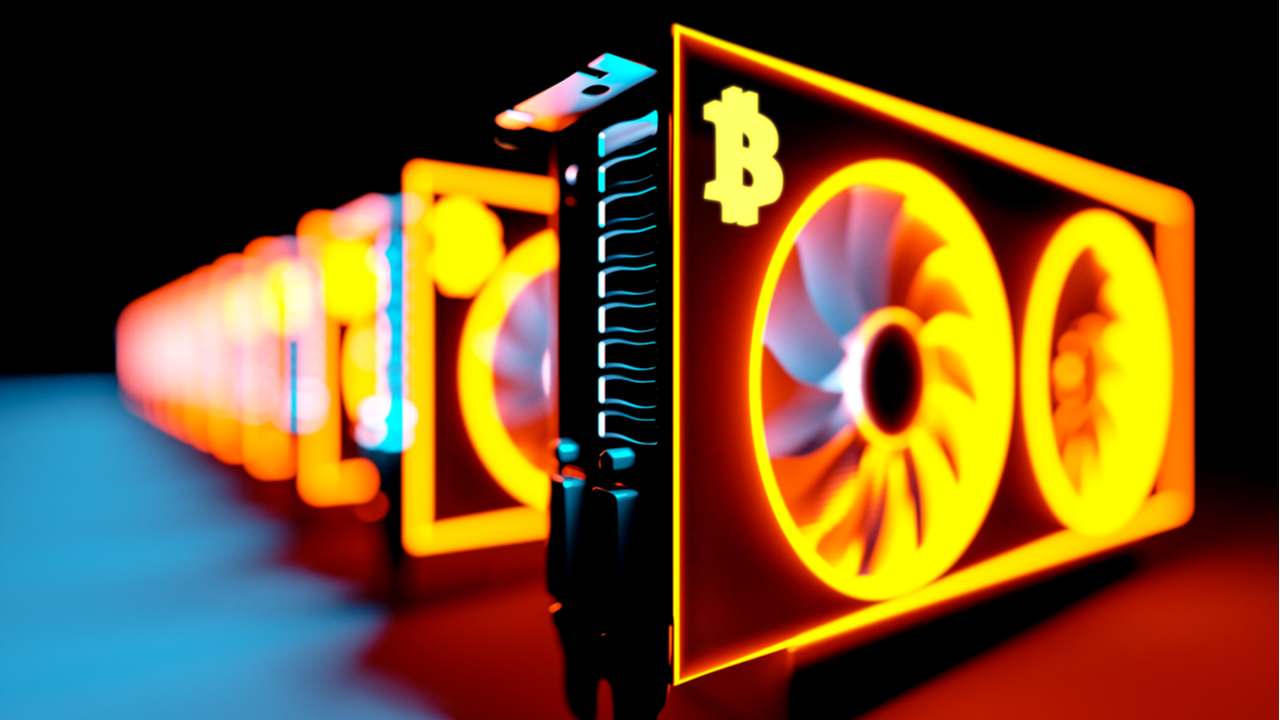
Finally, if you have created a second password on your wallet you would be able to use a “brute force” method to crack the password. For this you will need a GPU rig (with one or more NVIDIA or AMD video cards) which is able to try thousands of different passwords per second. In addition to owning GPU cards, you need to use a software tool like hashcat to run the password cracking for you.
If you are still not able to find any password, you could use a bunch of different word lists repositories. Make sure you have plenty of memory space and bandwidth as many of these word lists are 10 to 30GB in size. As you can see, one will need some programming skills and relevant hardware to attempt a wallet recovery. Remember that if all this seems to much for you, there are professional services like KeychainX that will for a fee help you recover your lost Blockchain.com or Blockchain.info wallet.
KeychainX Can Even Recover Blockchain Wallets With 15,17,19 or 21 Mnemonic Words
If you are not yet familiar with KeychainX, it is a bitcoin wallet recovery service operating since 2017. The company recovered wallet keys for many clients from all over the world and you can see some of their raving reviews on Trustpilot where KeychainX has an almost perfect 4.9 ‘Excellent’ score. Read this recent article about how it unlocks different types of wallets and here about specifically recovering keys from Multibit Classic or Multibit HD.
The service covers all kinds of situations such as recovering lost Bitcoin wallets from wallet.dat files, Dogecoin wallet passwords, blockchain second or first passwords, Android wallet or spending PIN, Ethereum from JSON files, and Ethereum presale wallets. KeychainX can even decrypt your blockchain.info 15,17,19 or 21 word mnemonic seed that is no longer supported by blockchain.com itself.
A GPU rig hard at work
KeychainX has shared a client success story that shows how it recovered an old blockchain.info wallet with more than a 12 words story mnemonic seed – something many people mistakenly think is impossible. The client only remembered 17 words out of his mnemonic seed which was used to backup the wallet, and the team had to use a combination of brute force and a lot of “source code archeology” to recover the funds from the no longer supported wallet. The story also shows the lengths that KeychainX is willing to go to for its clients and the amazing ingenuity that is sometimes needed in the process.
To learn more about the company visit KeychainX.io or just send an email to KeychainX@protonmail.com if you need to talk about password recovery.
This is a sponsored post. Learn how to reach our audience here. Read disclaimer below.
Image Credits: Shutterstock, Pixabay, Wiki Commons
Disclaimer: This article is for informational purposes only. It is not a direct offer or solicitation of an offer to buy or sell, or a recommendation or endorsement of any products, services, or companies. Bitcoin.com does not provide investment, tax, legal, or accounting advice. Neither the company nor the author is responsible, directly or indirectly, for any damage or loss caused or alleged to be caused by or in connection with the use of or reliance on any content, goods or services mentioned in this article.
Starting today, Horizen (ZEN) is available on Coinbase.com and in the Coinbase Android and iOS apps. Coinbase customers can now trade, send, receive, or store ZEN in most Coinbase-supported regions, with certain exceptions indicated in each asset page here. Trading for these assets is also supported on Coinbase Pro.
Horizen (ZEN) is a blockchain ecosystem that enables privacy-preserving decentralized applications. Using ZEN as its native asset, Horizen has both a main blockchain and a sidechain platform that enables developers to build custom private or public blockchains and decentralized applications.
One of the most common requests we hear from customers is to be able to buy and sell more cryptocurrencies on Coinbase. We announced a process for listing assets, designed in part to accelerate the addition of more cryptocurrencies. We are also investing in new tools to help people understand and explore cryptocurrencies. We launched informational asset pages (see ZEN), as well as a new section of the Coinbase website to answer common questions about crypto.
Customers can sign up for a Coinbase account here to buy, sell, convert, send, receive, or store e Coinbase Android and iOS apps. Coinbase customers can now trade, send, receive, or store ZEN today.
Please note: Coinbase Ventures may be an investor in the crypto projects mentioned here, and additionally, Coinbase may hold such tokens on its balance sheet for operational purposes. A list of Coinbase Ventures investments is available at https://ventures.coinbase.com/. Coinbase intends to maintain its investment in these entities for the foreseeable future and maintains internal policies that address the timing of permissible disposition of any related digital assets, if applicable. All assets, regardless of whether Coinbase Ventures holds an investor or Coinbase holds for operational purposes, are subject to the same strict review guidelines and review process.
This website contains links to third-party websites or other content for information purposes only (“Third-Party Sites”). The Third-Party Sites are not under the control of Coinbase, Inc., and its affiliates (“Coinbase”), and Coinbase is not responsible for the content of any Third-Party Site, including without limitation any link contained in a Third-Party Site, or any changes or updates to a Third-Party Site. Coinbase is not responsible for webcasting or any other form of transmission received from any Third-Party Site. Coinbase is providing these links to you only as a convenience, and the inclusion of any link does not imply endorsement, approval or recommendation by Coinbase of the site or any association with its operators.
Crypto is a new type of asset. Besides potential day to day or hour to hour volatility, each crypto asset has unique features. Make sure you research and understand individual assets before you transact.
All images provided herein are by Coinbase.
Horizen (ZEN) is now available on Coinbase was originally published in The Coinbase Blog on Medium, where people are continuing the conversation by highlighting and responding to this story.
Interoperability has become one of the driving themes within the crypto market and as the blockchain ecosystem evolves into an interconnected web of layer-one protocols, the importance of communication and efficiency among decentralized applications (dApps) will also increase.
Ren (REN), a blockchain protocol designed to provide interoperability and liquidity between different blockchain platforms, has started gaining traction over the past month and a half as activity in the decentralized finance (DeFi) sector has been on the rise.
Data from Cointelegraph Markets Pro and TradingView shows that after reaching a low of $00.41 on Aug. 9, the price of REN has climbed 185% to a daily high at $1.16 on Sept. 15 as its 24-hour trading volume spiked 443% to $673 million.
REN/USDT 1-day chart. Source: TradingView
Three reasons for the price growth seen in REN include the steadily increasing activity and total value locked on RenVM, the launch of a bridge to Arbitrum and the release of RenVM Greycore on the network’s testnet.
Rising volume and total value locked
REN’s bullish momentum can be found in the data for the total network volume and total value locked (TVL).
Total network volume and total value locked on Ren. Source: Ren Project
As 2021 progressed, new chains were added to the list of bridges supported, which now includes Ethereum, Binance Smart Chain, Solana, Polygon, Fantom, Avalanche and Arbitrum.
Each new bridge has helped to increase the volume and TVL on the Ren network, which has coincided with moves seen in REN p.
REN price follows the Bridge to Arbitrum
The spike in price seen on Sept. 15 was due, in large part, to the release of the Arbitrum bridge, an Ethereum (ETH) layer-two scaling solution Arbitrum, which is designed to host popular decentralized applications in a fast, low-fee environment.
The Ethereum network has been plagued by high fees and delayed transaction times, which have hampered the ability of many users to use DeFi or nonfungible token (NFT) related protocols on the network.
Arbitrum’s low-cost environment has proven to be an attractive DeFi environment for BTC holders who are now able to migrate to the layer-two solution and interact on the network with renBTC.
The total value locked on Arbitrum via the Ren protocol was $7.75 million as of Sept. 15 and is represented by the green line in the value locked chart above.
Related: Solana and Arbitrum knocked offline, while Ethereum evades attack
REN marches toward decentralization
A third reason behind the increase in activity for REN was the release of RenVM Greycore on the network’s testnet on Sept. 13, a move that was done as the project works toward its goal of full decentralization.
Greycore is a semi-decentralized validator set of nodes that are operated by reputable DeFi projects and it helps to add an additional layer of protection for the protocol.
The first project to join Greycore was BadgerDAO, a DeFi project focused on building projects that bring BTC to DeFi.
According to data from Cointelegraph Markets Pro, market conditions for REN have been favorable for some time.
The VORTECS™ Score, exclusive to Cointelegraph, is an algorithmic comparison of historical and current market conditions derived from a combination of data points including market sentiment, trading volume, recent price movements and Twitter activity.
VORTECS™ Score (green) vs. REN price. Source: Cointelegraph Markets Pro
As seen on the chart above, the VORTECS™ Score for REN turned green on Sept. 13 and climbed to a high of 71 on Sept. 14 just as the price of REN began to increase 72% over the next two days.
The views and opinions expressed here are solely those of the author and do not necessarily reflect the views of Cointelegraph.com. Every investment and trading move involves risk, you should conduct your own research when making a decision.
Starting today, Shiba Inu (SHIB) is available on Coinbase.com and in the Coinbase Android and iOS apps. Coinbase customers can now trade, send, receive, or store SHIB in most Coinbase-supported regions, with certain exceptions indicated in each asset page here. Trading for these assets is also supported on Coinbase Pro .
Shiba Inu (SHIB) is a token that aspires to be an Ethereum-based alternative to Dogecoin (DOGE), the popular memecoin. Unlike Bitcoin, which is designed to be scarce, SHIB is intentionally abundant — with a circulating supply of one quadrillion. The Shiba Inu Token ecosystem supports projects such as an NFT art incubator and the development of a decentralized exchange called Shibaswap.
One of the most common requests we hear from customers is to be able to buy and sell more cryptocurrencies on Coinbase. We announced a process for listing assets, designed in part to accelerate the addition of more cryptocurrencies. We are also investing in new tools to help people understand and explore cryptocurrencies. We launched informational asset pages (see SHIB), as well as a new section of the Coinbase website to answer common questions about crypto.
Customers can sign up for a Coinbase account here to buy, sell, convert, send, receive, or store e Coinbase Android and iOS apps. Coinbase customers can now trade, send, receive, or store SHIB today.
###
Please note: Coinbase Ventures may be an investor in the crypto projects mentioned here, and additionally, Coinbase may hold such tokens on its balance sheet for operational purposes. A list of Coinbase Ventures investments is available at https://ventures.coinbase.com/. Coinbase intends to maintain its investment in these entities for the foreseeable future and maintains internal policies that address the timing of permissible disposition of any related digital assets, if applicable. All assets, regardless of whether Coinbase Ventures holds an investor or Coinbase holds for operational purposes, are subject to the same strict review guidelines and review process.
This website contains links to third-party websites or other content for information purposes only (“Third-Party Sites”). The Third-Party Sites are not under the control of Coinbase, Inc., and its affiliates (“Coinbase”), and Coinbase is not responsible for the content of any Third-Party Site, including without limitation any link contained in a Third-Party Site, or any changes or updates to a Third-Party Site. Coinbase is not responsible for webcasting or any other form of transmission received from any Third-Party Site. Coinbase is providing these links to you only as a convenience, and the inclusion of any link does not imply endorsement, approval or recommendation by Coinbase of the site or any association with its operators.
Crypto is a new type of asset. Besides potential day to day or hour to hour volatility, each crypto asset has unique features. Make sure you research and understand individual assets before you transact.
All images provided herein are by Coinbase.
Shiba Inu (SHIB) is now available on Coinbase was originally published in The Coinbase Blog on Medium, where people are continuing the conversation by highlighting and responding to this story.
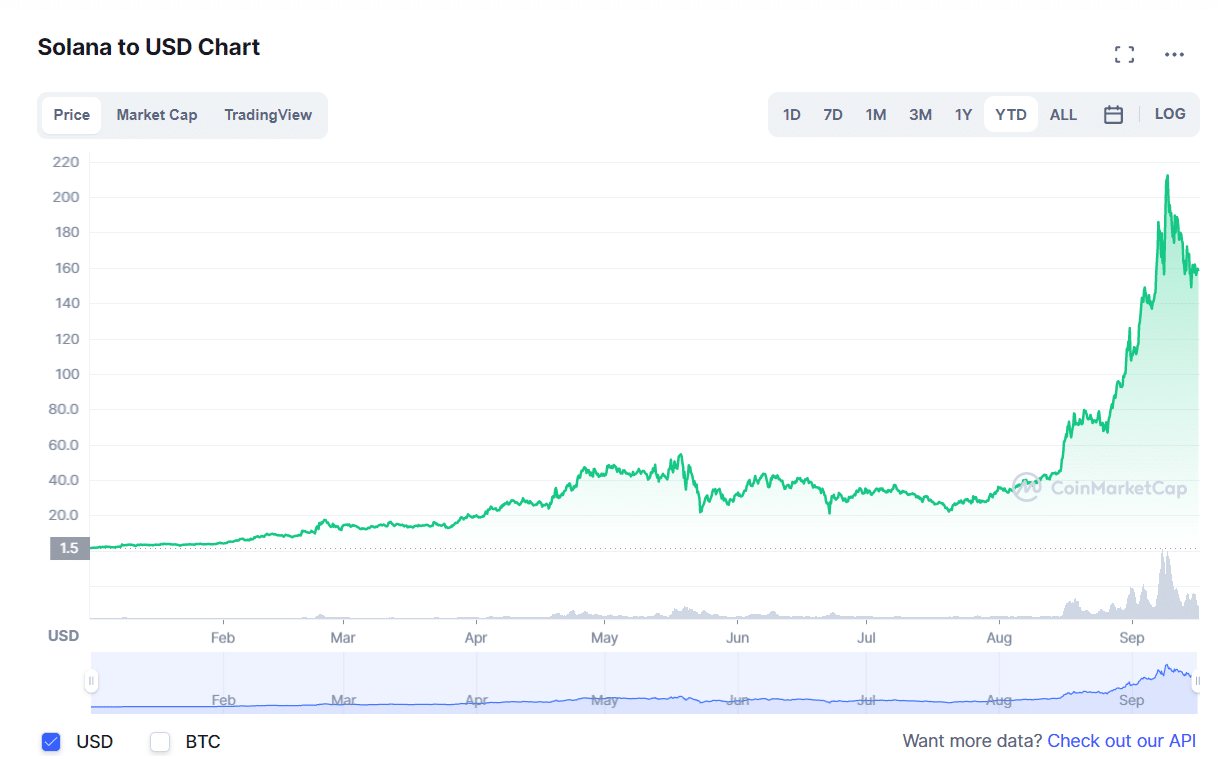
Not many retail and institutional investors heard about Solana (SOL) before 2021. The cryptocurrency hardly saw any substantial gains during the second half of 2020. However, Solana’s popularity skyrocketed in 2021 as the digital asset saw immense demand from retail and institutional investors.
The latest data posted by Coinmarketcap shows that Solana gained nearly 10,500% in 2021, which makes it the best performing digital currency among the top 10. SOL started this year at a price level of just $1.5 and touched an all-time high of approximately $210 on 9 September 2021. Solana’s trading volume and the overall network activity have increased substantially in the last few months.
Coinmarketcap
The most surprising part of the latest rally in Solana is the interest of institutional investors in the world’s 7th largest cryptocurrency. Last week, SOL investment products attracted $50 million worth of institutional inflows, which is more than the combined weekly inflows of Bitcoin, Ethereum, Cardano, Polkadot and XRP investment products.
So, what is the main reason behind Solana’s enormous rally in 2021? Crypto analysts believe that the technology behind Solana is better than most of its competitors and that is why Solana’s adoption has increased significantly in the last few months. Secondly, the fear of missing out (FOMO) is playing a major role in the recent surge in SOL’s demand.
Solana’s Technical Advantages
Maria Stankevich, Chief Business Development Officer at EXMO UK, believes that Solana’s high speed and low cost of the transaction are playing an important role in its global adoption. “To be honest, before the Solana project, we heard many times about so-called ‘Ethereum killers’. Cardano, Polkadot: they all tried to solve challenges ETH faced. ETH is still the absolute champion in the Defi world. However, the Ethereum network is trying to solve massive problems of the network overload which makes it impossible to scale the network to millions of the users since the commissions are rocketing to the roof,” Stankevich said.
Suggested articles
The Rising Star of the DeFi Project, GIBXSwap, Passes CertiK Security AuditGo to article >>
“Solana claims that its blockchain can support more than 50 000 transactions per sec (TPS) which makes it the fastest blockchain ever. In comparison, it’s 3000 times faster than ETH (15 TPS). Also, the average time of the block is 400-800 msec, and the average commission for a transaction is 0.000005 SOL (less than a cent!). Another secret of Solana is a new protocol Proof-of-History, that allows the unprecedented traffic possibility,” she added.
“So, the main advantages that influenced the price surge are: the high speed and low cost of the transactions, a more eco-friendly blockchain, the possibility of scalability (without the sharding and 2 level solutions), numerous partner relations inside of the network, a focus on the dapps in the Defi system, the experienced team, listing on many exchanges, the possibility to earn with staking, and security,” Stankevich explained.
FOMO
Finance Magnates also asked Johnny McCamley, Founder of CryptoClear, about his views on the latest price movement of SOL and the key advantages of the Solana blockchain. McCamley mentioned that the strong fundamentals of Solana blockchain and FOMO among retail and institutional investors are driving its price rally.
“Solana is an excellent investment for the long term- 1 of the 15 projects that we, at CryptoClear, include in our Dollar Cost Averaging plan (DCA Plan) for the long term due to the team, tech maturity and real-life use case. Solana ensures composability between ecosystem projects by maintaining a single international state as the network scales. Never deal with fragmented Layer 2 systems or sharded chains. Low cost, forever-Solana’s scalability ensures transactions remain less than $0.01 for both developers and users. Fast, forever-Solana is all about speed, with 400 millisecond block times. And as hardware gets faster, so does the network,” McCamley mentioned.
“One of the major reasons behind its recent price surge is FOMO (Fear of Missing Out). Those who do not own SOL and other crypto assets will have the fear that they have ‘missed the boat’ and start investing as soon as they can,” he added.
Starting today, Braintrust (BTRST) is available on Coinbase.com and in the Coinbase Android and iOS apps. Coinbase customers can now trade, send, receive, or store BTRST in most Coinbase-supported regions, with certain exceptions indicated here. Trading for these assets is also supported on Coinbase Pro.
Braintrust (BTRST) is an Ethereum token that powers Braintrust, a decentralized talent network connecting freelancers with organizations. BTRST is used to govern the network and also as an incentive to refer new users.
One of the most common requests we hear from customers is to be able to buy and sell more cryptocurrencies on Coinbase. We announced a process for listing assets, designed in part to accelerate the addition of more cryptocurrencies. We are also investing in new tools to help people understand and explore cryptocurrencies. We launched informational asset pages (see BTRST), as well as a new section of the Coinbase website to answer common questions about crypto.
Customers can sign up for a Coinbase account here to buy, sell, convert, send, receive, or store COTI today.
Please note: Coinbase Ventures may be an investor in the crypto projects mentioned here, and additionally, Coinbase may hold such tokens on its balance sheet for operational purposes. A list of Coinbase Ventures investments is available at https://ventures.coinbase.com/. Coinbase intends to maintain its investment in these entities for the foreseeable future and maintains internal policies that address the timing of permissible disposition of any related digital assets, if applicable. All assets, regardless of whether Coinbase Ventures holds an investor or Coinbase holds for operational purposes, are subject to the same strict review guidelines and review process.
This website contains links to third-party websites or other content for information purposes only (“Third-Party Sites”). The Third-Party Sites are not under the control of Coinbase, Inc., and its affiliates (“Coinbase”), and Coinbase is not responsible for the content of any Third-Party Site, including without limitation any link contained in a Third-Party Site, or any changes or updates to a Third-Party Site. Coinbase is not responsible for webcasting or any other form of transmission received from any Third-Party Site. Coinbase is providing these links to you only as a convenience, and the inclusion of any link does not imply endorsement, approval or recommendation by Coinbase of the site or any association with its operators.
Crypto is a new type of asset. Besides potential day to day or hour to hour volatility, each crypto asset has unique features. Make sure you research and understand individual assets before you transact.
All images provided herein are by Coinbase.
Braintrust (BTRST) is now available on Coinbase was originally published in The Coinbase Blog on Medium, where people are continuing the conversation by highlighting and responding to this story.