[ad_1]

In the recent live streamed AMA hosted by next generation mobile crypto cold wallet ELLIPAL, increasingly popular smart yield optimizer…
Continue reading on Medium »
[ad_2]
Source link

[ad_1]
In the recent live streamed AMA hosted by next generation mobile crypto cold wallet ELLIPAL, increasingly popular smart yield optimizer…
Continue reading on Medium »
[ad_2]
Source link
[ad_1]
For many people, financial technology is somewhat incidental. It is a passing part of daily life: we interact with fintech when we send money online, check our bank balances with our mobile phones, or use an app to buy cryptocurrency.
However, for much of the world fintech is so much more. Financial technology can and will play an important role in the ways that societies develop. With the advent of internet accessibility, fintech is reaching a larger group of people than ever before.
Bank Account Alternative. Business Account IBAN.
Here are some of the most important ways that fintech itself is changing, and that fintech is changing the world.
In the earlier days of financial technology, systems architecture was often created in a monolithic fashion: systems were built as a single unit, only alterable by making changes to the source code. In some cases, this kind of design meant that if part of a financial services system went down, the entire thing could be compromised.
Microservice architecture was designed to make digital financial services more flexible and secure. This kind of system design breaks down monolithic structures into smaller, independent services that can be deployed for specific purposes.
For example, an older system design could consist of a payments service, a credit auditing service, and an international money transfer mechanism that were all combined into a single piece of software. If the company that operated the software wanted to change the credit auditing service, it would have to update the entire system at once.
However, with a microservice architecture, the payments service, a credit auditing service, and an international money transfer mechanism could still operate within the same ecosystem as separate, independent entities. Therefore, if the system operator wanted to make changes to the credit auditing service, it could do so without disturbing any of the other pieces of the system.
While this architectural concept can be applied in the world of centralized financial services, it seems to borrow from the concept of ‘money legos’ that came from the decentralized finance (DeFi) sphere.
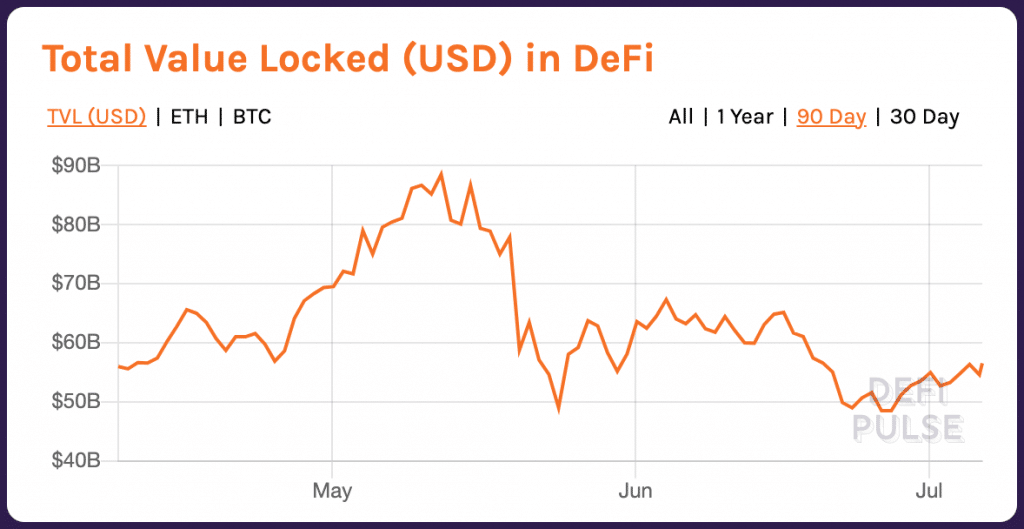
Seven months into 2021, decentralized finance is bigger than it has ever been. At the beginning of the year, the total value locked (TVL) in the DeFi ecosystem was equivalent to roughly $20 billion; today, DeFi’s TVL is roughly $56 billion. At its peak in May, the TVL was roughly $90 billion.
As the size of the DeFi ecosystem continues to grow, so too have the number of DeFi use cases. DeFi platforms have been built for asset management, digital identity, insurance, derivatives, synthetics assets, digital asset exchanges, analytics, risk management tools and more.
Because of the risks associated with many decentralized finance platforms, institutional players have largely stayed out of the DeFi world. Therefore, the vast majority of DeFi’s growth has come from retail users and investors.
However, some platforms are taking steps to create the infrastructure to support the entrance of institutional players into DeFi. For example, DeFi lending platform Aave announced earlier this week that it will be launching Aave Pro, a permissioned platform that will support institutional usage. Aave said that the launch is coming in response to ‘extensive demand from various institutions’.
Artificial intelligence and machine learning have a variety of use cases across financial technology. However, one of the most prominent use cases is monitoring, analyzing and predicting customer behavior. For example, AI can be used to determine how and when users of an online banking service might run into technical trouble, and then offer assistance through a chatbot.
Swiss Fintech Set to Change the Landscape of Isolated Financial ServicesGo to article >>
The use of AI and machine learning is expected to continue to grow with regard to financial regulations and policy compliance, algorithmic trading and fraud detection. AI systems can also play an important role in financial institutions’ anti-money laundering and counter-terrorism operations.
According to Planet Compliance, “the sectors that are expected to be most affected include insurance, financial data, asset management, decentralized exchanges and lending.”
The climate crisis has wreaked havoc in much of the world, and many new areas that were previously unaffected by climate change have recently undergone serious incidents. For example, the Pacific Northwest is currently in the midst of the worst heat waves in recorded history.
As a result, everyone is expected to do their part in the battle against climate catastrophe. This has touched the financial world in a fairly significant way: for example, some cryptocurrencies have been under fire this year for their heavy energy consumption.
Therefore, it is likely that financial technology companies across the board will be increasingly expected to demonstrate their sustainability initiatives.
Fintech companies and financial institutions may be held to a higher standard in terms of who they do business with. Dr Thomas Puschmann, Director Swiss FinTech Innovation Lab, said in a recent interview with Finance.Swiss that for example, in the lending sector, “[banks] need to know what firms are investing in sustainable solutions for the future.”
However, there are some significant challenges in terms of sustainability data collection that could guide the decision-making process of many fintech firms and banks.
“Take, for example, the value chain of a company. Today, we know the greenhouse gas emissions that a firm emits, these so-called Scope 1 emissions and Scope 2 emissions. Scope 1 are the ones that come out of your house; Scope 2 are the ones that you purchase in the form of energy from your energy provider; but Scope 3 emissions, which very often make up to 75 percent of all greenhouse gas emissions, come from anywhere in the supply chain that you can’t control and don’t even know it.”
“So you need data for that to decide if you want to lend money to such a firm,” he said.
Cryptocurrency and decentralized finance have long been slated as technologies that can provide financial services and opportunities to users in developing markets. However, the opportunity to take root in emerging economies is open to fintech companies.
In 2021, there has been massive unmet demand for financial services in the developing world. At the same time, the number of smartphone holders in emerging markets is continuing to increase This presents an important opportunity for fintech companies that can provide mobile-based services to users in untapped markets.
In an article entitled “Fintech and Sustainable Development: Assessing the Implications,” authors Juan Carlos, Castilla-Rubio, Nick Robins and Simon Zadek said that financial technology can support the growth of developing markets by “[unlocking] greater financial inclusion by reducing the costs for payments and providing better access to capital domestically and internationally.”
Moreover, the paper said that fintech can “Provide financial markets with the level playing field and market integrity needed for long-term real economy investments aligned with the sustainable development agenda,” among other things.
These are just a few of the ways that developments in financial technology are changing financial services as we know them.
What are your thoughts on the ways that fintech is impacting the world around you? Let us know in the comments below.
[ad_2]
Source link

[ad_1]
An ex-employee of the now-defunct crypto exchange Cryptopia has admitted in court to stealing crypto worth about $170,000. The employee pled guilty to stealing coins and customer data while he worked at Cryptopia when the company was still up and running.
A name suppression by the Christchurch district court of New Zealand keeps the employee anonymous for the time being. The employee pled guilty to two crimes, namely; theft by a person in a special relationship and theft of more than $1,000.
Related Reading | Robinhood Fined $70M For Causing “Significant Harm” To Customers
The crime was brought to light in 2020 due to complaints from a customer that he had deposited coins into a Cryptopia wallet by mistake. Cryptopia has been through a series of problems in the past. Which is what led to its now-defunct state. The company finally collapsed in 2019.
Cryptopia suffered two devastating hacks that eventually led to it shutting down in 2019. The company was hacked at the beginning of 2021 in January when a hack led to the theft of over 19,000 Ethereum. The crypto was transferred into an unknown wallet. The value of the crypto at the time of the hack in 2019 was $2.3 million. At this point, Cryptopia was serving a global customer base of 1.8 million customers.
Crypto subsequently went into liquidation that year and began the process of shutting down the exchange and mapping out ways for users to get their crypto back.
Bitcoin price loses momentum as it falls back into $33K range | Source: BTCUSD on TradingView.com
Later that year though, the company fell victim to another hack. This time losing about $15 million worth of crypto to the attackers. The hack happened during the liquidation. Somehow attackers were able to access a wallet that had not fallen victim to the hack and transfer the crypto out of that wallet to an unknown wallet. This hack represented about 15% of the company’s holdings of digital assets.
During the liquidation, employees of the company were terminated. But not before an employee had copied private keys and customer data. These he retained after his employment with the company were terminated.
The data available to this single employee reportedly gave him access to over $100 million worth of digital assets.
Having access to the keys, the employee believed that no one would check old transactions during the liquidation. The employee had transferred Bitcoins with the equivalent value of approximately $160,000 out of wallets and over $100,000 worth of other cryptos.
While he was employed at Cryptopia, the employee had made copies of Cryptopia’s private keys and customer data. He stored this on a USB flash drive. Which he then took home and uploaded the data onto his personal computer at home.
Upon finding out that old transactions were in fact going to be reviewed, the employee came forward to admit the theft. According to the employee, he had planned to return the crypto over time. And he had apparently taken the crypto because he was frustrated with the company, Cryptopia.
Related Reading | Bitcoin Whale Warns Of “November 2018 Vibes.” What This Means
The employee also admitted that he had believed he would get away with the theft as he did not think that anyone would go on to check old transactions.
Upon stepping forward, the employee had sought assurance that he would not be persecuted for the offenses. Although he has now been arrested and charged and will remain in jail until his sentencing, which is scheduled for October 20th, 2021.
The crime is unrelated to the Cryptopia hack. The employee has returned some of the cryptos and has promised to pay back the rest over time.
Featured image from PCMag, chart from TradingView.com
[ad_2]
Source link

[ad_1]
Decentralized lending protocol Aave is planning to launch “Aave Pro,” a permissioned platform for institutional investors later this month, according to a new report from Cointelegraph. The platform, which will provide the same kinds of services as Aave’s current platform, will be launched in partnership with the digital asset custody and settlement platform Fireblocks.
The new platform was reportedly announced in a webinar entitled ‘Next Steps in Institutional DeFi’ that featured Stani Kulechov, Michael Shaulov and Mike Novogratz, who are respectively the CEOs of Aave, Fireblocks and Galaxy Digital.
Bank Account Alternative. Business Account IBAN.

According to a screenshot of an email that is said to recap the contents of the webinar, Aave is launching Aave Pro in response to ‘extensive demand from various institutions’. The platform will only support four crypto assets in the beginning: BTC, ETH, AAVE and USDC. Additionally, Aave Pro’s pools will be kept separate from its main platform. Further, the email said that there are plans to eventually decentralized the governance of Aave Pro.
$AAVE Pro coming in July.
For those that didn’t attend the “NExt Steps in Institutional Defi” Zoom with Stani, here’s a recap email I received. pic.twitter.com/ClwlBkXh2r
Suggested articles
How Customer Retention Can Transform Profitability & Brand PerceptionGo to article >>
— Noah (@TraderNoah) July 4, 2021
In addition, Aave Pro will add a whitelisting layer onto Aave’s V2 smart contracts to ensure that only ‘institutions, corporates, and fintechs’ approved by Fireblocks’ Know-Your-Customer verification process can access the platform. Moreover, Fireblocks is responsible for Aave Pro’s anti-money laundering and anti-fraud controls.
Aave Pro is slated to vastly expand the total value locked in the Aave ecosystem, which currently sits at around $17 billion.
According to CoinTelegraph, the announcement of the new platform received ‘mixed reactions’ on Twitter. Some enthusiastic users pointed out that the platform will act as a rail for institutions entering the DeFi world in a meaningful way for the first time.
However, others pointed to an ongoing lawsuit against Fireblocks by staking provider StakeHound. The lawsuit was filed over the alleged deletion of private keys to a wallet that contained $72 million in ETH.
Aave first announced that it was entering the institutional world in May, when Kulechov said that Aave had created a “private pool” for institutions to “practice” with before jumping headfirst into DeFi. Furthermore, Aave partnered with Compound in early 2020 to launch DeFi services for institutional investors.
[ad_2]
Source link

[ad_1]

The Philippine Stock Exchange (PSE) is aiming to be first in line when financial regulators give the green light for crypto asset trading in the country.
On Friday, July 2, CNN reported that PSE president and CEO Ramon Monzon said the local bourse should be the country’s first exchange platform for crypto assets. He stated:
“If there should be any exchange for cryptos, it should be done at the PSE. Why? Number one, it’s because we have the trading infrastructure. But more importantly, we’ll be able to have investor protection safeguards especially with a product like crypto.”
The country’s stock exchange is now awaiting guidelines from the Philippine Securities and Exchange Commission and other financial regulators.
Despite his eagerness to support crypto asset markets, Monzon warned of crypto’s volatility, stating: “instant riches could be instant poverty too.”
Related: Crypto in the Philippines: Necessity is the mother of adoption
Government regulators in the Phillipines began researching regulating crypto asset trading in 2019 when the SEC sought feedback from banks, investors, and the public on whether the country was ready to build a fully-fledged cryptocurrency exchange.
Local demand for digital payments is strong, with as much as 10% of the GDP coming from remittances from an estimated 10 million expatriate Filipinos working overseas.
The Philippines has sought to establish itself as a regional hub for crypto in recent years, opening its Special Economic Zones in Cagayan to crypto firms in 2018.
In January, the central bank established new guidelines for crypto asset service providers after witnessing accelerated growth in the use of digital assets over the past three years.
[ad_2]
Source link
[ad_1]
Polygon has announced the integration of yield optimization vaults on the Maker Network. The blockchain-enabled protocol, formerly referred to as the Matic Chain, tweeted on Wednesday that it “will be opening a vault on Maker” and investing $50M of MATIC tokens as agreed liquidity from the treasury.
With the recent integration, it means the protocol has now broadened in scope, vision, and transformation to become an Ethereum scaling aggregator.
Related Reading | Scaramucci’s Skybridge Capital Launches Ethereum Fund
Such feet, among others, would see the protocol network providing developers with L2 solutions. This will be in addition to the POS/Plasma chain – mainnet, launched in April 2020.
Polygon provides the core components and tools to join the new, borderless economy and society. Two key platforms materialize it: The polygon framework and the Polygon protocol.
With these technologies, any project can quickly spin up a dedicated blockchain network that combines the best features of “stand-alone blockchains (sovereignty, scalability, and flexibility) and Ethereum (security, interoperability and developer experience).”
Plus, these blockchains are friendly with all the existing Ethereum tools such as Metamask, MyCrypto, Remix, etc. So again, the exchange of information among themselves and with Ethereum is facilitated.
Related Reading | Why Terra (LUNA) Will Reward Users With New Community Bounty Program
Summary: Polygon is a blockchain protocol and a framework for creating and connecting Ethereum-compatible blockchain networks.
One is collapsing together scalable solutions on Ethereum and supporting multiple chains in the Ethereum ecosystem.
MATIC, the native token of Polygon, is an ERC-20 token running on the Ethereum blockchain. The tokens are used for payment services on Polygon and as a settlement currency between users who operate within the Polygon ecosystem.

MATIC set to follow an upward trend in the daily chart. Source: MATICUSD Tradingview
This has turned out to be quite positive for the MATIC community as the token as hovering in the green-zone marking 1% of growth at the time of writing this article.
As an integral part of the announcement, $50M of MATIC tokens have been committed by Polygon on the newly opened vault on Maker.
MakerDAO is an organization developing technology for borrowing, savings, and a stable cryptocurrency on the Ethereum blockchain.
It has created a protocol permitting anyone with ETH and a MetaMask wallet to loan themselves money in the form of a stable coin referred to as “DAI.”
Related Reading | Ethereum Upgrades Could Jumpstart $40 Billion Staking Industry, JP Morgan
By integrating loans with a stable currency, MakerDAO typically allows anyone to borrow money and reliably predict how much they had to pay back. This alleviates the fear that used to come in the era of crypto to crypto borrowing.
Polygon board, opening a vault on Maker and committing $50M of MATIC tokens as seed liquidity from the treasury, sincerely thanks the MakerDAO community and team.
They appreciate the effort to quickly process the entire governance activities/polls and their feedback to onboard MATIC as collateral.
“This is a crucial development in Polygon’s long-term vision and commitment to develop the Ethereum scaling landscape and entice the gifted builders and engaged community members,” the board reveals.
Following this, Polygon will be minting DAI, which will invest in the Ethereum ecosystem.
Similarly, there are few other networks opening vaults on polygon technology. Beefy Finance, for instance, launched its first Beefy yield optimizing vault In Polygon on the 28th of April, 2021.
The finance tech is a Decentralized, Multi-Chain Yield Optimizer platform that allows its users to earn compound interest on their crypto holdings. In addition, it has launched a new Ape Swap vault deployed on Polygon.
Despite the attractiveness, there have been some skeptical postures on the project.
Many keen crypto lovers and observers are quarrying that, If approved, would Polygon utilize this class of vault themselves?
Are there any specifically identified users – individual or entity – who have expressed an intention to use this class of vault if MakerDAO onboarded this collateral? Well, for now the MATIC community seems to be appreciating the latest development.
Featured image from Pixabay, chart from TradingView.com
[ad_2]
Source link
[ad_1]
By Casper Sorensen, Vice President, Customer Experience
The following is the latest update in our series of blog posts describing our commitment to continually improving our customer experience.
At Coinbase, we strive to be the most trusted and easy to use platform to help our customers access the cryptoeconomy. We recognize the challenges some of our customers have experienced with their Coinbase accounts, and we want to reiterate that continually improving the customer experience remains a top priority. In my last post, we committed to providing you ongoing updates on the investments we’re making to better serve customers. Since then, we’ve continued to add even more support staff, improve and simplify our products, and identify additional opportunities to serve you more quickly and competently. Here’s an update:
We have recently eliminated our backlog across most queues and have sufficient agent capacity in place to minimize the risk of potential future backlogs. Since January, our customer contact rate (the number of times customers contact customer service divided by the number of monthly transacting users) has been reduced by 70%. Over that same period, we saw our total number of verified users increase from 43 million to 56 million.
But we realize we still have work to do. Here’s what we’re doing to make our customer service even better:
One of the biggest investments we’ve made is in our support staff. We now have more than 3,000 people dedicated to solving customer issues. This represents a more than 5x increase in support staff since January. We’re continuing to hire great people to quickly support our customers’ needs, as well as ensure we’re meeting customers where they are, which includes a growing number of social media platforms.
We’re on track to support customers live, via chat and phone. We’ve already begun rolling out a virtual assistant to help customers navigate common issues, and live chat via messaging is coming later this year. We’re working to offer live phone support in the coming months to assist customers with several issues including account security.
Coinbase takes extensive security measures to ensure your account and cryptocurrency investment remains as safe as possible. In addition, we provide ongoing education and resources for how to protect your accounts from Account Take-Overs — also referred to as “ATOs”. This happens when a bad actor is able to use your login credentials to access your account and perform fraudulent activity. While ATOs have only impacted a very small subset of our customers (a tiny fraction of one percent), we recognized that when they do occur, they can cause stress and confusion for our customers. That’s why we are standing up a phone support team which will guide these customers through the necessary steps to quickly lock down accounts, and restore access.
Our product teams continually ship new features designed to simplify and improve our products, including in-product alerts to provide relevant and useful information to customers. Through systematic customer pain point identification and close collaboration with our engineering team, we’ve been able to further reduce the possibility of high severity issues. For example, we’re implementing two-factor authentication recommendations for users with high balances to provide these users with additional security. By helping our customers avoid potential issues in the first place, we’ve made a meaningful impact on the number of customers coming to customer support for help. Further, we are hyper-focused on making sure our site is stable, ensuring during bull and bear markets you have the ability to buy and sell.
We’re improving our self-service online Coinbase Help resources. The cryptoeconomy continues to rapidly change, with new technologies introduced every week. Through initiatives like Coinbase Learn, we’re committed to helping our customers navigate these changes and our platform of products.
We appreciate your patience as we continue to improve the Coinbase experience for our customers. We will never tire in our pursuit of creating more value for our customers. For support questions, please visit our support page.
Customer Support Improvements at Coinbase was originally published in The Coinbase Blog on Medium, where people are continuing the conversation by highlighting and responding to this story.
[ad_2]
Source link

[ad_1]

As if 2020 didn’t provide enough nail-biting moments, 2021 is shaping up to be quite an interesting year for cryptocurrency. With the price of Bitcoin (BTC) floating around the $35,000 mark, skeptics and pundits are flocking to the streets of social media to celebrate the long-awaited demise of the decentralized economy. Of course, they quite conveniently forgot that the price of Bitcoin has experienced a 533% increase since the third halving happened in May 2020.
Given the number of people claiming the crypto bubble has burst — including former U.S. President Donald Trump — it is almost hard to remember that the price of Bitcoin was hovering between $9,000 and $10,000 a mere 12 months ago.
Since the halving, in fact, decentralized finance (DeFi) has emerged as the most promising sector of the cryptocurrency economy, fueling the adoption of the crypto space. A quick glance at the growth statistics clearly indicates just how much momentum DeFi has generated over the past year. In June 2020, the total value locked (TVL) in DeFi was around $1.05 billion. Today, DeFi boasts more than $104 billion locked-in protocols.
Related: Was 2020 a ‘DeFi year,’ and what is expected from the sector in 2021? Experts answer
Although DeFi is set to lead the crypto space into the mainstream, DeFi has been challenged to its core over the past two years. While some onlookers may point to the hurdles in March 2020 and May 2021, the fact remains that DeFi is quite resilient and is poised for further growth moving ahead.
Despite the frenetic growth of DeFi, the space has experienced two substantial stress tests over the past two years: March 2020 and May 2021. To be clear, these instances challenged the DeFi space in ways it had not previously been challenged. The spread of the global COVID-19 pandemic and the Elon Musk-provoked panic selloff, coupled with the crackdown on China’s Bitcoin miners, culminated in the loss of $1 trillion across the entire crypto market.
If the Twitter account of Musk is partially responsible for summoning the storm, DeFi provided a calming presence within the storm.
Following the massive panic selloff ignited by Musk, a far more telling and impressive thing occurred: nothing. DeFi protocols continued to operate exactly as designed: no crashes, no glitches. In fact, the DeFi sector would grow to surpass $100 billion in value — passing its stress test with flying colors.
This feat is especially impressive when juxtaposed against the stress test administered in March 2020. The combined capitalization of the DeFi sector took a hard nosedive — crashing below $1 billion. Worse, the frenzy culminated in a crisis within MakerDAO’s liquidations system, where the protocol became under-capitalized, and roughly $8 million worth of Ether (ETH) was bid on and purchased for free over a 40-minute time period.
Like the rest of the DeFi space, however, MakerDAO survived. Although its survival required it to auction off native MKR tokens to fill the bad debt, it was also able to weather the storm of March 2020’s “Black Thursday.”
Just 12 months later, DeFi would once again carry the mantle for the acceleration of the crypto space. Even famed mainstream investor Mark Cuban would go on to claim that with DeFi, cryptocurrency’s “utility has changed. There are so many things that you can do now. If I’ve got my Bitcoin, whether it goes up or down in value, I can take a percentage of that and borrow and lend and earn income, and be my own personal banker.”
The impact of the two aforementioned crises was vastly different across centralized and decentralized exchanges (DEXs), as well. While DEXs navigated the situations relatively effectively, their centralized counterparts experienced outages and significant liquidation chaos.
The May 2021 crisis was extremely difficult for centralized exchanges (CEXs), with more than $7 billion in futures positions being liquidated in a single day, marking the second-highest single-day liquidation ever. Additionally, CEX users experienced functionality issues, including prevention from adding collateral, closing loans or completing trades.
Related: Decentralization vs. centralization: Where does the future lie? Experts answer
Decentralized exchanges, on the other hand, were not only able to avoid outages or downtime, but DEXs also experienced unprecedented trade volume, according to Dune Analytics. Though, that is not to say there were no hiccups along the way. A record $700 million was liquidated in DeFi protocols over a two-day span, and users suffered from egregious gas prices. However, the protocols operated as designed, and did not present compounding issues to users at any point.
This alone highlighted the robustness of DeFi when compared with centralized platforms.
Perhaps the most important factor in the resilience of DeFi has been the ability of crypto traders to generate significant returns on tokens, regardless of the market volatility. DeFi protocols have become increasingly popular over the past year, as they reward traders with yield for their collateral and their farming. More broadly, yield farming helps traders generate maximum returns on their crypto assets by borrowing, lending and staking across different DeFi protocols. The trading technique is quite similar to dividend payments in the traditional banking system, where the yield paid out to traders helps them generate compounded returns.
Related: Yield farming is a fad, but DeFi promises to change the way we interact with money
This method was instrumental in helping DeFi weather the storms of 2020 and 2021, as traders continued to operate within DeFi protocols to earn annual percentage yield, or APY, while simultaneously circumventing the turbulence within the market.
The volatility we’ve witnessed over the past 18 months was largely unable to dissuade traders from investing in DeFi. In fact, the statistics argue the contrary. While some speculators were dusting off their snow coats in preparation for crypto winter, DeFi protocols experienced monthly all-time high revenues — pushing the TLV in DeFi protocols to nearly $8 billion.
The massive economic stress tests of 2020 and 2021 had the potential to dismantle previous iterations of the decentralized economy. This evolved, matured version of the cryptosphere, however, was much more prepared to weather the storm. Akin to influencer Logan Paul squaring off against lightweight champion Floyd Mayweather, simply surviving is a huge victory. And, similar to Paul, the DeFi space fared far better than most assumed.
Not only did DeFi protocols survive, they thrived. The volatility within the free market must not be the takeaway from the previous two years. The more telling occurrence is that DeFi passed these tests — tests that centralized protocols struggled with.
DeFi’s resilience alone speaks volumes about its potential and its staying power.
This article does not contain investment advice or recommendations. Every investment and trading move involves risk, and readers should conduct their own research when making a decision.
The views, thoughts and opinions expressed here are the author’s alone and do not necessarily reflect or represent the views and opinions of Cointelegraph.
Doug Leonard is the CEO of Hifi, a fixed-rate, fixed-term lending protocol built on the Ethereum blockchain. Doug holds a BS in information systems from Brigham Young University and a master’s degree in management information systems from Brigham Young University. Before being named CEO of Hifi Finance, Doug spent a year as a senior software architect at Mainframe.
[ad_2]
Source link

[ad_1]
From the earliest days I built Coinbase to harness the power of cryptocurrency and create more freedom in the world. Five years ago we codified this into the first version of our vision, mission and strategy, the top level objectives that our products and goals align to.
Every few years we take another look and see if we can improve the communication of these core tenets. Why? Because they inform almost every decision we make at Coinbase. “Does this help us achieve our mission?” is one of the most common questions we ask ourselves. This is how we ensure the decisions we make and products we ship are helping to drive our mission forward.
One of my philosophies around building a company is that you have the opportunity to stick only a few key messages in people’s heads about what you’re trying to achieve in the world. There are too many other brands in the world for people to remember much more than that. In this vein, we recently rolled out a simplified set of artifacts that describe Coinbase, with the goal of distilling each to their core.
Here is how we define them:
If people only remember one item, it should be our mission.
Our mission is to increase economic freedom in the world.

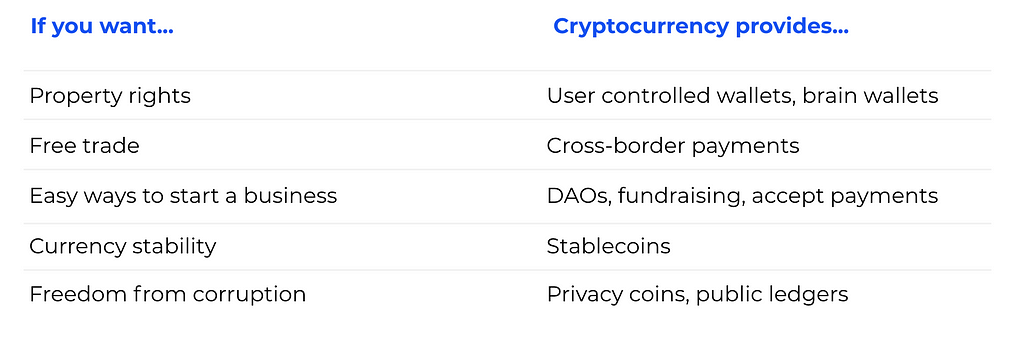
Why economic freedom? Economic freedom is a global indicator that is clearly defined and has been measured for decades. It is a composite metric, assessed both globally and for every country, that looks at a variety of factors like property rights, stability of currency, ability to start the business you want and work where you want, free trade, corruption, etc.
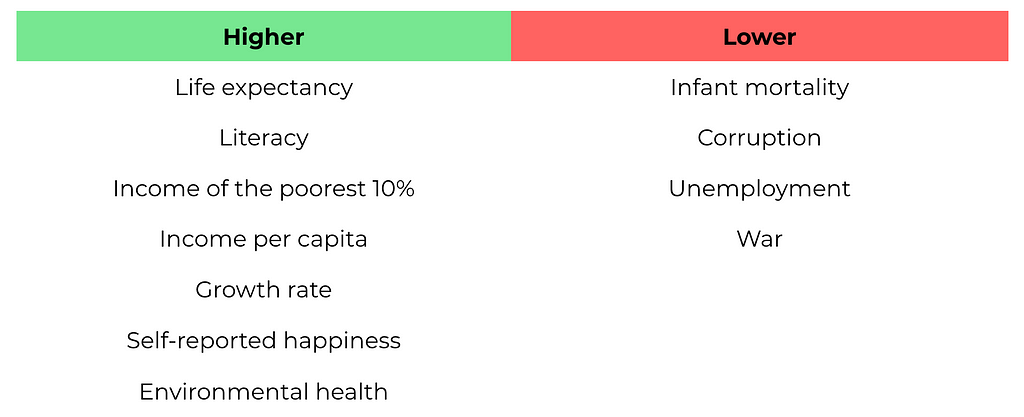
Economic freedom is a necessary, if not sufficient, condition for human progress. Societies with greater economic freedom have higher life expectancy and GDP growth, less war and corruption, better treatment of the environment, and higher income of their poorest 10%. Higher economic freedom correlates with the kind of societies that we all aspire to create.
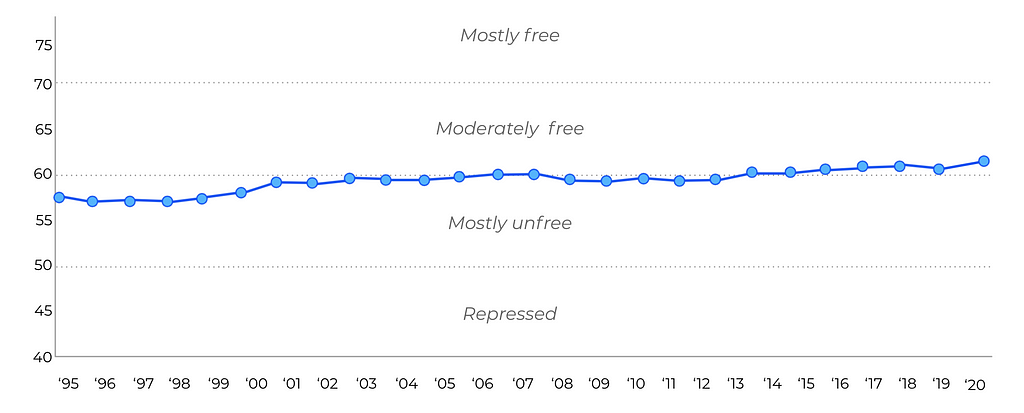
The problem is that economic freedom isn’t growing fast enough; the trend over the last 25 years has been a very gradual increase. Our job at Coinbase is to bend the shape of this curve upward.
When I first read the Bitcoin whitepaper back in 2010, I realized this computer science breakthrough might be the key to creating more economic freedom. The current financial system is rife with high fees, delays, unequal access, and barriers to innovation. In many countries, citizens don’t have access to sound money, a functioning credit system, or even basic property rights. I realized that we could use cryptocurrency to create sound financial infrastructure in every country around the world.
Cryptocurrency can provide the core tenets of economic freedom to anyone: property rights, sound money, free trade, and the ability to work how and where they want.
At Coinbase, we are laser focused on increasing economic freedom, because we believe that this is how we can have the biggest impact on the world. Everyone deserves access to financial services that can help empower them to create a better life for themselves and their families, and Coinbase is tasked with making this future a reality.
About five years ago, I wrote the Coinbase Secret Master Plan that outlined the four phases I envisioned cryptocurrency going through on its path to reaching 1 billion users. We have made incredible progress towards this plan, with >50M verified users on Coinbase, and more using other crypto products.
If our mission of increasing economic freedom is what we’re trying to achieve, then our strategy represents how we’re going to get there. This revised framing reflects where we are in the evolution of crypto 5 years later, and what we think the next 5+ years will look like.
Our strategy has 3 pillars:
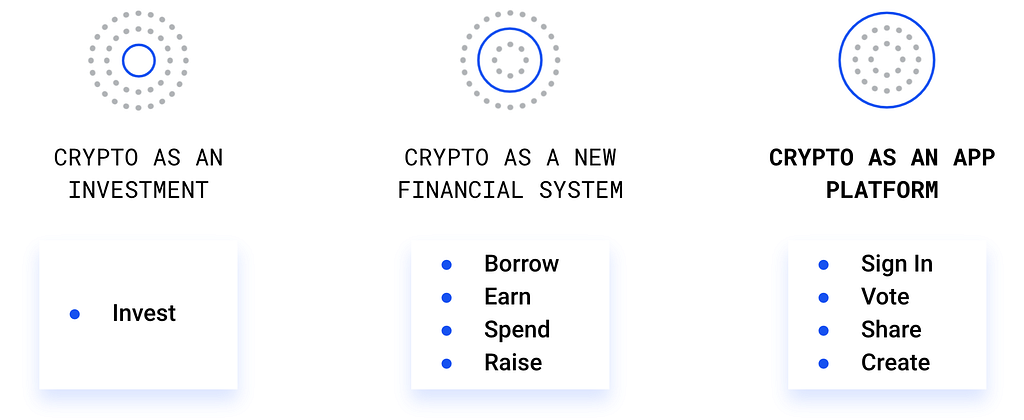
Crypto investing remains our core business and it’s the foundation of growing the cryptoeconomy. Investing is the first use case for every crypto holder and user, and we are the world’s most trusted onramp. We will continue focusing on:
Crypto investing was the first use case, and it is bootstrapping a large and growing network of crypto holders. As more users hold crypto, new products will be built to help them use their crypto. Coinbase will offer financial services that are powered by modern crypto infrastructure, including:
Our centralized products will continue to play a critical role in the growth of the cryptoeconomy. Over time, we expect DeFi (decentralized finance, built on open protocols) to outpace CeFi (centralized finance, including first party Coinbase products). We embrace decentralization, and will build products to make interacting with new DeFi as easy as we do our own first party products.
Finally, crypto companies and protocol teams are driving new innovations and products beyond financial use cases. Coinbase will invest deeply in discoverability and usability of third party products in the cryptoeconomy, and make crypto as easy to use as it is to buy:
Our mission and strategy are the what and the how, but building a world class company starts with building a high performing team. Our #1 priority is attracting and retaining top talent, which is why we are constantly working to build a culture to enable our team to do the best work of their careers. Our culture is the foundation of how we hire, and promote, and we’ve described it in detail in this document.
If you’re passionate about our mission, strategy and culture, come help us build the cryptoeconomy.
Our Mission, Strategy and Culture was originally published in The Coinbase Blog on Medium, where people are continuing the conversation by highlighting and responding to this story.
[ad_2]
Source link

[ad_1]

One of our top priorities at Coinbase is to be the most trusted and easy-to-use platform for accessing the broader cryptoeconomy. Coinbase currently offers our institutional clients easy access to the crypto markets through advanced trading and custody technology. But being easy-to-use also means providing a strong set of global fiat payment rails. Starting today institutional customers can access additional trading pairs and payments options through an expansion of supported fiat currencies on Coinbase Exchange.
Until now, many of our global clients have been limited to purchasing crypto in their local currency only. We now offer the fiat rails to enable deposits and withdrawals in USD, EUR, or GBP and access to the related trading pairs. This expansion of supported currencies has been a top request from international clients and has the potential to unlock billions of dollars in trading volume through improved access to major pools of liquidity. Institutional customers will now be able to trade in and out of various currencies regardless of where they are based. This is an important step in Coinbase’s journey towards creating a global trading platform.
“Access to SEN on Coinbase provides us with the flexibility to move USD quickly, keep providing liquidity in fast markets, and take advantage of opportunities” says Morgan Vincent, Head of Trading at Wintermute.
To learn more about Coinbase Prime, Exchange, Custody, our execution services, or Coinbase’s white label brokerage services click here.
Coinbase expands international payments options for institutional customers was originally published in The Coinbase Blog on Medium, where people are continuing the conversation by highlighting and responding to this story.
[ad_2]
Source link