SOL is up 75% over the past seven days, 205% in the past month, and 3,800% YTD. On Unchained, Multicoin Capital’s Kyle Samani discusses the DeFi projects fueling Solana’s growth, why he thinks Solana could make Ethereum obsolete, and the spectrum of decentralization. Show highlights:
what factors have contributed to SOL’s growth this year
what two milestones occurred last week that Kyle thinks supercharged SOL’s popularity
why Kyle thinks the issues with the Degen Ape Academy NFT drop were not actually a problem with the Solana blockchain
what projects will be possible on Solana that are impracticable on Ethereum
why Kyle thinks some combination of NFTs and social token apps will be the first breakout app on Solana
why Solana decreases the risk of massive liquidations — like the crypto industry saw on Black Thursday in March 2020
how Solana and Ethereum differ in regards to composability and fragmentation
what BitClout has to do with Kyle’s Solana investment thesis
why Solana could be the basis for the next crypto bull run
why Kyle thinks the Ethereum merge as it completes transition to Ethereum 2.0 will not really affect Solana
how the competition between Solana and Ethereum could play out in the next 12 months
why Kyle is not overly concerned about Solana being more centralized than Ethereum
what the Solana versus Ethereum competition will look like going forward, and why Solana may have the upper hand
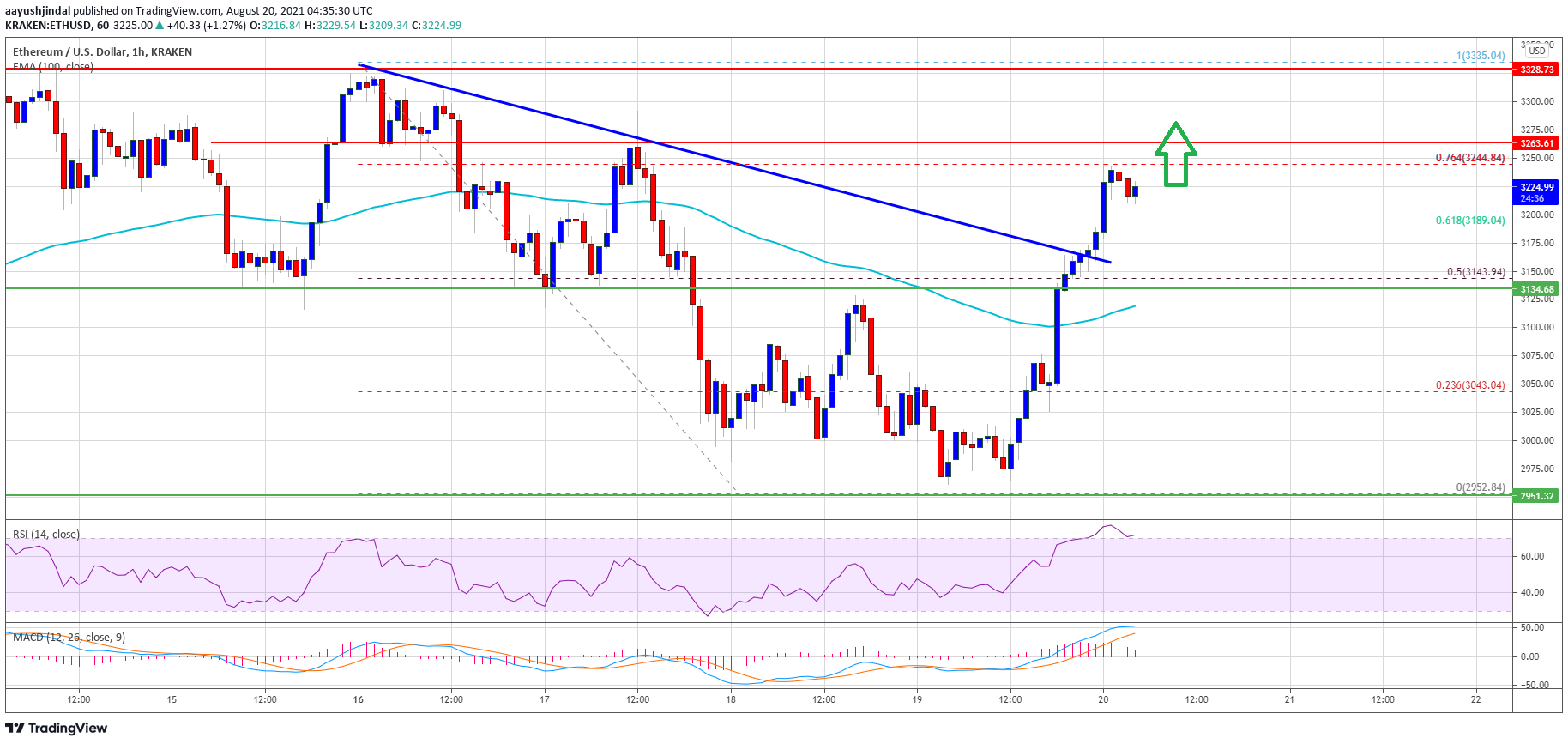
Ethereum remained well bid above the $2,950 support against the US Dollar. ETH price started a fresh increase and it could even surpass the $3,300 resistance.
Ethereum started a fresh increase above the $3,120 and $3,200 resistance levels.
The price is now trading above $3,150 and the 100 hourly simple moving average.
There was a break above a crucial bearish trend line with resistance near $3,150 on the hourly chart of ETH/USD (data feed via Kraken).
The pair could accelerate higher if there is a clear break above $3,260.
Ethereum Price Turns Green
Ethereum remained well bid above the $2,950 support zone, similar to bitcoin near $44,000. ETH price formed a base above $2,950 and it started a fresh increase.
There was a clear break above the $3,000 and $3,050 resistance levels. The price rallied above the 50% Fib retracement level of the main decline from the $3,335 swing high to $2,950 low. Ether even settled above the $3,150 level and the 100 hourly simple moving average.
Besides, there was a break above a crucial bearish trend line with resistance near $3,150 on the hourly chart of ETH/USD. The pair is now trading above the $3,200 resistance.
Source: ETHUSD on TradingView.com
On the upside, an initial resistance is near the $3,245 level. It is near the 76.4% Fib retracement level of the main decline from the $3,335 swing high to $2,950 low. The first key resistance is now forming near the $3,260 level. A break above the $3,260 zone could lift the price towards the $3,330 resistance. Any more gains may possibly call for a move towards the $3,500 level.
Dips Limited in ETH?
If ethereum fails to continue higher above the $3,245 and $3,260 resistance levels, it could start a fresh downside correction. An immediate support on the downside is near the $3,165 level.
The key support is now forming near the $3,150 zone and the 100 hourly simple moving average. A downside break below the $3,150 support zone could initiate a larger decline. The next major support could be $3,120, below which the bears might aim a retest of $3,000 in the near term.
Technical Indicators
Hourly MACD – The MACD for ETH/USD is now gaining pace in the bullish zone.
Hourly RSI – The RSI for ETH/USD is now well above the 60 level.
We believe in the cryptoeconomy, a future where economic transactions — buying, selling, spending, earning — will be based on crypto assets. Our products strive to make that vision a reality by making crypto trusted and easy to use for customers around the world.
Today, the majority of Coinbase corporate financial transactions, such as how we pay our vendors, employees, or invest corporate cash, remain heavily weighted in fiat. We’re in a strong position to lead by example and double down on how we can enable crypto adoption and utility, starting with how we operate our business.
Towards that goal, we are announcing a change in our investment policy. We have committed to invest $500 million of our cash and cash equivalents into a diverse portfolio of crypto assets. Going forward, we will also allocate 10% of quarterly net income into this same portfolio. This means we will become the first publicly traded company to hold Ethereum, Proof of Stake assets, DeFi tokens, and many other crypto assets supported for trading on our platform, in addition to Bitcoin, on our balance sheet.
Our crypto asset investment allocation will be driven by our aggregate custodial crypto balances — meaning our customers will drive our investment strategy. Our investments will be continually deployed over a multi-year window using a dollar cost averaging strategy. We are long term investors and will only divest under select circumstances, such as an asset delisting from our platform. All trades will be executed via our over the counter desk or away from our exchange to avoid any conflict of interest with our customers.
We may increase our allocation over time as the cryptoeconomy matures. We believe that in the future, more and more companies will hold crypto assets on their balance sheet. We hope by incorporating more crypto assets into our own corporate financial practices, we can take another step towards building a more open cryptoeconomy.
Coinbase updates investment policy to increase investments in crypto assets was originally published in The Coinbase Blog on Medium, where people are continuing the conversation by highlighting and responding to this story.
Smart contracts have been a revolutionary force in the blockchain industry because they have enabled the creation of decentralized finance protocols, nonfungible tokens and a new form of carrying out transactions without the need of a middleman.
Cardano (ADA) is one of the many projects that has been gaining momentum throughout 2021 and now that the project’s long-awaited smart contract capabilities are on the verge of becoming reality, the token is on the precipice of setting a new all-time high.
Data from Cointelegraph Markets Pro and TradingView shows that after bottoming at a low of $1.02 on July 20, the price of ADA has surged 139% to a multi-week high at $2.45.
ADA/USDT 1-day chart. Source: TradingView
Here’s a look at what some analysts and traders are saying about the recent price action for ADA and what token holders may want to keep an eye on in the short term.
A bullish upturn in the 50MA
The rapidly rising price of ADA has been hard for most traders to ignore, especially since multiple technical indicators have now flipped bullish.
One such indicator is the 50-day moving average (50MA), which is now pointed up after being on a downslope for roughly 2 months as highlighted in the following chart posted by pseudonymous Twitter user Pharmlord.
As seen in the chart above, once crossing above the 50-MA, ADA price doubled and is now on the verge of hitting a new all-time high at $2.46.
Flipping $2.30 to support is key
Insight into the important levels that ADA bulls need to keep an eye on was provided by Rekt Capital, a pseudonymous Twitter analyst who pinpointed the importance of the $2.30 level.
The $ADA dip gets bought aggressively and the rally continues
ADA is getting incredibly close to revisiting its final major resistance of $2.30 (black)
ADA has already managed to convincingly surpass a lower resistance zone shown in red on the chart above and is now it is attempting to break the May 16 all-time high at $2.46.
According to Rekt Capital:
“The only major resistance left before a new All-Time Highs is the black level ahead (~$2.30).”
Related: ADA hits $2 for the first time since May ahead of Cardano smart contract announcement
A cup and handle breakout will confirm the ATH
According to Twitter user ‘Fidzcrypto’, ADA is showing a distinct cup and handle formation on the daily timeframe.
Investopedia cites the cup and handle pattern as a technical indicator that resembles a cup with a handle, where the cup is in the shape of a “u” and the handle has a slight downward drift.”
The cup portion of the pattern can be seen on the chart between May 14 and Aug. 16, while the handle is seen in the price dip and recovery from Aug. 16 – Aug. 18.
According to Investopedia:
“The cup and handle is considered a bullish signal, with the right-hand side of the pattern typically experiencing lower trading volume. The pattern’s formation may be as short as seven weeks or as long as 65 weeks.”
The views and opinions expressed here are solely those of the author and do not necessarily reflect the views of Cointelegraph.com. Every investment and trading move involves risk, you should conduct your own research when making a decision.
Enya, a developer of decentralized infrastructure solutions, today announced the launch of the mainnet beta of Boba Network, its new Ethereum layer-2 Optimistic Rollup scaling solution that reduces gas fees, improves transaction throughput, and extends the capabilities of smart contracts.
Boba reduces gas fees and improves transaction throughput by aggregating transactions in volume while ensuring compatibility with Ethereum. DeFi and NFT applications that are currently cost-prohibitive on Ethereum become affordable on Boba.
Aiming to stand out among current Ethereum layer-2 solutions, Boba provides a streamlined exit of cryptocurrency-assets from Boba to Ethereum, extensible smart contracts, and, soon, decentralized autonomous organization (DAO) governance.
Overview: Boba Network
Optimizing for user experience, the Boba Network offers fast exits that are backed by community-driven liquidity pools, shrinking the withdrawal period from the conventional seven days to only a few minutes.
Further, the Boba NFT Bridge allows for cost-effective NFT launches which can be brought to Ethereum. NFT projects are all on Ethereum, but gas wars make it a playground only for the rich. Boba makes it possible to use NFTs for micro-transactions such as in gaming while enjoying the security of Ethereum.
This solution offers the best of both worlds: security and decentralization rooted in Ethereum (no compromise like a multisig bridge wallet) but also low transaction costs and fast execution.
In terms of new capabilities for the ecosystem, Boba enables Ethereum developers to create smart contracts that trigger code running on web-scale infrastructure such as AWS Lambda, making it possible to leverage sophisticated algorithms that are either too expensive, slow, or difficult to execute on-chain.
Finally, the Boba DAO lays the groundwork for decentralized governance by encouraging the community to propose network enhancements and vote on the proposals right on the Boba Network.
“We welcome the entire DeFi and NFT developer community to build on Boba. Our team is passionate about creating a more inclusive decentralized ecosystem. We are doing this by reducing barriers to adoption for users and developers. The launch of Boba’s mainnet beta today brings us one step closer…” – Alan Chiu, Founder & CEO of Enya
By Casper Sorensen, Vice President, Customer Experience
At Coinbase, our goal is to be the most trusted crypto platform. Our security team significantly invests to protect our 68+ million users.
We take many steps to protect our customers from account takeovers (ATOs), which are often caused by phishing campaigns, SIM swaps, or support scams.
First, every customer is opted in to two-factor authentication by default. This level of security is not the default for many traditional financial institutions and other technology platforms. But at Coinbase, we believe this extra helps provide important baseline protection for our customers.
Second, we require device verification for all customers when they log in from a new, unrecognized device. This provides yet another line of defense against potential attacks.
Finally, we encourage customers to use the most advanced hardware security keys available, such as Yubikeys. Yubikeys provide the most powerful two-factor authentication available on the market today.
As a result of these protection efforts, only a small number (less than .01%) of customers have been impacted by account takeovers. In the rare event that a customer notices a potential account takeover, we provide multiple channels for customers to quickly and easily lock their account so no further unauthorized activity can take place.
Today, we’re beginning to roll out phone support for ATOs, to provide customers with a live agent to kick off an investigation. If you believe you’re a victim of an ATO, please call +1 888 908–7930 or visit our support page to protect your account and get help.
Since January, we have improved our customer support by increasing our support staff headcount by 5x, providing self-service messaging prompts within the product itself to guide our customers through challenging transactions, and we’re scheduled to roll out live messaging as a new support channel later this year to provide real time support for our customers.
Our goal is to protect our customers as they participate in the cryptoeconomy while also providing them the best user experience possible. That said, we recognize that our work is never done when it comes to security and support — and they remain a top priority for Coinbase.
Continuing our commitment to customers: introducing phone support for ATOs was originally published in The Coinbase Blog on Medium, where people are continuing the conversation by highlighting and responding to this story.
Ethereum has been slowing down on its bullish momentum. The second cryptocurrency by market cap trades at $3,066 with a 4.2% loss in the daily chart.
ETH moving sideways in the daily chart. Source: ETHUSD Tradingview
After two weeks of profits and an incredible rally from the low at $2,000, mostly driven by the implementation of EIP-1559, Ethereum could see some downside in the short term.
The In/Out of the Money Around Price (IOMAP) metric, used to measure the average purchase price of a crypto asset and compared it to its current price, from IntoTheBlock suggests Ethereum sits at “stable support”.
Analyst Ali Martinez shared the chart below and indicated that over 230,000 addresses bought 7,33 million ETH between $2,970 and $3,080. Thus, ETH’s price must hold above these levels to prevent a bearish trend in the short term. Martinez added:
Any downswing below this price range could encourage investors to book profits quickly before their investments go “Out of the Money.”
ETH’s price IOMAP. Source: IntotheBlock via Ali Martinez
One of the key drivers for Ethereum has been institutional adoption that sees great potential in its ecosystem. Additional data provided by Arcane Research suggests adoption is still on the rise with ETH-based derivatives on the rise.
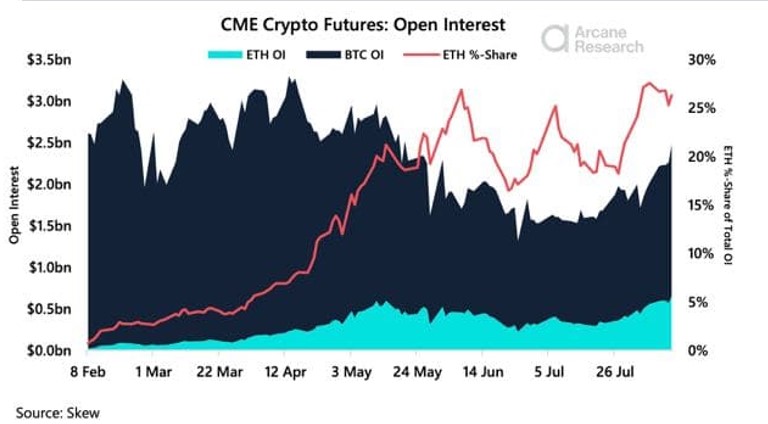
The research firm has recorded an increase in open interest (OI) for Ethereum futures on the Chicago Mercantile Exchange (CME). The ETH trading volumes have been gaining dominance and stand at around 30% of Bitcoin (BTC) and the open interest at 27%.
The OI of CME’s EH futures currently sits at an all-time high of $650 million. The OI of the bitcoin futures sits at $1.8 bn but is down substantially from its Feb 18th peak of $3.3 billion. Ether futures now account for 26.5% of the total OI in CME’s crypto futures.
Source: Arcane Research
Ethereum Takes Market Share Away From Bitcoin
The OI also suggests that institutions are “eagerly” building up their Ethereum (ETH) positions at the moment, Arcane Research said. Most likely, a consequence of the EIP-1559 and the expectations of future appreciation due to the network’s new fee model.
Source: Arcane Research
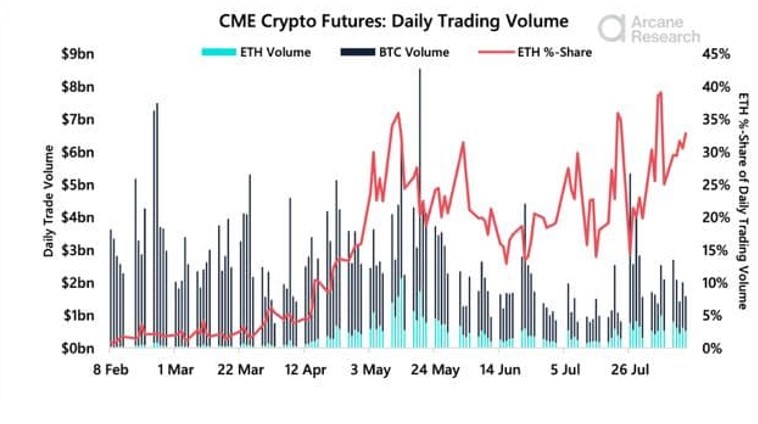
As the chart shows, ETH futures trading volume has been on a rise since mid-April 12 and only slow down during May and July’s crypto market crash. During this time Ethereum went as low as $1,650 but was able to quickly recover both in price and in the aforementioned metric.
The daily trading volume of the CME ETH futures has also seen a significant uptick in market share recently. On Friday, Aug 13th, the trading volume of the ETH futures accounted for 33% of the total trading volume in CME’s crypto futures. With the increased dominance of the ETH futures and the growing contango, a bullish sentiment around ETH among institutional investors seems to be brewing.
Ethereum co-founder Vitalik Buterin has taken a deep dive into token-based decentralized governance, suggesting that existing voting mechanisms are flawed and may be holding the DeFi sector back from realizing its full potential.
In a lengthy blog post published Aug. 16, Buterin stated the crypto community needs to “move beyond coin voting as it exists in its present form.”
Currently, the majority of decentralized finance (DeFi) projects manage their protocol upgrades, reward issuance, and other facets of governance elections where votes are distributed among token holders according to the size of their holdings.
However, many projects have come under fire for allowing their voting process to be dominated by whales holding vast swathes of the governance tokens, allowing them to vote in support of their personal interests.
Buterin highlighted two issues relating to token-based governance, emphasizing the risk of incentives misaligning among community members, and its vulnerability to “vote-buying” and “outright attacks” influencing the outcome of governance votes. He added:
“The most important thing that can be done today is moving away from the idea that coin voting is the only legitimate form of governance decentralization.”
Buterin noted the prevalence of “unbundling,” whereby “vote-buying” can be achieved and governance systems can be manipulated by borrowing on crypto collateral and using the tokenized assets to vote.
In the context of unbundling, “the borrower has governance power without economic interest, and the lender has economic interest without governance power,” he added.
Looking beyond token-based governance, Buterin advocated the exploration of “Proof-of-Humanity”-based governance systems where one vote is allocated per each of a protocol’s users.
Buterin also offered “Proof-of-Participation” as a possible solution, where voting is limited to the users of a protocol that have contributed work to the benefit of a project or its community, suggesting voting rights could be exclusively distributed to addresses that complete a specific task.
Ethereum’s co-founder also suggested quadratic voting — where the power of a single voter is proportional to the square root of the economic resources that they commit to a decision — could offer unique solutions to decentralized governance.
Related:Can DeFi and on-chain governance change human nature?
He also suggests a “skin in the game” approach that makes individual voters responsible for their decisions, stating:
“Coin voting fails because while voters are collectively accountable for their decisions (if everyone votes for a terrible decision, everyone’s coins drop to zero), each voter is not individually accountable.”
Geneva, Switzerland, Aug. 17, 2021 — Liti Capital, the Swiss-based litigation financing company that makes private equity investing accessible to everyone through blockchain technology, listed its wLITI token for the first time on HitBTC, a centralized exchange (CEX).
Up almost 20% in the past 24 hours, Solana (SOL) has been on an incredible rally across the board. In higher timeframes, the cryptocurrency records a 70% and 141% profit in the 7 day and monthly chart.
SOL on a rally in the daily chart. Source: SOLUSDT Tradingview
Perceived as one of Ethereum’s potential killer ecosystems, Solana continues to grow and attract attention from the crypto space. DeFi investor Daniel Cheung recently published a report on the fundamentals that support further appreciation for SOL’s price.
Cheung believes this cryptocurrency offers one of the “best” reward/risk scenarios for any crypto investments and predicted the arrival of the “Solana Summer”. This project has a straightforward pitch due to its high scalability and low-cost smart contract platform.
In addition, it provides a high level of scalability in an ecosystem without solutions such as sharding. Cheung believes that these features allow the application build on Solana to have “synchronous composability”.
This matters because with a single shared state and synchronous composability every application on Solana can communicate with each other atomically.
As Ethereum moves forwards with its migration from a Proof-of-Work consensus algorithm to Proof-of-Stake, its DeFi ecosystem could lose this property. Thus, some applications could become less interoperable with each other or stop working altogether.
The Bearish Case For Solana, What Could Prevent More Gains
As NewsBTC reported, the Solana Foundation launched stake pools with the purpose of increasing the security of its network, make it more censorship-resistant, and provide SOL holders with more incentives to participate in the ecosystem.
The latter has been one of the heaviest criticisms made by the project’s detractors in addition to the network’s level of centralization. Cheung believes this is part of the bearish thesis for Solana claiming the network “may never decentralize enough in the future”.
The second part that could prevent this ecosystem to gain further traction is Ethereum itself. This competitor still supports the majority of DeFi projects, has a high number of developers working on dApps and the development of the ecosystem, second layer solutions, and more.
Source: Daniel Cheung via Twitter
Cheung claimed Solana “faces a steep uphill battle vs Ethereum”. However, DeFi is one of the sectors where it’s more visible than the crypto industry is still in its early phase and could inevitably be heading towards a “multichain world”, as Cheung called it while he added the following:
It is still unclear whether smart contracts will be a winner-take-all market. While Ethereum is currently in the lead, data points increasingly point towards a multi-chain future, at the very least for the foreseeable future as this market plays out.
Moreover, on the centralization issue, the investor said that there is a lot of debate around when a blockchain has the right balance of decentralization. Cheung estimates that 1,000 or 10,000 nodes could be sufficient, this would make the criticism towards this network “invalid”.
Data presented by the investor claim that development activity in the SOL ecosystem are “trending very well” and has accompanied its price appreciation. The trend seems poised to continue in the coming months, as relevant figures in the crypto space, such as FTX CEO Sam Bankman Fried, are “heavily involved” with Solana.
Cheung claims that Bankman Fried has been making serious investments into this ecosystem. The exchange and its CEO have been making external investments in traditional finances, sports, and consolidating partnerships with other investors, politicians, celebrities, and others.
Thus, institutions from Wall Street are keener to jump into Solana and its ecosystem. Cheung concluded:
So with the bear arguments nullified, you are left with an asset that offers one of the best R/R in crypto right now, and one that offers practically unlimited upside in a bubble given its comped to $ETH which trades like its running to become the internet’s reserve currency.