Bitcoin price extended its recovery above the $36,000 zone against the US Dollar. BTC topped near $36,700 and it is now correcting gains.
Bitcoin started a fresh increase above the $35,000 and $36,000 resistance levels.
The price is now trading nicely above $35,000 and the 100 hourly simple moving average.
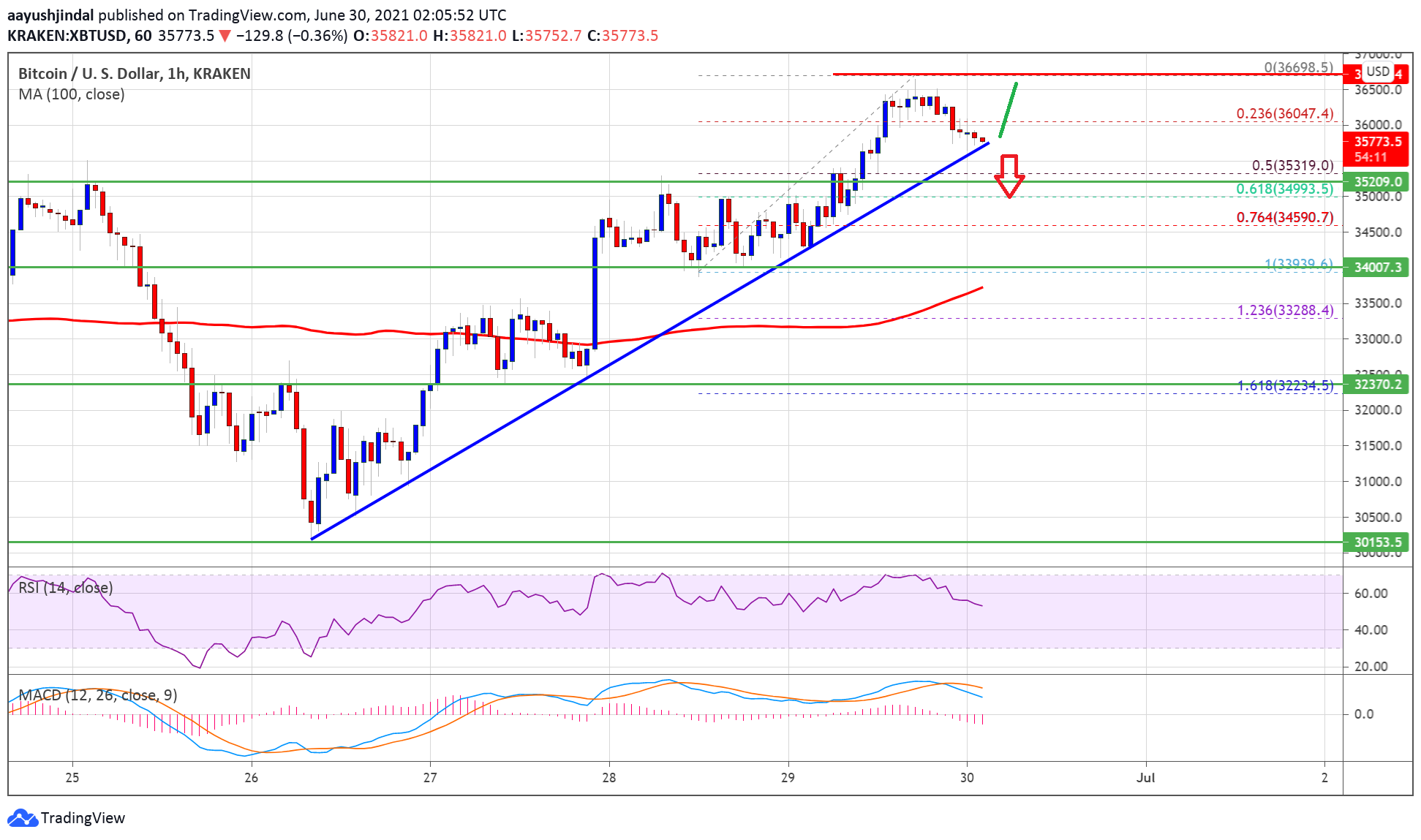
There is a major bullish trend line forming with support near $35,700 on the hourly chart of the BTC/USD pair (data feed from Kraken).
The pair is likely to start a downside correction below $35,700 and $35,500 in the near term.
Bitcoin Price is Correcting Gains
Bitcoin started a steady increase after it settle above the $34,000 level. BTC broke the key $35,000 barrier and the 100 hourly simple moving average to move further into a positive zone.
The price even spiked above the $36,500 resistance. It traded as high as $36,698 and it is now correcting gains. There was a break below the $36,500 and $36,000 levels. It even traded below the 23.6% Fib retracement level of the upward move from the $33,939 swing low to $36,698 high.
Bitcoin is still trading nicely above $35,000 and the 100 hourly simple moving average. There is also a major bullish trend line forming with support near $35,700 on the hourly chart of the BTC/USD pair.
Source: BTCUSD on TradingView.com
If the pair fails to stay above the trend line support, it could start a downside correction below $35,500. The next key support is near the $35,200 level. It is near the 50% Fib retracement level of the upward move from the $33,939 swing low to $36,698 high. Any more losses might call for an extended decline towards the $34,000 support zone in the coming sessions.
Fresh Increase in BTC?
If bitcoin remains stable above the trend line support, it could rise further above the $36,000 resistance. An immediate resistance on the upside is near the $36,500 level.
The next key resistance is near $36,700, above which the bulls are likely to aim a fresh high above $37,000. Any more gain could lift the price towards the $38,000 resistance. The next major barrier is near the $40,000 zone.
Technical indicators:
Hourly MACD – The MACD is slowly losing pace in the bullish zone.
Hourly RSI (Relative Strength Index) – The RSI for BTC/USD is still well above the 50 level.
Major Support Levels – $35,700, followed by $35,200.
Major Resistance Levels – $36,000, $36,500 and $38,000.
The cryptoeconomy is still in its early stages, but it is clear that every year more and more economic activity will take place on crypto rails. Coinbase is the trusted bridge to the cryptoeconomy today, but we need to become the place people also go to actually participate in the cryptoeconomy.
We’re seeing crypto quickly mature from its initial use case of trading bitcoin to the trading of thousands of new assets, and the adoption of new use cases like Decentralized Finance (DeFi), NFTs, smart contracts, Decentralized Autonomous Organizations (DAOs), and more. Much of this is relatively new and there are challenges to using it, but I see it as the future of where this industry is going. In the same way we helped people access Bitcoin for the first time in a trusted, easy way — we need to do the same for the decentralized cryptoeconomy.
The uses cases are here
For years, people at conferences and journalists would ask me, “Where are the use cases?” We’re finally seeing a wide range of emergent applications and products get traction. From NFTs, to a broad array of new dApps (decentralized apps), the cryptoeconomy is growing at an incredible pace, and I think this will continue to accelerate. Like the internet, or the mobile app stores, we’re seeing developers rush into the space to use these new tools to develop innovative use cases that we couldn’t have imagined before.
The opportunity for Coinbase
Our centralized (CeFi) products will continue to play a critical role in the growth of the cryptoeconomy. But the decentralized cryptoeconomy will also be a major area of growth. With all of this new innovation coming to crypto, we have a massive opportunity to give our customers access to these new products and features. Here are some of the ways we’re going to tackle this:
Bring more assets to Coinbase, faster: A few years ago we developed a rigorous process for evaluating new assets to list on our exchange (analyzing legal, security, compliance, and other risks). This process has been essential to responsibly growing our offering to date. But we need to move faster. We need to treat asset issuers as the very important customers they are, rolling out the red carpet, and courting them, and promptly responding to their inquiries. The goal is to list all legal assets and empower users to make their own risk-adjusted decisions.
Crypto is global, and we need to be too: Coinbase was founded in the US in 2012. We’re now a global company, with our products offered in >100 countries. We need to move from shipping products that cater only to the US (or UK/EU) to shipping products that work globally. This will increase the number of people who have access to our products and further our mission of increasing economic freedom in the world.
Build the crypto app store: Apple didn’t attempt to build every app for the iPhone, it empowered developers and gave mobile users an easy way to access new innovative apps. We need to do the same in crypto. There is now 10s of billions of dollars of economic activity running on dApps, and a new trend coming out every three months. We’ll work to give our users easy access to all of this from the main Coinbase product.
Here are our next steps
Improve our asset addition process
Reduce the burden on asset issuers: We’re simplifying inputs onto our legal review from 70 questions to 12 questions that get at what most raises concerns under the law. We’re also working through optimizing our Compliance and Security reviews.
Create an “experimental” zone for new assets: We need to be able to support new assets, but there may be additional risks for these networks (e.g. low liquidity, bugs in the code, etc). Because these assets often come with more risk than long standing and tested assets like Bitcoin, we need to make sure we are disclosing these risks to our customers appropriately, and enabling them to make educated decisions.
Move towards approving most assets for store/send/receive:We may not be able to trade every asset on our centralized exchange (for regulatory reasons), but we believe we can enable access to most assets for basic wallet functionality
Have an International-first mindset
We put a huge amount of effort into working with regulators in the US, UK, EU, etc. which has generated an enormous amount of value for customers in these regions, but it can also lead to products that are hyper focused on the western world. We’re going to flip this approach on its head by shipping more products in international markets on day one, while still partnering with regulators in more established markets to ensure our products are compliant with their local rules. This is also better aligned from a mission point of view, because sometimes international markets are even more in need of the economic freedom that crypto can provide.
Embrace third-party interfaces and self-custody
Soon any app built on decentralized crypto rails will be accessible to users of the Coinbase app. Our customer’s wallet and identity should seamlessly integrate into any of these apps. Part of this change will be embracing new wallet technologies, including those that allow for safe and easy self custody. In the future you will have the option to do self-custody of your crypto, right in the main Coinbase app.
Conclusion
The crypto industry is changing rapidly. The products that the most crypto-forward people are using today will be used by mainstream customers in a year, and by institutions a few years after that. We need to start integrating them today. Coinbase has shown that it can be a great crypto 1.0 company. Our next step is to show that we can be a great crypto 2.0 company.
This effort all ties back to our mission, which is to increase economic freedom in the world. Many of the most innovative use cases in crypto are being created in decentralized apps. By fully embracing this trend we can put crypto in the hands of more people around the world and thereby increase their economic freedom.
If these challenges excite you, please join our amazing team and come help build the cryptoeconomy.
Embracing decentralization at Coinbase was originally published in The Coinbase Blog on Medium, where people are continuing the conversation by highlighting and responding to this story.
Often a figure of ridicule within the crypto community thanks to his outlandish predictions as well as being a larger-than-life personality, John McAfee has ceased to be in the spotlight of the crypto community. However, following his alleged “suicide” that occurred in a Spanish prison cell on June 23, tributes have been flowing en masse for the tech savant, who was also an early proponent of digital currencies — especially Bitcoin (BTC) and later Monero (XMR).
McAfee had been in exile for the last few years of his life. In this regard, it has been widely reported that the creator of McAfee Antivirus had been on the run from the United States authorities for evading his tax liabilities, which were touted to be worth over $4 million. In all, he had been named in a total of 10 federal indictments and was ordered to be extradited to the U.S. mere hours before the news of his suicide surfaced.
After being apprehended by local authorities at Barcelona airport last year, McAfee seemed to have acclimatized quite well to his prison surroundings. “I have friends. The food is good. All is well” he tweeted in October 2020. This, in the eyes of former National Security Agency operative and whistleblower Edward Snowden, seemed to suggest that the U.S. legal system was so fractured that even native-born defendants “would rather die in a prison cell abroad” than become subject to such an unfair system.
Did McAfee predict his untimely demise?
One of the strangest aspects of this entire development is that over the course of the last few years, McAfee repeatedly emphasized the fact that American officials had been sending him subtle yet fairly explicit messages suggesting that his time here was nearly done and that he was going to be “suicided” soon.
On the subject, one of his tweets alarmingly read: “U.S. officials saying, in effect: ‘We’re coming for you, McAfee! We’re going to kill yourself.’ I got a tattoo today just in case. If I suicide myself, I didn’t. I was whackd. Check my right arm.”
Not only that, in one of his statements, he made it clear that in case he was ever found hanging in his cell, it would be through no fault of his own but rather an attempt “a la Epstein” to silence him. McAfee claimed that he had a lot of inside dirt on many of the world’s elites, government organizations, etc., even going as far as saying that he was going to start “naming names” — including a top-ranked Central Intelligence Agency employee who had directly been involved in a lot of sketchy business.
Furthermore, in an interview given by McAfee’s widow, Janice, on June 25, she claimed that the British-American tycoon was not even the least bit “suicidal” when she last spoke to him, which was apparently just a few hours before his body was discovered in his cell.
And while authorities claim that there is nothing suspicious about the tech titan’s death, following the aforementioned revelations, people all over social media have been saying that there might have been “foul play” involved.
Lastly, just a day before his untimely death, Spain’s National Court announced that it had come to an agreement with U.S. authorities regarding McAfee’s extradition — with the final decision still pending and subject to additional judicial inquiry. In fact, McAfee and his legal counsel had already devised a plan of action to appeal the decision, further suggesting that the pressure of the extradition alone may have not caused McAfee to resort to suicide.
McAfee’s mysterious final post on Instagram
Shortly after news of his demise started doing rounds online, calls for McAfee’s death being planned started to gain a lot of traction. Firstly, the flames were ignited when McAfee’s official Instagram account shared an image of the letter “Q,” supposedly shortly after his death.
The “Q” in question here is in direct reference to the QAnon conspiracy theory that suggests that a group of elite pedophiles run a global child sex trafficking ring and have a direct say in how the American administration runs. What’s more, the theory also suggests that this cabal of high-ranked elites can manipulate the global economy thanks to their control of the fractional banking system.
As expected, as a result of the post, a large number of QAnon influencers on Telegram started sharing images claiming that McAfee was just another sacrificial pawn — much like Jeffery Epstein — and had to be “suicided” due to the secrets he possessed regarding those in power across the globe.
Killswitch engaged, but where is all the information?
In a tweet from late 2019, McAfee noted in no uncertain terms that if he were to ever “disappear” mysteriously, he would release some 31-plus terabytes of incriminating data (related to various government officials as well as those in positions of power) to the media. However, even as people all over the world continue to wait quite eagerly for this information, no such data seems to have been made available so far.
In fact, he even allegedly wrote in a message that he has a stash of sensitive data that is backed up in a number of hard drives and has been stored in his condo near 88th Street, north of Miami Beach. That said, a quick look at McAfee’s feed shows no such post, suggesting that the message may have been tweeted and later deleted or could have been a total figment of imagination, to begin with.
Over the last couple of years, McAfee had continued to associate himself with many conspiracies, as is made evident by the fact that in one of his posts, he depicted himself standing in front of Jeffrey Epstein, the multi-millionaire and convicted sex offender, who was also the victim of an alleged “forced suicide.”
As part of the photo’s caption in his “Q” Instagram post, he added: “I never said Jeffrey Epstein was murdered. I said he didn’t commit suicide. Not the same. Could be alive. Could have never existed. Maybe murdered. I dunno. I only know he didn’t commit suicide.”
Lastly, the tech entrepreneur had recently even launched a cryptocurrency called Pizza that advertised itself with an image of Hillary Clinton eating pizza. The asset seemed to be a direct reference to the Pizzagate conspiracy theory, which garnered a lot of traction a couple of years ago after the former Secretary of State’s emails were leaked online through Wikileaks.
Will the story of John McAfee live on?
Born in 1945 to an American father who was serving in the army and stationed in the United Kingdom at the time, McAfee received his Ph.D. in mathematics before making his way to Silicon Valley in the late-1970s. Within a decade and a half, he was not only working for Lockheed but also spending a substantial portion of his personal time looking at software solutions that could help combat the growing problem of computer viruses.
In the early 90s, John established McAfee Associates from the comfort of his home and started devising novel solutions to help combat various digital threats that were prevalent at the time. As a result, before the dawn of the new millennium, the company was already raking in close to $5 million a year.
Following his passing, the tributes have been flowing in from all sides. For example, Bitcoin influencer and podcaster Anthony Pompliano shared a post remembering McAfee as a “kind, funny, and incredibly intelligent,” individual. Similarly, Cardano founder Charles Hoskinson, too, spoke highly of McAfee’s contributions to the domain of computer sciences, calling the man “one of the most enigmatic and interesting people in the cryptocurrency space and the history of computing.”
While there will always be people who either believe or disbelieve the narrative that the U.S. government had a role to play in McAfee’s death, the fact of the matter is that he did claim that he had a lot of dirt on the global elites. Now, whether or not any of this so-called classified information makes its way to the internet remains to be seen.
That, however, does not take away from the fact that McAfee was not only a true pioneer in the field of digital security but also a visionary who could foresee the rise of cryptocurrencies even when the space was in its infancy.
Conspiracies aside, the tech pioneer will be sorely missed by many.
By Dominique Baillet, Global Head of Employee Experience, Diversity & Inclusion
At Coinbase, our journey to becoming a remote-first company started last April, when we shared internally, and then publicly, that post-pandemic, we wouldn’t be going back to business as usual. A year of working toward this goal isn’t long enough to make us experts, but part of our culture is focusing on repeatable innovation, and a year into this journey is always a good milestone to take stock.
Be open to disrupting “the way we do things.” Before the pandemic forced us to experiment with universal work from home, Coinbase had a strong in-office culture that was only getting stronger. While we had a norm that employees could work remotely one day each week, so much of the energy and action of work was in the in-person interactions happening in the physical office that few people took advantage of this opportunity. Employees from other offices mostly visited San Francisco, not the other way around. Because of this, many employees in other offices keenly felt their distance from our San Francisco office, the de facto center of gravity for Coinbase.
Despite this powerful inertia, last April, after about a month of pandemic-induced WFH, we were willing to ask a big, deeply surprising, culture-shaking question: What if working remotely was … better? What if it actually had more advantages than being rooted to a single HQ? And after a month of grappling with that possibility, it became clear that we felt confident and convinced enough to say yes. Based on the opportunities to decentralize and disrupt ourselves and create access to a broad talent pool, even after the restrictions of covid had ended, we would embrace a transition to being a remote-first company. If we had let our office-based inertia carry us into the future of work, we’d still be where we were almost a year ago.
First, principles, then, answers. Why are we doing this? What are we solving for? What, ultimately, are we hoping to achieve? Before even beginning to answer the practical questions around remote-first, addressing these higher-order questions with a defined set of goals and design principles gave us a framework for anything we might face as part of this work. Our goals in this work are:
To get — and keep — top talent in every seat, as we scale.
To help employees embody what it means to act like owners.
To become the best crypto company in the world to work for.
These are intentionally broad, so we also defined a set of design principles to help us in the day-to-day work of pursuing a remote-first future. Whenever we find ourselves at a decision point, we’re able to look at these principles to guide us to the right answer:
Maximize choice for employees
Build equitable (not identical) experiences for employees in the office and out
Ensure equal access to opportunity, growth, and inclusion
Let the culture we want drive our decisions
Default to trusting employees
Once we defined these sources of guidance, we were able to lay out the next steps and get to work with focus, alignment, and speed.
Build a process that works for your culture. Even as we grow, Coinbase works to preserve the founding moment. Part of that start-up energy we embrace is showing our work. When we announced to employees that we would be transitioning to remote-first, we had some early ideas about what it might look like, but by no means did we have answers to all of our (or employees’) questions.
For other companies, this would have been the wrong way to approach this transition, but Coinbase employees highly value transparency, even if there’s ambiguity attached. Sharing our decision early and our progress often gave us the opportunity to directly involve employees in generating the solutions to these big questions (How will we collaborate? How can we recognize and reward employees?) rather than needing to brainstorm behind closed doors and emerge with a fully-formed plan. This process also allowed us to prioritize employees’ most important questions first (Where can I live? What will I get paid?) and deliver answers so they could make critical decisions about their lives outside of work.
Find and enlist natural owners. Coinbase still runs lean; we all wear many hats, and are accustomed to jumping in to solve for the unexpected. Naturally, this served us extremely well in the cultural all-hands-on-deck that 2020 required. When breaking out the initial workstreams of our transition to remote-first, some tracks, like Compensation, Security, and Learning & Development already had natural owners. Others, like Collaboration or Recognition, did not. In these cases, we were able to look around the company to find natural, if not official, leaders for these tracks of work. Specifically, this meant using our core working team to nominate likely candidates and then having open conversations with them about appetite, passion, and bandwidth for a topic. Sometimes, even if they weren’t ultimately the right choice, the conversation led us to the person who would be.
Once we’d identified the right people to lead each track of work, we prioritized our big questions to serve employees’ most immediate needs first:
P0 Questions:
Where can people work?
What will we pay them?
What are the other legal requirements to be remote-first?
P1 Questions:
How do we create equitable working experiences for all employees?
How do we maintain security?
What tooling and documentation do we need?
P2 Questions:
How do we collaborate and connect?
How do we train and develop for remote success?
How do we identify and recognize employees?
This allowed our core working team to support each workstream with project management guidance, and ensure that all we were hitting our goals for timing.
Done is better than perfect. While the shift to remote work rightly feels revolutionary, it is also evolutionary. We’re learning more every day about what employees need, how we can best support them, and how the different pieces of work we’re doing interact with each other. We believe that getting to 100% fidelity and finish, for work like this, will mean our answers are coming far too late to be useful. Instead, we’ve adopted an informal principle of shipping culture-related changes/updates at 80%, with the explicit acknowledgment that things will continue to evolve. With 1,200+ employees, if we’ve considered every eventuality before crafting a policy, approach, or norm, then we’ve probably waited too long. Of course, this approach requires humility, leaning into feedback from all of our stakeholders at the leadership and employee level, and (see above), being willing to question the way we do things, in order to do them better.
Finally: The next part of this journey will look totally different. We have all experienced so much change during the pandemic that it’s certainly felt like “the hard part” of this transition. And the psychological impact of going from an in-office world to one where an employee spends all of their waking weekday hours at home was tremendously challenging for many people. But this first chapter was also “the easy part” of remote-first because we were all in a single mode, forced into a state of universal work from home. The next chapter, in which we fully inhabit our remote-first future — with some folks in the office five days a week, some a few days a week, and others never — is where the rubber meets the road, and where we can expect a whole new set of lessons to learn.
Building a remote-first company: Our biggest lessons so far was originally published in The Coinbase Blog on Medium, where people are continuing the conversation by highlighting and responding to this story.
Ethereum started a fresh increase after the bulls defended $1,700 against the US Dollar. ETH price is likely to continue higher above the main $2,000 resistance.
Ethereum is showing positive signs above the $1,850 and $1,900 resistance levels.
The price is now well above $1,900 and the 100 hourly simple moving average.
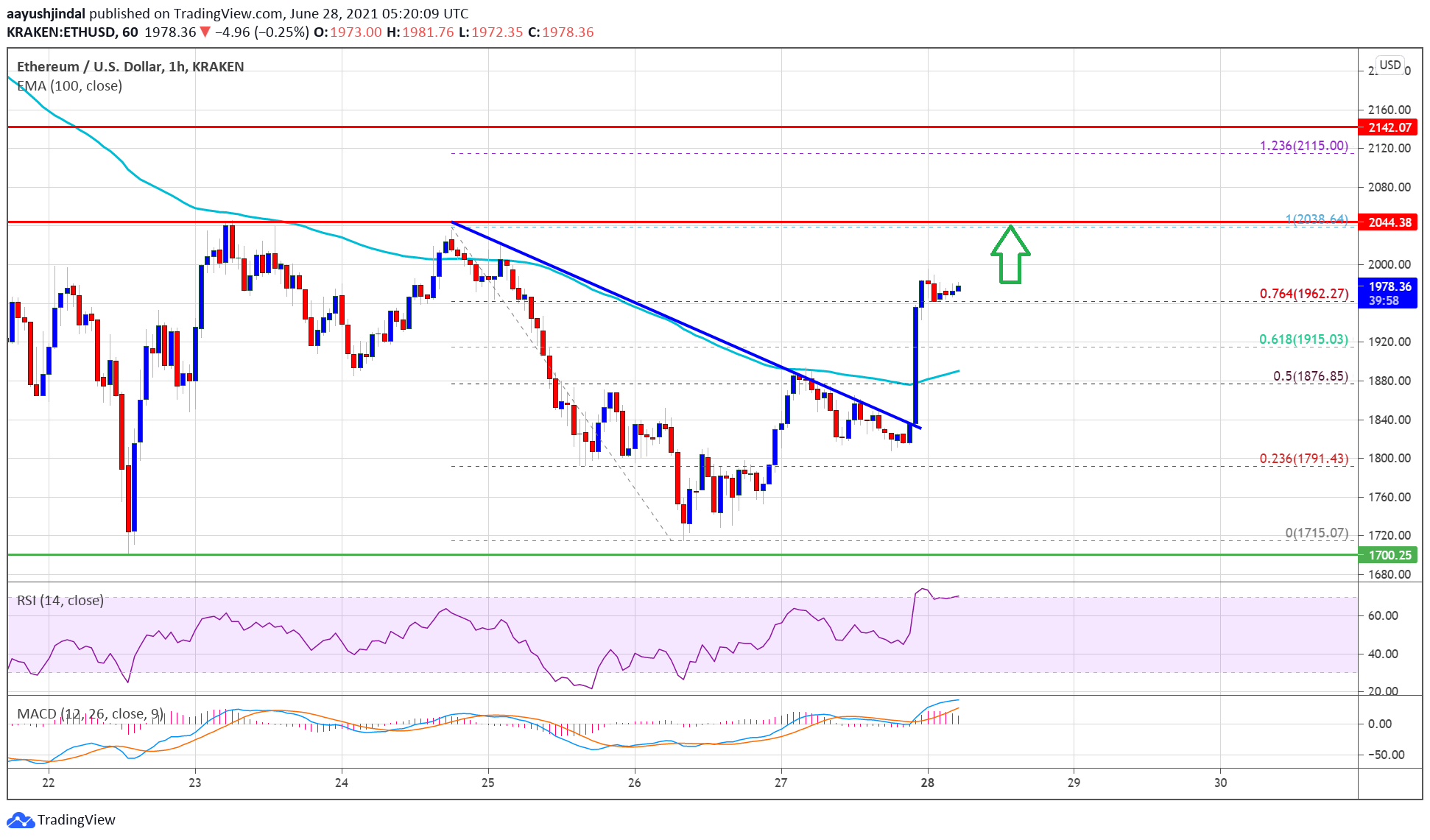
There was a break above a major bearish trend line with resistance near $1,840 on the hourly chart of ETH/USD (data feed via Kraken).
The pair is likely to clear the $2,000 barrier and it could accelerate higher in the near term.
Ethereum Price is Gaining Pace
Ethereum remained well bid above the last swing low near $1,700. ETH formed a base above $1,700 and it started a major increase. The bulls were able to push the price above the $1,850 resistance zone.
There was also a break above a major bearish trend line with resistance near $1,840 on the hourly chart of ETH/USD. The pair climbed above the 61.8% Fib retracement level of the of the key decline from the $2,038 swing high to $1,715 low.
It is now well above $1,900 and the 100 hourly simple moving average. Ether price is consolidating above the 76.4% Fib retracement level of the of the key decline from the $2,038 swing high to $1,715 low.
Source: ETHUSD on TradingView.com
It seems like the price could continue to rise above $1,980. The next key resistance is near the $2,000 zone. Any more gains could set the pace for a move towards the $2,115 level. It is near the 1.236 Fib extension level of the of the key decline from the $2,038 swing high to $1,715 low. An intermediate resistance could be near the $2,050 level.
Fresh Decline in ETH?
If Ethereum fails to clear the $2,000 and $2,050 resistance levels, it could start a fresh decline. An initial support on the downside is near the $1,920 level.
The first major support is now forming near the $1,875 level and the 100 hourly SMA. A downside break below the $1,875 zone could lead the price further lower. In the stated case, the price could move down further towards the $1,800 level.
Technical Indicators
Hourly MACD – The MACD for ETH/USD is slowly gaining pace in the bullish zone.
Hourly RSI – The RSI for ETH/USD is currently well above the 60 level.
Institutional exposure to cryptocurrencies via derivatives continued to grow in the second quarter, as CME Group’s newly launched Bitcoin (BTC) micro contract received considerable uptick in its first two months of trading.
Since launching on May 3, CME’s Micro Bitcoin futures contract has already surpassed 1 million contracts traded, the Chicago-based derivatives market announced earlier this week. CME executive Tim McCourt said the new product has been popular among institutions and day traders seeking to hedge their spot Bitcoin price risk.
Denominated at 0.1 BTC, the micro contract is one-tenth the size of one Bitcoin. By comparison, CME’s main Bitcoin futures contract unit is 5 BTC.
“We’ve seen more institutional volume than we anticipated, which shows that the timing was right for a smaller bitcoin contract,” said Brooks Dudley, the global head of digital assets at ED&F Man Capital Markets.
Related: ‘Bitcoin will go all the way to $160,000 this year,’ says Celsius CEO
Institutions have reduced their long-term exposure to Bitcoin and other cryptocurrencies during the latest correction, with outflows totaling $79 million last week, according to CoinShares data. In the case of BTC, newly liquidated coins are being scooped up by long-term holders who remain convinced in the long-term prospects of their investment.
More activity in the derivatives market suggests traders are hedging their positions, speculating on the short-term directional movement of Bitcoin or both. Although derivatives trading has increased institutional exposure to Bitcoin, it has also become a source of stress for spot holders. As Cointelegraph reported, Friday’s $6 billion in Bitcoin and Ether (ETH) expiries created considerable friction in the market, with some traders expecting extreme volatility.
The Bitcoin price mostly traded between $30,000 and $35,000 last week. Source: Cointelegraph
High volatility was reported in the latter half of the week, with the BTC price falling 13.6% peak-to-trough between June 24-26.
Elon Musk has seemingly left behind the Dogecoin for a shiny new dog coin; Shiba Inu. Shiba Inu is a dog breed. More specifically, the dog that is used in the Dogecoin memes is a Shiba Inu. Given the popularity of Dogecoin, the coin seems to have been created to benefit from that popularity.
The coin is created by someone who is only known by the name Ryoshi. Little else is known about the founder. This is very similar to the case of bitcoin with Satoshi Nakamoto. A moniker that no one has claimed is them to this date.
Related Reading | Crypto Isn’t Money, Annual Economic Report On Bitcoin
Musk posted a cryptic tweet on his Twitter earlier today apparently in reference to a dog breed he’s getting. But the message behind the tweet was received loud and clear by the market.
The tweet simply said, “My Shiba Inu will be named Floki.”
After the tweet went live, the price of Shiba Inu rose quickly. Rising 23% in a couple of hours.
More interestingly is the creation of another dog coin named Floki. The coin seems to have been created after Musk tweeted and now the coin is up a whopping 3,000 percent.
Rise Of The Dog Coins
The billionaire has always been a die-hard fan of Doge. Always tweeting in support of the coin and the project. He calls it the coin of the future. But it wasn’t until a couple of months ago that the billionaire’s tweets started leading the coin to pumps.
With the movement of market prices after his tweets, people seem to have started to hang on to the billionaire’s every word. Putting money into a newly made coin just because he mentioned that he was going to name his dog that.
Shiba Inu price pumps after Elon Musk's tweet | Source: SHIBUSD on TradingView.com
This is not the first time that Elon Musk has mentioned Shiba Inu. He made reference to the coin earlier in March when he tweeted that he was going to get a new dog. A Shiba Inu breed. The tweet read, “I’m getting a Shiba Inu. #resistanceisfutile.”
The tweet made no mention of the coin itself. But nonetheless, people took it as such and the coin pumped. SHIB, as the Shiba Inu coin is commonly known, has pretty much followed the pattern of Dogecoin ever since. Rising and falling accordingly whenever Musk tweeted and people bought the coin.
Doge And Subsequent Dog Coins
There have been a number of meme coins made as a nod to the Dogecoin. Coins like the DogeFather, Shiba Inu, ShibaPup, and others. Shiba Inu touts itself as the Dogecoin killer.
These coins have no use cases really. If anything, they are just coins made to pump and dump and make a quick buck from. There is nothing remarkable about the projects themselves.
But the remarkable thing is how these coins seem to gain market value. Coins with seemingly nothing to offer the market somehow end up with a huge market valuation. Shiba Inu currently has a $7.32 billion market cap.
Related Reading | Can Elon Musk Go To Prison For Manipulating Prices And Shilling Shitcoins?
All of these coins have one thing in common; they are all in reference to dogs.
Dogecoin itself that started all of it was created as a “tongue-in-cheek” joke towards bitcoin and the crypto market. It was not meant to do anything. Even the founders sold off all of their coins early on.
Musk has been talking about getting a Shiba Inu for months now but has still not gotten one. And people are using his tweets to manipulate the market.
Whether Musk meant the tweets to promote to coin is not known. But investors certainly think that’s what it’s meant to do.
Musk has been talking about getting a Shiba Inu for months now but there is none in sight.
Featured image from Observer, chart from TradingView.com
Bitcoin (BTC) and the U.S. dollar fell in tandem while the S&P 500 refreshed its record high at open on Friday as the Federal Reserve’s preferred inflation indicator surged to its highest levels in almost three decades.
According to data shared by the US Bureau of Economic Analysis, the US Core Personal Consumption Expenditure (PCI) rose 0.5% in May, coming in below the estimation of 0.6%.
Nevertheless, the expenditure rose 3.4% year-over-year, the highest level since 1991. The Federal Reserve treats core PCI as its benchmark metric to gauge inflation. The U.S. central bank has indicated that it would tolerate inflation above 2% until it ensures a stronger labor-market recovery.
The prospects of higher inflation fueled volatile bullish rallies across the risk-on markets in 2020, including Bitcoin and the U.S. stock market.
Bitcoin and the S&P 500 rallied in tandem against Fed’s expansionary policies. Source: TradingView
Investors considered them as better safe-havens as the Fed elected to hold interest rates near-zero and maintained its $120B monthly asset purchase program to contain the impact of the coronavirus pandemic on the U.S. economy.
However, the central bank’s policy ended up pushing the U.S. bond yields lower while hurting the dollar’s demand globally, thereby shifting investors to riskier haven alternatives, including Bitcoin.
But the flagship cryptocurrency dipped after the latest PCI readings, hinting that investors chose to ignore its safe-haven narrative over risks concerning China’s latest crypto ban and amid speculations that the U.S. would impose strict regulations on the cryptocurrency sector, on the whole.
The BTC/USD exchange rate slipped to an intraday low of $32,350 shorty after the New York opening bell Friday. Meanwhile, Gold, Bitcoin’s top safe-haven rival, recorded early morning gains after higher core CPI readings, with the August Comex Gold Futures trading 0.73% higher at $1,789.70 an ounce in the morning session.
Investors also snubbed the so-called safest safe-haven, the U.S. dollar. As a result, the greenback’s index against a basket of foreign currencies fell 0.33% to 91.525 in the early morning trade Friday. It later recovered back to 91.749.
Alexander Vasiliev, co-founder and CCO of Mercuryo said that demand for the dollar among corporate and retail investors would remain weaker against the prospects of higher inflation. Instead, they would rather hedge in assets with lower depreciation potential. He explained:
“While Bitcoin has won the argument as a suitable asset in this regard, its currently collapsing price will favor gold much more at such a time as this, and as such, investors may favor the latter more than the former. The price impact of these inflation figures on the asset classes will be more visible in the days and weeks ahead.”
Bitcoin dipped also as investors’ focus shifted towards the Wall Street equity markets following President Joe Biden’s latest stimulus deal worth $1T. The S&P 500 index surged 0.27% to an all-time high of 4,280.55. The tech-focused Nasdaq Composite went up 0.1%.
Fed’s mixed signals and Bitcoin
Francesco Sandrini, senior multi-asset strategist at fund manager Amundi, stated that inflation readings would keep going higher in the months ahead. Meanwhile, markets would struggle to find confidence in terms of how to protect them from higher consumer prices, especially as the Fed officials send mixed signals about whether inflation should result in tighter monetary policy.
For instance, Fed’s chair Jay Powell has called the recent inflation spikes in the U.S. economy, which could wipe long-term returns from stocks and bonds, as “transient” in nature. But St. Louis Fed president James Bullard said on Thursday that inflation may keep rising in the sessions ahead.
The Federal Open Market Committee’s latest set of economic projections took a hawkish turn as it suggested dual-rate hikes in 2023. As a result, Bitcoin turned lower on the news.
Related: 4 reasons why Paul Tudor Jones’ 5% Bitcoin exposure advice is difficult for major funds
“We remain unsure as to exactly what will happen to inflation over the coming 5 years,” noted CoinShares, a digital asset management firm, in a report published on June 21.
“But we see adding bitcoin and other real assets as a prudent measure to protect portfolios from the tail-risk of out-of-control inflation,” the firm added.
Vasiliev noted that strong anti-inflation narrative would keep investors’ interest in Bitcoin in the coming months, adding:
I believe a recovery to $40,000 is the goal, while investors look toward breaking the previous ATH of $64,000 in the mid to long term.
UPDATED to include Quant (QNT) as of June 24 at 3:34 p.m. PT
Starting today, BarnBridge (BOND), Livepeer (LPT) and Quant (QNT) are available on Coinbase.com and in the Coinbase Android and iOS apps. Coinbase customers can now trade, send, receive, or store BOND, LPT, and QNT in most Coinbase-supported regions, with the exception of Singapore. Trading for these assets is also supported on Coinbase Pro.
BarnBridge (BOND) BOND is an Ethereum token that governs BarnBridge, a protocol that enables users to hedge against DeFi yield sensitivity and price volatility. Its first application, SMART Yield, allows users to choose between risk profiles for lending on DeFi protocols such as Aave and Compound. By using SMART Yield, senior bond investors can receive fixed rates at potentially lower risk while junior bond investors can receive higher rates at higher risk.
Livepeer (LPT) LPT is an Ethereum token that powers the Livepeer network, a platform for decentralized video streaming. LPT is required to perform the work of transcoding and distributing video on the network while also incentivizing peers to ensure that the network is cost-effective and secure.
Quant (QNT) QNT is an Ethereum token that is used to power Quant Network’s Overledger brand of enterprise software solutions, which aim to connect public blockchains and private networks. Quant Network allows the creation of so-called mDapps that enable decentralized applications to operate on multiple blockchains at once.
One of the most common requests we hear from customers is to be able to buy and sell more cryptocurrencies on Coinbase. We announced a process for listing assets, designed in part to accelerate the addition of more cryptocurrencies. We are also investing in new tools to help people understand and explore cryptocurrencies. We launched informational asset pages (see BOND , LPT, and QNT ), as well as a new section of the Coinbase website to answer common questions about crypto.
Customers can sign up for a Coinbase account here to buy, sell, convert, send, receive, or store BOND, LPT, and QNT today.
### Please note: Coinbase Ventures may be an investor in the crypto projects mentioned here, and additionally, Coinbase may hold such tokens on its balance sheet for operational purposes. A list of Coinbase Ventures investments is available at https://ventures.coinbase.com/. Coinbase intends to maintain its investment in these entities for the foreseeable future and maintains internal policies that address the timing of permissible disposition of any related digital assets, if applicable. All assets, regardless of whether Coinbase Ventures holds an investor or Coinbase holds for operational purposes, are subject to the same strict review guidelines and review process.
This website contains links to third-party websites or other content for information purposes only (“Third-Party Sites”). The Third-Party Sites are not under the control of Coinbase, Inc., and its affiliates (“Coinbase”), and Coinbase is not responsible for the content of any Third-Party Site, including without limitation any link contained in a Third-Party Site, or any changes or updates to a Third-Party Site. Coinbase is not responsible for webcasting or any other form of transmission received from any Third-Party Site. Coinbase is providing these links to you only as a convenience, and the inclusion of any link does not imply endorsement, approval or recommendation by Coinbase of the site or any association with its operators.
Crypto is a new type of asset. Besides potential day to day or hour to hour volatility, each crypto asset has unique features. Make sure you research and understand individual assets before you transact.
All images provided herein are by Coinbase.
BarnBridge (BOND), Livepeer (LPT) and Quant (QNT) are now available on Coinbase was originally published in The Coinbase Blog on Medium, where people are continuing the conversation by highlighting and responding to this story.
The apocalyptic crash in NFT prices and market activity has caused some doubt over the longevity of non-fungible tokens. Even the art world, where non-fungible tokens have made the biggest splash, seems to be growing wary of NFTs.
Ben Reynolds, the Chief Executive and Founder of Sure Dividend, told Finance Magnates that: “to create a sustainable artist economy long-term, several changes need to occur.”
Bank Account Alternative. Business Account IBAN.
“With the lack of high-end identity and creation verifications, NFTs aren’t really supporting artists long-term. It has potential as a way for artists to earn money and royalties. Still, there’s a lot of issues to overcome to put more protection in place for artists,” he said, specifically pointing to instances of fraud and plagiarism within the NFT space.
Just last week, Coinbase Co-Founder Fred Ehrsam said on Bloomberg TV that: “90% of NFTs produced…probably will have little to no value in three to five years.”
“You could say the same thing about early internet companies in the late ’90s,” he added.
Ben Reynolds, Chief Executive and Founder of investment advisory firm Sure Dividend.
Ehrsam drew a parallel between NFTs and crypto markets at large: “People are going to try all sorts of things. There’ll be millions and millions of cryptocurrencies and crypto-assets, just like there were millions and millions of websites. Most of them won’t work.”
However, even if 90 per cent of NFTs will lose their value in the next several years, some of them will retain it, and as non-fungible token technology continues to develop, some analysts believe that new use cases will bring new verticals value to non-fungible token markets.
“NFTs Will Continue to Adjust Organically into a Wide Variety of Use-Cases.”
So, are NFTs over and done with?
Mango Dogwood, the Community Manager at Charged Particles, told Finance magnates that the answer is “Absolutely not.” Charged Particles is a platform that allows users to Interest-bearing Non-Fungible Tokens (DeFi NFTs).
“What we’re seeing is really just the beginning of what NFTs will be used for,” Dogwood said. “Art turned out to be an incredibly successful vehicle for teaching a huge new group of people about the underlying technology that is the blockchain, and a lot of these people are very creative thinkers who are bringing completely new innovation to the space.”
In other words, the boom-and-bust cycle that NFT markets saw at the beginning of this year may not have a meaningful impact on the future of non-fungible tokens: “I don’t think that NFTs have lost their relevance at all. In fact, I don’t think they’ve even seen the threshold of the relevance that’s coming in the next few years.”
“I think NFTs will continue to adjust organically into a wide variety of use-cases beyond what we’ve seen this year in the art world,” Dogwood said.
Mango Dogwood, the Community Manager at Charged Particles.
“Core NFT Developments Are Happening at a Deeper Level.”
Les Borsai, who is both the Chief Strategy Officer of Waves and a renowned NFT collector, has a different perspective: “I would say the hype has been increasing,” though “I suppose it depends where you are looking,” he told Finance Magnates.
“NFTs can be viewed in many ways. I think the basic understanding was that it was a collectable piece of art sold in a marketplace. The mainstream centralized outlets became interested, and everyone was launching an NFT. Today we have Television Stations, Shoe Brands, Sports Franchises and Gaming companies looking at them,” he said. “But for those outlets, the demand may have gone down.”
Suggested articles
ATFX Connect Appoints Steve Whittet as Institutional Sales DirectorGo to article >>
Borsai pointed out that even in their current iterations, NFTs already have many use cases. “For me, the core NFT developments are happening at a deeper level, not unlike altcoins that launched in 2014 on the back of the Ethereum launch. An NFT, unlike a piece of art that hangs on my wall, can be so many things.”
For example, “It can be a financial instrument that pays out like an annuity; it can be something I borrow and lend money on instantly. It can be used for yield farming based on Rarity. It can be an artefact in augmented reality or an avatar in VR. It can represent my identity the way a CryptoPunk can be a profile pic, which I have.”
“So for me, the hype is far from done,” Borsai said. “You don’t have to look far to find a Bored Ape or Wicked Cranium creating an economy…supported by the [NFT] community.”
“The ‘Metaverse’ Component and Gamification of NFTs Will Continue to Keep Them Relevant.”
However, Borsai, like many others, believes that the non-fungible token space is undergoing a major shift in focus: a move away from collectables and toward tokens that have a wider set of applications.
For example, “the ‘metaverse’ component and gamification of NFTs will continue to keep them relevant,” Borsai said. “If you look at Aavegotchi, Bored Apes and Alien Boys as examples, they have robust offerings where the NFT is part of their structure.”
At the same time, non-fungible token technology has been improving behind the scenes over the past few years. “In 2017, when I bought a CryptoKitty, I had to wait hours (if not days),” he said. “That was a technology problem. Today, we are not seeing that with NFT drops. As a matter of fact, the drops are blowing out in a matter of hours. We also have great new scaling solutions emerging.”
The “Democratization of Art.”
Borsai, Dogwood, and many others believe that the next frontier for non-fungible tokens is decentralized finance.
“I think we’ll start to see more and more intersection between NFTs and DeFi (Decentralized Finance),” Dogwood said, adding that: “this is what we’re exploring at Charged Particles.”
“Bringing together the implicit value from the financial side of crypto and the speculative value from the art side, we start to see some fascinating new doors open in the future of the NFT space.”
Similarly, Borsai added that decentralized finance could enable NFT market-making and “[building] an economy around collectables” in similar ways that DeFi innovators have “created new markets that bring superior returns,” for example, practices like Yield Farming.
But, the principles of decentralized finance can be used to create new use cases for non-fungible tokens, even within the art world.
“[DeFi innovators] look at traditional gallery systems and the approach to valuations in art and have better ideas,” Borsai said. “Ideas that support the community creating art so that a major collector or gallery isn’t the final say on what art deserves to be seen. It’s the democratization of art.”
Furthermore, Borsai pointed out that the intersection between DeFi and art could lead to the creation of new kinds of artistic work: for example, “sharing music is super interesting: taking a song and having many pieces create a different experience as a whole piece. It’s not unlike buying a series of pieces that make up one bigger piece.”
“I am excited to see my NFTs on my Samsung Frame,” he said.”If we have any doubt that we are headed in this direction, take a look at Christie’s and Sotheby’s launches. I could go on and on.”
What do you think about the future of NFTs in art and beyond? Let us know in the comments below.