Blog

  • What Are Cross-Chain Bridges and Why Do They Matter?

    What Are Cross-Chain Bridges and Why Do They Matter?

    [ad_1]

    While DeFi promises a world where people can transfer their money without the hassle and transaction fees of banks, anybody who has tried to convert ETH to BNB recently knows it’s not so simple. 

    Gas fees make cross-chain transactions very expensive, hindering the free flow of crypto assets. 

    So, it is not surprising that cross-chain bridges have grown at an unprecedented rate, a TVL increase of 89% MoM in October as DeFi transaction volume booms in the bull market. 

    However, did you know that cross-chain bridges solve other problems besides, what are essentially crypto transaction fees?

    As multi-chain projects and interoperability become key components of the industry, DeFi investors need to understand how cross-chain bridges work. 
    DeFi TVL (since January 2021)                                                                            Data source: Footprint Analytics


    DeFi TVL Ranking by BlockChain (since Jan 2021)                                         Data source: Footprint Analytics

    This article will look into the nature of cross-chain bridges, specifically:

    1. How does a cross-chain bridge work?
    2. Cross-chain bridges’ market performance.
    3. Problems addressed by cross-chain bridges.
    4. Selecting a cross-chain bridge.

    What Is a Cross-Chain Bridge?

    A cross-chain bridge or a blockchain bridge enables the transfer of tokens, assets, smart contract instructions, or data between blockchains. Two chains may have different protocols, rules, and governance models, but a cross-chain bridge connects these disparate blockchains together by interoperating securely.

    A cross-chain bridge allows users to:

    • Deploy digital asset transactions fast and easy;
    • Enjoy low operational difficulty;
    • Take advantage of lower transfer fees on non-scalable blockchains;
    • Implement dApps across multiple platforms.

    Here is an example of how cross-chain assets are transferred with a bridge:

    When a user needs to convert an asset such as an ERC20 A token on Ethernet into another asset such as BEP20 A token on the BSC chain via AnySwap, the ERC20 A will be locked on the source chain and then notify the bridge to generate the BEP20 A on the BSC chain before sending it to the user.

    In this example, the entire operation of the cross-chain bridge takes about five to 20 minutes, with an approximate gas fee in the range of $10 to $20, depending on the pre-congestion conditions in Ethereum at the time.

    Data source: anyswap.exchange

    How Has Crosslink Bridge Performed Recently?

    The market is currently dominated mostly by Layer 2 scale-out cross-chain bridges, which are mainly built on Ethereum for better interconnection and interoperability.

    According to Footprint, the TVL of cross-chain bridges was $16.2 billion as of Oct. 26, which is an increase of over 72.25% in the last 30 days. The four largest cross-chain bridges namely, Avalanche Bridge, Polygon Bridge, Arbitrum Bridge and Fantom Anyswap Bridge, account for 95.61% of the entire cross-chain bridge, with its highest monthly increase of 401.23% last month.

    Suggested articles

    Trading Education: Boost Your Skills in FBS TraderGo to article >>

    Data from the CoinTofu Cross-ChainBridge tool, reveal that these four cross-chain bridges have excellent user experience ratings.

    TVL & share distribution across- chain bridges (since Apr 2021)
    Data source: Footprint Analytics


    Ethereum Bridges TVL Ranking & Change
    Data source: Footprint Analytics

    The above chart shows that Optimism has had the most active deposits from the beginning of September to yesterday, followed by Avalanche. Current transfer fees are as low as $0.25 (according to L2 Fees) and their transfer fees are variable, but with relatively small changes.

    Ethereum Bridge Daily Unique Depositors (since June 2021)
    Data source: Footprint Analytics

    The main asset traded on cross-chain bridges is ETH (WETH), with total ETH lock-ups on the 15 cross-chain bridges valued at $6.882 billion as of Oct. 26. This represents approximately 42.6% of total lock-ups and the most used asset by investors, followed by WBTC and stablecoin USDC.
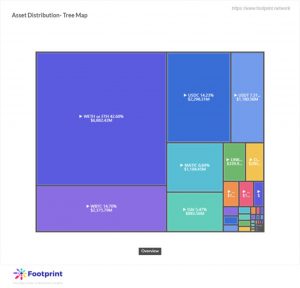
    Asset Distribution- Tree Map
    Data source: Footprint Analytics

    What Problems Do Cross-Chain Bridges Address?

    Cross-chain bridges create growth across chains (reflected by Fantom and Avalanche prices, which hit gains of 12% and 18%, respectively, in the first week of November) that offer disparate asset interoperability, which is a high level of security and a better asset rendition.

    Without a bridge, investors have to go through different exchanges and incur larger fees instead. 

    Cross-chain bridges also address the following:

    • Lower gas costs with increased transaction speeds;
    • User assets can be freely interacted with for a high user experience;
    • Improved productivity and usefulness of existing crypto assets;
    • Higher security and better privacy.

    The use of cross-chain bridges is appropriate in the following scenarios:

    • Token transfers between Ethereum and a Layer 2 network, with assets interoperable across chains, such as faster and easier deposit of funds, withdrawal of assets and exit times to reduce operational complexity;
    • High fees and use in times of Ethereum congestion;
    • Thin assets supported by single chains and more assets supported by cross-chain bridges;
    • Investors can use cross-chain bridges when investing in new chains to get to the head mine faster, but need to assess the full mechanics of the new chain and its security;
    • Arbitrage trading across the DEX on Optimism, Arbitrum and Polygon, etc.

    How to Choose the Right Cross-Chain Bridge

    Consider the following criteria when selecting a cross-chain bridge:

    •  A stable TVL exceeding USD$1 billion with a sound cross-chain mechanism and a credible execution environment reflected by gradual changes instead of abrupt fluctuations. Verification method of cross-chain information and management method of cross-chain funds must be taken into account;
    •  Reasonable transfer costs (from USD$1 to USD$5) across the chain and interaction speeds with an estimated arrival time of 10 to 30 minutes;
    •  Security to ensure against hackers that take advantage of vulnerabilities. 

    In addition, there are also a number of aggregation tools that offer a one-stop cross-chain bridge solution, of which CoinTofu has a better overall experience in terms of reaching the cross-chain page with one click and displaying the advantages of supported cross-chain bridges, estimated arrival times, transaction fees and user experience ratings.

    Data source:cointofu.com

    Conclusion

    With the development of the DeFi industry, cross-chain bridges have become more popular than traditional exchanges. They enable interoperability and mutual integration of blockchain applications to support project owners, various blockchains, and investors as well as address the problem of capital flow and lower transaction costs to users.


    Maxine Smith, a crypto writer from Singapore and a DeFi data analyst with a focus on market trends and regulations.


    [ad_2]

    Source link

  • SocialFi Puts Agency Back in the Hands of Users | by Bit Media Buzz | Nov, 2021

    SocialFi Puts Agency Back in the Hands of Users | by Bit Media Buzz | Nov, 2021

    [ad_1]

    Bit Media Buzz

    There are now over 100 million wallet addresses in the world, and the number of crypto and non-fungible token (NFT) enthusiasts keeps growing every day. The crypto community has economic power, interlinking relationships and seamless communication potential, but why doesn’t it have its own social media? A truly native crypto- and NFT-dedicated social media platform with a high density of fans has not yet been born.

    For crypto markets to grow in size and participants, there needs to be increased trust. For those who aren’t crypto native, the landscape can be bewildering. There are also dangers from scammers and spammers. It’s hard to fully protect users from these bad actors, but one way is to create a venue where they can get accurate information and not get played — a dedicated public opinion forum and social media platform for crypto communities.

    Furthermore, the current model of social media is inherently extractive. The platforms take their customers’ data and sell it on, while serving them increasingly intrusive advertising. As the saying goes: Users aren’t paying for social media; they are the product. This must change, and one way is through a fusion of social and finance (SocialFi), which puts the economics back in the hands of users.

    SocialFi aims to deliver benefits and rewards to users through the financialization and tokenization of social influence. Monaco Planet is a next-generation SocialFi platform that successfully completed its first round of multi-million-dollar financing with Three Arrows Capital and IMO Ventures. It goes live on Nov. 28.

    Monaco Planet attacks the problem of spammers and scammers by requiring login through wallets such as MetaMask. Because users can showcase their NFT collections on their personal profile page, their level of engagement and dedication identifies true influencers. Users who publish and show their own activities can follow verified key opinion leaders (KOL) throughout the community. The platform can also rank users by net worth and influence of their NFTs, fostering organic connections between KOLs and users.

    By introducing the concept of write-to-earn, content creation itself serves as a form of mining. Active content creators and discussion participants on Monaco Planet continuously reap the benefits in the form of native tokens. Most native tokens will be distributed to users who generate content, creating a form of mining that is sustainable, inclusive and genuinely productive.

    A true SocialFi platform belongs to its users. And as the vast majority of Monaco Planet’s native currency will be distributed to users as rewards for content creation, Monaco Planet functions as a true decentralized autonomous organization, governed by native token holders who can send in proposals and vote. As a SocialFi platform, the ownership and governance of Monaco Planet are determined by the users themselves. Moreover, holders of native tokens will enjoy the currency appreciation brought by the platform’s growing economic activity.

    As early users of Monaco Planet’s SocialFi platform, NFT holders will be the initial beneficiaries of content mining. They will enjoy the first batch of airdrops and act as mining leads during the first month of invitation-only membership. NFT holders will have exclusive quotas and whitelists for participating in popular projects and the privilege of increased visibility of posts, broadcasting and building groups.

    Monaco Planet’s SocialFi makes it clear: Influence you can trust is now a currency that can be minted.

    You can learn more about Monaco Planet at monaconft.io, follow the project on Twitter and join the conversation on Discord.

    Source


    [ad_2]

    Source link

  • Meme Tokens: The Good, The Bad and The Ugly

    Meme Tokens: The Good, The Bad and The Ugly

    [ad_1]

    Some believe that 2021 will be the year of ‘dogs’ for cryptocurrency. Dogecoin (DOGE) and Shiba Inu (SHIB), the canine combo, lead the meme currency pack in terms of price and market value. DOGE has increased almost 8,000 percent since the beginning of the year and is ranked #9 by market value on CoinMarketCap as of November 2021. SHIB, its opponent, has pumped more than 60,000,000% since January.

    Things move quickly in the meme coin world, as they do in most internet jokes because nobody cares about anything they read on social media for more than a few minutes. This means that coins must be generated quickly in order to be classified as a meme currency rather than simply another random coin. In this article, we will discuss Meme tokens, their good side, bad side and their future.

    What Are Meme Coins?

    Meme coins are cryptocurrencies that have garnered a lot of attention in a short period of time, mainly due to influencers and retail investors pushing them online. People are doing a debate on several meme coins like Safemoon vs Shiba Inu or Shib vs Doge etc.

    Dogecoin is the first meme coin, having been developed in 2013 as a joke based on a meme. It gained popularity once Elon Musk began tweeting about it, and regular investors began purchasing it in droves.

    Developers have launched a spate of joke currencies after Dogecoin since anybody can build a new cryptocurrency. Many of these currencies are Dogecoin spinoffs, such as Shiba Inu, but there are dozens of additional meme coins to choose from.

    Dogecoin Overview

    Dogecoin is crypto similar to Bitcoin and Ethereum, but it’s not the same as either of these prominent coins. Dogecoin was named after a once-popular meme and was founded, at least in part, as a lighthearted joke for

    Meggie Nahatakyan
    Meggie Nahatakyan

    cryptocurrency aficionados. Despite its strange genesis story, Dogecoin has skyrocketed in popularity in 2021, becoming the sixth-largest cryptocurrency by market valuation as of writing.

    Billy Marcus and Jackson Palmer, two software programmers, invented Dogecoin in late 2013. Palmer created the cryptocurrency’s logo by mistyping the term “doge” to represent a Shiba Inu dog, a popular joke at the time.

    Shiba Inu Overview

    Shiba Inu is an Ethereum-based altcoin (an alternative cryptocurrency to Bitcoin) using the Shiba Inu, a Japanese breed of hunting dog, as its symbol. Shiba Inu is widely regarded as a viable alternative to Dogecoin; in fact, Shiba Inu supporters refer to it as “the Dogecoin killer.”

    Shiba Inu and Dogecoin are meme coins, which are cryptocurrencies connected with a theme, in the instance of Shiba Inu and Dogecoin, the Shiba Inu dog, but they’re more often made as a prank or inside joke than as a legitimate digital product. While Dogecoin was established in December 2013, Ryoshi, an unidentified individual or group, invented Shiba Inu in August 2020.

    Cryptocurrency vs Meme Coins

    Meme coins are a sort of cryptocurrency, however, there is one significant distinction between cryptocurrencies and meme coins, and that difference is mostly the aim.

    Bitcoin and Ethereum, two major cryptocurrencies, were created to answer real-world issues. The ultimate objective is for it to be widely accepted by merchants, resulting in the creation of a new kind of decentralized currency that will revolutionize a range of sectors.

    Meme coins, on the other hand, currently serve no real-world use, and the majority of them were established for profit. Many investors sell quickly once their prices rise in order to earn a rapid profit. Because meme coins now have no practical utility.

    Meme Coins Good Sides

    When Dogecoin originally appeared in 2013, it was thought to be a prank. No one imagined this coin could be anything other than a meme, even in their wildest imaginations. Doge is now worth $100,000 if you purchased it for $1,000 last year. Consider those who bought Dogecoin in 2013 because they thought it was a joke (or simply for fun).

    Suggested articles

    How Blockchain is Helping Half A Billion Africans Solve the Identity ProblemGo to article >>

    If you put more than $1,000 into it, you’ll get a better return. Doge has proven to be one of the most profitable cryptocurrencies in history, and it is still bringing money to individuals. This is not a coincidence. Nowadays, investors are pouring money into Meme currencies, with Shiba Inu being the most recent example, reaching an all-time high in November 2021.

    Meme Coins Bad Ugly Sides

    Meme coins may have experienced exponential growth in 2021, but trading and investing in meme coins, like other cryptocurrencies, entails significant financial risk.

    Meme coin tokenomics might be worrisome. Bitcoin has a deflationary tendency, a blockchain, a well-written whitepaper, and an established ecosystem. In comparison to Bitcoin, most meme currencies are inflationary and have no limit on supply. The community’s collective humour frequently determines its ecology, use cases, and basics. Only a handful of meme coins have been created using major cryptocurrency technologies. DOGE, for example, got its technology from Litecoin (LTC), whereas SHIB was constructed on the Ethereum network.

    As the meme coin market grows, you should be cautious that certain projects may try to take advantage of the enthusiasm to defraud traders. For example, in only one week, Squid Game (SQUID), a meme currency based on the famous Netflix program of the same name, increased by almost 86,000%. The development team, on the other hand, immediately rug-pulled, causing the price to collapse by 99%. Worse, holders have been barred from selling their SQUID tokens.

    Meme Coin Future

    It might be difficult to predict if a meme coin will be bullish or bearish. Meme currencies often lack a market value and a high circulating quantity, making them very inexpensive and easy to get. Because meme currencies are frequently inexpensive and easy to obtain, there are several other aspects to consider while predicting the future of any meme currency.

    The growing popularity of meme tokens and dogecoins is being fueled in part by social media. Elon Musk is one of the market factors that has frequently been indirectly impacting the price fluctuations of DOGE and Floki Inu (FLOKI) via erratic Twitter updates.

    Such an attitude might be immensely destructive to cryptocurrencies in the long term. This might reverse the industry’s overall trajectory toward pushing the financial world towards an even more gloomy future.

    Nonetheless, new meme tokens and dog coins join the market on a daily basis, and regular investors tend to purchase them with the aim of replicating the profits made by DODGE and SHIB in the past. In fact, the excitement around dogecoins has developed to the point that it is apparently driving demand for genuine dogs.

    Are They Worth the Investment?

    Even the most experienced investors face ups and downs while investing in meme coins. However, by finding out and implementing the proper knowledge, one may limit the dangers while maximizing profits. There are thousands of meme currencies to choose from, and the vast majority of them are frauds. As a result, in order to compete in this market, you must be at your best.

    The reality is that diamonds may be found amid stones; you simply have to know where to look and how to look. These particular meme coins have the potential to create 1000 for early investors.

    Before investing in any meme currency, spend some time researching the token’s community to learn about the creators’ priorities. Do they have a long-term plan for community building and long-term growth? Are they more interested in raising the price and pressuring consumers to buy? The former is a positive thing, whilst the latter is a warning sign. Additionally, it would be helpful if you could find out whether the initiative has a whitepaper outlining its true goal and objective.

    Final Thoughts

    With new meme currencies hitting the market every day and traders seeking to emulate DOGE and SHIB’s earnings, it is crucial to DYOR before investing in any meme currency. Remember that meme coins are quite volatile compared to other digital currencies. Trading or investing in cryptocurrency is fraught with danger. Meme coins are heavily community-driven and may fall abruptly, so never invest money you can’t afford to lose.


    Meggie Nahatakyan, Crypto Analyst at the Top Coins.


    [ad_2]

    Source link

  • How Litentry’s Innovative Crowdloan Program Gives DOT Holders A Chance To Maximize Their Rewards

    How Litentry’s Innovative Crowdloan Program Gives DOT Holders A Chance To Maximize Their Rewards

    [ad_1]

    The crypto space is becoming more and more interoperable, developers in search of great adoption and success will need to embrace this trend. Amongst the ruling blockchains, Polkadot and its unique approach to governance and interoperability are quickly becoming the hub for the projects that could usher the future of the industry.

    Unlike Ethereum, Cardano, and other blockchains, Polkadot leverages a distinctive mechanism that lets the community choose the projects that will occupy limited slots on the network. To participate in the auctions, projects need to gather enough funds.

    Once the process is completed, winning projects will be deployed via parachains, independent networks that power the protocols. This process has already unleashed a fearful competition with many projects, such as Moonbeam, Bifrost, Astar Network, and Litentry going strong to take the lead.

    Most of these projects offer a steady reward to gain community support and win the auction. Astar has introduced a 3-bonus level for its supporters with 5% of its native token ASTR locked as part of their Crowdloan.

    On the other hand, Moonbeam offers uses a portion of a 30% Crowdloan pool, but investors must wait until the project deploys its compatibility with the Ethereum Virtual Machine (EVM). Also, 70% of the rewards will be distributed in the 96 weeks leasing period for the slot.

    Of the aforementioned projects, the Crowdloan launch by decentralized identity aggregation protocol Litentry offers a dynamic and versatile program with adaptive rewards, bonuses, and other opportunities for its supporters.

    On top of that, participants will be able to stake their DOTs without extra requirements or complications. The Litentry Network will connect its parachain to the Polkadot relay chain. In doing so, it will provide users with more security and interoperability.

    Already running on Ethereum and Binance Smart Chain with its own native token called LIT, giving it an advantage over similar projects trying to get a slot on Polkadot, the recently launch Crowdloan strategies are a major step for the network.

    The project has been listed on the leading crypto exchange Binance for a long time and has a strong liquidity base. Thus, investors have an additional layer of security and can rely on the legitimacy of the project.

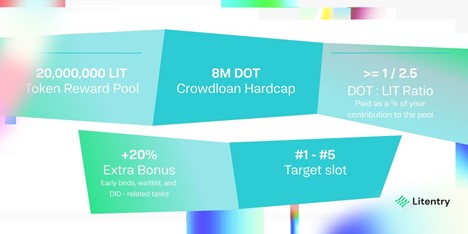
    The project has allocated 20% of LIT’s total supply or 20,000,000 to incentivize users and reward its supporters to obtain a superior position and a higher chance to obtain a slot in the Polkadot auction. The program will be live from the first slot to the fifth auction and will remain active until Litentry secures a place on the network.

    Litentry Offers The Best Rewards On The Polkadot Ecosystem

    litentry

    By allocating 20% of the LIT token total supply in the Crowdloan Program, Litentry offers DOT holders one of the best low-risk/high reward strategies to diversify their portfolio. In that way, investors will have an additional opportunity to profit other than staking their DOT.

    In order to participate in the Crowdloan Program, investors need to lock 5 DOTs for the auction. This initial investment will be rewarded with a minimum of 2.5 LIT.

    Later, final rewards will be estimated based on the contribution percentage of every user to the Crowdloan pool. In other words, one user’s DOT contribution will be divided by the total DOT contributions in the pool.

    These rewards will be distributed when the Litentry parachain running on the Polkadot relay chain goes live. Each investor will receive their LIT rewards linearly in each block for the duration of the Slot leasing period: 96 weeks.

    Even if the project fails to secure a slot, investors will still be compensated in the new Crowdloan campaign with additional LIT tokens until the program’s target is met. Compensations will reach an estimated 13% APY for a Crowdloan period of 5 weeks.

    For early supporters, there will be a bonus of up to 10% if they support the campaign before November 18 or 5% if they participate by November 25. Also, users can earn extra rewards if they complete an identity-based task and support Litentry Network’s main use case. Users can also earn extra incentives through several of Litentry’s partners, including the SubDAO airdrop, a Binance warmup promotion, and an all-new partnership with Polkadot Name System that earns users who contribute more than 10 DOT with a free .dot domain name.

    Although beneficial, Polkadot’s staking rewards have a much lower upside than betting on the growth of its ecosystem. A project such as Litentry network, with a high interoperable capacity and a use poised to see an increase in demand, as more people require an alternative to centralize data and identity systems.

    Therefore, the Crowdloan Reward Program is a great chance for early investors to fully capture Litentry’s potential to become a top project on one of the most promising ecosystems in the space. At the same time, these investors will maintain their capacity to move between blockchains.


    [ad_2]

    Source link

  • BTC, AVAX, MATIC, EGLD, MANA

    BTC, AVAX, MATIC, EGLD, MANA

    [ad_1]

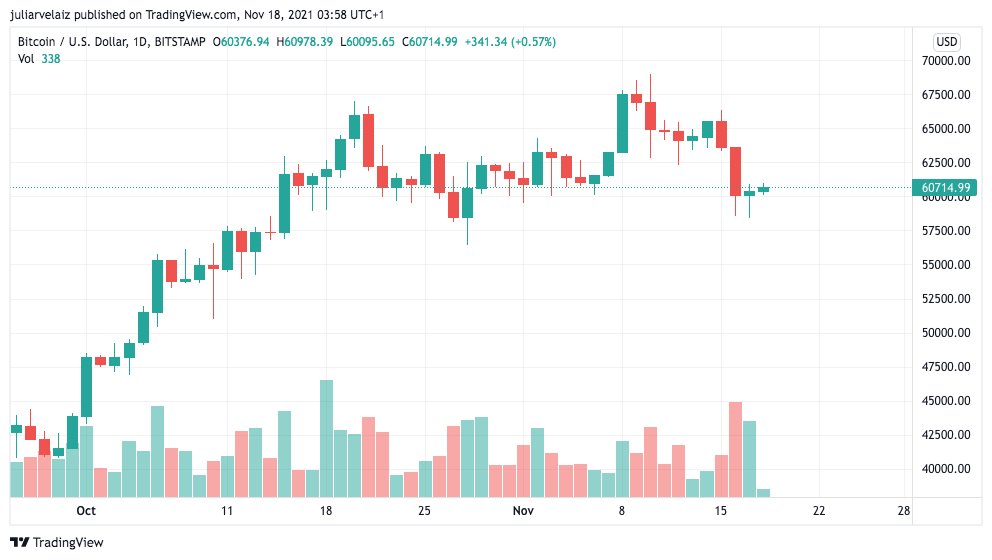
    Bitcoin (BTC) is witnessing a tough tussle near the $58,000 mark but that has not stopped select altcoins from hitting a new all-time high. This shows that traders are watching the fundamental developments on individual coins.

    One of the recent top performing major altcoins has been Avalanche (AVAX), which has soared more than 120% in November. The coin caught traders’ attention leading up to the announcement by accounting firm Deloitte which plans to build its disaster relief platforms on the Avalanche blockchain.

    Crypto market data daily view. Source: Coin360

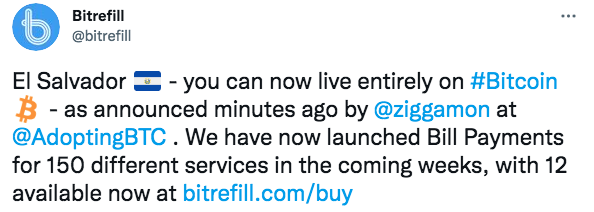
    In another step that shows growing crypto adoption, El Salvador’s President Nayib Bukele announced the launch of Bitcoin city, which will be powered by geothermal energy and initially funded by $1 billion worth of Bitcoin bonds.

    Could strong buying at lower levels boost Bitcoin above $60,000 and will altcoins participate in the recovery? Let’s study the charts of the top-5 cryptocurrencies that could attract traders’ attention in the short term.