Facebook whistleblower Frances Haugen has taken aim at Meta in a new interview, suggesting that its version of the Metaverse will simply repeat all of its past mistakes.
In an interview with Politico, Haugen said:
“They’ve made very grandiose promises about how there’s safety-by-design in the Metaverse. But if they don’t commit to transparency and access and other accountability measures, I can imagine just seeing a repeat of all the harms you currently see on Facebook.”
In 2021 Huagen leaked thousands of internal documents from Facebook to the Securities and Exchange Commission and The Wall Street Journal. Her experience working for the company has left her with concerns about privacy issues and about letting the corporation amass data about every aspect of user’s interactions in the Metaverse.
“I’m super concerned about how many sensors are involved. When we do the Metaverse, we have to put lots more microphones from Facebook; lots more other kinds of sensors into our homes,” she said.
“You don’t really have a choice now on whether or not you want Facebook spying on you at home. We just have to trust the company to do the right thing.”
Haugen isn’t the only one concerned. According to a recent survey, 70% of people don’t trust Meta to handle privacy properly.
Andy Yen, CEO of encrypted email service ProtonMail is also concerned with the unilateral powers of Big Tech giants like Meta. Last week, he said in an interview, that his own company, Proton, will only be able to survive based on the goodwill of tech giants.
“Tech giants could today remove us from the Internet with zero legal or financial repercussions,” he said.
Yen has also raised concerns about Big Tech controlling the Metaverse in the past, telling Newsweek last year that Meta was “building a new infrastructure where they control everything. They control the device, they have the VR headsets, you’re now in their world, on their devices, on their platform.”
Yen said that given their track record, he doesn’t believe we should trust Meta with power like that and that promises around privacy in the Metaverse are useless unless its business model changes.
“At the end of the day, their business model revolves on taking your data and monetizing it. So, there is fundamentally always going to be a conflict between what they say and what they actually have to do to make money.”
Data collection
The Electronic Frontier Foundation (EFF) is a nonprofit organization defending civil liberties in the digital world. Like Yen, it believes that VR headsets and AR glasses, and other wearables, will make data collection and surveillance easier than ever before. In December they stated:
“This data harvesting, sometimes done by companies with a history of putting profit before protections, sets the stage for unprecedented invasions into our lives, our homes, and even our thoughts.”
The EFF is concerned that data collected and used for targeted advertising will generate “biometric psychography” and that our deepest desires and inclinations will be up for sale. Once the information has been collated, the data could be monetized by third parties, even without our knowledge or agreement.
The China syndrome
While the Metaverse may seem like an issue for the distant future, in China, citizens are living it every day, in a different way.
WeChat is the social media platform of choice in China. It has a mind-boggling user base of over one billion. Of those, 850 million are active users. The app is amassing data about users in China on a scale never seen before. And, the Chinese government can monitor every word, picture and video on it.
WeChat came under heavy criticism from Reporters Without Borders (RSF) before the Winter Olympic Games earlier this year. RSF urged journalists to protect themselves against Chinese surveillance while reporting in-situ. They said, “RSF recommends journalists who travel to China to avoid downloading applications that could allow the Chinese authorities to monitor them.” These included WeChat and TikTok.
Coming up onWednesday is the first instalment of the Invest Shariah Dialogue Series 2022, an annual four-part series organized by Bursa Malaysia that provides a platform for industry experts to discuss the Islamic capital market and Shariah investing-related topics.
Dubai-based Khalid Howladar will speak on the topic of Millenials and Gen Z: Embracing the Future of Investing. Howladar is Chairman of the Advisory Board at MRHB.Network, a landmark DeFi project in Islamic Finance, offering halal and ethical decentralized finance solutions.
Talking points include:
The debate on whether crypto is halal vs haram and whether the next generation should participate or avoid this space, Millennials and Gen Z being the biggest adopters of crypto, a sector now worth about US$2 trillion
The opportunities and use cases of decentralized finance (DeFi) and its role — if any — in Islamic finance and supporting sustainability goals.
Clarity on these terms — blockchain and cryptocurrencies. Is there a misconception on these digital innovations — do they have any value or are they just pure speculation.
How MRHB is raising the bar on safe investing amongst Millenials and Gen Z and how the platform is envisaged to create future investment opportunities.
About MRHB DeFi
MRHB (pronounced ‘Marhaba’) DeFi is a decentralised finance platform built to bring ethics to the DeFi space with an approach that supports the inclusion of faith-based and other excluded communities in addition to existing crypto-natives so that everyone can benefit from the full empowerment potential of DeFi to help build a true peer-to-peer financial and economic value system.
Based on the tenets of blockchain such as trust, transparency, and security, MRHB DeFi has encapsulated universally applicable principles of Islamic Finance into those tenets of blockchain to render a suite of offerings that are also ESG compliant.
The project is backed by a diverse and strong team with backgrounds spanning crypto, technology, faith-compliant investing, finance and seasoned institutional veterans of industry.
MRHB DeFi Official Channels
Website | Twitter | Telegram Chat | Telegram Announcements | Medium | Documents | Facebook | LinkedIn | Telegram Arabic Community | Russian Community | Turkish Community |Persian Community | Urdu/Hindi Community
In part one of this quant research piece, we introduce the decentralized finance (DeFi) collateralized lending platform known as Compound Finance and discuss its use case for stablecoins, in comparison to the notion of a “risk-free” interest rate from traditional finance (TradFi). Our goal is to tie these concepts together to educate on how different types of low-risk investment work within the TradFi and crypto markets.
This introduction examines stablecoin lending yield and shares insights on yield performance, volatility, and the factors driving lending yield. Part two of this piece will examine the factors that drive lending yield in more detail.
Stablecoins are a niche part of the ever-growing crypto ecosystem, primarily used by crypto investors as a practical and cost-efficient way to transact in cryptocurrency. The invention of stablecoins in the crypto ecosystem is brilliant because of the following properties:
Similar to the fiat currencies used in model economies, stablecoins provide stability in price for people transacting across digital currencies or between fiat and digital currencies.
Stablecoins are native crypto tokens that can be transacted on-chain in a decentralized manner without involvement of any central agency.
With the growing adoption of cryptocurrencies by investors from the TradFi world, stablecoins have become a natural exchange medium between the traditional and crypto financial worlds.
Two of the shared core concepts in the traditional and crypto financial worlds are the concepts of risk and return. Expectedly, investors are likely to demand higher return for higher risk. During the current Russia-Ukraine war, the Russian interest rate increased from an average of approximately 9% to 20% in 2 weeks, which is a clear indication of how the financial market reacts to risk.
Central to the framework of risk and return is the notion of a “risk-free” rate. In TradFi, this rate serves as a baseline in judging all investment opportunities, as it gives the rate of return of a zero-risk investment over a period of time. In other words, an investor generally considers this baseline rate as a minimum rate of return he or she expects for any investment, because rational investors would not take on additional risk for a return lower than the “risk-free” rate.
One example of a “risk-free” asset is the U.S. Treasury debt asset (treasury bonds, bills, and notes), which is a financial instrument issued by the U.S. government. When you buy one of these instruments, you are lending the U.S. government your money to fund its debt and pay the ongoing expenses. These investments are considered “risk-free” because their payments are guaranteed by the U.S. government, and the chance of default is extremely low.
A “risk-free” rate is always associated with a corresponding period/maturity. In the example above, treasury debt assets could have different maturities, and the corresponding risk-free rate (also called treasury yield) are different as well.
The duration could be as short as one day, in which case we call it overnight risk-free rate or general collateral rate. This rate is associated with the overnight loan in the money market and its value is decided by the supply and demand in this market. The loans are typically collateralized by highly rated assets like treasury debt, and are thus deemed risk-free as well.
Source: WallStreetMojo
With the growth in acceptance of crypto assets and the corresponding market globally, crypto based investing has become a popular topic for people who have been previously exposed only to the traditional financial market. When entering into a new financial market like this, the first thing these investors generally observe is the risk-free rate, as it will be used as the anchor point for evaluating all other investment opportunities.
There is no concept of treasury debt in the crypto world, and as such, the “low-risk” (rather than risk-free) interest rate is achieved in DeFi collateralized lending platforms such as Compound Finance. We use the term “low-risk” here, because Compound Finance, along with many other DeFi collateralized lending platforms, are not risk-free, but rather subject to certain risks such as smart contract risk and liquidation risk. In the case of liquidity risk, a user who has negative account liquidity is subject to liquidation by other users of the protocol to return his/her account liquidity back to positive (i.e. above the collateral requirement). When a liquidation occurs, a liquidator may repay some or all of an outstanding loan on behalf of a borrower and in return receive a discounted amount of collateral held by the borrower; this discount is defined as the liquidation incentive. To summarize risk in DeFi, the closest we can get to risk-free is low-risk.
To clarify, for the sake of this post (and part two), we are looking into Compound V2. On Compound, users interact with smart contracts to borrow and lend assets on the platform. As shown in the example diagram above:
Lenders first supply stablecoins (or other supported assets) such as DAI to liquidity pools on Compound. Contributions of the same coin form a large pool of liquidity (a “market”) that is available for other users to borrow.
The borrower can borrow stablecoins (take a loan) from the pool by providing other valuable coins like ETH as collateral in the above diagram. The loans are over-collateralized to protect the lenders such that for each $1 of the ETH used as the collateral, only a portion of it (say 75 cents) can be borrowed in stablecoins.
Lenders are issued cTokens to represent their corresponding contributions in the liquidity pool.
Borrowers are also issued cTokens for their collateral deposits, because these deposits will form their own liquidity pools for other users to borrow as well.
How much interest a borrower needs to pay on their loans, and how much interest a lender can receive in return, is determined by the protocol formulas (based on supply/demand). It is not the intention of this blog to give a comprehensive introduction to the Compound protocol and the many formulas involved (interested parties please refer to the whitepaper for an in-depth education). Rather, we would like to focus on the yield that an investor can generate by providing liquidity to the pool, which will facilitate our yield comparison between the two financial worlds.
A Compound user receives cTokens in exchange for providing liquidity to the lending pool. While the amount of cTokens he holds stays the same through the process, the exchange rate that each unit of cToken can be redeemed with to get the fund back keeps going up. The more loans are taken out of the pool, the more interest rate will be paid by the borrowers, and the quicker the exchange rate will go up. So in this sense, the exchange rate is an indication of the value of the asset that a lender has invested over time, and the return from time T1 to T2 can be simply obtained as
R(T1,T2)=exchangeRate(T2)/exchangeRate(T1)-1.
Additionally, annualized yield for this investment (assuming continuous compounding) can be calculated as
While the Compound pools support many stablecoin assets such USDT, USDC, DAI, FEI etc, we are only going to analyze the yields on collateralized lending for the top 2 stablecoins by market cap, i.e. USDT and USDC, with market capitalizations of $80B and $53B respectively. Together, they make up over 70% of the total market for stablecoins.
Here below are the plots of the annualized daily, weekly, monthly, and biannual yields generated according to the formulas in the previous section. As one can see, the daily yield is pretty volatile, while the weekly, monthly, and biannual yields are respectively the smoothed version of the prior granular plot. USDT and USDC have pretty similar patterns in the plot, as lending of both of these assets experienced high yield and high volatility for the start of 2021. This indicates there are some systematic factors there that are affecting the DeFi lending market as a whole.
Source: The Graph
One hypothesis of the systemic factors that could affect the lending yield involves crypto market data such as BTC/ETH prices and their corresponding volatilities. To illustrate an example (higher risk in this case), when BTC and ETH are in an ascending trend, it is believed that many bull-chasing investors will borrow from the stablecoin pools to buy BTC/ETH and then use the purchased BTC/ETH as collateral to borrow more stablecoins, and then repeat this cycle until the leverage is at a satisfying high level. This leverage effect helps the investors to magnify their returns as BTC/ETH keeps going up. We will explore this analysis more in part two of this blog post.
Future Directions
This blog has given a broadly applicable introduction to DeFi collateralized lending through the lens of Compound Finance and how it compares to “risk-free” rates from TradFi. As mentioned above, in part two of this blog post, we will further examine collateralized lending yields and share our insights on yield performance, volatility, and driving factors.
We, as part of the Data Science Quantitative Research team, aim to get a good holistic understanding of this space from a quantitative perspective that can be used to drive new Coinbase products. We are looking for people that are passionate in this effort, so if you are interested in Data Science and in particular Quantitative Research in crypto, come join us.
The analysis makes use of the Compound v2 subgraph made available through the Graph Protocol. Special thanks to Institutional Research Specialist, David Duong, for his contribution and feedback.
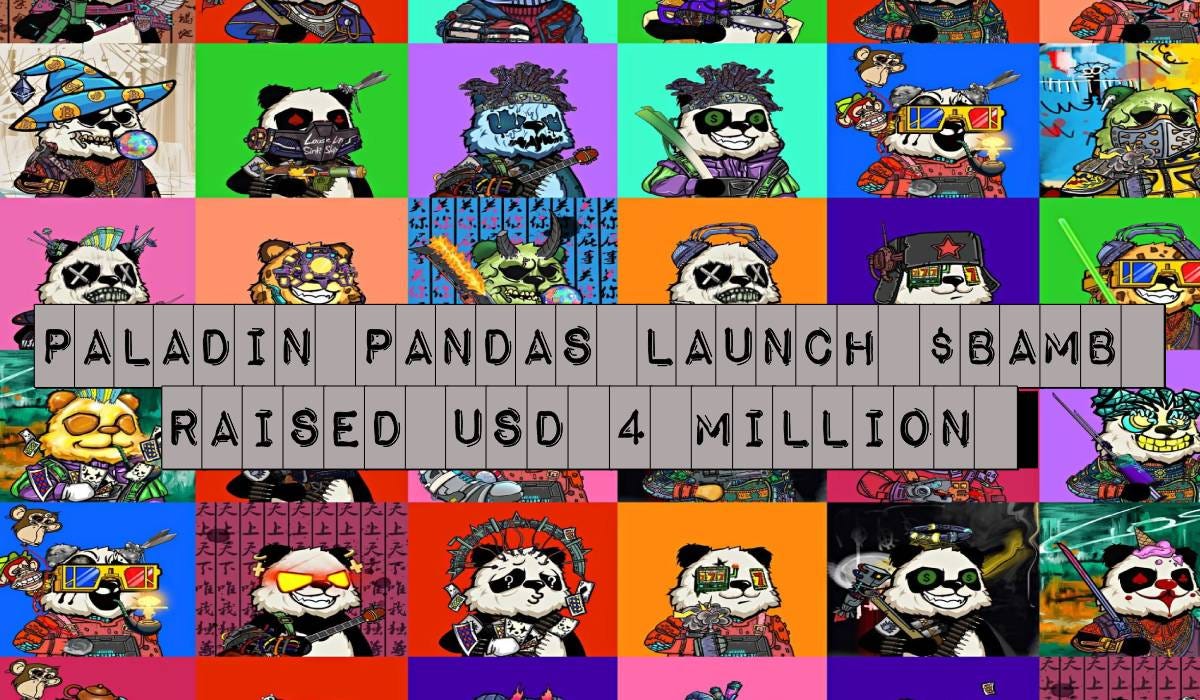
OHDAT-affiliated NFT Game Project Paladin Pandas launched their ERC-20 Token $BAMB on the Ethereum chain on April 6th 2022. This established Paladin Pandas as one of the first NFT projects that has completed both the launch of their play-to-earn game and their token.
A hand-drawn 10K NFT collection launched on Opensea on September 28th 2021, Paladin Pandas sold out in 32 minutes. It was ranked №6 on the daily volume leaderboard, №13 on the weekly volume leaderboard and featured on the OpenSea homepage.
NFT whale owners including influencer and top collector, Zeneca_33, COLE, co-founder of Pudgy Penguins, and NFT influencers Josh Ong and NFT Girl, as well as crypto artist JN Silva, all added Paladin Pandas to their collection.
This led to recognition from established VCs and other institutions and angel investors and OHDAT raised funding totalling US$4M from Future Capital, Hashkey Capital, Innoangel, Y2Z Capital, Vincent Niu, the founder of Sky9 Capital and Mandy Wang, the founder of Odaily. The funds raised were to go towards launching new projects and implementing the Open World social simulation game and MMORPG game, highlighted on their Roadmap 2.0.
On January 25th, Paladin Pandas launched ‘PvE game Space Expedition’, where players send their Pandas to planets on an expedition (with 15 stages each) while strategically putting the Pandas into teams of 3 to retrieve the lost $BAMB (Bamboonium) through battles and mini-games. Since categories like element, class, weapon all matter in the gameplay, players need to select the right pandas to buy and be sent to battle, involving strategy gameplay.
All $BAMB earned from the PvE game is locked in the players’ $BAMB balance, to be unlocked and claimable at a weekly rate of 15%. The lockup can be lifted if players manage to get on the PvP daily/weekly leaderboard.
On March 9th, PvP: ‘Panda v. Panda’ open demo was officially released, a 1V1 3D combat game for true gamers. Players pay $BAMB to enter the arena and loot more $BAMB from other players. With 48 weapons, 7 basic moves and 21 stages, the gameplay is not limited to a ‘Stake-to-Earn’ mechanism; it is an actual ‘Play-to-Earn’ NFT game with delightful strategy gaming, which is a stab at revolutionizing NFT gaming. Up to now, which can be quite monotonous when the focus is only on the earnings. The PvP open demo initiated the “Clean the rugs’ campaign and airdropped 40K $BAMB tokens to the gamefi project holdlers.
Giving perks to all NFT holders was taken into account when devising the Paladin Pandas ecosystem. Mandatory to use a Paladin Panda to enter the game, so as to extend the user base to more NFT gamers, non-holders can also rent Pandas by paying $BAMB. The rental limit for each Panda is 2x for PvE and 3x for PvP.
Besides being an in-game currency, $BAMB has several utilities. First, $BAMB can be staked along with LP tokens to mine 5% of the overall supply, a total of 25M $BAMB. Second, $BAMB can be swapped to Power Raffle tickets, which is a WEB3 raffle machine to win blue chip NFT projects with minimum entry fees. Third, $BAMB holders are able to access exclusive online store merchandise, in-game marketplace boosts, and also the whitelist marketplace to consume their tokens.
To celebrate the $BAMB launch, the OHDAT team will incentivize Panda owners with 2 airdrops. First, 60 Rent Tickets will be dropped to 30K new addresses for mining the game, for their first run. Second, 1.5% of the overall supply, totaling 7.5M $BAMB will be airdropped to all Panda holders. Prioritizing fun gaming features, Paladin Pandas aims for $BAMB to be a “blue chip token” in the NFT market over the long term.
Hong Kong-based MaiCapital Limited, which is a blockchain and virtual asset manager, has secured approval from the local financial market supervisor, the Securities and Futures Commission (SFC), that will allow the company to manage assets with 100 percent virtual assets.
Until now, the company operated with SFC’s Type 4 and Type 9 licenses, which it obtained in 2018. The first allows the company to advise on securities, while the second grants permission to act as an asset manager.
Announced on Tuesday, the company also brought in Wealthking Investment as an investor and shareholder.
“With the extended approval from SFC, MaiCapital is on an even greater trajectory to bring more innovative investment products and services to professional and institutional investors,” said Liu Zhiwei, the Chairman of Wealthking.
Actively Managed Crypto Funds
MaiCapital has been operating two actively managed blockchain
Blockchain
Blockchain comprises a digital network of blocks with a comprehensive ledger of transactions made in a cryptocurrency such as Bitcoin or other altcoins.One of the signature features of blockchain is that it is maintained across more than one computer. The ledger can be public or private (permissioned.) In this sense, blockchain is immune to the manipulation of data making it not only open but verifiable. Because a blockchain is stored across a network of computers, it is very difficult to tamper with. The Evolution of BlockchainBlockchain was originally invented by an individual or group of people under the name of Satoshi Nakamoto in 2008. The purpose of blockchain was originally to serve as the public transaction ledger of Bitcoin, the world’s first cryptocurrency.In particular, bundles of transaction data, called “blocks”, are added to the ledger in a chronological fashion, forming a “chain.” These blocks include things like date, time, dollar amount, and (in some cases) the public addresses of the sender and the receiver.The computers responsible for upholding a blockchain network are called “nodes.” These nodes carry out the duties necessary to confirm the transactions and add them to the ledger. In exchange for their work, the nodes receive rewards in the form of crypto tokens.By storing data via a peer-to-peer network (P2P), blockchain controls for a wide range of risks that are traditionally inherent with data being held centrally.Of note, P2P blockchain networks lack centralized points of vulnerability. Consequently, hackers cannot exploit these networks via normalized means nor does the network possess a central failure point.In order to hack or alter a blockchain’s ledger, more than half of the nodes must be compromised. Looking ahead, blockchain technology is an area of extensive research across multiple industries, including financial services and payments, among others.
Blockchain comprises a digital network of blocks with a comprehensive ledger of transactions made in a cryptocurrency such as Bitcoin or other altcoins.One of the signature features of blockchain is that it is maintained across more than one computer. The ledger can be public or private (permissioned.) In this sense, blockchain is immune to the manipulation of data making it not only open but verifiable. Because a blockchain is stored across a network of computers, it is very difficult to tamper with. The Evolution of BlockchainBlockchain was originally invented by an individual or group of people under the name of Satoshi Nakamoto in 2008. The purpose of blockchain was originally to serve as the public transaction ledger of Bitcoin, the world’s first cryptocurrency.In particular, bundles of transaction data, called “blocks”, are added to the ledger in a chronological fashion, forming a “chain.” These blocks include things like date, time, dollar amount, and (in some cases) the public addresses of the sender and the receiver.The computers responsible for upholding a blockchain network are called “nodes.” These nodes carry out the duties necessary to confirm the transactions and add them to the ledger. In exchange for their work, the nodes receive rewards in the form of crypto tokens.By storing data via a peer-to-peer network (P2P), blockchain controls for a wide range of risks that are traditionally inherent with data being held centrally.Of note, P2P blockchain networks lack centralized points of vulnerability. Consequently, hackers cannot exploit these networks via normalized means nor does the network possess a central failure point.In order to hack or alter a blockchain’s ledger, more than half of the nodes must be compromised. Looking ahead, blockchain technology is an area of extensive research across multiple industries, including financial services and payments, among others. Read this Term-themed hedge funds since 2019, receiving investments only from institutions and qualified professional investors. According to the company, the latest SFC approval will allow it to deploy crypto investment strategies with greater flexibility.
MaiCapital’s CEO, Benedict Ho said: “MaiCapital has always prided itself in its ability to invest in the nascent cryptocurrency asset class with the highest compliance
Compliance
In finance, banking, investing, and insurance compliance refers to following the rules or orders set down by the government regulatory authority, either as providing a service or processing a transaction. Compliance concerning finance would also be a state of being following established guidelines or specifications. This designation can also encompass efforts to ensure that organizations are abiding by both industry regulations and government legislation. Understanding ComplianceCompliance is a system of checks and balances that prevents fraud and inefficiencies.Additionally, this also ensures cooperation with federal financial regulations with the ultimate goal of protecting the public and provide needed information to governmental agencies to stop fraud, money laundering, and terrorist funding. Compliance in the financial industry offers stability to the markets and serves to protect customers, workers, and taxpayers from ethical threats that are inherited in individual decisions.Many organizations are also obligated to track and store compliance data. This includes all data that is relevant or belongs to a company, brokerage, etc. that can be used for the purpose of implementing or validating compliance or regulatory reporting.Given shifting regulations and the importance of compliance, the use of advanced software is increasingly being implemented to help companies manage their compliance data more efficiently. This cache includes calculations, data transfers, and audit trails.While finance is a globally unified concept, compliance is not. Regulatory compliance varies across both industries and jurisdictions. For example, the financial regulatory structures of one country may be lacking or different in another. Of note, the most tightly regulated jurisdictions in terms of compliance in the forex industry include the United States, United Kingdom or most European Union countries, Australia, New Zealand, Canada, and others.
In finance, banking, investing, and insurance compliance refers to following the rules or orders set down by the government regulatory authority, either as providing a service or processing a transaction. Compliance concerning finance would also be a state of being following established guidelines or specifications. This designation can also encompass efforts to ensure that organizations are abiding by both industry regulations and government legislation. Understanding ComplianceCompliance is a system of checks and balances that prevents fraud and inefficiencies.Additionally, this also ensures cooperation with federal financial regulations with the ultimate goal of protecting the public and provide needed information to governmental agencies to stop fraud, money laundering, and terrorist funding. Compliance in the financial industry offers stability to the markets and serves to protect customers, workers, and taxpayers from ethical threats that are inherited in individual decisions.Many organizations are also obligated to track and store compliance data. This includes all data that is relevant or belongs to a company, brokerage, etc. that can be used for the purpose of implementing or validating compliance or regulatory reporting.Given shifting regulations and the importance of compliance, the use of advanced software is increasingly being implemented to help companies manage their compliance data more efficiently. This cache includes calculations, data transfers, and audit trails.While finance is a globally unified concept, compliance is not. Regulatory compliance varies across both industries and jurisdictions. For example, the financial regulatory structures of one country may be lacking or different in another. Of note, the most tightly regulated jurisdictions in terms of compliance in the forex industry include the United States, United Kingdom or most European Union countries, Australia, New Zealand, Canada, and others. Read this Term standards and an unyielding focus to protect the interests of investors.”
In addition, the Hong Kong asset manager highlighted that it only partners with regulated digital asset exchanges and venues for its hedge funds. Two of its partners are Coinbase and OSL.
“It is so exciting to be working with MaiCapital and to provide access to our comprehensive suite of products and services including custody, prime brokerage, trading tools and analytics, and an enterprise infrastructure built on top of a robust security platform,” said Coinbase’s APAC Institutional Sales Head, Kayvon Pirestani.
Hong Kong-based MaiCapital Limited, which is a blockchain and virtual asset manager, has secured approval from the local financial market supervisor, the Securities and Futures Commission (SFC), that will allow the company to manage assets with 100 percent virtual assets.
Until now, the company operated with SFC’s Type 4 and Type 9 licenses, which it obtained in 2018. The first allows the company to advise on securities, while the second grants permission to act as an asset manager.
Announced on Tuesday, the company also brought in Wealthking Investment as an investor and shareholder.
“With the extended approval from SFC, MaiCapital is on an even greater trajectory to bring more innovative investment products and services to professional and institutional investors,” said Liu Zhiwei, the Chairman of Wealthking.
Actively Managed Crypto Funds
MaiCapital has been operating two actively managed blockchain
Blockchain
Blockchain comprises a digital network of blocks with a comprehensive ledger of transactions made in a cryptocurrency such as Bitcoin or other altcoins.One of the signature features of blockchain is that it is maintained across more than one computer. The ledger can be public or private (permissioned.) In this sense, blockchain is immune to the manipulation of data making it not only open but verifiable. Because a blockchain is stored across a network of computers, it is very difficult to tamper with. The Evolution of BlockchainBlockchain was originally invented by an individual or group of people under the name of Satoshi Nakamoto in 2008. The purpose of blockchain was originally to serve as the public transaction ledger of Bitcoin, the world’s first cryptocurrency.In particular, bundles of transaction data, called “blocks”, are added to the ledger in a chronological fashion, forming a “chain.” These blocks include things like date, time, dollar amount, and (in some cases) the public addresses of the sender and the receiver.The computers responsible for upholding a blockchain network are called “nodes.” These nodes carry out the duties necessary to confirm the transactions and add them to the ledger. In exchange for their work, the nodes receive rewards in the form of crypto tokens.By storing data via a peer-to-peer network (P2P), blockchain controls for a wide range of risks that are traditionally inherent with data being held centrally.Of note, P2P blockchain networks lack centralized points of vulnerability. Consequently, hackers cannot exploit these networks via normalized means nor does the network possess a central failure point.In order to hack or alter a blockchain’s ledger, more than half of the nodes must be compromised. Looking ahead, blockchain technology is an area of extensive research across multiple industries, including financial services and payments, among others.
Blockchain comprises a digital network of blocks with a comprehensive ledger of transactions made in a cryptocurrency such as Bitcoin or other altcoins.One of the signature features of blockchain is that it is maintained across more than one computer. The ledger can be public or private (permissioned.) In this sense, blockchain is immune to the manipulation of data making it not only open but verifiable. Because a blockchain is stored across a network of computers, it is very difficult to tamper with. The Evolution of BlockchainBlockchain was originally invented by an individual or group of people under the name of Satoshi Nakamoto in 2008. The purpose of blockchain was originally to serve as the public transaction ledger of Bitcoin, the world’s first cryptocurrency.In particular, bundles of transaction data, called “blocks”, are added to the ledger in a chronological fashion, forming a “chain.” These blocks include things like date, time, dollar amount, and (in some cases) the public addresses of the sender and the receiver.The computers responsible for upholding a blockchain network are called “nodes.” These nodes carry out the duties necessary to confirm the transactions and add them to the ledger. In exchange for their work, the nodes receive rewards in the form of crypto tokens.By storing data via a peer-to-peer network (P2P), blockchain controls for a wide range of risks that are traditionally inherent with data being held centrally.Of note, P2P blockchain networks lack centralized points of vulnerability. Consequently, hackers cannot exploit these networks via normalized means nor does the network possess a central failure point.In order to hack or alter a blockchain’s ledger, more than half of the nodes must be compromised. Looking ahead, blockchain technology is an area of extensive research across multiple industries, including financial services and payments, among others. Read this Term-themed hedge funds since 2019, receiving investments only from institutions and qualified professional investors. According to the company, the latest SFC approval will allow it to deploy crypto investment strategies with greater flexibility.
MaiCapital’s CEO, Benedict Ho said: “MaiCapital has always prided itself in its ability to invest in the nascent cryptocurrency asset class with the highest compliance
Compliance
In finance, banking, investing, and insurance compliance refers to following the rules or orders set down by the government regulatory authority, either as providing a service or processing a transaction. Compliance concerning finance would also be a state of being following established guidelines or specifications. This designation can also encompass efforts to ensure that organizations are abiding by both industry regulations and government legislation. Understanding ComplianceCompliance is a system of checks and balances that prevents fraud and inefficiencies.Additionally, this also ensures cooperation with federal financial regulations with the ultimate goal of protecting the public and provide needed information to governmental agencies to stop fraud, money laundering, and terrorist funding. Compliance in the financial industry offers stability to the markets and serves to protect customers, workers, and taxpayers from ethical threats that are inherited in individual decisions.Many organizations are also obligated to track and store compliance data. This includes all data that is relevant or belongs to a company, brokerage, etc. that can be used for the purpose of implementing or validating compliance or regulatory reporting.Given shifting regulations and the importance of compliance, the use of advanced software is increasingly being implemented to help companies manage their compliance data more efficiently. This cache includes calculations, data transfers, and audit trails.While finance is a globally unified concept, compliance is not. Regulatory compliance varies across both industries and jurisdictions. For example, the financial regulatory structures of one country may be lacking or different in another. Of note, the most tightly regulated jurisdictions in terms of compliance in the forex industry include the United States, United Kingdom or most European Union countries, Australia, New Zealand, Canada, and others.
In finance, banking, investing, and insurance compliance refers to following the rules or orders set down by the government regulatory authority, either as providing a service or processing a transaction. Compliance concerning finance would also be a state of being following established guidelines or specifications. This designation can also encompass efforts to ensure that organizations are abiding by both industry regulations and government legislation. Understanding ComplianceCompliance is a system of checks and balances that prevents fraud and inefficiencies.Additionally, this also ensures cooperation with federal financial regulations with the ultimate goal of protecting the public and provide needed information to governmental agencies to stop fraud, money laundering, and terrorist funding. Compliance in the financial industry offers stability to the markets and serves to protect customers, workers, and taxpayers from ethical threats that are inherited in individual decisions.Many organizations are also obligated to track and store compliance data. This includes all data that is relevant or belongs to a company, brokerage, etc. that can be used for the purpose of implementing or validating compliance or regulatory reporting.Given shifting regulations and the importance of compliance, the use of advanced software is increasingly being implemented to help companies manage their compliance data more efficiently. This cache includes calculations, data transfers, and audit trails.While finance is a globally unified concept, compliance is not. Regulatory compliance varies across both industries and jurisdictions. For example, the financial regulatory structures of one country may be lacking or different in another. Of note, the most tightly regulated jurisdictions in terms of compliance in the forex industry include the United States, United Kingdom or most European Union countries, Australia, New Zealand, Canada, and others. Read this Term standards and an unyielding focus to protect the interests of investors.”
In addition, the Hong Kong asset manager highlighted that it only partners with regulated digital asset exchanges and venues for its hedge funds. Two of its partners are Coinbase and OSL.
“It is so exciting to be working with MaiCapital and to provide access to our comprehensive suite of products and services including custody, prime brokerage, trading tools and analytics, and an enterprise infrastructure built on top of a robust security platform,” said Coinbase’s APAC Institutional Sales Head, Kayvon Pirestani.
Starting immediately and as part of an effort to increase transparency by providing as much information symmetry as possible, Coinbase will be using this blog post as a pilot to communicate assets under consideration for listing in Q2 2022 (April 1st, 2022 to June 30th, 2022).
April 1 — June 30 2022 Roadmap
The following assets are under consideration for listing on Coinbase in the 2nd quarter of 2022. Transfers and trading are not supported for these or any other assets until a listing is officially announced. Depositing these assets into your Coinbase account before an official announcement may lead to permanent loss of funds.
*This is not an exhaustive list of all assets under consideration. Any asset not referenced in the list does not preclude any such asset from potential listing.
As a reminder, Coinbase recently introduced an Experimental label that may be applied to newly listed assets. Some of the assets mentioned above may be listed with this Experimental label.
Disclaimer & Risks: There will be times when an asset is delayed or removed from consideration for listing for any number of factors. While we will try to make every reasonable effort to minimize this risk of occurrence, it should be understood that all information in this blog is in no way intended to be relied upon as a promise or guarantee of listing. Coinbase reserves the right to discontinue this blog post.
Changelog
Changes to our roadmap will be updated and communicated here regularly.
4/12 Change name from Polkamon (PMON) to Polychain Monsters (PMON)
Why are you considering listing these assets?
As mentioned during our launch of Asset Hub, our goal is to list every asset possible that meets our standards for legal, compliance and technical security. These standards do not take into account the market cap or popularity of a project. This means there are assets that we have concluded do not meet our standards and thus will not be listed on Coinbase at this time.
If we haven’t yet listed a popular asset, it is likely due to various reasons including:
We have concluded that the asset does not meet our minimum listing standards across legal, compliance and technical security
We do not have enough information about the asset
Technical integration work is required
Our review process is outlined in greater detail here.
How do you choose which “types” of assets to support?
We are working to add support for additional networks and ecosystems as we aim to provide the greatest inventory of assets to our users.
Today we support 3 “types” of assets for trading on Coinbase:
Native assets on their own network (recent examples include MINA and STX)
ERC-20 tokens on the Ethereum network (recent examples include APE and GALA)
SPL tokens on the Solana network (recent examples include ORCA and FIDA)
Resources on listing criteria
NOT INVESTMENT ADVICE
The content is for informational purposes only, is general in nature and should not be relied upon or construed as legal, tax, investment, financial, a promise, guarantee, or other advice. Nothing contained herein constitutes a solicitation, recommendation, endorsement, or offer by Coinbase or its affiliates to buy or sell any cryptocurrency or other instruments in any jurisdiction in which such solicitation or offer would be unlawful under the laws of such jurisdiction. Additionally, Coinbase Ventures may be an investor in the crypto projects mentioned here, and additionally, Coinbase may hold such tokens on its balance sheet for operational purposes. A list of Coinbase Ventures investments is available at https://ventures.coinbase.com/. Finally, Coinbase has a conflict of interest policy that prevents board members or Coinbase employees from being involved in a listing decision where they have a financial interest.
On-chain shows Bitcoin miner outflows have been elevated recently, suggesting miners were involved in the recent selloff that took the price of the crypto below $42k.
Bitcoin Miner Outflows Spiked Up Before The Crash Below $42k
As pointed out by an analyst in a CryptoQuant post, BTC miners seem to have been one of the sellers behind the price drop to $42k.
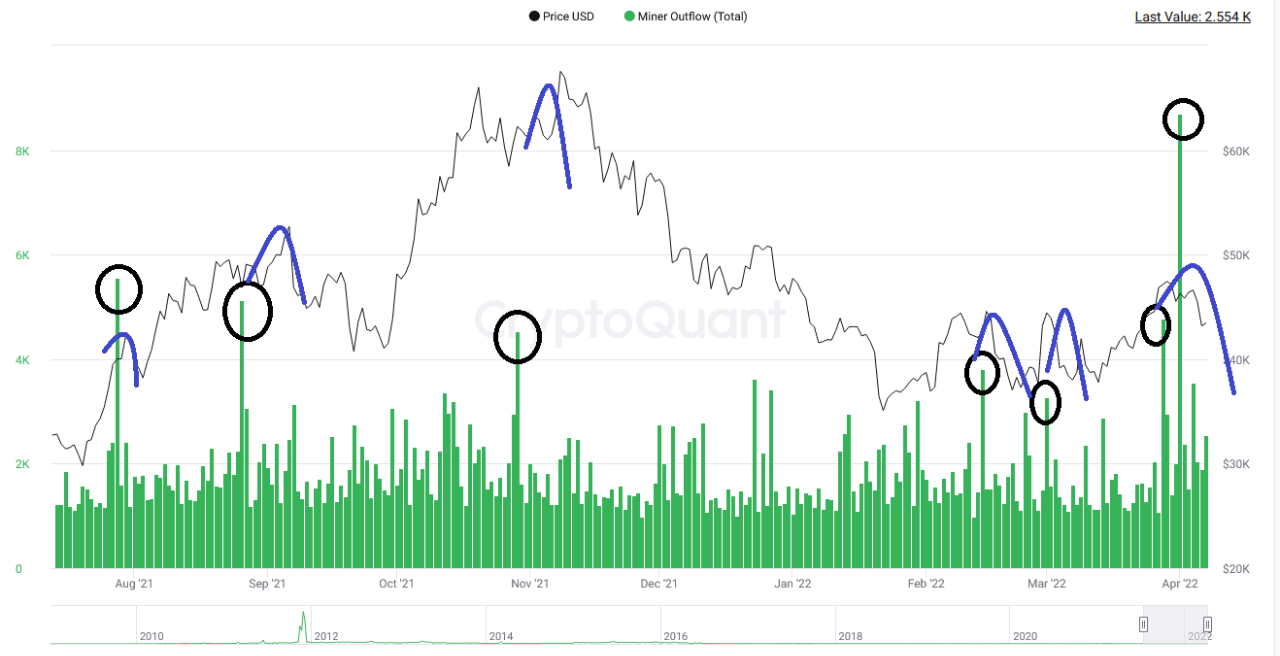
The relevant indicator here is the “miner outflow,” which measures the total amount of Bitcoin exiting wallets of all miners.
When the value of this metric spikes up, it means miners are moving a large number of coins out of their wallets right now. Such a trend can be bearish for the price of the crypto as it may be a sign of dumping from these original whales.
Related Reading | Ark CEO Cathie Wood Is As Bullish As Ever, Sees Bitcoin Hitting $1 Million By 2030
On the other hand, low values of these outflows suggest a normal or healthy amount of selling from miners. This trend, when sustained, can prove to be bullish for the BTC price.
Now, here is a chart that shows the trend in the Bitcoin miner outflows over the past several months:
Looks like the value of the indicator has shot up recently | Source: CryptoQuant
As you can see in the above graph, the Bitcoin miner outflows seem to have shown spikes in recent weeks, just before the selloff.
This would suggest that miners look to have played a role in the dump recently, sending the price of the coin diving below the $42k level.
A trend like this has been observed a few times in the past several months already, as the quant has marked in the chart.
Related Reading | Mexico’s Third Richest Man Says No To Bonds, Yes To Bitcoin
Currently, it’s unclear whether Bitcoin miners have already calmed down or if more selling is coming in the next few days.
BTC Price
After around twenty days of holding strongly above the level, Bitcoin’s price is now once again revisiting the $41k mark.
At the time of writing, the coin’s price floats around $41.1k, down 11% in the last seven days. Over the past month, the crypto has gained 4% in value.
The below chart shows the trend in the price of BTC over the last five days.
The value of BTC seems to have taken a plunge over the past twenty-four hours | Source: BTCUSD on TradingView
Due to this sharp downtrend in the price of the coin as well as the wider market, crypto futures has collected a huge amount of liquidations today. In the last 24 hours, liquidations have amounted to more than $322 million, $175 million of which occurred in the past 4 hours alone.
Featured image from Unsplash.com, charts from TradingView.com, CryptoQuant.com
Italian professional soccer club AC Milan will be releasing its first-ever nonfungible token (NFT) project in collaboration with the BitMEX crypto exchange. Proceeds will go to Fondazione Milan, the clubs’ charity arm.
The limited-edition collection will feature 75,817 NFTs, a number representative of the capacity of the club’s home ground, San Siro stadium. It will depict a 3D image of a jersey found in South Sudan by Danish war photographer Jan Grarup who was in the country documenting widespread flooding last December.
BitMEX partnered with AC Milan to contribute to the project by providing trading discounts and “other benefits” to the first 10,000 pre-orders. BitMEX will also donate to Fondazione Milan by purchasing a “large number” of the NFTs.
As per the announcement, the club says the proceeds will contribute to funding its charitable causes around the world, specifically mentioning the ongoing crisis in Ukraine and a UNICEF project in South Sudan.
Magic Eden to accept tokens from DeGods and Aurory projects
Magic Eden, the largest marketplace by volume for Solana NFTs, according to DappRadar, has confirmed it will accept the tokens from popular Solana NFT projects “DeGods DUST” and Aurory’s “AURY” within the coming weeks.
The marketplace first teased integration of the DUST token in late March, tweeting “brb integrating $DUST” on March 31. On April 1, a drawing of a Magic Eden-themed bar with the caption “$AURY” was tweeted.
— Magic Eden Solana’s Leading NFT Marketplace (@MagicEden) April 1, 2022
“DeGods” is the most traded collection in 30 days on Magic Eden, according to its own statistics, and has an all-time trading volume on the platform of 307,121 Solana (SOL), or $33.8 million at the time of writing. “Aurory” is in third place overall in sales volume for a Solana NFT project according to DappRadar, with an all-time volume of $79.5 million.
Related: Content creators introducing a new paradigm with NFTs
The integration of the tokens may be the latest attempt by the platform to solidify itself as Solana’s native NFT marketplace after OpenSea announced it will integrate Solana, putting the two platforms in direct competition.
According to reports, Tiffany Huang, head of content and marketing at Magic Eden, stated that the platform was looking to integrate tokens from other “blue chip” NFT collections.
Solana NFT sales are gaining momentum
Solana NFTs are seeing a significant gain in volume. In the last 24 hours, the NFT sales volume on the Solana blockchain has hit over $9.2 million — an increase of 51.5% — according to analytics firm CryptoSlam.
It comes after a drop was seen in the trading volume of Solana NFTs following the March 30 announcement that OpenSea would integrate the blockchain when OpenSea announced the Solana integration. On April 6, the day before the integration was live, trading volume decreased by 34.4%.
Ethereum is still the top network when it comes to NFTs, with $49.4 million in sales made in the last 24 hours.
Other Nifty News
Starbucks has announced its foray into NFTs, with CEO Howard Schultz stating that ”sometime before the end of the calendar year, we are going to be in the NFT business.”
Autograph, the NFT platform co-founded by Tom Brady, has signed a multi-year partnership with ESPN to create a docuseries and NFT collection titled “Man in the Arena: Tom Brady,” which details the career of the NFL legend.
Coinbase halts payments via Unified Payments Interface (UPI) on Sunday in less than 4 days after the its launch. Clients of the crypto exchange in India are unable to purchase cryptocurrencies via UPI as a payment method. ‘Currently unavailable’ error is displayed.
On 7 April the National Payments Corporation of India (NPCI) tweeted that it is unaware of any crypto exchange
Exchange
An exchange is known as a marketplace that supports the trading of derivatives, commodities, securities, and other financial instruments.Generally, an exchange is accessible through a digital platform or sometimes at a tangible address where investors organize to perform trading. Among the chief responsibilities of an exchange would be to uphold honest and fair-trading practices. These are instrumental in making sure that the distribution of supported security rates on that exchange are effectively relevant with real-time pricing.Depending upon where you reside, an exchange may be referred to as a bourse or a share exchange while, as a whole, exchanges are present within the majority of countries. Who is Listed on an Exchange?As trading continues to transition more to electronic exchanges, transactions become more dispersed through varying exchanges. This in turn has caused a surge in the implementation of trading algorithms and high-frequency trading applications. In order for a company to be listed on a stock exchange for example, a company must divulge information such as minimum capital requirements, audited earnings reports, and financial reports.Not all exchanges are created equally, with some outperforming other exchanges significantly. The most high-profile exchanges to date include the New York Stock Exchange (NYSE), the Tokyo Stock Exchange (TSE), the London Stock Exchange (LSE), and the Nasdaq. Outside of trading, a stock exchange may be used by companies aiming to raise capital, this is most commonly seen in the form of initial public offerings (IPOs).Exchanges can now handle other asset classes, given the rise of cryptocurrencies as a more popularized form of trading.
An exchange is known as a marketplace that supports the trading of derivatives, commodities, securities, and other financial instruments.Generally, an exchange is accessible through a digital platform or sometimes at a tangible address where investors organize to perform trading. Among the chief responsibilities of an exchange would be to uphold honest and fair-trading practices. These are instrumental in making sure that the distribution of supported security rates on that exchange are effectively relevant with real-time pricing.Depending upon where you reside, an exchange may be referred to as a bourse or a share exchange while, as a whole, exchanges are present within the majority of countries. Who is Listed on an Exchange?As trading continues to transition more to electronic exchanges, transactions become more dispersed through varying exchanges. This in turn has caused a surge in the implementation of trading algorithms and high-frequency trading applications. In order for a company to be listed on a stock exchange for example, a company must divulge information such as minimum capital requirements, audited earnings reports, and financial reports.Not all exchanges are created equally, with some outperforming other exchanges significantly. The most high-profile exchanges to date include the New York Stock Exchange (NYSE), the Tokyo Stock Exchange (TSE), the London Stock Exchange (LSE), and the Nasdaq. Outside of trading, a stock exchange may be used by companies aiming to raise capital, this is most commonly seen in the form of initial public offerings (IPOs).Exchanges can now handle other asset classes, given the rise of cryptocurrencies as a more popularized form of trading. Read this Term using UPI.
Coinbase response to the NPCI with the following statement:
“We are aware of the recent statement published by NPCI regarding the use of UPI by cryptocurrency exchanges. We are committed to working with NPCI and other relevant authorities to ensure we are aligned with local expectations and industry norms.”
At the time of this writing, India-based users are unable to buy tokens via UPI (selling option is available). It is unclear whether it is related to a significant drop in crypto trading volumes following the 30% tax in India.
It has been reported that cryptocurrencies
Cryptocurrencies
By using cryptography, virtual currencies, known as cryptocurrencies, are nearly counterfeit-proof digital currencies that are built on blockchain technology. Comprised of decentralized networks, blockchain technology is not overseen by a central authority.Therefore, cryptocurrencies function in a decentralized nature which theoretically makes them immune to government interference. The term, cryptocurrency derives from the origin of the encryption techniques that are employed to secure the networks which are used to authenticate blockchain technology. Cryptocurrencies can be thought of as systems that accept online payments which are denoted as “tokens.” Tokens are represented as internal ledger entries in blockchain technology while the term crypto is used to depict cryptographic methods and encryption algorithms such as public-private key pairs, various hashing functions, and an elliptical curve. Every cryptocurrency transaction that occurs is logged in a web-based ledger with blockchain technology.These then must be approved by a disparate network of individual nodes (computers that maintain a copy of the ledger). For every new block generated, the block must first be authenticated and confirmed ‘approved’ by each node, which makes forging the transactional history of cryptocurrencies nearly impossible. The World’s First CryptoBitcoin became the first blockchain-based cryptocurrency and to this day is still the most demanded cryptocurrency and the most valued. Bitcoin still contributes the majority of the overall cryptocurrency market volume, though several other cryptos have grown in popularity in recent years.Indeed, out of the wake of Bitcoin, iterations of Bitcoin became prevalent which resulted in a multitude of newly created or cloned cryptocurrencies. Contending cryptocurrencies that emerged after Bitcoin’s success is referred to as ‘altcoins’ and they refer to cryptocurrencies such as Bitcoin, Peercoin, Namecoin, Ethereum, Ripple, Stellar, and Dash. Cryptocurrencies promise a wide range of technological innovations that have yet to be structured into being. Simplified payments between two parties without the need for a middle man is one aspect while leveraging blockchain technology to minimize transaction and processing fees for banks is another. Of course, cryptocurrencies have their disadvantages too. This includes issues of tax evasion, money laundering, and other illicit online activities where anonymity is a dire ingredient in solicitous and fraudulent activities.
By using cryptography, virtual currencies, known as cryptocurrencies, are nearly counterfeit-proof digital currencies that are built on blockchain technology. Comprised of decentralized networks, blockchain technology is not overseen by a central authority.Therefore, cryptocurrencies function in a decentralized nature which theoretically makes them immune to government interference. The term, cryptocurrency derives from the origin of the encryption techniques that are employed to secure the networks which are used to authenticate blockchain technology. Cryptocurrencies can be thought of as systems that accept online payments which are denoted as “tokens.” Tokens are represented as internal ledger entries in blockchain technology while the term crypto is used to depict cryptographic methods and encryption algorithms such as public-private key pairs, various hashing functions, and an elliptical curve. Every cryptocurrency transaction that occurs is logged in a web-based ledger with blockchain technology.These then must be approved by a disparate network of individual nodes (computers that maintain a copy of the ledger). For every new block generated, the block must first be authenticated and confirmed ‘approved’ by each node, which makes forging the transactional history of cryptocurrencies nearly impossible. The World’s First CryptoBitcoin became the first blockchain-based cryptocurrency and to this day is still the most demanded cryptocurrency and the most valued. Bitcoin still contributes the majority of the overall cryptocurrency market volume, though several other cryptos have grown in popularity in recent years.Indeed, out of the wake of Bitcoin, iterations of Bitcoin became prevalent which resulted in a multitude of newly created or cloned cryptocurrencies. Contending cryptocurrencies that emerged after Bitcoin’s success is referred to as ‘altcoins’ and they refer to cryptocurrencies such as Bitcoin, Peercoin, Namecoin, Ethereum, Ripple, Stellar, and Dash. Cryptocurrencies promise a wide range of technological innovations that have yet to be structured into being. Simplified payments between two parties without the need for a middle man is one aspect while leveraging blockchain technology to minimize transaction and processing fees for banks is another. Of course, cryptocurrencies have their disadvantages too. This includes issues of tax evasion, money laundering, and other illicit online activities where anonymity is a dire ingredient in solicitous and fraudulent activities. Read this Term volumes dropped by as much as 55% following the new crypto tax. Mobikwik wallet, which has partnered with many crypto exchanges announced it is terminating its e-Wallet services from cryptocurrency exchanges.
It is possible that due to the NPCI statement on 7 April, banks may be blocking transactions to Coinbase via UPI. It is still unclear at this stage why depositing via UPI is disabled at Coinbase while some suggesting it is temporary.
India Cryptocurrency Regulations
According to local reports in India, the government may not announce any form of regulations on cryptocurrencies until there is a global consensus.
The assumption is that India is waiting for Europe and the US to announce their framework for regulating cryptocurrencies. India’s central bank (RBI) opposes cryptocurrencies, stating that they are a threat to financial stability.
India’s court however removed the restrictions that were imposed by the RBI in 2020. Since the India crypto market spiked by +641% from July 2020 to June 2021. It has been suggested that local banks side with the RBI’s views on cryptocurrencies.
Coinbase halts payments via Unified Payments Interface (UPI) on Sunday in less than 4 days after the its launch. Clients of the crypto exchange in India are unable to purchase cryptocurrencies via UPI as a payment method. ‘Currently unavailable’ error is displayed.
On 7 April the National Payments Corporation of India (NPCI) tweeted that it is unaware of any crypto exchange
Exchange
An exchange is known as a marketplace that supports the trading of derivatives, commodities, securities, and other financial instruments.Generally, an exchange is accessible through a digital platform or sometimes at a tangible address where investors organize to perform trading. Among the chief responsibilities of an exchange would be to uphold honest and fair-trading practices. These are instrumental in making sure that the distribution of supported security rates on that exchange are effectively relevant with real-time pricing.Depending upon where you reside, an exchange may be referred to as a bourse or a share exchange while, as a whole, exchanges are present within the majority of countries. Who is Listed on an Exchange?As trading continues to transition more to electronic exchanges, transactions become more dispersed through varying exchanges. This in turn has caused a surge in the implementation of trading algorithms and high-frequency trading applications. In order for a company to be listed on a stock exchange for example, a company must divulge information such as minimum capital requirements, audited earnings reports, and financial reports.Not all exchanges are created equally, with some outperforming other exchanges significantly. The most high-profile exchanges to date include the New York Stock Exchange (NYSE), the Tokyo Stock Exchange (TSE), the London Stock Exchange (LSE), and the Nasdaq. Outside of trading, a stock exchange may be used by companies aiming to raise capital, this is most commonly seen in the form of initial public offerings (IPOs).Exchanges can now handle other asset classes, given the rise of cryptocurrencies as a more popularized form of trading.
An exchange is known as a marketplace that supports the trading of derivatives, commodities, securities, and other financial instruments.Generally, an exchange is accessible through a digital platform or sometimes at a tangible address where investors organize to perform trading. Among the chief responsibilities of an exchange would be to uphold honest and fair-trading practices. These are instrumental in making sure that the distribution of supported security rates on that exchange are effectively relevant with real-time pricing.Depending upon where you reside, an exchange may be referred to as a bourse or a share exchange while, as a whole, exchanges are present within the majority of countries. Who is Listed on an Exchange?As trading continues to transition more to electronic exchanges, transactions become more dispersed through varying exchanges. This in turn has caused a surge in the implementation of trading algorithms and high-frequency trading applications. In order for a company to be listed on a stock exchange for example, a company must divulge information such as minimum capital requirements, audited earnings reports, and financial reports.Not all exchanges are created equally, with some outperforming other exchanges significantly. The most high-profile exchanges to date include the New York Stock Exchange (NYSE), the Tokyo Stock Exchange (TSE), the London Stock Exchange (LSE), and the Nasdaq. Outside of trading, a stock exchange may be used by companies aiming to raise capital, this is most commonly seen in the form of initial public offerings (IPOs).Exchanges can now handle other asset classes, given the rise of cryptocurrencies as a more popularized form of trading. Read this Term using UPI.
Coinbase response to the NPCI with the following statement:
“We are aware of the recent statement published by NPCI regarding the use of UPI by cryptocurrency exchanges. We are committed to working with NPCI and other relevant authorities to ensure we are aligned with local expectations and industry norms.”
At the time of this writing, India-based users are unable to buy tokens via UPI (selling option is available). It is unclear whether it is related to a significant drop in crypto trading volumes following the 30% tax in India.
It has been reported that cryptocurrencies
Cryptocurrencies
By using cryptography, virtual currencies, known as cryptocurrencies, are nearly counterfeit-proof digital currencies that are built on blockchain technology. Comprised of decentralized networks, blockchain technology is not overseen by a central authority.Therefore, cryptocurrencies function in a decentralized nature which theoretically makes them immune to government interference. The term, cryptocurrency derives from the origin of the encryption techniques that are employed to secure the networks which are used to authenticate blockchain technology. Cryptocurrencies can be thought of as systems that accept online payments which are denoted as “tokens.” Tokens are represented as internal ledger entries in blockchain technology while the term crypto is used to depict cryptographic methods and encryption algorithms such as public-private key pairs, various hashing functions, and an elliptical curve. Every cryptocurrency transaction that occurs is logged in a web-based ledger with blockchain technology.These then must be approved by a disparate network of individual nodes (computers that maintain a copy of the ledger). For every new block generated, the block must first be authenticated and confirmed ‘approved’ by each node, which makes forging the transactional history of cryptocurrencies nearly impossible. The World’s First CryptoBitcoin became the first blockchain-based cryptocurrency and to this day is still the most demanded cryptocurrency and the most valued. Bitcoin still contributes the majority of the overall cryptocurrency market volume, though several other cryptos have grown in popularity in recent years.Indeed, out of the wake of Bitcoin, iterations of Bitcoin became prevalent which resulted in a multitude of newly created or cloned cryptocurrencies. Contending cryptocurrencies that emerged after Bitcoin’s success is referred to as ‘altcoins’ and they refer to cryptocurrencies such as Bitcoin, Peercoin, Namecoin, Ethereum, Ripple, Stellar, and Dash. Cryptocurrencies promise a wide range of technological innovations that have yet to be structured into being. Simplified payments between two parties without the need for a middle man is one aspect while leveraging blockchain technology to minimize transaction and processing fees for banks is another. Of course, cryptocurrencies have their disadvantages too. This includes issues of tax evasion, money laundering, and other illicit online activities where anonymity is a dire ingredient in solicitous and fraudulent activities.
By using cryptography, virtual currencies, known as cryptocurrencies, are nearly counterfeit-proof digital currencies that are built on blockchain technology. Comprised of decentralized networks, blockchain technology is not overseen by a central authority.Therefore, cryptocurrencies function in a decentralized nature which theoretically makes them immune to government interference. The term, cryptocurrency derives from the origin of the encryption techniques that are employed to secure the networks which are used to authenticate blockchain technology. Cryptocurrencies can be thought of as systems that accept online payments which are denoted as “tokens.” Tokens are represented as internal ledger entries in blockchain technology while the term crypto is used to depict cryptographic methods and encryption algorithms such as public-private key pairs, various hashing functions, and an elliptical curve. Every cryptocurrency transaction that occurs is logged in a web-based ledger with blockchain technology.These then must be approved by a disparate network of individual nodes (computers that maintain a copy of the ledger). For every new block generated, the block must first be authenticated and confirmed ‘approved’ by each node, which makes forging the transactional history of cryptocurrencies nearly impossible. The World’s First CryptoBitcoin became the first blockchain-based cryptocurrency and to this day is still the most demanded cryptocurrency and the most valued. Bitcoin still contributes the majority of the overall cryptocurrency market volume, though several other cryptos have grown in popularity in recent years.Indeed, out of the wake of Bitcoin, iterations of Bitcoin became prevalent which resulted in a multitude of newly created or cloned cryptocurrencies. Contending cryptocurrencies that emerged after Bitcoin’s success is referred to as ‘altcoins’ and they refer to cryptocurrencies such as Bitcoin, Peercoin, Namecoin, Ethereum, Ripple, Stellar, and Dash. Cryptocurrencies promise a wide range of technological innovations that have yet to be structured into being. Simplified payments between two parties without the need for a middle man is one aspect while leveraging blockchain technology to minimize transaction and processing fees for banks is another. Of course, cryptocurrencies have their disadvantages too. This includes issues of tax evasion, money laundering, and other illicit online activities where anonymity is a dire ingredient in solicitous and fraudulent activities. Read this Term volumes dropped by as much as 55% following the new crypto tax. Mobikwik wallet, which has partnered with many crypto exchanges announced it is terminating its e-Wallet services from cryptocurrency exchanges.
It is possible that due to the NPCI statement on 7 April, banks may be blocking transactions to Coinbase via UPI. It is still unclear at this stage why depositing via UPI is disabled at Coinbase while some suggesting it is temporary.
India Cryptocurrency Regulations
According to local reports in India, the government may not announce any form of regulations on cryptocurrencies until there is a global consensus.
The assumption is that India is waiting for Europe and the US to announce their framework for regulating cryptocurrencies. India’s central bank (RBI) opposes cryptocurrencies, stating that they are a threat to financial stability.
India’s court however removed the restrictions that were imposed by the RBI in 2020. Since the India crypto market spiked by +641% from July 2020 to June 2021. It has been suggested that local banks side with the RBI’s views on cryptocurrencies.
The outlook for projects in the decentralized finance (DeFi) sector has begun to improve in recent months as a combination of global events have highlighted the benefits of holding funds outside of the traditional financial systems.
One project that has rallied over the past few months is Kyber Network (KNC), a multi-chain cryptocurrency trading and liquidity hub that aims to offer users the best trading rates.
Data from Cointelegraph Markets Pro and TradingView shows that after bouncing off a low of $2.83 on April 6, the price of KNC jumped 55.4% to hit an all-time high of $4.04 on April 8 amid a 253% spike in its 24-hour trading volume.
KNC/USDT 1-day chart. Source: TradingView
Three reasons for the building momentum of KNC include the integration of support for ten separate blockchain networks, the launch of a liquidity mining program with Avalanche (AVAX) and an expanding list of partnerships and protocol integrations that expand the reach of the Kyber Network.
Kyber Network adds multi-chain support
One of the biggest factors providing a boost to Kyber Network is the protocol’s push to integrate with the top chains across the cryptocurrency ecosystem.
KyberSwap, the main decentralized exchange interface on the network, now offers trading across ten separate networks, including Ethereum (ETH), Avalanche, Polygon (MATIC), BNB Smart Chain (BSC), Aurora, Arbitrum, Fantom (FTM), Oasis (ROSE), Velas (VLX) and Cronos (CRO).
Interoperability has become one of the main themes driving growth not just in DeFi, but in all sectors of the crypto economy because the ability to send assets and data across multiple chains is a necessary feature in the future of DeFi, the NFT sector the Metaverse.
As more chains come online, the ability to access them through one protocol is a desirable feature that many crypto and DeFi investors will come to expect.
KNC joins Avalanche Rush Phase 2
Another significant development that has helped attract increased attention and trading activity on the Kyber Network is the project’s partnership with the Avalanche Network and the Avalanche Rush Phase 2 liquidity mining program.
The liquidity incentive program kicked off on March 21 and it includes a total of $1 million in rewards for liquidity providers.
Avalanche is one of the fastest-growing Ethereum Virtual Machine (EVM) compatible networks in the cryptocurrency ecosystem and it has helped to attract more users and liquidity to the Kyber Network users by offering a low-fee alternative to Ethereum.
New partnerships and protocol integrations
A third reason for the building momentum behind KNC is the continued addition of new partnerships and major protocol integrations that are helping to spread the reach of the network.
On April 7, it was announced that KyberSwap integrated with Uniswap v3 on the Ethereum and Polygon network, bringing the most active decentralized exchange into the KyberSwap ecosystem.
The project has also revealed a new partnership with the Bondex professional network and Kyber Ventures, the investment arm of the Kyber Network, established a working relationship with Pegacy, a popular NFT racing game.
VORTECS™ data from Cointelegraph Markets Pro began to detect a bullish outlook for KNC on April 6, prior to the recent price rise.
The VORTECS™ Score, exclusive to Cointelegraph, is an algorithmic comparison of historical and current market conditions derived from a combination of data points including market sentiment, trading volume, recent price movements and Twitter activity.
VORTECS™ Score (green) vs. KNC price. Source: Cointelegraph Markets Pro
As seen in the chart above, the VORTECS™ Score for KNC spiked into the green on April 6 and hit a high of 75 around nine hours before the price increased 55.4% over the next two days.
The views and opinions expressed here are solely those of the author and do not necessarily reflect the views of Cointelegraph.com. Every investment and trading move involves risk, you should conduct your own research when making a decision.