[ad_1]
Authorities from the US and the UK are investigating
cryptocurrency transactions traversing Russian exchanges. Recent revelations
suggest that over $20 billion in crypto transfers have been flagged for
investigation.
According to a report by Bloomberg, the suspicions
revolve around Moscow-based Garantex and its use of the Tether cryptocurrency.
At the center of the scrutiny is Tether, a dollar-pegged stablecoin. The sizable volume of transactions sent through
Garantex using Tether has raised red flags, prompting regulatory bodies to
delve deeper into potential sanctions evasion and illicit financial activities.
Tether Holdings, the issuer of the eponymous
stablecoin, finds itself entangled in the investigation. Authorities caution
that unraveling the intricacies of these transactions requires time and
resources, with no immediate conclusions drawn.
Garantex, founded in Estonia but operating primarily
out of Moscow, finds itself in the regulatory crosshairs. Stripped of its
license in Estonia and sanctioned by Western powers, the exchange denies
allegations of complicity in illicit activities.
However, evidence suggests a pattern of facilitating
transactions involving sanctioned entities and criminal groups. As the
investigation unfolds, the spotlight on cryptocurrency exchanges intensifies. While asserting cooperation with law enforcement, the
company faces scrutiny over the role of Tether in facilitating criminal
activities, including investment scams and money laundering schemes.
Challenges and Complexity
Despite concerted efforts to clamp down on illicit
financial flows, the task remains daunting. Cryptocurrency transactions present
a myriad of challenges, from their decentralized nature to the cloak of
anonymity they afford.
Regulatory bodies are poised to implement stricter
oversight measures to curb abuse and safeguard the integrity of the financial
system. Yet, the evolving landscape of digital currencies underscores the
ongoing challenges in combating financial crime in the digital age.
As geopolitical tensions escalate due to Russia’s
invasion of Ukraine, Western powers are tightening their grip on financial
networks to stem the flow of funds that could support Vladimir Putin’s regime.
Authorities from the US and the UK are investigating
cryptocurrency transactions traversing Russian exchanges. Recent revelations
suggest that over $20 billion in crypto transfers have been flagged for
investigation.
According to a report by Bloomberg, the suspicions
revolve around Moscow-based Garantex and its use of the Tether cryptocurrency.
At the center of the scrutiny is Tether, a dollar-pegged stablecoin. The sizable volume of transactions sent through
Garantex using Tether has raised red flags, prompting regulatory bodies to
delve deeper into potential sanctions evasion and illicit financial activities.
Tether Holdings, the issuer of the eponymous
stablecoin, finds itself entangled in the investigation. Authorities caution
that unraveling the intricacies of these transactions requires time and
resources, with no immediate conclusions drawn.
Garantex, founded in Estonia but operating primarily
out of Moscow, finds itself in the regulatory crosshairs. Stripped of its
license in Estonia and sanctioned by Western powers, the exchange denies
allegations of complicity in illicit activities.
However, evidence suggests a pattern of facilitating
transactions involving sanctioned entities and criminal groups. As the
investigation unfolds, the spotlight on cryptocurrency exchanges intensifies. While asserting cooperation with law enforcement, the
company faces scrutiny over the role of Tether in facilitating criminal
activities, including investment scams and money laundering schemes.
Challenges and Complexity
Despite concerted efforts to clamp down on illicit
financial flows, the task remains daunting. Cryptocurrency transactions present
a myriad of challenges, from their decentralized nature to the cloak of
anonymity they afford.
Regulatory bodies are poised to implement stricter
oversight measures to curb abuse and safeguard the integrity of the financial
system. Yet, the evolving landscape of digital currencies underscores the
ongoing challenges in combating financial crime in the digital age.
As geopolitical tensions escalate due to Russia’s
invasion of Ukraine, Western powers are tightening their grip on financial
networks to stem the flow of funds that could support Vladimir Putin’s regime.
[ad_2]
Source link


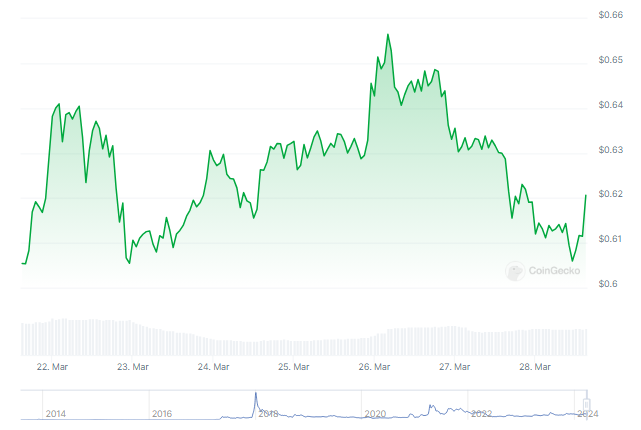 XRP up in the last seven days. Source: Coingecko
 The U.S. Commodity Futures Trading Commission (CFTC) has filed a lawsuit against Kucoin, emphasizing the classification of bitcoin, ethereum, and litecoin as commodities. The enforcement action, launched in the U.S. District Court for the Southern District of New York, accuses Kucoin of multiple regulatory breaches involving these digital assets. Kucoin’s Legal Battles Shine a Bright […]


 This week, the publicly traded mining company Marathon Digital Holdings unveiled new firmware and a control board designed to enhance the efficiency of bitcoin mining rigs. Marathon revealed it has been developing this technology for about a year. Marathon Releases Custom Firmware and MARA UCB 2100 Control Board On March 25, 2024, Marathon (Nasdaq: MARA) […]