Nik De, managing editor for global policy and regulation at CoinDesk, stops by Unconfirmed to discuss the current state of crypto regulation, including recent comments by SEC Chair Gary Gensler on stablecoins and why Coinbase decided to sideline its Lend product. Highlights:
Nik’s biggest takeaway from Gary Gensler’s interview with the Washington Post
why Nik thinks Gensler has escalated his rhetoric regarding stablecoins and DeFi
how crypto exchanges are currently regulated and how that might change
what it would take to convince crypto exchanges to register with the SEC
whether the SEC has the purview to regulate stablecoins
Nik’s thoughts on Coinbase’s Lend product and the SEC’s stance on lending products
what the overall picture of crypto lending is in the US
whether the SEC will go after DeFi protocols
what to expect from the SEC going forward, especially with the end of its fiscal year coming up next week
Digital Asset Research: https://digitalassetresearch.com
Sorare: https://sorare.com
Episode Links
Nikhilesh De
Content
Coinbase blogs regarding Lend
SEC Chair Gary Gensler Washington Post Q&A
Brian Armstrong tweet storm
BlockFi and Celsius overview
Read my latest Medium post, “The Reason Crypto Regulation Is Turning Out to Be So Difficult,” which takes take a deeper dive into some of the topics addressed in this pod 🙂
After what looked to be a month of prosperity following the August bull run, Bitcoin has now entered into an era of increasingly bearish signals. The asset had seen a number of rallies that pushed it over two-month highs, successfully breaking above the $52K resistance range on a number of occasions. Throwing the entire market into a stretched-out period of positive sentiment.
September has now come with its own unique set of problems for the digital asset. Bitcoin price has been suffering since the beginning of the month, ushered in with a flash crash that rocked the market only a week into September. The market continues to suffer from the aftershock of this flash crash, which has left a trail of blood in the market, and led to massive liquidations.
Related Reading | Just 10 Days After El Salvador’s “Bitcoin Day”, President Bukele Confirms 1.1 Million Citizens Have Chivo Wallet
Bitcoin Price Crash Leads To Sell-Offs
In only a matter of days, the price of bitcoin has fallen from $47,000 to $40,000, which triggered liquidations in the market. The long liquidations totaled up to the tune of $860 million across exchanges. The liquidations took place over two days when the price of the digital asset had inevitably fallen to $40,000 on Tuesday, September 21st. Although significant, the liquidations, which were spread across two days, still sat below the sell-offs seen following the September 7th crash.
Related Reading | Did Bitcoin Really Experience A Flash Crash Down To $5,400?
Monday marked the beginning of the liquidations as the market saw $470 million long positions liquidated. And the following Tuesday, a total of $390 million long positions were liquidated as well. At this point, the price of bitcoin had hit levels not seen since mid-August. And as market sentiment shifted into the negative, the price continued to plunge.
BTC longs liquated on Monday and Tuesday add up to $860 million | Source: Arcane Research
Current sell-off volumes have remained beneath the $1.2 billion sell-off in early September, suggesting that this current sell-off is more organic than previous ones. Also, it shows that the current market is more influenced by spot activity compared to the derivatives market.
September And Its Chokehold On The Market
September has historically come with challenges for the crypto market. So the crash that rocked bitcoin and the entire market at the beginning of the month is on-brand. Crashes with at least a 17% value loss have happened in September for the past four years and it looks like 2021 has fallen in line with this trend.
However, the end of September has always come with better forecasts for the following month. Chart analysis show crashes in the month precede recoveries that put the market on course to regain its lost value. Setting the market up for another bull run.
BTC price trading north of $43K | Source: BTCUSD on TradingView.com
The price of BTC has now recovered above its Tuesday’s lows, which saw the digital asset plunge below $40K. Bitcoin is currently trading above $42,000 at the time of writing. While the total market cap has fallen below $800 billion.
Featured image from Bitcoin News, charts from Arcane Research and TradingView.com
The following is an internal memo that I shared with Coinbase employees this week and would also like to share publicly to help people see how we’re working toward our mission of increasing economic freedom in the world.
Tl;dr: Our core thesis is that greater adoption and usage of cryptocurrency will increase economic freedom in the world, because crypto solves many of the shortcomings of the current financial system that hinder economic freedom.
Team,
Every quarter at our company All Hands, we review our Mission (what we’re trying to achieve) and our Strategy (how we’re going to get there). One question I often hear from employees is: “How does cryptocurrency create more economic freedom in the world?” This is a great question, so I wanted to share my thoughts with all of you.
First, a refresher: Economic freedom is a composite measure of 12 factors. It quantifies the rights of people to control their own labor and property in each country and globally. Economic freedom varies dramatically across the world, and while our economy is increasingly global, the government of any single country has significant control over the financial and economic freedoms of its people. Low economic freedom in a given country isn’t always due to malicious activity (e.g, fraud, oppression, etc) — it’s often due to mismanagement (poor monetary and fiscal policy) or simply bad infrastructure.
Crypto and economic freedom
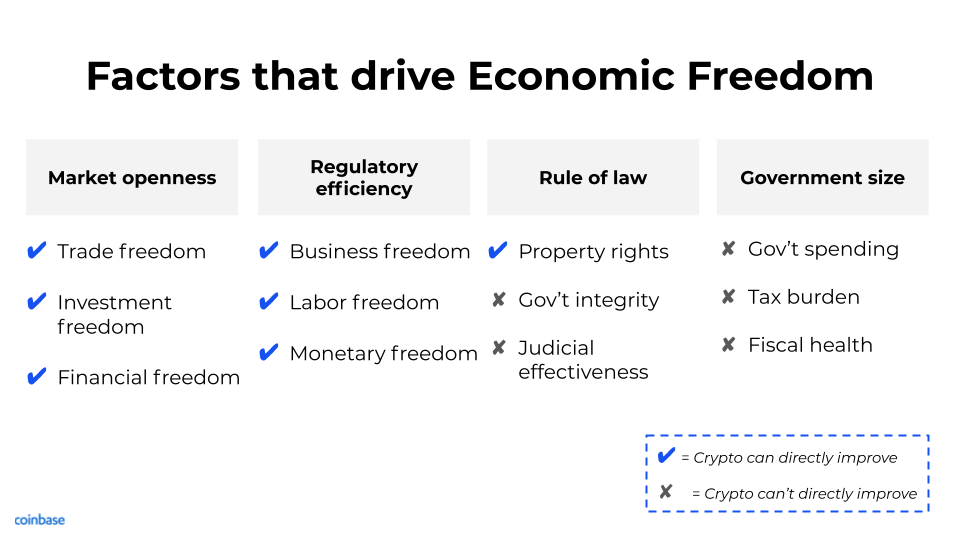
The question to ask is:How can we build a global economy where anyone with an internet connection can participate, where property rights are enforced, and where money preserves its value? Crypto is the solution. Crypto can’t directly improve every facet of economic freedom (e.g., tax policies and government spending), but it can improve most of the underlying drivers (see below).
Read more about each of the factors here.
Why is crypto so uniquely positioned to increase economic freedom? Because it has these inherent properties:
Crypto is an open, global network
Crypto networks are open, removing the barriers of borders. It allows every person in the world to transact on shared networks, in the same way they communicate on a shared network (the internet). More importantly these networks themselves are not controlled by governments that can use their monetary systems to hinder economic freedom (and prosperity). This design principle leads to more open markets and increases trade freedom, investment freedom, financial freedom, and monetary freedom.
Crypto enforces property rights
Property rights allow people to save their income, grow their wealth, and plan for the long term because they know the fruits of their labor are safe from unfair seizure or theft. Before crypto, your confidence in property rights was a function of the trust you had in your government and its respect for the rule of law. With crypto, anyone can acquire and grow their wealth without intervention from trusted 3rd parties like a government or a bank, or fear that their wealth could easily be seized. Property rights are also about the ability to enter contractual agreements. In some areas around the world, a contract has little value, because you can’t be confident in its enforcement. Smart contracts move enforcement from the courts to the blockchain, enabling gains from specialization and commercial exchange.
Crypto is unbiased
Crypto networks are often pseudonymous (or even anonymous). They don’t care where you live, what your race or gender is, or who you voted for in the last election. Unlike the current financial system they are inherently open and unbiased. Anyone with an internet connection can create a wallet, get paid in crypto, spend in crypto and accrue wealth in crypto. Service providers like Coinbase do have compliance programs as required by law, but we don’t control access to all crypto and we don’t own the network. Anyone can access crypto networks through other providers if we make a bad decision, or are forced into bad regulation. In addition, self custody wallets like Coinbase Wallet provide an ever greater degree of freedom when it comes to financial inclusion.
Crypto enables mobility
As I mentioned above, there are important components of economic freedom that cryptocurrency can’t directly benefit (e.g., government integrity, tax policies, fiscal health, etc.). However, cryptocurrency does provide the conditions for mobility by reducing switching costs, allowing people to both accrue wealth and bring it across borders. Cryptocurrency is the ultimate embodiment of the power of the individual, by significantly reducing the barriers to emigration / exit, and thus increasing economic freedom.
Conclusion
As you can see, cryptocurrency can impact many of the factors that lead to more economic freedom. It can both help build better-functioning economies in countries with less economic freedom, and make it easier to emigrate to a better life. This is why our core thesis as a company is that greater adoption and usage of cryptocurrency will increase economic freedom in the world.
Technology is the longest lever we can pull to improve the human condition. At its core, cryptocurrency is a technology breakthrough that allows us to build a more free and open financial system that enables the rights of people to control their own labor and property. It is the best tool that exists to advance our mission of increasing economic freedom in the world.
What does this mean for Coinbase? Crypto is in many ways still nascent. It’s still hard to use, crypto networks are plagued with scaling challenges, and the economy built on top of crypto infrastructure is in its early days. Our strategy and roadmap is geared towards solving these challenges: We’re focused on building easy-to-use products that abstract away the complexity of blockchains, and we’re building the primitives of a functioning financial system. We still have a long way to go, but the future is bright.
How crypto enables economic freedom was originally published in The Coinbase Blog on Medium, where people are continuing the conversation by highlighting and responding to this story.
Geneva, Switzerland — September 22, 2021: Liti Capital SA, the Swiss-based litigation funding provider disrupting private equity investing with blockchain technology, is launching ScamBusters, a revolutionary new tool that allows users to vote for which crypto-focused cases the company should pursue next.
Devoted to fighting fraud
Fraud within cryptocurrency and blockchain is rife. This year will be a record for investment fraud: 14,079 investment scams were reported to the FTC in the first quarter of 2021, and victims lost $215 million in this quarter alone. Liti Capital is bringing its expertise in picking, funding and winning court cases and inviting consumers to vote on which scams it should pursue in court next.
“The idea that scammers can freely operate in the crypto sphere without facing the consequences of their actions must end to bring trust and change the perception blockchain and crypto projects have in our society”, says Andy Christen, CVO/COO at Liti Capital.
Liti Capital commits to allocating between 5% and 10% of its yearly investment budget to finance cases that have affected its community members. Any LITI or wLITI token holder can report a purported fraud to the company.
How ScamBusters works
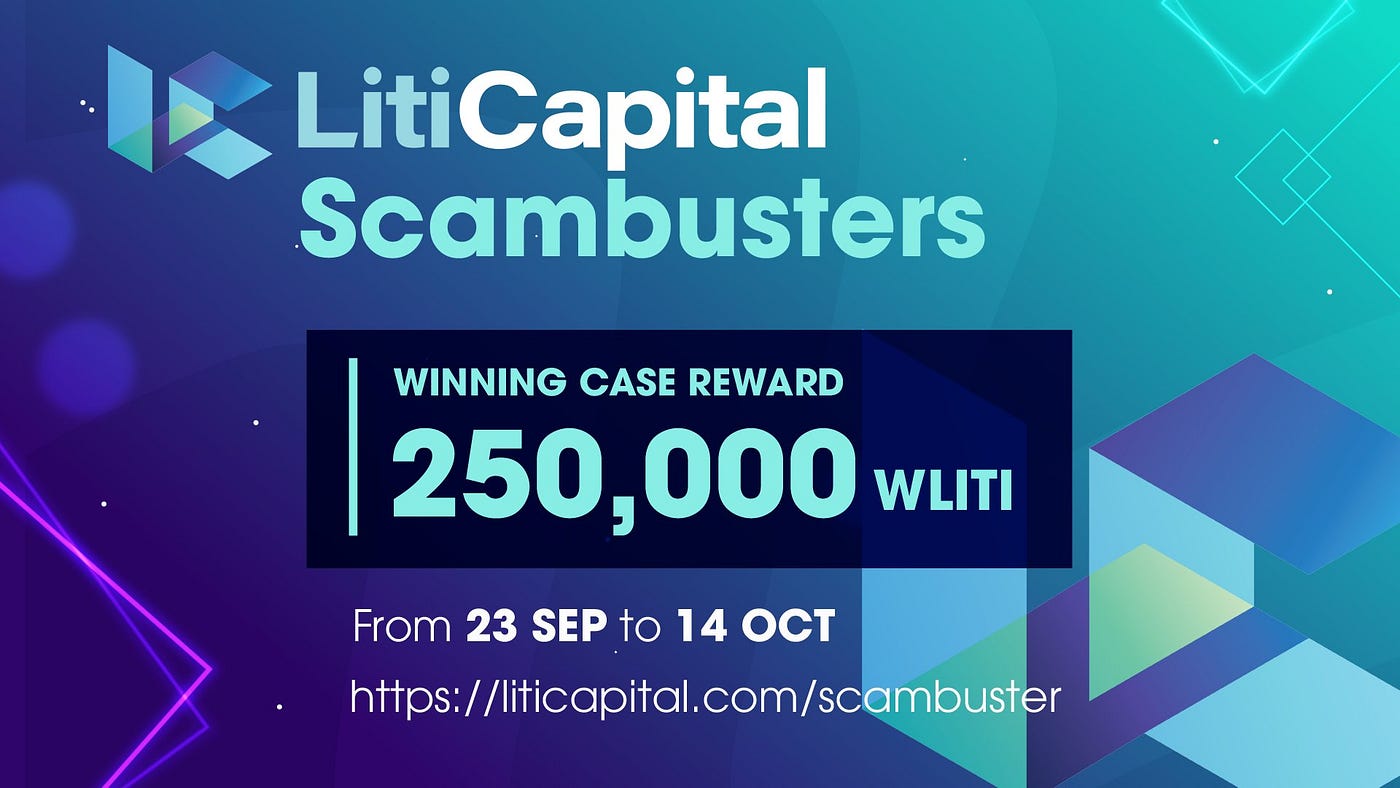
ScamBusters is a community voting event to select which crypto scam cases Liti Capital will sue. LITI and wLITI token holders can use their tokens without spending them to vote for the case(s) they think have the most merit. The more tokens they have, the more voting power they can exercise. Voters of the winning case will share an award up to 250,000 wLITI, distributed pro-rata to their votes.
Once members of the community have submitted cases on the ScamBusters website, Liti Capital instructs its team of legal experts based in 140 countries across the world to explore details of the case.
A selection of cases are then presented back to community members, with the case collecting the highest number of votes being added to Liti Capital’s portfolio. Community voting begins on September 23, 2021, with the first winning case announced on October 15, 2021.
“If cryptocurrency is going to become the de facto way people take part in the Web3 world, trust, regulation and a robust legal system are all parts of that puzzle,” says Jonas Rey, CEO at Liti Capital.
About Liti Capital
Liti Capital is bringing the litigation asset class to everyone through Blockchain technology with LITI tokens, an equity token that is a share of stock in Liti Capital SA. The launch of LITI and wLITI tokens allows any investor to engage in the high-performing litigation finance market previously only available to elite investors.
For project information, please read the Whitepaper.
For token distribution, please read Tokenomics.
Liti Capital Official Channels
Liti Capital Website: https://liticapital.com
Liti Capital Telegram: https://t.me/Liti_Capital_Official
Liti Capital Telegram Announcements: https://t.me/Liti_Capital_Official_ANN
Liti Capital LinkedIn: https://www.linkedin.com/company/liti-capital
As financial authorities around the globe become increasingly concerned about stablecoin regulation, a jurisdiction in China is preparing to pilot a new yuan-pegged stablecoin for international trade.
Chris Banbury, head of global operations at permissionless blockchain project Conflux, told Cointelegraph on Sept. 21 that the firm will provide its technology to launch an offshore renminbi (RMB) stablecoin pegged to China’s central bank digital currency (CBDC), the digital yuan.
“This is going to be pegged to the digital yuan in price only with no formal integration,” Banbury noted, adding that the project will be exploring how the token trades against other currencies.
The new stablecoin project will facilitate international trade in Shanghai’s Lin-gang Special Area after the Chinese government granted the free economic zone permission to explore free trade with an offshore RMB stablecoin in July.
“While the use case for the offshore RMB stablecoin has been approved by the government of China and Shanghai, the pilot program is not endorsed by or connected with the government,” Banbury noted.
In contrast to popular stablecoins like Tether (USDT) and USD Coin (USDC), the upcoming offshore RMB stablecoin will not be a private stablecoin because it is fully decentralized, Banbury said. The executive said that the new stablecoin is called the “offshore RMB stablecoin” because its functionality will be limited to global trading:
“The term ‘offshore’ refers to the RMB’s use for international trading purposes — not domestic trading. The digital yuan is used exclusively for domestic purposes. As such, the offshore RMB is not an ‘offshore yuan.’ The digital yuan is for domestic purposes overseen by the People’s Bank of China.”
Related: Chinese banks explore e-yuan for selling investment funds and insurance
According to Banbury, the offshore RMB stablecoin is being held through the Shanghai ShuTu Blockchain Research Institute, a branch of the Conflux Tree-Graph Institute for blockchain research and development. The stablecoin has not yet received a dedicated ticker as the development team is still determining when to launch, he added.
One of the world’s first nations to debut a CBDC, China has continued to crack down on cryptocurrency trading and mining, with local authorities shutting down multiple mining farms and suspending crypto trading transactions this year.
MANILA, Philippines — MYMEDIA Digital, the largest digital marketing platform in Myanmar, has rebranded into RFOX MEDIA, the new media venture that acts as the brand and marketing division for the blockchain-driven ecosystem created by Southeast Asia-based venture builder RedFOX Labs. The rebrand follows RedFOX Labs’ acquisition of MYMEDIA in February 2021.
The new RFOX MEDIA venture strengthens MYMEDIA’smarket-leading platform, which connects consumers directly to brands and influencers across food, fashion, sport, and entertainment. Advertisers that have worked with MYMEDIA include global brands such as Samsung, Huawei, Nestle, Lenovo, Grab, Oppo, Realme, VIVO, and GrandRoyal. The MYMEDIA Facebook page, which also reflects the rebrand to RFOX MEDIA, together with all social media channels and websites, have 13 million followers and 40-million-page impressions, driven by 20 million minutes of viewed video footage per month and other content that extends its reach to 30 million users per month.
Digital media marketing leader in Myanmar and Southeast Asia
As part of the rebranding and further integration within the RFOX ecosystem, RFOX MEDIA has launched a new dual-language website in Burmese and English, reflecting both its status as the digital marketing leader in Myanmar and its next phase of growth into different parts of the world, with an initial focus on Southeast Asia as a fast-growing regional hub. The expansion plans for RFOX MEDIA will drive further growth to the already-impressive social media metrics that it has gained in just one country so far.
Partnerships for games, e-commerce, digital finance and more
Amid projected international growth, RFOX MEDIA continues its work of maintaining market leadership in Myanmar by leveraging many products and services from the RFOX ecosystem. Earlier this month, RFOX MEDIA introduced RFOX Run, an upcoming jump-and-run casual game in Myanmar that will debut a new gaming rewards model called Play-to-Eat, an innovation on the increasingly popular Play-to-Earn model. Through Play-to-Eat, all winning players from Myanmar can soon get free food vouchers that they can redeem on foodpanda, the leading food delivery service in Myanmar.
Expect more innovations of this nature as RFOX MEDIA helps expand the utility of the RFOX token through partnerships for games, e-commerce, digital finance, and more industries, as well as through new solutions like the upcoming RFOX TV streaming service.
Rene Heumueller, COO of RFOX MEDIA, commented:
“I’m extremely happy to be part of RedFOX Labs as we build out RFOX MEDIA. I am passionate about building products and services that improve people’s lives, and this is the right place to be. The RFOX MEDIA team is built on the back of the existing team of MYMEDIA and pulls on years of experience and a library of content. This gives us a strong head start we need in a fiercely competitive landscape, especially as we expand our operations internationally.”
Ben Fairbank, CEO and Co-founder of RedFOX Labs, commented:
“The rebranding of MYMEDIA into RFOX MEDIA is the initial step towards applying our expertise in scaling technology and building integrations and interoperability, providing exponential value to a digital marketing platform that is ready to expand into Southeast Asia and beyond.
Our acquisition of MYMEDIA earlier this year allows us to build out equivalent platforms in other countries in Southeast Asia, leveraging a Rolodex of global advertisers already using MYMEDIA who are chomping at the bit to get exposure in the region. Southeast Asia has 360 million internet users, including 104 million aged between 25 to 34 — the most valuable age group to major advertisers.”
About RedFOX Labs
RedFOX Labs is a Southeast Asian venture builder that identifies and builds successful business models for the region’s markets. It is focused on unlocking the true market value of the Southeast Asian digital economy for high consumer demand services such as e-commerce, e-media, e-travel, and esports/gaming and focuses on adding value to the digital economy using emerging technologies such as blockchain. As a company, its value is tradable through its native token ($RFOX).
By Casper Sorensen, Vice President, Customer Experience
The following is the latest update in our series of blog posts describing our commitment to continually improving our customer experience.
One of our Coinbase cultural tenets is Customer Focus. This tenet sets the expectation that we solve customer problems with technology that is instinctive to use and continuously ask “How does this create more value for our customers?”
We recognize that when it comes to our customer support experience, we’re early in our journey of creating more value for customers.
In past blog posts we highlighted how improving our customer support experience is a top priority and this year we have more than quadrupled our capacity and launched new ways to contact us. As the journey continues, we are excited to share that we will implement the capabilities below by year end:
Faster Response Times: Speed matters in the fast moving cryptoeconomy, so we are matching that speed by further increasing our capacity to provide customers with the best response times in the industry. Customers should trust that we will match their sense of urgency when they contact us.
24/7 Live Phone Support: Direct connections matter, so 24/7 phone support will be available for all retail customers who prefer speaking live with an expert. Whether the question is simple or complex, customers in the US, UK, Germany, and Japan will have the option to connect with our in-country based customer service teams before the end of 2021 with further expansion planned for 2022.
Live Messaging: We value our customers’ time, so we’re launching messaging, which means customers can connect with us when the time is right and continue the conversation seamlessly if they have to step away. Our team of customer service experts will be available via messaging 24/7 with the speed our customers expect.
In-Product Support: Ease of use is important, so this year we are creating a more seamless support experience within our iOS and Android apps. This suite of features will provide users with an intelligent and personalized self service experience, saving customers time when they have questions. Live support will be a core part of this experience as well, allowing customers to quickly message our team of experts when needed.
Our goal is to provide our customers with the most trusted customer service experience in crypto. We look forward to providing these new capabilities to you, so please stay tuned as we will continue to update this blog with the status of our journey.
Coinbase To Launch 24/7 Phone Support and Other Enhancements to Customer Support by End of Year was originally published in The Coinbase Blog on Medium, where people are continuing the conversation by highlighting and responding to this story.
MANILA, Philippines — RFOX Media, a subsidiary of Southeast Asia based RedFOX Labs, has launched RFOX Run, a new jump-and-run casual game in Myanmar, powered by prolific tournament game platform Goama. RFOX Run introduces a new gaming rewards model called Play-to-Eat, an innovation of the increasingly popular Play-to-Earn model, where players that are identified as winners and have signed up for an RFOX ID can redeem food vouchers from foodpanda, the leading food delivery service in Myanmar.
At RedFOX Labs, we believe that blockchain companies have a responsibility to explore humanitarian approaches to the innovations they produce. Through our Play-to-Eat model, we believe that RFOX Run users will gain the dual benefits of food rewards and blockchain education, providing them with both immediate- and long-term solutions.
The top RFOX Run players can claim their prizes through the RFOX Media website by registering for an RFOX ID. Winners will receive foodpanda vouchers redeemable with a unique voucher ID, and get their choice of food delivered to their doorstep. To kickstart the campaign, RFOX Media has allocated $22,000 worth of vouchers as rewards.
The global play-to-earn market, mainly driven by blockchain-based companies, has experienced exponential growth this year, with a total market capitalization of $9.21 billion and average year-to-date growth rates of 1,604.12%, according to analysis from CoinMarketCap data on 36 identified play-to-earn companies. From a larger perspective, the video game industry is currently valued at around $170 billion and is expected to grow to $268 billion after five years, according to CoinTelegraph.
In this context, RFOX Media can become a crucial participant in the high-growth play-to-earn market through RFOX Run. Its unique approach to encourage further adoption through play-to-eat and other models reflects RedFOX Labs’ endeavors in empowering blockchain-related growth in Southeast Asia. RedFOX Labs also operates RedFOX Games, which currently runs the KOGs Slam! NFT game on closed beta testing, with more products about to launch.
Earlier this month, RFOX Media and Goama entered a partnership for the launch of RFOX Run in Myanmar, with plans to extend the relationship across the Southeast Asia region. This collaboration brings together an audience of more than 20 million Southeast Asian residents and aims at serving the largely untapped gaming market in Myanmar.
Ben Fairbank, CEO, and Co-founder of RedFOX Labs commented:
“Just weeks after we revealed the partnership between RFOX Media and Goama, I’m happy to see that it has delivered innovative results through the new RFOX Run game and the first-of-its-kind Play-to-Eat model in Myanmar. The Myanmar market is still so young, with a lot of potential, and through this collaboration we have quickly launched a new casual game that has an added benefit of rewarding top players with food. We look forward to serving millions in Myanmar with innovative gaming solutions like this, among other things we are planning to launch in the future for the country.”
Wayne Kennedy, CPO and Co-founder of Goama said:
“We at Goama are very thrilled to work with RedFOX Labs to be the first ones to bring both NFTs and tournament prizes to Myanmar! This furthers our ambition of bringing a casual eSports platform to leading apps throughout Southeast Asia. We’re also very happy to have created RFOX Run, where users can compete for the top spot and at the same time be compensated with food vouchers!”
About RedFOX Labs
RedFOX Labs is a Southeast Asian venture builder that identifies and builds successful business models for the region’s emerging markets. It is focused on unlocking the true market value of the Southeast Asian digital economy for high consumer demand services such as e-commerce, e-media, e-travel, and esports/gaming and focuses on adding value to the digital economy using emerging technologies such as blockchain. As a company, its value is tradable through its native token ($RFOX).
foodpanda is a leading delivery platform in Asia dedicated to bringing consumers a wide range of food, groceries and more, quickly and conveniently. Powered by technology and operational excellence, foodpanda is spearheading the growth of quick-commerce (q-commerce) across the region with its network of retail partners, as well as pandamart cloud stores to provide more on-demand options beyond the millions of food delivery options. foodpanda operates in more than 400 cities across 12 markets in Asia — Singapore, Hong Kong, Thailand, Malaysia, Pakistan, Taiwan, Philippines, Bangladesh, Laos, Cambodia, Myanmar, and Japan. foodpanda is a subsidiary of Delivery Hero, a global leader of the food delivery industry. www.foodpanda.com
About Goama
Goama is a leader in platform gamification, setting the benchmark in digital innovation and user engagement, working with some of the world’s biggest superapps and brands. Its turnkey solution offers a plug and play platform that creates unique gamified experiences that empower its business partners to build engaged communities. Goama has partnerships with the leading apps across 24+ countries to help them drive user engagement, increase monetization opportunities, and acquire new users. https://goama.com
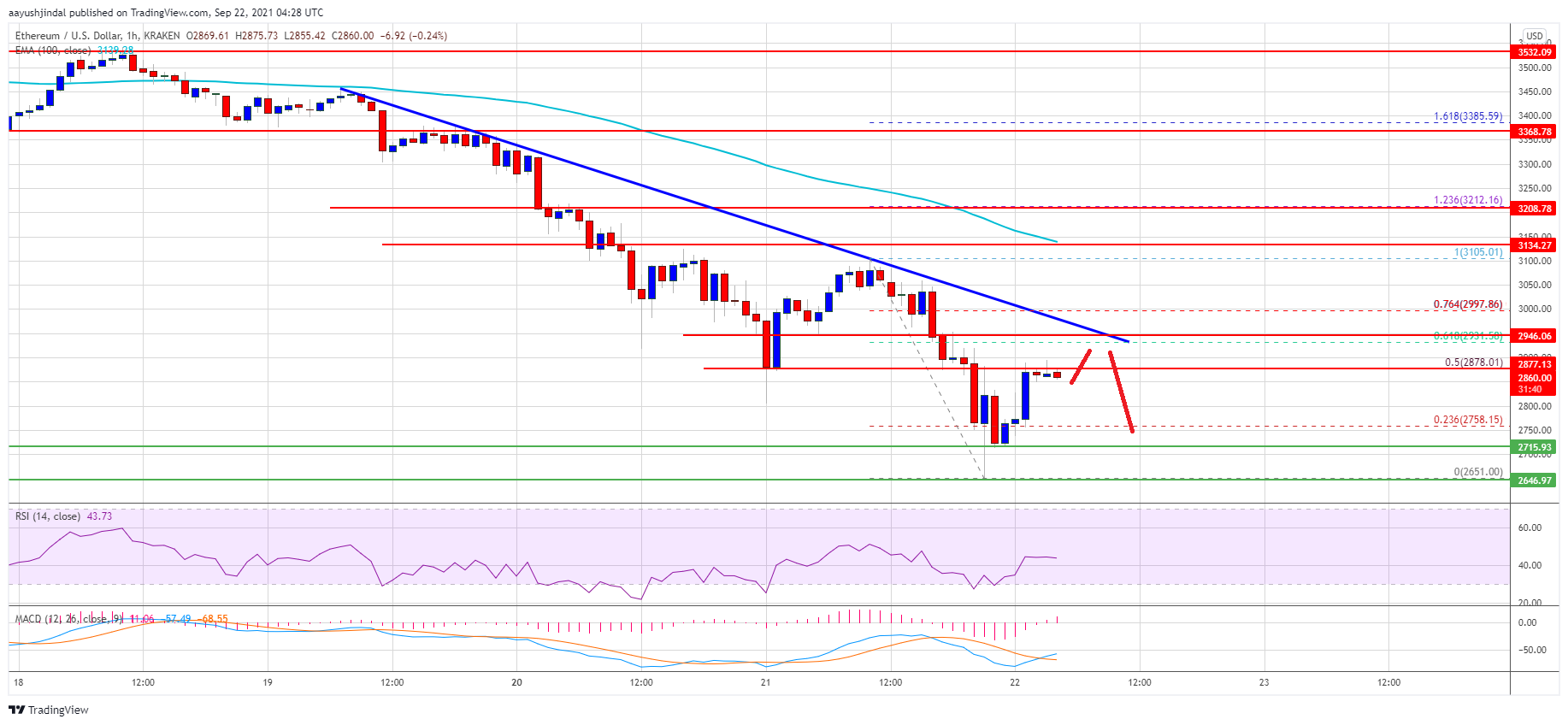
Ethereum settled below the $3,000 support zone against the US Dollar. ETH price could resume its decline unless there is a clear break above the $3,000 resistance zone.
Ethereum started a fresh decline below the $3,100 and $3,000 support levels.
The price is now trading below $3,000 and the 100 hourly simple moving average.
There is a major bearish trend line forming with resistance near $3,000 on the hourly chart of ETH/USD (data feed via Kraken).
The pair could resume its decline unless there is a clear break above the $3,000 resistance zone.
Ethereum Price Remains At Risk
Ethereum started another decline from the $3,100 resistance zone. ETH traded below many important support zones near $3,000 and the 100 hourly simple moving average, similar to bitcoin.
The price even broke the $2,800 support level to move further into a bearish zone. A low is formed near $2,651 and the price is now correcting losses. There was a break above the $2,800 and $2,850 resistance levels.
The price recovered above the 23.6% Fib retracement level of the recent drop from the $3,105 swing high to $2,651 low. An immediate resistance on the upside is near the $2,880 level. There is also a major bearish trend line forming with resistance near $3,000 on the hourly chart of ETH/USD.
Source: ETHUSD on TradingView.com
The trend line is close to the 50% Fib retracement level of the recent drop from the $3,105 swing high to $2,651 low. A close above the $3,000 resistance could start a decent recovery. The next major resistance might be near the $3,105 level. A clear break and close above the $3,105 level could start a steady increase. The next major resistance sits near $3,135 and the 100 hourly SMA.
More Losses in ETH?
If ethereum fails to correct higher above the $2,880 and $3,000 resistance levels, it could start another decline. An initial support on the downside is near the $2,800 level.
The next major support seems to be forming near the $2,650 level. A downside break below the $2,650 support zone could lead the price towards the $2,550 zone. The next major support is near the $2,500 level, below which ether price might decline towards the $2,420 support zone.
Technical Indicators
Hourly MACD – The MACD for ETH/USD is slowly losing pace in the bullish zone.
Hourly RSI – The RSI for ETH/USD is still below the 50 level.
Ether (ETH) price fell below the $3,000 support on Sept. 20 as global markets entered a risk-aversion mode. The Invesco China Technology ETF (CQQQ) closed down 4.2%, while the SPDR S&P Metals and Mining ETF (XME) lost 3.8%.
Some analysts pointed to the potential ripple effects of the default of Evergrande, a major Chinese real estate company. In contrast, others blame the ongoing debates over the debt limit in Washington as the catalyst for this week’s volatility. As a result, the CBOE Volatility Index (VIX), usually referred to as the “stock market fear index,” jumped by more than 30% to reach its highest level since May.
On Sept.19, U.S. Treasury Secretary Janet Yellen called for Congress to raise the U.S. debt ceiling again in a Wall Street Journal op-ed. Yellen suggested that avoiding this would risk causing the government to default on payments and generate a “widespread economic catastrophe.”
One of the major focuses for traditional markets is this week’s U.S. Federal Open Market Committee meeting, which ends on Sept. 22. At the meeting, the Federal Reserve is expected to signal when it will cut back its $120 billion monthly asset purchase program.
How these events impact Ether price
Ether price in USD at Bitstamp. Source: TradingView
Even though the $3,000 level sits near the bottom range of the previous performance of the past 45 days, Ether still accumulated 210% gains in 2021. The network’s adjusted total value locked (TVL) jumped from $13 billion in 2020 to $60 billion and the decentralized finance (DeFi), gaming, and nonfungible token (NFT) sectors experienced an impressive surge while Ethereum maintained dominance of the sector’s market share.
Despite mean gas fees surpassing $20 in September, Ethereum has kept roughly 60% of the decentralized exchange (DEX) volume. Its largest competitor, Binance Smart Chain, held an average daily volume slightly below $1 billion, albeit having a transaction fee below $0.40.
Ether futures data shows pro traders are still bullish
Ether’s quarterly futures are the preferred instruments of whales and arbitrage desks due to their settlement date and the price difference from spot markets. However, the contract’s biggest advantage is the lack of a fluctuating funding rate.
These fixed-month contracts usually trade at a slight premium to spot markets, indicating that sellers request more money to withhold settlement longer. Therefore, futures should trade at a 5% to 15% annualized premium in healthy markets. This situation is technically defined as “contango” and is not exclusive to crypto markets.
ETH futures 3-month annualized premium. Source: Laevitas
As displayed above, Ether’s futures contracts premium spiked to 15% on Sept. 6 as ETH price tested the $4,000 resistance. Apart from that brief overshot, the basis indicator ranged from 8% to 12% over the past month, considered healthy and bullish.
The crash to sub-$3,000 in the early hours of Sept. 21 was not enough to scare seasoned traders. More importantly, U.S. Securities and Exchange Commission chairman Gary Gensler’s interview on cryptocurrency regulation also had no noticeable impact on Ether price. Had there been a generalized fear, Ether futures premium would have reflected this.
The views and opinions expressed here are solely those of the author and do not necessarily reflect the views of Cointelegraph. Every investment and trading move involves risk. You should conduct your own research when making a decision.