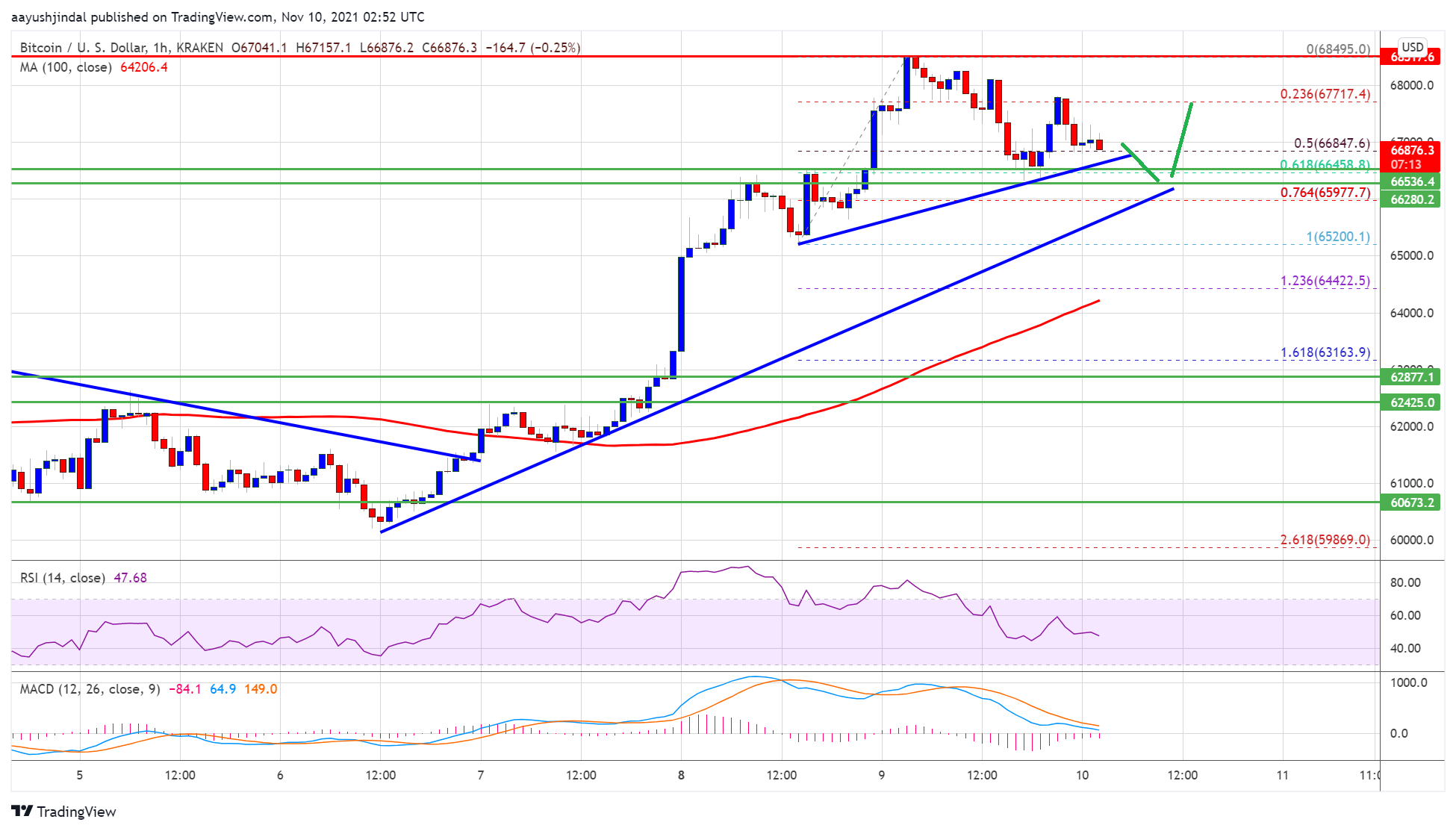
Bitcoin price started a downside correction from the $68,500 zone against the US Dollar. BTC might start a fresh increase unless there is a break below $64,000.
Bitcoin started a downside correction below the $68,000 and $67,000 levels.
The price is still trading above $65,000 and the 100 hourly simple moving average.
There is a key bullish trend line forming with support near $66,000 on the hourly chart of the BTC/USD pair (data feed from Kraken).
The pair could start a fresh increase if the $64,000 support remains intact.
Bitcoin Price Corrects Lower
Bitcoin price gained pace above the $65,000 support zone. BTC extended its rally above the $66,500 and $67,000 resistance levels. The price even surged above the $68,000 level.
It traded to a new all-time high near $68,495 before there was a downside correction. The price declined below the $68,000 and $67,800 support levels. There was a break below the 50% Fib retracement level of the upward move from the $65,200 swing low to $68,495 high.
However, bitcoin still trading above $65,000 and the 100 hourly simple moving average. There is also a key bullish trend line forming with support near $66,000 on the hourly chart of the BTC/USD pair.
On the upside, an immediate resistance is near the $67,500 level. The first major resistance is near the $68,000 level. A clear break above $68,000 resistance may possibly call open the doors for a fresh increase. The next major resistance sits near the $68,500 level. Any more gains might lead the price towards the $70,000 level.
Dips Supported in BTC?
If bitcoin fails to clear the $68,000 resistance zone, it could extend its downside correction. An immediate support on the downside is near the $66,500 level. The first major support is now forming near the $66,400 level.
It is close to the 61.8% Fib retracement level of the upward move from the $65,200 swing low to $68,495 high. The next major support is near the $65,000 level, below which the price could dive towards the key breakdown support at USD 64,000 in the near term.
Technical indicators:
Hourly MACD – The MACD is now losing pace in the bullish zone.
Hourly RSI (Relative Strength Index) – The RSI for BTC/USD is now just below the 50 level.
Major Support Levels – $66,400, followed by $66,000.
Major Resistance Levels – $67,500, $68,000 and $68,500.
Starting Today, Tuesday November 9, transfer GYEN into your Coinbase Pro account ahead of trading. Support for GYEN will generally be available in Coinbase’s supported jurisdictions with certain exceptions as indicated in each asset page here. Trading will begin on or after 9AM Pacific Time (PT) Wednesday November 10, if liquidity conditions are met.
One of the most common requests we receive from customers is to be able to trade more assets on our platform. Per the terms of our listing process, we anticipate supporting more assets that meet our standards over time. Most recently we have added trading support for Crypto.com Protocol (CRO), Kryll (KRL), LCX (LCX) SUKU (SUKU), OriginTrail (TRAC), Assemble Protocol (ASM), ARPA Chain (ARPA), Bounce (AUCTION), Perpetual Protocol (PERP), BadgerDAO (BADGER), Rarible (RARI), Function X (FX), Jasmy (JASMY), Wrapped Centrifuge (WCFG) and Avalanche (AVAX).
Starting Today, Tuesday November 9 we will begin accepting inbound transfers of GYEN to Coinbase Pro. Trading will begin on or after 9AM Pacific Time (PT) Wednesday November 10, if liquidity conditions are met.
Once sufficient supply of GYEN is established on the platform, trading on our GYEN-USD, GYEN-USDT and GYEN-EUR order books will launch in phases, post-only or auction mode then limit-only and full trading mode. If at any point one of the new order books does not meet our assessment for a healthy and orderly market, we may keep the book in one state for a longer period of time or suspend trading as per our Trading Rules.
We will publish tweets from our Coinbase Pro Twitter account as each order book moves through the phases.
GYEN (GYEN)is a stablecoin running on Ethereum that’s intended to maintain a value of one Japanese Yen. The company behind GYEN, GMO-Z.com Trust Company, claims to hold reserves that fully back each GYEN.
GYEN is not yet available on Coinbase.com or via our Consumer mobile apps. We will make a separate announcement if and when this support is added.
You can sign up for a Coinbase Pro account here to start trading. For more information on trading GYEN on Coinbase Pro, visit our support page.
### Please note: Coinbase Ventures may be an investor in the crypto projects mentioned here, and additionally, Coinbase may hold such tokens on its balance sheet for operational purposes. A list of Coinbase Ventures investments is available at https://ventures.coinbase.com/. Coinbase intends to maintain its investment in these entities for the foreseeable future and maintains internal policies that address the timing of permissible disposition of any related digital assets, if applicable. All assets, regardless of whether Coinbase Ventures holds an investor or Coinbase holds for operational purposes, are subject to the same strict review guidelines and review process. This website contains links to third-party websites or other content for information purposes only (“Third-Party Sites”). The Third-Party Sites are not under the control of Coinbase, Inc., and its affiliates (“Coinbase”), and Coinbase is not responsible for the content of any Third-Party Site, including without limitation any link contained in a Third-Party Site, or any changes or updates to a Third-Party Site. Coinbase is not responsible for webcasting or any other form of transmission received from any Third-Party Site. Coinbase is providing these links to you only as a convenience, and the inclusion of any link does not imply endorsement, approval or recommendation by Coinbase of the site or any association with its operators.
Crypto is a new type of asset. Besides potential day to day or hour to hour volatility, each crypto asset has unique features. Make sure you research and understand individual assets before you transact.
All images provided herein are by Coinbase.
######
GYEN (GYEN) is launching on Coinbase Pro was originally published in The Coinbase Blog on Medium, where people are continuing the conversation by highlighting and responding to this story.
Reddit co-founder Alexis Ohanian has teamed up with Solana Ventures to launch a new investment fund dedicated to Web3 and social projects, potentially setting the stage for the next wave of budding crypto startups.
Ohanian announced Tuesday at the Breakpoint conference in Lisbon, Portugal that his Seven Seven Six venture firm and Solana Ventures have allocated $100 million to Web3 and “decentralized social projects.” In an accompanying news release, the internet entrepreneur touted his venture firm’s expertise in “identifying and investing in early social and crypto trends,” which include Reddit, Patreon and Coinbase, among others.
Raj Gokal, the COO of Solana Labs, said “Web3 turns users and creators into owners and stakeholders, a change that can’t come soon enough to social media.”
Centralized social media platforms such as Facebook are said to generate hundreds of billions of dollars in annual revenue, mostly through advertising and without rewarding content creators for their contributions. While efforts to “decentralize” social media have been underway since at least 2017, no blockchain-based social project has reached mainstream adoption. Seven Seven Six and Solana Ventures said they will prioritize technologies and applications that [eliminate] value extraction from centralized intermediaries.”
Related: BREAKING: Facebook rebrands to Meta as focus expands beyond social media
Solana Ventures has been highly active on the investment front, having only recently spearheaded a $100 million fund dedicated to Web3 gaming, also known as GameFi. Similar funds were also launched by Sanctor Capital and Huobi Group. Over $17 billion in venture capital has flowed to crypto- and blockchain-focused startups so far in 2021.
Sydney, Australia, November 9th, 2021 — With the blockchain gaming metaverse proving to be more than just a buzzword for gamers, Gachyi Land, the first gacha-launchpad ecosystem gears towards its premiere NFT launch, slated to debut on the 22nd of November 2021.
This launch opens up the runway for Gachyi Land as they get the ball rolling for a series of other launches on the Gachyi launchpad. Commenting on the significance of this event, the founding partner of Gachyi Land,Harly Zappino has expressed his excitement:
“Life is too short to slave away on tasks that you despise doing and unfortunately that is how our society is currently structured. The digital world is our future. Let’s make it fun, let’s make it colorful, and let’s provide real-world value to those who want to interact with it!”
Dubbed the Goo Goo series, the first NFT series dropped on Gachyi Land will feature generative artwork with different traits that include body, eyes, mouth, accessories, background, and clouds, among other features. Certain unusual and rare characteristics may entitle their owners to special privileges.
The series finds its footing in folklore inspired by the Gachyi Goddess before she became entirely fossilized. According to Gachyi Land Lore, she created the Goo Goos and ensured that all of her wisdom was handed down to guide them through the RPG (role-playing game).
While the Goo Goo series does not include playable RPG characters, owners will be able to access significant in-game benefits. Slime Tales from Gachyi Land’s second NFT series will implement RPG characters with a Dungeons and Dragons class system that has the ability to breed dual class characters.
Gachyi Land: Introducing the first NFT gacha-launchpad ecosystem
Coming up as a first mover, Gachyi Land will be the first gacha-launchpad to issue NFTs (on its website) as a full-fledged utility across its entire ecosystem. Each NFT issued on the Gachyi NFT Launchpad will serve a purpose within the ecosystem. They will either have in-game functionality such as boosts or exclusive pre-sale access, or their utility can be built into future games.
Besides their own designed NFTs, other projects with similar themes to Gachyi Land, such as those with kawaii and mystical creatures type of themes, will be able to participate in its utility-centric ecosystem. Expanding the entire ecosystem, other projects’ NFTs can be integrated into Gachyi Land’s mini-party games or Play-To-Earn MMORPG.
The NFTs will be deployed on the Polygon blockchain based on the ERC-721 token standard, priced in MATIC. They will be encapsulated and released through interactive Gachapon Machines (a.k.a Gacha-Launchpad). The minting process aims to give the buyers a whole new experience playing with e-Gachapon machines coupled with lo-fi music, great visuals and stunning animation. Each series will feature a maximum of 5 NFTs available on the Launchpad, giving buyers a sneak peak of what could be minted.
Incubating a disruptive NFT gaming ecosystem to empower artists
Gachyi Land is on a mission to empower small artists to use Gachyi Land’s resources to unleash their creativity on the world, to give them the exposure and recognition they deserve. Most artists have yet to take advantage of the unlimited opportunities available in the NFT domain while others may have misconceptions about it. To address this challenge, Gachyi is stepping in to provide artists with the platform, community, technology, and tools they need to exhibit their work and explore the potential within the digital landscape.
“Gachyi Land will be a solution to this and will be a part of a greater movement to fundamentally change the way humanity thinks and interacts with the world. In our virtual world, what defines you are the choices you make and the way you choose to interact. Not labels, not gender, not titles and certainly not the way you look!” states Zappino.
About Gachyi Land
Gachyi Land is building an ecosystem that consists of an NFT Launchpad and Play-To-Earn MMORPG. NFTS issued on their platform will be incorporated within the ecosystem to serve either an in-game functionality such as boosts or exclusive pre-sale access, or their utility can be built into future games.
With its disruptive Play2Earn MMORPG, Gachyi is providing artists with the platform, community, technology, and tools they need to unleash their creativity and gain the exposure they deserve. NFTs will be minted via Gachyi’s interactive gachapon machines on the Polygon blockchain based on the ERC-721 token standard, priced in MATIC.
In May, we introduced a downloadable browser extension that brought Coinbase Wallet onto laptops and desktops. We’ve seen incredible traction with the Coinbase Wallet extension, which made it easier to securely connect to decentralized apps (dapps) and decentralized finance (DeFi) from more devices.
Today, we’re bringing full standalone functionality to Coinbase Wallet extension. Now customers can browse dapps, access thousands of cryptocurrencies, trade on decentralized exchanges (DEXes), earn interest, and collect NFTs, all with just a few clicks.
Total control of your crypto from your browser
When we first launched the Coinbase Wallet extension, we wanted to empower millions of customers to engage in the exciting world of dapps, and bringing Coinbase Wallet to desktops was a key way to increase access to the larger crypto ecosystem.
Today’s release gives the Coinbase Wallet extension full standalone functionality, unlocking the world of crypto on desktop. Now, you can browse dapps, access thousands of cryptocurrencies, trade on decentralized exchanges (DEXes), earn interest, and collect NFTs from your browser without needing to confirm transactions on your smartphone.
It all starts with your recovery phrase
With today’s release, we have made it easy for both new and existing Wallet users to get started with the standalone extension.
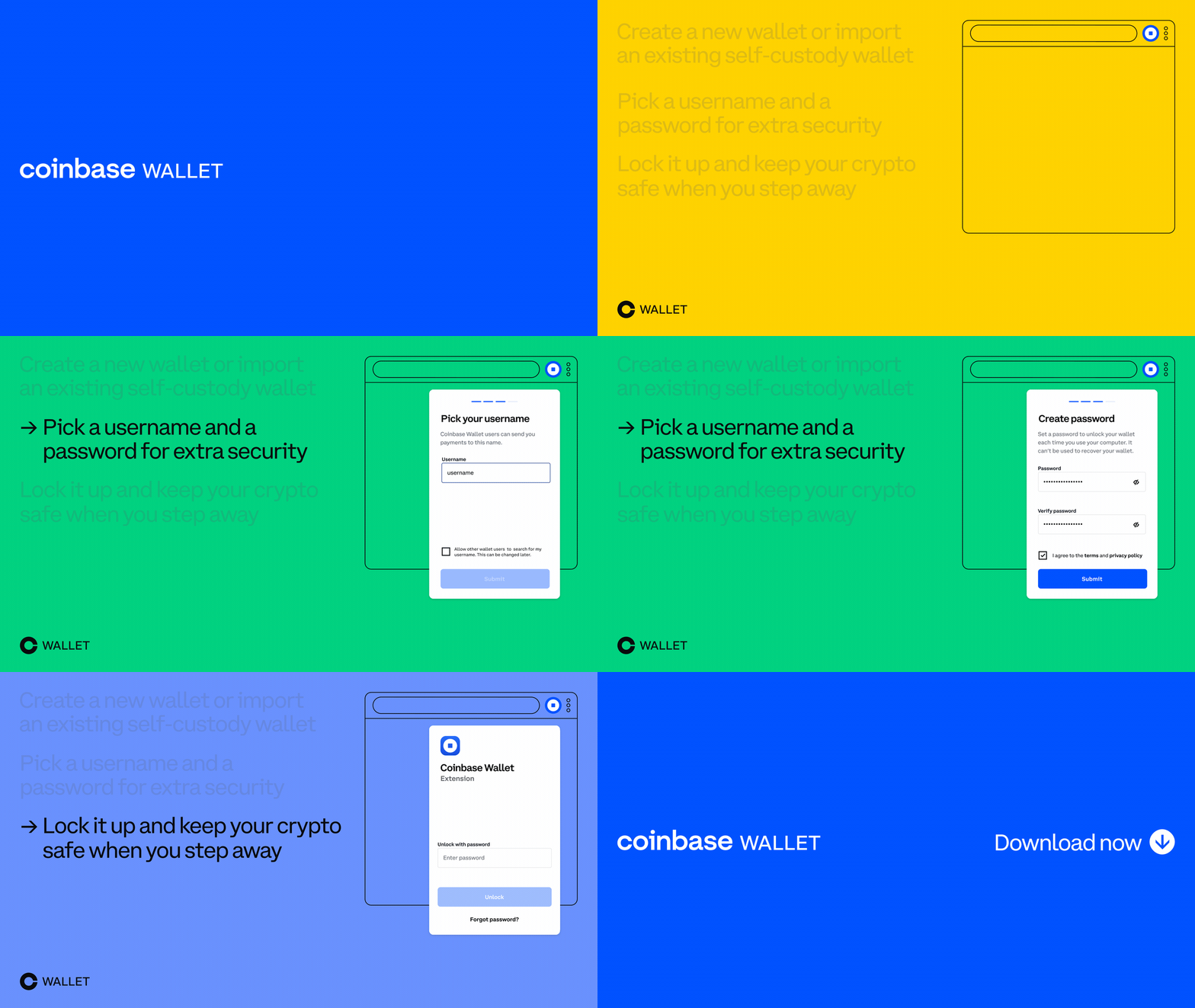
If you have been using the Coinbase Wallet extension via WalletLink, make sure you have your recovery phrase handy and then choose ‘Sign out’ from the Settings menu in your Wallet extension. Choose ‘Import a wallet’ and then enter your recovery phrase.
If you are a new customer, download Coinbase Wallet for free from the Chrome web store. If you do not already have a self-custody wallet, select ‘Create a new wallet’. If you would like to import an existing self-custody wallet, such as MetaMask, Trust Wallet, Coinbase Wallet, or another Ethereum-based wallet, choose ‘Import a wallet’ and then enter your recovery phrase.
If you have been using WalletLink and would prefer to continue using the browser extension as a linked account and keep handling confirmations and signing from the mobile app, you do not need to take any additional steps. If you need to re-enable the connection, choose WalletLink in your Coinbase Wallet mobile app’s settings.
You can also seamlessly link your self-custody Coinbase Wallet to a Coinbase account and access everything that Coinbase has to offer, including buying crypto with cash.
Looking forward
We’ll continue working to empower everyone to use dapps and web3 by building the easiest-to-use and most accessible self-custody wallet in the ecosystem.
You can download the new Wallet extension from the Chrome web store. We’re always listening to our users and welcome feedback. Follow us on Twitter @CoinbaseWallet for the latest Wallet-related news, and visit our help center for any additional questions.
Coinbase Wallet is now available as a standalone browser extension was originally published in The Coinbase Blog on Medium, where people are continuing the conversation by highlighting and responding to this story.
November 8, 2021, Monday — Coming up this Wednesday, November 10, 2021 is the 15th Islamic Financial Services Board (IFSB) Summit where leading members in the Islamic Financial Services Industry (IFSI) will be in attendance to converse and assess new and disruptive trends and advancements in digital finance and fintech across the IFSI world.
Event Details
Date | Wednesday, 10 November 2021
14:45–16:00 KSA (Kingdom of Saudi Arabia)
Session Chair: Mr. Ayman
Sejiny, Chief Executive Officer, Islamic Corporation for the Development of the
Private Sector (ICD)
Session Line-up:
Prof. Dr. Mohamad Akram
Laldin, Executive Director, International Shari’ah Research Academy for Islamic
Finance (ISRA).
Mr. Khalid Jamal Al Kayed,
Chief Executive Officer, Bank Nizwa
Mr. Zeiad Idris, Chief
Executive Officer, Algrba
Mr. Khalid Howladar, Head
(Credit & Sukuk Advisory), RJ Fleming & Co
The Islamic Financial Services Board is a discussionary forum dedicated to meeting and talking about the Islamic Financial Services Industry (IFSI) where leaders in the field can propose ways to grow the market, argue strategies and give one another’s expertise and experience.
The general topic of the IFSB Summit will be crypto-investments, digital assets and halal crypto. Representing MRHB DeFi at the summit is Khalid Howlader, Chairman of MRHB’s Governance Board, where he will meet with policymakers, financial industry leaders, experts, and many other stakeholders in Islamic Finance. Khalid Howlader, is also the Senior Managing Director and Head of Credit & Sukuk for R.J. Fleming & Co. for institutional and sovereign clients. With his global perspectives, he is a recognised authority in his field and has addressed investors worldwide as well as audiences at the World Bank, IMF, ECB and IIF.
The main purpose of the event is to spread awareness about recent changes in the IFSI world, bringing to the forefront of Islamic Finance topics like regulatory frameworks and effective jurisdiction along with trade-offs and questions regarding ethics and innovation.
About MRHB DeFi
MRHB (pronounced ‘Marhaba’) DeFi is a decentralised finance platform built to bring ethics to the DeFi space with an approach that supports the inclusion of faith-based and other excluded communities in addition to existing crypto-natives so that everyone can benefit from the full empowerment potential of DeFi to help build a true peer-to-peer financial and economic value system.
Based on the tenets of blockchain such as trust, transparency, and security, MRHB DeFi has encapsulated universally applicable principles of Islamic Finance into those tenets of blockchain to render a suite of offerings that are also ESG compliant.
The project is backed by a diverse and strong team with backgrounds spanning crypto, technology, faith-compliant investing, finance and seasoned institutional veterans of industry. The public sale offering will be in December. Register your interest and read more about MRHB DeFi’s Shariah Concept Paper, Lite and White Paper here.
The esports industry has become a popular culture due to increased activities from global investors, media outlets, and brands. It is estimated that by the end of 2021, there will be about 26.6 million monthly esports viewers, an 11.4% increase from figures recorded in 2020.
While these numbers seem lucrative, not all esports platforms hold up to their names. Many have ended up as scams, while a few others are still finding their way. On the other hand, some platforms do not fully appreciate the diversity between players, while others are yet to establish sound gaming systems. This is why a team of developers, led by BC Simon and Pritesh Kuchera, created MetaPlay to host E-sport tournaments for all the amateur players as if they were professionals. The platform seeks to change the e-sport experience by slowly tackling issues within the industry.
Introducing MetaPlay
At the end of October PolyPlay was hacked and had money stolen. Unlike most teams that roll over and die, PolyPlay spent the first 24 hours salvaging any funding they could, managing to rescue 87% of the funds. Within 24 hours PolyPlay relaunched as MetaPlay hitting $21, listed within 12 hours on coin market cap, coingecko and centralized exchange MEXC.
In a crypto world where trust and honor are hard to find, BC Simon and Pritesh Kucheria stand by and live for their communities’ best interests. This resulted in the most successful and fastest relaunch in cryptocurrency history. A team you can trust, a community that trusts in a wild west called cryptocurrencies.
MetaPlay is a blockchain-based gaming platform created for the e-sport industry. The platform offers tournaments, staking, and a launchpad with a fully transparent and DOXXED team. MetaPlay seeks to become the next driving force by being Gaming’s Gold Standard.
Despite being relatively new in the market, MetaPlay has already begun leading the esports scene worldwide. The platform organized different tournaments in the last few weeks, including MetaPlay CSGO, LoL, and NBA2K tournaments, to keep its community engaged. During these events, MetaPlay saw numerous top-level teams join to compete with players from different gaming communities across the globe.
Notably, MetaPlay recently launched its launchpad and feeder projects. The project has also developed an NFT marketplace that will go to the Wax blockchain NFT. This marketplace will allow for the creation of artworks to recognize all MetaPlay partners, team members, or developers.
MetaPlay uses a business model inspired by J.D Rockefeller to run its operation. This model calls for internal promotion of launches, feeder projects’ management, and hiring team members. So far, this business model has proven successful as the platform continues to record significant growth. In the last forum months, MetaPlay has seen 16000 investors stake about $13,000,000. Notably, during launch, the MetaPlay native token was trading at $0.04; however, through the business model and launching on Oxbull Tech, MetaPlay’s rise rose significantly, and it is now trading at $18.
MetaPlay has already formed various strategic partnerships to help further its mission. The platform recently partnered up with the Harmony team to launch HarmonyPad. Notably, the Harmonypad, following its launch, has been on an upward trend following increased investor interest in the product.
MetaPlay also recently formed a partnership with HederaPad (HbarPad), working closely with the CEO and team of Hedera. Other strategic partnerships include ones with Oxbull, Travala, Tenset, and others. Reportedly, these partnerships are geared towards helping MetaPlay develop a better ecosystem that will eventually set the project at the top of the chain hierarchy.
Commenting on how MetaPlay will break through to the top 100 projects, BC Simon stated:
“We are the most desirable coin in crypto because we don’t falsely promote ourselves or hype products. We work 16 hours a day; we’re active in telegram from CEO to all 112 staff. We don’t sleep, we build. Many said that we couldn’t maintain this pace for longer than a week or two, and we’ve gone on four months of this. We are the fastest building coin in crypto, and our progress reflects that. It won’t be long until we’re rightfully in the top 100.”
In the coming days, plans to launch a YouTube highlight channel, hire Twitch streamers, being pro leagues, launch a gaming DEX launchpad, and finally integrate profiles and App
Anyone who hasn’t been living under a rock is probably aware that the gaming industry has been on an absolute tear. It’s one of the industries that has benefited from the COVID-19 pandemic in a big way.
That said, the average investor might not be aware of the following growth figures:
The global gaming market is currently worth $180 billion — the fastest-growing form of entertainment globally. For reference, the global film industry is worth $100 billion and all North American sports combined are $73 billion in terms of annual revenues.
Global game market revenue. Source: Bloomberg, Pelham Smithers, GamingScan.com
Experts predict that the number of online streamers of online games will rise to one billion by 2025 — one in nine people today.
Three of the top four most viewed United States sporting events in 2018 were not even traditional sporting events. They were e-sporting events. For example, the League of Legends championship had 30 million more views than the AFC Championship and 45 million more views than the NCAA Football Championship.
ESports viewers in the United States. Source: MBA@Syracuse
Travis Scott did a live performance on the popular gaming platform Fortnite last April. It received over 12.3 million views and netted Scott over $20 million per TechCrunch and GamesIndustry.biz.
So what is going on here and where is this growth coming from?
We can attribute much of this simply to the rise of technology and exponential growth. Technology continues to transform how we communicate, how we assemble, how we create and consume information, how we transfer value and how we form online communities.
Howard Shultz, the former CEO of Starbucks, popularized the idea of a “third physical space” with his coffee shop concept. It was his belief that humans needed a “third space” to assemble outside of the office and at home. Starbucks was the answer.
We see this same concept playing out today among the younger generations. Except the new shared space is digital and it’s called the metaverse. This is where kids are increasingly hanging out these days. They go there to engage with their friends. listen to music, or play video games. We can think of this as the next iteration of digital communities: AOL chat rooms, then Myspace. Facebook and finally the metaverse.
We’ve got concerts in the metaverse now. Burning Man has been digitized. And we’re just getting started.
History of gaming
The first video games came out in the late 50’s — a simple tennis game similar to Pong. Later, Atari was invented in 1977. Nintendo started releasing popular games starting in the early ’80s with Mario Bros, The Legend of Zelda, Donkey Kong, etc.
It’s important to note that the business model has changed significantly over the years. We used to pay $60 for a game at, for example, GameStop, and off we went. It was a one-time cost with unlimited play. Games were released in a similar manner to how Hollywood flicks would be promoted and released. 90% of revenues would come in the first two weeks.
This model is out now. The freemium model is in. Users play for free and are induced to make in-game purchases to upgrade skills, dress up avatars, buy weapons, enhance animations, etc. We see this today on Roblox, Fortnite and other popular games.
This is a much more profitable model for game makers, as it keeps their users engaged and always upgrading to compete with their friends. We are moving to a world where social signaling occurs among younger generations in the metaverse via an in-game avatar, the weapon they wield and the skins they possess. Welcome to the future.
Why gaming will move to blockchains
Gaming today happens on walled-off data networks. This means that users cannot own their in-game assets (skins, avatars, abilities, etc). The platform owns them. Axie Infinity is disrupting this model because users own their assets such as nonfungible tokens (NFTs) on Axie and are able to sell them in a free market/gaming economy for profit. Below is a view of the revenues earned by Axie Infinity users since May of this year:
Axie Infinity total revenue. Source: Token Terminal
Annualized revenues per Token Terminal shake out to$2.7 billionfor this open and permissionless pay-to-play blockchain game. Important note: blockchain technology is the vehicle through which users can own their in-game assets.This is not possible on the tech used today.
Blockchains allow for gaming economies to organically form. Users can be paid to play. Again, Axie Infinity is leading the charge here. Axie users make investments to acquire the Axie NFTs and the AXS native token to begin play. From there, they can earn the SLP token by playing/competing, as the tokens earned can then be exchanged for other crypto assets or fiat, etc. Many users in the Philippines are earning several times their usual monthly salary simply by playing Axie Infinity, all during the economic hardship brought on by COVID-19, which is pretty cool. Let me ask you this: If you can get paid to play a game on a blockchain vs. not being paid to play on a non-blockchain game, which would you choose? As Charlie Munger says: “show me the incentives and I’ll show you the outcome.”
Public blockchains are open to all and permissionless. Do you have a cell phone and an internet connection? Cool, you are welcome to participate. This isn’t really how it works in today’s closed data architecture, especially if you live outside the United States. Not only can you participate on a blockchain, but you can also earn income. As smartphone adoption continues to scale out with the growth of 4G and 5G technology in emerging markets, we should expect more and more users to be accessing crypto and blockchain-based games in the near future.
Open protocols collapse and compress the cost of existing technologies. Public blockchains are open protocols. Ethereum is an open protocol. Anyone can build games on Ethereum. By doing so, one is fundamentally outsourcing much of their operating and capital costs to the Ethereum base layer blockchain, meaning that it is much easier to start a game for entrepreneurs. Low barriers to entry increase competition. This ultimately benefits the end-users. We’ve seen this play out over and over in history. Blockchains are simply the next iteration of open source technology.
Decentralization. Because blockchains are open and permissionless, anyone can build on them. This means we should expect a future where there are blockchain games built on top of various layer-one blockchains, for example, Ethereum, Solana, Cosmos, etc. Users will be able to switch games with ease, and they will be able to bring their assets such as NFTs in the form of skins, avatars, or weapons with them. This is something that is not possible today. Furthermore, users will be able to trade their NFT assets for profit if they choose, or maybe they would want to build NFTs? Go ahead — you don’t have to own a gaming platform to do it.
Gaming economies are the future, and they will happen on blockchains.
The views and opinions expressed here are solely those of the author and do not necessarily reflect the views of Cointelegraph.com. Every investment and trading move involves risk, you should conduct your own research when making a decision.
Oracles, according to Cryptopedia, are protocols for smart contracts in the blockchain industry to interact with external data. Smart contracts are essentially computer programs that run within a blockchain and automate a set of transactions when certain conditions are met. Thus, smart contracts contribute to the complete decentralization of the blockchain industry by allowing transactions to take place automatically and without the intervention of a third party.
As appealing as the concept of blockchain as a self-contained, permissionless, and trustless system is, it would have no real-world applications if there was no way to use external, off-chain data, which is where oracles come into play.
According to a recent report, the blockchain industry has over 77 million active users, demonstrating the constant innovation in the space, even though it is only a decade old.
Because oracles connect the blockchain world to the outside world, there is a need to keep up with the blockchain industry’s constant innovation. However, oracles have struggled with centralized control, as some protocols are controlled by a single entity and serve as the sole source of data for smart contracts. If blockchain technology is to achieve its primary goal of decentralization, oracle networks must also be decentralized to provide smart contracts with an increased level of security and transparency.
The Importance Of Decentralized Protocols Like QED
One of the significant issues with introducing oracles to the blockchain is that it contradicts the ethos of blockchain technology, which is trustlessness. One way to address this is to ensure that oracles connected to the blockchain are decentralized and not governed by a single entity.
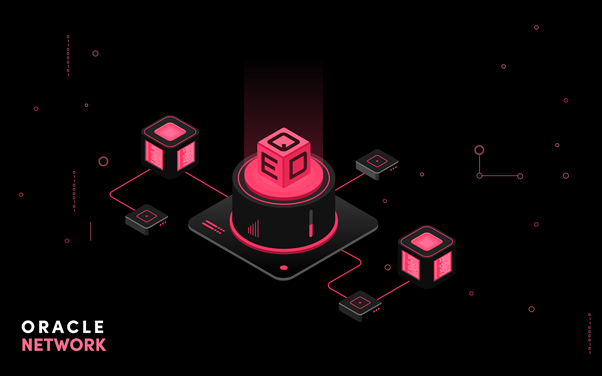
QED is a decentralized oracle protocol with a robust economic model that connects blockchains, smart contract platforms, and off-chain data resources. QED is a decentralized oracle that aims to achieve trustlessness by distributing data points among multiple entities and modeling the blockchain network.
DelphiOracle, QED’s base software, is the most widely used protocol on WAX.io, the world’s most trusted blockchain ecosystem for NFTs, dApps, and video games. For more than four years, the Delphi oracle has served as a multi-party source of truth, providing smart contracts with real-time prices for asset pairings on the various blockchain networks. DelphiOracle has already proven itself in the blockchain industry, and QED is built on it. The purpose of introducing QED is to solve problems inherent in existing models of oracles and blockchain systems.
Economic Model Of QED
The economic model of QED distinguishes it from existing Oracle protocols because it focuses on both the technological and commercial sides, which are both important when it comes to delivering and aggregating real-world data for smart contracts. The following are some of the characteristics of the QED economic model:
Recourse: QED is customer-centric because it protects users by providing a recourse mechanism. Clients would eventually be able to use the external collateral provided by QED to process loss restitution that may have occurred due to systemic risks.
Accuracy: To maximize real-time accuracy, automated systematic and reliability scoring is implemented to phase out poor-performing articles by increasing allocation to more capital-efficient oracles.
Decentralization: QED used distributed ledger technology as a mode of operation, promoting decentralization and eliminating the lingering issue of centralization in Oracle protocols. The native token “$QED” also serves as an economic constraint for QED.
Final Thoughts
QED is a breath of fresh air for Oracle protocols. It aspires to lead the next generation of Oracle protocols that provide services to smart contracts in a fully decentralized, transparent, and open manner. To make the most of its innovative economic model, QED intends to integrate with public blockchains. Furthermore, to promote scalability and interoperability, the QED protocol is also powered by the UX network. QED’s economic model was implemented to address issues with the commercial viability of existing Oracle protocols, and it would as a model for the next generation of Oracle protocols shortly.
Stablecoins and their use in decentralized finance (DeFi) have played a key role in the 2021 cryptocurrency bull market because allow investors to participate in the ever-growing number of protocols that offer high yield staking pools and they ease the process of transacting without needing to use a centralized exchange.
One project that has seen a significant amount of adoption thanks to its focus on creating a truly decentralized ecosystem and asset-backed stablecoin is the Abracadabra.money DeFi protocol and its native SPELL token.
Data from Cointelegraph Markets Pro and TradingView shows that after hitting a low of $0.0114 on Oct. 15, the price of SPELL rallied 178.55% to establish a new record high at $0.035 on Nov. 1 as its 24-hour trading volume spiked to $109.82 million.
SPELL/USD 4-hour chart. Source: TradingView
Three reasons why SPELL is attracting the attention of DeFi users are the growth of Magic Internet Money (MIM) as a fully decentralized, cross-chain capable stablecoin, numerous cross-chain integrations that have expanded the MIM and SPELL’s reach throughout the ecosystem and the token’s governance and tokenomic structure.
Decentralized stablecoin growth
One of the biggest factors attracting the attention of active DeFi users is Abracadabra’s native Magic Internet Money stablecoin which is a fully collateralized and minted by depositing interest-bearing assets on the DeFi protocol.
The growing popularity and adoption of MIM can be seen by the increasing total value locked on Abracadabra, which reached a record $4.15 billion on Nov. 1 according to data from Defi Llama.
Total value locked on Abracadabra.money. Source: Defi Llama
There has also been steady growth MIM’s circulating supply, which stands at $1.933 billion according to data from CoinMarketCap. The most recent expansion is in large part due to the expansion of assets that can be pledged as collateral to mint MIM, which now includes popular tokens like Shiba Inu (SHIB), FTX Token (FTT), wrapped Olympus (OHM) and Fantom (FTM).
Cross-chain integrations extend SPELL’s reach
A second reason inv are taking a closer look at SPELL is its expanding ecosystem which has recently added cross-chain support for multiple blockchain networks including Fantom and the Binance Smart Chain (BSC).
BSC is the most recent addition to the Abracadabra ecosystem after the community voted to add support for the network in a vote that closed on Oct. 30.
♂️!
A new governance proposal is out to decide whether we should deploy https://t.co/gHWEQJMoOc on #BSC!
Other blockchain protocols currently supported by Abracadabra include Ethereum (ETH), Arbitrum and Avalanche (AVAX), and the platform also benefits from multiple cross-protocol partnerships including integrations with Convex Finance (CVX), Yearn Finance (YFI), Curve Finance (CRV) and SushiSwap (SUSHI).
Related: Magic Internet Money races past $1B, sets sights on MakerDao
Favorable tokenomics and a decreasing circulating supply
Another factor catching the eye of DeFi investors is the tokenomic structure of SPELL which includes governance votes on emissions to control inflation.
The team behind SPELL regularly monitors the emission schedule across the various DeFi pools in its ecosystem to ensure that new tokens are being minted and utilized in the most beneficial way for the protocol and holders.
Due to increasing adoption and the uptick in price price, a large number of tokens originally set to be minted are no longer needed so the team decided to decrease the emission schedule by 20% beginning on Nov. 1. This effectively removed 8.7 billion SPELL tokens from the current circulating supply.
Going forward, the outlook for the project remains bullish and the team also has plans to further integrate SPELL and MIM to the Fantom ecosystem and also offer new staking opportunities in Arbitrum and Avalanche.
The views and opinions expressed here are solely those of the author and do not necessarily reflect the views of Cointelegraph.com. Every investment and trading move involves risk, you should conduct your own research when making a decision.