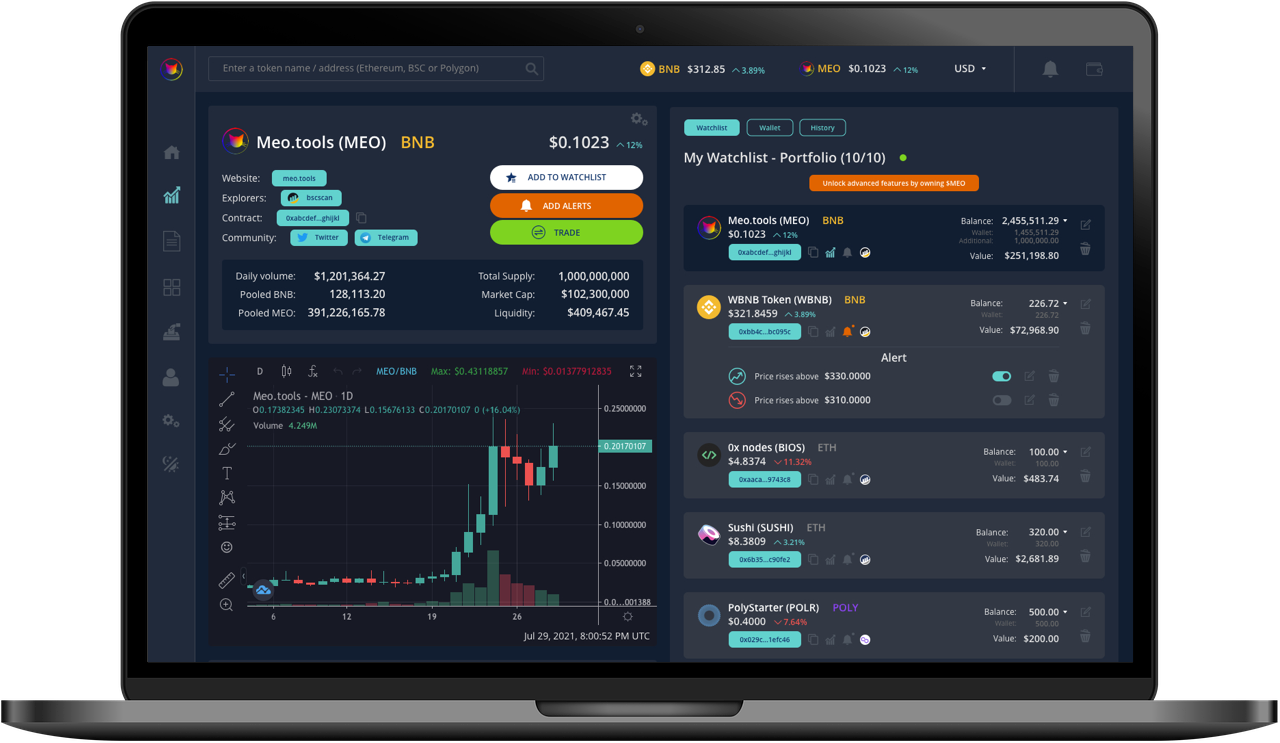
A Vietnam-based team recently launched MeoTools (meo.tools), an all-in-one crypto tracking dashboard. With the multi-function MeoTools dashboard platform, users can:
Keep an eye on their portfolio in real-time
Get different alert types for tokens and their overall portfolio
Follow asset data including price, trading volume, liquidity, project socials, and more
Easily swap coins and tokens
Utilize interactive charts to help analyze the market with useful information
Back in October 2021, the MeoTools team completed a platform audit by Certik with passing marks. This ensures when users use the MeoTools platform, there is little risk of anything dubious happening to them.
The project is still in the development phase and is looking to support more chains in the future, but it currently supports Binance Smart Chain, Ethereum, and Polygon. Moreover, MeoTools will soon release a version of the dashboard exclusively for mobile devices.
MEO Token
In addition, the platform includes a native token anointed ‘MEO.’ Its tokenomics enable holders to benefit from extra features and for subscriptions to the platform.
Version 1 of MeoTools supports Binance Smart Chain, Ethereum, and Polygon
By Brian Armstrong, CEO and Cofounder, & Alex Reeve, Identity Product Lead
These days, everyone is talking about the Metaverse.
Primitive Metaverse platforms are selling virtual land for millions of dollars. Billions more are being invested in Metaverse startups. And Mark Zuckerberg recently renamed his entire company to reflect a focus on building the Metaverse.
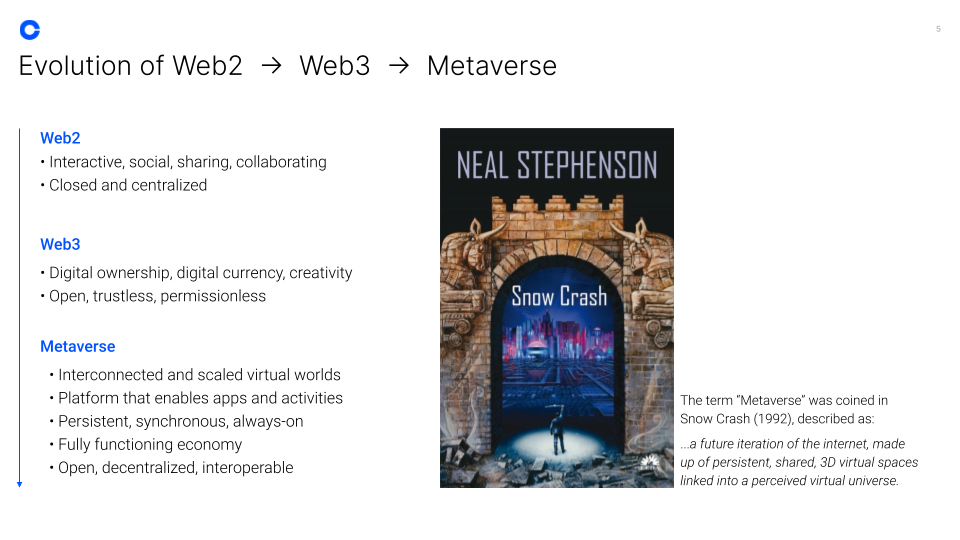
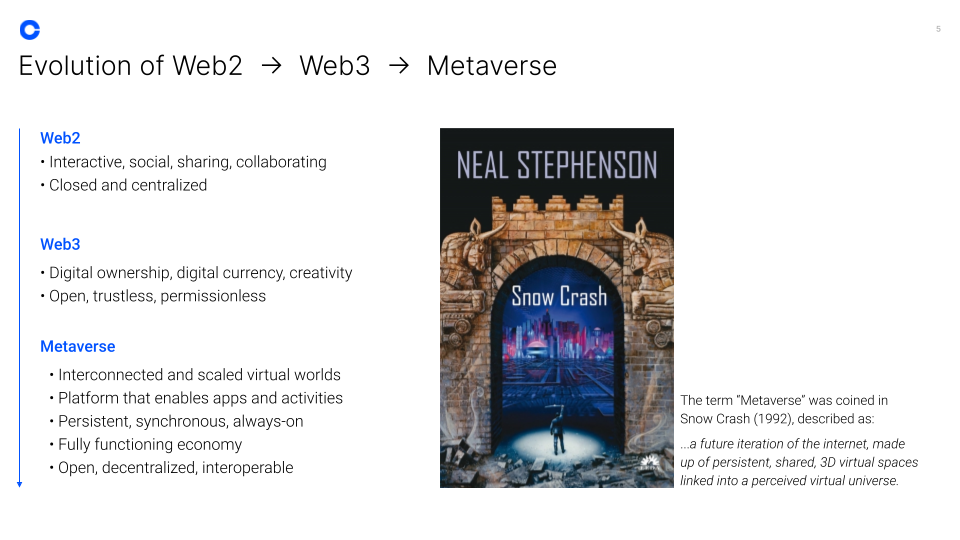
The term “Metaverse” is not new. It was first used by author Neal Stephenson in his 1992 novel “Snow Crash.” But as technology improves, and we spend more of our lives online, more people are starting to think about what’s next — and how the future might revolutionize both the digital and the physical world.
Recently, our team put together an internal presentation about the Metaverse, who’s working on it, and how crypto will help make it real. I thought the presentation was well done, so I’m sharing most of the slides here.
Defining the Metaverse
At Coinbase, our thinking about the Metaverse has been heavily influenced by venture capitalist and writer Matthew Ball (you can find his work here). Like Matt, we define the Metaverse as:
The future of the internet: A massively-scaled, persistent, interactive, and interoperable real-time platform comprised of interconnected virtual worlds where people can socialize, work, transact, play, and create.
The earliest version of the internet, Web1, was about accessing static web pages. Web2 is about interactive, social experiences within closed ecosystems. And Web3 will be about digital ownership within an open, decentralized environment.
The Metaverse is the distant evolution of Web3. In its most complete form, it will be a series of decentralized, interconnected virtual worlds with a fully functioning economy where people can do just about anything they can do in the physical world.
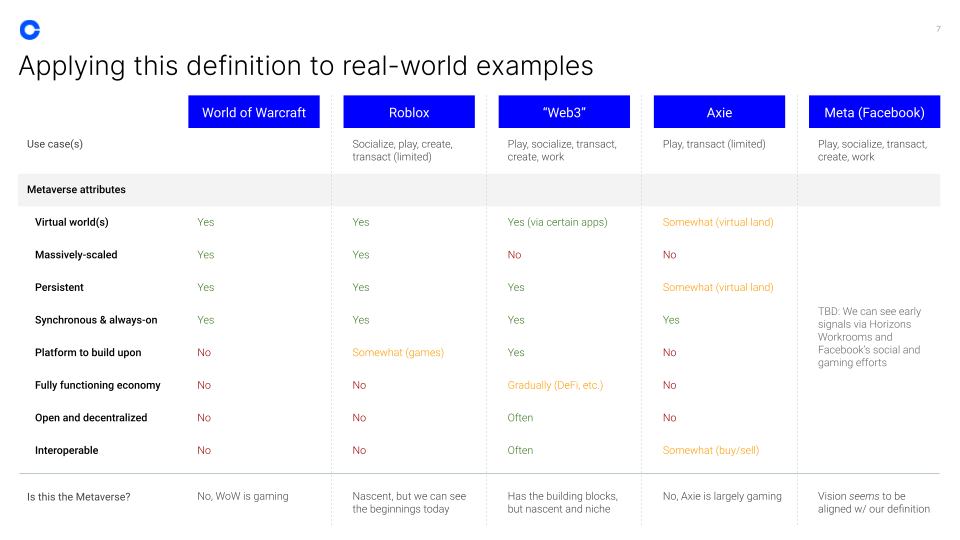
Importantly, the Metaverse is not the same thing as gaming (an activity you can do within the Metaverse), or virtual reality (a way of interfacing with the Metaverse). It’s also not the same as Web3 (a distant ancestor of the Metaverse).
To illustrate this, here’s how some current platforms stack up against our definition of the Metaverse:
Elements of the Metaverse
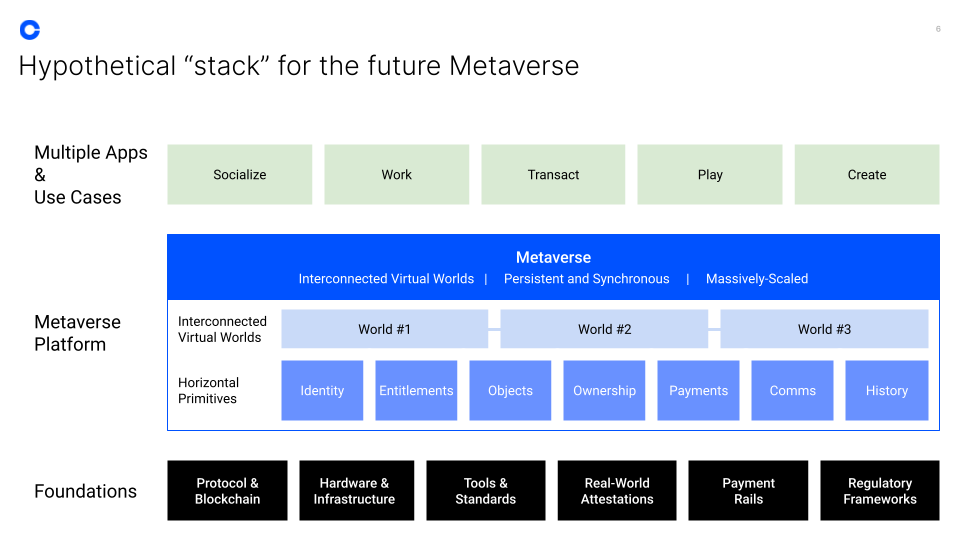
While the full Metaverse is years away, it will rest on a foundation that’s being built right now.
Like the internet today, the Metaverse will rely on hardware and infrastructure, tools and standards, and regulatory frameworks — most of which haven’t been fully developed yet.
But unlike today’s internet, there won’t just be one Metaverse. There will be many Metaverses, and they’ll be interconnected. That’s why it will be important for any Metaverse to be trustless — meaning people can interact directly without going through an intermediary — and permissionless — meaning anyone can participate without authorization from a governing body.
To achieve this, the Metaverse will rely on blockchain to transfer identity and ownership across virtual worlds, attestation to verify them, and payment rails that allow people buy, sell, and earn income within a decentralized economy.
Who’s building the Metaverse today?
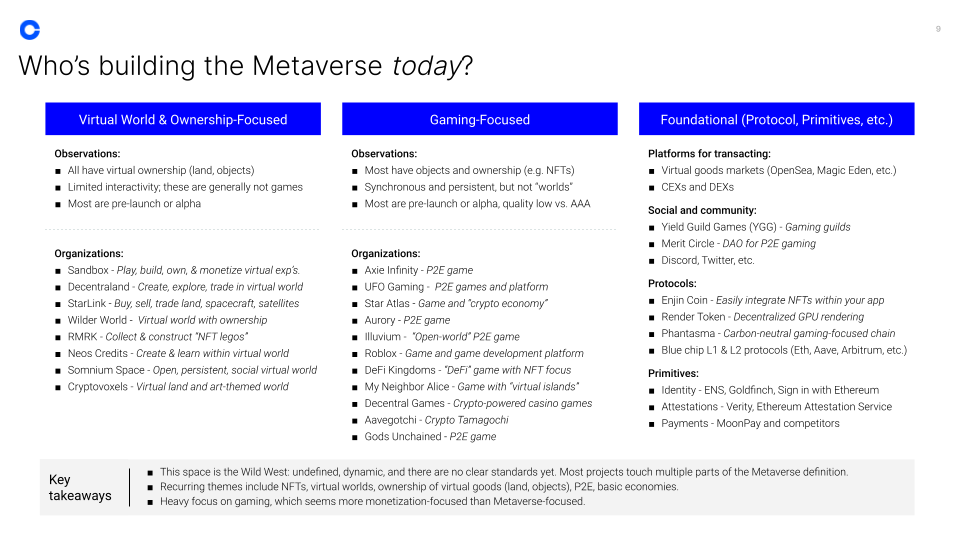
While we can’t build anything close to the full Metaverse yet, different companies and organizations are experimenting with different elements of it. Most fall into three categories:
The Metaverse ecosystem is still very much in its infancy: emergent and yet to be defined. That’s its beauty too. There’s a heavy focus on gaming, mostly because it’s easy to monetize. But we’re beginning to see glimpses of what the future might look like.
Identity
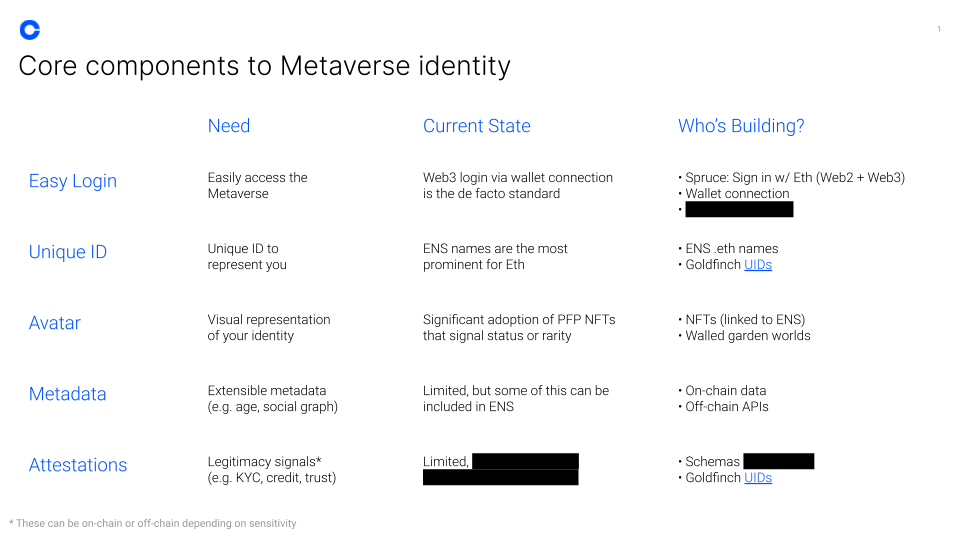
Identity determines who you are, what you can access and do, and how you’re represented across the worlds of the Metaverse.
In the Metaverse, our identities will have to include an easy login, a unique ID, an avatar that represents us, metadata that follows us, and attestation so we can prove who we are. Here’s where each of those pieces stands today:
Where Coinbase comes in
At Coinbase, we want to help pull all the pieces of identity together — essentially creating an identity on-ramp into the Metaverse.
That’s the idea behind our work with ENS, which makes it possible to create a unique username NFT that resolves to a wallet. Eventually, this will allow users to carry a unique ID across different worlds in the Metaverse.
We’re also working on technology that will allow you to purchase your avatar, define and maintain your public profile, and establish trust. And we’re working on features like Sign in with [Eth/Coinbase], which could allow users to sign into every app in the Metaverse.
Conclusion
At the end of the day, this isn’t about expanding our business or making money. It’s about building a critical piece of the Metaverse ecosystem, and helping crypto grow in the right way.
We know that the Metaverse will exist, and we know it will be a series of interconnected virtual worlds. Our goal is to make it easy for anyone to establish their identity and gain access to those worlds in a way that’s simple, trusted, and decentralized.
If we succeed, it will allow the Metaverse to reach its full potential — and keep it free and open to everyone.
How Coinbase thinks about the Metaverse was originally published in The Coinbase Blog on Medium, where people are continuing the conversation by highlighting and responding to this story.
The crypto payment solutions platform, Ramp recently secured $53 million in the Series A funding round to expand its product development. While the demand for crypto assets has increased during the last few months, payments companies have ramped up their efforts to introduce innovative solutions for a seamless crypto payment experience.
Ramp outlined the importance of regulation in the global financial sector. In addition to approval from the Financial Conduct Authority in the UK, Ramp received approval from the Financial Crimes Enforcement Network (FinCEN) in the United States.
According to the company, the latest financing will help the expansion of its presence. The Series A funding round was led by Balderton Capital along with participation from existing investors NFX, Galaxy Digital, Seedcamp and Firstminute Capital. Moreover, angel investors Taavet Hinrikus (Wise) and Francesco Simonesci (TrueLayer) joined the round.
“Just six months after closing our Seed round, we’re thrilled to announce we’ve raised $52.7 million [in a] Series A round, led by Balderton Capital. Four years ago, we set out to build a payments infrastructure application to simplify the exchange of value on public blockchains. During that time, we’ve launched and expanded our on-ramping products and have built an incredible community of partners, investors and customers,” Szymon Sypniewicz, the CEO of Ramp Network, commented.
“Today, Ramp is a partner to more than 400 developers, including Mozilla, Browser, Dapper Labs (the company behind NBA Top Shot) and top crypto and Defi apps like Aave, Argent, Trust Wallet and Zerion, as well as wildly popular games, Sorare and Axie Infinity,” Sypniewicz added.
Crypto Startups
Emerging crypto companies around the world have raised substantial funding in the last quarter. Earlier this week, the crypto firm, Anchorage secured $350 million in funding at a valuation of $3 billion. Recently, the Bitcoin company, NYDIG topped the valuation of $7 billion after a raise of almost $1 billion.
The crypto payment solutions platform, Ramp recently secured $53 million in the Series A funding round to expand its product development. While the demand for crypto assets has increased during the last few months, payments companies have ramped up their efforts to introduce innovative solutions for a seamless crypto payment experience.
Ramp outlined the importance of regulation in the global financial sector. In addition to approval from the Financial Conduct Authority in the UK, Ramp received approval from the Financial Crimes Enforcement Network (FinCEN) in the United States.
According to the company, the latest financing will help the expansion of its presence. The Series A funding round was led by Balderton Capital along with participation from existing investors NFX, Galaxy Digital, Seedcamp and Firstminute Capital. Moreover, angel investors Taavet Hinrikus (Wise) and Francesco Simonesci (TrueLayer) joined the round.
“Just six months after closing our Seed round, we’re thrilled to announce we’ve raised $52.7 million [in a] Series A round, led by Balderton Capital. Four years ago, we set out to build a payments infrastructure application to simplify the exchange of value on public blockchains. During that time, we’ve launched and expanded our on-ramping products and have built an incredible community of partners, investors and customers,” Szymon Sypniewicz, the CEO of Ramp Network, commented.
“Today, Ramp is a partner to more than 400 developers, including Mozilla, Browser, Dapper Labs (the company behind NBA Top Shot) and top crypto and Defi apps like Aave, Argent, Trust Wallet and Zerion, as well as wildly popular games, Sorare and Axie Infinity,” Sypniewicz added.
Crypto Startups
Emerging crypto companies around the world have raised substantial funding in the last quarter. Earlier this week, the crypto firm, Anchorage secured $350 million in funding at a valuation of $3 billion. Recently, the Bitcoin company, NYDIG topped the valuation of $7 billion after a raise of almost $1 billion.
Cryptocurrency has been the center of attention since the beginning of the pandemic, even reaching the point where Google searches for Bitcoin out weighed the searches of COVID-19. At the same time, world-class scammers have taken note of the increased interest in the sector. With the growing popularity of the crypto and blockchain industries, there has been an unprecedented rise in scammers in this space.
The high-tech nature of the crypto industry combined with the limited knowledge that most possess is the perfect combination for scammers. It makes it an easy environment to pull off scams worth millions of dollars. However, there are those working to stop scammers from invading the space. Here is a breakdown of some of the tools and firms working on solutions to fight back the scammers from the budding crypto sector.
SpyWolf
SpyWolf is a project whose stated mission is to hunt down crypto scammers. They have a goal of eliminating all monetary fraud in the crypto space. To achieve this goal, SpyWolf uses a utility token and advanced auditing services.
Every project in the crypto space is welcome to request an audit by the SpyWolf team. The team will then publish easy-to-read audit reviews of the project’s code, team, website, and social media channels. They will then provide a promotional NFT as part of the audit, which can be shared with the project’s community. This NFT acts as a “Certificate of Trust”, which proves to the community that a project is SAFU.
The SpyWolf project also offers KYC services that are meant to protect the crypto industry against fraud, money laundering, corruption, and terror financing. Additionally, they offer consultancy services on how to launch a project from the idea stage. SpyWolf experts will guide project creators throughout the process to ensure they possess a strong foundation. As part of the consultancy, SpyWolf works with a team of lawyers to ensure projects comply with law.
To ensure that it successfully combats fraud in the crypto space, SpyWolf runs a unique bounty program that rewards those that help identify fraudulent projects in the space.
The net effect of the SpyWolf project is the creation of a safer crypto space for all. It ensures that when people try to join the space, they are not scammed, which could put them off technology and ecosystem that could revolutionize all aspects of modern life.
CertiK
CertiK is another project that is leading the effort to clean up the crypto space. It is a security blockchain with numerous uses. The primary use of CertiK is as a Formal Verification technology for performing security audits on crypto projects. It also runs a leaderboard page where projects are rated by their level of trust.
It performs security audits on blockchain protocols, DApps, Wallets, and smart contracts. To date, CertiK has partnered with leading players in the sector such as Huobi, Binance, and IBM. The goal of CertiK is to uncover exploits and other security vulnerabilities in the code of projects in the crypto space. Besides performing audits, CertiK has a secure programming language within its native blockchain. Using this native language, users can create verified smart contracts on the blockchain using DeepSEA.
Escrow Protocol
Escrow Protocol is another project worth talking about. It operates as a decentralized trust fund, which combines traditional crowdfunding with blockchain technology via smart contracts. Startups seeking funds can create roadmap milestones and timelines. These are based on their actual capacity and realistic performance targets.
Via Escrow Protocol, they establish measurable achievement for the delivery of funds once promises have been fulfilled. With Escrow Protocol, project designers can build trust with investors by allowing ICO funds to be managed post-raise using milestone-triggered micropayments. It gives investors unprecedented oversight over a project, which protects them from rug-pulls that have become common in the crypto space.
Summary
While the crypto space is still young and attractive to scammers, experts within the space are taking them on and succeeding. As the use of the tools above continues to grow, it will help to deter scammers while also helping to build trust amongst potential investors. The result will be a healthier ecosystem, whose growth is not hampered by a lack of trust.
Crypto trading platform Voyager Digital has inked a deal with the National Women’s Soccer League, or NWSL, aiming to provide players crypto education and financial support.
In a Tuesday announcement, Voyager said it would become the league’s first cryptocurrency brokerage partner as part of a multi-year deal. The trading platform said a “significant amount” of the investment would fund rostered players’ crypto accounts. There are expected to be 12 teams in the NWSL starting in 2022, so up to 312 players could benefit from the Voyager partnership.
“Voyager’s investment in the league is especially innovative because we’ve collectively designed the partnership to include direct financial resources for every one of our players, as well as education on the revolutionary changes underway in digital assets,” said NWSL interim CEO Marla Messing.
Soccer ball. Source: Pexels
As part of the deal with Voyager, one player from each of the NWSL’s teams will act as an ambassador, attending educational events and creating crypto-related content. The exchange said it would be offering “key lessons and tools” aimed at helping players develop long-term financial growth opportunities after their sports careers had ended.
Many crypto companies and platforms have formed partnerships with sports organizations across the globe as the space expands and seemingly becomes more profitable as a sponsor. Voyager is already the crypto brokerage and international partner for the Dallas Mavericks basketball team following an October deal. Crypto derivatives exchange FTX also announced it had become the official sponsor of Major League Baseball in June.
Related:Crypto.com partners with Italian football’s Lega Serie A
Founded in 2018, Voyager Digital currently offers more than 60 digital assets for trading on its mobile app, which also includes services such as yield farming. In October, the platform announced it had received a $75 million investment from crypto quantitative trading firm and liquidity provider Alameda Research.
American no-fee broker Robinhood announced on Tuesday that it has acquired cross-exchange trading platform Cove Markets. This will allow investors on Robinhood to easily manage their cryptocurrency accounts.
The official blog post highlighted that both the companies ‘share a common goal of making investing in cryptocurrencies simpler and lower cost’.
As a part of the acquisition, Cove Markets co-founders Scott Knudsen and Victor Glava, along with their team, will join Robinhood’s crypto unit. However, neither of the companies have disclosed the amount involved in the
acquisition
Acquisition
Acquisition means acquiring or taking possession or the securing of property, services, or abilities. To put it simply, it is the act or process of acquiring or gaining. You can acquire a work of art, you can acquire an ability such as speaking another language, you can acquire a business or shares in a company and you can acquire an accountant’s service. For example, you can acquire a new car. In a broad sense, Acquisition can mean the act of taking ownership or possession of something. There are many ways to acquire or to take the acquisition of property and services. How Companies Utilize AcquisitionsIn finance, the term acquisition is most often used when referring to taking control of a company. An acquisition can be either an agreed deal or a hostile takeover. Companies also may acquire units of a company, property, or other assets. An acquisition is when one business, person, or company purchases most if not of another company’s shares to gain control of that company. Buying more than 50% of a target firm’s stock and other assets allows the acquirer to make decisions about the newly acquired assets without the approval of the company’s shareholders. In finance, there are several types of acquisitions that one speaks of when referring to Acquisitions and Mergers. A horizontal acquisition is when two companies come together with similar products/services. Conversely, a vertical acquisition means two companies join forces in the same industry, but they are at different points on the supply chain.Moreover, a conglomerate represents two companies in different industries join forces, or one takes over the other to broaden their range of services and products. Finally, a concentric acquisition occurs when companies will share customers but provide different services.
Acquisition means acquiring or taking possession or the securing of property, services, or abilities. To put it simply, it is the act or process of acquiring or gaining. You can acquire a work of art, you can acquire an ability such as speaking another language, you can acquire a business or shares in a company and you can acquire an accountant’s service. For example, you can acquire a new car. In a broad sense, Acquisition can mean the act of taking ownership or possession of something. There are many ways to acquire or to take the acquisition of property and services. How Companies Utilize AcquisitionsIn finance, the term acquisition is most often used when referring to taking control of a company. An acquisition can be either an agreed deal or a hostile takeover. Companies also may acquire units of a company, property, or other assets. An acquisition is when one business, person, or company purchases most if not of another company’s shares to gain control of that company. Buying more than 50% of a target firm’s stock and other assets allows the acquirer to make decisions about the newly acquired assets without the approval of the company’s shareholders. In finance, there are several types of acquisitions that one speaks of when referring to Acquisitions and Mergers. A horizontal acquisition is when two companies come together with similar products/services. Conversely, a vertical acquisition means two companies join forces in the same industry, but they are at different points on the supply chain.Moreover, a conglomerate represents two companies in different industries join forces, or one takes over the other to broaden their range of services and products. Finally, a concentric acquisition occurs when companies will share customers but provide different services. Read this Term deal.
“Scott, Victor and the Cove Markets team will bolster our crypto trading platform and help us strengthen our leadership in the crypto industry,” Christine Brown, Chief Operating Officer of Robinhood Crypto, said.
“Their wealth of experience in trading
execution
Execution
Execution is the process during which a client submits an order to the brokerage, which consequently executes it resulting in an open position in a given asset. The execution of the order occurs only when it is filled. There is typically a time delay between the placement of the order and the execution which is called latency.In the retail FX space, reliable brokers always strive to deliver best execution to their clients in order to maintain a solid business relationship with them. This is a common marketing point of emphasis by brokers, whose action execution varies considerably from company to company. When execution prices are not matching the submitted price the client is charged or credited the difference resulting from the negative or positive slippage.Slippage is a very contentious issue among retail traders, which can lead to issues. Many traders view levels of slippage at brokers as a key determinant for their business. Best Execution a Legal ObligationBrokers are required by law to diver to their clients the best execution possible. Some regulators are requiring brokers to submit execution stats in order to assess the quality of their services. Other brokers are regularly posting execution statistics in order to boost the confidence of their clients in the best execution commitment of the company.Best execution has been a point of emphasis in recent years from both retail and institutional players in the FX industry. Negotiating and executing transactions in order to promote a robust, fair, open, liquid and appropriately transparent FX market is identified as one of the six main principles outlined in the FX Global Code of Conduct, which came into effect in 2018.
Execution is the process during which a client submits an order to the brokerage, which consequently executes it resulting in an open position in a given asset. The execution of the order occurs only when it is filled. There is typically a time delay between the placement of the order and the execution which is called latency.In the retail FX space, reliable brokers always strive to deliver best execution to their clients in order to maintain a solid business relationship with them. This is a common marketing point of emphasis by brokers, whose action execution varies considerably from company to company. When execution prices are not matching the submitted price the client is charged or credited the difference resulting from the negative or positive slippage.Slippage is a very contentious issue among retail traders, which can lead to issues. Many traders view levels of slippage at brokers as a key determinant for their business. Best Execution a Legal ObligationBrokers are required by law to diver to their clients the best execution possible. Some regulators are requiring brokers to submit execution stats in order to assess the quality of their services. Other brokers are regularly posting execution statistics in order to boost the confidence of their clients in the best execution commitment of the company.Best execution has been a point of emphasis in recent years from both retail and institutional players in the FX industry. Negotiating and executing transactions in order to promote a robust, fair, open, liquid and appropriately transparent FX market is identified as one of the six main principles outlined in the FX Global Code of Conduct, which came into effect in 2018. Read this Term and crypto market infrastructure will help us to build more powerful trading capabilities, bringing the benefits of better competition in the crypto markets to our customers.”
Filling the Gap Between Crypto Exchanges
Founded three years ago, Cove Markets is building tools to help crypto investors manage their accounts maintained across multiple exchanges.
“Now, we are excited to join Robinhood to help build a world-class platform that can improve trading for millions of customers,” Cove Markets CEO, Knudsen, said.
Robinhood started to offer cryptocurrency investment services in 2018 in addition to its regular commission-free stock trading services. Though it does not allow investors to own and move crypto like other dedicated crypto exchanges, it is in the process of rolling out a crypto wallet.
Meanwhile, crypto trading demand on Robinhood soared with the initial rally of meme tokens earlier this year as it was the only credible American exchange to list them at the time. The platform generated more than half of its transaction-based revenue in Q2 2021 from crypto trading, but the demand faded away in the next quarter.
American no-fee broker Robinhood announced on Tuesday that it has acquired cross-exchange trading platform Cove Markets. This will allow investors on Robinhood to easily manage their cryptocurrency accounts.
The official blog post highlighted that both the companies ‘share a common goal of making investing in cryptocurrencies simpler and lower cost’.
As a part of the acquisition, Cove Markets co-founders Scott Knudsen and Victor Glava, along with their team, will join Robinhood’s crypto unit. However, neither of the companies have disclosed the amount involved in the
acquisition
Acquisition
Acquisition means acquiring or taking possession or the securing of property, services, or abilities. To put it simply, it is the act or process of acquiring or gaining. You can acquire a work of art, you can acquire an ability such as speaking another language, you can acquire a business or shares in a company and you can acquire an accountant’s service. For example, you can acquire a new car. In a broad sense, Acquisition can mean the act of taking ownership or possession of something. There are many ways to acquire or to take the acquisition of property and services. How Companies Utilize AcquisitionsIn finance, the term acquisition is most often used when referring to taking control of a company. An acquisition can be either an agreed deal or a hostile takeover. Companies also may acquire units of a company, property, or other assets. An acquisition is when one business, person, or company purchases most if not of another company’s shares to gain control of that company. Buying more than 50% of a target firm’s stock and other assets allows the acquirer to make decisions about the newly acquired assets without the approval of the company’s shareholders. In finance, there are several types of acquisitions that one speaks of when referring to Acquisitions and Mergers. A horizontal acquisition is when two companies come together with similar products/services. Conversely, a vertical acquisition means two companies join forces in the same industry, but they are at different points on the supply chain.Moreover, a conglomerate represents two companies in different industries join forces, or one takes over the other to broaden their range of services and products. Finally, a concentric acquisition occurs when companies will share customers but provide different services.
Acquisition means acquiring or taking possession or the securing of property, services, or abilities. To put it simply, it is the act or process of acquiring or gaining. You can acquire a work of art, you can acquire an ability such as speaking another language, you can acquire a business or shares in a company and you can acquire an accountant’s service. For example, you can acquire a new car. In a broad sense, Acquisition can mean the act of taking ownership or possession of something. There are many ways to acquire or to take the acquisition of property and services. How Companies Utilize AcquisitionsIn finance, the term acquisition is most often used when referring to taking control of a company. An acquisition can be either an agreed deal or a hostile takeover. Companies also may acquire units of a company, property, or other assets. An acquisition is when one business, person, or company purchases most if not of another company’s shares to gain control of that company. Buying more than 50% of a target firm’s stock and other assets allows the acquirer to make decisions about the newly acquired assets without the approval of the company’s shareholders. In finance, there are several types of acquisitions that one speaks of when referring to Acquisitions and Mergers. A horizontal acquisition is when two companies come together with similar products/services. Conversely, a vertical acquisition means two companies join forces in the same industry, but they are at different points on the supply chain.Moreover, a conglomerate represents two companies in different industries join forces, or one takes over the other to broaden their range of services and products. Finally, a concentric acquisition occurs when companies will share customers but provide different services. Read this Term deal.
“Scott, Victor and the Cove Markets team will bolster our crypto trading platform and help us strengthen our leadership in the crypto industry,” Christine Brown, Chief Operating Officer of Robinhood Crypto, said.
“Their wealth of experience in trading
execution
Execution
Execution is the process during which a client submits an order to the brokerage, which consequently executes it resulting in an open position in a given asset. The execution of the order occurs only when it is filled. There is typically a time delay between the placement of the order and the execution which is called latency.In the retail FX space, reliable brokers always strive to deliver best execution to their clients in order to maintain a solid business relationship with them. This is a common marketing point of emphasis by brokers, whose action execution varies considerably from company to company. When execution prices are not matching the submitted price the client is charged or credited the difference resulting from the negative or positive slippage.Slippage is a very contentious issue among retail traders, which can lead to issues. Many traders view levels of slippage at brokers as a key determinant for their business. Best Execution a Legal ObligationBrokers are required by law to diver to their clients the best execution possible. Some regulators are requiring brokers to submit execution stats in order to assess the quality of their services. Other brokers are regularly posting execution statistics in order to boost the confidence of their clients in the best execution commitment of the company.Best execution has been a point of emphasis in recent years from both retail and institutional players in the FX industry. Negotiating and executing transactions in order to promote a robust, fair, open, liquid and appropriately transparent FX market is identified as one of the six main principles outlined in the FX Global Code of Conduct, which came into effect in 2018.
Execution is the process during which a client submits an order to the brokerage, which consequently executes it resulting in an open position in a given asset. The execution of the order occurs only when it is filled. There is typically a time delay between the placement of the order and the execution which is called latency.In the retail FX space, reliable brokers always strive to deliver best execution to their clients in order to maintain a solid business relationship with them. This is a common marketing point of emphasis by brokers, whose action execution varies considerably from company to company. When execution prices are not matching the submitted price the client is charged or credited the difference resulting from the negative or positive slippage.Slippage is a very contentious issue among retail traders, which can lead to issues. Many traders view levels of slippage at brokers as a key determinant for their business. Best Execution a Legal ObligationBrokers are required by law to diver to their clients the best execution possible. Some regulators are requiring brokers to submit execution stats in order to assess the quality of their services. Other brokers are regularly posting execution statistics in order to boost the confidence of their clients in the best execution commitment of the company.Best execution has been a point of emphasis in recent years from both retail and institutional players in the FX industry. Negotiating and executing transactions in order to promote a robust, fair, open, liquid and appropriately transparent FX market is identified as one of the six main principles outlined in the FX Global Code of Conduct, which came into effect in 2018. Read this Term and crypto market infrastructure will help us to build more powerful trading capabilities, bringing the benefits of better competition in the crypto markets to our customers.”
Filling the Gap Between Crypto Exchanges
Founded three years ago, Cove Markets is building tools to help crypto investors manage their accounts maintained across multiple exchanges.
“Now, we are excited to join Robinhood to help build a world-class platform that can improve trading for millions of customers,” Cove Markets CEO, Knudsen, said.
Robinhood started to offer cryptocurrency investment services in 2018 in addition to its regular commission-free stock trading services. Though it does not allow investors to own and move crypto like other dedicated crypto exchanges, it is in the process of rolling out a crypto wallet.
Meanwhile, crypto trading demand on Robinhood soared with the initial rally of meme tokens earlier this year as it was the only credible American exchange to list them at the time. The platform generated more than half of its transaction-based revenue in Q2 2021 from crypto trading, but the demand faded away in the next quarter.
Starting today Decentralized Social (DESO) is available on Coinbase.com and in the Coinbase Android and iOS apps. Coinbase customers can now trade, send, receive, or store DESO in most Coinbase-supported regions, with certain exceptions indicated in each asset page here. Trading for these assets is also supported on Coinbase Pro.
Decentralized Social (DESO) is the native cryptocurrency powering the Decentralized Social blockchain, a platform designed to support a wide variety of decentralized social media applications. DESO can be used to purchase “social tokens” and NFTs, and to create profiles and posts for Decentralized Social applications.
One of the most common requests we hear from customers is to be able to buy and sell more cryptocurrencies on Coinbase. We announced a process for listing assets, designed in part to accelerate the addition of more cryptocurrencies. We are also investing in new tools to help people understand and explore cryptocurrencies. We launched informational asset pages (see DESO ), as well as a new section of the Coinbase website to answer common questions about crypto.
Customers can sign up for a Coinbase account here to buy, sell, convert, send, receive, or store e Coinbase Android and iOS apps. Coinbase customers can now trade, send, receive, or store DESO today.
###
Please note: Coinbase Ventures may be an investor in the crypto projects mentioned here, and additionally, Coinbase may hold such tokens on its balance sheet for operational purposes. A list of Coinbase Ventures investments is available at https://ventures.coinbase.com/. Coinbase intends to maintain its investment in these entities for the foreseeable future and maintains internal policies that address the timing of permissible disposition of any related digital assets, if applicable. All assets, regardless of whether Coinbase Ventures holds an investor or Coinbase holds for operational purposes, are subject to the same strict review guidelines and review process.
This website contains links to third-party websites or other content for information purposes only (“Third-Party Sites”). The Third-Party Sites are not under the control of Coinbase, Inc., and its affiliates (“Coinbase”), and Coinbase is not responsible for the content of any Third-Party Site, including without limitation any link contained in a Third-Party Site, or any changes or updates to a Third-Party Site. Coinbase is not responsible for webcasting or any other form of transmission received from any Third-Party Site. Coinbase is providing these links to you only as a convenience, and the inclusion of any link does not imply endorsement, approval or recommendation by Coinbase of the site or any association with its operators.
Crypto is a new type of asset. Besides potential day to day or hour to hour volatility, each crypto asset has unique features. Make sure you research and understand individual assets before you transact.
All images provided herein are by Coinbase.
Decentralized Social (DESO) is launching on Coinbase was originally published in The Coinbase Blog on Medium, where people are continuing the conversation by highlighting and responding to this story.
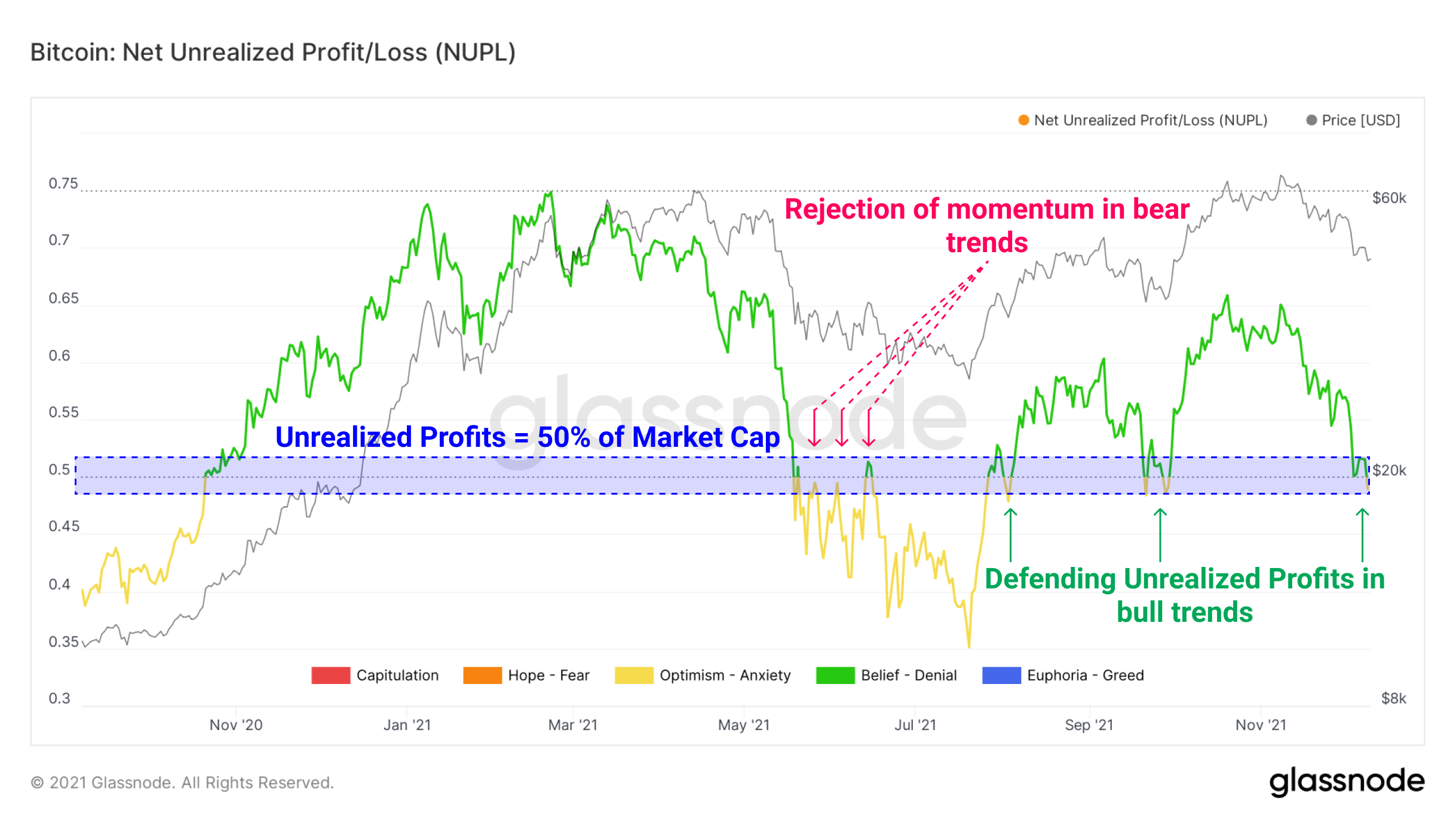
The Bitcoin NUPL indicator shows the market is currently testing a key support level that may be a junction between bullish and bearish trends.
Bitcoin NUPL Shows Market Currently Stands At Key Support Level
As per the latest weekly report from Glassnode, the NUPL shows that the market has entered a key zone that can decide whether the following trend will be bullish or bearish.
The Net Unrealized Profit/Loss (NUPL) is an on-chain indicator that measures the difference between the unrealized profit and loss to check whether the market as a whole is currently in a state of profit or loss.
The metric measures this by looking at what price each coin on the chain was bought at, and comparing it with the current price.
When the value of the indicator is below zero, it means the overall Bitcoin network is in a state of profit at the moment.
On the other hand, when NUPL assumes values above zero, then the market is, on an average, having unrealized gains.
Related Reading | Weekend Volatility Awakens Bitcoin Buyers, Active Addresses
Now, here is a chart that shows how the value of this Bitcoin indicator has changed over the past year:
Looks like the overall market is currently in a state of profit | Source: The Glassnode Week Onchain (Week 50)
As you can see in the above graph, there is a highlighted zone around the NUPL value of 0.5. At this value, 50% of the Bitcoin market cap is in the form of unrealized gains.
Related Reading | Goldman Sachs CEO Sidesteps Bitcoin Inquiries, Says Blockchain Is More Important
The report describes this zone as a historical battleground between the bulls and the bears. During periods of bearish trend, this zone usually provides resistance, while in times of bullish sentiment, the zone would act as support.
Now as the chart shows, the indicator seems to be touching this zone again. This type of retest has already happened a few times in the past few months, and the bulls stood strong during those.
Back during the May crash, however, the support didn’t last and the indicator shot below the zone. Afterwards each touch of the zone sent the price back down.
It’s possible that the market might hold support here as well just like the last few retests. But it’s not set in stone; any transition down here could be bad for the coin’s price, just like how it was in May.
BTC’s Price
At the time of writing, Bitcoin’s price floats around $46.9k, down 8% in the last seven days. The below chart shows the trend in the price of BTC over the last five days.
BTC's price once again plunges down | Source: BTCUSD on TradingView
Featured image from Unsplash.com, charts from TradingView.com, Glassnode.com
Dubai, UAE, December 14th, 2021 — MRHB (Marhaba) DeFi, the world’s first halal and ethical Decentralized Finance (DeFi) platform, is proud to announce their partnership with UAE-based crypto pioneer Masary Capital to bring DeFi opportunities to both retail and institutional clients in the United Arab Emirates and beyond, for the first time in the Islamic Finance space — a market estimated at around USD 3 trillion globally.
The agreement was signed between Masary CEO, Mr. Khalil Abdullah, and MRHB CEO & Founder, Mr. Naquib Mohammed, in Dubai, UAE, a fast emerging global crypto hub for the sector.
MRHB DeFi will be providing an entire ecosystem of eight innovative and shariah-compliant DeFi products for distribution through Masary Capital’s retail platform that provides easy access to crypto payments, investments, services and global remittance facilities. Together, they will encourage maximum UAE participation in the crypto space for those consumers who are focussed on halal services and opportunities.
“Our pioneering crypto platform will provide a seamless path for our businesses, institutions and consumers to participate. Our partnership with MRHB DeFi is aimed atgiving access to the full potential of DeFi to our Islamic customers,” said Masary Capital CEO, Mr. Khalil Abdullah.
Masary Islamic is one of the key product suites of Masary Capital that will be “Powered by MRHB”. Under the leadership of Mr. Khalil, Masary Capital aims to unlock transactional efficiencies of blockchain technology to shape a new financial system that is both highly efficient and productive.
“We are proud that Masary Capital has chosen us to be their preferred DeFi partner,” said MRHB DeFi CEO Naquib Mohammed. “This partnership will drive both retail and crucial institutional growth in the region and support our vision of providing DeFi to over 1 Billion people who find themselves excluded from the cryptosphere due to faith, lack of access and complexity.”
MRHB DeFi has a Shariah Board that vets all tokens and projects before acceptance on their halal-only platform. Users of the platform will have access to an ecosystem of products, including DeFi investments, interest-free financing and blockchain startup launchpads amongst others. All products operate in a completely transparent, decentralized and secure manner while following the ethical principles of Islamic Finance.
An Unprecedented Commitment to Community and Ethics
With a strong first mover advantage, MRHB DeFi has built an active community of more than 70,000 across Twitter, Telegram and more. Approximately 90% of the 1,000 members who participated in MRHB’s two public pre-launch token sales were first-time cryptocurrency investors across the globe — including non-Muslims with a strong interest in a more ethical approach to crypto opportunities.
The MRHB ecosystem avoids business practices, tokens, crypto assets and projects that include any form of gambling, social exploitation, pornography and usury of any kind amongst other prohibitions. Islamic Finance principles in general encourage projects that support asset or utility-backed financing, transparency, sustainability and equitable risk-reward sharing. These principles have universal appeal far beyond the faith-conscious community. The project is also aligned with a number of the Sustainable Development Goals set by the United Nations.
Masary Capital has now joined the host of institutional investors and partners in MRHB DeFi who are on board to bring DeFi innovation to the Islamic finance industry. To date, investors include Sheesha Finance, Blockchain Australia, Mozaic, Contango Digital Assets, NewTribe Capital, Acreditus Partners, EMGS Group, Sinofy Group, Australian Gulf Capital, MKD Capital and a grant from Polygon Technology.
About MRHB DeFi
MRHB DeFi is a halal, decentralized finance platform built to embody the true spirit of an “Ethical and Inclusive DeFi” by following faith-based financial and business principles, where all excluded communities can benefit from the full empowerment potential of DeFi.
The diverse team comprises researchers, technocrats, influencers, Islamic fintech experts & business entrepreneurs, who came together to ensure that MRHB DeFi prevails in a manner that will impact society as a whole, essentially bridging the gap between the faith-conscious communities and the blockchain world.
About Masary Capital
Masary aims to become a pioneer in providing state-of-the-art seamless blockchain and crypto solutions across all channels of customer interaction and to successfully establish the adoption of crypto-related activities, solutions, payment services and infrastructure in the UAE and GCC.
The innovative and diverse team have key strategic partnerships with industry leaders and is poised to offer the region’s first Emirati-owned crypto super-platform, offering solutions that empower users to harness the investment potential of crypto-assets.
Starting Today, Monday December 13, transfer DESO into your Coinbase Pro account ahead of trading. Support for DESO will generally be available in Coinbase’s supported jurisdictions with certain exceptions as indicated in each asset page here. Trading will begin on or after 9AM Pacific Time (PT), Tuesday December 14, if liquidity conditions are met.
One of the most common requests we receive from customers is to be able to trade more assets on our platform. Per the terms of our listing process, we anticipate supporting more assets that meet our standards over time. Most recently we have added trading support for API3 (API3), Bluezelle (BLZ), Gods Unchained (GODS), Immutable X (IMX), Measurable Data Token (MDT), Ribbon Finance (RBN), Circuits of Value (COVAL), IDEX (IDEX), Moss Carbon Credit (MCO2), Polkastarter (POLS), ShapeShift FOX Token (FOX), Spell Token (SPELL) and SuperFarm (SUPER).
Once sufficient supply ofDESO is established on the platform, trading on our DESO-USD, DESO-USDT and DESO-EUR order books will launch in phases, post-only or auction mode then limit-only or full trading mode. If at any point one of the new order books does not meet our assessment for a healthy and orderly market, we may keep the book in one state for a longer period of time or suspend trading as per our Trading Rules.
We will publish tweets from our Coinbase Pro Twitter account as each order book moves through the phases.
Decentralized Social (DESO) is the native cryptocurrency powering the Decentralized Social blockchain, a platform designed to support a wide variety of decentralized social media applications. DESO can be used to purchase “social tokens” and NFTs, and to create profiles and posts for Decentralized Social applications.
DESO is not yet available on Coinbase.com or via our Consumer mobile apps. We will make a separate announcement if and when this support is added.
You can sign up for a Coinbase Pro account here to start trading. For more information on trading DESO on Coinbase Pro, visit our support page.
### Please note: Coinbase Ventures may be an investor in the crypto projects mentioned here, and additionally, Coinbase may hold such tokens on its balance sheet for operational purposes. A list of Coinbase Ventures investments is available at https://ventures.coinbase.com/. Coinbase intends to maintain its investment in these entities for the foreseeable future and maintains internal policies that address the timing of permissible disposition of any related digital assets, if applicable. All assets, regardless of whether Coinbase Ventures holds an investor or Coinbase holds for operational purposes, are subject to the same strict review guidelines and review process. This website contains links to third-party websites or other content for information purposes only (“Third-Party Sites”). The Third-Party Sites are not under the control of Coinbase, Inc., and its affiliates (“Coinbase”), and Coinbase is not responsible for the content of any Third-Party Site, including without limitation any link contained in a Third-Party Site, or any changes or updates to a Third-Party Site. Coinbase is not responsible for webcasting or any other form of transmission received from any Third-Party Site. Coinbase is providing these links to you only as a convenience, and the inclusion of any link does not imply endorsement, approval or recommendation by Coinbase of the site or any association with its operators.
Crypto is a new type of asset. Besides potential day to day or hour to hour volatility, each crypto asset has unique features. Make sure you research and understand individual assets before you transact.
All images provided herein are by Coinbase.
######
Decentralized Social (DESO) is launching on Coinbase Pro was originally published in The Coinbase Blog on Medium, where people are continuing the conversation by highlighting and responding to this story.