There have been several reactions and comment from prominent personalities about the trend of cryptocurrency from the beginning of 2022. The world’s most prominent controversial podcaster and comedian, Joe Rogan, has just expressed his ‘hope’ for digital assets. He made this confession during a recent podcast interview.
On January 8, Rogan, through the 1760th episode of his podcast ‘The Joe Rogan Experience,’ deliberated on the crypto future. This discussion was with Adam Curry, his fellow podcaster.
The estimated number of listeners for every episode of Rogan’s podcast is about 11 million. This is significantly high irrespective of the moves from Spotify in censoring some offensive episodes. Also, Rogan’s podcast bagged the top position of the most popular during 2021 on Spotify.
The world’s most prominent podcaster stated that cryptocurrency would either entirely fall or become an opportunity for sailing to a better future for human lives.
Curry stated that several young individuals are moving out on his part. Such moves could be for developing parallel networks and systems. He confirmed his loyalty to Bitcoin by stating that he’s on the BTC train to provide more security for his funds. He lamented the broken money system, causing misery, inflation, and even wars due to its link to oil.
Related Reading | How the CFTC fine on Coinbase could affect future crypto company listing
Curry has been the host of ‘No Agenda,’ a right-wing podcast that has received criticisms from the medical community and mainstream media. They believed that Curry has been promoting conspiracy theories.
Metaverse And Cryptocurrency Vision From Podcasters
The discussion between Rogan and Curry transcended to the potential of digital Metaverse that Silicon Valley controls. Also, they talked about NFTs and their role within the crypto space.
The crypto total market cap stays above $2 trillion | Source: TradingView.com
Rogan composed a theory for the future where firms could devise their digital tokens. Hence, buying their products will demand that customers utilize the tokens.
He cited that Apple could achieve that with ease. Rogan explained that the process would be first to buy the digital coins you will use to buy the company’s products. He said that the process is similar to stocks.
Reacting to that, Curry expressed his disagreement by saying that Rogan’s explanation is different from the plan. Instead, Curry stated that powerful governments and institutions are expected to focus on their Central Bank Digital Currencies, CBDCs.
He mentioned that individuals would have crypto tokens and wallets allocated from the Federal Reserve. Hence, retail banking will have little or no use.
Irrespective of the positive vibes from the podcasters in appreciating cryptocurrency, lots of crypto community members are pretty skeptical.
Related Reading | Did US Regulators Began Offensive Against Crypto Platforms? CFTC Fines Kraken
The two podcasters, Rogan and Curry, stand within the crypto space as being highly controversial. Rogan is famous for his kicks against ‘political uprightness. So, he had gained past criticism for his jokes that depicts racism, sexism, and transphobia.
Rogan received payment from CashApp in July 2021 to advertise Bitcoin to his listeners. Also, in November, he got $100,000 as a BTC payment.
Featured image from Pixabay, chart from TradingView.com
An Indonesian college student has reportedly become a millionaire by selling nonfungible token (NFT) versions of his selfies on the OpenSea NFT marketplace.
Sultan Gustaf Al Ghozali, a 22-year-old computer science student from Semarang, Indonesia, converted and sold nearly 1,000 selfie images as NFTs. According to Ghozali, he took photos of himself for five years — between the ages of 18 and 22 — as a way to look back on his graduation journey.
Ghozali selfies were taken sitting or standing in front of his computer, which was later converted into NFTs and uploaded to OpenSea in December 2021. The artist set the price for each NFT selfie at $3 without expecting interest from serious buyers. While monetizing his expressionless images, Ghozali said:
“You can do anything like flipping or whatever but please don’t abuse my photos or my parents will very disappointed in me. I believe in you guys so please take care of my photos.”
Ghozali’s OpenSea profile. Source: OpenSea.
Going against his wildest expectations, Ghozali’s NFT offering blew up as prominent members of Crypto Twitter showed support by purchasing and marketing the offerings.
With the rising popularity, one of Ghozali’s NFT sold for 0.247 Ether (ETH) on Jan 14. worth $806 at the time of purchase, according to AFP. The young entrepreneur also adds a touch of personalization by providing some background information along with the selfies, which adds to the rarity of the NFT.
At its peak, Ghozali’s selfie NFTs sold for 0.9 ETH, worth roughly $3,000, according to a Lifestyle Asia report. Ghozali’s collection subsequently reached a total trade volume of 317 ether, equivalent to more than $1 million. The young artist also made his first tax payment on the basis of this income through OpenSea.
this is my first tax payment in my life https://t.co/VDa8KYYPGs
Related: NFT sales and blockchain games continue to grow despite the recent market slump: Report
Despite the recent sluggish performance of the overall crypto market, the NFT marketplace and blockchain gaming industry continues to record high transaction volumes.
As Cointelegraph reported, DappRadar data shows that the number of UAW connected to Ethereum NFT DApps grew by 43% since Q3 2021. In addition, the money generated by NFT trading went from $10.7 billion in Q3 2021 to $11.9 billion in the first ten days of 2022.
On November 19, 2021, Coinbase learned that it had erroneously credited some customers transacting in GYEN and POWR either 100x or 1/100th the amount they purchased. Coinbase promptly disabled trading in POWR and GYEN, worked around the clock to resolve the underlying technical issue, and then made adjustments in customer accounts to reflect the amount of GYEN and POWR that customers actually purchased. This incident affected approximately 0.0072% of Coinbase’s total verified users.
What happened?
On November 19 at approximately 4:00 p.m. EST, Coinbase updated an internal data source related to POWR and GYEN precision. The update was tested through our standard automated testing and deployment monitoring procedures. However, the testing didn’t detect that the update would propagate at various speeds through a number of internal systems and would result in customers being credited either 100x or 1/100th the amount of GYEN or POWR they purchased.
The data rollout error was identified through our position risk monitoring systems shortly after the November 19 4:00 p.m. EST update. At 5:35 p.m. EST, we disabled transacting in GYEN and POWR pending resolution of the underlying issue. At 7:26 p.m. EST, we identified accounts that transacted in GYEN or POWR during the data rollout, and temporarily restricted these accounts pending further investigation. By November 21, restrictions were removed for 98.8% of these accounts and, by December 13, Coinbase restored full trading for GYEN and POWR.
What did Coinbase do to correct the problem?
Coinbase immediately devoted substantial engineering resources to quickly correct the problem, ensuring our customers received the correct amount of GYEN and POWR that they purchased. For customers who were erroneously over-credited 100x the GYEN and POWR they purchased, we ensured that they received the correct amount of assets that they paid for. For those who still had GYEN and POWR in their accounts, this was relatively straightforward — we notified customers of the error and simply debited those customers’ accounts, removing the extra GYEN or POWR that was erroneously credited.
Some customers had already converted their GYEN and POWR to other digital assets, such as Bitcoin. Other customers sent their GYEN and POWR to wallets off the Coinbase platform, but kept other digital assets on the Coinbase platform. For these customers, we notified them of the error and, in accordance with the Coinbase User Agreement, withdrew other assets from these customers’ Coinbase accounts equal to the amount of GYEN or POWR they had been over-credited.
When determining how much to debit from these customers’ accounts, we used the most favorable exchange rate for our customers. Specifically, we calculated the USD value of the GYEN or POWR owed to Coinbase by using the lowest exchange rate on the Coinbase Exchange from the time this incident began until trading was halted ($0.00825/GYEN, $0.4742/POWR). This minimized the amount owed to Coinbase by these customers. We then debited funds from user accounts up to this USD value, starting with their fiat balances, then USDC and other stablecoin balances, followed by other digital asset balances ranked by descending market cap. The value of these digital assets was calculated using the market rate at the time user accounts were debited.
A small group of customers who were erroneously over-credited GYEN or POWR sent these digital assets off-platform and left no other assets on the Coinbase platform. Coinbase has been reaching out to those customers individually and appreciates our customers’ cooperation returning the erroneously credited GYEN and POWR. Repayment of the over-credited funds is required under the Coinbase User Agreement.
For customers who were undercredited GYEN or POWR, receiving a lower amount than they purchased, Coinbase first determined the amount of GYEN or POWR owed to these customers. Coinbase then calculated the USD value of the GYEN or POWR owed to customers by using the highest exchange rate from the start of the incident until the remediation process was completed ($0.009799/GYEN, $0.9617/POWR), which was the most favorable exchange rate for our customers. That means that regardless of the price customers purchased at, we assumed that the customers would have sold these assets at the highest price while trading was disabled. After calculating this USD value, we credited customers an equivalent amount of Bitcoin. We credited these customers in Bitcoin because GYEN and POWR trading was still suspended, and Bitcoin is used in every country where customers were affected.
To further benefit our customers we used an exchange rate of $55,000/BTC, which was lower than the market rate of BTC at the time these BTC payments were made. This exchange rate ensured our customers received more Bitcoin than they would have received had we used the actual BTC-USD exchange rate at the time.
Additionally, for all customers whose accounts were restricted, Coinbase provided a customer experience credit of up to $100 in BTC.
What happens next?
Many customers still have questions about how their accounts were credited or debited because of this incident. For questions specific to your account, please feel free to reach out to Coinbase Support.
Coinbase is also revising the information in our customers’ account statements and tax forms to correctly reflect our customers’ GYEN and POWR transactions. If your statements or tax forms appear incorrect, please reach out to Coinbase Support, but know that we are working to correct that information as well.
GYEN Values Before the Data Rollout Error.
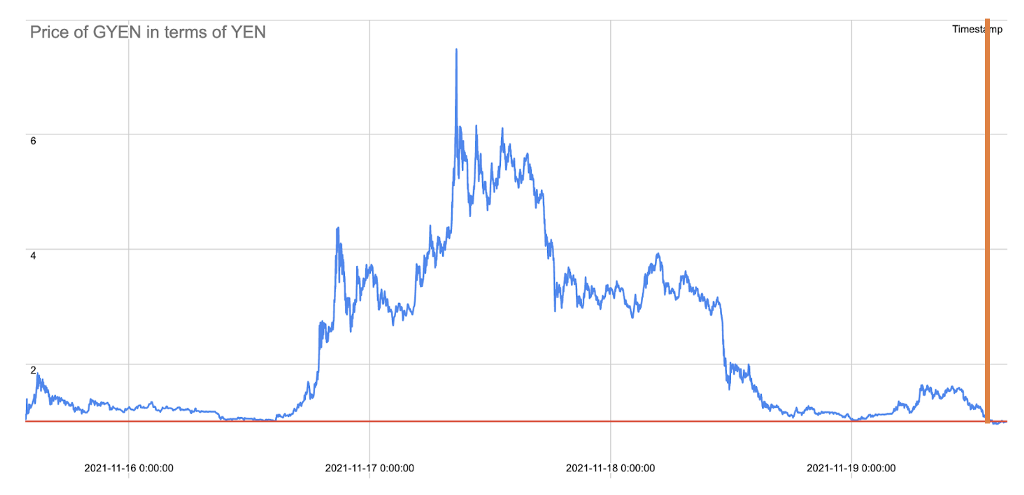
In the days leading up to the data rollout error, between November 16 and November 19, Coinbase Exchange observed GYEN-USD break parity when compared to JPY/USD. We have seen customers speculate on social media that this incident was somehow related to this break in parity. We have also seen customers speculate that this break in parity was somehow caused by Coinbase. These allegations are false and reflect a misunderstanding about what GYEN is and how Coinbase works.
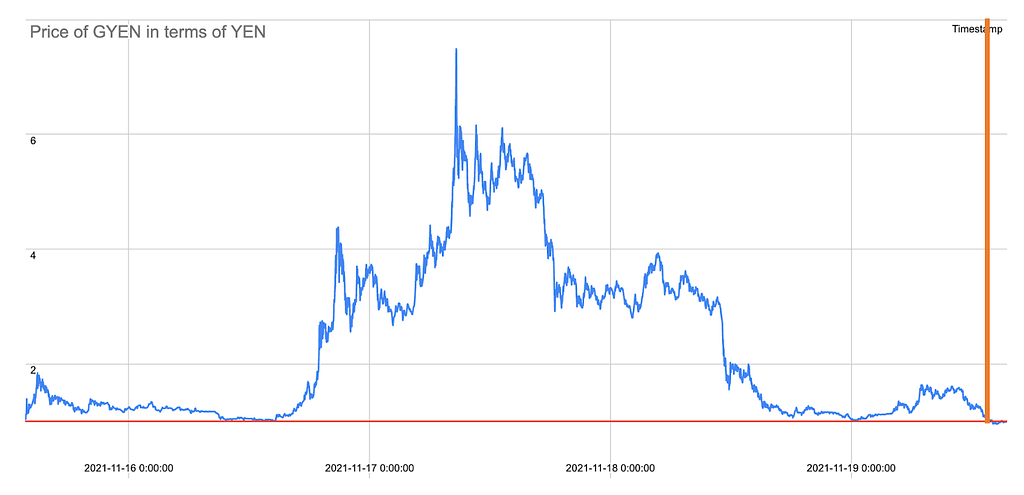
The Break in Parity Occurred Before and Was Not Related to the Incident. This break in parity occurred days before the incident. At the peak of this break in parity, on November 17, 1 GYEN traded for approximately ¥7.48.
The price of GYEN (blue) in Yen (red) during the break in parity, with a high of ¥7.48 (Red Line Indicating the time of the Data Rollout Error)
By the time the data rollout error occurred, on November 19, GYEN’s price stability had recovered and GYEN was trading at approximately ¥0.96–0.98. When Coinbase unrestricted impacted customers’ accounts, GYEN was trading at approximately ¥0.98. In other words, the break in parity occurred before the data rollout error and the two issues had nothing to do with each other.
How the Break in Parity Occurred. When Coinbase listed GYEN, there was significant demand for GYEN that could not be matched by supply. The surge in buyer demand for GYEN, coupled with the insufficient supply of GYEN across all markets (not just Coinbase), ultimately caused the break in parity. From November 17 through November 19, Coinbase implemented an alert, informing its customers who were buying, selling and trading GYEN of “Unusual Market Activity — Due to unusual market activity for GYEN, you may have trouble trading GYEN on Coinbase.com. We apologize for any inconvenience caused by this.” The break in parity occurred because of these market conditions specific to the GYEN digital asset unrelated to Coinbase operations.
Incident Post Mortem: November 19, 2021 was originally published in The Coinbase Blog on Medium, where people are continuing the conversation by highlighting and responding to this story.
Visa and ConsenSys, a blockchain software startup, are working to develop a central bank digital currency (CBDC) pilot program to explore retail applications such as cards and wallets.
Both firms will first meet with an estimated 30 central banks to discuss the goals that governments hope to achieve with government-backed digital currency. The pilot program is scheduled to begin in the spring of this year.
Visa To Pilot CBDC In Select Countries
Visa (V) announced on Thursday that it will take its crypto services to the next level by teaming with blockchain software company Consensys to create a central bank digital currency onramp (CBDC).
The payments giant plans to launch a “CBDC sandbox” in the spring, where central banks can try out the technology after minting it on Consensys’ Quorum network.
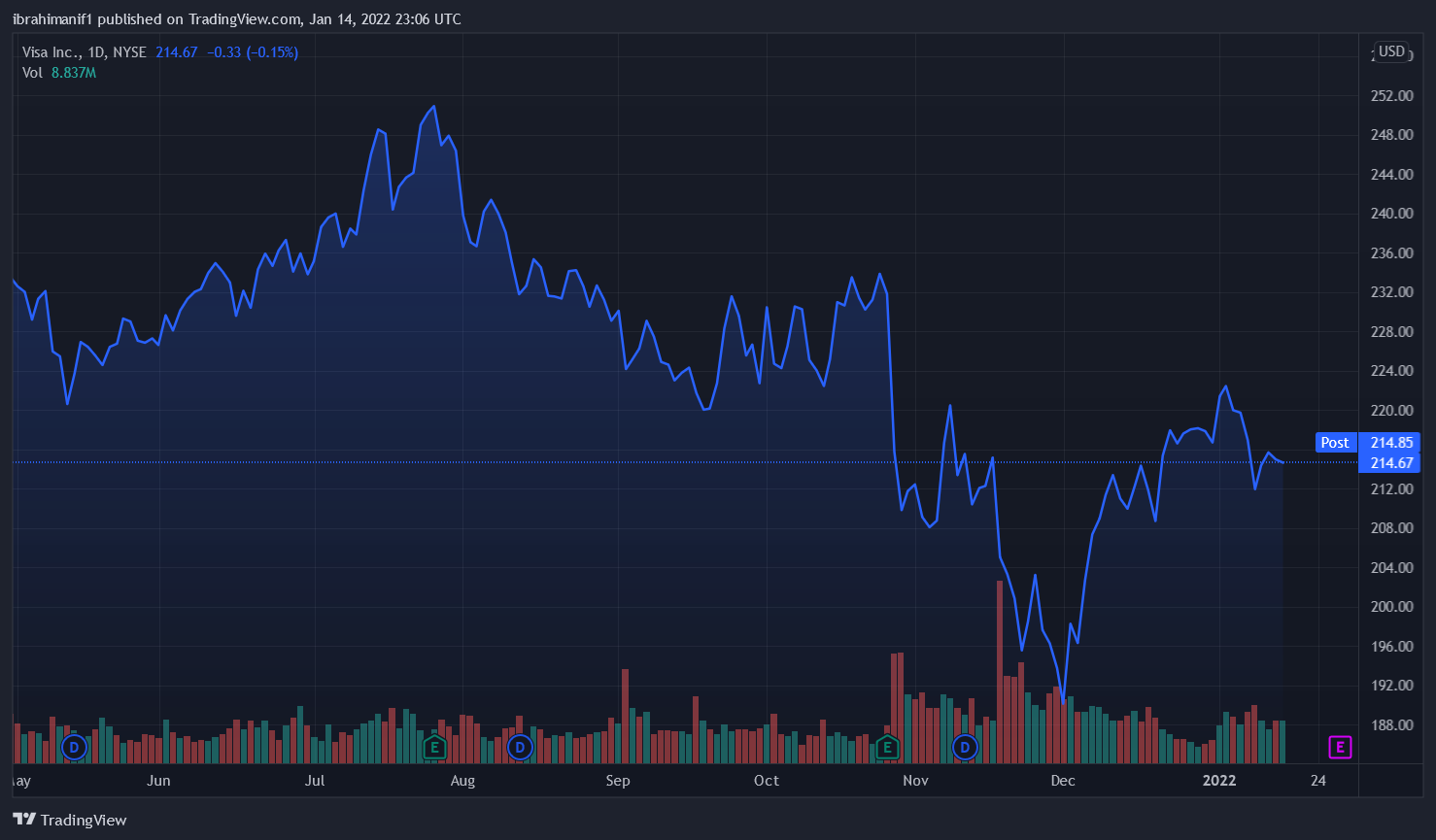
Visa Trades At $214. Source: TradingView
Customers will be able to use their CBDC-linked Visa card or digital wallet anyplace Visa is accepted globally, according to Catherine Gu, Visa’s head of CBDC, who spoke with ConsenSys in a blog post Q&A.
Gu Said:
“If successful, CBDC could expand access to financial services and make government disbursements more efficient, targeted and secure – that’s an attractive proposition for policy makers.”
A CBDC is a type of central bank obligation that is issued in digital form and can be used by the general public, comparable to the US dollar.
Related article | Visa Survey Shows Crypto Payments Could Boom In 2022
Countries Are Launching CBDCs
The decision comes as regulators around the world struggle to figure out how to treat CBDCs in a changing financial landscape dominated by cryptocurrencies. The notion that crypto and digital money will upend financial markets or replace fiat currency is a major issue.
Mastercard also announced the launch of a CBDC test platform in 2020, which allowed banks to simulate the issuance, distribution, and exchange of CBDCs amongst banks, financial service providers, and consumers.
“Central banks are moving from research to actually wanting to have a tangible product they can experiment with,” Chuy Sheffield, Visa’s head of crypto.
If Visa is successful, it might help bridge the gap between central banks and financial institutions. Visa is accepted by over 80 million merchant locations worldwide.
In the last year and a half, the number of countries investigating CBDCs has more than doubled. According to the Atlantic Council’s CBDC tracker, at least 87 different countries — accounting for 90% of global GDP — are considering financial technology in some way.
China has already started a number of digital yuan pilot initiatives and plans to accept the currency for the Beijing Winter Olympics. Nigeria and the Bahamas have their own CBDCs in circulation.
In early December, Visa announced the formation of a worldwide crypto advisory practice to assist financial institutions in developing their cryptocurrency operations as demand for crypto goods grows.
Related article | Visa Is Building A Payment Channel Network On Ethereum
Featured image from Pixabay, chart from TradingView.com
By Casper Sorensen, Vice President, Customer Experience
The following is the latest update in our series of blog posts describing our commitment to continuously improving our customer experience.
In past blog posts we highlighted our ongoing journey to create more value for customers with our support experience. In 2021, we invested in providing improved support experiences by increasing our staffing, accelerating our response times, as well as adding dozens of educational resources to our help pages so customers can get the most accurate information on our products and services.
In our pursuit to provide customers with the most trusted customer service experience in crypto we are excited to highlight new live support options for our customers.
In Q4 we began offering localized phone support for retail customers in the US, UK, Ireland, Germany, and Japan. Whether the question is simple or complex, our trained professionals are ready to help. These new phone support options expand on the Coinbase One support which launched in October 2021 and is available to customers in the United States 24/7 from a dedicated team, and the fastest answer times in crypto.
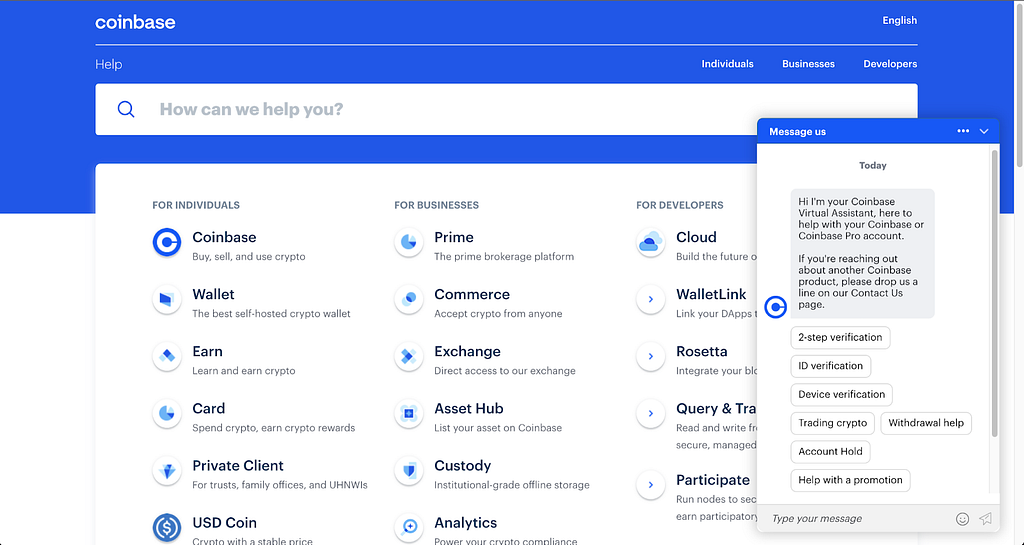
In December 2021, we began providing US retail customers with live messaging via our new Help Center platform. Live messaging offers customers the flexibility to connect with us when the time is right and continue the conversation seamlessly if they have to step away. Our team of customer service experts are available via messaging 24/7 with the speed our customers expect.
The journey continues in 2022, we will provide more localized phone and messaging options for our customers globally as well as bring further enhancements to our in-app support experience for iOS and Android.
We remain deeply focused on providing our customers with intuitive support technology and appreciate patience as we continue to grow. We look forward to continuous enhancements so please stay tuned to this blog for updates on the status of our journey.
Coinbase Expands Live Customer Support was originally published in The Coinbase Blog on Medium, where people are continuing the conversation by highlighting and responding to this story.
cryptocurrency exchange
Cryptocurrency Exchange
A cryptocurrency exchange is an online platform that supports the exchange of various currencies for a cryptocurrency or digital asset.Comparable to a generalized financial exchange, a crypto exchange’s core function is to permit and encourage the buying and selling of cryptos.This is accomplished by producing a stable trading environment suitable for traders nested through different locations around the world. Sometimes a crypto exchange may be referred to as a digital currency exchange (DCE) for short.How Does Trading Take Place on a Crypto Exchange?Cryptocurrency trading occurs over a centralized exchange, although these crypto exchanges should be used with caution given the implications that surround the custody of new assets. Similar to the banking industry, when a crypto exchange holds cryptocurrencies of users they accrue interest and are no longer classified as client money.These provide an accessible platform for not only companies, hedge funds, and retail traders for exchanging digital currencies.Additionally, crypto exchanges serve a critical role in producing stability within the cryptocurrency sector given how the sourcing and pricing of these assets are innately volatile. One could think of a crypto exchange as an intermediary who provides a service by connecting buyers and sellers from various markets under one roof. In exchange for facilitating trades and for services rendered, a digital currency exchange generally collects a fee of an outgoing transaction that averages between 0.20% to 0.25% or will request a deposit fee that has been known to be as high as 11% for credit card deposits. Crypto exchanges may also support the exchange of crypto tokens, such as the Binance Token, which is ranked as the 9th most valuable cryptocurrency in the world.
A cryptocurrency exchange is an online platform that supports the exchange of various currencies for a cryptocurrency or digital asset.Comparable to a generalized financial exchange, a crypto exchange’s core function is to permit and encourage the buying and selling of cryptos.This is accomplished by producing a stable trading environment suitable for traders nested through different locations around the world. Sometimes a crypto exchange may be referred to as a digital currency exchange (DCE) for short.How Does Trading Take Place on a Crypto Exchange?Cryptocurrency trading occurs over a centralized exchange, although these crypto exchanges should be used with caution given the implications that surround the custody of new assets. Similar to the banking industry, when a crypto exchange holds cryptocurrencies of users they accrue interest and are no longer classified as client money.These provide an accessible platform for not only companies, hedge funds, and retail traders for exchanging digital currencies.Additionally, crypto exchanges serve a critical role in producing stability within the cryptocurrency sector given how the sourcing and pricing of these assets are innately volatile. One could think of a crypto exchange as an intermediary who provides a service by connecting buyers and sellers from various markets under one roof. In exchange for facilitating trades and for services rendered, a digital currency exchange generally collects a fee of an outgoing transaction that averages between 0.20% to 0.25% or will request a deposit fee that has been known to be as high as 11% for credit card deposits. Crypto exchanges may also support the exchange of crypto tokens, such as the Binance Token, which is ranked as the 9th most valuable cryptocurrency in the world. Read this Term led by Sam Bankman-Fried, announced a launch of a new venture capital business unit called FTX Ventures. According to the Wall Street Journal media outlets, the exchange has pumped $2 billion fund into the new capital unit to focus on investing in crypto-industry startups. The allocation makes the FTX Ventures’ fund as one of the largest venture capitals in the crypto industry. FTX exchange disclosed that the $2 billion venture fund will be led by Amy Wu, a former General Partner at $10 billion venture capital firm Lightspeed.
As per FTX exchange, the FTX Ventures will majorly focus on
blockchain
Blockchain
Blockchain comprises a digital network of blocks with a comprehensive ledger of transactions made in a cryptocurrency such as Bitcoin or other altcoins.One of the signature features of blockchain is that it is maintained across more than one computer. The ledger can be public or private (permissioned.) In this sense, blockchain is immune to the manipulation of data making it not only open but verifiable. Because a blockchain is stored across a network of computers, it is very difficult to tamper with. The Evolution of BlockchainBlockchain was originally invented by an individual or group of people under the name of Satoshi Nakamoto in 2008. The purpose of blockchain was originally to serve as the public transaction ledger of Bitcoin, the world’s first cryptocurrency.In particular, bundles of transaction data, called “blocks”, are added to the ledger in a chronological fashion, forming a “chain.” These blocks include things like date, time, dollar amount, and (in some cases) the public addresses of the sender and the receiver.The computers responsible for upholding a blockchain network are called “nodes.” These nodes carry out the duties necessary to confirm the transactions and add them to the ledger. In exchange for their work, the nodes receive rewards in the form of crypto tokens.By storing data via a peer-to-peer network (P2P), blockchain controls for a wide range of risks that are traditionally inherent with data being held centrally.Of note, P2P blockchain networks lack centralized points of vulnerability. Consequently, hackers cannot exploit these networks via normalized means nor does the network possess a central failure point.In order to hack or alter a blockchain’s ledger, more than half of the nodes must be compromised. Looking ahead, blockchain technology is an area of extensive research across multiple industries, including financial services and payments, among others.
Blockchain comprises a digital network of blocks with a comprehensive ledger of transactions made in a cryptocurrency such as Bitcoin or other altcoins.One of the signature features of blockchain is that it is maintained across more than one computer. The ledger can be public or private (permissioned.) In this sense, blockchain is immune to the manipulation of data making it not only open but verifiable. Because a blockchain is stored across a network of computers, it is very difficult to tamper with. The Evolution of BlockchainBlockchain was originally invented by an individual or group of people under the name of Satoshi Nakamoto in 2008. The purpose of blockchain was originally to serve as the public transaction ledger of Bitcoin, the world’s first cryptocurrency.In particular, bundles of transaction data, called “blocks”, are added to the ledger in a chronological fashion, forming a “chain.” These blocks include things like date, time, dollar amount, and (in some cases) the public addresses of the sender and the receiver.The computers responsible for upholding a blockchain network are called “nodes.” These nodes carry out the duties necessary to confirm the transactions and add them to the ledger. In exchange for their work, the nodes receive rewards in the form of crypto tokens.By storing data via a peer-to-peer network (P2P), blockchain controls for a wide range of risks that are traditionally inherent with data being held centrally.Of note, P2P blockchain networks lack centralized points of vulnerability. Consequently, hackers cannot exploit these networks via normalized means nor does the network possess a central failure point.In order to hack or alter a blockchain’s ledger, more than half of the nodes must be compromised. Looking ahead, blockchain technology is an area of extensive research across multiple industries, including financial services and payments, among others. Read this Term and cryptocurrency investments. Wu talked about the development and stated that the fund will make strategic concentrated bets into companies in the crypto market, from Latin America, Africa, and beyond. She said that FTX Ventures is especially excited about consumer and social web3 as well as Web3 gaming applications. She further mentioned that the venture firm also targets layer-1 and layer-2 blockchain platforms, blockchain infrastructure, cross-chain protocols, crypto-fueled and NFT-powered video games, and wallet payment applications.
“It’s not necessarily tied to the strategy of FTX. The objective is more to accelerate the adoption of blockchain technology. We want to be known for the value add that we bring, leveraging the resources, the expertise and the global network of FTX,” Wu elaborated.
Why Crypto Startups Are Attracting Venture Capital Money
The development by FTX cryptocurrency exchange to have launched its FTX Ventures’ fund comes at a time when the crypto and blockchain space sees a lot of interest from venture capital companies. Such interests translated into a significant amount of investments made in the space during the year 2021. Startups in the crypto and blockchain sector have become winners in the category of record-breaking fundraising. Venture capitalists bet big in cryptocurrency in the previous year, investing more cash than ever into emerging companies in the sector. Startups in the blockchain and crypto space were powered by a record $33 billion in ventral capital funding last year. That can be compared with the year 2020, which saw venture funding of about $3.1 billion.
In 2021, about 43% of crypto funding went into firms involved in lending, investing, exchange services, and trading of cryptocurrencies. Meanwhile, 17% was channeled towards startups in Metaverse (a network of 3D virtual worlds), Web3 (a decentralized online ecosystem based on the blockchain), DAOs (decentralized autonomous organizations), and FTs (non-fungible tokens). Other categories that also attracted significant venture capital interest include decentralized finance, infrastructure, and custody.
Crypto startups have become so profitable that they have begun attracting growth-stage capital. In the previous year, major crypto funds such as Hivemind, a16z, and Paradigm managed to raise billions of dollars to bet in crypto and blockchain startups.
On January 14, FTX, a popular Bahamian-based
cryptocurrency exchange
Cryptocurrency Exchange
A cryptocurrency exchange is an online platform that supports the exchange of various currencies for a cryptocurrency or digital asset.Comparable to a generalized financial exchange, a crypto exchange’s core function is to permit and encourage the buying and selling of cryptos.This is accomplished by producing a stable trading environment suitable for traders nested through different locations around the world. Sometimes a crypto exchange may be referred to as a digital currency exchange (DCE) for short.How Does Trading Take Place on a Crypto Exchange?Cryptocurrency trading occurs over a centralized exchange, although these crypto exchanges should be used with caution given the implications that surround the custody of new assets. Similar to the banking industry, when a crypto exchange holds cryptocurrencies of users they accrue interest and are no longer classified as client money.These provide an accessible platform for not only companies, hedge funds, and retail traders for exchanging digital currencies.Additionally, crypto exchanges serve a critical role in producing stability within the cryptocurrency sector given how the sourcing and pricing of these assets are innately volatile. One could think of a crypto exchange as an intermediary who provides a service by connecting buyers and sellers from various markets under one roof. In exchange for facilitating trades and for services rendered, a digital currency exchange generally collects a fee of an outgoing transaction that averages between 0.20% to 0.25% or will request a deposit fee that has been known to be as high as 11% for credit card deposits. Crypto exchanges may also support the exchange of crypto tokens, such as the Binance Token, which is ranked as the 9th most valuable cryptocurrency in the world.
A cryptocurrency exchange is an online platform that supports the exchange of various currencies for a cryptocurrency or digital asset.Comparable to a generalized financial exchange, a crypto exchange’s core function is to permit and encourage the buying and selling of cryptos.This is accomplished by producing a stable trading environment suitable for traders nested through different locations around the world. Sometimes a crypto exchange may be referred to as a digital currency exchange (DCE) for short.How Does Trading Take Place on a Crypto Exchange?Cryptocurrency trading occurs over a centralized exchange, although these crypto exchanges should be used with caution given the implications that surround the custody of new assets. Similar to the banking industry, when a crypto exchange holds cryptocurrencies of users they accrue interest and are no longer classified as client money.These provide an accessible platform for not only companies, hedge funds, and retail traders for exchanging digital currencies.Additionally, crypto exchanges serve a critical role in producing stability within the cryptocurrency sector given how the sourcing and pricing of these assets are innately volatile. One could think of a crypto exchange as an intermediary who provides a service by connecting buyers and sellers from various markets under one roof. In exchange for facilitating trades and for services rendered, a digital currency exchange generally collects a fee of an outgoing transaction that averages between 0.20% to 0.25% or will request a deposit fee that has been known to be as high as 11% for credit card deposits. Crypto exchanges may also support the exchange of crypto tokens, such as the Binance Token, which is ranked as the 9th most valuable cryptocurrency in the world. Read this Term led by Sam Bankman-Fried, announced a launch of a new venture capital business unit called FTX Ventures. According to the Wall Street Journal media outlets, the exchange has pumped $2 billion fund into the new capital unit to focus on investing in crypto-industry startups. The allocation makes the FTX Ventures’ fund as one of the largest venture capitals in the crypto industry. FTX exchange disclosed that the $2 billion venture fund will be led by Amy Wu, a former General Partner at $10 billion venture capital firm Lightspeed.
As per FTX exchange, the FTX Ventures will majorly focus on
blockchain
Blockchain
Blockchain comprises a digital network of blocks with a comprehensive ledger of transactions made in a cryptocurrency such as Bitcoin or other altcoins.One of the signature features of blockchain is that it is maintained across more than one computer. The ledger can be public or private (permissioned.) In this sense, blockchain is immune to the manipulation of data making it not only open but verifiable. Because a blockchain is stored across a network of computers, it is very difficult to tamper with. The Evolution of BlockchainBlockchain was originally invented by an individual or group of people under the name of Satoshi Nakamoto in 2008. The purpose of blockchain was originally to serve as the public transaction ledger of Bitcoin, the world’s first cryptocurrency.In particular, bundles of transaction data, called “blocks”, are added to the ledger in a chronological fashion, forming a “chain.” These blocks include things like date, time, dollar amount, and (in some cases) the public addresses of the sender and the receiver.The computers responsible for upholding a blockchain network are called “nodes.” These nodes carry out the duties necessary to confirm the transactions and add them to the ledger. In exchange for their work, the nodes receive rewards in the form of crypto tokens.By storing data via a peer-to-peer network (P2P), blockchain controls for a wide range of risks that are traditionally inherent with data being held centrally.Of note, P2P blockchain networks lack centralized points of vulnerability. Consequently, hackers cannot exploit these networks via normalized means nor does the network possess a central failure point.In order to hack or alter a blockchain’s ledger, more than half of the nodes must be compromised. Looking ahead, blockchain technology is an area of extensive research across multiple industries, including financial services and payments, among others.
Blockchain comprises a digital network of blocks with a comprehensive ledger of transactions made in a cryptocurrency such as Bitcoin or other altcoins.One of the signature features of blockchain is that it is maintained across more than one computer. The ledger can be public or private (permissioned.) In this sense, blockchain is immune to the manipulation of data making it not only open but verifiable. Because a blockchain is stored across a network of computers, it is very difficult to tamper with. The Evolution of BlockchainBlockchain was originally invented by an individual or group of people under the name of Satoshi Nakamoto in 2008. The purpose of blockchain was originally to serve as the public transaction ledger of Bitcoin, the world’s first cryptocurrency.In particular, bundles of transaction data, called “blocks”, are added to the ledger in a chronological fashion, forming a “chain.” These blocks include things like date, time, dollar amount, and (in some cases) the public addresses of the sender and the receiver.The computers responsible for upholding a blockchain network are called “nodes.” These nodes carry out the duties necessary to confirm the transactions and add them to the ledger. In exchange for their work, the nodes receive rewards in the form of crypto tokens.By storing data via a peer-to-peer network (P2P), blockchain controls for a wide range of risks that are traditionally inherent with data being held centrally.Of note, P2P blockchain networks lack centralized points of vulnerability. Consequently, hackers cannot exploit these networks via normalized means nor does the network possess a central failure point.In order to hack or alter a blockchain’s ledger, more than half of the nodes must be compromised. Looking ahead, blockchain technology is an area of extensive research across multiple industries, including financial services and payments, among others. Read this Term and cryptocurrency investments. Wu talked about the development and stated that the fund will make strategic concentrated bets into companies in the crypto market, from Latin America, Africa, and beyond. She said that FTX Ventures is especially excited about consumer and social web3 as well as Web3 gaming applications. She further mentioned that the venture firm also targets layer-1 and layer-2 blockchain platforms, blockchain infrastructure, cross-chain protocols, crypto-fueled and NFT-powered video games, and wallet payment applications.
“It’s not necessarily tied to the strategy of FTX. The objective is more to accelerate the adoption of blockchain technology. We want to be known for the value add that we bring, leveraging the resources, the expertise and the global network of FTX,” Wu elaborated.
Why Crypto Startups Are Attracting Venture Capital Money
The development by FTX cryptocurrency exchange to have launched its FTX Ventures’ fund comes at a time when the crypto and blockchain space sees a lot of interest from venture capital companies. Such interests translated into a significant amount of investments made in the space during the year 2021. Startups in the crypto and blockchain sector have become winners in the category of record-breaking fundraising. Venture capitalists bet big in cryptocurrency in the previous year, investing more cash than ever into emerging companies in the sector. Startups in the blockchain and crypto space were powered by a record $33 billion in ventral capital funding last year. That can be compared with the year 2020, which saw venture funding of about $3.1 billion.
In 2021, about 43% of crypto funding went into firms involved in lending, investing, exchange services, and trading of cryptocurrencies. Meanwhile, 17% was channeled towards startups in Metaverse (a network of 3D virtual worlds), Web3 (a decentralized online ecosystem based on the blockchain), DAOs (decentralized autonomous organizations), and FTs (non-fungible tokens). Other categories that also attracted significant venture capital interest include decentralized finance, infrastructure, and custody.
Crypto startups have become so profitable that they have begun attracting growth-stage capital. In the previous year, major crypto funds such as Hivemind, a16z, and Paradigm managed to raise billions of dollars to bet in crypto and blockchain startups.
Coinbase Voices is a collection of employee stories that highlight the expertise of our Coinbase team and share their journeys to crypto. In this post, Carolina Verdelho, Senior Recruiting Manager, discusses her experience as an international recruiter and how she’s using it to help shape the future of Coinbase.
Tell us about your journey to becoming a Sr. Recruiting Manager. What does your job entail?
I’ve been in Recruiting for more than 15 years now, and have always worked with tech companies. I started my career in Brazil, working in traditional tech like Dell and Oracle, hiring people across all of Latin America in technical, sales and business positions.
My first language is Portuguese, but because I had exposure to other countries from the start, I also learned to speak Spanish and English. I didn’t expect to get into Recruiting at first — in fact, it was my last choice of careers. Now, don’t even think about taking me away from it! It’s what I love.
What made you want to work at Coinbase?
I had worked for almost nine years at Facebook when I decided I needed something new. One day, I was talking with a friend and shared that I wanted to do something different, but didn’t know what that was. He pointed out that when I joined Dell, the company was going to Retail, and when I joined Oracle, it was launching software as a service. When I joined Facebook, no one knew what social media would turn out to be. I joined at a pivotal time in those companies’ journeys. He said, “I think you should do that again.” He works for a blockchain company and suggested that I try the crypto environment. I wasn’t sure, but I started doing some homework and changed my status to Open on LinkedIn. To my surprise, someone from Coinbase reached out to me, along with five other crypto companies. I thought, maybe my friend is right — maybe it is for me. From there, I started talking to people at Coinbase and learning more about what the company had to offer.
Candidates often ask me during interviews: Why did you decide to leave Facebook and join Coinbase? I find myself giving the same answer that I gave when I joined Facebook nine years ago. At that time, it was a company of 4,000 global employees. I remember the VP of Engineering asked me why I wanted to join, and what I thought the company would be in five years. I told her, “I don’t know what this company is going to be in the next five years — and that’s exactly why I want to join. I want to help build it.” It’s the same for Coinbase — I don’t know where we’ll be in five years, but I want to help us get there.
What project are you working on over the next 60 days?
My role has changed quite a bit since I joined Coinbase in May of this year. I wear three different hats: I manage a Recruiting team hiring engineering managers in the United States; I’m helping to stand up recruiting efforts in Latin America, including Brazil and others; and, I’m doing the same for EMEA, in the UK, Ireland, Israel and more.
Internationally, we are starting everything from scratch — hiring recruiters, finding agencies who will help us, and establishing a system for how to hire in each country. We’re in hyper-growth mode, and it’s an exciting time to be here — especially on the Recruiting team.
What’s it like working for a remote-first company? What advice would you give to someone considering it?
I was at Facebook when the pandemic hit and everyone went remote, and was later offered the opportunity to work from home full-time. When I was looking to join another company, that was one of the mandatory requirements for me.
Remote work allows me to balance managing a family — a husband, kids and a dog — while also working and being as available as I can be. It doesn’t make sense for me to commute 30–40 minutes in the car when I could be doing something productive, like supporting my team or finding a solution to a problem. Working remotely is the best use of my time.
I also love that we have a lot of tools that help us interact with each other. We use Slack and Google Meet to connect, so I don’t miss out on meeting people. I think I know people better now in this virtual environment than I did face-to-face. I get to know more about them and really talk to them instead of just seeing each other in passing.
The one piece of advice I would give to people is to set boundaries. I make sure I have a dedicated workspace where I can be 100% focused on what I’m doing. When I’m there, my brain recognizes that I’m working. Then, when I’m done and it’s time to be with my family, I can close the door and detach from work.
Finally, just because I can be at the computer at any time doesn’t mean I’m available at any time. If you don’t set boundaries upfront, things will be difficult. Use your ‘me’ time to be with your family, take care of yourself, exercise, read a book, go for a walk — get fresh air. It’s important to set aside time in your day to recharge, then hit the ground running when it’s time to work.
What’s it like onboarding remotely?
I really had a hard time the first two days at Coinbase — it was difficult for me to understand what was going on. I told my husband, “What have I done?” He reminded me that I was at a company for nine years and things would be different now. In the days following, people were very open to supporting me, explaining things, and helping me understand why we do things the way we do here.
I think onboarding remotely is a bit of a challenge because you’re essentially opening a different computer in the same place you were working the day before, for a different company. After a few days, I started to catch on — I think giving time to acclimate to the culture and providing access to resources makes a huge difference. I had an amazing buddy who helped me onboard and was always available and checking on me. That was a total game-changer.
What do you value most about Coinbase’s culture? What do you think sets it apart?
I took a leadership course a few years back, where the teacher said that we should hire people not only by their skills or experience, but by their values, and that the values of the person should match the values of the company. Before I interviewed with Coinbase, I read the values and asked myself if I could work and operate following them. The answer is a huge yes.
There’s a cultural value here that’s very important to me: Act Like an Owner. It might be because I’m driving a lot of things for international expansion, but I strongly believe that I shouldn’t expect or wait around for others to take care of something for me. I should own it and ensure its successful completion.
I think what sets Coinbase apart for me is the winning combination of a solid business foundation, a very strong leadership team, and the excitement of hyper-growth. You don’t find this often. Being able to join this company and put your fingerprint on this growth and say, “Hey, I was the one who did this, who moved this needle or helped jumpstart that initiative,” that’s such a rare and exciting opportunity. Coinbase also gives people the responsibility and accountability to push the company forward — everyone feels like they’re a part of something bigger than themselves, and that’s something that I love.
Tell us something about you that we wouldn’t know from your LinkedIn profile.
Something not many people know is that my first job was working at the video rental store, Blockbuster. I was watching a documentary about the company a few weeks ago and thinking back on all that I learned in that experience: How to listen to people, how to approach people that I don’t know, how to offer my help and manage expectations. I learned a lot from that experience, and I’m very thankful.
I can also say that I learned a lot from my recruiting experience there. I walked away thinking, how can I do better for people? How can I be respectful of their time and feelings? Maybe being a part of that process helped shape the Recruiting professional I am today.
One of the fastest-growing crypto exchanges in Australia, BTC Markets recently announced a partnership with Ajla Tomljanovic, a prominent tennis player in the country. According to the latest female tennis player rankings, Ajla currently stands at 45th position worldwide. In Australia, Ajla holds the second position.
BTC Markets is the only female-led digital exchange in Australia. Due to the rising interest of retail and institutional Australian clients in digital currencies, BTC Markets experienced a strong surge in demand for its crypto trading products during 2021.
“We’re excited to announce our sponsorship of rising tennis star and 2021 Wimbledon Quarter-Finalist, Ajla Tomljanović. Crypto moves fast on our exchange, just like Ajla on the court, & she encapsulates the promise and potential of Australia,” BTC Markets highlighted in a recent announcement.
In addition, the tennis star expressed her happiness on the latest collaboration and mentioned that the clients of BTC Markets will have an opportunity to meet her in person. “I’m really excited to be partnering with BTC Markets, Australia’s largest crypto exchange. To celebrate, we’re giving away some prizes including the chance to meet me in person,” Ajla said.
Crypto in Australia
Crypto adoption in Australia is on the rise. In November last year, Perth Heat, one of the most successful baseball teams in Australia, announced that the club has decided to pay its players in Bitcoin. Furthermore, Perth Heat is holding BTC on its balance sheet. The Commonwealth Bank of Australia is planning to expand its presence in the global crypto market.
“We are so proud to support the next wave of Australian talent with Ajla,” said the Chief Executive of BTC Markets, Caroline Bowler. “Cryptocurrency on BTC Markets is fast-moving, just like Ajla on the tennis court. We know our clients will be proud to cheer her on this summer.”
One of the fastest-growing crypto exchanges in Australia, BTC Markets recently announced a partnership with Ajla Tomljanovic, a prominent tennis player in the country. According to the latest female tennis player rankings, Ajla currently stands at 45th position worldwide. In Australia, Ajla holds the second position.
BTC Markets is the only female-led digital exchange in Australia. Due to the rising interest of retail and institutional Australian clients in digital currencies, BTC Markets experienced a strong surge in demand for its crypto trading products during 2021.
“We’re excited to announce our sponsorship of rising tennis star and 2021 Wimbledon Quarter-Finalist, Ajla Tomljanović. Crypto moves fast on our exchange, just like Ajla on the court, & she encapsulates the promise and potential of Australia,” BTC Markets highlighted in a recent announcement.
In addition, the tennis star expressed her happiness on the latest collaboration and mentioned that the clients of BTC Markets will have an opportunity to meet her in person. “I’m really excited to be partnering with BTC Markets, Australia’s largest crypto exchange. To celebrate, we’re giving away some prizes including the chance to meet me in person,” Ajla said.
Crypto in Australia
Crypto adoption in Australia is on the rise. In November last year, Perth Heat, one of the most successful baseball teams in Australia, announced that the club has decided to pay its players in Bitcoin. Furthermore, Perth Heat is holding BTC on its balance sheet. The Commonwealth Bank of Australia is planning to expand its presence in the global crypto market.
“We are so proud to support the next wave of Australian talent with Ajla,” said the Chief Executive of BTC Markets, Caroline Bowler. “Cryptocurrency on BTC Markets is fast-moving, just like Ajla on the tennis court. We know our clients will be proud to cheer her on this summer.”
Fees.wtf is a simple service that shows Ether (ETH) users their lifetime spend on Ethereum blockchain transactions by measuring gas. You plug in your wallet address on their website and they tell me how much gas you spent.
The project released their token, WTF, in an airdrop Friday at midnight. Essentially, users would be able to claim WTF tokens as well as a “Rekt” NFT for 0.01 ETH. The Rekt NFT grants lifetime access to the pro version of fees.wtf.
According to their Discord announcement, the initial launch would offer 100 million of WTF and the “circulating supply will be the main attraction in the tokenomics.” However, it didn’t quite go to plan.
Following a series of frantic trading behavior between bots in the opening hours of the airdrop, one bot ran off with a reported 58 ETH, or $180,000. On Etherscan, 58 ETH was drained from the wrapped ETH (WETH) to the WTF liquidity pool.
Social media channels were quick to respond because many airdrop participants lamented losing thousands of dollars in ETH. The WTF team chimed in two hours after the airdrop to calm their ranks:
“Immediately on launch there was only a tiny bit of liquidity and there were ape bots that were chucking in 100s of ETH into a pool with an ETH or two of liquidity. They also had high slippage and ended up being sandwiched by the other bots which essentially drained all their ETH.”
Basically, within five minutes of the token launch, poor liquidity pool management from the WTF devs left the liquidity pool exposed. As there was low liquidity, bots were able to manipulate the price of WTF to then sell for WETH.
The bots would battle it out till one winner would take home the pot. In effect, the bot stole from users who provided liquidity to the pool, trying to claim their WTF tokens and Rekt NFT. The victor managed to send an “ultra-fast transaction at 3,000 Gwei”, making a 6x return on their initial investment.
The WTF team sent out another Discord update two hours after the airdrop, stating that “The core contracts are all fine, this was a war on Uniswap.” The team added, “We hope no one was affected by it.” However, as has become a common occurrence in airdrops of late, lots of users lost a lot of money.
The price graph of the token since launch paints a thousand words. The initial spike shows the bot activity, swiftly followed by a 10x loss in value.
The official WTF Discord group is brimming with users sharing stories of losing money. Some are “shaking” with rage while death threats and lawsuit claims are rife.
One Etherscan transaction points to one user losing 42 ETH, or $135,000, for 0.000044170848308398 WTF, effectively $0.01.
As daylight dawns on the project, some Twitter users have called out the project as a Ponzi scheme. The referral element to the project is spurious. Referrers of the WTF project claim a 50% on fees “to make wtf go viral,” while the WTF team earns 4% from each transfer. In total, the WTF team claimed almost half a million in token transfer fees in a little over 8 hours.
Twitter user Lefteris Karapetsas didn’t mince his words:
Summing up.
WTF “team” made an app any dev can do in 1 hour Slapped a token + ponzinomics on it Anons aped without thinking and lost ETH in gas and claim fees Team has so far made 116 ETH + 6,168,806 WTF. Roughly around $855,665 and this is getting bigger by the second
— Lefteris Karapetsas | Hiring for @rotkiapp (@LefterisJP) January 14, 2022
The WTF project states merely that the supply of tokens is “deflationary”, and that 40 million WTF tokens will go to their treasury. There is not a great deal of detail regarding the token distribution. Meows.ETH concluded their Twitter thread with a zen approach to the controversial project launch:
“If you were fortunate enough to claim a big amount of $WTF and cash it out for a profit, be happy. Unless you’re attempting to bot the initial liquidity, don’t FOMO into buying a newly launched altcoin with high slippage.”
Allbridge, a cross-chain bridge that lets users transfer assets between different blockchain networks, today announced $2 million in funding led by Race Capital. Allbridge offers a simple way to bridge tokenized assets between Ethereum Virtual Machine (EVM) and non-EVM compatible blockchains.
In the seven months since launch, Allbridge has bridged over $4.8B in assets, making it the largest cross-chain asset bridge supporting Solana, Fantom, Avalanche, Celo, Polygon, Ethereum, BSC, Terra, and more.
Founded by Andriy Velykyy and Yuriy Savchenko, who have worked together since 2016 on many different crypto payments integrations and non-custodial multi-chain crypto wallets, Allbridge aims to connect all kinds of layer-1 and layer-2 networks to bring more interoperability to DeFi.
Not only does Allbridge enable users to interact with and transfer assets between EVM-based blockchains like Ethereum, Polygon, and BSC, it also bridges non-EVM compatible blockchains like Solana and Terra.
“We want to be the go-to platform that bridges every popular blockchain and digital asset on the market, enabling billions of token transfers on a daily basis. We’re also working on APIs that will enable developers to build dApps on top of Allbridge. Cross-chain swaps built on Allbridge are the easiest way to exchange any asset between any networks, enabling new functionality like cross-chain lending where users can leverage collateral on one chain in order to receive an asset on another chain.” – Andriy Velykyy, Co-Founder of Allbridge
Allbridge enables users to select the network they want to provide the liquidity to with just a couple of clicks–whenever and wherever they want.