Ethereum (ETH) is trading at USD2,932.45, with a trading volume of USD9,666,018,686 in the last 24 hours. Ethereum price posted a gain of 1.23%, a 24-hour low of $2,870.18, and a high of $2,980.08.
It is currently at the No. 2 spot on the Coin Market Cap chart, with a current market cap of USD350,616,744,281. Tokens in circulation now total 119,564,241 ETH.
Three months ago, ETH – the second-biggest cryptocurrency – was trading at $4,809; on Jan. 11, 2022, it dropped to $3,251, and on Feb. 4, it was at $3,026.
Other currencies, including Tether, BNB, USD Coin, XRP, Cardano, Solana, and Terra, are also seeing significant drops, hurting the market.
These recent significant dips in Ethereum and Bitcoin are also driven by sustained increasing inflation, a dismal December employment report, and persistent hints by the Federal Reserve that the central bank may begin slowing down steps to prop up the economy as it improves.
Ethereum Price Forecast
Based on current data, Ethereum’s price will average $2,822.07 and reach a high of USD3,174.82.
After reaching a high of $4,100 on Dec. 27, Ethereum has fluctuated between $2,100 and $4,000 in the days afterward.
Despite the poor start to 2022, many analysts remain optimistic, forecasting that Ethereum would reach and exceed $12,000 this year.
ETH/USD at $2886.5 in the daily chart | Source: TradingView.com
Related Reading | Ethereum Faces Rejection, Why ETH Could Nosedive Below $3K
Meanwhile, after a robust November, Bitcoin has also paused over the previous month. Bitcoin achieved a new all-time high when it crossed $68,000.
There is little doubt that Bitcoin and Ethereum will continue to fluctuate in the future, and experts advise investors to remain cautious.
Experts say to overlook the ups and downs while making a long-term investment. That doesn’t imply that the recent slide in price has extinguished Ethereum’s volatility.
Crypto Expert Advises On ETH
The real issue is whether or not these currencies will continue to increase after they are owned, Jeremy Schneider, the Personal Finance Club’s investment guru, said.
“No more than 5% of your whole portfolio should be held as Ethereum due to the lack of assurance that its value will rise,” Schneider said.
The investment expert added that people should not invest at the risk of not accomplishing their other financial objectives, such as paying off high-interest debt or preparing for future retirement.
Like Bitcoin, Ethereum has its blockchain, maintained by a global network of over 2.4 million computers known as “nodes.” Anyone with the required hardware, skills, and time may run an Ethereum node and contribute to network validation.
Miners are in charge of finding new blocks on the Ethereum network. These are analogous to digital boxes that store transaction and other data.
Miners compete by utilizing specialized computer equipment to be the next person to add a block to the chain and collect transaction fees (from the transactions they add to the block) as well as “block rewards.”
Related Reading | Ethereum Prints Bearish Technical Pattern, Why It Could Revisit $2.5K
Featured image from CoinSpeaker, chart from TradingView.com
Bitcoin (BTC) has given back some of its recent gains, but on-chain data resource Ecoinometrics said that whales are accumulating because they believe the price is attractive from a long-term perspective.
On the downside, analyst Willy Woo believes that $33,000 is a strong bottom for Bitcoin. Popular Twitter trader Credible Crypto citing data from PlanC said that the odds of Bitcoin declining below $30,000 are poor.
Crypto market data daily view. Source:Coin360
Fidelity Digital Assets Head of Research Chris Kuiper believes that Bitcoin’s downside risk could be minimal when compared to other digital assets, but it could rally substantially if it manages to replace gold as a store of value.
Could Bitcoin and altcoins stage a recovery after the recent pullback? Let’s study the charts of the top-5 cryptocurrencies that may attract investor attention in the short term.
BTC/USDT
Bitcoin turned down from the overhead resistance at $45,456 but a minor positive is that the bulls have not allowed the price to break below the 20-day exponential moving average ($41,383).
BTC/USDT daily chart. Source: TradingView
If the price rebounds off the current level, the bulls will try to propel the BTC/USDT pair above $45,456. A close above this level will complete a bullish inverse head and shoulders pattern.
The pair could then rally to $52,088 where the bears are likely to mount a strong challenge. If bulls thrust the price above this level, the pair could start its northward march toward the pattern target at $56,904.
This positive view will be negated if the price breaks and sustains below $39,600. Such a move could open the doors for a possible drop to $36,250.
BTC/USDT 4-hour chart. Source: TradingView
The pair turned down from $45,456 and broke below the moving averages. The bulls are currently attempting to defend the minor support at $41,688.88 but are facing stiff resistance at the moving averages.
If the price turns down from the current level and breaks below $41,688.88, the pair could slide to $39,600. If the price rebounds off this level, then the pair could remain range-bound between $39,600 and $45,456 for a few days.
On the upside, a break and close above the moving averages will be the first indication that bulls have a slight edge. The pair could then rise to $43,920 and later to $45,456.
XRP/USDT
Ripple (XRP) broke and closed above the moving averages on Feb. 7, indicating that the downtrend could be coming to an end. The bears tried to pull the price back below the breakout level at $0.75 but the bulls thwarted their attempt.
XRP/USDT daily chart. Source: TradingView
The price rebounded off $0.75 and the bulls are trying to push the XRP/USDT pair toward the overhead resistance at $1. A break and close above this resistance could open the doors for a possible rally to $1.41.
The moving averages are on the verge of a bullish crossover and the relative strength index (RSI) is in the positive zone, indicating that buyers have the upper hand. This positive view will invalidate on a break and close below $0.75. Such a move will indicate that bears continue to sell on rallies.
XRP/USDT 4-hour chart. Source: TradingView
The 4-hour chart shows that the bulls and the bears are battling it out near the $0.82 mark. The bulls pushed the price above this level but the bears stalled the rally at $0.85 and have pulled the pair back below $0.82.
A minor positive is that bulls are buying the dips to the 50-SMA. If the price rebounds off this support, the bulls will try to drive the pair above $0.85 and challenge the resistance at $0.91. Conversely, a break and close below the 50-SMA could pull the pair to $0.75. A break and close below this support could indicate the start of a deeper correction.
CRO/USDT
Crypto.com’s native coin (CRO) broke above the 50-day SMA ($0.47) on Feb. 7, suggesting that the corrective phase could be over. The price rallied to $0.54 on Feb. 10 where the bears are mounting a strong defense.
CRO/USDT daily chart. Source: TradingView
The moving averages are on the verge of a bullish crossover and the RSI is in the positive territory, indicating that the buyers have a slight edge. If the current rebound off the moving averages sustains, it will suggest that bulls are buying on dips. The bulls will then attempt to push the price above $0.54 and resume the uptrend.
If they can pull it off, the CRO/USDT pair could rise to $0.60 and then to $0.68. Contrary to this assumption, if the price turns down and breaks below the 20-day EMA, the pair could drop to $0.39.
CRO/USDT 4-hour chart. Source: TradingView
The 4-hour chart shows the pair is rising inside an ascending channel pattern. The bulls tried to push the price above the channel but the bears had other plans. They pulled the price back into the channel, trapping the aggressive bulls.
The buyers are attempting to defend the 50-SMA. If the price sustains above the 20-EMA, the bulls will again try to push the pair above the resistance line of the channel. This positive view will invalidate if the price turns down and plummets below the support line of the channel.
Related: Can XRP price reach $1 after 25% gains in one week? Watch this key support level
FTT/USDT
FTX Token (FTT) has been volatile inside a broadening formation. The failure of the buyers to propel the price above the resistance line indicates that bears are selling the rallies to this level.
FTT/USDT daily chart. Source: TradingView
However, a minor positive is that bulls are buying the dips in the zone between the 20-day EMA ($43.85) and the 50-day SMA ($41.50). If the price rebounds off the current level, the buyers will make one more attempt to clear the overhead hurdle.
If they manage to do that, the FTT/USDT pair could start a new uptrend. The pair could then rally to $53.50 where the bears may again pose a strong challenge but if this resistance is crossed, the rally could extend to $65.
This bullish view will invalidate if the price turns down and plummets below the 50-day SMA. That will indicate that the pair could extend its stay inside the broadening pattern for a few more days.
FTT/USDT 4-hour chart. Source: TradingView
The failure of the bulls to push the price above the $48 to $50 overhead resistance zone may have attracted profit-booking from short-term traders. The pair has broken below both moving averages and could drop to the 38.2% Fibonacci retracement levels at $41.99.
If the price rises from the current level or $41.99, it will suggest that buyers are accumulating on dips. The bulls will then again try to push the price above the 50-SMA. If they succeed, the pair could challenge the overhead resistance.
On the downside, a break and close below $41.99 could signal the start of a deeper correction to the 50% retracement level at $39.95.
THETA/USDT
Theta Network (THETA) broke and closed above the downtrend line on Feb.10, indicating that the downtrend could be coming to an end. Generally, a rally above a stiff resistance tends to turn back and retest the breakout level.
THETA/USDT daily chart. Source: TradingView
If bulls succeed in flipping the breakout level into support, it suggests a change in sentiment from sell on rallies to buy on dips. The 20-day EMA ($3.49) has started to turn up and the RSI is in the positive territory, suggesting advantage to buyers.
If the price rebounds off the downtrend line, the bulls will attempt to start a new uptrend. A break and close above $4.39 could attract further buying and the THETA/USDT pair could rise toward $6.
This bullish view will invalidate if the price turns down from the current level and plummets below the downtrend line. Such a move will suggest that the break above the downtrend line could have been a bull trap.
THETA/USDT 4-hour chart. Source: TradingView
The pair has been rising inside an ascending channel pattern. The bulls tried to push the price above the resistance line of the channel but the bears did not relent. This may have led to profit-booking by the short-term bears, pulling the price toward the support line.
The price has bounced off the support line on three previous occasions hence, the bulls will again try to defend it. If the price rebounds off the level and rises above the downtrend line, it will signal the resumption of the uptrend.
Alternatively, a break and close below the support line of the channel could signal a deeper correction to $3.20.
The views and opinions expressed here are solely those of the author and do not necessarily reflect the views of Cointelegraph. Every investment and trading move involves risk, you should conduct your own research when making a decision.
Central Bank Digital Currencies (CBDCs), a phenomenon that took over the global financial system in 2021, is now getting popular among African economies. Recently, the Central Bank of Kenya (CBK) published a discussion paper on CBDCs to highlight different opportunities and risks associated with the central bank digital currencies.
CBK noted that AML, technology risks, and infrastructure costs are some of the major risks associated with CBDCs. However, the bank also outlined a few prominent features of the digital currencies including the expansion of cross-border payments, financial stability, innovation, and financial inclusion.
The Kenyan central bank highlighted the rising popularity of digital tools in the global payments industry. “Following the outbreak of the coronavirus (COVID-19) pandemic, digital platforms have emerged as important financial inclusion tools across the world. To reap the full benefits and manage risks, policymakers are looking to step up. Central banks are exploring the possibility of rolling out CBDC solutions to meet their future payments needs in a digital economy,” CBK mentioned.
According to a recent survey conducted by the Bank for International Settlements, nearly 86% of central banks around the world are exploring the possibilities of CBDCs.
Risks
The Central Bank of Kenya said that it is monitoring the ongoing developments in the global CBDC ecosystem. While the bank outlined the potential advantages of CBDCs, it added that the disadvantages of digital assets must be considered before further developments.
“There are significant potential risks with CBDC issuance. These include financial exclusion, technology risks, competing with bank deposits and undermining bank intermediation, hampering monetary policy transmission, Anti-Money Laundering and Combating the Financing of Terrorism (AML/CFT), and data privacy balance and infrastructure costs,” the Central Bank of Kenya added.
Recently, the Bank of Korea announced the completion of the first phase of its central bank digital currency testing.
Central Bank Digital Currencies (CBDCs), a phenomenon that took over the global financial system in 2021, is now getting popular among African economies. Recently, the Central Bank of Kenya (CBK) published a discussion paper on CBDCs to highlight different opportunities and risks associated with the central bank digital currencies.
CBK noted that AML, technology risks, and infrastructure costs are some of the major risks associated with CBDCs. However, the bank also outlined a few prominent features of the digital currencies including the expansion of cross-border payments, financial stability, innovation, and financial inclusion.
The Kenyan central bank highlighted the rising popularity of digital tools in the global payments industry. “Following the outbreak of the coronavirus (COVID-19) pandemic, digital platforms have emerged as important financial inclusion tools across the world. To reap the full benefits and manage risks, policymakers are looking to step up. Central banks are exploring the possibility of rolling out CBDC solutions to meet their future payments needs in a digital economy,” CBK mentioned.
According to a recent survey conducted by the Bank for International Settlements, nearly 86% of central banks around the world are exploring the possibilities of CBDCs.
Risks
The Central Bank of Kenya said that it is monitoring the ongoing developments in the global CBDC ecosystem. While the bank outlined the potential advantages of CBDCs, it added that the disadvantages of digital assets must be considered before further developments.
“There are significant potential risks with CBDC issuance. These include financial exclusion, technology risks, competing with bank deposits and undermining bank intermediation, hampering monetary policy transmission, Anti-Money Laundering and Combating the Financing of Terrorism (AML/CFT), and data privacy balance and infrastructure costs,” the Central Bank of Kenya added.
Recently, the Bank of Korea announced the completion of the first phase of its central bank digital currency testing.
In 2021, crypto has been one of the biggest trends shaping tech and finance, and according to mainstream news headlines, decentralized autonomous organizations (DAOs) are set to be a force to be reckoned with in crypto in 2022. Mark Cuban called them the “ultimate combination of capitalism and progressivism.” Yet, while DAOs are relatively easy to understand conceptually, they’re a segment of the crypto market in a state of rapid flux, with many innovative use cases emerging. However, setting up and running a DAO also comes with its own set of unique challenges, which are also changing and developing over time.
What is a DAO?
The purest definition of a DAO is inherent in the name. An organization is a group of people and entities with a common goal or idea. It’s decentralized, so there is no CEO or board of executives responsible for decision-making, and it’s autonomous, meaning it’s self-governing. Self-governing means that there are governance rules programmed into blockchain-based smart contracts, and members of the DAO vote on matters affecting the DAO according to those rules.
One of the earliest DAOs, a project called The DAO, illustrates one of the most straightforward use cases of a DAO and also happens to be pivotal in the history of DAOs. The Genesis DAO, as it was also known, was an investment contract allowing Ether (ETH) holders to deposit their funds. Projects could apply to The DAO for funding, and if DAO token holders agreed to the investment terms, the smart contract would disburse funds. However, in June 2016, within weeks of launch, a hacker found a bug in the underlying smart contract code and managed to drain The DAO of around $70 million worth of ETH.
At the time, the incident wreaked havoc in the Ethereum community, and as a result, DAOs made little progress over the subsequent two or three years. However, once the touch paper of the DeFi movement was lit, the idea of DAOs took off once again.
Related: DAOs are meant to be completely autonomous and decentralized, but are they?
DeFi and the return of DAOs
DeFi emerged from the desire among the blockchain community to create an open, permissionless, decentralized financial system. As such, DAOs offered an attractive way for projects to demonstrate their commitment to decentralization through community governance.
As a result, during 2020, when DeFi began to gain rapid ground, governance tokens became vastly popular. Flagship DeFi apps including Compound (COMP), Uniswap (UNI) and Aave (AAVE) launched tokens allowing users to participate in decentralized governance, while newcomer DeFi projects have taken to launching their governance tokens from the start.
Current and emerging trends
So why are DAOs now making such a splash even among mainstream news outlets? Part of the reason is the surge in popularity of nonfungible tokens (NFTs), which are set to play a more significant role in DAO governance and who gets to participate.
In September, Andreessen Horowitz invested $5 million into “Friends with Benefits,” a Discord chat comprised of various crypto enthusiasts, artists and NFT collectors. The group raised a total of $10 million when it decided to operate as a DAO, demonstrating the value to be generated from the vast online communities that have formed — even without economic incentives — on platforms like Facebook and Telegram.
In November, things took an even more intriguing turn when “ConstitutionDAO” raised more than $40 million to bid on the rights to acquire an official copy of the U.S. constitution document in a Sotheby’s auction. It was the first time Sotheby’s had worked with a DAO, which had managed to gather support from over 17,000 donors in advance of the auction. Although ConstitutionDAO was ultimately outbid by Citadel CEO, Ken Griffin, the experiment itself was arguably a success in that it demonstrated its intended concept.
Another emerging trend is investment DAOs, as some believe that DAOs are set to disrupt the traditional VC model of funding entirely. These DAOs are allowing groups of Web3 natives to pool and deploy capital in such a way that now allows individuals to compete with traditional finance entities.
So it’s understandable that with such a wide range of applications out there, DAOs are causing considerable excitement and could prove to be as big as NFTs have been in 2021. However, there will be challenges along the way.
The path to DAO adoption isn’t smooth
Firstly, education is still a considerable gap. Even within the cryptocurrency community, the DAO concept is still gaining traction, and implementation is far from advanced. There are still relatively few “user interfaces” for DAO governance, although more and more tools are coming online to help organize and overcome the challenges that traditional organization structures have wrestled with for years.
Regulation can be another challenge that DAOs will have to grapple with as they transition into the mainstream. Laws around incorporation and tax structuring are ambiguous and often outdated, leaving DAOs to make their interpretation to fill in the gaps.
It’s also worth noting that decentralization is a spectrum and not binary. Although DAO governance tokens allow users to participate in decentralized governance, most projects still operate with a degree of centralization.
Related: Decentralization vs. centralization: Where does the future lie? Experts answer
Finally, decentralized governance is hard, particularly at scale. It’s a large challenge with multiple obstacles that have plagued blockchain developers since the early days. How do you keep voters engaged once the community becomes large enough, and votes need to be conducted with increasing frequency?
How do you stop wealthy whales from buying their way to power by scooping up a majority of tokens? To what extent should code be law, and shouldn’t there be fail-safes in place in case a malicious entity manages to wrest majority control? If so, who controls the fail-safes?
There are no easy answers to these questions, but now that crypto, NFTs and DeFi have found a foothold to reach the mainstream consciousness, it seems natural that DAOs will follow. Furthermore, as they become more mainstream, it should become easier to identify smother means by which communities can decentralize governance.
This article does not contain investment advice or recommendations. Every investment and trading move involves risk, and readers should conduct their own research when making a decision.
The views, thoughts and opinions expressed here are the author’s alone and do not necessarily reflect or represent the views and opinions of Cointelegraph.
Hannes Graah is the former vice president of growth at Revolut, and founder of stablecoin yielding protocol Gro. He also spent eight years at Spotify scaling company operations and assorted growth projects until mid-stage, then launching new regions until the initial public offering. A four-time startup founder, he is also an investor and advisor in more than 10 companies as well as a growth strategist for more than 30 brands and companies.
Altcoins have been bigger winners than bitcoin in the recent recovery. Even though the latter led the recovery, the smaller cap coins have been making all of the waves in the space, outperforming other indexes and bitcoin included. All of this has pointed to an altcoin season after a purported ‘crypto winter’ and the gains recorded so far in February are additional proof of this.
Small Cap Index Takes The Lead
The whole of the crypto market had suffered from the downtrend that began in December. However, the second week of February had come to some reprieve with double-digit gains across bitcoin and all of the indexes. The small, mid, and large cap indexes have all returned gains so far, but the small cap has taken the leading, showing increased bullish momentum in the smaller cap altcoins.
Related Reading | Bitcoin Steadies Above $45k, US Inflation Comes In At 7.5% Year Over Year
Just two weeks into February, the small cap index has seen gains as high as 19%. This is a huge step-up for the index after it closed out January as the worst-performing index, seeing accelerated losses compared to its counterparts. The tables have now turned as the gains for the small cap index have been 4% higher than all of the others.
Small cap index returns highest gains | Source: Arcane Research
Bitcoin, the mid cap, and the large cap index all returned doubled-digit gains for January. Most of the gains recorded were from a single week that saw prices surge across the crypto market.
What About Bitcoin?
Bitcoin has no doubt also returned impressive gains for its investors in the same time period. It may not be as high as the small cap index but still remains one of the top gainers n the space. It follows the move of the market sentiment from extreme negativity back into the positive. Momentum picking up has also helped in this case.
Related Reading | JPMorgan Puts Bitcoin At $150,000 In The Long-Term, But What About Its ‘Fair Value’?
The Digital asset is now trading above its 20-day moving average but remains low on the 50-day average. At its current point, the next resistance for the asset to break lies at $45,240. However, a break above a second resistance point at $46,712 is what will really solidify its entrance into another bear rally. Until then, it will likely continue to hover between $43,000 and $44,000.
BTC starts another recovery trend | Source: BTCUSD on TradingView.com
On the support side, bitcoin’s break below $43,000 will see its next support at $42,790. Not a far-off point, but if it does not hold then another decline to $40,000 may be imminent.
Nevertheless, the digital asset has shown strong sell signals around the 50 and 100-day moving averages. Unless buyers make significant headway in holding up the price of bitcoin, bears are more likely to take over, pulling bitcoin into another stretched-out downtrend.
Featured image from Forbes, charts from Arcane Research and TradingView.com
Investors are increasingly demanding high-quality, diversified exposure to digital investment strategies. And to meet those expectations, institutions must quickly move along the adoption curve, armed with sophisticated tools and trading capabilities. Coinbase Prime continues to meet the unique goals of institutional investors in navigating this complex market now and in the future, iterating on and enhancing our products and solutions.
That’s why we empowered OneRiver Digital Assessment Management to offer wealth managers direct access to ONE Digital SMA,a suite of digital investment strategies and indexes in an easy-to-use separately managed account (SMA) platform.
ONE Digital SMA is a solution for wealth managers that want to give clients access to crypto through direct ownership of assets, complete transparency and the ability to optimize future returns through value-added services, like staking.
Behind ONE Digital SMA’s strategies is the power of Coinbase Prime, an institutional-grade execution engine, advanced trading platform and secure custody solution trusted by industry-leading corporations, hedge funds, wealth managers, asset managers, family offices, university endowments and other multi-strategy allocators.
Coinbase Prime worked with OneRiver Digital to map investment processes, operational workflows, security requirements, and permissions — all to create a best-in-class, comprehensive solution for institutions and, ultimately, wealth managers.
To learn more about Coinbase Prime or explore an SMA solution for your institution’s clients, click here.
Coinbase Global, a major cryptocurrency exchange in the US, announced on Wednesday that it has removed ‘how to buy’ instructions for at least three crypto tokens which have been identified as ‘rug pulls’ that could make investors lose their money.
The three said tokens include ‘DeFi100’, ‘Mercenary’, and the ‘SQUID token’. Last week, Reuters media outlets brought attention to the tokens on Coinbase sales pages that were suspected to be rug pulls.
Jaclyn Sales, a spokesperson at Coinbase, stated yesterday that the links associated with such tokens were removed from the crypto exchange’s website after they were brought into the limelight by Reuters.
CoinMarketCap was identified to have automatically created the sales pages. Since its establishment, CoinMarketCap has had the goal of collecting all of the data about the crypto space and putting them in one, online location, so that anyone, anywhere can find out more about any particular crypto coin they are interested in.
However, Shaun Heng, the Vice-President of Growth and Operations at CoinMarketCap, talked about the ‘crypto tokens’ in question, and stated that CoinMarket did not create the pages as there was no partnership with Coinbase.
So, Coinbase pulled down the pages that featured ‘DeFi100’ ‘Mercenary’, and ‘Squid Game’ crypto tokens on its website.
In addition, the Coinbase spokesperson said that the
exchange
Exchange
An exchange is known as a marketplace that supports the trading of derivatives, commodities, securities, and other financial instruments.Generally, an exchange is accessible through a digital platform or sometimes at a tangible address where investors organize to perform trading. Among the chief responsibilities of an exchange would be to uphold honest and fair-trading practices. These are instrumental in making sure that the distribution of supported security rates on that exchange are effectively relevant with real-time pricing.Depending upon where you reside, an exchange may be referred to as a bourse or a share exchange while, as a whole, exchanges are present within the majority of countries. Who is Listed on an Exchange?As trading continues to transition more to electronic exchanges, transactions become more dispersed through varying exchanges. This in turn has caused a surge in the implementation of trading algorithms and high-frequency trading applications. In order for a company to be listed on a stock exchange for example, a company must divulge information such as minimum capital requirements, audited earnings reports, and financial reports.Not all exchanges are created equally, with some outperforming other exchanges significantly. The most high-profile exchanges to date include the New York Stock Exchange (NYSE), the Tokyo Stock Exchange (TSE), the London Stock Exchange (LSE), and the Nasdaq. Outside of trading, a stock exchange may be used by companies aiming to raise capital, this is most commonly seen in the form of initial public offerings (IPOs).Exchanges can now handle other asset classes, given the rise of cryptocurrencies as a more popularized form of trading.
An exchange is known as a marketplace that supports the trading of derivatives, commodities, securities, and other financial instruments.Generally, an exchange is accessible through a digital platform or sometimes at a tangible address where investors organize to perform trading. Among the chief responsibilities of an exchange would be to uphold honest and fair-trading practices. These are instrumental in making sure that the distribution of supported security rates on that exchange are effectively relevant with real-time pricing.Depending upon where you reside, an exchange may be referred to as a bourse or a share exchange while, as a whole, exchanges are present within the majority of countries. Who is Listed on an Exchange?As trading continues to transition more to electronic exchanges, transactions become more dispersed through varying exchanges. This in turn has caused a surge in the implementation of trading algorithms and high-frequency trading applications. In order for a company to be listed on a stock exchange for example, a company must divulge information such as minimum capital requirements, audited earnings reports, and financial reports.Not all exchanges are created equally, with some outperforming other exchanges significantly. The most high-profile exchanges to date include the New York Stock Exchange (NYSE), the Tokyo Stock Exchange (TSE), the London Stock Exchange (LSE), and the Nasdaq. Outside of trading, a stock exchange may be used by companies aiming to raise capital, this is most commonly seen in the form of initial public offerings (IPOs).Exchanges can now handle other asset classes, given the rise of cryptocurrencies as a more popularized form of trading. Read this Term plans to conduct an upgrade to safeguard its auto-created webpages.
Crypto Funds Go Missing
Coinbase is the most popular consumer-facing cryptocurrency exchange in the US. Formed in 2012, the firm allows users to hold, purchase and sell crypto coins like
Bitcoin
Bitcoin
Bitcoin is the world’s first digital currency that was created in 2009 by a mysterious entity named Satoshi Nakamoto. As a digital currency or cryptocurrency, Bitcoin operates without a central bank or single administrator. Instead, Bitcoin can be sent via a Peer-to-Peer (P2P) networking, devoid of intermediaries.Bitcoins are not issued or backed by any governments or banks, and Bitcoin is not considered to be legal tender, although they do have status as an acknowledged transfer of value in some jurisdictions. Rather than composing a physical currency, Bitcoins are pieces of code that can be sent and received across a kind of distributed ledger network called a blockchain. Transactions on the Bitcoin network are confirmed by a network of computers (or nodes) that solve a series of complex equations. This process is called mining. In exchange for mining, the computers receive rewards in the form of new Bitcoins. Mining grows increasingly difficult over time, and the rewards get smaller and smaller. There is a total of 21 million Bitcoins. As of May 2020, there are 18.3 million Bitcoins in circulation. This number changes approximately every 10 minutes when new blocks are mined. Presently, each new block adds 12.5 bitcoins into circulation.Since its inception, Bitcoin has remained the most popular and largest cryptocurrency in terms of market cap in the world. Bitcoin’s popularity has contributed significantly to the release of thousands of other cryptocurrencies, called “altcoins.” While the crypto market was originally hegemonic, today’s landscape features countless altcoins.Bitcoin ControversyBitcoin has been extremely controversial since its original launch. Given its mercurial nature, Bitcoin has been criticized for its use in illegal transactions and money laundering.As its impossible to trace, these attributes make Bitcoin the ideal vehicle for illicit behavior. Moreover, critics point to its high electricity consumption for mining, rampant price volatility, and thefts from exchanges. Bitcoin has been seen as a speculative bubble given its lack of oversight. The crypto has weathered multiple collapses and survived over a decade so far. Unlike its launch back in 2009, Bitcoin today is viewed far differently and is much more accepted by merchants and other entities.
Bitcoin is the world’s first digital currency that was created in 2009 by a mysterious entity named Satoshi Nakamoto. As a digital currency or cryptocurrency, Bitcoin operates without a central bank or single administrator. Instead, Bitcoin can be sent via a Peer-to-Peer (P2P) networking, devoid of intermediaries.Bitcoins are not issued or backed by any governments or banks, and Bitcoin is not considered to be legal tender, although they do have status as an acknowledged transfer of value in some jurisdictions. Rather than composing a physical currency, Bitcoins are pieces of code that can be sent and received across a kind of distributed ledger network called a blockchain. Transactions on the Bitcoin network are confirmed by a network of computers (or nodes) that solve a series of complex equations. This process is called mining. In exchange for mining, the computers receive rewards in the form of new Bitcoins. Mining grows increasingly difficult over time, and the rewards get smaller and smaller. There is a total of 21 million Bitcoins. As of May 2020, there are 18.3 million Bitcoins in circulation. This number changes approximately every 10 minutes when new blocks are mined. Presently, each new block adds 12.5 bitcoins into circulation.Since its inception, Bitcoin has remained the most popular and largest cryptocurrency in terms of market cap in the world. Bitcoin’s popularity has contributed significantly to the release of thousands of other cryptocurrencies, called “altcoins.” While the crypto market was originally hegemonic, today’s landscape features countless altcoins.Bitcoin ControversyBitcoin has been extremely controversial since its original launch. Given its mercurial nature, Bitcoin has been criticized for its use in illegal transactions and money laundering.As its impossible to trace, these attributes make Bitcoin the ideal vehicle for illicit behavior. Moreover, critics point to its high electricity consumption for mining, rampant price volatility, and thefts from exchanges. Bitcoin has been seen as a speculative bubble given its lack of oversight. The crypto has weathered multiple collapses and survived over a decade so far. Unlike its launch back in 2009, Bitcoin today is viewed far differently and is much more accepted by merchants and other entities. Read this Term. The online platform has gained much popularity and turned itself into a reliable exchange for mainstream crypto investors. However, Coinbase said, as a disclaimer, that its online pages offering tips on investing in tokens are informational rather than investment advice and that the exchange is not liable for ‘errors and delays’.
While the popularity of crypto adoption has significantly grown, scams in the industry have continued to make headlines. Chainalysis research company revealed that scams scooped over $7.7 billion from investors last year. The most common form of scam was the ‘rug pull’, where developers launch a scam project, attract investors and then abandon the project, escaping with the investors’ funds. Last year, Squid Game crypto token crashed to zero after the developers did a rug pull that robbed over $3.38 million from investors.
Coinbase Global, a major cryptocurrency exchange in the US, announced on Wednesday that it has removed ‘how to buy’ instructions for at least three crypto tokens which have been identified as ‘rug pulls’ that could make investors lose their money.
The three said tokens include ‘DeFi100’, ‘Mercenary’, and the ‘SQUID token’. Last week, Reuters media outlets brought attention to the tokens on Coinbase sales pages that were suspected to be rug pulls.
Jaclyn Sales, a spokesperson at Coinbase, stated yesterday that the links associated with such tokens were removed from the crypto exchange’s website after they were brought into the limelight by Reuters.
CoinMarketCap was identified to have automatically created the sales pages. Since its establishment, CoinMarketCap has had the goal of collecting all of the data about the crypto space and putting them in one, online location, so that anyone, anywhere can find out more about any particular crypto coin they are interested in.
However, Shaun Heng, the Vice-President of Growth and Operations at CoinMarketCap, talked about the ‘crypto tokens’ in question, and stated that CoinMarket did not create the pages as there was no partnership with Coinbase.
So, Coinbase pulled down the pages that featured ‘DeFi100’ ‘Mercenary’, and ‘Squid Game’ crypto tokens on its website.
In addition, the Coinbase spokesperson said that the
exchange
Exchange
An exchange is known as a marketplace that supports the trading of derivatives, commodities, securities, and other financial instruments.Generally, an exchange is accessible through a digital platform or sometimes at a tangible address where investors organize to perform trading. Among the chief responsibilities of an exchange would be to uphold honest and fair-trading practices. These are instrumental in making sure that the distribution of supported security rates on that exchange are effectively relevant with real-time pricing.Depending upon where you reside, an exchange may be referred to as a bourse or a share exchange while, as a whole, exchanges are present within the majority of countries. Who is Listed on an Exchange?As trading continues to transition more to electronic exchanges, transactions become more dispersed through varying exchanges. This in turn has caused a surge in the implementation of trading algorithms and high-frequency trading applications. In order for a company to be listed on a stock exchange for example, a company must divulge information such as minimum capital requirements, audited earnings reports, and financial reports.Not all exchanges are created equally, with some outperforming other exchanges significantly. The most high-profile exchanges to date include the New York Stock Exchange (NYSE), the Tokyo Stock Exchange (TSE), the London Stock Exchange (LSE), and the Nasdaq. Outside of trading, a stock exchange may be used by companies aiming to raise capital, this is most commonly seen in the form of initial public offerings (IPOs).Exchanges can now handle other asset classes, given the rise of cryptocurrencies as a more popularized form of trading.
An exchange is known as a marketplace that supports the trading of derivatives, commodities, securities, and other financial instruments.Generally, an exchange is accessible through a digital platform or sometimes at a tangible address where investors organize to perform trading. Among the chief responsibilities of an exchange would be to uphold honest and fair-trading practices. These are instrumental in making sure that the distribution of supported security rates on that exchange are effectively relevant with real-time pricing.Depending upon where you reside, an exchange may be referred to as a bourse or a share exchange while, as a whole, exchanges are present within the majority of countries. Who is Listed on an Exchange?As trading continues to transition more to electronic exchanges, transactions become more dispersed through varying exchanges. This in turn has caused a surge in the implementation of trading algorithms and high-frequency trading applications. In order for a company to be listed on a stock exchange for example, a company must divulge information such as minimum capital requirements, audited earnings reports, and financial reports.Not all exchanges are created equally, with some outperforming other exchanges significantly. The most high-profile exchanges to date include the New York Stock Exchange (NYSE), the Tokyo Stock Exchange (TSE), the London Stock Exchange (LSE), and the Nasdaq. Outside of trading, a stock exchange may be used by companies aiming to raise capital, this is most commonly seen in the form of initial public offerings (IPOs).Exchanges can now handle other asset classes, given the rise of cryptocurrencies as a more popularized form of trading. Read this Term plans to conduct an upgrade to safeguard its auto-created webpages.
Crypto Funds Go Missing
Coinbase is the most popular consumer-facing cryptocurrency exchange in the US. Formed in 2012, the firm allows users to hold, purchase and sell crypto coins like
Bitcoin
Bitcoin
Bitcoin is the world’s first digital currency that was created in 2009 by a mysterious entity named Satoshi Nakamoto. As a digital currency or cryptocurrency, Bitcoin operates without a central bank or single administrator. Instead, Bitcoin can be sent via a Peer-to-Peer (P2P) networking, devoid of intermediaries.Bitcoins are not issued or backed by any governments or banks, and Bitcoin is not considered to be legal tender, although they do have status as an acknowledged transfer of value in some jurisdictions. Rather than composing a physical currency, Bitcoins are pieces of code that can be sent and received across a kind of distributed ledger network called a blockchain. Transactions on the Bitcoin network are confirmed by a network of computers (or nodes) that solve a series of complex equations. This process is called mining. In exchange for mining, the computers receive rewards in the form of new Bitcoins. Mining grows increasingly difficult over time, and the rewards get smaller and smaller. There is a total of 21 million Bitcoins. As of May 2020, there are 18.3 million Bitcoins in circulation. This number changes approximately every 10 minutes when new blocks are mined. Presently, each new block adds 12.5 bitcoins into circulation.Since its inception, Bitcoin has remained the most popular and largest cryptocurrency in terms of market cap in the world. Bitcoin’s popularity has contributed significantly to the release of thousands of other cryptocurrencies, called “altcoins.” While the crypto market was originally hegemonic, today’s landscape features countless altcoins.Bitcoin ControversyBitcoin has been extremely controversial since its original launch. Given its mercurial nature, Bitcoin has been criticized for its use in illegal transactions and money laundering.As its impossible to trace, these attributes make Bitcoin the ideal vehicle for illicit behavior. Moreover, critics point to its high electricity consumption for mining, rampant price volatility, and thefts from exchanges. Bitcoin has been seen as a speculative bubble given its lack of oversight. The crypto has weathered multiple collapses and survived over a decade so far. Unlike its launch back in 2009, Bitcoin today is viewed far differently and is much more accepted by merchants and other entities.
Bitcoin is the world’s first digital currency that was created in 2009 by a mysterious entity named Satoshi Nakamoto. As a digital currency or cryptocurrency, Bitcoin operates without a central bank or single administrator. Instead, Bitcoin can be sent via a Peer-to-Peer (P2P) networking, devoid of intermediaries.Bitcoins are not issued or backed by any governments or banks, and Bitcoin is not considered to be legal tender, although they do have status as an acknowledged transfer of value in some jurisdictions. Rather than composing a physical currency, Bitcoins are pieces of code that can be sent and received across a kind of distributed ledger network called a blockchain. Transactions on the Bitcoin network are confirmed by a network of computers (or nodes) that solve a series of complex equations. This process is called mining. In exchange for mining, the computers receive rewards in the form of new Bitcoins. Mining grows increasingly difficult over time, and the rewards get smaller and smaller. There is a total of 21 million Bitcoins. As of May 2020, there are 18.3 million Bitcoins in circulation. This number changes approximately every 10 minutes when new blocks are mined. Presently, each new block adds 12.5 bitcoins into circulation.Since its inception, Bitcoin has remained the most popular and largest cryptocurrency in terms of market cap in the world. Bitcoin’s popularity has contributed significantly to the release of thousands of other cryptocurrencies, called “altcoins.” While the crypto market was originally hegemonic, today’s landscape features countless altcoins.Bitcoin ControversyBitcoin has been extremely controversial since its original launch. Given its mercurial nature, Bitcoin has been criticized for its use in illegal transactions and money laundering.As its impossible to trace, these attributes make Bitcoin the ideal vehicle for illicit behavior. Moreover, critics point to its high electricity consumption for mining, rampant price volatility, and thefts from exchanges. Bitcoin has been seen as a speculative bubble given its lack of oversight. The crypto has weathered multiple collapses and survived over a decade so far. Unlike its launch back in 2009, Bitcoin today is viewed far differently and is much more accepted by merchants and other entities. Read this Term. The online platform has gained much popularity and turned itself into a reliable exchange for mainstream crypto investors. However, Coinbase said, as a disclaimer, that its online pages offering tips on investing in tokens are informational rather than investment advice and that the exchange is not liable for ‘errors and delays’.
While the popularity of crypto adoption has significantly grown, scams in the industry have continued to make headlines. Chainalysis research company revealed that scams scooped over $7.7 billion from investors last year. The most common form of scam was the ‘rug pull’, where developers launch a scam project, attract investors and then abandon the project, escaping with the investors’ funds. Last year, Squid Game crypto token crashed to zero after the developers did a rug pull that robbed over $3.38 million from investors.
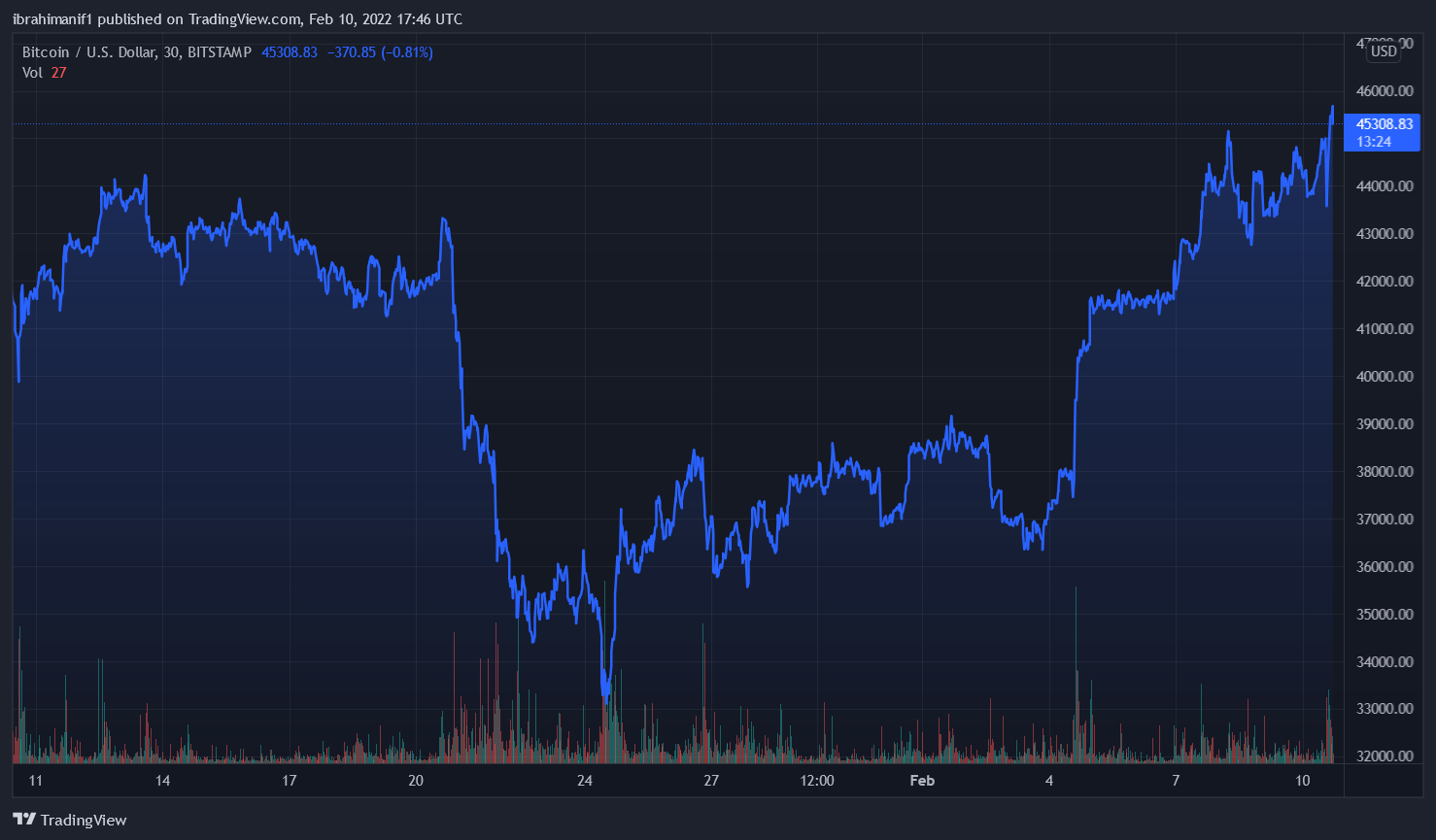
Bitcoin price recovered to within $45k after sliding below $44k as analysts indicated probable swings for the flagship cryptocurrency. The release of US inflation rates seems to have had no effect on the king cryptocurrency.
Bitcoin’s price rose past a crucial barrier overnight Wednesday, reaching $45,300, before falling as the broader market dipped in early trades after US markets opened.
Bitcoin Unaffected By Inflation Rates
Over the last 24 hours, BTC/USD has moved in a range of $43,402.81 – $45,398.91, exhibiting high volatility. Trading volume has climbed by 16.21% to $28.8 billion, while the overall market cap is around $860.47 billion dollars, leading in a 42% market dominance.
As investors analyzed new US inflation data, which came in at 7.5% year-over-year vs an expected 7.3%, the earlier decline took shape. Risky assets like crypto and equities have reacted negatively, with all eyes on the Federal Reserve’s upcoming rate hike in March.
BTC/USD steadies above $45k. Source: TradingView
Despite being 0.2% higher than predicted, rising inflation did not have the same favorable impact on risk assets like Bitcoin as it had in recent months.
The S&P 500 fell 0.23%, the Nasdaq composite fell 0.18%, and the Dow Jones Industrial Average remained barely above the flat line.
According to analysts, the Federal Reserve may now have additional motivation to begin raising interest rates sooner due to the speed of year-over-year price increases.
Crypto trader and analyst Michael van de Poppe observed:
“The Consumer Price Index (CPI) results for the U.S.A. are coming in at 7.5% year-over-year, the expectations were 7.3% year-over-year.$DXY is shooting up and risk-on assets are dropping down like Bitcoin & equities.Likelihood that the FED will start rate hikes in March.”
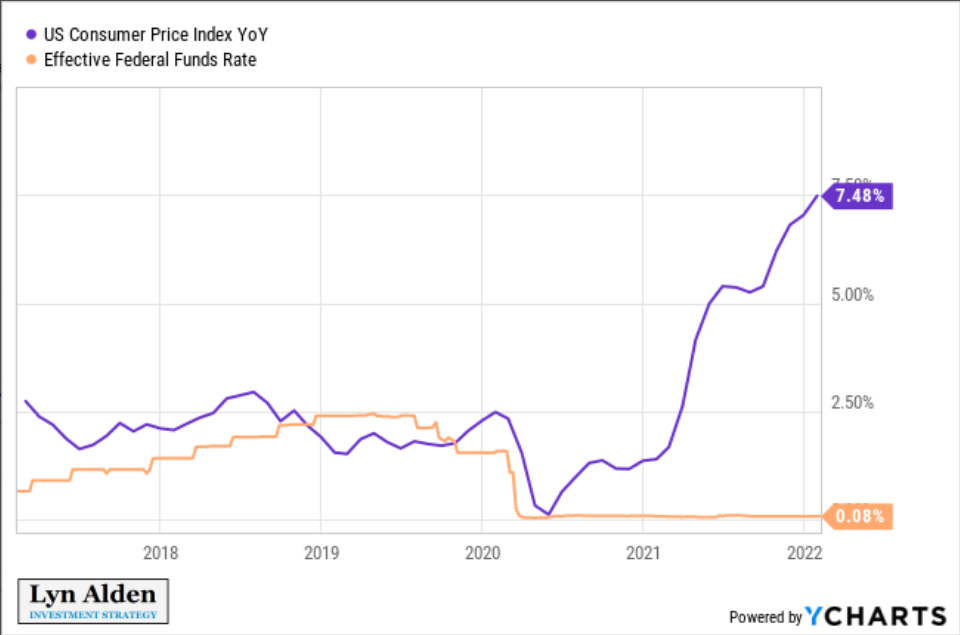
However, for economist Lyn Alden, it was cash savers who had been losing the most from inflation. she noted alongside a chart:
U.S. CPI vs. effective federal funds rate chart. Source: Lyn Alden/ Twitter
“Official inflation currently has its biggest gap over short-term interest rates since 1951. People holding cash in a bank or T-bills over the past year lost over 7% of their purchasing power.”
Related article | Investors Take Refuge In Bitcoin As Inflation Rises
BTC Will Hit $50k In Short term
The Fed will be put to the test here, as they had hoped for a steady tightening cycle rather than a hasty tightening that would appear to be a policy blunder. The political pressure on the Biden administration and Democrats will increase as core inflation rises over the Fed’s objective and real average hourly earnings fall. Although November is still a long way off, this inflation report shows that price hikes are everywhere, and there is rising opposition to new fiscal stimulus measures that would exacerbate pricing pressures.
As investors predict that pricing pressures may be peaking just before the Fed’s March policy meeting, US stocks have regained most of their inflation-related losses.
Given the rise in global bond yields, Bitcoin prices are holding up well. Bitcoin’s optimal future environment is risk appetite, which may be tough to achieve until after the Fed’s first couple of rate hikes. Institutional investors in Bitcoin are focusing on Treasuries because the momentum trade appears to be quite simple. For the short term, Bitcoin appears to be settling in between $40,000 and $50,000.
Cameron Winklevoss, co-founder of Gemini, feels Bitcoin is still the best inflation hedge, corroborating thoughts from the crypto community and even mainstream investors.
Inflation hit 7.5% in January. Highest in four decades. It continues to accelerate.
The best way to shield yourself from this pernicious, silent tax on your life’s work — your blood, sweat, and tears — is bitcoin.
By: Trent Fuenmayor, Program Manager, Coinbase Giving
Coinbase’s mission is to increase economic freedom in the world through the crypto-economy. To achieve this, it is essential to develop common infrastructure that is transparent, safe, secure, and benefits all participants. The open source community has provided critical support for Crypto development, with some support from donations from industry organizations and academic institutions. Our goal is to similarly support developers who are committed to growing and maintaining the Crypto ecosystem.
We launched our Crypto Community Fund in 2020 to aid this community effort, and in 2022 we’ve allocated up to $5M through Coinbase Giving, our philanthropic arm, to expand the program. Today, we have officially opened applications for our 2022 developer grants focused on blockchain developers who contribute directly to a blockchain codebase or researchers producing white papers addressing one or more of the following themes:
Eligibility and Preferences
Process
We will consider these applications on a rolling basis. Proposals will be shortlisted by current crypto developers and important community members. Coinbase will make the final decision.
We encourage all blockchain developers and prospective developers to apply for a Crypto Community Fund grant here.
This website contains links to third-party websites or other content for information purposes only (“Third-Party Sites”). The Third-Party Sites are not under the control of Coinbase, Inc., and its affiliates (“Coinbase”), and Coinbase is not responsible for the content of any Third-Party Site, including without limitation any link contained in a Third-Party Site, or any changes or updates to a Third-Party Site. Coinbase is not responsible for webcasting or any other form of transmission received from any Third-Party Site. Coinbase is providing these links to you only as a convenience, and the inclusion of any link does not imply endorsement, approval or recommendation by Coinbase of the site or any association with its operators.
Chinese entertainment conglomerate Tencent has been approved by the United Nations to lead a project exploring the creation of a standard technical and security framework for non-fungible tokens (NFTs) .
The project, dubbed a “technical framework for DLT-based digital collection services” will be the world’s first U.N.-approved standards initiative for NFTs, according to state-owned local media.
The U.N. agency for information and communication technologies, The International Telecommunication Union (ITU) approved the project, which is expected to complete an initial draft by the end of 2022, according to a report from the South China Morning Post.
Currently, any recommendations advised by the ITU only become mandatory and enforceable when nations adopt them as law.
“The international standard aims to specify the technical architecture, technical flows, functional requirements, and security requirements for blockchain-based digital collectibles,” wrote Tencent in a statement released on Tuesday.
“It could help drive a consensus and common understanding around the world on the formation of a technical framework for digital collection services.”
Meanwhile, the Chinese government is in the process of developing its own state-backed Blockchain Services Network (BSN).
This will help the Chinese Government to support the deployment of NFT projects unrelated to cryptocurrency, which it banned once again in Sep 2021.
Tencent will collaborate with a number of other companies on the initiative, including Alibaba affiliate Ant Group, The Chinese Academy of Information and Communications Technology, Beijing University of Posts and Telecommunications and Zhejiang Lab.
Related: China aims to separate NFTs from crypto via new blockchain infrastructure
In China NFTs are often referred to as “digital collectibles” in order to avoid criticism from the anti-crypto media and government. For this reason, Chinese NFT-creators tend to avoid public or decentralized blockchains such as Ethereum or Solana, opting to create their collectibles on permissioned blockchains.
Despite the country’s apprehension for crypto, it’s clearly very keen on exploring potential use cases for blockchain technology.
At the end of last month, China announced the commencement of a national plan to expedite blockchain development and innovation across key areas including manufacturing, energy, government data sharing and services, law enforcement, taxation, criminal trials, inspection and cross-border finance.