Data from Cointelegraph Markets Pro and TradingView showed an eerily calm start to the first Wall Street session of the week for both stocks and crypto.
Fears of a dramatic bout of volatility accompanying the open thanks to Feb. 21’s announcement by Russian President Vladimir Putin that he would recognize two breakaway republics in eastern Ukraine had been high.
Sanctions, still being announced at the time of writing, were likewise assumed to be about to fuel the fire but on the day, there was little movement.
The S&P 500 was all but flat thirty minutes after trading began, leaving Russian markets as the main losers and gold as the standout winner.
“I think that we’re going to open in the red and then, immediately bounce up on the risk-on assets and have a slight correction on gold,” Cointelegraph contributor Michaël van de Poppe previously forecast.
Fellow trader and analyst Scott Melker meanwhile focused attention on the potential for the Russia-Ukraine debacle to influence policy at the United States Federal Reserve.
According to banking giant JPMorgan, the effect of a potential conflict could be to make the Fed abandon the veracity of its planned interest rate hikes this year.
Lol
So war potentially means more stimulus and printing = good for assets.
According to a note published Feb. 22 quoted by various media outlets, analysts at JPMorgan believe that the trigger for a Fed rethink would come in the form of commodity price increases.
“Russia-Ukraine tension is a low earnings risk for U.S. corporates, but an energy price shock amid an aggressive central bank pivot focused on inflation could further dampen investor sentiment and growth outlook,” they wrote.
The sanctions meanwhile held off on all-out economic retaliation, with Russia’s two largest state-owned banks, Sberbank and VTB, left untouched.
Traders take Bitcoin’s recovery one step at a time
Looking ahead on Bitcoin, popular trader Anbessa meanwhile eschewed calm as BTC/USD conformed to expectations without a significant trend violation.
Related: Bitcoin Mayer Multiple returns to July 2021 levels in fresh sign $37K BTC is a long-term buy
A potential support/resistance flip near $37,700 was on the cards, he said, this hopefully becoming an important feature for the higher timeframe chart going forward.
If you expect the HTF S/R flip u don’t care how high #BTC pumps shortterm.
Patience is a virtue. Today #BTC followed the projection after hitting $45,8k and while your Guru panics, you have to know throwbacks are healthy.
As Cointelegraph reported, however, Bitcoin and altcoins remain off the radar for the majority of mainstream consumers, with mostly large-volume institutional players and whales maintaining meaningful participation.
“If we are bleeding new users but still have heavy dilution and retail outflows. There is no recovery. Maybe for BTC. But not alts far out on the risk curve,” fellow trader Pentoshi added in his own discussion of the macro environment.
Solana (SOL), also known as the ‘Ethereum Killer’ suffered from heavy losses since November 2021. At its peak Solana was trading at $260 (approx.) and is currently orbiting around $94. We will discuss whether SOL has the potential to break higher with its projects and tokens.
Why Investors Are Selling Solana?
Before attempting to assess whether Solana can indeed rebound from its current levels, it is important to understand what leads to the strong selling in the cryptocurrency. While some analysts are pointing to the recent OpenSea phishing attack as the cause, Solana has suffered from more severe issues.
Congestion in the network weighed on the cryptocurrency last month. The recent wormhole bridge hack only fueled the selling.
source: ethexplorer
Over $320 million was stolen via the wormhole bridge that allowed investors to ETH from the Ethereum blockchain to Solana. The ETH is converted to Wormhole ETH or wETH for short, which is pegged to the value Ethereum in the ETH blockchain.
A vulnerability in the bridge’s function (validator action approval or VAA for short) enabled the hacker to mint 120,000 wETH, which was valued at a notch over $322 million. The hacker transferred 93,750 wETH back to ETH, the remaining 26,250 wETH was swapped for 432,662 SOL (approx.).
source: wETH minting hack recorded at solana explorer
As 120,000 wETH went missing (from the mint) it was required for the sum to be replaced. Initially, there was great uncertainty as to who would provide the missing cryptocurrencies.
Jump Crypto Replaced 120,000 wETH
A message was sent to the attacker via Notifi, an Ethereum messaging service. The hacker was offered a bounty of $10 million for the exploit details and the return of the minted wETH,
“We noticed you were able to exploit the Solana VAA verification and mint tokens. We’d like to offer you a whitehat agreement, and present you a bug bounty of $10 million for exploit details, and returning the wETH you’ve minted.”
(View the full message on Notifi)
The hacker ignored the message and kept the 93,750 ETH in his account.
Jump Crypto shortly announced on Twitter that it has replaced the missing 120,000 wETH in order to sustain the network. Without the cryptocurrencies, there would have been serious repercussions. The vulnerability in the wormhole bridge was patched.
The bridge hack is what took SOL below $100 in the market. Investors would like to see some reassurance that security is a top priority. Solana is trading in tandem with leading
cryptocurrencies
Cryptocurrencies
By using cryptography, virtual currencies, known as cryptocurrencies, are nearly counterfeit-proof digital currencies that are built on blockchain technology. Comprised of decentralized networks, blockchain technology is not overseen by a central authority.Therefore, cryptocurrencies function in a decentralized nature which theoretically makes them immune to government interference. The term, cryptocurrency derives from the origin of the encryption techniques that are employed to secure the networks which are used to authenticate blockchain technology. Cryptocurrencies can be thought of as systems that accept online payments which are denoted as “tokens.” Tokens are represented as internal ledger entries in blockchain technology while the term crypto is used to depict cryptographic methods and encryption algorithms such as public-private key pairs, various hashing functions, and an elliptical curve. Every cryptocurrency transaction that occurs is logged in a web-based ledger with blockchain technology.These then must be approved by a disparate network of individual nodes (computers that maintain a copy of the ledger). For every new block generated, the block must first be authenticated and confirmed ‘approved’ by each node, which makes forging the transactional history of cryptocurrencies nearly impossible. The World’s First CryptoBitcoin became the first blockchain-based cryptocurrency and to this day is still the most demanded cryptocurrency and the most valued. Bitcoin still contributes the majority of the overall cryptocurrency market volume, though several other cryptos have grown in popularity in recent years.Indeed, out of the wake of Bitcoin, iterations of Bitcoin became prevalent which resulted in a multitude of newly created or cloned cryptocurrencies. Contending cryptocurrencies that emerged after Bitcoin’s success is referred to as ‘altcoins’ and they refer to cryptocurrencies such as Bitcoin, Peercoin, Namecoin, Ethereum, Ripple, Stellar, and Dash. Cryptocurrencies promise a wide range of technological innovations that have yet to be structured into being. Simplified payments between two parties without the need for a middle man is one aspect while leveraging blockchain technology to minimize transaction and processing fees for banks is another. Of course, cryptocurrencies have their disadvantages too. This includes issues of tax evasion, money laundering, and other illicit online activities where anonymity is a dire ingredient in solicitous and fraudulent activities.
By using cryptography, virtual currencies, known as cryptocurrencies, are nearly counterfeit-proof digital currencies that are built on blockchain technology. Comprised of decentralized networks, blockchain technology is not overseen by a central authority.Therefore, cryptocurrencies function in a decentralized nature which theoretically makes them immune to government interference. The term, cryptocurrency derives from the origin of the encryption techniques that are employed to secure the networks which are used to authenticate blockchain technology. Cryptocurrencies can be thought of as systems that accept online payments which are denoted as “tokens.” Tokens are represented as internal ledger entries in blockchain technology while the term crypto is used to depict cryptographic methods and encryption algorithms such as public-private key pairs, various hashing functions, and an elliptical curve. Every cryptocurrency transaction that occurs is logged in a web-based ledger with blockchain technology.These then must be approved by a disparate network of individual nodes (computers that maintain a copy of the ledger). For every new block generated, the block must first be authenticated and confirmed ‘approved’ by each node, which makes forging the transactional history of cryptocurrencies nearly impossible. The World’s First CryptoBitcoin became the first blockchain-based cryptocurrency and to this day is still the most demanded cryptocurrency and the most valued. Bitcoin still contributes the majority of the overall cryptocurrency market volume, though several other cryptos have grown in popularity in recent years.Indeed, out of the wake of Bitcoin, iterations of Bitcoin became prevalent which resulted in a multitude of newly created or cloned cryptocurrencies. Contending cryptocurrencies that emerged after Bitcoin’s success is referred to as ‘altcoins’ and they refer to cryptocurrencies such as Bitcoin, Peercoin, Namecoin, Ethereum, Ripple, Stellar, and Dash. Cryptocurrencies promise a wide range of technological innovations that have yet to be structured into being. Simplified payments between two parties without the need for a middle man is one aspect while leveraging blockchain technology to minimize transaction and processing fees for banks is another. Of course, cryptocurrencies have their disadvantages too. This includes issues of tax evasion, money laundering, and other illicit online activities where anonymity is a dire ingredient in solicitous and fraudulent activities. Read this Term such as ETH and Bitcoin.
Solana OpenSea Integration?
The hacker house events are a great idea. Core Solana Labs engineers participate in offline events, providing educational programming on DeFi, NFTs and how to start working with Solana. If the events would have been announced following the bridge exploitations and not in January, perhaps it would have had some impact on SOL.
We explored the play to earn games that are based on Solana’s blockchain. According to playtoearn.net which is listing the top 50 games per
blockchain
Blockchain
Blockchain comprises a digital network of blocks with a comprehensive ledger of transactions made in a cryptocurrency such as Bitcoin or other altcoins.One of the signature features of blockchain is that it is maintained across more than one computer. The ledger can be public or private (permissioned.) In this sense, blockchain is immune to the manipulation of data making it not only open but verifiable. Because a blockchain is stored across a network of computers, it is very difficult to tamper with. The Evolution of BlockchainBlockchain was originally invented by an individual or group of people under the name of Satoshi Nakamoto in 2008. The purpose of blockchain was originally to serve as the public transaction ledger of Bitcoin, the world’s first cryptocurrency.In particular, bundles of transaction data, called “blocks”, are added to the ledger in a chronological fashion, forming a “chain.” These blocks include things like date, time, dollar amount, and (in some cases) the public addresses of the sender and the receiver.The computers responsible for upholding a blockchain network are called “nodes.” These nodes carry out the duties necessary to confirm the transactions and add them to the ledger. In exchange for their work, the nodes receive rewards in the form of crypto tokens.By storing data via a peer-to-peer network (P2P), blockchain controls for a wide range of risks that are traditionally inherent with data being held centrally.Of note, P2P blockchain networks lack centralized points of vulnerability. Consequently, hackers cannot exploit these networks via normalized means nor does the network possess a central failure point.In order to hack or alter a blockchain’s ledger, more than half of the nodes must be compromised. Looking ahead, blockchain technology is an area of extensive research across multiple industries, including financial services and payments, among others.
Blockchain comprises a digital network of blocks with a comprehensive ledger of transactions made in a cryptocurrency such as Bitcoin or other altcoins.One of the signature features of blockchain is that it is maintained across more than one computer. The ledger can be public or private (permissioned.) In this sense, blockchain is immune to the manipulation of data making it not only open but verifiable. Because a blockchain is stored across a network of computers, it is very difficult to tamper with. The Evolution of BlockchainBlockchain was originally invented by an individual or group of people under the name of Satoshi Nakamoto in 2008. The purpose of blockchain was originally to serve as the public transaction ledger of Bitcoin, the world’s first cryptocurrency.In particular, bundles of transaction data, called “blocks”, are added to the ledger in a chronological fashion, forming a “chain.” These blocks include things like date, time, dollar amount, and (in some cases) the public addresses of the sender and the receiver.The computers responsible for upholding a blockchain network are called “nodes.” These nodes carry out the duties necessary to confirm the transactions and add them to the ledger. In exchange for their work, the nodes receive rewards in the form of crypto tokens.By storing data via a peer-to-peer network (P2P), blockchain controls for a wide range of risks that are traditionally inherent with data being held centrally.Of note, P2P blockchain networks lack centralized points of vulnerability. Consequently, hackers cannot exploit these networks via normalized means nor does the network possess a central failure point.In order to hack or alter a blockchain’s ledger, more than half of the nodes must be compromised. Looking ahead, blockchain technology is an area of extensive research across multiple industries, including financial services and payments, among others. Read this Term, only 3 games that are based on Solana are actually live. Most of the games are in development or in beta and alpha.
Age of Sam, a popular NFT Solana based project may be insufficient to lift the cryptocurrency higher.
At the end of January speculations on the Solana OpenSea integration surfaced. A well-known Hong Kong hacker by the name of Jane Manchun Wong is notorious for unearthing app features before they are publicly announced.
Jane has already revealed features on Instagram, Spotify and Facebook before they were announced to the public. According to a tweet on 25 January 2022, OpenSea is developing an integration with Phantom wallet.
Phantom wallet is used for buying and selling crypto and NFTs on the Solana blockchain.
Jane claims she used reverse engineering to unmask OpenSea’s intentions to integrate Solana into the NFT marketplace. OpenSea declined to confirm it has such plans.
Adding SOL to OpenSea, which is currently the biggest NFT marketplace platform, may contribute to SOL recovery from the bridge hack. Because of the recent phishing attack OpenSea experienced, the chance that such plans having ever existed may now be delayed.
OpenSea is currently busy dealing with the phishing attack. If there were integrations plans they may be delayed.
Is It a Good Time to Buy Solana?
From the technical end, Solana may struggle to trade back above $130. The next support based on the monthly chart is around $52. To invalidate the downtrend in the monthly chart, SOL may require to trade back above $160.
Based on the daily chart, some support is offered at the $84 mark. If Solana succeeds in breaking above $121, it may extend its gains towards $140.
Portals announced last week they have raised $5 million to build a metaverse platform based on the Solana blockchain. Foundation Capital and Alameda Research participated in the funding round.
Adam Gomez, the Co-Founder of Portals, said, “We are building an entirely new Times Square in the metaverse.” Building the platform may take time and had no impact on cryptocurrency.
President Biden is expected to issue the executive order on cryptocurrencies this week. The executive order will instruct governing bodies to begin the coordination of crypto regulations. It is unclear at the time of writing the impact the order will have as it is widely anticipated.
One event that has triggered a reaction in the crypto markets is the Fed monetary policy. A rate hike is expected in March 2022 with possible insights into the pace of future rate hikes. It is still early to predict how will the Fed impact SOL as it greatly depends on the monetary policy.
The daily support at $84 appears to be the only lifeboat for SOL at the time of writing.
Solana (SOL), also known as the ‘Ethereum Killer’ suffered from heavy losses since November 2021. At its peak Solana was trading at $260 (approx.) and is currently orbiting around $94. We will discuss whether SOL has the potential to break higher with its projects and tokens.
Why Investors Are Selling Solana?
Before attempting to assess whether Solana can indeed rebound from its current levels, it is important to understand what leads to the strong selling in the cryptocurrency. While some analysts are pointing to the recent OpenSea phishing attack as the cause, Solana has suffered from more severe issues.
Congestion in the network weighed on the cryptocurrency last month. The recent wormhole bridge hack only fueled the selling.
source: ethexplorer
Over $320 million was stolen via the wormhole bridge that allowed investors to ETH from the Ethereum blockchain to Solana. The ETH is converted to Wormhole ETH or wETH for short, which is pegged to the value Ethereum in the ETH blockchain.
A vulnerability in the bridge’s function (validator action approval or VAA for short) enabled the hacker to mint 120,000 wETH, which was valued at a notch over $322 million. The hacker transferred 93,750 wETH back to ETH, the remaining 26,250 wETH was swapped for 432,662 SOL (approx.).
source: wETH minting hack recorded at solana explorer
As 120,000 wETH went missing (from the mint) it was required for the sum to be replaced. Initially, there was great uncertainty as to who would provide the missing cryptocurrencies.
Jump Crypto Replaced 120,000 wETH
A message was sent to the attacker via Notifi, an Ethereum messaging service. The hacker was offered a bounty of $10 million for the exploit details and the return of the minted wETH,
“We noticed you were able to exploit the Solana VAA verification and mint tokens. We’d like to offer you a whitehat agreement, and present you a bug bounty of $10 million for exploit details, and returning the wETH you’ve minted.”
(View the full message on Notifi)
The hacker ignored the message and kept the 93,750 ETH in his account.
Jump Crypto shortly announced on Twitter that it has replaced the missing 120,000 wETH in order to sustain the network. Without the cryptocurrencies, there would have been serious repercussions. The vulnerability in the wormhole bridge was patched.
The bridge hack is what took SOL below $100 in the market. Investors would like to see some reassurance that security is a top priority. Solana is trading in tandem with leading
cryptocurrencies
Cryptocurrencies
By using cryptography, virtual currencies, known as cryptocurrencies, are nearly counterfeit-proof digital currencies that are built on blockchain technology. Comprised of decentralized networks, blockchain technology is not overseen by a central authority.Therefore, cryptocurrencies function in a decentralized nature which theoretically makes them immune to government interference. The term, cryptocurrency derives from the origin of the encryption techniques that are employed to secure the networks which are used to authenticate blockchain technology. Cryptocurrencies can be thought of as systems that accept online payments which are denoted as “tokens.” Tokens are represented as internal ledger entries in blockchain technology while the term crypto is used to depict cryptographic methods and encryption algorithms such as public-private key pairs, various hashing functions, and an elliptical curve. Every cryptocurrency transaction that occurs is logged in a web-based ledger with blockchain technology.These then must be approved by a disparate network of individual nodes (computers that maintain a copy of the ledger). For every new block generated, the block must first be authenticated and confirmed ‘approved’ by each node, which makes forging the transactional history of cryptocurrencies nearly impossible. The World’s First CryptoBitcoin became the first blockchain-based cryptocurrency and to this day is still the most demanded cryptocurrency and the most valued. Bitcoin still contributes the majority of the overall cryptocurrency market volume, though several other cryptos have grown in popularity in recent years.Indeed, out of the wake of Bitcoin, iterations of Bitcoin became prevalent which resulted in a multitude of newly created or cloned cryptocurrencies. Contending cryptocurrencies that emerged after Bitcoin’s success is referred to as ‘altcoins’ and they refer to cryptocurrencies such as Bitcoin, Peercoin, Namecoin, Ethereum, Ripple, Stellar, and Dash. Cryptocurrencies promise a wide range of technological innovations that have yet to be structured into being. Simplified payments between two parties without the need for a middle man is one aspect while leveraging blockchain technology to minimize transaction and processing fees for banks is another. Of course, cryptocurrencies have their disadvantages too. This includes issues of tax evasion, money laundering, and other illicit online activities where anonymity is a dire ingredient in solicitous and fraudulent activities.
By using cryptography, virtual currencies, known as cryptocurrencies, are nearly counterfeit-proof digital currencies that are built on blockchain technology. Comprised of decentralized networks, blockchain technology is not overseen by a central authority.Therefore, cryptocurrencies function in a decentralized nature which theoretically makes them immune to government interference. The term, cryptocurrency derives from the origin of the encryption techniques that are employed to secure the networks which are used to authenticate blockchain technology. Cryptocurrencies can be thought of as systems that accept online payments which are denoted as “tokens.” Tokens are represented as internal ledger entries in blockchain technology while the term crypto is used to depict cryptographic methods and encryption algorithms such as public-private key pairs, various hashing functions, and an elliptical curve. Every cryptocurrency transaction that occurs is logged in a web-based ledger with blockchain technology.These then must be approved by a disparate network of individual nodes (computers that maintain a copy of the ledger). For every new block generated, the block must first be authenticated and confirmed ‘approved’ by each node, which makes forging the transactional history of cryptocurrencies nearly impossible. The World’s First CryptoBitcoin became the first blockchain-based cryptocurrency and to this day is still the most demanded cryptocurrency and the most valued. Bitcoin still contributes the majority of the overall cryptocurrency market volume, though several other cryptos have grown in popularity in recent years.Indeed, out of the wake of Bitcoin, iterations of Bitcoin became prevalent which resulted in a multitude of newly created or cloned cryptocurrencies. Contending cryptocurrencies that emerged after Bitcoin’s success is referred to as ‘altcoins’ and they refer to cryptocurrencies such as Bitcoin, Peercoin, Namecoin, Ethereum, Ripple, Stellar, and Dash. Cryptocurrencies promise a wide range of technological innovations that have yet to be structured into being. Simplified payments between two parties without the need for a middle man is one aspect while leveraging blockchain technology to minimize transaction and processing fees for banks is another. Of course, cryptocurrencies have their disadvantages too. This includes issues of tax evasion, money laundering, and other illicit online activities where anonymity is a dire ingredient in solicitous and fraudulent activities. Read this Term such as ETH and Bitcoin.
Solana OpenSea Integration?
The hacker house events are a great idea. Core Solana Labs engineers participate in offline events, providing educational programming on DeFi, NFTs and how to start working with Solana. If the events would have been announced following the bridge exploitations and not in January, perhaps it would have had some impact on SOL.
We explored the play to earn games that are based on Solana’s blockchain. According to playtoearn.net which is listing the top 50 games per
blockchain
Blockchain
Blockchain comprises a digital network of blocks with a comprehensive ledger of transactions made in a cryptocurrency such as Bitcoin or other altcoins.One of the signature features of blockchain is that it is maintained across more than one computer. The ledger can be public or private (permissioned.) In this sense, blockchain is immune to the manipulation of data making it not only open but verifiable. Because a blockchain is stored across a network of computers, it is very difficult to tamper with. The Evolution of BlockchainBlockchain was originally invented by an individual or group of people under the name of Satoshi Nakamoto in 2008. The purpose of blockchain was originally to serve as the public transaction ledger of Bitcoin, the world’s first cryptocurrency.In particular, bundles of transaction data, called “blocks”, are added to the ledger in a chronological fashion, forming a “chain.” These blocks include things like date, time, dollar amount, and (in some cases) the public addresses of the sender and the receiver.The computers responsible for upholding a blockchain network are called “nodes.” These nodes carry out the duties necessary to confirm the transactions and add them to the ledger. In exchange for their work, the nodes receive rewards in the form of crypto tokens.By storing data via a peer-to-peer network (P2P), blockchain controls for a wide range of risks that are traditionally inherent with data being held centrally.Of note, P2P blockchain networks lack centralized points of vulnerability. Consequently, hackers cannot exploit these networks via normalized means nor does the network possess a central failure point.In order to hack or alter a blockchain’s ledger, more than half of the nodes must be compromised. Looking ahead, blockchain technology is an area of extensive research across multiple industries, including financial services and payments, among others.
Blockchain comprises a digital network of blocks with a comprehensive ledger of transactions made in a cryptocurrency such as Bitcoin or other altcoins.One of the signature features of blockchain is that it is maintained across more than one computer. The ledger can be public or private (permissioned.) In this sense, blockchain is immune to the manipulation of data making it not only open but verifiable. Because a blockchain is stored across a network of computers, it is very difficult to tamper with. The Evolution of BlockchainBlockchain was originally invented by an individual or group of people under the name of Satoshi Nakamoto in 2008. The purpose of blockchain was originally to serve as the public transaction ledger of Bitcoin, the world’s first cryptocurrency.In particular, bundles of transaction data, called “blocks”, are added to the ledger in a chronological fashion, forming a “chain.” These blocks include things like date, time, dollar amount, and (in some cases) the public addresses of the sender and the receiver.The computers responsible for upholding a blockchain network are called “nodes.” These nodes carry out the duties necessary to confirm the transactions and add them to the ledger. In exchange for their work, the nodes receive rewards in the form of crypto tokens.By storing data via a peer-to-peer network (P2P), blockchain controls for a wide range of risks that are traditionally inherent with data being held centrally.Of note, P2P blockchain networks lack centralized points of vulnerability. Consequently, hackers cannot exploit these networks via normalized means nor does the network possess a central failure point.In order to hack or alter a blockchain’s ledger, more than half of the nodes must be compromised. Looking ahead, blockchain technology is an area of extensive research across multiple industries, including financial services and payments, among others. Read this Term, only 3 games that are based on Solana are actually live. Most of the games are in development or in beta and alpha.
Age of Sam, a popular NFT Solana based project may be insufficient to lift the cryptocurrency higher.
At the end of January speculations on the Solana OpenSea integration surfaced. A well-known Hong Kong hacker by the name of Jane Manchun Wong is notorious for unearthing app features before they are publicly announced.
Jane has already revealed features on Instagram, Spotify and Facebook before they were announced to the public. According to a tweet on 25 January 2022, OpenSea is developing an integration with Phantom wallet.
Phantom wallet is used for buying and selling crypto and NFTs on the Solana blockchain.
Jane claims she used reverse engineering to unmask OpenSea’s intentions to integrate Solana into the NFT marketplace. OpenSea declined to confirm it has such plans.
Adding SOL to OpenSea, which is currently the biggest NFT marketplace platform, may contribute to SOL recovery from the bridge hack. Because of the recent phishing attack OpenSea experienced, the chance that such plans having ever existed may now be delayed.
OpenSea is currently busy dealing with the phishing attack. If there were integrations plans they may be delayed.
Is It a Good Time to Buy Solana?
From the technical end, Solana may struggle to trade back above $130. The next support based on the monthly chart is around $52. To invalidate the downtrend in the monthly chart, SOL may require to trade back above $160.
Based on the daily chart, some support is offered at the $84 mark. If Solana succeeds in breaking above $121, it may extend its gains towards $140.
Portals announced last week they have raised $5 million to build a metaverse platform based on the Solana blockchain. Foundation Capital and Alameda Research participated in the funding round.
Adam Gomez, the Co-Founder of Portals, said, “We are building an entirely new Times Square in the metaverse.” Building the platform may take time and had no impact on cryptocurrency.
President Biden is expected to issue the executive order on cryptocurrencies this week. The executive order will instruct governing bodies to begin the coordination of crypto regulations. It is unclear at the time of writing the impact the order will have as it is widely anticipated.
One event that has triggered a reaction in the crypto markets is the Fed monetary policy. A rate hike is expected in March 2022 with possible insights into the pace of future rate hikes. It is still early to predict how will the Fed impact SOL as it greatly depends on the monetary policy.
The daily support at $84 appears to be the only lifeboat for SOL at the time of writing.
Recently we sat down with Matas Sauciunas, CEO of one of the most exciting DeFi projects of the year: ALF Protocol. Matas and his team have already secured significant Venture Capital funding which they have used to develop a protocol for capital deployment on Solana for the purposes of liquidity provision and yield farming. Alf aims to become the go-to place for blockchain liquidity, initially launching on Solana and then potentially expanding to other chains.
Matas is passionate about the Solana ecosystem and how its low fees and extremely high speed give it the potential to be the leading Layer 1 solution, and his team is building out a core piece of the Solana native Decentralized Financial services. I trust you enjoy this conversation as much as I did and I look forward to watching this dynamic team and project go from strength to strength in 2022.
Interviewer: Hi Matas, thank you for setting aside the time for this interview. I can imagine how busy everything is at your side, knowing that the development of the protocol is well underway. Please, could you explain in a simple way what is Alfprotocol?
Matas: Hi there. Yes, everything is super busy on our side, but anyway it’s great meeting you and speaking with you today. I get this question quite often because of the complexity of the project so my usual reply is that Alfprotocol is a decentralized application built on the Solana blockchain that lets the user supply their tokens to earn interest, borrow some funds for outside use by providing collateral, use our in-house built decentralized exchange & become liquidity providers by supplying tokens to the farms and earn yield rewards and token rewards. What’s unique is that Alfprotocol will provide leverage for users to use to increase their position size while investing in the liquidity provision.
Interviewer: The idea that you and your team are building sounds complex but exciting! Could you tell me a bit more about Decentralised Finance (DeFi)? Why is DeFi getting so much hype and what is your personal opinion on the future of DeFi?
Matas: Decentralized Finance lets users use financial services like lending and borrowing without centralized intermediaries, it also provides endless opportunities to create different protocols that are providing unique use cases of the decentralized money market. What’s important is that DeFi had a growth of 88x last year and is expected to grow by another 10x this year. Also, DeFi comprises only around 5-6% of the entire cryptocurrency market cap. That statistic alone gives me the insight that we’re still in the early stages of DeFi, and we can lock a decent spot within the ecosystem itself.
Interviewer: Thank you for such an explanation. Alfprotocol has chosen the Solana blockchain to work on. Why Solana?
Matas: First of all, Solana is experiencing tremendous growth in attention from developers and investors. And that attention comes for a reason. Solana blockchain is super fast and super cheap and next to that the whole ecosystem of Solana is growing rapidly. We chose Solana because we’re building a leveraged protocol, so we need a blockchain that is super fast with the transactions and also cheap to use. Solana can provide that. Also, the DeFi protocols within the Solana are still at the early stages. So we do have a great opportunity to lock a decent spot for the future of Solana and aim to become a homepage for DeFi on Solana.
Interviewer: Thank you. Solana is definitely on a massive growth trend as you said. Your and your team’s decision to build on this fast and inexpensive blockchain does make sense. Could you provide the top three advantages of the Alfprotocol?
Matas: Certainly. The first advantage would be that users will have an all-in-one place, (a “one-stop shop”) for all DeFi services which at the moment isn’t widely available in the ecosystem, meaning users need to move between different protocols. The second advantage is that those who are risk-seeking investors will have an opportunity to use higher leverage (in some cases up to 200x) for liquidity provision. Of course, the use of high leverage will be highly monitored and will be available for limited farms and users. And lastly, the third advantage is that the entire team building and collaborating on the protocol is transparent and provides regular updates on the development status, educational material, etc. So having a strong and transparent team behind the protocol is a very important aspect.
Interviewer: Absolutely. Transparency and regular communication with the community is always necessary. Just a few more questions Matas, at what stage is your project now and who are the backers of the Alfprotocol right now?
Matas: At the moment Alfprotocol is at the early development stage. We aim to have our public IDO within Q2 of 2022 and aim to launch a fully working protocol in late Q3, 2022. The MVP release of the protocol is expected to take place in early Q2, 2022. The current backers of the project are Zen Capital, Dust Ventures, DIB Ventures, SRT Ventures, Alpha Hunt and Scorpio VC.
Interviewer: Last question for you Matas: how can users participate in the early stage of the Alfprotocol?
Matas: Users do have an opportunity to apply an allocation of Alfprotocol tokens at this early stage of the protocol just like Venture Capital firms do. We cal this round a Pre-IDO round and it is available on our website. Alternatively, users can send us an email via [email protected] with the headline of “Pre-IDO round” and our dedicated person will reply and help with the allocation process.
Interviewer: Thank you for answering all of the questions! It’s been a great time speaking with you and I would like to wish you all the best for the future of Alfprotocol!
Matas: It’s been a great talk with you as well – thank you for your time.
Bitcoin continues to trend lower over the weekend and seems at risk of re-testing previous lows. The first crypto by market cap was rejected at mid-area north of $40,000 and was unable to muster the momentum to hold those levels.
Related Reading | Did Top Three Bitcoin Addresses Just Call Another Local Bottom?
As of press time, Bitcoin trades at $39,921 with a 1.2% and 5.2% loss in the last day and 7 days, respectively.
BTC trends to the downside on the daily chart. Source: BTCUSD Tradingview
Yuya Hasegawa, analyst for Bitbank, attributes BTC’s price recent price action to the Russia-Ukraine situation. In that sense, the analyst expects potential relief as the U.S. Secretary of State Antony Blinken and the Russian Minister of Foreign Affairs Sergey Lavrov scheduled a phone call for next week.
This could tone down the tensions around the situation at the border. On top of that, the analyst claims Bitcoin is sitting at “ample technical support” which could protect its price from further downside.
However, is a long weekend in the U.S. which usually leads to potential periods of high volatility driven by low trading volumes across the crypto market. Hasegawa said talking about BTC’s price immediate and medium-term potential headwinds:
We still have the January U.S. PCE, February jobs report, and CPI until the March FOMC meeting, so it is safe to say that, depending especially on these inflation data, the worst may be still ahead of us, and even if the price rebounds from the current level in the short term, upside is likely quite limited unless the Russian military shows some signs of retreating.
The macro-situation seems to occupy everyone’s attention. A separate analyst from Material Indicators (MI) claims the Russia-Ukraine situation could see an outcome after the Winter Olympics in Beijing. These events have been linked to similar crises in the past, such as the invasion of Crimea which took place in 2014 during the Olympics hosted by Russia.
Bitcoin To See Short Squeeze Over Long Weekend?
Further data provided by Material Indicators claims BTC could have entered a distribution phase. Recommending traders to “avoid knife catching”, especially during periods of low volume, MI presented their Trend Precognition indicator which flashed a bearish arrow on the daily chart as BTC’s price trend below $40,000.
Material Indicator’s Trend Precognition Indicator flashed a bearish signal on the daily chart. Source: Material Indicators via Twitter
This could suggest the benchmark crypto might re-test its lows which could find good support, as MI claimed, “in areas of prior consolidation”. The levels between $35,000 to $38,000 were relevant during BTC’s price previous sell-off and could operate as support.
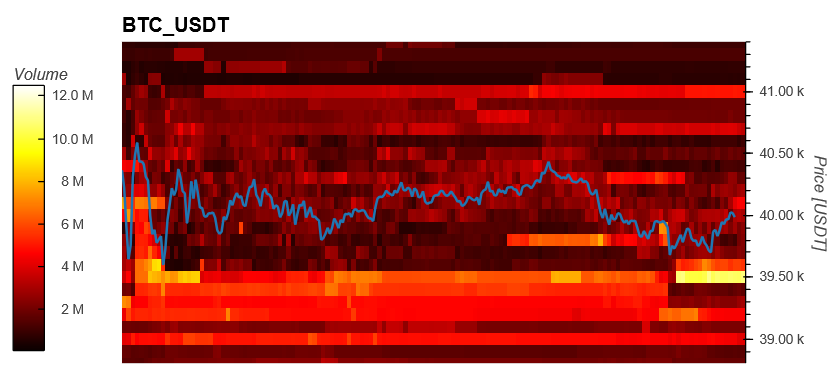
However, MI noted that there are “Liquidity gaps”, levels on the order book with low bids or asks orders, on both sides of the BTC/USDT trading pair. Thus, Bitcoin could see a short squeeze to the upside or downside.
Related Reading |Comparing Apple’s Growth With Bitcoin, Why This Expert Sets $700K As Long-Term Goal
Currently, there are around $10 million in bid order around $39,500. Therefore, there seems to be strong support for BTC at that level which could favor the bulls, at least in the short term.
BTC’s price (blue line on the chart) with potential support on $39,500 due to concentration of bid orders (levels below the price). Source Material Indicators
The frenzy around meme coins took over the crypto market in 2021. With a monumental rise of more than 10,000%, Dogecoin (DOGE) thrashed every opponent and entered the list of top 10 digital currencies. The story of Shiba Inu (SHIB) was no different. The biggest rival of Dogecoin performed better than its counterpart in 2021. In fact, for a brief period, the market cap of Shiba Inu jumped above the overall value of Dogecoin.
Both meme coins witnessed strong growth among crypto communities during the last year. However, with a drop of over 60% from their all-time highs, several questions are rising around the future of Shiba Inu and Dogecoin. Even after the massive market correction, DOGE and SHIB have a market cap of $18 billion and $14 billion, respectively. Finance Magnates asked leading crypto voices to share their opinions regarding the future of meme coins.
“Memecoins like Dogecoin and Shiba Inu may be performing woefully at the moment, but this by no means implies they are fizzling out their relevance. The broader market is underperforming at the moment and by virtue of the nature, meme coins are poised to print a far wider rate of decline based on their volatility,” Sven Wenzel, co-founder of Castello Coin, said.
Market Conditions
According to Wenzel, the current market conditions are tough but under the normal market situation, meme coins will skyrocket once again. “When normalcy seems to return to the market, we can expect Dogecoin and Shiba Inu to do what they know how to do best-that is, chart a massive upward growth. With the current market downturn, a number of investors have lost a lot of money, and the first instinct by many risk-takers will be to invest in tweet-sensitive coins that can help boost the prices of Dogecoin and Shiba Inu. Based on this, we are likely to see massive retail cash inflows into these top meme coins in a short while,” Wenzel added.
Doge and SHIB
Maria Stankevich, the Chief Business Development Officer at EXMO UK, believes that not all meme coins will disappear, some are here to stay.
“It is difficult to argue with the statement that along with the formation of the market, we will inevitably observe its natural cleansing from empty projects. But we’re still in the nascent phase, where most players feel pretty free with little to no regulation. For example, we can take the current situation with Elon Musk and McDonald’s. After the publication of McDonald’s, the Grimacecoin token was created on the Binance Smart Chain network, the value of which at the moment increased by more than 200,000%, to $2. It isn’t easy to imagine such a situation in the traditional finance market, so most classic traders look at cryptocurrencies as a sandbox where children play,” she said.
“However, there is a trend mainly related to the regulation and protection of clients from scams. I would not say that all meme-coins will disappear. Dogecoin is a specific marker of the era of creation and formation of cryptocurrencies. The creators had no plans to launch the coin into space, and I am sure that none of them expected Elon Musk to become their ambassador. I think that shortly the number of dummy projects will decrease. Still, until there is proper regulation, there will always be people who hope for a magical way to earn money without doing anything quickly,” Maria explained.
Rising Demand
Johnny McCamely, CEO of CryptoClear, said that the short-term spike in Shiba Inu and Dogecoin is due to a rise in demand from investors. “Recent rallies in coins such as DOGE and SHIB are driven by a surge in demand to get rich quick, bitcoin is back above $40,000 USD and traders and investors are switching back onto Crypto. Many are wanting to make a quick gain via the likes of DOGE and SHIB, many other “meme coins” as they are termed have popped up recently such as Marshall Rogan Inu (MRI). I believe this is a short-term spike due to the investor’s demand to get rich quick,” he said.
The frenzy around meme coins took over the crypto market in 2021. With a monumental rise of more than 10,000%, Dogecoin (DOGE) thrashed every opponent and entered the list of top 10 digital currencies. The story of Shiba Inu (SHIB) was no different. The biggest rival of Dogecoin performed better than its counterpart in 2021. In fact, for a brief period, the market cap of Shiba Inu jumped above the overall value of Dogecoin.
Both meme coins witnessed strong growth among crypto communities during the last year. However, with a drop of over 60% from their all-time highs, several questions are rising around the future of Shiba Inu and Dogecoin. Even after the massive market correction, DOGE and SHIB have a market cap of $18 billion and $14 billion, respectively. Finance Magnates asked leading crypto voices to share their opinions regarding the future of meme coins.
“Memecoins like Dogecoin and Shiba Inu may be performing woefully at the moment, but this by no means implies they are fizzling out their relevance. The broader market is underperforming at the moment and by virtue of the nature, meme coins are poised to print a far wider rate of decline based on their volatility,” Sven Wenzel, co-founder of Castello Coin, said.
Market Conditions
According to Wenzel, the current market conditions are tough but under the normal market situation, meme coins will skyrocket once again. “When normalcy seems to return to the market, we can expect Dogecoin and Shiba Inu to do what they know how to do best-that is, chart a massive upward growth. With the current market downturn, a number of investors have lost a lot of money, and the first instinct by many risk-takers will be to invest in tweet-sensitive coins that can help boost the prices of Dogecoin and Shiba Inu. Based on this, we are likely to see massive retail cash inflows into these top meme coins in a short while,” Wenzel added.
Doge and SHIB
Maria Stankevich, the Chief Business Development Officer at EXMO UK, believes that not all meme coins will disappear, some are here to stay.
“It is difficult to argue with the statement that along with the formation of the market, we will inevitably observe its natural cleansing from empty projects. But we’re still in the nascent phase, where most players feel pretty free with little to no regulation. For example, we can take the current situation with Elon Musk and McDonald’s. After the publication of McDonald’s, the Grimacecoin token was created on the Binance Smart Chain network, the value of which at the moment increased by more than 200,000%, to $2. It isn’t easy to imagine such a situation in the traditional finance market, so most classic traders look at cryptocurrencies as a sandbox where children play,” she said.
“However, there is a trend mainly related to the regulation and protection of clients from scams. I would not say that all meme-coins will disappear. Dogecoin is a specific marker of the era of creation and formation of cryptocurrencies. The creators had no plans to launch the coin into space, and I am sure that none of them expected Elon Musk to become their ambassador. I think that shortly the number of dummy projects will decrease. Still, until there is proper regulation, there will always be people who hope for a magical way to earn money without doing anything quickly,” Maria explained.
Rising Demand
Johnny McCamely, CEO of CryptoClear, said that the short-term spike in Shiba Inu and Dogecoin is due to a rise in demand from investors. “Recent rallies in coins such as DOGE and SHIB are driven by a surge in demand to get rich quick, bitcoin is back above $40,000 USD and traders and investors are switching back onto Crypto. Many are wanting to make a quick gain via the likes of DOGE and SHIB, many other “meme coins” as they are termed have popped up recently such as Marshall Rogan Inu (MRI). I believe this is a short-term spike due to the investor’s demand to get rich quick,” he said.
At Coinbase, our number one priority is ensuring that we uphold our security commitments to our customers. On February 11, 2022, we received a report from a third-party researcher indicating that they had uncovered a flaw in Coinbase’s trading interface. We promptly mobilized our security incident response team to identify and patch the bug, and resolved the underlying system issue without any impact to customer funds.
This blog post provides a deeper look into the timeline of events surrounding the bug report, as well as an explanation of the bug itself and the steps we took to resolve it and ensure it cannot happen again.
(note, all events occurred on February 11, 2022, and all times are in PST)
10:16 AM: A member of the crypto community tweets that they have uncovered a serious flaw in the Coinbase trading interface, and requests contacts in the Coinbase Security team.
11:00 AM: Based on limited initial information provided by intermediaries, Coinbase Security declares an incident and mobilizes engineering resources to begin testing all trading interfaces to determine the validity of the alleged bug.
11:21 AM: The crypto researcher files a vulnerability report via HackerOne, Coinbase’s bug bounty platform, indicating that the flaw resides in a specific API for Retail Advanced Trading. Coinbase engineers also complete a review of all other user interfaces and Coinbase Exchange APIs and determine that they are not impacted.
11:42 AM: Coinbase engineers are able to reproduce the bug, and the Retail Advanced Trading platform is placed into cancel-only mode, disabling new trades.
4:01 PM: A patch is validated and released, resolving the incident.
The underlying cause of the bug was a missing logic validation check in a Retail Brokerage API endpoint, which allowed a user to submit trades to a specific order book using a mismatched source account. This API is only utilized by our Retail Advanced Trading platform, which is currently in limited beta release.
To give an example:
A user has an account with 100 SHIB, and a second account with 0 BTC.
The user submits a market order to the BTC-USD order book to sell 100 BTC, but manually edits their API request to specify their SHIB account as the source of funds.
Here, the validation service would check to determine whether the source account had a sufficient balance to complete the trade, but not whether the source account matched the proposed asset for submitting the trade.
As a result, a market order to sell 100 BTC on the BTC-USD order book would be entered on the Coinbase Exchange.
There were mitigating factors that would have limited the impact of this flaw had it been exploited at scale. For example, Coinbase Exchange has automatic price protection circuit breakers, and our trade surveillance team continuously monitors our markets for health and anomalous trading activity.
Thanks to the researcher who responsibly disclosed this issue, Coinbase was able to fix this bug in a matter of hours, and conclusively determine that it has never been maliciously exploited. We have also implemented additional checks to ensure that it cannot happen again.
Coinbase strongly supports independent security research, and when those researchers uncover serious issues, we want to ensure that they are rewarded accordingly. As a result, we are paying our largest-ever bug bounty for this finding: $250,000.
We welcome future submissions from this researcher and others via our HackerOne program: https://hackerone.com/coinbase.
From video game enthusiasts monetizing their passions as shout casters to fashion influencers supercharging their careers into livestreamers on e-commerce platforms, the creator economy flourished, evolved and matured in the past year. Largely catalyzed by the ongoing COVID-19 pandemic, contemporary creators benefited from the gradual shift in consumer behaviors as more people came online across the globe. Now valued at over $100 billion, the creator economy is witnessing staggering growth as the worlds of e-commerce, social media and online communities converge.
With opportunities mounting in social tokens and corresponding virtual playgrounds such as the Metaverse, the year ahead seems to be filled with a great deal of promise. What lies ahead for creators in an increasingly digital and decentralized 2022?
A more equitable dynamic
From OnlyFans to TikTok, social networks may give creators access to communities but these creators are what drive traffic to these platforms due to the strength of their content. Whether they are an artist, musician, writer, photographer or all-around influencer, they are the true revenue drivers on these platforms. However, the relationship between a creator and their community is ultimately intermediated by a third party — the platform — which can impact the extent to which a creator is fully rewarded and compensated for their work. Sometimes this manifests itself as a cut in revenue and can even impact the type of content created and what it can include.
Related: Twitter and TikTok embrace NFTs: Mainstream adoption incoming?
Imagine if you could create without limits. This is the benefit that social tokens stand to offer. Blockchain-powered fan tokens can fulfill several functions: For one, they can be used to reward fans for their engagement, further encouraging them to engage with a universe of content. Not only does this help in growing one’s community, but social tokens can also be used as a medium of exchange — fans can directly compensate creators for work that they like, powering a mini economy that effectively cuts out the middleman from the equation. By essentially tokenizing themselves, creators invite their fans to take a stake in all they do — consider the example of 23-year-old entrepreneur Alex Masmej who launched ALEX to raise enough funds for a flight to San Francisco to launch his startup.
Social tokens essentially represent the ethos of Web3, connecting creators and consumers of content directly and enabling them to benefit from a value exchange. However, there are philosophical questions that merit some thought. What does it mean to tokenize yourself? Do you risk raising the bar and the pressure to perform? After all, incidents of social media influencers struggling to meet the demands of their followers have been well-chronicled. But as the creator economy continues to evolve, social tokens are still a valuable step forward that looks to level the financial playing field for what’s fast becoming a legitimate career path.
Revitalizing the meaning of engagement
Much like social tokens, nonfungible tokens (NFTs) are another innovation shaping the creator economy. Consider that the NFT-based crypto art market is now worth over $2.3 billion (as of mid-February 2022), pointing to the lucrative opportunity that artists have in accessing new monetization streams for their work.
Meanwhile, NFTs can also be leveraged to engineer a new model of fan engagement as they reconcile virtual assets with real-world experiences. Enter the phygital experience — a mix of physical and digital. NFTs can be tied to real-world perks — if you’re a musician, that could mean a lifetime supply of concert tickets or VIP meet and greets and as an artist, a select number of prints in a collection — all while ensuring that these assets verifiably belong to a fan, attesting to their ownership and authenticity. As economies gradually reopen and we continue to see the eventual normalization of social activities, experiential NFTs as a tool for long-term fan engagement are likely to grow in popularity.
Let’s not stop there, though: Enter interactive NFTs. These assets can change over time based on a fan’s modification to the content. Consider a digital collectible like a player card issued by an athlete — a fan can request for a digital autograph to be emblazoned onto the item, effectively adding to and altering the NFT, adding to its scarcity. For artists, this could mean creating collaborating digital artworks that their fans can add to, allowing for a more active two-way fan-creator relationship.
Related: Bull or bear market, creators are diving headfirst into crypto
Celebrating the rise of Asia
Much has been said about the age of Asia and that phenomenon certainly extends to the continent’s creator economy. In 2021, the number of influencers across the region grew by 66 percent, particularly in markets such as Indonesia, Japan, the Philippines, Taiwan and Thailand. While the influence of Western social networks is certainly widespread across the continent — with the likes of Indonesia’s growing population of digital natives ranking fourth in the world for Instagram usage — localized homegrown alternatives continue to proliferate. From China’s Sina Weibo to Japan’s LINE, creators need to master strategies to best navigate the cultural and communal nuances unique to each market.
Though the majority of Asian nations are still on the rise, China has arguably solidified its position as a leader in the creator economy, backed by a mature, professionalized network of e-commerce platforms that have helped to popularize live streaming as a career — a market that is estimated to rake in $60 billion each year. The model is fast replicating itself in other Asian markets, especially across Southeast Asia by e-commerce marketplaces such as Lazada and Shopee.
Related: All eyes on Asia: Crypto’s new chapter post-China
Meanwhile, a digital-savvy approach to tackling the physical restrictions posed by the coronavirus has been actively employed by Asian creators — to see this, one doesn’t need to look further than K-pop musicians who’ve seamlessly transitioned to offering virtual experiences to their fans and has entered the world of NFTs to mint audio-visual digital collectibles that their fans can buy, sell and trade.
Asia is primed to play host to this development given the legitimization and formalization of its continental creator economy. Whether it’s a traditional celebrity or an entrepreneur turned livestreamer, the opportunities for them to rally a community of loyal fans and shoppers rests firmly in their hands. But in light of the unique nuances to navigate across each culture, local firms should be taking a distinctly localized approach to celebrating the very differences that add to the challenge of mastering Asia’s creator landscape. A decentralized community strives to put the power back in the hands of creators with a model that’s uniquely made in Asia for Asia. As the continent’s creator economy continues to flourish, only time will tell how both fans and creators will adapt to the incoming wave of decentralization.
The value of alternatives
Contemporary creators are burdened by choice — forced to reckon with the growing number of platforms and access points to cultivate new and existing communities of fans. With the era of Web3 upon us, it’s truly an exciting time to be a creator. What we can hope to see is a creator economy that no longer rests on a disparate landscape of channels, but a distributed, interoperable network that maximizes all the touchpoints and opportunities to meaningfully engage. Meanwhile, the staggering rise of Asia and its influential position in generating cultural products and developing new platforms that have the potential to shape multiple industries is set to redefine the creator economy and its participants as we know it.
As we look to 2022, creators are now, more than ever, armed with innovations to set apart their offerings — from virtual worlds to collectibles growing in sophistication. Beyond that, they now have new pathways to explore, ones that can ultimately promise a more equitable, leveled playing field as they transform their passions into careers. The opportunities on the horizon are clear: The dawn of decentralization is the next step in bringing the creator economy to new heights.
This article does not contain investment advice or recommendations. Every investment and trading move involves risk, and readers should conduct their own research when making a decision.
The views, thoughts and opinions expressed here are the author’s alone and do not necessarily reflect or represent the views and opinions of Cointelegraph.
Weiwei Geng is the CEO of Unite, a creator ecosystem built in Asia for Asia that looks to put power into the hands of the continent’s creative communities. In addition to his role at Unite, Weiwei is also the co-founder of Rally and serves as an executive board member of the RLY Network Association. Previously, Weiwei served as managing director of China at Gen.G, a leading esports organization with top teams in China, South Korea and the United States.
Electricity consumption has been one of the major concerns with the advent of cryptocurrencies especially Polkadot. Though with models running with the Proof-of-Stake (PoS) consensus mechanism, this electricity use seems to be minimal since their process for transaction validations is staking. But the story is not the same for those running with Proof-of-Work (PoW) such as Bitcoin.
Mining is the associated process through which the PoW models could validate their network transactions. However, the process consumes lots of electricity as it uses highly computational equipment to solve cryptographic puzzles.
DOT sits at $18 Source: DOTUSD on TradingView.com
This high energy consumption led to several crackdowns on crypto mining in different countries, especially Bitcoin, in 2021. The move was in line with the argument that such practices facilitate environmental pollution.
This concern on energy consumption propelled the Crypto Carbon Ratings Institute (CCRI) to research the rate of electricity consumption by some blockchains. CCRI studied some networks like Solana, Bitcoin, Ethereum, and Polkadot in its research.
Related Reading | Lessons From Reason’s “The Fake Environmentalist Attack on Bitcoin” Mini-Doc
Based on the results from CCRI research, Polkadot, the strong competitor of Ethereum, emerged as the network with the least electricity consumption compared with Ethereum, Solana, Bitcoin, and other top cryptocurrencies.
This indicates that Polkadot minimally impacts environmental and climatic changes and pollution more than the other networks. According to the CCRI rating, Polkadot’s energy consumption is 6.6 times the annual value of electricity used by an average U.S. family.
A blockchain’s electricity consumption stands as a high determinant factor of its capital inflow from institutional investors. This formed Tesla’s 2021 move against Bitcoin as the electric car company suspended BTC as one of its payment options. The car giant cited BTC mining’s environmental impact as totally unacceptable.
Among all the networks involved in the research, Bitcoin shows the highest energy consumption. Next in the line are Ethereum, Solana, Cardano, Algorand, Avalanche, and Tezos.
Polkadot Announces Pioneers Prize Program
Polkadot has announced its Pioneers Prize Program in a recent move for more technological innovation within its ecosystem. This program is packed with $20 million rewards. The picking of winners will be through a series of challenges and some set prizes. It’s part of the network’s plan to facilitate the growth of its ecosystem and Web3.
The field and general outlook of the network have put DOT on a bullish trend for investors. The contributory influences are coming from Polkadot’s rating of low electricity consumption and its Pioneers Prize Program.
Related Reading | Bitcoin On-Chain Demands Suggests That The Market Has Reached Its Bottom
From analysts’ evaluation of the Polkadot price trend, the protocol has rounded off both its retest and breakout. Most of them think that the DOT has moved to its buy zone.
Featured image from Pixabay, chart from TradingView.com
Charlie Munger, the ancient vice chairman of Berkshire Hathaway and Warren Buffet’s right hand man, has no issue with providing his honest thoughts on cryptocurrency: He hates it.
Speaking at a shareholder’s Q&A session at the annual meeting for LA-based newspaper company, Daily Journal Corp, the 98-year-old investing icon likened crypto to a sexually transmitted disease.
“I certainly didn’t invest in crypto. I’m proud of the fact that I avoided it. It’s like some venereal disease.”
Munger continued to express his contempt for Bitcoin and other cryptocurrencies, adding, “I wish it had been banned immediately… I admire the Chinese for banning it. I think they were right and we were wrong to allow it.”
Munger and Buffet are no strangers to criticizing and downplaying the emergence of cryptocurrency. Buffett has previously ridiculed Bitcoin for being an asset that “does not create anything,” he’s called it “rat poison squared” and said that it is nothing more than a “delusion that attracts charlatans”.
Munger’s imaginative depiction of cryptocurrency do not seem to be reflected in the new investment thesis of Berkshire Hathaway, which is softening up on its exposure to cryptocurrency.
In a securities filing late Feb. 14, Berkshire Hathaway disclosed that it had increased its exposure to cryptocurrency by purchasing $1 billion worth of Nubank stock, Brazil’s largest fintech bank which is popular amongst Brazil’s crypto investors.
“The Nubank investment can be tagged as Buffett’s way of supporting the fintech/crypto world without taking back his criticisms of the past,” asserted Greg Waisman, co-founder and chief operating officer of crypto wallet service Mercuryo, adding that Berkshire is now backing the “digital currency ecosystem indirectly.”
Related: Warren Buffett Doesn’t Want to Own any Cryptocurrency
Crypto Twitter has been quick to respond to Munger’s comments on digital assets.
@gmoneyNFT called out the irony in Munger’s recent remarks point blank to their 225,000 followers:
Charlie Munger: Fiat currency is going to zero
Also Charlie Munger: Crypto is like some venereal disease. I’m proud of the fact that I’ve avoided it. pic.twitter.com/ua85ubdy35
While @cryptonator1337 took aim at Munger’s age, stating to his 35k followers that Munger may not be the best person to consult when it comes to new technology.
When Munger was born in 1924…
.. Lenin died .. the Ottoman Empire ended .. Disney created the first cartoon .. IBM was founded in New York State .. the US president delivered a radio broadcast the first time
But sure let’s listen to him talking about #Bitcoin