Rakuten, a leading Japanese internet company, has officially entered into the growing non-fungible token (NFT) space through the launch of Rakuten NFT. The newly launched platform supports buying and selling of the emerging asset class.
Rakuten mentioned that the NFT marketplace has many innovative features, including an efficient platform that enables IP holders to build their own websites for issuing and selling NFTs. According to the company, customers will be able to earn and spend Rakuten Points after purchasing through the use of their Rakuten ID.
In 2021, amid the growing adoption of non-fungible tokens around the world, Rakuten announced its plan to roll out its own NFT marketplace. On 25 February 2022, the company officially introduced the marketplace through a new website and mentioned that the sales of NFT content will start at 9:00 pm JST.
“Any NFTs purchased can be added to a collection on the buyer’s own webpage and can also be put up for sale in the marketplace and sold. A service for peer-to-peer issuing and selling of NFT content is planned for launch in 2023 or later, which will support IP holders in Japan and worldwide to issue NFTs, as well as spur further development of a global market for NFTs. Plans also call for the introduction of a diversity of additional payment methods,” Rakuten explained.
NFT Ecosystem
The global NFT ecosystem saw rapid growth in 2021. After a record jump in trading volumes and adoption, leading players in the financial services industry entered the non-fungible token market. Last year, the Japanese firm GMO entered the NFT market through a joint venture. Furthermore, prominent sports and entertainment brands are planning to take advantage of the latest buzz.
“Rakuten NFT is planning to produce and sell the J.League NFT Collection Players Anthem, the J.League official NFT collection, and to develop the Rakuten NFT Art Gallery, a collection of original NFT artwork selected by Rakuten NFT,” Rakuten added.
Rakuten, a leading Japanese internet company, has officially entered into the growing non-fungible token (NFT) space through the launch of Rakuten NFT. The newly launched platform supports buying and selling of the emerging asset class.
Rakuten mentioned that the NFT marketplace has many innovative features, including an efficient platform that enables IP holders to build their own websites for issuing and selling NFTs. According to the company, customers will be able to earn and spend Rakuten Points after purchasing through the use of their Rakuten ID.
In 2021, amid the growing adoption of non-fungible tokens around the world, Rakuten announced its plan to roll out its own NFT marketplace. On 25 February 2022, the company officially introduced the marketplace through a new website and mentioned that the sales of NFT content will start at 9:00 pm JST.
“Any NFTs purchased can be added to a collection on the buyer’s own webpage and can also be put up for sale in the marketplace and sold. A service for peer-to-peer issuing and selling of NFT content is planned for launch in 2023 or later, which will support IP holders in Japan and worldwide to issue NFTs, as well as spur further development of a global market for NFTs. Plans also call for the introduction of a diversity of additional payment methods,” Rakuten explained.
NFT Ecosystem
The global NFT ecosystem saw rapid growth in 2021. After a record jump in trading volumes and adoption, leading players in the financial services industry entered the non-fungible token market. Last year, the Japanese firm GMO entered the NFT market through a joint venture. Furthermore, prominent sports and entertainment brands are planning to take advantage of the latest buzz.
“Rakuten NFT is planning to produce and sell the J.League NFT Collection Players Anthem, the J.League official NFT collection, and to develop the Rakuten NFT Art Gallery, a collection of original NFT artwork selected by Rakuten NFT,” Rakuten added.
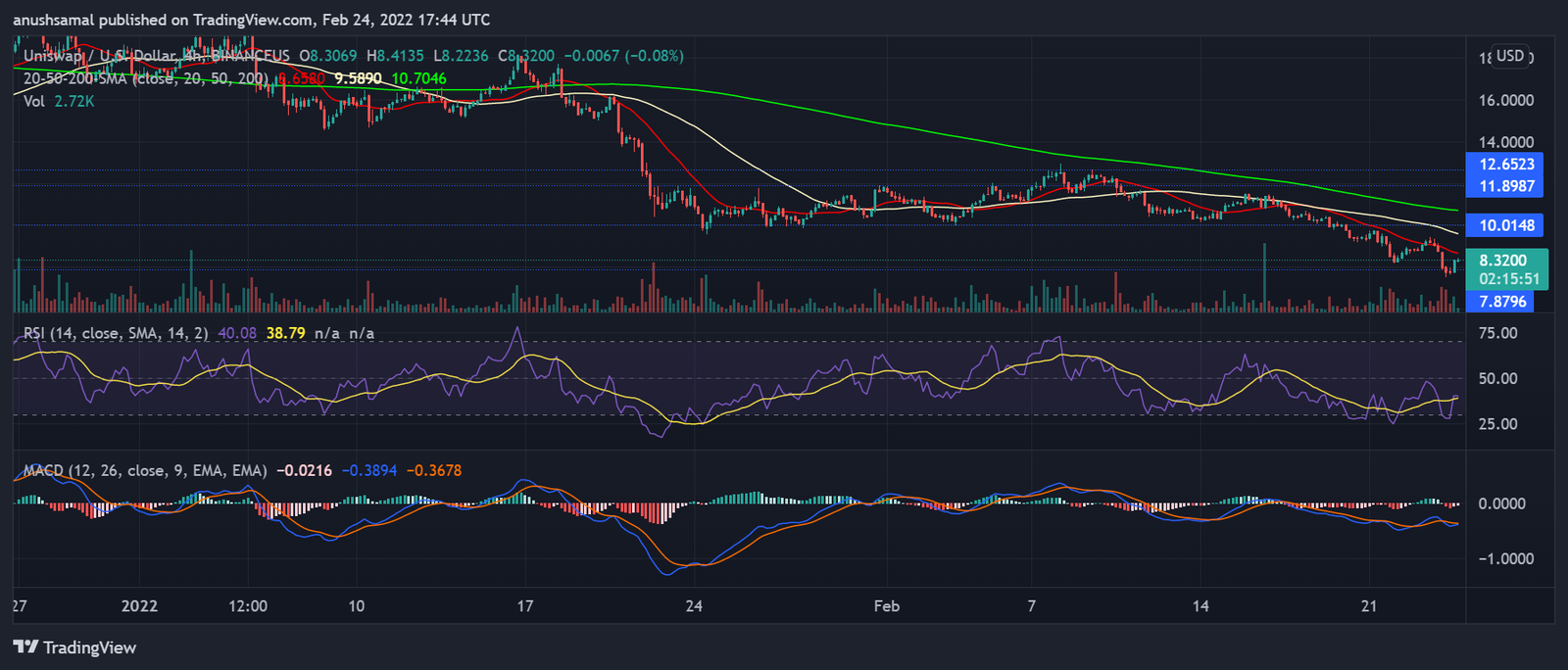
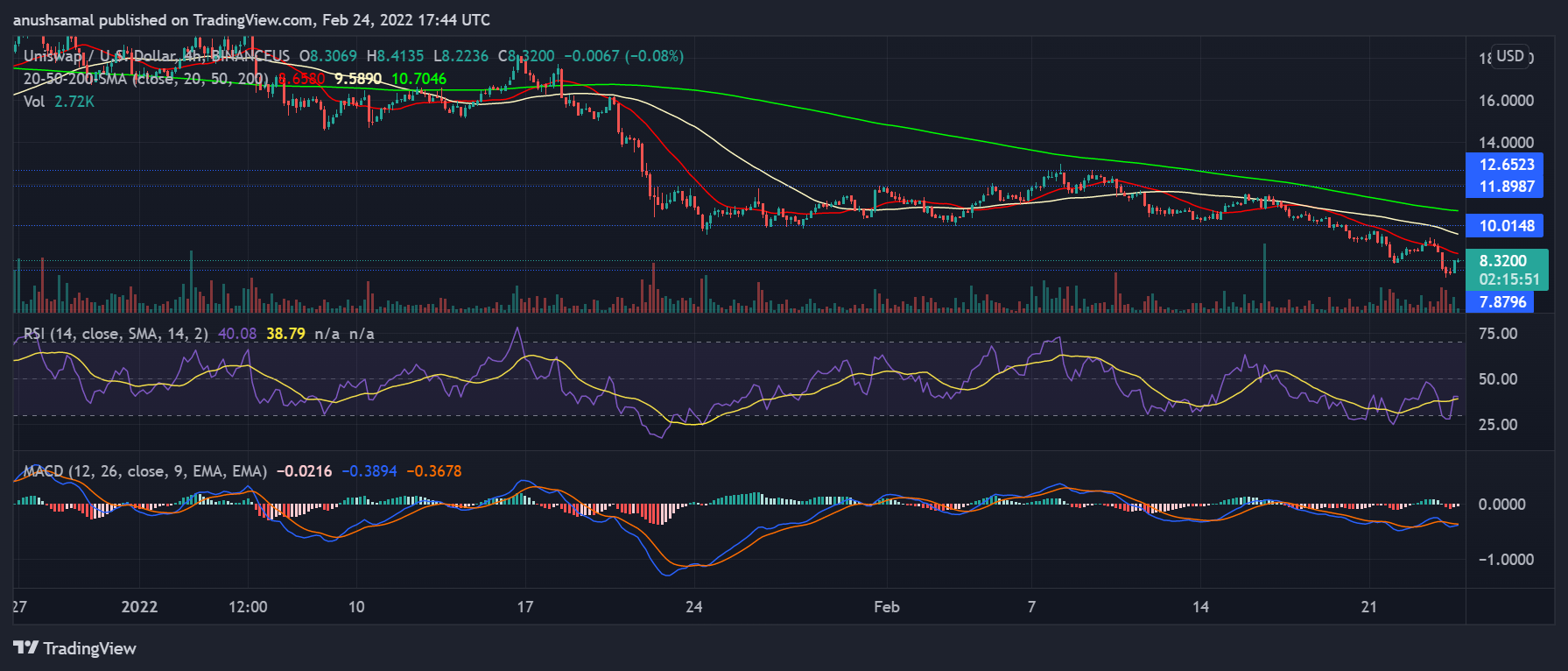
The broader crypto market jolted hard owing to the tension between Russia and Ukraine. Uniswap broke below its crucial support level and was priced at $8.32. Bitcoin slid off its charts at press time, after noting a 9% depreciation. The crypto market had barely recovered from the December crash.
With the Russia and Ukraine tension intensifying most altcoins have again lost much of their strength. Uniswap for instance at the current price level flashed a yearly low too.
Uniswap had registered an all-time high of $45 in the month of May, last year post which the coin continued to dip on its charts. The coin breached its long holding support level of $12.65 and broke below a series of resistance lines.
Related Article | Bloomberg Strategist: This Is The Defining Moment To Buy Bitcoin
Uniswap Price Analysis: Four-Hour Chart
Image Source: UNI/USD TradingView
Uniswap was priced at $8.32 and was closing near its immediate support level of $7.87. In the last 24 hours, UNI lost 7% of its value and over the last week, the coin had shed almost 24% of its value. The coin had tried to consolidate near its $12.65 support line, post which UNI continued to move in a downtrend.
After the coin breached the aforementioned support line, UNI had tried to hold itself above the price floor of $8.36, however, the coin broke below the $8.36 price mark. Uniswap had also tried to bounce back from the $8.36 and touch the $9.26 price mark.
If the coin continues to trade beneath the $10.01 price floor, which UNI had retested a couple of times then there could be chances that UNI would dip below the support level of $7.87.
The coin has remained under brought for almost one week now, forcing the coin to touch a yearly low. The last time UNI traded at this price mark it was in the month of January 2021. A fall from the $7.87 would push UNI to trade between the $6 and $5.88 price levels.
Rationale
The technical outlook of Uniswap was quite bearish at the time of writing, over the past week UNI had displayed a consistent bearish outlook. Ever since UNI started dipping down from the $10.01 support line, buyers started to exit the market.
Related Reading | Russia Can Avoid Sanctions By Using A Wide Range Of Cryptocurrency Tools
The aforementioned situation had pushed the UNI to the oversold area. The Relative Strength Index was parked underneath the half-line, which indicated that buying strength was absent in the market and selling pressure dominated the coin. Although RSI had noted a slight uptick, at press time the indicator again started to side with the bears.
UNI was trading beneath the 20-SMA line, which is indicative of a bearish outlook. The sellers in the market were responsible for driving the price momentum of the market.
MACD underwent a bearish crossover and the coin started to depict red histograms at the time of writing. This reading meant that the market trend continued to act in accordance with the bears in the market.
In the past, earning money through games was only possible by uploading gaming videos online, streaming game content and playing competitively through esports. But in 2021, many realized that through blockchain, gamers can earn money simply by playing.
This trend may continue in 2022 as play-to-earn (P2E) business models become more developed and blockchain adoption in esports becomes more mainstream. In a report published by gaming insight company Newzoo, the firm predicts that P2E models will become more viable in 2022 as gaming companies try to adopt blockchain.
“Publishers might use blockchain technology to facilitate more secure and legitimized player-to-player trading within a centralized game environment.”
Additionally, the need to diversify earning streams may lead esports organizations to turn to blockchain-based earning mechanisms by utilizing nonfungible tokens. Because of this, new esports business models involving blockchain are starting to emerge and will have more developments in 2022 according to Newzoo.
Apart from these, the report shows that metaverse-related games may also become more prevalent as younger players continue to frequent existing “proto-metaverse” games like Roblox, Fortnite and Minecraft.
Games are playing a key role in shaping the #metaverse. But who are the #metaverse players?
We zoomed in on people who play proto-metaverse games like #Roblox, #Fortnite, and #Minecraft to find out. ️♂️
Newzoo also predicts that “the brand gold rush for virtual real estate is only just beginning.” As companies continue to see the potential opportunities within metaverse games, more investments may flow to virtual real estate.
Related: Warner Music Group announces partnership with blockchain gaming developer Splinterlands
At the moment, Pokemon-inspired Axie Infinity continues to be at the top of the blockchain gaming ecosystem. However, Cointelegraph experts note that games like DeFi Kingdoms, Crabada or Yield Hunt have the potential to eventually replace Axie Infinity and take the top spot within the blockchain gaming industry.
Meanwhile, apart from playing games, the blockchain gaming community has also taken steps to give back to those in need by donating to charitable causes. Back in 2021, the community raised $1.4 million to help victims of a typhoon.
Japan’s largest lender, Mitsubishi UFJ Financial Group (MUFG) announced on Tuesday the decision to shut down the blockchain-based online payments network, Global Open Network Japan that was developed in collaboration with Akamai Technologies.
The bank has already started the preparation of the stuttering and cited a tough environment in the payments
Payments
One of the bases of mediums of exchange in the modern world, a payment constitutes the transfer of a legal currency or equivalent from one party in exchange for goods or services to another entity. The payments industry has become a fixture of modern commerce, though the players involved and means of exchange have dramatically shifted over time.In particular, a party making a payment is referred to as a payer, with the payee reflecting the individual or entity receiving the payment. Most commonly the basis of exchange involves fiat currency or legal tender, be it in the form of cash, credit or bank transfers, debit, or checks. While typically associated with cash transfers, payments can also be made in anything of perceived value, be it stock or bartering – though this is far more limited today than it has been in the past.The Largest Players in the Payments IndustryFor most individuals, the payments industry is dominated currently by card companies such as Visa or Mastercard, which facilitate the use of credit or debit expenditures. More recently, this industry has seen the rise of Peer-to-Peer (P2P) payments services, which have gained tremendous traction in Europe, the United States, and Asia, among other continents.One of the biggest parameters for payments is timing, which looms as a crucial element for execution. By this metric, consumer demand incentivizes technology that prioritizes the fastest payment execution.This can help explain the preference for debit and credit payments overtaking check or money orders, which in previous decades were much more commonly utilized. A multi-billion-dollar industry, the payments space has seen some of the most innovation and advances in recent years as companies look to push contactless technology with faster execution times.
One of the bases of mediums of exchange in the modern world, a payment constitutes the transfer of a legal currency or equivalent from one party in exchange for goods or services to another entity. The payments industry has become a fixture of modern commerce, though the players involved and means of exchange have dramatically shifted over time.In particular, a party making a payment is referred to as a payer, with the payee reflecting the individual or entity receiving the payment. Most commonly the basis of exchange involves fiat currency or legal tender, be it in the form of cash, credit or bank transfers, debit, or checks. While typically associated with cash transfers, payments can also be made in anything of perceived value, be it stock or bartering – though this is far more limited today than it has been in the past.The Largest Players in the Payments IndustryFor most individuals, the payments industry is dominated currently by card companies such as Visa or Mastercard, which facilitate the use of credit or debit expenditures. More recently, this industry has seen the rise of Peer-to-Peer (P2P) payments services, which have gained tremendous traction in Europe, the United States, and Asia, among other continents.One of the biggest parameters for payments is timing, which looms as a crucial element for execution. By this metric, consumer demand incentivizes technology that prioritizes the fastest payment execution.This can help explain the preference for debit and credit payments overtaking check or money orders, which in previous decades were much more commonly utilized. A multi-billion-dollar industry, the payments space has seen some of the most innovation and advances in recent years as companies look to push contactless technology with faster execution times. Read this Term space behind the move. “Slow growth of payment transaction numbers caused by the impact of the COVID-19 pandemic and other factors, made it difficult to develop its business on the scale originally anticipated,” the official press release stated.
Death of an Ambitious Project
MUFG and Akamai first announced their plans to form a joint venture in 2019 for the development of a blockchain payments system. However, the project faced delays before its launch in April 2021.
The Japanese bank owned 80 percent of the joint venture, and the rest was with Akamai.
One of the primary goals of the project was to provide a platform with high scalability
Scalability
Scalability is a term that describes the constraints of a network via hash rates to meet increased demand. In the context of Bitcoin, scalability reflects the issue in which a limited rate can process transactions adequately.Blocks within the Bitcoin blockchain are limited in both size and frequency. The overall transaction processing capacity of the network is dictated by the average block creation time of 10 minutes as well as a block size limit of 1 megabyte. Consequently, this leads to pain points in transaction processing, relative to other cryptos or traditional payments options. Inherent Scalability Issues with BitcoinBitcoin’s block size limit represents a true bottleneck in its design. This reflects the potential downside of a Proof-of-Work (PoW) system with Bitcoin’s consensus protocol.Lags in transaction processing capacity can result in increasing transaction fees and delayed processing of transactions that cannot be fit into a block.This is perhaps one of Bitcoin’s most pressing issues long term, an issue that has since head to the creation of other altcoins or networks to remedy this concern.There have also been many attempts to solve Bitcoin’s scalability problem through software upgrades.Increasing the network’s transaction processing limit requires making changes to the technical workings of bitcoin. This is where forks in the network can come into play, be it soft or hard forks.However, forks have resulted in the creation of entirely new cryptocurrency networks such as Bitcoin Cash, among others. Technical optimizations have also been floated to decrease the amount of computing resources required to process and record Bitcoin transactions. Presently there is no consensus on what the best solution to Bitcoin’s scalability is.
Scalability is a term that describes the constraints of a network via hash rates to meet increased demand. In the context of Bitcoin, scalability reflects the issue in which a limited rate can process transactions adequately.Blocks within the Bitcoin blockchain are limited in both size and frequency. The overall transaction processing capacity of the network is dictated by the average block creation time of 10 minutes as well as a block size limit of 1 megabyte. Consequently, this leads to pain points in transaction processing, relative to other cryptos or traditional payments options. Inherent Scalability Issues with BitcoinBitcoin’s block size limit represents a true bottleneck in its design. This reflects the potential downside of a Proof-of-Work (PoW) system with Bitcoin’s consensus protocol.Lags in transaction processing capacity can result in increasing transaction fees and delayed processing of transactions that cannot be fit into a block.This is perhaps one of Bitcoin’s most pressing issues long term, an issue that has since head to the creation of other altcoins or networks to remedy this concern.There have also been many attempts to solve Bitcoin’s scalability problem through software upgrades.Increasing the network’s transaction processing limit requires making changes to the technical workings of bitcoin. This is where forks in the network can come into play, be it soft or hard forks.However, forks have resulted in the creation of entirely new cryptocurrency networks such as Bitcoin Cash, among others. Technical optimizations have also been floated to decrease the amount of computing resources required to process and record Bitcoin transactions. Presently there is no consensus on what the best solution to Bitcoin’s scalability is. Read this Term and multi-connectivity data processing to meet the rising demand for the Internet of Things (IoT). In the shutdown notice, the bank pointed out that it struggled to fit its solution with the IoT growing market needs.
The joint venture, GO-NET Japan, is now coordinating with its clients and partners, and will eventually close all operations and then start the liquidation process. However, the Japanese bank highlighted that the shutdown of the project will not impact its financial results in the ongoing financial year.
Despite the shuttering of the project, MUFG is still bullish with plans of its other digital strategies and is discussing further collaboration with Akamai.
“MUFG is discussing further opportunities of collaboration with Akamai and seeking to drive momentum in open innovation through alliances with global business partners and by utilizing the latest technologies based on experience from the GO-NET project,” the lender added.
Japan’s largest lender, Mitsubishi UFJ Financial Group (MUFG) announced on Tuesday the decision to shut down the blockchain-based online payments network, Global Open Network Japan that was developed in collaboration with Akamai Technologies.
The bank has already started the preparation of the stuttering and cited a tough environment in the payments
Payments
One of the bases of mediums of exchange in the modern world, a payment constitutes the transfer of a legal currency or equivalent from one party in exchange for goods or services to another entity. The payments industry has become a fixture of modern commerce, though the players involved and means of exchange have dramatically shifted over time.In particular, a party making a payment is referred to as a payer, with the payee reflecting the individual or entity receiving the payment. Most commonly the basis of exchange involves fiat currency or legal tender, be it in the form of cash, credit or bank transfers, debit, or checks. While typically associated with cash transfers, payments can also be made in anything of perceived value, be it stock or bartering – though this is far more limited today than it has been in the past.The Largest Players in the Payments IndustryFor most individuals, the payments industry is dominated currently by card companies such as Visa or Mastercard, which facilitate the use of credit or debit expenditures. More recently, this industry has seen the rise of Peer-to-Peer (P2P) payments services, which have gained tremendous traction in Europe, the United States, and Asia, among other continents.One of the biggest parameters for payments is timing, which looms as a crucial element for execution. By this metric, consumer demand incentivizes technology that prioritizes the fastest payment execution.This can help explain the preference for debit and credit payments overtaking check or money orders, which in previous decades were much more commonly utilized. A multi-billion-dollar industry, the payments space has seen some of the most innovation and advances in recent years as companies look to push contactless technology with faster execution times.
One of the bases of mediums of exchange in the modern world, a payment constitutes the transfer of a legal currency or equivalent from one party in exchange for goods or services to another entity. The payments industry has become a fixture of modern commerce, though the players involved and means of exchange have dramatically shifted over time.In particular, a party making a payment is referred to as a payer, with the payee reflecting the individual or entity receiving the payment. Most commonly the basis of exchange involves fiat currency or legal tender, be it in the form of cash, credit or bank transfers, debit, or checks. While typically associated with cash transfers, payments can also be made in anything of perceived value, be it stock or bartering – though this is far more limited today than it has been in the past.The Largest Players in the Payments IndustryFor most individuals, the payments industry is dominated currently by card companies such as Visa or Mastercard, which facilitate the use of credit or debit expenditures. More recently, this industry has seen the rise of Peer-to-Peer (P2P) payments services, which have gained tremendous traction in Europe, the United States, and Asia, among other continents.One of the biggest parameters for payments is timing, which looms as a crucial element for execution. By this metric, consumer demand incentivizes technology that prioritizes the fastest payment execution.This can help explain the preference for debit and credit payments overtaking check or money orders, which in previous decades were much more commonly utilized. A multi-billion-dollar industry, the payments space has seen some of the most innovation and advances in recent years as companies look to push contactless technology with faster execution times. Read this Term space behind the move. “Slow growth of payment transaction numbers caused by the impact of the COVID-19 pandemic and other factors, made it difficult to develop its business on the scale originally anticipated,” the official press release stated.
Death of an Ambitious Project
MUFG and Akamai first announced their plans to form a joint venture in 2019 for the development of a blockchain payments system. However, the project faced delays before its launch in April 2021.
The Japanese bank owned 80 percent of the joint venture, and the rest was with Akamai.
One of the primary goals of the project was to provide a platform with high scalability
Scalability
Scalability is a term that describes the constraints of a network via hash rates to meet increased demand. In the context of Bitcoin, scalability reflects the issue in which a limited rate can process transactions adequately.Blocks within the Bitcoin blockchain are limited in both size and frequency. The overall transaction processing capacity of the network is dictated by the average block creation time of 10 minutes as well as a block size limit of 1 megabyte. Consequently, this leads to pain points in transaction processing, relative to other cryptos or traditional payments options. Inherent Scalability Issues with BitcoinBitcoin’s block size limit represents a true bottleneck in its design. This reflects the potential downside of a Proof-of-Work (PoW) system with Bitcoin’s consensus protocol.Lags in transaction processing capacity can result in increasing transaction fees and delayed processing of transactions that cannot be fit into a block.This is perhaps one of Bitcoin’s most pressing issues long term, an issue that has since head to the creation of other altcoins or networks to remedy this concern.There have also been many attempts to solve Bitcoin’s scalability problem through software upgrades.Increasing the network’s transaction processing limit requires making changes to the technical workings of bitcoin. This is where forks in the network can come into play, be it soft or hard forks.However, forks have resulted in the creation of entirely new cryptocurrency networks such as Bitcoin Cash, among others. Technical optimizations have also been floated to decrease the amount of computing resources required to process and record Bitcoin transactions. Presently there is no consensus on what the best solution to Bitcoin’s scalability is.
Scalability is a term that describes the constraints of a network via hash rates to meet increased demand. In the context of Bitcoin, scalability reflects the issue in which a limited rate can process transactions adequately.Blocks within the Bitcoin blockchain are limited in both size and frequency. The overall transaction processing capacity of the network is dictated by the average block creation time of 10 minutes as well as a block size limit of 1 megabyte. Consequently, this leads to pain points in transaction processing, relative to other cryptos or traditional payments options. Inherent Scalability Issues with BitcoinBitcoin’s block size limit represents a true bottleneck in its design. This reflects the potential downside of a Proof-of-Work (PoW) system with Bitcoin’s consensus protocol.Lags in transaction processing capacity can result in increasing transaction fees and delayed processing of transactions that cannot be fit into a block.This is perhaps one of Bitcoin’s most pressing issues long term, an issue that has since head to the creation of other altcoins or networks to remedy this concern.There have also been many attempts to solve Bitcoin’s scalability problem through software upgrades.Increasing the network’s transaction processing limit requires making changes to the technical workings of bitcoin. This is where forks in the network can come into play, be it soft or hard forks.However, forks have resulted in the creation of entirely new cryptocurrency networks such as Bitcoin Cash, among others. Technical optimizations have also been floated to decrease the amount of computing resources required to process and record Bitcoin transactions. Presently there is no consensus on what the best solution to Bitcoin’s scalability is. Read this Term and multi-connectivity data processing to meet the rising demand for the Internet of Things (IoT). In the shutdown notice, the bank pointed out that it struggled to fit its solution with the IoT growing market needs.
The joint venture, GO-NET Japan, is now coordinating with its clients and partners, and will eventually close all operations and then start the liquidation process. However, the Japanese bank highlighted that the shutdown of the project will not impact its financial results in the ongoing financial year.
Despite the shuttering of the project, MUFG is still bullish with plans of its other digital strategies and is discussing further collaboration with Akamai.
“MUFG is discussing further opportunities of collaboration with Akamai and seeking to drive momentum in open innovation through alliances with global business partners and by utilizing the latest technologies based on experience from the GO-NET project,” the lender added.
New York, USA, 22.2.22 — NFT marketplace, Mintable, is sending 3 NFTs that were stolen in a recent OpenSea exploit, back to their rightful owners. They found the NFTs on the LooksRare marketplace, which has garnered its own reputation for over USD 10 billion in wash trading and stolen NFTs, while acquiring NFTs for Mintable’s most recent flash sale.
KR1, a blockchain and crypto-asset investment company, has now announced it has participated in the HydraDX (HDX) crowdloan and Polkadot (DOT) parachain auction. KR1 contributed a total of 350,000.00 DOT to the HydraDX crowdloan campaign, which successfully secured a parachain slot in the ongoing round of Polkadot parachain auctions.
HydraDX.io is a cross-chain liquidity protocol designed to enable frictionless liquidity for crypto assets across various chains. In contrast to most decentralized exchanges in production today, which rely on separate pools for separate assets, HydraDX’s solution enables deposits of ‘all’ assets into one shared liquidity pool, the ‘Omnipool’, unlocking unparalleled efficiencies.
The contributed DOT will be time-locked on the Polkadot blockchain for 96 weeks and will be returned to KR1 following the completion of the respective HydraDX parachain lease. Following the successful HydraDX parachain auction bid, KR1 is going to receive a to-be-determined amount of HydraDX tokens over a time period of 96 weeks in return for supporting the HydraDX crowdloan campaign.
This method of token distribution involves no direct investment of capital, instead, it is an indirect investment with the opportunity costs being the inaccessibility of the locked DOT funds as well as foregoing any staking yields on the contributed DOT for the time period.
In addition, KR1 will receive a total of 45,000,000 HDX tokens (and a yet-to-be-determined amount of Basilisk (BSX) tokens) in line with KR1’s previous backing of HydraDX’s seed funding round that was announced on December 22nd, 2020, and a much smaller, yet-to-be-determined amount of HDX tokens in line with the company’s contribution to Basilisk’s Kusama crowdloan campaign and parachain auction that was announced on September 22nd, 2021.
HDX is the native token of HydraDX. It will be used for governance, staking, and more.
“HydraDX winning a Polkadot parachain slot is the next big step for the project and a huge endorsement by the community of the protocol’s objective to bring all liquidity together in an ‘ocean of liquidity.’ We see HydraDX as the endgame of liquidity in a cross-chain world and we have a high conviction rate in the team’s ability to achieve this goal.” – Keld van Schreven, Managing Director & Co-Founder of KR1
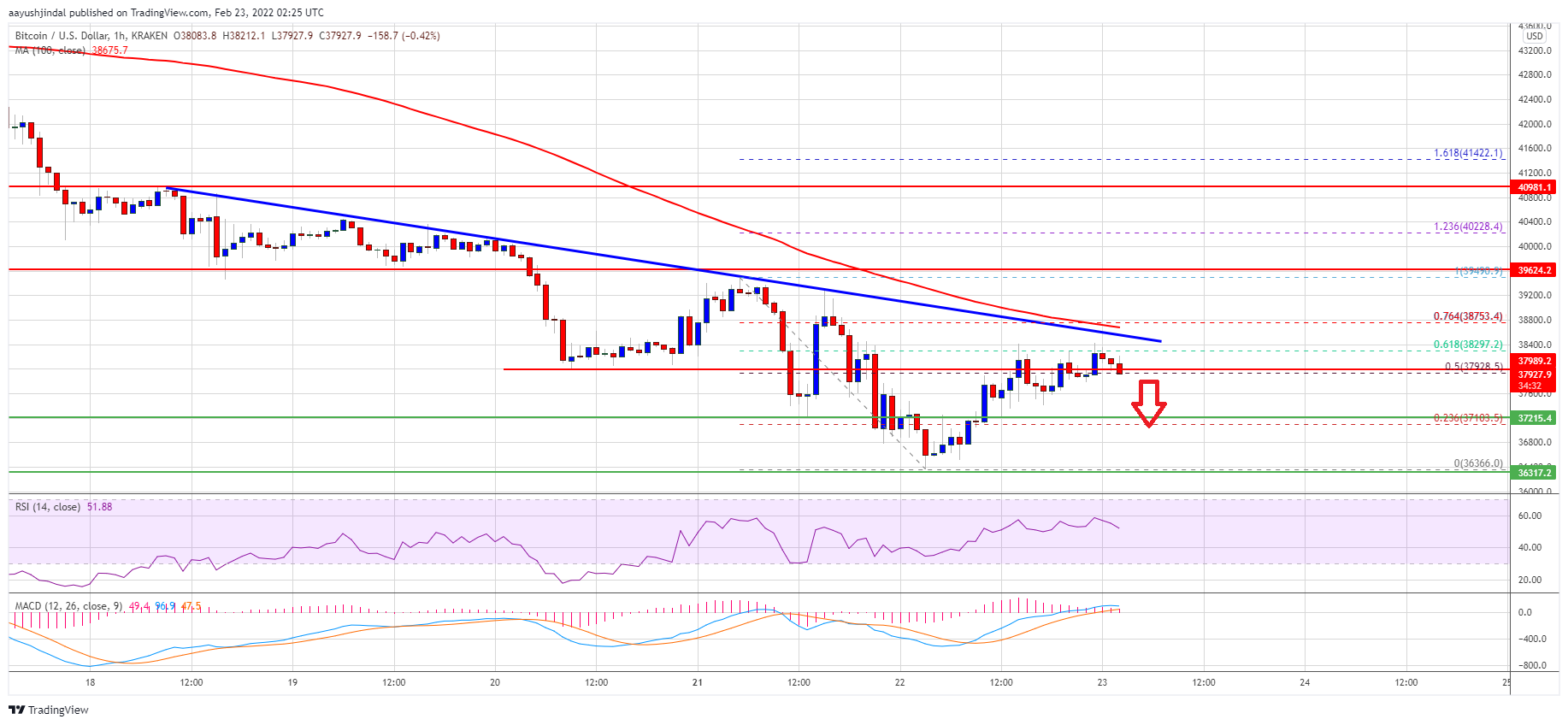
Bitcoin is struggling to recover above the $38,400 resistance zone against the US Dollar. BTC could resume decline if it stays below the $38,500 level.
Bitcoin is currently facing resistance near the $38,400 and $38,500 levels.
The price is trading below $38,500 and the 100 hourly simple moving average.
There is a crucial bearish trend line forming with resistance near $38,450 on the hourly chart of the BTC/USD pair (data feed from Kraken).
The pair could start a fresh decline if there is no clear move above $38,500.
Bitcoin Price Faces Hurdle
Bitcoin price found support near the $36,350 after a sharp decline. BTC formed a base and started a recovery wave above the $37,000 level. The price was able to surpass the $37,500 resistance level.
The bulls pushed the price above the 50% Fib retracement level of the key decline from the $39,492 swing high to $36,366 low. There was also a push above the $38,000 level. However, the price is now facing a strong resistance near the $38,250 level.
The 61.8% Fib retracement level of the key decline from the $39,492 swing high to $36,366 low is also near the $38,250 level. The next key resistance is near the $38,400 level.
There is also a crucial bearish trend line forming with resistance near $38,450 on the hourly chart of the BTC/USD pair. A clear move above the trend line resistance could send the price to $38,800 and the 100 hourly simple moving average.
Source: BTCUSD on TradingView.com
To gain bullish momentum, the price must settle above the $38,800 level. In the stated case, there are chances of a move above the $39,500 resistance.
Fresh Decline in BTC?
If bitcoin fails to start a recovery wave above the $38,400 resistance zone, it could start a fresh decline. An immediate support on the downside is near the $37,250 zone.
The next major support is seen near the $37,000 level. If there is a downside break below the $37,000 support zone, the price might gain bearish momentum for a move to $36,000. Any more losses could lead the price to $35,000.
Technical indicators:
Hourly MACD – The MACD is now losing pace in the bullish zone.
Hourly RSI (Relative Strength Index) – The RSI for BTC/USD is declining towards the 50 level.
Major Support Levels – $37,250, followed by $37,000.
Major Resistance Levels – $38,250, $38,400 and $39,500.
This report updates on what WEFUZZ, Coinbase Crypto Community Fund grant recipient, has been working on over the first part of their year-long Crypto development grant. This specifically covers their work on a decentralized, crowdsourced security audit and bug bounty solution.
By WEFUZZ, Coinbase Crypto Community Fund grant recipient
WEFUZZ implements a fully decentralized, crowdsourced security audit and bug bounty solution: a set of smart contracts that allow developers and companies to get their smart contracts, blockchains, websites, etc., audited by the auditors and hackers community. With this work, WEFUZZ aims to become the *Hacker DAO*.
Crowdsourcing is a sourcing model in which individuals or organizations obtain goods or services — including ideas, voting, micro-tasks etc., from a large, relatively open, and rapidly evolving group of participants. Companies like Uber, Gitcoin and GoJek already use this model. Crowdsourcing model offers improved costs, speed, quality, flexibility, scalability, and diversity.
The traditional crowdsourcing system consists mainly of three roles: requesters, workers (auditors in our case), and a centralized system. Requesters submit tasks to be completed through the crowdsourcing system. A set of auditors complete this task and submit solutions to the crowdsourcing system. Requesters will then select a proper solution (usually the first or the best one that solves the task) and reward the corresponding worker
This makes centralized systems vulnerable. User’s sensitive information (e.g. name, email address etc.,) and vulnerability reports are saved in the database of these centralized systems, which has the inherent risk of privacy disclosure and data loss. Centralized choke points are not only attack vectors for leaks and hacks, but also for outages.
Crowdsourcing companies are keen on maximizing their benefits and require requesters paying for services, which in turn increase user’s costs. Most crowdsourcing systems demand a 10–25% service fee.
All these issues add up to the already existing concerns of smart contract and multi-chains owners and developers (the audit requesters), freelance auditors’ and ethical hackers’ concerns. Some of these concerns are:
Ensuring their assets are safe from cyber theft, data hacks or any other risk that can result in a loss of funds and compromised data
Being able to get audits done in a cost-effective way — be it private or public security audits
Making sure the smart contracts are audited by multiple auditors
Hackers do not want to share sensitive personal data
Hackers and auditors and developers need complete transparency
WEFUZZ is a fully decentralized, crowdsourced audit and bug bounty platform aiming to be the Hacker DAO. WEFUZZ aims to provide reliability, fairness, security and low service fees by design.
The decentralized platform has many advantages such as higher user security, service availability, and lower costs. Smart contracts running on a chosen blockchain are used to perform the whole process of crowdsourcing tasks which contains posting audit and bounty campaigns, submitting audit and bug reports, bounty assignment, etc.
WEFUZZ solution offers numerous added benefits to users:
Data Security: Reports are encrypted with auditors’ and target developers’ public key, so that the bug reports only gets read by who it is intended for. Files are encrypted and stored on the decentralized network storage. No more data breaches, hacks, password leaks or any other risk affecting existing cloud based audit and bug bounty platforms.
Cost Effectiveness: Allowing smart contract developers, multi-chain developers, and companies to get audits performed in a cost-effective way directly by the auditors and hacker crowd on the WEFUZZ platform. This helps the developers and companies avoid huge fees and congestion issues affecting the traditional bug bounty platforms.
Flexible anonymity: Auditors and hackers can choose to remain anonymous while submitting reports, protecting their privacy, and still getting paid.
Communication Security: No centralized data storage, complete anonymity, no data transfers, no moderators and complete end-to-end encryption. All the data resides encrypted on the Solana blockchain and all the files reside on the IPFS blockchain.
Audit Requestors: Developers, companies or any individual can request audits or start a private/public bug bounty campaign.
Auditors: Auditors can be anyone from ethical hackers to audit firms who can perform the requested audits or participate in bug bounty campaigns.
Judges: Judges are community members who are either elected by the community or have been raised to the Judge category through reputation.
Currently, we are working on the conceptualization, technical architecture, and system design of WEFUZZ, besides building our MVP on Solana and Polygon blockchains, and testing the optimal chain for our project.
Please join our Discord and follow us on our Twitter and Medium to keep track of the progress. We are going to release the code and other tools we build as part of the research and development in this Github account.
Dubai, U.A.E., February 22nd, 2022 — MRHB DeFi, the world’s first ethics-based decentralized finance (DeFi) platform, is announcing the 22.2.22 launch of Sahal Wallet, a non-custodial cryptocurrency wallet that functions as a gateway to the entire MRHB ecosystem of ethical DeFi products.
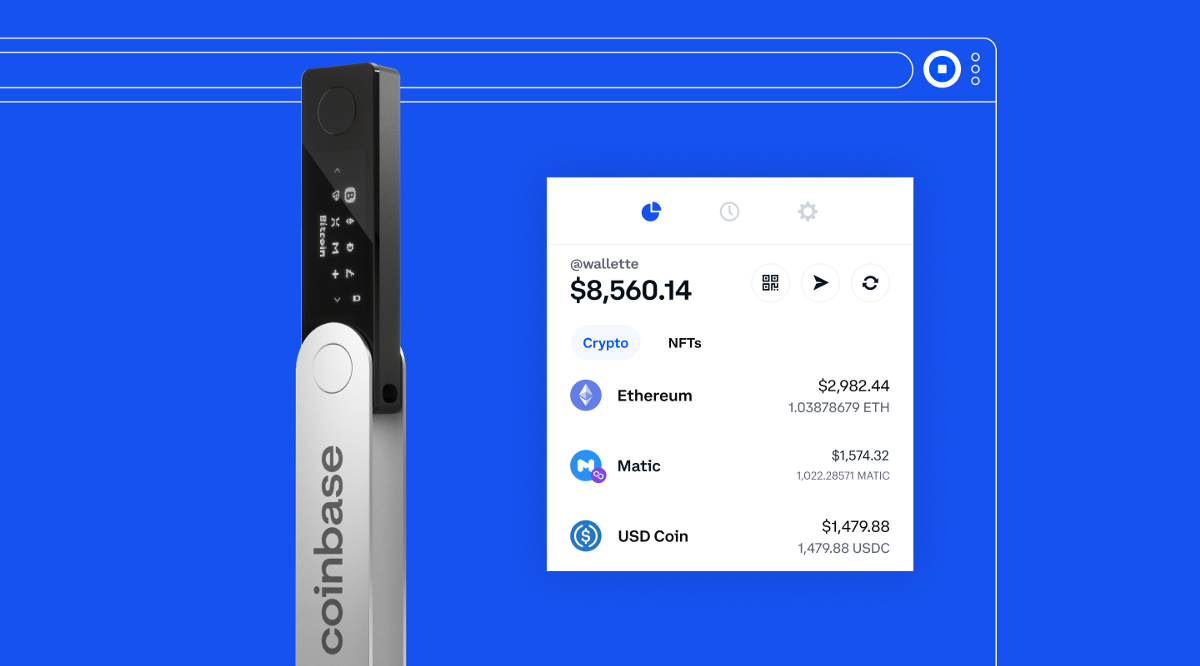
Since launching the Coinbase Wallet browser extension as a standalone self-custody option in November, we’ve seen incredible adoption. Wallet extension makes it even easier to explore web3 by bringing the world of decentralized apps (dapps) to more devices. Today, we’re adding support for Ledger hardware wallets to Coinbase Wallet extension, providing an additional layer of security and greater peace of mind for our users.
Ledger is an industry leader in hardware wallets, with more than 4 million people putting their trust in Ledger to keep their crypto safe. To celebrate today’s launch, we have partnered with Ledger to release the Nano X Coinbase Edition, which is available for a limited time in Ledger’s online store.
Building the most user-friendly self-custody experience in crypto means giving our users more ways to keep their crypto secure while they access web3 and the world of crypto. And today’s launch is just the beginning — we will continue to build out support for more hardware wallets across all of our users’ devices.
Coinbase Wallet is your passport to collecting NFTs, participating in DeFi, joining a DAO, and so much more. As you start to live more of your life on the blockchain, it’s more important than ever to keep your assets safe.
Fortunately, there are many steps you can take to keep you and your assets safe as you explore web3. It all starts with your recovery phrase, backing it up in a secure location, and making sure to never share it with anyone. And as a reminder, Coinbase will never ask you for your recovery phrase.
Coinbase Wallet offers additional layers of security for our users. For users of Wallet browser extension, we recommend adding a password to keep your assets safe. And in the Coinbase Wallet mobile app, you can use biometrics or a PIN to secure your Wallet.
Today, we are adding support for Ledger hardware wallets in the Coinbase Wallet browser extension, introducing an additional security option for our users. Hardware wallets are physical devices that store the private keys to your crypto wallet offline. Because every transaction on the blockchain requires both a user’s public and private keys, a hardware wallet ensures that only the user who holds the physical device can complete a transaction.
Using a hardware wallet is a lot like using two factor authentication to secure a website login, but instead of a six digit code that is sent as an SMS or generated in an authenticator app, your hardware wallet is used to physically confirm transactions with the press of a button.
Whether you are a first-time hardware wallet user or already have a Ledger it is easy to use Coinbase Wallet to connect to the ever-growing world of NFTs, dapps, and DeFi. All you need to do is download the Coinbase Wallet browser extension, connect your Ledger to your computer, and follow the on-screen instructions.
While today’s launch brings support for Ledger devices to the Wallet extension, we have ambitious plans to support more types of hardware wallets not only in Coinbase Wallet extension, but with our mobile apps as well. We will soon also add support for users with multiple active wallet addresses on a single Ledger device to select which address they want to use with Coinbase Wallet.
We want to empower everyone to use dapps and access web3, and that requires building the easiest-to-use and most accessible self-custody wallet in the ecosystem. Today’s release solves another set of important user needs, including the ability to use a hardware wallet for enhanced security.
You can experience the latest enhancements for yourself by downloading Coinbase Wallet for free from the App Store on iOS, Google Play on Android, or the Chrome web store. Make sure to follow us on Twitter @CoinbaseWallet for the latest Wallet-related news.
Coinbase Wallet is a self-custody wallet providing software services subject to Coinbase Wallet Terms of Service and Privacy Policy. Coinbase Wallet is distinct from Coinbase.com, and private keys for Coinbase Wallet are stored directly by the user and not by Coinbase.com. Fees may apply. You do not need a Coinbase.com account to use Coinbase Wallet.
Ledger and the Ledger logo are registered trademarks of Ledger SAS. Purchase of the Ledger Nano X Coinbase Edition can be made on Ledger’s website and subject to Ledger Sales Terms and Conditions and Privacy Policy. Subject to availability.