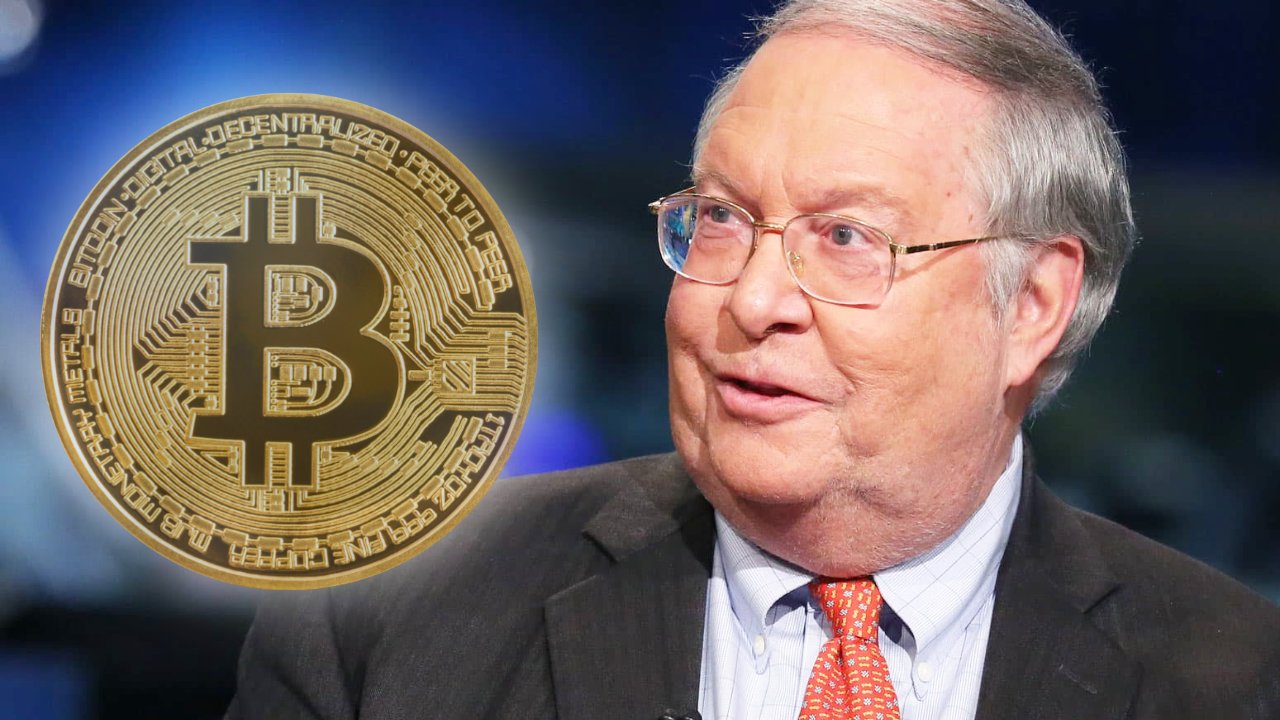
Billionaire Bill Miller, a seasoned billionaire investor, explains why he believes the current crypto outlook is very positive for Bitcoin.
Miller likens Bitcoin to digital gold when it comes to the digital currency. Other cryptos are simply “adventure investments” since they lack the uniqueness of Bitcoin, he said.
A fund manager, Miller highlighted that nearly half of Russia’s reserves are held in currencies controlled by individuals seeking to do them damage.
Miller, a co-founder of Miller Value Partners, spoke on the future of crypto in the face of Russia’s ongoing invasion of Ukraine.
Related Article | Criminal Whales Hold $25 Billion In Crypto Assets: Chainalysis Report
Crypto Outlook Favorable For Stakeholders
“The rest of crypto is a different story,” he said. The remainder of the cryptos could be called “adventure investments” since he believes they are all attempting to tackle different challenges.
The renowned value investor has been a long-term advocate of bitcoin. Last month, he revealed he had “a substantial” amount of bitcoin, and compared it to digital gold as a hedge against inflation.
He also referred to the current crypto outlook and Bitcoin as “insurance against financial disaster.”
Miller’s deep knowledge of investing and the stock market holds weight because of his vast business experience.
BTC total market cap at $740.14 billion in the daily chart | Source: TradingView.com
Russian Sanctions Good For Bitcoin?
Russia has 16% of its $640 billion in reserves in dollars, with 32% of assets denominated in euros.
According to Miller, they have 22% of their reserves in gold, which is the only component other nations cannot seize. He said:
“I believe this is very bullish for bitcoin.”
Several nations have slapped Russia with all sorts of sanctions since it attacked Ukraine.
As a result, the Russian currency and the stock prices of Russian enterprises listed on foreign exchanges have fallen precipitously.
European Union Commission President Ursula von der Leyen did not mince words, last week:
“We will paralyze the assets of Russia’s central bank,”
This announcement is expected to result in transactions being suspended and, in effect, will render the central bank unable to dispose of its assets.
War Drives Bitcoin Up: Devere CEO
Meanwhile, the CEO of Devere Group, Nigel Green, also shares the same level of optimism and has predicted that bitcoin’s price will reach $50,000 by the end of this month if the current outlook for the crypto is to be the gauge.
Bitcoin is now trading at $39,007. Green believes that the dollar’s standing as a global reserve currency might be threatened if viable and practical alternatives, such as cryptocurrency, emerge.
Related Article | Bitcoin Staggers After Putin’s Nuclear Deterrence Alert Warning
He said that the conflict between Russia and Ukraine has prompted people, corporations, and government agencies throughout the world to explore “alternatives to traditional systems” in response to the war.
According to Green, Bitcoin is now the 14th most valuable currency in the world, and he thinks it will rise much higher in the rankings in the coming months.
He said:
“Smart investors recognize this and will increase their exposure to cryptocurrencies before prices further climb.”
The Devere boss believes geopolitical tensions and institutional investors are driving the price of the (still) most sought-after crypto in the world.
Featured image from Bitcoin News, chart from TradingView.com
The number of Bitcoin millionaires, addresses with 1,000+ coins, has touched its highest level since April 2021. Glassnode’s on-chain data shows that 2,262 BTC addresses are now holding more than 1,000 coins.
According to the current price of Bitcoin, each of these addresses hold at least $40 million worth of cryptocurrency. “Number of addresses holding 1k+ coins just reached an 11-month high of 2,262,” Glassnode highlighted.
Despite price challenges and a drop in network activity, Bitcoin addresses holding more than 1,000 coins have increased. A sharp surge was observed at the start of March 2022. Relatively smaller Bitcoin holders with at least 1 BTC also joined the accumulation trend.
According to Glassnode, there are more than 820,000 addresses with at least $40,000 worth of BTC. “The number of BTC addresses holding 1+ Bitcoin just reached a 10-month high of 820,552,” the on-chain analytics platform mentioned.
BTC witnessed a decent rally at the start of March 2022 after global investors shifted their focus towards emerging assets. However, its price failed to sustain above $40,000 on Friday.
Bitcoin Adoption
The adoption of the digital asset kept rising at a rapid pace despite challenges in the recent weeks. In an interview with The Street, Jamie Iannone, CEO of eBay, said that the company is planning to explore the possibilities to accept digital currencies.
“Crypto adoption globally continues to soar and aligns with the thesis that we are in an accumulation phase. Ebay’s CEO hinted this week that they will soon integrate crypto payments, as they aim to capture GenZ and millennial audiences. This comes after the firm enabled NFT trading last year on its platform. Integrating crypto would be a great step for mainstream adoption, as eBay has around 160 million active buyers worldwide as of Q2 2021,” Marcus Sotiriou, Analyst at GlobalBlock, said.
The number of Bitcoin millionaires, addresses with 1,000+ coins, has touched its highest level since April 2021. Glassnode’s on-chain data shows that 2,262 BTC addresses are now holding more than 1,000 coins.
According to the current price of Bitcoin, each of these addresses hold at least $40 million worth of cryptocurrency. “Number of addresses holding 1k+ coins just reached an 11-month high of 2,262,” Glassnode highlighted.
Despite price challenges and a drop in network activity, Bitcoin addresses holding more than 1,000 coins have increased. A sharp surge was observed at the start of March 2022. Relatively smaller Bitcoin holders with at least 1 BTC also joined the accumulation trend.
According to Glassnode, there are more than 820,000 addresses with at least $40,000 worth of BTC. “The number of BTC addresses holding 1+ Bitcoin just reached a 10-month high of 820,552,” the on-chain analytics platform mentioned.
BTC witnessed a decent rally at the start of March 2022 after global investors shifted their focus towards emerging assets. However, its price failed to sustain above $40,000 on Friday.
Bitcoin Adoption
The adoption of the digital asset kept rising at a rapid pace despite challenges in the recent weeks. In an interview with The Street, Jamie Iannone, CEO of eBay, said that the company is planning to explore the possibilities to accept digital currencies.
“Crypto adoption globally continues to soar and aligns with the thesis that we are in an accumulation phase. Ebay’s CEO hinted this week that they will soon integrate crypto payments, as they aim to capture GenZ and millennial audiences. This comes after the firm enabled NFT trading last year on its platform. Integrating crypto would be a great step for mainstream adoption, as eBay has around 160 million active buyers worldwide as of Q2 2021,” Marcus Sotiriou, Analyst at GlobalBlock, said.
After two years and many COVID-19 restrictions finally subsiding, the world is welcoming the return of in-person theater, movies, comedy, music and sports. This has left some wondering what will happen to the legions of digital creatives who occupied and entertained us while normal life was at a standstill — and to the multibillion-dollar economy they inhabit.
Will the world forget the platforms and artists they discovered during the pandemic now the doors of festivals, fashion shows and concerts are open to them again? Is the creator economy, which recent estimates suggest will exceed $100 billion this year, strong enough to withstand a stampede back to real-life experiences?
I strongly believe it is. Government-imposed restrictions may have accelerated the pace of change, but the transformative trends in video streaming we witnessed during the pandemic were nascent before and would have caught hold regardless.
And, while I claim no deep training in macroeconomics, I am a technologist who has spent the past several years working in and around one of the most transformative new technologies to arise in decades: the blockchain. This is the technology that will completely reshape digital life, supercharging the creator economy in the process.
Related: Decentralization revolutionizes the creator’s economy, but what will it bring?
Playing on a digital stage
The enforced slowdown has given many artists the time — and the push — needed to experiment in the digital sphere, find new audiences and explore new ways to showcase their talents.
Even musicians who might never have given serious thought to live streaming a concert have taken to the digital stage. And, there’s evidence this will continue. Take singer Dua Lipa, who broke paid livestreaming records with 2020’s Studio 2054 concert. Initially said to be reluctant, Dua Lipa decided to go the livestream route after being forced to postpone an album tour. This turned out to be a good call: Her digital appearance drew more than five million views globally.
A survey from Middlesex University and funded by the UK Economic and Social Research Council showed that some 90% of musicians and 92% of fans believe livestreaming would remain an effective way to reach fans unwilling or unable to travel to venues in the post-pandemic world. Providers should take note: The study also found that audiences do not expect free access to live music and are not particularly discouraged by paywalls.
The rise in creative energy has inspired the developer community as well. New niche streaming platforms have grown up, helped by the emergence of low-cost decentralized infrastructure that allows application builders to encode video, store data and handle identity without having to pay expensive centralized cloud providers for such services.
Related: Music in the Metaverse creates social and immersive experiences for users
These centralized providers will increasingly find themselves on the defensive. Two attention-grabbing incidents in 2021 are illustrative: Hackers attacked Twitch and released private information about its code and its users to the world. And, Facebook suffered colossal reputational damage from a lengthy outage and whistleblower claims that its management has repeatedly chosen to prioritize profit over safety.
What comes next?
Big Tech’s woes and pandemic-related restrictions have sped up fundamental changes already underway in how the world produces, consumes and uses video content — changes likely to propel growth in the creator economy well into the future. And, given the increasing availability of low-cost decentralized blockchain infrastructure, these emerging players have a shot at mounting a serious challenge to the FAANG-run streaming providers.
There are five ways that blockchain will hasten growth in the creator economy, and help cement it as a central force in worldwide culture and entertainment:
Exclusivity: Nonfungible token- (NFT-) gated access and NFT ticketing are only two of the decentralized tools that improve the digital experience for event-goers: NFT tickets curb scalping while giving attendees a unique souvenir, all while token gating supports unique experiences for fans such as access to private groups and direct messaging with creators.
Fan ownership: The Web3 era is defined by the shift from extracting value from renters to accreting value to owners. Just as the blockchain enables fans to engage directly with their favorite creators, it offers a pathway to asset ownership in individual creator economies outside of traditional centralized platforms.
Low-cost streaming: Video streaming accounts for more than 80% of Web2 internet traffic and counting. Developers, eager to seize a piece of this market without being crushed by high costs, are increasingly seeking blockchain-based affordable infrastructure to support creator streams. With their new ability to draw global audiences through on-demand access-anywhere streams, creators are turning to uniquely Web3 features such as tipping, paid entry and live shopping to monetize their content.
Immersive interactivity: The one-way nature of Web2 publishing is already giving way to immersive interactivity that rewards users for participation. With the ability to record immutably and securely on the blockchain, creators can incentivize interactions without sacrificing privacy.
Niche down: While Web2 was built to scale up, Web3 is built to niche down. With its lower cost, increased security and resistance to censorship, the blockchain makes it possible to build micro-communities serving smaller niches than would be economically viable in Web2. That’s a fundamental shift that not only puts creators in control but also makes communities less appealing to attention-seeking trolls.
The stage has been set for a blossoming of creative activity, and those poised to take it will be assisted by decentralized infrastructure.
Related: The Metaverse will change the live music experience, but will it be decentralized?
Digital creatives have always recognized that they must be nimble to succeed. Now, there is a technology that will empower them and their analog peers to reach new audiences on their own terms without having to cede power or profit to tech behemoths like Google and Amazon.
My faith in the ability of musicians, gamers, influencers and creators to adapt to the new realities to come — and to thrive in them — has never been stronger.
The creator economy? The clue’s in the name.
This article does not contain investment advice or recommendations. Every investment and trading move involves risk, and readers should conduct their own research when making a decision.
The views, thoughts and opinions expressed here are the author’s alone and do not necessarily reflect or represent the views and opinions of Cointelegraph.
Doug Petkanics is a co-founder at Livepeer, where the team is building a decentralized live video broadcast platform to enable the next generation of video streaming. Prior to Livepeer, Doug was co-founder and CEO of Wildcard, a mobile browser. He also co-founded Hyperpublic, which was acquired by Groupon. He was the VP of Engineering at both.
MRHB DeFi recently announced a new strategic partnership with Sukhavati Labs, a decentralized cloud network service focused on storage. Now all NFTs minted on the MRHB DeFi network — such as on the SouqNFT Marketplace — will be stored in a secure and permissionless manner at a low cost on the decentralized Sukhavati network.
The recent dip in the price of Bitcoin is not impacting the mining activities across the BTC network. Nasdaq-listed Bitcoin mining company, Riot Blockchain recently announced its production and operation updates for February 2022 and reported a significant surge of 189% YoY in BTC production.
During the recent month, the company produced 436 Bitcoin, compared to 179 coins in the same period last year. As of 28 February 2022, the mining firm held almost 5,783 BTC, produced by Riot’s self-mining operations.
The Bitcoin mining company has expanded its hash rate substantially since the start of 2021. In the recent announcement, Riot provided updates on the expansion of its mining infrastructure.
“Throughout the month of February, Riot has continued to make progress on the first phase of its 200 MW immersion-cooled Bitcoin mining deployment, with over 10,000 S19j Pro Antminers now deployed in immersion-cooling tanks,” said Jason Les, the CEO of Riot Blockchain.
“We have begun the performance evaluation process and will be monitoring our immersion performance data closely over the next 60 days. As our team continues to build out our immersion operation, we are evaluating and assessing future opportunities to further leverage our expertise in immersion-cooling development and deployment,” Les added.
As a result of the company’s enhanced mining infrastructure, its profits increased during last year. In 2021, Riot Blockchain announced collaborations with several leading firms around the world, including Bitmain Technologies Limited for the purchase of S19j Antminers.
Hash Rate
While providing details about the estimated hash rate in 2022, Riot mentioned that it is planning to reach a total self-mining hash rate capacity of 12.8 EH/s by January 2023.
“Approximately 97% of Riot’s self-mining fleet will consist of the latest generation S19 series miner model. Upon full deployment of all currently contracted miners, the Company’s total self-mining fleet will consume approximately 370 MW of energy,” Riot highlighted.
The recent dip in the price of Bitcoin is not impacting the mining activities across the BTC network. Nasdaq-listed Bitcoin mining company, Riot Blockchain recently announced its production and operation updates for February 2022 and reported a significant surge of 189% YoY in BTC production.
During the recent month, the company produced 436 Bitcoin, compared to 179 coins in the same period last year. As of 28 February 2022, the mining firm held almost 5,783 BTC, produced by Riot’s self-mining operations.
The Bitcoin mining company has expanded its hash rate substantially since the start of 2021. In the recent announcement, Riot provided updates on the expansion of its mining infrastructure.
“Throughout the month of February, Riot has continued to make progress on the first phase of its 200 MW immersion-cooled Bitcoin mining deployment, with over 10,000 S19j Pro Antminers now deployed in immersion-cooling tanks,” said Jason Les, the CEO of Riot Blockchain.
“We have begun the performance evaluation process and will be monitoring our immersion performance data closely over the next 60 days. As our team continues to build out our immersion operation, we are evaluating and assessing future opportunities to further leverage our expertise in immersion-cooling development and deployment,” Les added.
As a result of the company’s enhanced mining infrastructure, its profits increased during last year. In 2021, Riot Blockchain announced collaborations with several leading firms around the world, including Bitmain Technologies Limited for the purchase of S19j Antminers.
Hash Rate
While providing details about the estimated hash rate in 2022, Riot mentioned that it is planning to reach a total self-mining hash rate capacity of 12.8 EH/s by January 2023.
“Approximately 97% of Riot’s self-mining fleet will consist of the latest generation S19 series miner model. Upon full deployment of all currently contracted miners, the Company’s total self-mining fleet will consume approximately 370 MW of energy,” Riot highlighted.
Ethereum has mostly mirrored bitcoin’s run in the recent rally. This has seen the digital asset break as high as $3,000 once again for the year. This point which has proved elusive for the cryptocurrency has continued to give it a hard time. In previous times, Ethereum has had a had time staying above this level. Such has been the case this time around as it fails to secure its spot above e$3K.
Ethereum On The Decline
Like all other cryptocurrencies, Ethereum is a highly volatile asset and as such is subject to wild fluctuations in its price. For the last few months, it has fluctuated but remained mostly around the $2,600 to $ 2,800=0 level. With the recent rally, it was finally able to break out of this trend and begin a whole new one, one which saw it rise above the coveted $3K level.
Related Reading | TA: Ethereum Prints Bearish Pattern, Why It Could Correct To $2.8K
Nevertheless, this recovery would prove to be short-lived given that ETH could not maintain this position. Meeting fierce resistance from the bears at the $3,000 point, the digital asset was unable to form any meaningful support above it. This meant that the price crumbled below it but it would prove to be a continuous downward trend given the current indicators.
The fall below $3k saw the digital asset trading below its 50-day moving average. Now, this is an incredibly important point for cryptocurrencies in general given their high volatility. Since buyers are unwilling to purchase the digital asset at prices they did over the past few weeks, it indicates that Ethereum is still a seller’s market. Thus, it is expected that there will be a continuous downtrend as more coins are dumped on the market.
ETH falls below $3k | Source: ETHUSD on TradingView.com
This however does not spell bad news all around though. A market like ETH’s can quickly switch up and turn into a buyer’s market, especially when prices are as low as they are right now. If this happens, then Ethereum could very well see another 10% bounce that will cement its position above the $3k resistance point.
Market Sentiments Falls To Fear
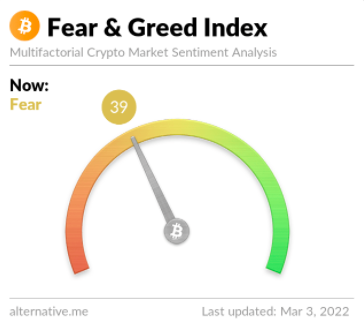
The Fear & Greed Index had moved out of the fear territory back into a neutral point at the start of the week but this new wave of positive sentiment did not hold. The index has now moved back into fear at a current score of 39 as at the time of this writing, showing that despite recent rallies, investor sentiments are still more negative than anything.
Related Reading | Terra (LUNA) Outperforms Popular Cryptos Ether, Dogecoin In The Past 24 Hours
Ethereum and the crypto market are directly affected by investor sentiment as they show when investors are likely to put money in the market. Currently, with the index in fear, it shows that investors are very wary of putting money in the market. However, this does not necessarily spell bad news for ETH.
Market sentiments drop to fear | Source: Alternative.me
Usually, when most investors are fearful, it can present a good buying opportunity. In the past, whales have been known to take advantage of moments like these to fill their bags. If so, then ETH can kickstart another rally. But only a large absorption of current supply can start the digital asset on this path.
Featured image from CNBC, chart from TradingView.com
Algorand, a next-gen blockchain application network, today announced a major release that will empower the creation of more sophisticated apps while marking a milestone for its cross-chain interoperability.
Developers are now able to build complex dapps for the Algorand ecosystem with smart contract-to-contract calling, and network participants can take their first step towards trustless cross-chain interoperability with quantum-secure keys for the upcoming State Proof technology.
These upgrades come on the heels of a $20 million incentive program from the Algorand Foundation focused on developer tooling and EVM compatibility, putting Algorand at the forefront of blockchain interoperability and post-quantum security while providing features advanced decentralized applications.
“With this latest upgrade, Algorand continues its leadership position when it comes to ongoing delivery of highly sophisticated blockchain technology. We’ve received overwhelmingly positive feedback from developers during the beta testing and are excited to roll out these enhancements to the broader blockchain developer ecosystem.” – Paul Riegle, Chief Product Officer at Algorand
Core elements of this release include:
Smart contract compatibility with contract-to-contract calls: Allows complex dApps that can efficiently and trustlessly interact with other smart contract-based dApps to extend functionality and usability.
Post-quantum secure Falcon Keys: These keys will, in the near future, be used to generate State Proofs, a new blockchain infrastructure that will allow Algorand to be trustlessly accessed in low-power environments like mobile phones, smartwatches, and on other blockchains.
These features add to Algorand’s already advanced tech, high performance, and rich developer resources. Accessible to all types of developers, smart contracts on Algorand can be written in Python or Reach.
Since its launch, Algorand has experienced zero downtime, the highly scalable blockchain supports the creation of DeFi protocols, NFTs, payment solutions, regulated digital assets, and more.
Ferrum Network, a cross-blockchain service company & ecosystem, has now announced it will integrate the zkSync Ethereum layer-2 scaling solution into its suite of products. This synergy comes following Ferrum’s participation in the Series B round for Matter Labs, creator of zkSync.
zkSync is a user-centric zero-knowledge (ZK)-rollup platform for Ethereum and is live on the mainnet.
Recent funding into layer-2 scaling provider Matter Labs came from Ferrum Network’s investment arm, Ferrum Ventures. Matter Labs and its ZK-rollup system — zkSync — will now be integrated into Ferrum Network’s products and ecosystem.
Matter Labs / zkSync
Matter Labs is a pioneer of zero-knowledge rollups. The organization launched the first-ever public ZK-rollup prototype in early 2019, was the first to implement recursive ZK proofs on Ethereum, and created the world’s first practical FPGA-based hardware for ZKP acceleration in 2020.
Recently, Matter Labs announced the first EVM-compatible ZK-rollup on Ethereum’s public testnet, allowing developers to deploy existing Solidity applications to a highly scalable, low-cost environment without sacrificing the security or decentralization provided by Ethereum.
“When you really think about it, most of us in this space are here because of Ethereum. Ferrum’s mission has always been to breakdown barriers to mass adoption… and scaling Ethereum is one of the most important milestones in doing so. It’s a bit poetic to have zkSync — a project uniquely positioned to scale Ethereum — as our first official Ferrum Ventures investment.” – Ian Friend, Co-Founder & COO at Ferrum Network
Integration of zkSync with Ferrum Network
Staking-as-a-Service
Ferrum will be integrating its Staking-as-a-Service products with zkSync, these products include:
Traditional Staking
VIP Staking
NFT Staking
Multi-Asset Staking
LP Staking
These products can foster an enormous amount of TVL on the network and provide a layer of utility for all projects who choose to deploy them.
InfinitySwap
Secondly, Ferrum will be integrating its multi-chain aggregator — InfinitySwap with zkSync.
This will allow for multi-chain swaps for assets deployed on zkSync making these assets more composable and helping to port liquidity to the network. InfinitySwap will look to source the volume transacted across the protocol by leveraging the LPs of DEXs on the zkSync network.
The ultimate goal of InfinitySwap is to become a smart routing multi-chain aggregator that solves the problem of fragmented liquidity by routing fractionalized transactions toward optimal arbitrage opportunities across multiple networks and DEXs.
“At Matter Labs, we’re humbled by the talented teams that wish to work with us in helping usher in the future of open finance. We considered Ferrum Ventures to be a talented team strongly aligned with our mission and values, and look forward to witnessing the impact they’ll have.” – Tyler Perkins, CMO at Matter Labs
zkSync enters the Ferrum ecosystem
Ferrum Network will also extend the benefits of zkSync across its ecosystem with:
Iron Alliance – Matter Labs and zkSync will be part of the Iron Alliance — Ferrum Network’s official group partners. Projects in the alliance will have access to the team at Matter Labs and vice versa.
Ferrum Advisory Services – Projects incubated by Ferrum Advisory Services will also have direct access to the team at Matter Labs and developer support programs when building on zkSync.
“We couldn’t be more thrilled to be joining forces with Matter Labs and zkSync as they embark on a mission to scale Ethereum. We’ll look to facilitate the process via our stake through Ferrum Ventures, our suite of products, and introducing them to the Iron Alliance. Stay tuned!” – The Ferrum Network Team
By Sonia Pinto, Senior Product Marketing Manager and Alexis Hamel, Product Manager, Custody
Coinbase Prime offers custody and trading for more than 50 DeFi coins and tokens, across a wide range of segments, including DEXs, lend, and borrow.We facilitate governance for a growing number of tokens including UNI, COMP, and MKR. This gives our customers the opportunity to directly participate in the governance of DeFi projects.
Asset managers, like Grayscale and Bitwise, are increasingly stepping into DeFi beyond Bitcoin and Ethereum. FinTechs are also expanding their DeFi offerings to cater to growing demand. Venture capital funding for blockchain startups reached $25 billion last year, up 713% from $3.1 billion in 2020. Coinbase Ventures, A16Z and Paradigm are some of the VCs doubling down on DeFi.
As one of the most trusted names in the industry, Coinbase offers access to a broad range of assets, customized account support, and a rapidly growing number of capabilities for our clients to participate in DeFi.
DeFi Opportunities
While Bitcoin or Ethereum are the currency of the blockchains, Defi tokens are built on top of the blockchain and represent a wide range of new opportunities for institutions. As of January 2022, nearly $200 Billion was deposited through smart contracts across major blockchains. This measure is referred to as the Total Value Locked (TVL). Ethereum-based projects alone account for 60% of DeFi TVL.
Defi offers a global, open alternative to financial services consumers utilize today — including savings, loans, trading, and insurance — creating a financial system that is automated, accessible 24/7, permissionless and more transparent. DeFi protocols with the highest adoption rates include Compound and Aave for lending, Curve for stablecoins swap, Uniswap for token swaps, or DYDX for derivatives.
Where do I start?
Gain access to our prime broker by navigating to coinbase.com/prime. Click “Get started” and fill in the required information to apply for a Coinbase Prime account. For our existing clients who have a Coinbase Custody, or Coinbase Exchange account, please contact your account manager or PrimeOps@coinbase.com.
With the recent attack on OpenSea highlighting blockchain vulnerabilities, Charles Guillemet, the CTO of Ledger warns users about “blind signing” which he defines as “consenting a transaction to be signed blindly, without understanding what it means.”
In an interview with Cointelegraph, Guillemet broke down the problems and highlighted issues with blind signing. The Ledger CTO notes that consenting to transactions requires signing a message to be sent to the blockchain. A user is the only one capable of signing transactions with the private key, while others can verify if it’s correct. “The issue is that this message is not intelligible by default. It’s a digital payload,” says Guillemet.
Guillemet also explained that when a coin transfer is signed, it’s normally supported by a wallet that “properly parses the payload and displays its intent.” However, when it comes to signing complex interactions with smart contracts, Guillemet says that “parsing the display is not always properly supported and you have no choice but consenting blindly for a transaction that you don’t understand.”
“It’s risky because you can think you’re signing a transaction to move part of your funds to address A while you actually sign a transaction to move all your funds to address B.”
Related: OpenSea disables features temporarily as contract migration completes
The security expert also gave examples where blind signing led to significant losses. In the most recent OpenSea exploit, users encountered a phishing attack that resulted in the loss of $1.7 million worth in nonfungible tokens (NFTs). Guillemet notes that in this incident, the attackers tricked their victims into blind-signing a message that made them consent to sell all their NFTs for 0 ETH.
“The attacker had only to sign a transaction saying ‘I’m ok to buy these NFTs for 0 ETH,’ and then presented these two messages to OpenSea to actually execute the transaction swapping 0 ETH against all the victims’ NFTs.”
When asked what he thinks is the solution to the issue of blind signing, Guillemet turned to an old crypto adage, “don’t trust, verify.” He tells crypto users to “always verify the transaction you consent to sign.” One suggestion that the security expert brought up is signing transactions using trusted displays that can be found on hardware wallets.