Era7’s ‘Game Of Truth’joins GameFi and offers players mildly competitive entertainment that provides an avenue to earn.
Blockchain technology is quickly redefining the gaming industry by introducing an economic incentive model. Presently, the metaverse is an industry estimated to be valued at a USD 300 bn market cap by 2025. As the industry continues to expand, play-to-earn games like Era7 have taken center stage, bringing new and interesting innovations to the gaming sector.
Era7 is a gaming platform built on the Binance Smart Chain (BSC) that blends TCG (trading card gaming) with fast-paced competitive gameplay while incorporating NFT-themed play-to-earn features.
With GameFi and the NFT-powered economy at the heart of Era7’s product offering, the project intends to push innovation even further, allowing players to experience the euphoria of gameplay and benefit from the economic value that GameFi offers.
Meet the Team and High-Profile Industry Backers
Members of the Era7 core team come from well-known international Korean game companies such as Com2uS, NCsoft, Nexon, and Netmarble, all of which have more than 15 years’ history in the traditional mobile and online video gaming industry.
So far Era7 has received strategic investment and backing from renowned VCs, industry heavyweights, and institutions in the blockchain industry, including Hashkey, Huobi Ventures, Okcoin, Binary Capital, DAG, Waterdrip, Dreamseeker, BTC12, Tembusu, and Mobox. Era7 backers and partners are strategically aligned with the vision and mission of the gaming platform, bringing industry experience and the valuable connections necessary to position Era7 as a cutting-edge NFT-powered trading card gaming platform.
Game of Truth: The Backstory
Era7’s artistic inspiration comes from TCGs like Hearthstone and Magic: The Gathering.
The Game of Truth plot revolves around seven races on the Continent of Truth who compete for the title of “King of Truth.” Amongst the races are groups of specially gifted individuals who are sent to attend Summoner Academy to undergo rigorous training where they graduate to become Summoners. Upon graduation, they travel the world to make Summoning Pacts with the most powerful amongst the seven races, to establish strong allies in order to consolidate their power.
Since ancient times, throughout the year, battles amongst the Summoners have been held in the heart of the Continent. These Summoning Battles attract Summoners from all over the world who battle for the “King of Truth” title. The winner is crowned King of the Continent, and he and his race are awarded the highest honors in the land.
Elaine, Mother of Light, a Game of Truth NFT Master Card
Game of Truth: The Trading Cards
There are 1,000 exquisitely crafted cards in total — Master Cards for summoning and other functionalities and Battle Cards for combat gameplay. The cards all have unique values and attributes, allowing players to create a wide range of card combination strategies.
The fact that there are so many cards with different attributes allows the game to be random, providing endless possibilities for each battle. The large and well-designed card system is underpinned by a well-developed numerical system that supports innovative gameplay.
There is a rating system which categorizes the cards into 4 ranks — Common, Rare, Epic, and Legendary. The unique Master Cards and Battle Cards, which are also NFT collectibles, can be traded. The Battle Cards serve as the foundation for combat gameplay — before they can begin fighting, players must have at least 30 Battle Cards.
Game of Truth: The Gameplay
The Game of Truth is a three-minute battle game designed to utilize strategic thinking to help players increase their competitive advantage, evolve strategically while they play, dive into the adventure of a lifetime and connect with like-minded gamers worldwide.
The NFT-based trading card gaming platform aims to become the gamer’s choice by offering mildly competitive and fast-paced gaming. Using their Master Cards, players can summon Battle Cards to fight within various categories of competitions, such as PVP (player-versus-player), PVE (player-versus-environment), Daily or Weekly Quests, Real-Time Tournaments and fast-paced Championships. Ranking games and World Cup games, as well as other gaming activities like placing bets are being planned. Players will be able to obtain valuable tokens as well as NFT incentives during the game battles.
Game of Truth: an NFT-powered Play-To-Earn Economy
According to Era7, their first NFT sale is planned for December 20th, 2021, with Master Card and Blind Box containing different card highlights. To get the most up-to-date news and developments on this highly anticipated NFT sale, both players and investors should follow Era7 on Twitter and Telegram.
Using the GameFi model, Game of Truth empowers ordinary game players to reap extraordinary economic benefits. Era7 is built around NFT concepts like play-to-earn gamification, rewarding players for winning battles.
Both the Era token and the GOT token power the Era7 gaming economy. GOT tokens can be earned by participating in PVP and PVE and can also be purchased with Era tokens. Era tokens can also be used to purchase Master Cards, Battle Cards and NFT mystery boxes, as well as other in-game functionalities like purchasing land, or to get more community rights when participating in governance voting. It is also the token which will be tradable on exchanges for other cryptocurrencies.
If a player wins a PVP battle game, he will receive GOT tokens and a PVP rank. A higher rating will also allow players to earn more GOT tokens during battle. Rewards will be paid out on a daily/monthly basis.
With an incentivized gaming economic model, blockchain is redefining what we know to be the conventional gaming model, giving gamers the ability to earn passively while getting entertained.
Also, players will have ownership of their in-game digital items and collectibles which in most cases have a real-world monetary value attached to them, unlike in traditional gaming platforms.
More than half of the one billion Era tokens issued will be utilized for in-game rewards. In-game event incentives, participation in daily PVP and other tournaments, land pledges, and marketplace transactions will be some of the many avenues players will be able to accrue Era tokens.
How Era7 Fits into the Contemporary Global Gaming Ecosystem
The global Collectible Card Game market size is fast-growing at break-neck speeds and is expected to reach US$ 27.2 billion by the end of 2026. Despite this astonishing growth, this is only a fraction of the global gaming market, which currently sits at US$175.8 billion. The fast-growing pace of the Collectible Card Game market increases the growth prospect of TCG-based games like Era7 which brings a more innovative approach by leveraging the power of blockchain to provide Play-to-Earn features to gaming.
Even before incorporating NFTs into its gaming structure, Era7 had established a strong presence in the industry, attracting a huge number of Southeast Asian players and amassing a traditional gaming user base of more than 10 million. With an NFT-powered play2earn economy now added into its gaming structure, Era7 has the potential to outgrow and surpass traditional trading card games.
You can learn more about Era7: Game of Truth from its official Website, follow the project on Twitter and join the conversation on Telegram or Discord.
(L to R) Andrew Poernomo, Saransh Goila & Jaimie Van Heije are joining the Foodverse
Every facet of blockchain technology including the emerging metaverse is growing rapidly as the world turns to an era of revolutionary technologies. Novel blockchain innovations are redefining the entire ecosystem. OneRare is a groundbreaking gaming project that looks to impact the cryptosphere with its unique take on Food. In an exclusive interview, the project revealed it is ready to spearhead an exciting journey to foodify the blockchain.
OneRare is poised to bring into the blockchain ecosystem, a new wave of the metaverse, with food as its core. It is the very first of its kind and will be a major turning point for the global Food & Beverage industry that gets access to the blockchain for the first time.
The foodverse is significantly growing and in an exclusive interview, the OneRare team has revealed its latest collaboration with celebrity chefs to promote the project. Arnold Poernomo (Celebrity chef and judge on cooking reality series Masterchef Indonesia), Saransh Goila (Indian chef and winner of India’s youngest Super Chef title), and Jaimie Van Heije (A renowned Dutch Chef and owner of several high cuisine restaurants in The Netherlands), are joining the OneRare Foodverse to celebrate their culinary journey.
Establishing An Ever-Growing Community Of Food Lovers On The Foodverse
OneRare is keen on building an ever-growing community of food lovers on its unique food metaverse to promote the ecosystem, and creating the first opportunity for Celebrity chefs & their special signature dishes to reach global markets.
“OneRare celebrates global cuisines, and it’s a natural fit to celebrate the best culinary artists from around the world. We are very excited to be joined by Arnold Poernomo, Saransh Goila & Jaimie Van Heije as we celebrate their iconic dishes and introduce them to Web3 audiences”, said Supreet Raju, CEO & Co-founder of OneRare.
Saransh Golia, the popular Indian Super Chef expressed his excitement on the collaboration saying,
“From being a chef in my home kitchen to teaching and creating recipes virtually I’ve learnt that food really has no boundaries. Super excited to explore this new chapter of food in the metaverse by OneRare. The fact that you can create your favourite recipes in the metaverse and own dish NFTs is fascinating for me. I’m really looking forward to showcasing my favourite dishes on OneRare, and hoping to make the metaverse a delicious space!”
With the Chefs in the Foodverse, the OneRare community gets an exciting chance to explore the best of culinary talent from all across the world, while exploring the exciting new world of NFTs and Gaming. The Chefs will also get a chance to meet new audiences from across the world, and create a future opportunity for being able to swap these NFTs for real life meals at the Chefs’ restaurants.
An Authentic Food Experience
As the first food metaverse, OneRare is exclusively dedicated to providing an authentic food experience for foodies all around the world. The project offers lots of creative opportunities on its platform for artists, game buffs, foodies, and food industry mavens to explore. It’s even more exciting with top partners onboard.
The project recently concluded a $2.35 million fundraise with leading investment funds and is all set for its public launch on Trustpad and Enjnstarter. OneRare is ready to create an experience that will be inclusive to everyone and foodify the blockchain.
Bitcoin started a fresh increase above $58,000 against the US Dollar. BTC traded close to $60,000 and is currently correcting gains.
Bitcoin started a fresh increase above the $58,000 and $58,500 levels.
The price is now trading above $58,000 and the 100 hourly simple moving average.
There was a break below a key bullish trend line with support near $58,550 on the hourly chart of the BTC/USD pair (data feed from Kraken).
The pair must remain above $57,500 and the 100 hourly SMA to start another increase.
Bitcoin Price is Back above 100 SMA
Bitcoin price was stable above the $57,000 level. BTC started a fresh increase and was able to clear the $58,000 resistance zone. There was also a break above the $58,500 level and the 100 hourly simple moving average.
However, there was no test of the $60,000 resistance zone. A high was formed near $59,400 and the price is now correcting gains. There was a break below the $58,500 support level.
Besides, there was a break below a key bullish trend line with support near $58,550 on the hourly chart of the BTC/USD pair. The pair traded below the 23.6% Fib retracement level of the upward move from the $55,909 swing low to $59,400 high.
An immediate support is near the $58,200 level. The first major support is now forming near the $57,650 level. It is close to the 50% Fib retracement level of the upward move from the $55,909 swing low to $59,400 high.
Source: BTCUSD on TradingView.com
The next major support is near the $57,500 level and the 100 hourly SMA, below which the price could resume its decline towards the main breakdown support at $55,500.
Fresh Increase In BTC?
If bitcoin stays above the $57,500 support and the 100 hourly SMA, it could start a fresh increase. On the upside, an initial resistance is near the $59,000 level.
The next key resistance is near the $59,500 level. A close above the $59,000 and $59,500 levels may possibly push the price above $60,000. The next major resistance sits near the $61,200 level.
Technical indicators:
Hourly MACD – The MACD is now gaining pace in the bullish zone.
Hourly RSI (Relative Strength Index) – The RSI for BTC/USD is declining towards the 50 level.
Major Support Levels – $57,650, followed by $57,500.
Major Resistance Levels – $59,000, $59,500 and $60,000.
Bitcoin’s (BTC) price action hasn’t been bullish despite the $69,000 all-time high on Nov. 10. Some argue that that descending channel formed 40 days ago is the dominant trend, and $56,000 marks its current resistance.
BTC/USD price on FTX. Source: TradingView
Such bearishness follows scrutiny from United States regulators, after a Nov. 1 report from the President’s Working Group on Financial Markets suggested that stablecoin issuers in the U.S. should be subject to “appropriate federal oversight,” similar to banks and savings associations.
On Nov. 12, the Bitcoin-backed exchange-traded fund (ETF) request was rejected by the U.S. Securities and Exchange Commission. To justify the denial, the regulator cited the lack of ability of its participants to deter fraud and market manipulation in Bitcoin trading.
More recently, on Nov. 23, the chair of the U.S. Senate Committee on Banking, Housing and Urban Affairs sent notices to multiple exchanges and stablecoin issuers. The questions on consumer and investor protection on stablecoins suggest that lawmakers may be preparing a hearing on the subject.
Still, bulls might have a different take on such news as stablecoins are by no means necessary for Bitcoin to work. Furthermore, there’s not much that the U.S. government can do to suppress projects and developers willing to relocate outside its jurisdiction.
Bitcoin options mostly bullish for Friday’s expiry
Despite the 17% pullback over the past 14 days from the $69,000 all-time high, the Bitcoin call (buy) options vastly dominate Friday’s expiry.
Bitcoin options aggregate open interest for Nov. 26. Source: Bybt
At first sight, the $1.9 billion in call (buy) options dominate the weekly expiry by 113% compared with the $885 million in put (sell) instruments. But the 2.13 call-to-put ratio is deceptive because the recent drop will likely wipe out 90% of the bullish bets.
For example, if Bitcoin’s price remains below $58,000 at 8:00 am UTC on Nov. 26, only $150 million worth of those call (buy) options will be available at the expiry. There is no value in the right to buy Bitcoin at $60,000 or $70,000 if it’s trading below that price.
Bears can secure a $365 million gain sub-$56k
Below are the four most likely scenarios based on the current price action. For example, the data shows how many contracts will be available on Friday for both bulls (call) and bear (put) instruments. The imbalance favoring each side represents the theoretical profit:
Below $56,000: 720 calls vs. 7,490 puts. The net result favors bear (put) options by $365 million.
Between $56,000 and $58,000: 2,630 calls vs. 4,840 puts. The net result is $125 million favoring the bear (put) instruments.
Between $58,000 and $60,000: 3,600 calls vs. 3,850 puts. The net result is balanced.
Between $60,000 and $62,000: 6,180 calls vs. 2,340 puts. The net result shifts favoring the call (bull) instruments by $230 million.
This crude estimate considers the call options used in bullish bets and put options exclusively in neutral-to-bearish trades. However, a trader could have sold a call option, effectively gaining a negative exposure to Bitcoin above a specific price. Unfortunately, there’s no easy way to estimate this effect.
Bulls have double the incentives to defend $56,000
As displayed by the 40-day descending channel, bulls need to keep the $56,000 resistance to avoid further losing momentum. One must keep in mind that it took less than two weeks to bring Bitcoin from $41,500 to $56,000 back on Oct. 10. Therefore, maintaining this level is crucial to validate Nov. 10’s all-time high.
Moreover, if bulls manage to push Bitcoin’s price above $58,000, that will save them from a potential $365 million loss if BTC bears gain the upper hand on the back of the regulatory winds. A mere 1.5% drop from the current $56,800 might give bears just enough confidence to instill even more pain.
The views and opinions expressed here are solely those of the author and do not necessarily reflect the views of Cointelegraph. Every investment and trading move involves risk. You should conduct your own research when making a decision.
We have a huge admiration for small businesses because they play an essential role in both our economy and our culture.
Infused with the unique personalities and perspectives of both owners and patrons alike, small businesses are integral to shaping the identity of communities far and wide.
They’re also built from the ground up by people with a dream and a vision. And that’s something Coinbase will always get behind.
For us, that support looks like this: making crypto as easy to use as possible so more money can find its way into the hands of small business owners rather than large banks and corporations. Coinbase Commerce, for example, illustrates how switching from traditional finance to crypto can provide tangible benefits and additional profits to business owners. If a business uses the Coinbase-managed version of Commerce to accept USDC, it would only incur a 1% transaction fee on the sale, as opposed to the 2.5% — 3.5% charged by most credit cards. The business owner can then convert the USDC into US Dollars and withdraw to a bank account for free, or they can leave it in their Coinbase account to earn rewards.
At first glance, that may seem like a small savings, but on hundreds or thousands of transactions per week, it adds up to a lot of money. Money we think would be better spent by owners reinvesting in themselves and helping their businesses grow and thrive.
That’s why we’re launching “We Accept Crypto,” an effort to raise awareness of small businesses that accept cryptocurrency as a form of payment.
Whether you’re a small business owner or a small business shopper, show your support for your community by participating in #WeAcceptCrypto.
Here’s how it works:
If you own or work at a small business that accepts crypto payments:
You can post on Instagram, Instagram Stories or Twitter with a picture of your business and tag it with #weacceptcrypto
Coinbase may feature your business on one of our social media platforms
Coinbase will send a link via DM to the first 1,000 businesses who post using the hashtag. Use the link to provide your shipping information and Coinbase will send you a complimentary window sticker for your business
If you shop at a small business who accepts crypto payments:
You can post on Instagram, Instagram Stories or Twitter with a picture of you supporting a small business that takes crypto and tag it with #shopcrypto
Coinbase may reshare your post on one of our social media platforms
Coinbase will send a link via DM to the first 1,000 shoppers who post using the hashtag. Use the link to provide your shipping information and Coinbase will send you a complimentary tote bag
Additionally, small businesses can right click + save our official “We Accept Crypto” badge below for free and add it to their websites or social channels, to show the world that it accepts crypto. Send us a screenshot if you do!
Terms and Conditions
Gift recipients must be based in the United States. Gift recipients must reply to their DM from Coinbase with their shipping information by midnight Pacific time on 11/30/21. Limit one gift per person and while supplies last.
#WeAcceptCrypto was originally published in The Coinbase Blog on Medium, where people are continuing the conversation by highlighting and responding to this story.
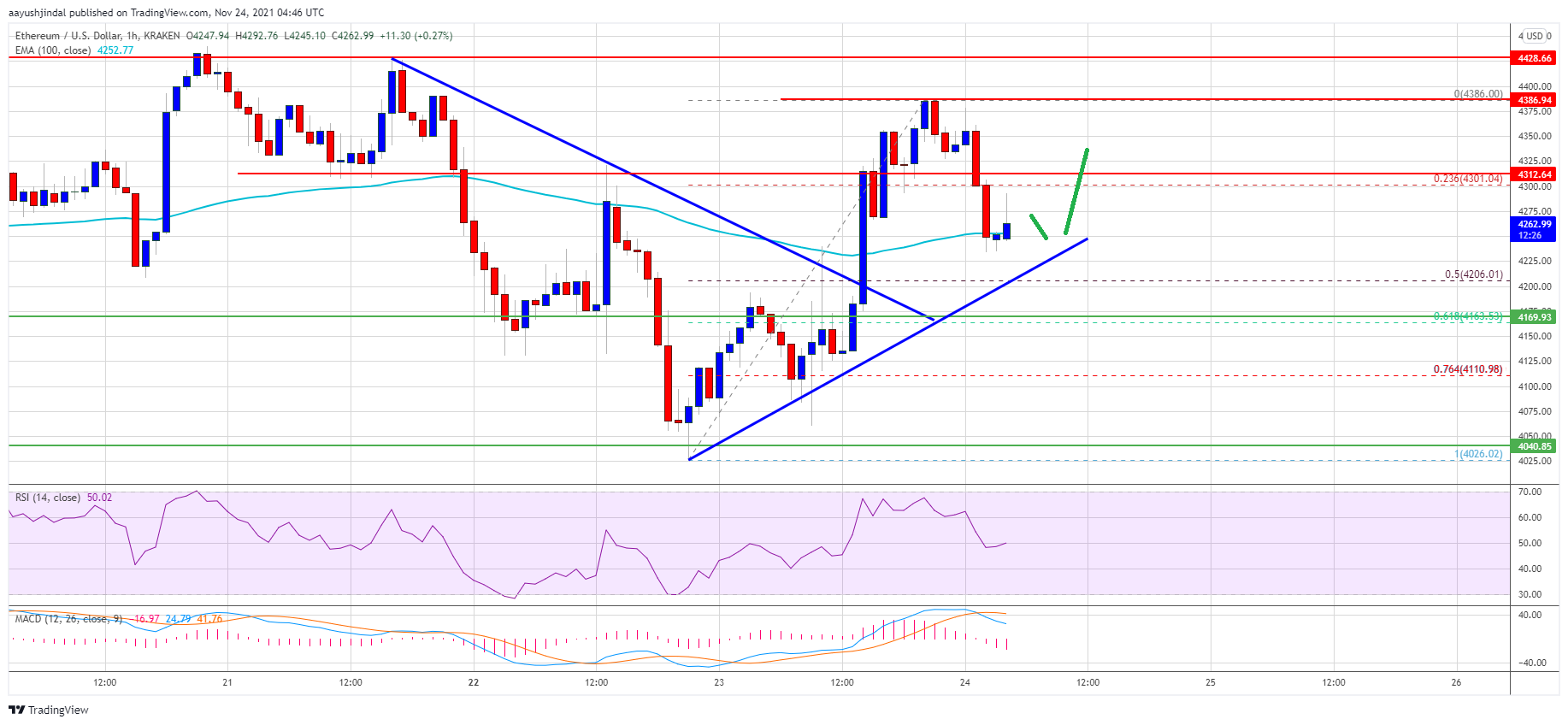
Ethereum remained stable above $4,050 against the US Dollar. ETH could gain bullish momentum once it clears the $4,325 and $4,350 resistance levels.
Ethereum is showing a few positive signs above the $4,200 level.
The price is now trading above $4,200 and the 100 hourly simple moving average.
There was a break above a major bearish trend line with resistance near $4,205 on the hourly chart of ETH/USD (data feed via Kraken).
The pair could extend gains if there is a clear break above the $4,350 resistance zone.
Ethereum Price Is Recovering
Ethereum remained strong above the $4,050 support level, unlike bitcoin. ETH price formed a base and started a steady recovery wave above the $4,120 resistance zone.
There was a clear break above the $4,200 resistance zone and the 100 hourly simple moving average. Besides, there was a break above a major bearish trend line with resistance near $4,205 on the hourly chart of ETH/USD.
The pair climbed higher above the $4,300 resistance zone and formed a high near $4,386. It is now correcting gains below the $4,300 level. There was a break below the 23.6% Fib retracement level of the upward move from the $4,026 swing low to $4,386 high.
Source: ETHUSD on TradingView.com
Ether price is now trading above $4,200 and the 100 hourly simple moving average. An initial resistance on the upside is near the $4,300 level.
The first major resistance is near the $4,350 level. A close above the $4,300 and $4,350 levels could start a fresh increase in the near term. In the stated case, the price might rise towards the $4,450 level. Any more gains could lift the price towards the $4,500 barrier in the near term.
Fresh Drop in ETH?
If ethereum fails to start a fresh increase above the $4,350 level, it could start a fresh decline. An initial support on the downside is near the $4,220 level. There is also a connecting bullish trend line near $4,220 on the same chart.
The first key support is now forming near the $4,200 level. It is close to the 50% Fib retracement level of the upward move from the $4,026 swing low to $4,386 high. A downside break below the $4,200 support might push the price further lower.
Technical Indicators
Hourly MACD – The MACD for ETH/USD is losing pace in the bullish zone.
Hourly RSI – The RSI for ETH/USD is now near the 50 level.
Pennsylvania Senator Pat Toomey, one of the lawmakers who supported amending the language around crypto in the recently passed infrastructure law, said the United States should lead the world in the adoption of a central bank digital currency, or CBDC.
In a Tuesday interview with Bloomberg’s David Westin, Toomey said the U.S. dollar should have “the most sophisticated capabilities of any currency in the world” as the country could benefit from a digital dollar. However, the senator said the rollout of any U.S. central bank digital currency should not rely on the Federal Reserve as a traditional bank for retail accounts, citing issues with privacy.
“The idea of having a tokenized dollar that is capable of being exchanged on a peer-to-peer basis on a platform where developers can innovate and develop new products and services… I think there’s a strong case for that,” said Toomey.
The Pennsylvania senator added that he would vote in favor of Jerome Powell’s nomination for a second term as Fed chair. Toomey cited Powell’s role in stabilizing U.S. financial markets during the early months of the pandemic as well as the fact he’s been “in action for some time now.”
One of fifty Republican lawmakers currently serving in the Senate, Toomey is crossing partisan lines in supporting President Joe Biden’s nomination of Powell. At a time when party politics in the U.S. seemingly embeds itself in every piece of legislation put forth and the Democratic Party controls each chamber of Congress by only a slim majority, every vote counts when it comes to enacting policy.
Related: 8-word crypto amendment in infrastructure bill an ‘affront to the rule of law’
Toomey was behind a bipartisan effort to amend some of the provisions in the recently passed infrastructure law to not apply to developers, miners and others in the crypto space. The bill ultimately passed both the Senate and House without any clarification on crypto, but lawmakers introduced legislation on Thursday to “fix” its tax reporting requirements.
A guide to the multi-chain future, sidechains, and layer-2 solutions
Around the Block from Coinbase Ventures sheds light on key trends in crypto. Written by Justin Mart & Connor Dempsey.
As of late 2021, Ethereum has grown to support thousands of applications from decentralized finance, NFTs, gaming and more. The entire network settles trillions of dollars in transactions annually, with over $170 billion locked on the platform.
But as the saying goes, more money, more problems. Ethereum’s decentralized design ends up limiting the amount of transactions it can process to just 15 per second. Since Ethereum’s popularity far exceeds 15 transactions per second, the result is long waits and fees as high as $200 per transaction. Ultimately, thisprices out many users and limits the types of applications Ethereum can handle today.
If smart-contract based blockchains are to ever grow to support finance and Web 3 applications for billions of users, scaling solutions are needed. Thankfully, the cavalry is beginning to arrive, with many proposed solutions coming online recently.
In this edition of Around The Block, we explore the crypto world’s collective quest to scale.*
To compete or to complement?
The goal is to increase the number of transactions that openly accessible smart contract platforms can handle, while retaining sufficient decentralization. Remember, it would be trivial to scale smart contract platforms through a centralized solution managed by a single entity (Visa can handle 45,000 transactions per second), but then we’d be right back to where we started: a world owned by a handful of powerful centralized actors.
The approaches being taken to fix this problem come twofold: (1) build brand new networks competitive to Ethereum that can handle more activity, or (2) build complementary networks that can handle Ethereum’s excess capacity.
Broadly, they break out across a few categories:
Layer 1 blockchains (competitive to Ethereum)
Sidechains (somewhat complementary to Ethereum)
Layer 2 networks (complementary to Ethereum)
While each differs in architecture and approach, the goal is the same: let users actually use the networks (eg, interact with DeFi, NFTs, etc) without paying exorbitant fees or experiencing long wait times.
Layer 1s
Ethereum is considered a layer 1 blockchain — an independent network that secures user funds and executes transactions all in one place. Want to swap 100 USDC for DAI using a DeFi application like Uniswap? Ethereum is where it all happens.
Competing layer 1s do everything Ethereum does, but in a brand new network, soup to nuts. They’re differentiated by new system designs that enable higher throughput, leading to lower transaction fees, but usually at the cost of increased centralization.
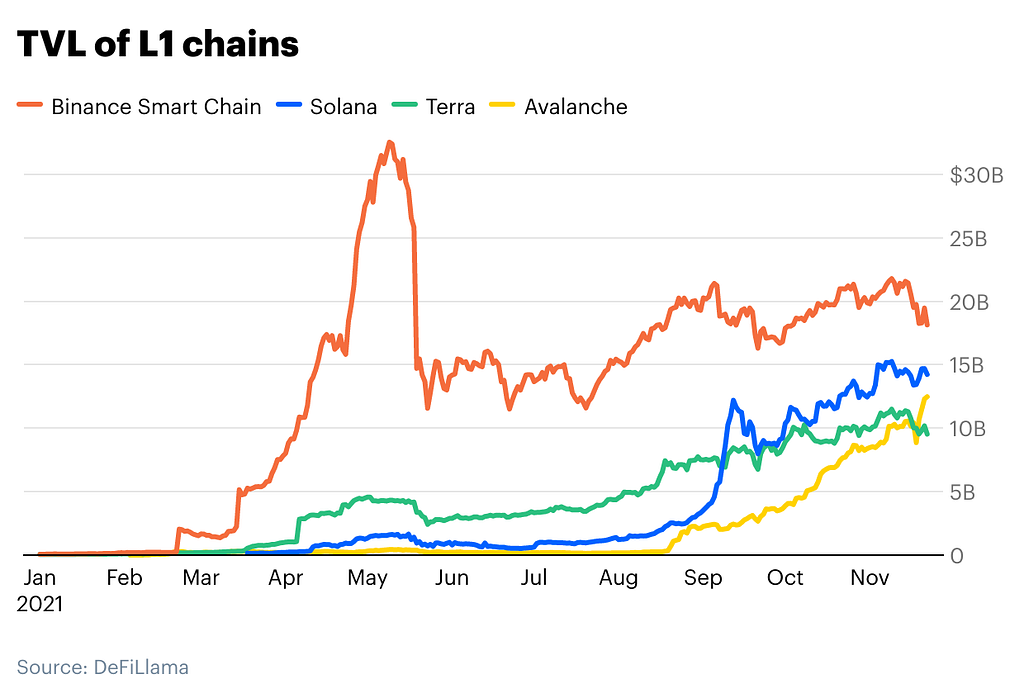
New layer 1s have come online in droves over the last 10 months, with the aggregate value on these networks rocketing from $0 to ~$75B over the same time period. This field is currently led by Solana, Avalanche, Terra, and Binance Smart Chain, each with growing ecosystems that have reached over $10 billion in value.
Leading non-ETH L1s by TVL
All layer 1s are in competition to attract both developers and users. Doing so without any of Ethereum’s tooling and infrastructure that make it easy to build and use applications, is difficult. To bridge this gap, many layer 1s employ a tactic called EVM compatibility.
EVM stands for the Ethereum Virtual Machine, and it’s essentially the brain that performs computation to make transactions happen. By making their networks compatible with the EVM, Ethereum developers can easily deploy their existing Ethereum applications to a new layer 1 by essentially copying and pasting their code. Users can also easily access EVM compatible layer 1s with their existing wallets, making it simple for them to migrate.
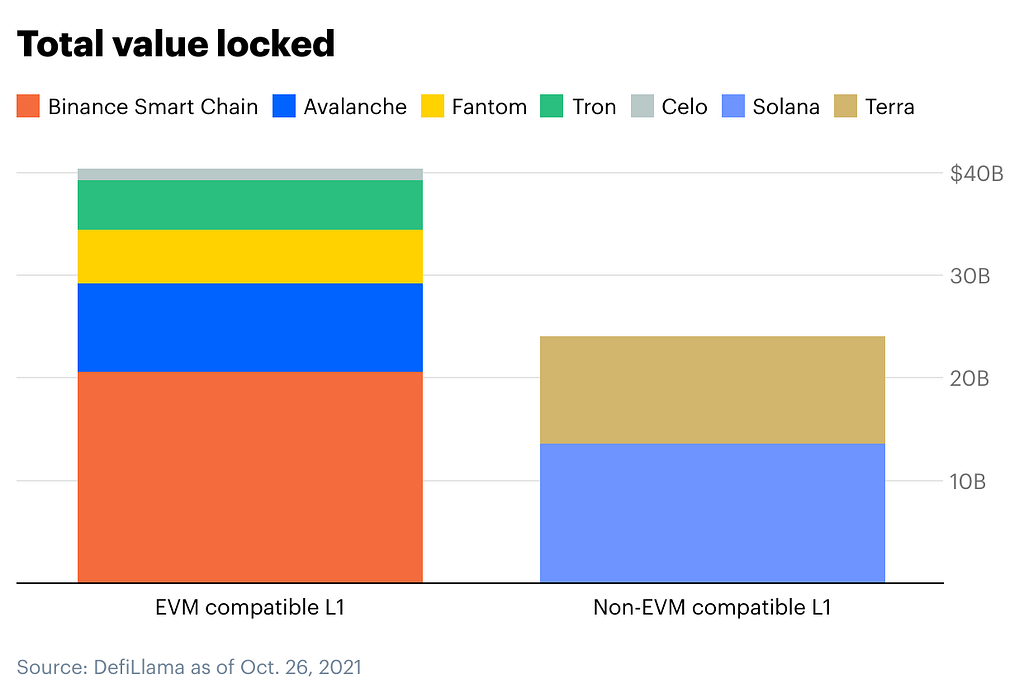
Take Binance Smart Chain (BSC) as an example. By launching an EVM compatible network and tweaking the consensus design to enable higher throughput and cheaper transactions, BSC saw usage explode last summer across dozens of DeFi applications all resembling popular Ethereum apps like Uniswap and Curve. Avalanche, Fantom, Tron, and Celo have also taken the same approach.
Conversely, Terra and Solana do not currently support EVM compatibility.
TVL of EVM compatible vs non-EVM compatible L1s
Interoperable Chains
In a slightly different layer 1 bucket are blockchain ecosystems like Cosmos and Polkadot. Rather than build new stand-alone blockchains, these projects built standards that let developers create application specific blockchains capable of talking to each other. This can allow, for example, tokens from a gaming blockchain to be used within applications built on a separate blockchain for social networking.
There is currently over $100B+ sitting on chains built using Cosmos’ standard that can eventually interoperate. Meanwhile, Polkadot recently reached a milestone that will similarly unite its ecosystem of blockchains.
In short, there’s now a diverse landscape of direct Ethereum competitors, with more on the way.
Sidechains
The distinction between sidechains and new layer 1s is admittedly a fuzzy one. Sidechains are very similar to EVM-compatible layer 1s, except that they’ve been purpose built to handle Ethereum’s excess capacity, rather than compete with Ethereum as a whole. These ecosystems are closely aligned with the Ethereum community and host Ethereum apps in a complementary fashion.
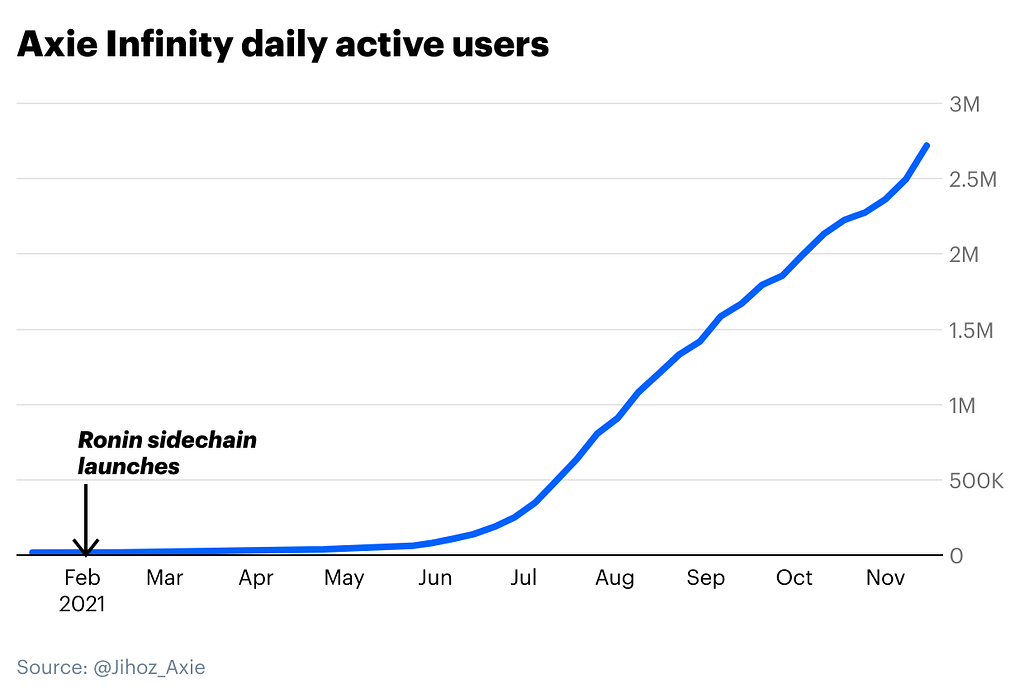
Axie Infinity’s Ronin sidechain is a prime example. Axie Infinity is an NFT game originally built on Ethereum. Since Ethereum fees made playing the game prohibitively expensive, the Ronin sidechain was built to allow users to move their NFTs and tokens from Ethereum to a low fee environment. This made the game affordable to more users, and preceded an explosion in the game’s popularity.
As of this writing, users have moved over $7.5B from Ethereum to Ronin to play Axie Infinity.
Polygon POS
Where sidechains like Ronin are application specific, others are suited for more general purpose applications. Right now, Polygon’s proof-of-stake (POS) sidechain is the industry leader with nearly $5B in value deployed over 100 DeFi and gaming applications including familiar names like Aave and Sushiswap, as well as a Uniswap clone called Quickswap.
Again, Polygon POS really doesn’t look that different from an EVM compatible layer-1. However, it’s been built as part of a framework to scale Ethereum rather than compete with it. The Polygon team sees a future where Ethereum remains the dominant blockchain for high value transactions and value storage, while everyday transactions move to Polygon’s lower-cost blockchains. (Polygon POS also maintains a special relationship with Ethereum through a process known as checkpointing).
With transaction fees of less than a penny, Polygon’s vision of the future looks plausible. And with the help of incentive programs, users have flocked to Polygon POS with daily transactions surpassing Ethereum (though spam transactions inflate this number).
Layer 2s (Rollups)
Layer 1s and sidechains both have a distinct challenge: securing their blockchains. To do so, they must pay a new cohort of miners or proof of stake validators to verify and secure transactions, usually in the form of inflation from a base token (e.g. Polygon’s $MATIC, Avalanche’s $AVAX).
However, this brings notable downsides:
Having a base token naturally makes your ecosystem more competitive rather than complementary to Ethereum
Validating and securing transactions is a complex and challenging task that your network is responsible for indefinitely
Wouldn’t it be nice if we could create scalable ecosystems that borrowed from Ethereum’s security? Enter layer 2 networks, and “rollups” in particular. In a nutshell, layer 2s are independent ecosystems that sit on top of Ethereum in such a way that relies on Ethereum for security.
Critically, this means that layer 2s do not need to have a native token — so not only are they more complementary to Ethereum, they are essentially part of Ethereum. The Ethereum roadmap even pays homage to this idea by signaling that Ethereum 2.0 will be “rollup centric.”
How rollups work
Layer 2s are commonly called rollups because they “rollup” or bundle transactions together and execute them in a new environment, before sending the updated transaction data back to Ethereum. Rather than have the Ethereum network process 1,000 Uniswap transactions individually (expensive!), the computation is offloaded on a layer 2 rollup before submitting the results back to Ethereum (cheap!).
However, when results are posted back to Ethereum, how does Ethereum know that the data is correct and valid? And how can Ethereum prevent anyone from posting incorrect information? These are critical questions that differentiate the two types of rollups: Optimistic rollups, and Zero Knowledge rollups (ZK rollups).
Optimistic Rollups
When submitting results back to Ethereum, optimistic rollups “optimistically” assume that they’re valid. In other words, they let the operators of the rollup post any data they want (including potentially incorrect / fraudulent data), and just assume it’s correct — an optimistic outlook no doubt! But there are ways to fight fraud. As a check and balance, there is a window of time after any withdrawal where anyone watching can call out fraud (remember blockchains are transparent, anyone can watch what’s happening). In the event that one of these watchers can mathematically prove that fraud occurred (by submitting a fraud proof), the rollup reverts any fraudulent transactions and penalizes the bad actor and rewards the watcher (a clever incentive system!).
The drawback is a brief delay when you move funds between the rollup and Ethereum, waiting to see if any watchers catch any fraud. In some cases this can be up to a week, but we expect these delays to come down over time.
The key point is that optimistic rollups are intrinsically tied to Ethereum and ready to help Ethereum scale today. Accordingly, we’ve seen strong nascent growth with many leading DeFi projects moving to the leading optimistic rollups — Arbitrum and Optimistic Ethereum.
Arbitrum & Optimistic Ethereum
Arbitrum (by Off-chain Labs) and Optimistic Ethereum (by Optimism) are the two main projects implementing optimistic rollups today. Notably, both are still in their early stages, with both companies maintaining levels of centralized control but with plans to decentralize over time.
It’s estimated that once mature, optimistic roll ups can offer anywhere from a 10–100x improvement in scalability. Even in their early days, DeFi applications on Arbitrum and Optimism have already accrued billions in network value.
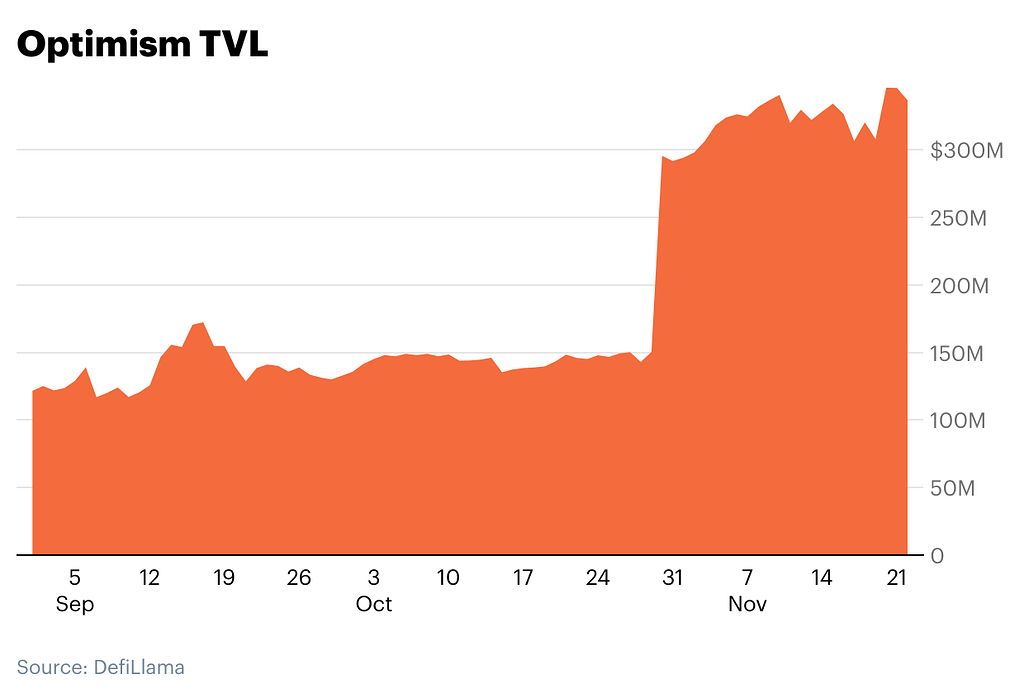
Optimism is earlier in its adoption curve with over $300M in TVL deployed across 7 DeFi applications, most notably Uniswap, Synthetix, and 1inch.
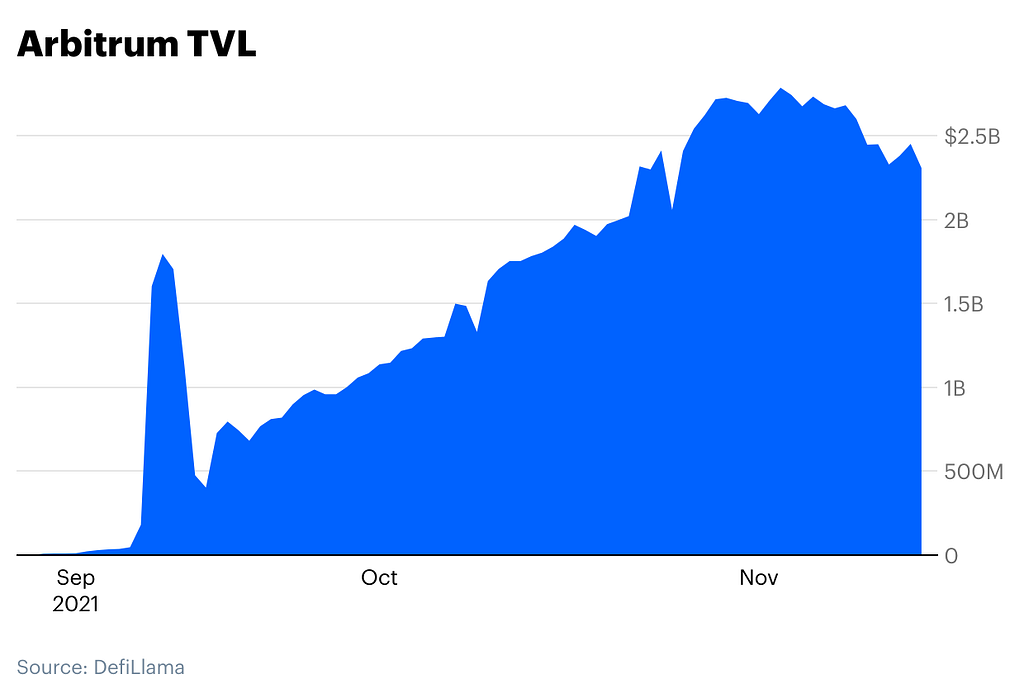
Arbitrum is further along, with around $2.5B in TVL across 60+ applications including familiar DeFi protocols like Curve, Sushiswap, and Balancer.
Aribtrum has also been selected as Reddit’s scaling solution of choice for their long awaited efforts to tokenize community points for the social media platform’s 500 million monthly active users.
ZK Rollups
Where optimistic rollups assume the transactions are valid and leave room for others to prove fraud, ZK rollups do the work of actually proving to the Ethereum network that transactions are valid.
Along with the results of the bundled transactions, they submit what’s called a validity proof to an Ethereum smart contract. As the name suggests, validity proofs let the Ethereum network verify that the transactions are valid, making it impossible for the relayer to cheat the system. This eliminates the need for a fraud proof window, so moving funds between Ethereum and ZK-rollups is effectively instant.
While instant settlement and no withdrawal times sound great, ZK rollups are not without tradeoffs. First, generating validity proofs is computationally intensive, so you need high powered machines to make them work. Second, the complexity surrounding validity proofs makes it more difficult to support EVM compatibility, limiting the types of smart contracts that can be deployed to ZK-rollups. As such, optimistic rollups have been first to market and are more capable of addressing Ethereum’s scaling woes today, but ZK-rollups may become a better technical solution in the long run.
ZK Rollup Adoption
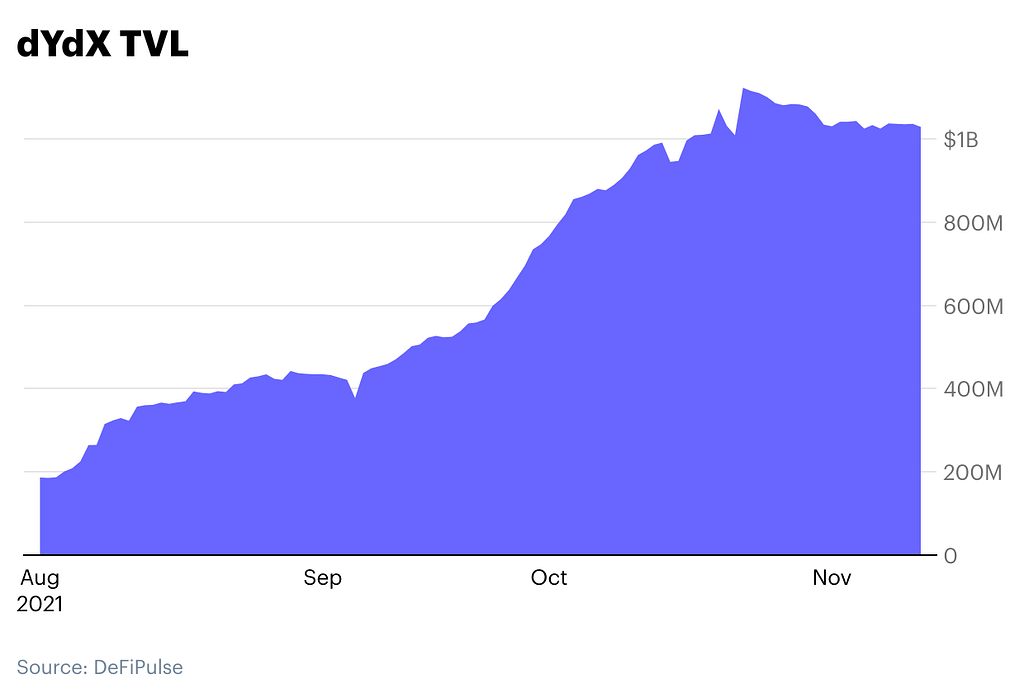
The ZK rollup landscape runs deep, with multiple teams and implementations in the works and in production. Some prominent players include Starkware, Matter Labs, Hermez, and Aztec. Today, ZK-rollups mainly support relatively simple applications such as payments or exchanges (owing to limitations on what types of applications ZK-rollups can support today). For example, derivatives exchange dYdX employs a ZK rollup solution from Starkware (StarkEx) to support nearly 5 million weekly transactions and $1B+ in TVL.
The real prize however, is ZK rollup solutions that are fully EVM compatible and thus capable of supporting popular general applications (like the full suite of DeFi apps) without the withdrawal delays of optimistic rollups. The main players in this realm are MatterLab’s zkSync 2.0, Starkware’s Starknet, Polygon Hermez’s zkEVM, and Polygon Miden, which are all currently working towards mainnet launch. (Aztec, meanwhile, is focused on applying zk proofs to privacy).
Many in the industry (Vitalik included) are looking at ZK rollups in conjunction with Ethereum 2.0 as the long term solution to scaling Ethereum, mainly stemming from their ability to fundamentally handle hundreds of thousands of transactions per second without compromising on security or decentralization.The upcoming rollouts of fully EVM compatible ZK rollups will be one of the key things to watch as the quest to scale Ethereum progresses.
A fragmenting world
In the long run, these scaling solutions are necessary if smart contract platforms are to scale to billions of users. In the near term, these solutions, however, may present significant challenges for users and crypto operators alike. Navigating from Ethereum to these networks requires using cross-chain bridges, which is complex for users and carries latent risk. For example, several cross-chain bridges have already been the target of $100+ million dollar exploits.
More importantly, the multi-chain world fragments composability and liquidity. Consider that Sushiswap is currently implemented on Ethereum, Binance Smart Chain, Avalanche, Polygon, and Arbitrum. Where Sushiswap’s liquidity was once concentrated on one network (Ethereum), it’s now spread across five different networks.
Ethereum applications have long benefited from composability — i.e. Sushiswap on Ethereum is plug-and-play with other Ethereum apps like Aave or Compound. As applications spread out to new networks, an application implemented on one layer 1/sidechain/layer 2 is no longer composable with apps implemented on another, limiting usability and creating challenges for users and developers.
An uncertain future
Will new layer 1s like Avalanche or Solana continue to grow to compete with Ethereum? Will blockchain ecosystems like Cosmos or Polkadot proliferate? Will sidechains continue to run in harmony with Ethereum, taking on its excess capacity? Or will rollups in conjunction with Ethereum 2.0 win out? No one can say for sure.
While the future is uncertain, everyone can take solace in the knowledge that there are so many smart teams dedicated to tackling the most challenging problems that open, permissionless networks face. Just as broadband ultimately helped the internet support a host of revolutionary applications like YouTube and Uber, we believe that we’ll eventually look at the winning scaling solutions in the same light.
* This post focuses on scaling smart-contract based blockchains. Bitcoin scaling is best saved for a future post.
Scaling Ethereum & crypto for a billion users was originally published in The Coinbase Blog on Medium, where people are continuing the conversation by highlighting and responding to this story.
While DeFi promises a world where people can transfer their money without the hassle and transaction fees of banks, anybody who has tried to convert ETH to BNB recently knows it’s not so simple.
Gas fees make cross-chain transactions very expensive, hindering the free flow of crypto assets.
So, it is not surprising that cross-chain bridges have grown at an unprecedented rate, a TVL increase of 89% MoM in October as DeFi transaction volume booms in the bull market.
However, did you know that cross-chain bridges solve other problems besides, what are essentially crypto transaction fees?
As multi-chain projects and interoperability become key components of the industry, DeFi investors need to understand how cross-chain bridges work.
DeFi TVL (since January 2021) Data source: Footprint Analytics
DeFi TVL Ranking by BlockChain (since Jan 2021) Data source: Footprint Analytics
This article will look into the nature of cross-chain bridges, specifically:
How does a cross-chain bridge work?
Cross-chain bridges’ market performance.
Problems addressed by cross-chain bridges.
Selecting a cross-chain bridge.
What Is a Cross-Chain Bridge?
A cross-chain bridge or a blockchain bridge enables the transfer of tokens, assets, smart contract instructions, or data between blockchains. Two chains may have different protocols, rules, and governance models, but a cross-chain bridge connects these disparate blockchains together by interoperating securely.
A cross-chain bridge allows users to:
Deploy digital asset transactions fast and easy;
Enjoy low operational difficulty;
Take advantage of lower transfer fees on non-scalable blockchains;
Implement dApps across multiple platforms.
Here is an example of how cross-chain assets are transferred with a bridge:
When a user needs to convert an asset such as an ERC20 A token on Ethernet into another asset such as BEP20 A token on the BSC chain via AnySwap, the ERC20 A will be locked on the source chain and then notify the bridge to generate the BEP20 A on the BSC chain before sending it to the user.
In this example, the entire operation of the cross-chain bridge takes about five to 20 minutes, with an approximate gas fee in the range of $10 to $20, depending on the pre-congestion conditions in Ethereum at the time.
Data source: anyswap.exchange
How Has Crosslink Bridge Performed Recently?
The market is currently dominated mostly by Layer 2 scale-out cross-chain bridges, which are mainly built on Ethereum for better interconnection and interoperability.
According to Footprint, the TVL of cross-chain bridges was $16.2 billion as of Oct. 26, which is an increase of over 72.25% in the last 30 days. The four largest cross-chain bridges namely, Avalanche Bridge, Polygon Bridge, Arbitrum Bridge and Fantom Anyswap Bridge, account for 95.61% of the entire cross-chain bridge, with its highest monthly increase of 401.23% last month.
Suggested articles
Trading Education: Boost Your Skills in FBS TraderGo to article >>
Data from the CoinTofu Cross-ChainBridge tool, reveal that these four cross-chain bridges have excellent user experience ratings.
TVL & share distribution across- chain bridges (since Apr 2021) Data source: Footprint Analytics
Ethereum Bridges TVL Ranking & Change Data source: Footprint Analytics
The above chart shows that Optimism has had the most active deposits from the beginning of September to yesterday, followed by Avalanche. Current transfer fees are as low as $0.25 (according to L2 Fees) and their transfer fees are variable, but with relatively small changes.
Ethereum Bridge Daily Unique Depositors (since June 2021) Data source: Footprint Analytics
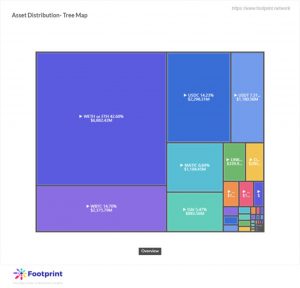
The main asset traded on cross-chain bridges is ETH (WETH), with total ETH lock-ups on the 15 cross-chain bridges valued at $6.882 billion as of Oct. 26. This represents approximately 42.6% of total lock-ups and the most used asset by investors, followed by WBTC and stablecoin USDC.
Asset Distribution- Tree Map Data source: Footprint Analytics
What Problems Do Cross-Chain Bridges Address?
Cross-chain bridges create growth across chains (reflected by Fantom and Avalanche prices, which hit gains of 12% and 18%, respectively, in the first week of November) that offer disparate asset interoperability, which is a high level of security and a better asset rendition.
Without a bridge, investors have to go through different exchanges and incur larger fees instead.
Cross-chain bridges also address the following:
Lower gas costs with increased transaction speeds;
User assets can be freely interacted with for a high user experience;
Improved productivity and usefulness of existing crypto assets;
Higher security and better privacy.
The use of cross-chain bridges is appropriate in the following scenarios:
Token transfers between Ethereum and a Layer 2 network, with assets interoperable across chains, such as faster and easier deposit of funds, withdrawal of assets and exit times to reduce operational complexity;
High fees and use in times of Ethereum congestion;
Thin assets supported by single chains and more assets supported by cross-chain bridges;
Investors can use cross-chain bridges when investing in new chains to get to the head mine faster, but need to assess the full mechanics of the new chain and its security;
Arbitrage trading across the DEX on Optimism, Arbitrum and Polygon, etc.
How to Choose the Right Cross-Chain Bridge
Consider the following criteria when selecting a cross-chain bridge:
A stable TVL exceeding USD$1 billion with a sound cross-chain mechanism and a credible execution environment reflected by gradual changes instead of abrupt fluctuations. Verification method of cross-chain information and management method of cross-chain funds must be taken into account;
Reasonable transfer costs (from USD$1 to USD$5) across the chain and interaction speeds with an estimated arrival time of 10 to 30 minutes;
Security to ensure against hackers that take advantage of vulnerabilities.
In addition, there are also a number of aggregation tools that offer a one-stop cross-chain bridge solution, of which CoinTofu has a better overall experience in terms of reaching the cross-chain page with one click and displaying the advantages of supported cross-chain bridges, estimated arrival times, transaction fees and user experience ratings.
Data source:cointofu.com
Conclusion
With the development of the DeFi industry, cross-chain bridges have become more popular than traditional exchanges. They enable interoperability and mutual integration of blockchain applications to support project owners, various blockchains, and investors as well as address the problem of capital flow and lower transaction costs to users.
Maxine Smith, a crypto writer from Singapore and a DeFi data analyst with a focus on market trends and regulations.
There are now over 100 million wallet addresses in the world, and the number of crypto and non-fungible token (NFT) enthusiasts keeps growing every day. The crypto community has economic power, interlinking relationships and seamless communication potential, but why doesn’t it have its own social media? A truly native crypto- and NFT-dedicated social media platform with a high density of fans has not yet been born.
For crypto markets to grow in sizeand participants, there needs to be increased trust. For those who aren’t crypto native, the landscape can be bewildering. There are also dangers from scammers and spammers. It’s hard to fully protect users from these bad actors, but one way is to create a venue where they can get accurate information and not get played — a dedicated public opinion forum and social media platform for crypto communities.
Furthermore, the current model of social media is inherently extractive. The platforms take their customers’ data and sell it on, while serving them increasingly intrusive advertising. As the saying goes: Users aren’t paying for social media; they are the product. This must change, and one way is through a fusion of social and finance (SocialFi), which puts the economics back in the hands of users.
SocialFi aims to deliver benefits and rewards to users through the financialization and tokenization of social influence. Monaco Planet is a next-generation SocialFi platform that successfully completed its first round of multi-million-dollar financing with Three Arrows Capital and IMO Ventures. It goes live on Nov. 28.
Monaco Planet attacks the problem of spammers and scammers by requiring login through wallets such as MetaMask. Because users can showcase their NFT collections on their personal profile page, their level of engagement and dedication identifies true influencers. Users who publish and show their own activities can follow verified key opinion leaders (KOL) throughout the community. The platform can also rank users by net worth and influence of their NFTs, fostering organic connections between KOLs and users.
By introducing the concept of write-to-earn, content creation itself serves as a form of mining. Active content creators and discussion participants on Monaco Planet continuously reap the benefits in the form of native tokens. Most native tokens will be distributed to users who generate content, creating a form of mining that is sustainable, inclusive and genuinely productive.
A true SocialFi platform belongs to its users. And as the vast majority of Monaco Planet’s native currency will be distributed to users as rewards for content creation, Monaco Planet functions as a true decentralized autonomous organization, governed by native token holders who can send in proposals and vote. As a SocialFi platform, the ownership and governance of Monaco Planet are determined by the users themselves. Moreover, holders of native tokens will enjoy the currency appreciation brought by the platform’s growing economic activity.
As early users of Monaco Planet’s SocialFi platform, NFT holders will be the initial beneficiaries of content mining. They will enjoy the first batch of airdrops and act as mining leads during the first month of invitation-only membership. NFT holders will have exclusive quotas and whitelists for participating in popular projects and the privilege of increased visibility of posts, broadcasting and building groups.
Monaco Planet’s SocialFi makes it clear: Influence you can trust is now a currency that can be minted.
You can learn more about Monaco Planet at monaconft.io, follow the project on Twitter and join the conversation on Discord.