Starting immediately and as part of an effort to increase transparency by providing as much information symmetry as possible, Coinbase will be using this blog post as a pilot to communicate assets under consideration for listing in Q2 2022 (April 1st, 2022 to June 30th, 2022).
April 1 — June 30 2022 Roadmap
The following assets are under consideration for listing on Coinbase in the 2nd quarter of 2022. Transfers and trading are not supported for these or any other assets until a listing is officially announced. Depositing these assets into your Coinbase account before an official announcement may lead to permanent loss of funds.
*This is not an exhaustive list of all assets under consideration. Any asset not referenced in the list does not preclude any such asset from potential listing.
As a reminder, Coinbase recently introduced an Experimental label that may be applied to newly listed assets. Some of the assets mentioned above may be listed with this Experimental label.
Disclaimer & Risks: There will be times when an asset is delayed or removed from consideration for listing for any number of factors. While we will try to make every reasonable effort to minimize this risk of occurrence, it should be understood that all information in this blog is in no way intended to be relied upon as a promise or guarantee of listing. Coinbase reserves the right to discontinue this blog post.
Changelog
Changes to our roadmap will be updated and communicated here regularly.
4/12 Change name from Polkamon (PMON) to Polychain Monsters (PMON)
Why are you considering listing these assets?
As mentioned during our launch of Asset Hub, our goal is to list every asset possible that meets our standards for legal, compliance and technical security. These standards do not take into account the market cap or popularity of a project. This means there are assets that we have concluded do not meet our standards and thus will not be listed on Coinbase at this time.
If we haven’t yet listed a popular asset, it is likely due to various reasons including:
We have concluded that the asset does not meet our minimum listing standards across legal, compliance and technical security
We do not have enough information about the asset
Technical integration work is required
Our review process is outlined in greater detail here.
How do you choose which “types” of assets to support?
We are working to add support for additional networks and ecosystems as we aim to provide the greatest inventory of assets to our users.
Today we support 3 “types” of assets for trading on Coinbase:
Native assets on their own network (recent examples include MINA and STX)
ERC-20 tokens on the Ethereum network (recent examples include APE and GALA)
SPL tokens on the Solana network (recent examples include ORCA and FIDA)
Resources on listing criteria
NOT INVESTMENT ADVICE
The content is for informational purposes only, is general in nature and should not be relied upon or construed as legal, tax, investment, financial, a promise, guarantee, or other advice. Nothing contained herein constitutes a solicitation, recommendation, endorsement, or offer by Coinbase or its affiliates to buy or sell any cryptocurrency or other instruments in any jurisdiction in which such solicitation or offer would be unlawful under the laws of such jurisdiction. Additionally, Coinbase Ventures may be an investor in the crypto projects mentioned here, and additionally, Coinbase may hold such tokens on its balance sheet for operational purposes. A list of Coinbase Ventures investments is available at https://ventures.coinbase.com/. Finally, Coinbase has a conflict of interest policy that prevents board members or Coinbase employees from being involved in a listing decision where they have a financial interest.
On-chain shows Bitcoin miner outflows have been elevated recently, suggesting miners were involved in the recent selloff that took the price of the crypto below $42k.
Bitcoin Miner Outflows Spiked Up Before The Crash Below $42k
As pointed out by an analyst in a CryptoQuant post, BTC miners seem to have been one of the sellers behind the price drop to $42k.
The relevant indicator here is the “miner outflow,” which measures the total amount of Bitcoin exiting wallets of all miners.
When the value of this metric spikes up, it means miners are moving a large number of coins out of their wallets right now. Such a trend can be bearish for the price of the crypto as it may be a sign of dumping from these original whales.
Related Reading | Ark CEO Cathie Wood Is As Bullish As Ever, Sees Bitcoin Hitting $1 Million By 2030
On the other hand, low values of these outflows suggest a normal or healthy amount of selling from miners. This trend, when sustained, can prove to be bullish for the BTC price.
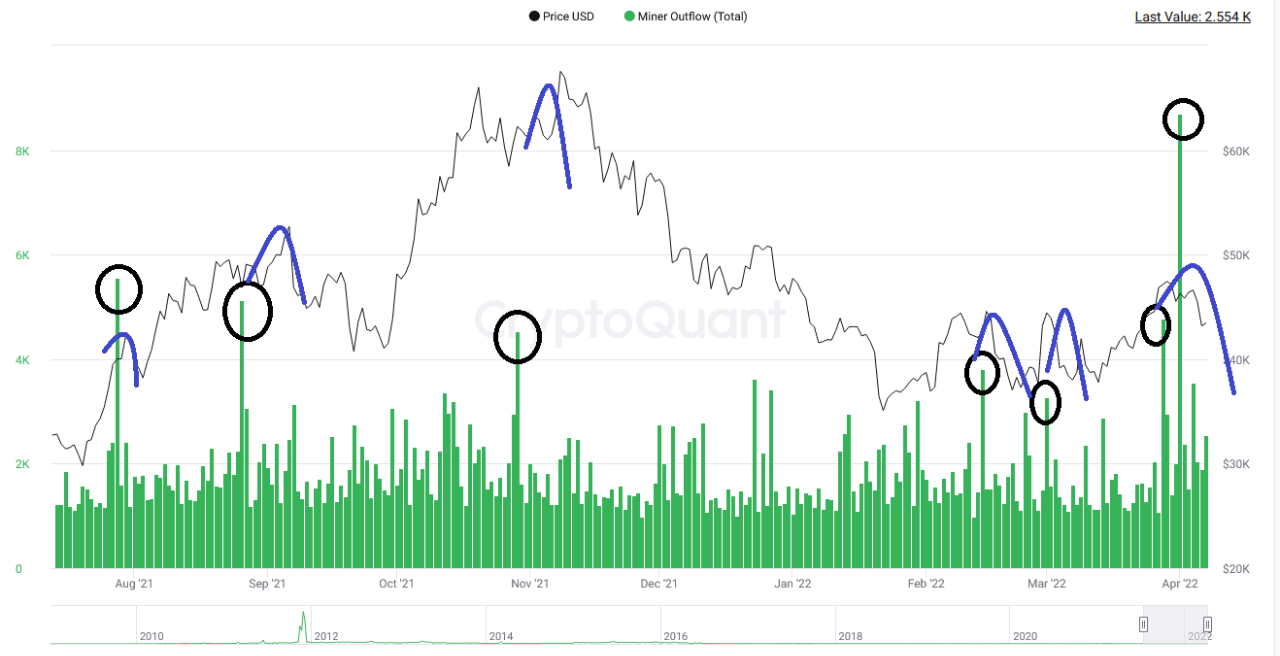
Now, here is a chart that shows the trend in the Bitcoin miner outflows over the past several months:
Looks like the value of the indicator has shot up recently | Source: CryptoQuant
As you can see in the above graph, the Bitcoin miner outflows seem to have shown spikes in recent weeks, just before the selloff.
This would suggest that miners look to have played a role in the dump recently, sending the price of the coin diving below the $42k level.
A trend like this has been observed a few times in the past several months already, as the quant has marked in the chart.
Related Reading | Mexico’s Third Richest Man Says No To Bonds, Yes To Bitcoin
Currently, it’s unclear whether Bitcoin miners have already calmed down or if more selling is coming in the next few days.
BTC Price
After around twenty days of holding strongly above the level, Bitcoin’s price is now once again revisiting the $41k mark.
At the time of writing, the coin’s price floats around $41.1k, down 11% in the last seven days. Over the past month, the crypto has gained 4% in value.
The below chart shows the trend in the price of BTC over the last five days.
The value of BTC seems to have taken a plunge over the past twenty-four hours | Source: BTCUSD on TradingView
Due to this sharp downtrend in the price of the coin as well as the wider market, crypto futures has collected a huge amount of liquidations today. In the last 24 hours, liquidations have amounted to more than $322 million, $175 million of which occurred in the past 4 hours alone.
Featured image from Unsplash.com, charts from TradingView.com, CryptoQuant.com
Italian professional soccer club AC Milan will be releasing its first-ever nonfungible token (NFT) project in collaboration with the BitMEX crypto exchange. Proceeds will go to Fondazione Milan, the clubs’ charity arm.
The limited-edition collection will feature 75,817 NFTs, a number representative of the capacity of the club’s home ground, San Siro stadium. It will depict a 3D image of a jersey found in South Sudan by Danish war photographer Jan Grarup who was in the country documenting widespread flooding last December.
BitMEX partnered with AC Milan to contribute to the project by providing trading discounts and “other benefits” to the first 10,000 pre-orders. BitMEX will also donate to Fondazione Milan by purchasing a “large number” of the NFTs.
As per the announcement, the club says the proceeds will contribute to funding its charitable causes around the world, specifically mentioning the ongoing crisis in Ukraine and a UNICEF project in South Sudan.
Magic Eden to accept tokens from DeGods and Aurory projects
Magic Eden, the largest marketplace by volume for Solana NFTs, according to DappRadar, has confirmed it will accept the tokens from popular Solana NFT projects “DeGods DUST” and Aurory’s “AURY” within the coming weeks.
The marketplace first teased integration of the DUST token in late March, tweeting “brb integrating $DUST” on March 31. On April 1, a drawing of a Magic Eden-themed bar with the caption “$AURY” was tweeted.
— Magic Eden Solana’s Leading NFT Marketplace (@MagicEden) April 1, 2022
“DeGods” is the most traded collection in 30 days on Magic Eden, according to its own statistics, and has an all-time trading volume on the platform of 307,121 Solana (SOL), or $33.8 million at the time of writing. “Aurory” is in third place overall in sales volume for a Solana NFT project according to DappRadar, with an all-time volume of $79.5 million.
Related: Content creators introducing a new paradigm with NFTs
The integration of the tokens may be the latest attempt by the platform to solidify itself as Solana’s native NFT marketplace after OpenSea announced it will integrate Solana, putting the two platforms in direct competition.
According to reports, Tiffany Huang, head of content and marketing at Magic Eden, stated that the platform was looking to integrate tokens from other “blue chip” NFT collections.
Solana NFT sales are gaining momentum
Solana NFTs are seeing a significant gain in volume. In the last 24 hours, the NFT sales volume on the Solana blockchain has hit over $9.2 million — an increase of 51.5% — according to analytics firm CryptoSlam.
It comes after a drop was seen in the trading volume of Solana NFTs following the March 30 announcement that OpenSea would integrate the blockchain when OpenSea announced the Solana integration. On April 6, the day before the integration was live, trading volume decreased by 34.4%.
Ethereum is still the top network when it comes to NFTs, with $49.4 million in sales made in the last 24 hours.
Other Nifty News
Starbucks has announced its foray into NFTs, with CEO Howard Schultz stating that ”sometime before the end of the calendar year, we are going to be in the NFT business.”
Autograph, the NFT platform co-founded by Tom Brady, has signed a multi-year partnership with ESPN to create a docuseries and NFT collection titled “Man in the Arena: Tom Brady,” which details the career of the NFL legend.
Coinbase halts payments via Unified Payments Interface (UPI) on Sunday in less than 4 days after the its launch. Clients of the crypto exchange in India are unable to purchase cryptocurrencies via UPI as a payment method. ‘Currently unavailable’ error is displayed.
On 7 April the National Payments Corporation of India (NPCI) tweeted that it is unaware of any crypto exchange
Exchange
An exchange is known as a marketplace that supports the trading of derivatives, commodities, securities, and other financial instruments.Generally, an exchange is accessible through a digital platform or sometimes at a tangible address where investors organize to perform trading. Among the chief responsibilities of an exchange would be to uphold honest and fair-trading practices. These are instrumental in making sure that the distribution of supported security rates on that exchange are effectively relevant with real-time pricing.Depending upon where you reside, an exchange may be referred to as a bourse or a share exchange while, as a whole, exchanges are present within the majority of countries. Who is Listed on an Exchange?As trading continues to transition more to electronic exchanges, transactions become more dispersed through varying exchanges. This in turn has caused a surge in the implementation of trading algorithms and high-frequency trading applications. In order for a company to be listed on a stock exchange for example, a company must divulge information such as minimum capital requirements, audited earnings reports, and financial reports.Not all exchanges are created equally, with some outperforming other exchanges significantly. The most high-profile exchanges to date include the New York Stock Exchange (NYSE), the Tokyo Stock Exchange (TSE), the London Stock Exchange (LSE), and the Nasdaq. Outside of trading, a stock exchange may be used by companies aiming to raise capital, this is most commonly seen in the form of initial public offerings (IPOs).Exchanges can now handle other asset classes, given the rise of cryptocurrencies as a more popularized form of trading.
An exchange is known as a marketplace that supports the trading of derivatives, commodities, securities, and other financial instruments.Generally, an exchange is accessible through a digital platform or sometimes at a tangible address where investors organize to perform trading. Among the chief responsibilities of an exchange would be to uphold honest and fair-trading practices. These are instrumental in making sure that the distribution of supported security rates on that exchange are effectively relevant with real-time pricing.Depending upon where you reside, an exchange may be referred to as a bourse or a share exchange while, as a whole, exchanges are present within the majority of countries. Who is Listed on an Exchange?As trading continues to transition more to electronic exchanges, transactions become more dispersed through varying exchanges. This in turn has caused a surge in the implementation of trading algorithms and high-frequency trading applications. In order for a company to be listed on a stock exchange for example, a company must divulge information such as minimum capital requirements, audited earnings reports, and financial reports.Not all exchanges are created equally, with some outperforming other exchanges significantly. The most high-profile exchanges to date include the New York Stock Exchange (NYSE), the Tokyo Stock Exchange (TSE), the London Stock Exchange (LSE), and the Nasdaq. Outside of trading, a stock exchange may be used by companies aiming to raise capital, this is most commonly seen in the form of initial public offerings (IPOs).Exchanges can now handle other asset classes, given the rise of cryptocurrencies as a more popularized form of trading. Read this Term using UPI.
Coinbase response to the NPCI with the following statement:
“We are aware of the recent statement published by NPCI regarding the use of UPI by cryptocurrency exchanges. We are committed to working with NPCI and other relevant authorities to ensure we are aligned with local expectations and industry norms.”
At the time of this writing, India-based users are unable to buy tokens via UPI (selling option is available). It is unclear whether it is related to a significant drop in crypto trading volumes following the 30% tax in India.
It has been reported that cryptocurrencies
Cryptocurrencies
By using cryptography, virtual currencies, known as cryptocurrencies, are nearly counterfeit-proof digital currencies that are built on blockchain technology. Comprised of decentralized networks, blockchain technology is not overseen by a central authority.Therefore, cryptocurrencies function in a decentralized nature which theoretically makes them immune to government interference. The term, cryptocurrency derives from the origin of the encryption techniques that are employed to secure the networks which are used to authenticate blockchain technology. Cryptocurrencies can be thought of as systems that accept online payments which are denoted as “tokens.” Tokens are represented as internal ledger entries in blockchain technology while the term crypto is used to depict cryptographic methods and encryption algorithms such as public-private key pairs, various hashing functions, and an elliptical curve. Every cryptocurrency transaction that occurs is logged in a web-based ledger with blockchain technology.These then must be approved by a disparate network of individual nodes (computers that maintain a copy of the ledger). For every new block generated, the block must first be authenticated and confirmed ‘approved’ by each node, which makes forging the transactional history of cryptocurrencies nearly impossible. The World’s First CryptoBitcoin became the first blockchain-based cryptocurrency and to this day is still the most demanded cryptocurrency and the most valued. Bitcoin still contributes the majority of the overall cryptocurrency market volume, though several other cryptos have grown in popularity in recent years.Indeed, out of the wake of Bitcoin, iterations of Bitcoin became prevalent which resulted in a multitude of newly created or cloned cryptocurrencies. Contending cryptocurrencies that emerged after Bitcoin’s success is referred to as ‘altcoins’ and they refer to cryptocurrencies such as Bitcoin, Peercoin, Namecoin, Ethereum, Ripple, Stellar, and Dash. Cryptocurrencies promise a wide range of technological innovations that have yet to be structured into being. Simplified payments between two parties without the need for a middle man is one aspect while leveraging blockchain technology to minimize transaction and processing fees for banks is another. Of course, cryptocurrencies have their disadvantages too. This includes issues of tax evasion, money laundering, and other illicit online activities where anonymity is a dire ingredient in solicitous and fraudulent activities.
By using cryptography, virtual currencies, known as cryptocurrencies, are nearly counterfeit-proof digital currencies that are built on blockchain technology. Comprised of decentralized networks, blockchain technology is not overseen by a central authority.Therefore, cryptocurrencies function in a decentralized nature which theoretically makes them immune to government interference. The term, cryptocurrency derives from the origin of the encryption techniques that are employed to secure the networks which are used to authenticate blockchain technology. Cryptocurrencies can be thought of as systems that accept online payments which are denoted as “tokens.” Tokens are represented as internal ledger entries in blockchain technology while the term crypto is used to depict cryptographic methods and encryption algorithms such as public-private key pairs, various hashing functions, and an elliptical curve. Every cryptocurrency transaction that occurs is logged in a web-based ledger with blockchain technology.These then must be approved by a disparate network of individual nodes (computers that maintain a copy of the ledger). For every new block generated, the block must first be authenticated and confirmed ‘approved’ by each node, which makes forging the transactional history of cryptocurrencies nearly impossible. The World’s First CryptoBitcoin became the first blockchain-based cryptocurrency and to this day is still the most demanded cryptocurrency and the most valued. Bitcoin still contributes the majority of the overall cryptocurrency market volume, though several other cryptos have grown in popularity in recent years.Indeed, out of the wake of Bitcoin, iterations of Bitcoin became prevalent which resulted in a multitude of newly created or cloned cryptocurrencies. Contending cryptocurrencies that emerged after Bitcoin’s success is referred to as ‘altcoins’ and they refer to cryptocurrencies such as Bitcoin, Peercoin, Namecoin, Ethereum, Ripple, Stellar, and Dash. Cryptocurrencies promise a wide range of technological innovations that have yet to be structured into being. Simplified payments between two parties without the need for a middle man is one aspect while leveraging blockchain technology to minimize transaction and processing fees for banks is another. Of course, cryptocurrencies have their disadvantages too. This includes issues of tax evasion, money laundering, and other illicit online activities where anonymity is a dire ingredient in solicitous and fraudulent activities. Read this Term volumes dropped by as much as 55% following the new crypto tax. Mobikwik wallet, which has partnered with many crypto exchanges announced it is terminating its e-Wallet services from cryptocurrency exchanges.
It is possible that due to the NPCI statement on 7 April, banks may be blocking transactions to Coinbase via UPI. It is still unclear at this stage why depositing via UPI is disabled at Coinbase while some suggesting it is temporary.
India Cryptocurrency Regulations
According to local reports in India, the government may not announce any form of regulations on cryptocurrencies until there is a global consensus.
The assumption is that India is waiting for Europe and the US to announce their framework for regulating cryptocurrencies. India’s central bank (RBI) opposes cryptocurrencies, stating that they are a threat to financial stability.
India’s court however removed the restrictions that were imposed by the RBI in 2020. Since the India crypto market spiked by +641% from July 2020 to June 2021. It has been suggested that local banks side with the RBI’s views on cryptocurrencies.
Coinbase halts payments via Unified Payments Interface (UPI) on Sunday in less than 4 days after the its launch. Clients of the crypto exchange in India are unable to purchase cryptocurrencies via UPI as a payment method. ‘Currently unavailable’ error is displayed.
On 7 April the National Payments Corporation of India (NPCI) tweeted that it is unaware of any crypto exchange
Exchange
An exchange is known as a marketplace that supports the trading of derivatives, commodities, securities, and other financial instruments.Generally, an exchange is accessible through a digital platform or sometimes at a tangible address where investors organize to perform trading. Among the chief responsibilities of an exchange would be to uphold honest and fair-trading practices. These are instrumental in making sure that the distribution of supported security rates on that exchange are effectively relevant with real-time pricing.Depending upon where you reside, an exchange may be referred to as a bourse or a share exchange while, as a whole, exchanges are present within the majority of countries. Who is Listed on an Exchange?As trading continues to transition more to electronic exchanges, transactions become more dispersed through varying exchanges. This in turn has caused a surge in the implementation of trading algorithms and high-frequency trading applications. In order for a company to be listed on a stock exchange for example, a company must divulge information such as minimum capital requirements, audited earnings reports, and financial reports.Not all exchanges are created equally, with some outperforming other exchanges significantly. The most high-profile exchanges to date include the New York Stock Exchange (NYSE), the Tokyo Stock Exchange (TSE), the London Stock Exchange (LSE), and the Nasdaq. Outside of trading, a stock exchange may be used by companies aiming to raise capital, this is most commonly seen in the form of initial public offerings (IPOs).Exchanges can now handle other asset classes, given the rise of cryptocurrencies as a more popularized form of trading.
An exchange is known as a marketplace that supports the trading of derivatives, commodities, securities, and other financial instruments.Generally, an exchange is accessible through a digital platform or sometimes at a tangible address where investors organize to perform trading. Among the chief responsibilities of an exchange would be to uphold honest and fair-trading practices. These are instrumental in making sure that the distribution of supported security rates on that exchange are effectively relevant with real-time pricing.Depending upon where you reside, an exchange may be referred to as a bourse or a share exchange while, as a whole, exchanges are present within the majority of countries. Who is Listed on an Exchange?As trading continues to transition more to electronic exchanges, transactions become more dispersed through varying exchanges. This in turn has caused a surge in the implementation of trading algorithms and high-frequency trading applications. In order for a company to be listed on a stock exchange for example, a company must divulge information such as minimum capital requirements, audited earnings reports, and financial reports.Not all exchanges are created equally, with some outperforming other exchanges significantly. The most high-profile exchanges to date include the New York Stock Exchange (NYSE), the Tokyo Stock Exchange (TSE), the London Stock Exchange (LSE), and the Nasdaq. Outside of trading, a stock exchange may be used by companies aiming to raise capital, this is most commonly seen in the form of initial public offerings (IPOs).Exchanges can now handle other asset classes, given the rise of cryptocurrencies as a more popularized form of trading. Read this Term using UPI.
Coinbase response to the NPCI with the following statement:
“We are aware of the recent statement published by NPCI regarding the use of UPI by cryptocurrency exchanges. We are committed to working with NPCI and other relevant authorities to ensure we are aligned with local expectations and industry norms.”
At the time of this writing, India-based users are unable to buy tokens via UPI (selling option is available). It is unclear whether it is related to a significant drop in crypto trading volumes following the 30% tax in India.
It has been reported that cryptocurrencies
Cryptocurrencies
By using cryptography, virtual currencies, known as cryptocurrencies, are nearly counterfeit-proof digital currencies that are built on blockchain technology. Comprised of decentralized networks, blockchain technology is not overseen by a central authority.Therefore, cryptocurrencies function in a decentralized nature which theoretically makes them immune to government interference. The term, cryptocurrency derives from the origin of the encryption techniques that are employed to secure the networks which are used to authenticate blockchain technology. Cryptocurrencies can be thought of as systems that accept online payments which are denoted as “tokens.” Tokens are represented as internal ledger entries in blockchain technology while the term crypto is used to depict cryptographic methods and encryption algorithms such as public-private key pairs, various hashing functions, and an elliptical curve. Every cryptocurrency transaction that occurs is logged in a web-based ledger with blockchain technology.These then must be approved by a disparate network of individual nodes (computers that maintain a copy of the ledger). For every new block generated, the block must first be authenticated and confirmed ‘approved’ by each node, which makes forging the transactional history of cryptocurrencies nearly impossible. The World’s First CryptoBitcoin became the first blockchain-based cryptocurrency and to this day is still the most demanded cryptocurrency and the most valued. Bitcoin still contributes the majority of the overall cryptocurrency market volume, though several other cryptos have grown in popularity in recent years.Indeed, out of the wake of Bitcoin, iterations of Bitcoin became prevalent which resulted in a multitude of newly created or cloned cryptocurrencies. Contending cryptocurrencies that emerged after Bitcoin’s success is referred to as ‘altcoins’ and they refer to cryptocurrencies such as Bitcoin, Peercoin, Namecoin, Ethereum, Ripple, Stellar, and Dash. Cryptocurrencies promise a wide range of technological innovations that have yet to be structured into being. Simplified payments between two parties without the need for a middle man is one aspect while leveraging blockchain technology to minimize transaction and processing fees for banks is another. Of course, cryptocurrencies have their disadvantages too. This includes issues of tax evasion, money laundering, and other illicit online activities where anonymity is a dire ingredient in solicitous and fraudulent activities.
By using cryptography, virtual currencies, known as cryptocurrencies, are nearly counterfeit-proof digital currencies that are built on blockchain technology. Comprised of decentralized networks, blockchain technology is not overseen by a central authority.Therefore, cryptocurrencies function in a decentralized nature which theoretically makes them immune to government interference. The term, cryptocurrency derives from the origin of the encryption techniques that are employed to secure the networks which are used to authenticate blockchain technology. Cryptocurrencies can be thought of as systems that accept online payments which are denoted as “tokens.” Tokens are represented as internal ledger entries in blockchain technology while the term crypto is used to depict cryptographic methods and encryption algorithms such as public-private key pairs, various hashing functions, and an elliptical curve. Every cryptocurrency transaction that occurs is logged in a web-based ledger with blockchain technology.These then must be approved by a disparate network of individual nodes (computers that maintain a copy of the ledger). For every new block generated, the block must first be authenticated and confirmed ‘approved’ by each node, which makes forging the transactional history of cryptocurrencies nearly impossible. The World’s First CryptoBitcoin became the first blockchain-based cryptocurrency and to this day is still the most demanded cryptocurrency and the most valued. Bitcoin still contributes the majority of the overall cryptocurrency market volume, though several other cryptos have grown in popularity in recent years.Indeed, out of the wake of Bitcoin, iterations of Bitcoin became prevalent which resulted in a multitude of newly created or cloned cryptocurrencies. Contending cryptocurrencies that emerged after Bitcoin’s success is referred to as ‘altcoins’ and they refer to cryptocurrencies such as Bitcoin, Peercoin, Namecoin, Ethereum, Ripple, Stellar, and Dash. Cryptocurrencies promise a wide range of technological innovations that have yet to be structured into being. Simplified payments between two parties without the need for a middle man is one aspect while leveraging blockchain technology to minimize transaction and processing fees for banks is another. Of course, cryptocurrencies have their disadvantages too. This includes issues of tax evasion, money laundering, and other illicit online activities where anonymity is a dire ingredient in solicitous and fraudulent activities. Read this Term volumes dropped by as much as 55% following the new crypto tax. Mobikwik wallet, which has partnered with many crypto exchanges announced it is terminating its e-Wallet services from cryptocurrency exchanges.
It is possible that due to the NPCI statement on 7 April, banks may be blocking transactions to Coinbase via UPI. It is still unclear at this stage why depositing via UPI is disabled at Coinbase while some suggesting it is temporary.
India Cryptocurrency Regulations
According to local reports in India, the government may not announce any form of regulations on cryptocurrencies until there is a global consensus.
The assumption is that India is waiting for Europe and the US to announce their framework for regulating cryptocurrencies. India’s central bank (RBI) opposes cryptocurrencies, stating that they are a threat to financial stability.
India’s court however removed the restrictions that were imposed by the RBI in 2020. Since the India crypto market spiked by +641% from July 2020 to June 2021. It has been suggested that local banks side with the RBI’s views on cryptocurrencies.
The outlook for projects in the decentralized finance (DeFi) sector has begun to improve in recent months as a combination of global events have highlighted the benefits of holding funds outside of the traditional financial systems.
One project that has rallied over the past few months is Kyber Network (KNC), a multi-chain cryptocurrency trading and liquidity hub that aims to offer users the best trading rates.
Data from Cointelegraph Markets Pro and TradingView shows that after bouncing off a low of $2.83 on April 6, the price of KNC jumped 55.4% to hit an all-time high of $4.04 on April 8 amid a 253% spike in its 24-hour trading volume.
KNC/USDT 1-day chart. Source: TradingView
Three reasons for the building momentum of KNC include the integration of support for ten separate blockchain networks, the launch of a liquidity mining program with Avalanche (AVAX) and an expanding list of partnerships and protocol integrations that expand the reach of the Kyber Network.
Kyber Network adds multi-chain support
One of the biggest factors providing a boost to Kyber Network is the protocol’s push to integrate with the top chains across the cryptocurrency ecosystem.
KyberSwap, the main decentralized exchange interface on the network, now offers trading across ten separate networks, including Ethereum (ETH), Avalanche, Polygon (MATIC), BNB Smart Chain (BSC), Aurora, Arbitrum, Fantom (FTM), Oasis (ROSE), Velas (VLX) and Cronos (CRO).
Interoperability has become one of the main themes driving growth not just in DeFi, but in all sectors of the crypto economy because the ability to send assets and data across multiple chains is a necessary feature in the future of DeFi, the NFT sector the Metaverse.
As more chains come online, the ability to access them through one protocol is a desirable feature that many crypto and DeFi investors will come to expect.
KNC joins Avalanche Rush Phase 2
Another significant development that has helped attract increased attention and trading activity on the Kyber Network is the project’s partnership with the Avalanche Network and the Avalanche Rush Phase 2 liquidity mining program.
The liquidity incentive program kicked off on March 21 and it includes a total of $1 million in rewards for liquidity providers.
Avalanche is one of the fastest-growing Ethereum Virtual Machine (EVM) compatible networks in the cryptocurrency ecosystem and it has helped to attract more users and liquidity to the Kyber Network users by offering a low-fee alternative to Ethereum.
New partnerships and protocol integrations
A third reason for the building momentum behind KNC is the continued addition of new partnerships and major protocol integrations that are helping to spread the reach of the network.
On April 7, it was announced that KyberSwap integrated with Uniswap v3 on the Ethereum and Polygon network, bringing the most active decentralized exchange into the KyberSwap ecosystem.
The project has also revealed a new partnership with the Bondex professional network and Kyber Ventures, the investment arm of the Kyber Network, established a working relationship with Pegacy, a popular NFT racing game.
VORTECS™ data from Cointelegraph Markets Pro began to detect a bullish outlook for KNC on April 6, prior to the recent price rise.
The VORTECS™ Score, exclusive to Cointelegraph, is an algorithmic comparison of historical and current market conditions derived from a combination of data points including market sentiment, trading volume, recent price movements and Twitter activity.
VORTECS™ Score (green) vs. KNC price. Source: Cointelegraph Markets Pro
As seen in the chart above, the VORTECS™ Score for KNC spiked into the green on April 6 and hit a high of 75 around nine hours before the price increased 55.4% over the next two days.
The views and opinions expressed here are solely those of the author and do not necessarily reflect the views of Cointelegraph.com. Every investment and trading move involves risk, you should conduct your own research when making a decision.
Recently, bitcoin prices have struggled, often dipping below the $43,000 mark and then failing to post substantial gains.
Around 9:20 a.m. EDT, the world’s most popular crypto asset retreated to $42,777.20, CoinDesk data show, Saturday.
The majority of cryptocurrencies traded lower early Saturday. Global crypto market market capitalization fell nearly 3% to $1.15 trillion in the last 24 hours, while total crypto market volume was up 9.3 percent to $89.50 billion.
Suggested Reading | Ark CEO Cathie Wood Is As Bullish As Ever, Sees Bitcoin Hitting $1 Million By 2030
Bitcoin Short Stay At Near $44K
Bitcoin was able to inch back slightly shortly thereafter, reaching $43,962.01 at approximately 10 a.m. EDT. Following this comeback, it retreated again, falling to around $42,840 at 1:30 p.m.
On the other hand, the overall volume of stablecoins was $74.34 billion, or 83.06% of the total 24-hour volume of the cryptocurrency market.
Bitcoin was recently trading at an average price of around $43,500, roughly where it was 24 hours ago and well below the $47,000 barrier it crossed just a few days earlier, as investors continued to weigh in on the Federal Reserve’s new hawkish zeal and the ongoing twist of economic developments sparked by Russia’s attack on Ukraine.
BTC total market cap at $805.46 billion on the weekend chart | Source: TradingView.com
Unease Over Fed’s Monetary Policy Tightening
According to an email from Oanda Senior Market Analyst Americas Edward Moya:
“Bitcoin is unsure of its direction as Wall Street gets concerned about the central bank’s aggressiveness in tightening monetary policy.”
Following these recent price swings, various experts expressed their predictions for the cryptocurrency’s future direction.
Ben McMillan, chief information officer at IDX Digital Assets, weighed in, indicating critical levels of support and opposition.
“$43k is a critical support level in the near term as bitcoin attempts to build on its recent relative strength,” he noted.
Suggested Reading | Bitcoin Helps Market Hover Past $2 Trillion As BTC Nears $48,000
Containing Inflation
Cryptocurrency prices deviated somewhat from the performance of the main equities markets, which were marginally positive. The Nasdaq, which is heavily weighted toward the tech sector, gained less than a tenth of a percentage point.
The US central bank has communicated strongly over the last week, both collectively and through individual governors, that it will step up efforts to contain inflation, which has hit about 8%, a four-decade high.
The correlation coefficient between Bitcoin and US equities has increased in the last 90 days as investors have become more risk averse in response to the Federal Reserve’s withdrawal of the pandemic-era intervention that is attributed with catalyzing the ascent of cryptocurrency.
Featured image from Research Affiliates, chart from TradingView.com
A well-known global multi-asset
Multi-Asset
Composed of varying asset classes, multi-asset is a blanket designation combining different classes such bonds, equities, cash equivalents, fixed income, and alternative investments.When compared to traditional balanced funds, multi-asset solutions differ because they target specific investment outcomes. This includes outcomes such as return above inflation as opposed to gauging performance against standardized benchmarks.Given the composition of multi-asset classes, they need to be dynamically managed so that funds can continue to generate returns while keeping risk within fixed parameters. What Are Advantages or Disadvantages to Multi-Asset Investments?While multi-asset investing may better distribute risk, it should be known that a hindrance may be exerted upon potential returns.Indeed, multi-asset classes do not always perform as well as most stock funds due to containing other assets such as cash, bonds, or real estate investments. As a result, traders generally tend to gravitate towards target-date mutual funds, target allocation mutual funds, and ETFs.Multi-asset funds that fluctuate with an investor’s time scope are target-date mutual funds. Generally, target-date mutual funds run in congruence with an investor’s retirement age and are composed primarily of equities (85% to 90%) while the remaining is distributed to a money market or fixed income. Target allocation mutual funds are centered around an investor’s risk tolerance and are offered by most mutual fund companies. Equities compose between 20% to 85% of multi-asset funds and may also include international equities and bonds.Trading ETFs through contracts-for-difference (CFD) trading provides traders with a more immediate avenue to multi-asset investing with financial instruments such as precious metals, commodities, and currencies. The diversification that stems from the wake of multi-asset investing helps protect traders against unforeseen market pitfalls and volatility. However, these tend not to perform as effectively as the majority of stock funds in common years due to an allocation of assets.
Composed of varying asset classes, multi-asset is a blanket designation combining different classes such bonds, equities, cash equivalents, fixed income, and alternative investments.When compared to traditional balanced funds, multi-asset solutions differ because they target specific investment outcomes. This includes outcomes such as return above inflation as opposed to gauging performance against standardized benchmarks.Given the composition of multi-asset classes, they need to be dynamically managed so that funds can continue to generate returns while keeping risk within fixed parameters. What Are Advantages or Disadvantages to Multi-Asset Investments?While multi-asset investing may better distribute risk, it should be known that a hindrance may be exerted upon potential returns.Indeed, multi-asset classes do not always perform as well as most stock funds due to containing other assets such as cash, bonds, or real estate investments. As a result, traders generally tend to gravitate towards target-date mutual funds, target allocation mutual funds, and ETFs.Multi-asset funds that fluctuate with an investor’s time scope are target-date mutual funds. Generally, target-date mutual funds run in congruence with an investor’s retirement age and are composed primarily of equities (85% to 90%) while the remaining is distributed to a money market or fixed income. Target allocation mutual funds are centered around an investor’s risk tolerance and are offered by most mutual fund companies. Equities compose between 20% to 85% of multi-asset funds and may also include international equities and bonds.Trading ETFs through contracts-for-difference (CFD) trading provides traders with a more immediate avenue to multi-asset investing with financial instruments such as precious metals, commodities, and currencies. The diversification that stems from the wake of multi-asset investing helps protect traders against unforeseen market pitfalls and volatility. However, these tend not to perform as effectively as the majority of stock funds in common years due to an allocation of assets. Read this Term investment platform, eToro, announced that it had launched its own non-fungible token (NFT) fund, eToro.art. According to the press release, the platform seeks to support NFT creators, agencies, and brands within the sphere.
To begin the program, eToro unveiled its NFT collection. This includes blue chip projects such as Bored Ape Yacht Club, CryptoPunks, World of Women, as well as emerging artists’ projects. Upon deployment of its full funds, this collection will make eToro one of the most dominant NFT collectors in the world.
“As a company with one eye constantly on ‘what’s next,’ eToro sees huge potential in the metaverse and a range of new digital assets. eToro has a community of over 27 million registered users who want insight into and access to new and emerging technologies. As one of the first companies to offer crypto alongside more traditional assets, it is only natural for eToro to serve as the bridge
Bridge
The bridge or liquidity bridge is an essential component for brokers that are enabling their clients to trade at interbank rates directly via a Prime Broker or a Prime-of-Prime (PoP). While market makers do not require a bridge in order to service its clients, brokers which are sending through orders to a liquidity provider or an electronic execution venue need a bridge to connect their trading platform to the interbank market.Bridges are used extensively in forex trading, specifically for Metatrader, the world’s most popular trading platform. Bridges can be connecting a broker to a prime of prime or to a prime broker. Connectivity providers are delivering solutions mostly oriented towards the most popular platforms in the market – MetaTrader 4 (MT4) and MT5. The component is another crucial part of proper risk mitigation for the brokerage. The Need for Bridges in Retail TradingGiven the rise of the MT4 and MT5 platforms, there has since arose a need for bridge technology. This is due to the fact that Metaquotes, the company behind MT4, only envisaged their platform being used as a purely an interface client broker trading.This means the broker set the quotes, set the spread, and traded against the client. However, the trader actually had no direct access to the wholesale forex market, yet many brokers were unwilling to let go of MT4 in favor of other platforms which already inherently supported access to the market via Electronic Communications Networks (ECN) due to MT4’s huge popularity and thus potential loss of clients. MetaTrader was not designed to communicate with banks or liquidity providers because Metaquotes didn’t implement the FIX protocol (Financial Information Exchange). The FIX protocol is an electronic communications protocol setup in the early 1990’s to provide worldwide exchange of information in real time with respect to the transactions of financial markets and instruments. As a result, software was developed by third parties to enable MetaTrader to connect traders to the interbank.
The bridge or liquidity bridge is an essential component for brokers that are enabling their clients to trade at interbank rates directly via a Prime Broker or a Prime-of-Prime (PoP). While market makers do not require a bridge in order to service its clients, brokers which are sending through orders to a liquidity provider or an electronic execution venue need a bridge to connect their trading platform to the interbank market.Bridges are used extensively in forex trading, specifically for Metatrader, the world’s most popular trading platform. Bridges can be connecting a broker to a prime of prime or to a prime broker. Connectivity providers are delivering solutions mostly oriented towards the most popular platforms in the market – MetaTrader 4 (MT4) and MT5. The component is another crucial part of proper risk mitigation for the brokerage. The Need for Bridges in Retail TradingGiven the rise of the MT4 and MT5 platforms, there has since arose a need for bridge technology. This is due to the fact that Metaquotes, the company behind MT4, only envisaged their platform being used as a purely an interface client broker trading.This means the broker set the quotes, set the spread, and traded against the client. However, the trader actually had no direct access to the wholesale forex market, yet many brokers were unwilling to let go of MT4 in favor of other platforms which already inherently supported access to the market via Electronic Communications Networks (ECN) due to MT4’s huge popularity and thus potential loss of clients. MetaTrader was not designed to communicate with banks or liquidity providers because Metaquotes didn’t implement the FIX protocol (Financial Information Exchange). The FIX protocol is an electronic communications protocol setup in the early 1990’s to provide worldwide exchange of information in real time with respect to the transactions of financial markets and instruments. As a result, software was developed by third parties to enable MetaTrader to connect traders to the interbank. Read this Term to bring new users into NFTs and the metaverse. We’re incredibly excited to see the developments in this space over the coming months,” Yoni Assia, Co-Founder and CEO at eToro said, commented.
Funds Distribution
eToro will use the $20 million dollar fund to acquire blue chip NFTs, as well as to seed emerging creators and NFT projects. Additionally, eToro plans to support new NFT projects for up-and-coming creators and brands. eToro plans to invest $10 million in emerging projects and act as a strategic partner to bring new emerging projects to market by 2022.
The projects partnering with eToro will receive a range of support and services to help them develop their NFT project from concept to market. Financial support, technical support, marketing support, and community support will all be provided. Creators will have to fill out an intake application on eToro.art to participate in the program.
Recently, eToro released its fourth-quarter of 2021 full-year financial results, noting a significant increase in total commission. According to the report for the quarter ended December 31, 2021, the investment platform netted $304 million, which is up 85% compared with Q4 of 2020.
A well-known global multi-asset
Multi-Asset
Composed of varying asset classes, multi-asset is a blanket designation combining different classes such bonds, equities, cash equivalents, fixed income, and alternative investments.When compared to traditional balanced funds, multi-asset solutions differ because they target specific investment outcomes. This includes outcomes such as return above inflation as opposed to gauging performance against standardized benchmarks.Given the composition of multi-asset classes, they need to be dynamically managed so that funds can continue to generate returns while keeping risk within fixed parameters. What Are Advantages or Disadvantages to Multi-Asset Investments?While multi-asset investing may better distribute risk, it should be known that a hindrance may be exerted upon potential returns.Indeed, multi-asset classes do not always perform as well as most stock funds due to containing other assets such as cash, bonds, or real estate investments. As a result, traders generally tend to gravitate towards target-date mutual funds, target allocation mutual funds, and ETFs.Multi-asset funds that fluctuate with an investor’s time scope are target-date mutual funds. Generally, target-date mutual funds run in congruence with an investor’s retirement age and are composed primarily of equities (85% to 90%) while the remaining is distributed to a money market or fixed income. Target allocation mutual funds are centered around an investor’s risk tolerance and are offered by most mutual fund companies. Equities compose between 20% to 85% of multi-asset funds and may also include international equities and bonds.Trading ETFs through contracts-for-difference (CFD) trading provides traders with a more immediate avenue to multi-asset investing with financial instruments such as precious metals, commodities, and currencies. The diversification that stems from the wake of multi-asset investing helps protect traders against unforeseen market pitfalls and volatility. However, these tend not to perform as effectively as the majority of stock funds in common years due to an allocation of assets.
Composed of varying asset classes, multi-asset is a blanket designation combining different classes such bonds, equities, cash equivalents, fixed income, and alternative investments.When compared to traditional balanced funds, multi-asset solutions differ because they target specific investment outcomes. This includes outcomes such as return above inflation as opposed to gauging performance against standardized benchmarks.Given the composition of multi-asset classes, they need to be dynamically managed so that funds can continue to generate returns while keeping risk within fixed parameters. What Are Advantages or Disadvantages to Multi-Asset Investments?While multi-asset investing may better distribute risk, it should be known that a hindrance may be exerted upon potential returns.Indeed, multi-asset classes do not always perform as well as most stock funds due to containing other assets such as cash, bonds, or real estate investments. As a result, traders generally tend to gravitate towards target-date mutual funds, target allocation mutual funds, and ETFs.Multi-asset funds that fluctuate with an investor’s time scope are target-date mutual funds. Generally, target-date mutual funds run in congruence with an investor’s retirement age and are composed primarily of equities (85% to 90%) while the remaining is distributed to a money market or fixed income. Target allocation mutual funds are centered around an investor’s risk tolerance and are offered by most mutual fund companies. Equities compose between 20% to 85% of multi-asset funds and may also include international equities and bonds.Trading ETFs through contracts-for-difference (CFD) trading provides traders with a more immediate avenue to multi-asset investing with financial instruments such as precious metals, commodities, and currencies. The diversification that stems from the wake of multi-asset investing helps protect traders against unforeseen market pitfalls and volatility. However, these tend not to perform as effectively as the majority of stock funds in common years due to an allocation of assets. Read this Term investment platform, eToro, announced that it had launched its own non-fungible token (NFT) fund, eToro.art. According to the press release, the platform seeks to support NFT creators, agencies, and brands within the sphere.
To begin the program, eToro unveiled its NFT collection. This includes blue chip projects such as Bored Ape Yacht Club, CryptoPunks, World of Women, as well as emerging artists’ projects. Upon deployment of its full funds, this collection will make eToro one of the most dominant NFT collectors in the world.
“As a company with one eye constantly on ‘what’s next,’ eToro sees huge potential in the metaverse and a range of new digital assets. eToro has a community of over 27 million registered users who want insight into and access to new and emerging technologies. As one of the first companies to offer crypto alongside more traditional assets, it is only natural for eToro to serve as the bridge
Bridge
The bridge or liquidity bridge is an essential component for brokers that are enabling their clients to trade at interbank rates directly via a Prime Broker or a Prime-of-Prime (PoP). While market makers do not require a bridge in order to service its clients, brokers which are sending through orders to a liquidity provider or an electronic execution venue need a bridge to connect their trading platform to the interbank market.Bridges are used extensively in forex trading, specifically for Metatrader, the world’s most popular trading platform. Bridges can be connecting a broker to a prime of prime or to a prime broker. Connectivity providers are delivering solutions mostly oriented towards the most popular platforms in the market – MetaTrader 4 (MT4) and MT5. The component is another crucial part of proper risk mitigation for the brokerage. The Need for Bridges in Retail TradingGiven the rise of the MT4 and MT5 platforms, there has since arose a need for bridge technology. This is due to the fact that Metaquotes, the company behind MT4, only envisaged their platform being used as a purely an interface client broker trading.This means the broker set the quotes, set the spread, and traded against the client. However, the trader actually had no direct access to the wholesale forex market, yet many brokers were unwilling to let go of MT4 in favor of other platforms which already inherently supported access to the market via Electronic Communications Networks (ECN) due to MT4’s huge popularity and thus potential loss of clients. MetaTrader was not designed to communicate with banks or liquidity providers because Metaquotes didn’t implement the FIX protocol (Financial Information Exchange). The FIX protocol is an electronic communications protocol setup in the early 1990’s to provide worldwide exchange of information in real time with respect to the transactions of financial markets and instruments. As a result, software was developed by third parties to enable MetaTrader to connect traders to the interbank.
The bridge or liquidity bridge is an essential component for brokers that are enabling their clients to trade at interbank rates directly via a Prime Broker or a Prime-of-Prime (PoP). While market makers do not require a bridge in order to service its clients, brokers which are sending through orders to a liquidity provider or an electronic execution venue need a bridge to connect their trading platform to the interbank market.Bridges are used extensively in forex trading, specifically for Metatrader, the world’s most popular trading platform. Bridges can be connecting a broker to a prime of prime or to a prime broker. Connectivity providers are delivering solutions mostly oriented towards the most popular platforms in the market – MetaTrader 4 (MT4) and MT5. The component is another crucial part of proper risk mitigation for the brokerage. The Need for Bridges in Retail TradingGiven the rise of the MT4 and MT5 platforms, there has since arose a need for bridge technology. This is due to the fact that Metaquotes, the company behind MT4, only envisaged their platform being used as a purely an interface client broker trading.This means the broker set the quotes, set the spread, and traded against the client. However, the trader actually had no direct access to the wholesale forex market, yet many brokers were unwilling to let go of MT4 in favor of other platforms which already inherently supported access to the market via Electronic Communications Networks (ECN) due to MT4’s huge popularity and thus potential loss of clients. MetaTrader was not designed to communicate with banks or liquidity providers because Metaquotes didn’t implement the FIX protocol (Financial Information Exchange). The FIX protocol is an electronic communications protocol setup in the early 1990’s to provide worldwide exchange of information in real time with respect to the transactions of financial markets and instruments. As a result, software was developed by third parties to enable MetaTrader to connect traders to the interbank. Read this Term to bring new users into NFTs and the metaverse. We’re incredibly excited to see the developments in this space over the coming months,” Yoni Assia, Co-Founder and CEO at eToro said, commented.
Funds Distribution
eToro will use the $20 million dollar fund to acquire blue chip NFTs, as well as to seed emerging creators and NFT projects. Additionally, eToro plans to support new NFT projects for up-and-coming creators and brands. eToro plans to invest $10 million in emerging projects and act as a strategic partner to bring new emerging projects to market by 2022.
The projects partnering with eToro will receive a range of support and services to help them develop their NFT project from concept to market. Financial support, technical support, marketing support, and community support will all be provided. Creators will have to fill out an intake application on eToro.art to participate in the program.
Recently, eToro released its fourth-quarter of 2021 full-year financial results, noting a significant increase in total commission. According to the report for the quarter ended December 31, 2021, the investment platform netted $304 million, which is up 85% compared with Q4 of 2020.
The Tennessee Titans will be the first NFL team in the league to accept cryptocurrency payments, according to emerging reports. While details are limited, it’s now known that the club will utilize a third-party payments provider to allow for larger, recurring purchases via Bitcoin.
It’s unknown who exactly that payment provider is, if other crypto token payments will be supported now or in the future, and a timeline for such support (as well as potential timelines for broader support for more simple transactions like one-game tickets). Nonetheless, it’s still substantial news for a league that has historically been hesitant in allowing crypto integration.
The NFL’s Opening Up?
In recent weeks, new reports emerged that the NFL would lighten it’s restrictions around cryptocurrency deals for clubs, while still keeping some gates involved; while teams could now form cryptocurrency partners, there would still be restrictions around stadium signage and deal-length (capped at three years). Nonetheless, this still showed a signal that the league was warming up to crypto-related deals. To date, the NFL has sought out a stiffer stance on crypto deals, relative to most other leagues, that have engaged through a variety of sponsorship channels – from league-wide deals to individual team jersey sponsorships.
For the Tennessee Titans, while the functionality of Bitcoin-supported payments will only be available for large and recurring payments, the team has expressed a desire to have payment support for everything from tickets to merchandise and in-game food and beverage. Nonetheless, the move still secures the Titans as the first team in the NFL to accept crypto payments in any capacity. In the near-term, expect major payments for things like season tickets, suites, etc. to be the major crypto-related revenue for the team.
Adoption news has left BTC charts unbothered. | Source: BTC-USD on TradingView.com
Related Reading | TA: Bitcoin Steadies Above $43K, Why BTC Could Recover Higher
Tennessee Titans Joining The Short List
The Tennessee Titans join an exceptionally short list of professional teams in the ‘big four’ of sports leagues (NFL, NBA, NHL, and MLB) that accept crypto payments; the MLB’s Oakland Athletics and the NBA’s Dallas Mavericks and Sacramento Kings are the only major league clubs in the U.S. to make active strides in accepting crypto payments.
Expect this list to continue to grow, particularly as broader industry partnerships come to life – such as the recently announced Strike & Shopify deal. As crypto payments continue to see broader adoption, and as crypto exchange and blockchain technology sponsorship deals continue to grow and evolve, there be an increasing amount of clubs and even leagues that feel that there is a slice of the pie that they’re missing out on.
Related Reading | Mike Novogratz Doubles Down On $500,000 Bitcoin Prediction
Featured image from Pixabay, Charts from TradingView.com
The writer of this content is not associated or affiliated with any of the parties mentioned in this article. This is not financial advice.
Terraform Labs (TFL) and the Luna Foundation Guard (LFG) have announced they have purchased a combined $200 million worth of AVAX tokens from the Avalanche Foundation.
TFL, the company responsible for the development of the Terra blockchain, swapped $100 million worth of Terra’s native token, LUNA for AVAX tokens, in order to “strategically align ecosystem incentives”, according to Terra’s twitter.
LFG, a non-profit organization mandated to build reserves for Terra’s algorithmic stablecoin UST, used its own holdings of UST to purchase an additional $100 million worth of AVAX from the Avalanche Foundation.
These purchases are meant to reinforce the stability of Terra’s native UST stablecoin, which currently has a market cap of $16.7 billion.
Do Kwon, the founder of Terraform Labs, told Bloomberg that LFG selected AVAX for its UST reserves because of solid growth in the blockchain’s ecosystem as well as the stark loyalty of its users.
“Avalanche is still a growing ecosystem — a lot of it is fueled by loyalty to the AVAX token and users feel a lot of affinity with an asset that aligns itself with AVAX…whereas for the average Ethereum user, aligning yourself with Ether doesn’t really mean that much.”
As Terra continues to strengthen the position of UST, competitors are looking for new ways to dethrone the stablecoin. Near Protocol (NEAR), a Layer-1 blockchain and competitor to both Ethereum and Terra, is rumored to be releasing a stablecoin called USN, which will reportedly also offer a decentralized finance protocol capable of providing users with a 20% annual percentage yield (APY) on their USN deposits.
This is similar to the Terra ecosystem’s Anchor protocol which currently offers users a 19.49% APY on UST deposits.
In a Substack post detailing what he understands of the plans, Crypto Insiders Telegram group founder Zoran Kole argued that Near protocol was superior to both Etheruem and Terra, offering data from Electric Capital that outlined Near Protocol’s substantial growth in terms of development.
Source: Zoran Kole
Kole concluded that Near’s network growth combined with its soon-to-be-released USN stablecoin and subsequent DeFi protocols could eventually allow for Near Protocol with an $11.7 billion market cap to catch up to and eventually eclipse Terra, which has a market cap of $37.2 billion.
“This will lead to a comparison of Near to Terra ($LUNA) as the narrative for attractive stablecoin yields proliferates.”
Coinbase is reducing the number of confirmations required for several assets on the platform. We expect this change to both improve customer experience and security posture.
What’s changed
New confirmation requirements for Bitcoin, Litecoin, Ethereum, and Ethereum Classic pursuant to the table below:
Why we made these changes
Confirmation requirements for assets are based on many factors. These factors change over time just like the assets themselves. To ensure a great customer experience, Coinbase continually evolves our security posture and periodically amends confirmation requirements.
For Bitcoin, Ethereum, Litecoin, and Ethereum Classic, it has been determined that confirmation requirements can be reduced. In practice, this means that deposits will be confirmed on Coinbase faster than before while still meeting a high bar for asset security.