Author: admin

  • Ethereum CME Open Interest, Why Trading Volume Ballooned

    Ethereum CME Open Interest, Why Trading Volume Ballooned

    [ad_1]

    Ethereum has been slowing down on its bullish momentum. The second cryptocurrency by market cap trades at $3,066 with a 4.2% loss in the daily chart.

    Ethereum ETH ETHUSD
    ETH moving sideways in the daily chart. Source: ETHUSD Tradingview

    After two weeks of profits and an incredible rally from the low at $2,000, mostly driven by the implementation of EIP-1559, Ethereum could see some downside in the short term.

    The In/Out of the Money Around Price (IOMAP) metric, used to measure the average purchase price of a crypto asset and compared it to its current price, from IntoTheBlock suggests Ethereum sits at “stable support”.

    Analyst Ali Martinez shared the chart below and indicated that over 230,000 addresses bought 7,33 million ETH between $2,970 and $3,080. Thus, ETH’s price must hold above these levels to prevent a bearish trend in the short term. Martinez added:

    Any downswing below this price range could encourage investors to book profits quickly before their investments go “Out of the Money.”

    Ethereum ETH ETHUSD
    ETH’s price IOMAP. Source: IntotheBlock via Ali Martinez

    One of the key drivers for Ethereum has been institutional adoption that sees great potential in its ecosystem. Additional data provided by Arcane Research suggests adoption is still on the rise with ETH-based derivatives on the rise.

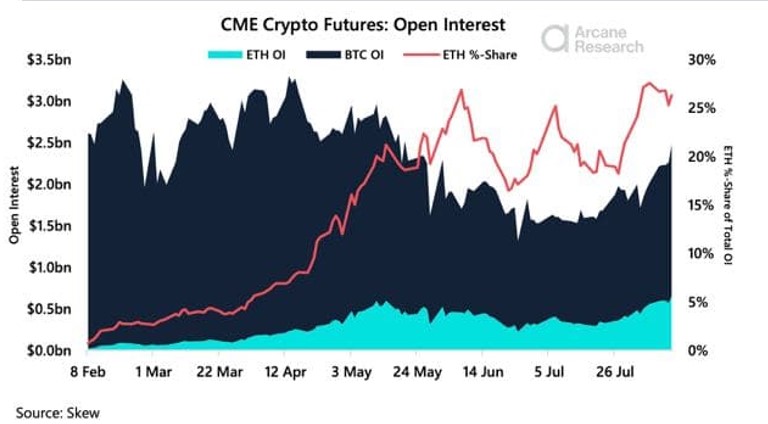
    The research firm has recorded an increase in open interest (OI) for Ethereum futures on the Chicago Mercantile Exchange (CME). The ETH trading volumes have been gaining dominance and stand at around 30% of Bitcoin (BTC) and the open interest at 27%.

    The OI of CME’s EH futures currently sits at an all-time high of $650 million. The OI of the bitcoin futures sits at $1.8 bn but is down substantially from its Feb 18th peak of $3.3 billion. Ether futures now account for 26.5% of the total OI in CME’s crypto futures.

    Ethereum ETH ETHUSD
    Source: Arcane Research

    Ethereum Takes Market Share Away From Bitcoin

    The OI also suggests that institutions are “eagerly” building up their Ethereum (ETH) positions at the moment, Arcane Research said. Most likely, a consequence of the EIP-1559 and the expectations of future appreciation due to the network’s new fee model.

    ETH ETHUSD
    Source: Arcane Research

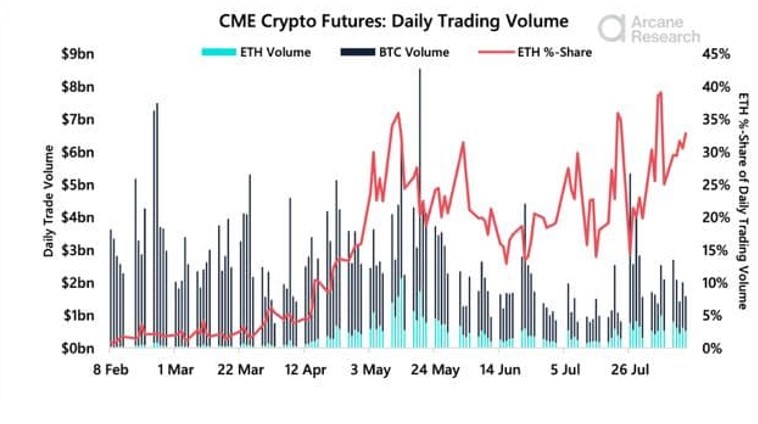
    As the chart shows, ETH futures trading volume has been on a rise since mid-April 12 and only slow down during May and July’s crypto market crash. During this time Ethereum went as low as $1,650 but was able to quickly recover both in price and in the aforementioned metric.

    The daily trading volume of the CME ETH futures has also seen a significant uptick in market share recently. On Friday, Aug 13th, the trading volume of the ETH futures accounted for 33% of the total trading volume in CME’s crypto futures. With the increased dominance of the ETH futures and the growing contango, a bullish sentiment around ETH among institutional investors seems to be brewing.


    [ad_2]

    Source link

  • Vitalik thinks token-based decentralized governance is holding DeFi back

    Vitalik thinks token-based decentralized governance is holding DeFi back

    [ad_1]

    Ethereum co-founder Vitalik Buterin has taken a deep dive into token-based decentralized governance, suggesting that existing voting mechanisms are flawed and may be holding the DeFi sector back from realizing its full potential.

    In a lengthy blog post published Aug. 16, Buterin stated the crypto community needs to “move beyond coin voting as it exists in its present form.”

    Currently, the majority of decentralized finance (DeFi) projects manage their protocol upgrades, reward issuance, and other facets of governance elections where votes are distributed among token holders according to the size of their holdings.

    However, many projects have come under fire for allowing their voting process to be dominated by whales holding vast swathes of the governance tokens, allowing them to vote in support of their personal interests.

    Buterin highlighted two issues relating to token-based governance, emphasizing the risk of incentives misaligning among community members, and its vulnerability to “vote-buying” and “outright attacks” influencing the outcome of governance votes. He added:

    “The most important thing that can be done today is moving away from the idea that coin voting is the only legitimate form of governance decentralization.”

    Buterin noted the prevalence of “unbundling,” whereby “vote-buying” can be achieved and governance systems can be manipulated by borrowing on crypto collateral and using the tokenized assets to vote.

    In the context of unbundling, “the borrower has governance power without economic interest, and the lender has economic interest without governance power,” he added.

    Looking beyond token-based governance, Buterin advocated the exploration of “Proof-of-Humanity”-based governance systems where one vote is allocated per each of a protocol’s users.

    Buterin also offered “Proof-of-Participation” as a possible solution, where voting is limited to the users of a protocol that have contributed work to the benefit of a project or its community, suggesting voting rights could be exclusively distributed to addresses that complete a specific task.

    Ethereum’s co-founder also suggested quadratic voting — where the power of a single voter is proportional to the square root of the economic resources that they commit to a decision — could offer unique solutions to decentralized governance.

    Related: Can DeFi and on-chain governance change human nature?

    He also suggests a “skin in the game” approach that makes individual voters responsible for their decisions, stating:

    “Coin voting fails because while voters are collectively accountable for their decisions (if everyone votes for a terrible decision, everyone’s coins drop to zero), each voter is not individually accountable.”