2

Author: admin

  • Why Be a Crypto Conservative

    Why Be a Crypto Conservative

    [ad_1]

    It can be overwhelming trying to figure out what to put in your crypto portfolio. Which layer 1 alternatives should you place in there? Is LUNA eclipsing SOL? What is your metaverse play, and do you have any gaming coins?

    Not everyone wants to go down the metaverse and gaming rabbit holes, admittedly. There are 100X possibilities, perhaps, but it can feel like a casino, and scratch cards are available if you like gambling, which is not to discourage anyone from playing, but it’s not for everyone.

    When it comes to the larger contenders, the layer 1 alternatives, the landscape, although still crowded, becomes a little more inviting. By layer 1 alternatives, what is meant is competitors to Ethereum (less so Bitcoin, which is in a category of its own), that are built to run decentralized applications and handle things like DeFi and NFTs.

    Here, you are looking at networks such as Cardano, Solana, Avalanche, Fantom, Cosmos and there are more too. These are names that are big enough that any newcomer will come across them soon enough. And, in terms of what they actually do, that makes sense quickly too. As mentioned, they are, basically, competing with Ethereum (although Cosmos is a little different, as it goes about constructing an internet of blockchains).

    You see praise and criticism, and it is not always clear what is true, and what is deliberately meant to steer investors in a certain direction, put out there by commenters with ulterior motives. Cardano is meticulous but takes an age to progress. Solana is speedy but not sufficiently decentralized. Fantom just had a key advisor walk away. And, so on.

    It is at this point that you might decide to try some networks out and see how they work. There is nothing better than first-hand experience, but in the end that doesn’t always clear matters up, because the thing is, the contenders all work well.

    You pick up some nice-looking NFTs on Cardano and Solana. Play around with the Osmosis DEX on Cosmos. Tour through various DeFi landscapes. All the wallets you’ve downloaded operate smoothly, transactions are quick, sometimes impressively speedy, rarely delayed to any greatly troubling extent.

    What you find is, they all seem to function impressively and be solidly put together, and after a while, they even start to feel relatively user-friendly. And, it’s at exactly this point that it can make sense to think about changing direction and becoming a crypto conservative.

    To be clear, a crypto conservative’s portfolio contains two things: Bitcoin and Ethereum.

    It is instructive to look at snapshots of the top ten (or twenty or thirty) cryptos over the past few years. You’ll notice something. From position three and lower, there is constant change, names come and go, and projects appear, ascend, and then disappear into obscurity.

    By contrast, the top two are ever-present and never move, except for their rapidly growing numbers, market cap and price, which constantly spin larger and larger. The top two, of course, are Bitcoin and Ethereum.

    In the end, you can’t help but wonder, is it worth investing in crypto aside from these two? Sure, perhaps you can make some quick gains on the small caps and get out when you’re on top. And, then you can put your gains into, well, the top two.

    At this point in what may, conceivably, be a critical stage in a global crypto transition, a multitude of projects can be skillfully built out and project all the right signals, but still, is it worthwhile challenging Bitcoin and Ethereum, and what would be the point in doing so? In this field perhaps more than any other, network effects are critical, and by that measure, there is an increasingly unassailable gap opening up.

    And, besides which, although we ought to be emotionless and analytical when it comes to investing, it is difficult not to get attached to those top two, on levels that go beyond just investment and returns. Bitcoin created all this, the entire landscape, and its earliest believers are among the most dedicated and driven people around, operating with true conviction from the very start.

    And, then there is Ethereum, committed, as much so as bitcoiners are, to decentralization and neutrality, and to the creation of a global computing network that enables fairness and freedom through technology and code.

    We must not be overly romantic, but these seem like noble, admirably eccentric enterprises that, self-starting and deliberately out of step with all established, power-wielding structures, just might work. And, if that isn’t worth buying into for the long haul, then I don’t know what is.

    Sometimes it appears, simultaneously, that Bitcoin will decentralize money, while Ethereum is decentralizing the web, and that neither of these changes can come a moment too soon. In that case, if you want to peacefully fix what is broken and at the same time have a portfolio you can feel relaxed about, then it pays to be a crypto conservative.

    It can be overwhelming trying to figure out what to put in your crypto portfolio. Which layer 1 alternatives should you place in there? Is LUNA eclipsing SOL? What is your metaverse play, and do you have any gaming coins?

    Not everyone wants to go down the metaverse and gaming rabbit holes, admittedly. There are 100X possibilities, perhaps, but it can feel like a casino, and scratch cards are available if you like gambling, which is not to discourage anyone from playing, but it’s not for everyone.

    When it comes to the larger contenders, the layer 1 alternatives, the landscape, although still crowded, becomes a little more inviting. By layer 1 alternatives, what is meant is competitors to Ethereum (less so Bitcoin, which is in a category of its own), that are built to run decentralized applications and handle things like DeFi and NFTs.

    Here, you are looking at networks such as Cardano, Solana, Avalanche, Fantom, Cosmos and there are more too. These are names that are big enough that any newcomer will come across them soon enough. And, in terms of what they actually do, that makes sense quickly too. As mentioned, they are, basically, competing with Ethereum (although Cosmos is a little different, as it goes about constructing an internet of blockchains).

    You see praise and criticism, and it is not always clear what is true, and what is deliberately meant to steer investors in a certain direction, put out there by commenters with ulterior motives. Cardano is meticulous but takes an age to progress. Solana is speedy but not sufficiently decentralized. Fantom just had a key advisor walk away. And, so on.

    It is at this point that you might decide to try some networks out and see how they work. There is nothing better than first-hand experience, but in the end that doesn’t always clear matters up, because the thing is, the contenders all work well.

    You pick up some nice-looking NFTs on Cardano and Solana. Play around with the Osmosis DEX on Cosmos. Tour through various DeFi landscapes. All the wallets you’ve downloaded operate smoothly, transactions are quick, sometimes impressively speedy, rarely delayed to any greatly troubling extent.

    What you find is, they all seem to function impressively and be solidly put together, and after a while, they even start to feel relatively user-friendly. And, it’s at exactly this point that it can make sense to think about changing direction and becoming a crypto conservative.

    To be clear, a crypto conservative’s portfolio contains two things: Bitcoin and Ethereum.

    It is instructive to look at snapshots of the top ten (or twenty or thirty) cryptos over the past few years. You’ll notice something. From position three and lower, there is constant change, names come and go, and projects appear, ascend, and then disappear into obscurity.

    By contrast, the top two are ever-present and never move, except for their rapidly growing numbers, market cap and price, which constantly spin larger and larger. The top two, of course, are Bitcoin and Ethereum.

    In the end, you can’t help but wonder, is it worth investing in crypto aside from these two? Sure, perhaps you can make some quick gains on the small caps and get out when you’re on top. And, then you can put your gains into, well, the top two.

    At this point in what may, conceivably, be a critical stage in a global crypto transition, a multitude of projects can be skillfully built out and project all the right signals, but still, is it worthwhile challenging Bitcoin and Ethereum, and what would be the point in doing so? In this field perhaps more than any other, network effects are critical, and by that measure, there is an increasingly unassailable gap opening up.

    And, besides which, although we ought to be emotionless and analytical when it comes to investing, it is difficult not to get attached to those top two, on levels that go beyond just investment and returns. Bitcoin created all this, the entire landscape, and its earliest believers are among the most dedicated and driven people around, operating with true conviction from the very start.

    And, then there is Ethereum, committed, as much so as bitcoiners are, to decentralization and neutrality, and to the creation of a global computing network that enables fairness and freedom through technology and code.

    We must not be overly romantic, but these seem like noble, admirably eccentric enterprises that, self-starting and deliberately out of step with all established, power-wielding structures, just might work. And, if that isn’t worth buying into for the long haul, then I don’t know what is.

    Sometimes it appears, simultaneously, that Bitcoin will decentralize money, while Ethereum is decentralizing the web, and that neither of these changes can come a moment too soon. In that case, if you want to peacefully fix what is broken and at the same time have a portfolio you can feel relaxed about, then it pays to be a crypto conservative.

    [ad_2]

    Source link
  • Play to Earn Game Edensol Integrates Secretum Messaging and Trading dApp

    Play to Earn Game Edensol Integrates Secretum Messaging and Trading dApp

    [ad_1]

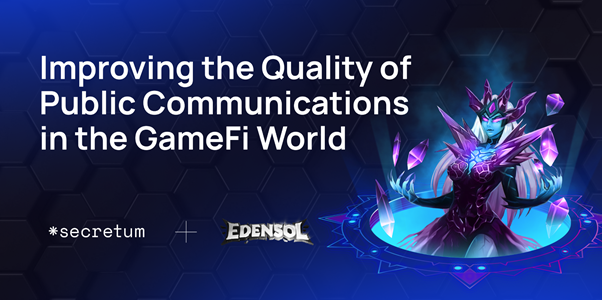
    With the appearance of Metaverse, GameFi projects’ popularity is increasingly growing in the blockchain space whereas Web 2.0 traditional tools seem to be obsolete and not adapted to the Web 3.0 conceptual step up. This instrumental gap is filled by a unique partnership between Secretum and Edensol. Security, transparency, decentralization and immediacy as fundamental values of Web 3.0 meet safety and stability, menaced in other gameFi projects using traditional messengers.

    What is Edensol?

    Edensol is a revolutionary gaming Metaverse that combines fantasy action with the use of groundbreaking NFTs on the Solana blockchain. It’s play-to-earn gaming, easy to understand, exciting, and fast-paced. The main characters of the game are heroes, warriors, rangers, mages and pets. The value of an NFT character depends on its level of personalization (special cosmetic characteristics, number of types of pets owned etc.), as well as the frequency and success of the battles.

    To sell and purchase NFTs players can use NSOL tokens and go trade on the Edensol marketplace. Edensol includes various types of NFTs, among which are heroes, whose value depends on its level of personalization and strength, gear (swords, axes, traps, fireballs, magic spells and battle outfits), eggs and pets.

    The prices of these NFTs vary depending on the value of their superpowers, their looks, their not-yet-unlocked potential, and the rarity of their species. Some ultra-rare gear NFT items with completely unique artistic features and effects will be also tradable on secondary marketplaces in the future.

    Significant advantages of financial gaming with NFTs in Edensol

    A fusion of virtual gaming with NFTs is a confluence of crypto, gaming and money. Gamification of financial systems is disrupting the traditional gaming industry as we know it. It is the next step for the cryptomarket and it has various strengths and advantages. The total value of NFTs rocketing to a new record high of $43 billion in October 2021.

    • In contrast to traditional gaming, where users play to win, Edensol adopts a play-to-earn model and permits the revenue capacity of NFT, which is proven to be significant.
    • Edensol takes advantage of the popularity of video games, combined with unique features of cryptocurrencies
    • Edensol provides verifiable and constant ownership for the players. All data is stored on the decentralized public Solana blockchain, which keeps track of what everyone owns. This means that players, not the game developers, own all of the in-game assets, even if a server is turned off or the gaming company suffers technical downtime. Edensol allows players to maintain ownership of all their in-game items and currency, thanks to tokenization.
    • The game becomes reality. Due to blockchain technology, Edensol adds real-world value to in-game purchases. Interior tokens and items can be traded for cryptocurrencies and, ultimately, actual cash. When a user creates an in-game account, Edensol automatically creates and links a crypto wallet to that account, which is used to store NFTs, in addition to NSOL and any other cryptocurrency. At any time, players can transfer all their in-game NFTs to their crypto wallets, and then sell them on decentralized marketplaces

    These aspects make crypto gaming with Edensol a source of real income for players. It could be a passive income or even a full-time one.

    Although blockchain-based crypto gaming is still vulnerable to attacks. Players can lose all of their assets in a hacking incident. For example, a Discord server by NFT marketplace Fractal got hacked, swindling members over $150,000 in crypto assets. And here comes Secretum as a perfect game-changer for crypto trading.

    What is Secretum?

    Secretum is unique, fully decentralized, end-to-end encrypted and secure trading on the Solana Blockchain. The major innovation of Secretum is enabling the trading of all crypto assets (fungible and NFTs) directly between users, via a hybrid messaging and trading function.

    Secretum possesses a completely anonymous and secure sign-up process with only a user’s crypto wallet address. It is DeFi, metaverse compatible, OTC, P2P trading dApp with access to smart public channels. All data is safely stored on the independent and verified nodes in the Secretum network, with no central point of failure.

    Secretum is just like Edensol based on the Solana blockchain. So it is fast and cheap, with low fees and instant trades due to Solana’s capability of 50,000 transactions per second and an average cost per transaction of only $0.00025.

    As gameFi projects and Edensol, in particular, are sensitive to cyber-attacks Secretum is a perfect detail to solve this problem and ensure the safety of users and their assets from scammers. Secretum provides a safe connection in the web 3.0 world and keeps players’ possessions secure and private.

    Edensol + Secretum: complementary partnership

    Thus, Edensol will use Secretum dApp to ensure safe and end-to-end communications for users, whereas Edensol will be a perfect addition to the Secretum community as a fantasy metaverse and an actual play-to-earn income possibility, combining fun-packed action with P2E features and the use of collectible NFTs on the Solana blockchain. Edensol community members will benefit from OTC, P2P trading functionality in the Secretum dApp. They will be able to trade their $NSOL tokens and NFT gaming assets without intermediaries.

    This highly qualitative partnership allows gamers to avoid scammers. All thanks to verification of $NSOL tokens possession, safety and security of Secretum, a brand new Web 3.0 era messenger and trading solution. Being a solution to most of the insecurity problems of DEXs, Secretum perfectly complements the Solana metaverse and Edensol gameFi project.


    [ad_2]

    Source link

  • Fetch.ai (FET) gains 43% after $150M development fund and Cosmos IBC announcement

    Fetch.ai (FET) gains 43% after $150M development fund and Cosmos IBC announcement

    [ad_1]

    Development across the cryptocurrency ecosystem continues to move forward despite the day-to-day whipsaw price movements and this progress is furthering the public’s awareness of Web3 and the value of blockchain technology. 

    One project that has been climbing the charts amid a marketing push to develop better brand recognition is Fetch.ai, a protocol focused on building a token-based decentralized machine learning network capable of supporting the smart infrastructure being built around the digital economy.

    Data from Cointelegraph Markets Pro and TradingView shows that the price of FET has climbed 43.13% over the past two days, rallying from a low of $0.322 on March 21 to an intraday high at $0.46 on March 23 as its 24-hour trading volume underwent a five-fold increase.

    FET/USDT 4-hour chart. Source: TradingView

    Three reasons for the building interest in Fetch.ai are the launch of a $150 million development fund, plans to further integrate the project into the Cosmos ecosystem and the recent launch of a large-scale marketing campaign.

    Fetch.ai launches a $150 million development fund

    The biggest news to come out of the Fetch ecosystem was the March 22 launch of a $150 million ecosystem development fund, in conjunction with MEXC Global, Huobi and Bybit, that is aimed at attracting developers and established projects to the Fetch.ai ecosystem.

    Ecosystem development funds have become a popular theme across the cryptocurrency community as projects have found them to be a useful way of attracting new projects and users to their protocols in a field that is becoming increasingly crowded and difficult in which to gain traction.

    Deeper integration with Cosmos

    A second major development bridging increased attention to Fetch.ai has been its ongoing integration with the Cosmos ecosystem and Interblockchain Communication Protocol.

    Fetch officially joined the list of projects that were launching within the interoperability-focused Cosmos ecosystem in February and it is currently in the process of upgrading the Fetch.ai chain to allow IBC transfers between supported networks.

    Cosmos has been one of the most active and growing ecosystems over the past six months despite the weakness in the wider cryptocurrency market, which has the potential to benefit Fetch by bringing increased token liquidity and access to a greater pool of investors.

    Related: Fetch.ai launches NFT platform for AI-generated art

    A renewed marketing push

    The third factor helping to increase the awareness of Fetch has been an increased focus on marketing the project to the wider public, including a partnership with Formula 1 driver Alex Albon.

    On top of this Formula 1 sponsorship, marketing for Fetch has also begun to appear in highly visible areas, including digital billboards in Times Square, New York, and subway and bus terminal advertisements.

    Fetch.ai has also begun to recruit crypto influencers to help increase awareness and it has benefited from being listed on the Voyager app on March 18.

    VORTECS™ data from Cointelegraph Markets Pro began to detect a bullish outlook for FET on March 21, prior to the recent price rise.

    The VORTECS™ Score, exclusive to Cointelegraph, is an algorithmic comparison of historical and current market conditions derived from a combination of data points including market sentiment, trading volume, recent price movements and Twitter activity.

    VORTECS™ Score (green) vs. FET price. Source: Cointelegraph Markets Pro

    As seen in the chart above, the VORTECS™ Score for FET hit a high of 80 on March 21, around one hour before the price increased 42.56% over the next two days.

    The views and opinions expressed here are solely those of the author and do not necessarily reflect the views of Cointelegraph.com. Every investment and trading move involves risk, you should conduct your own research when making a decision.