Electricity consumption has been one of the major concerns with the advent of cryptocurrencies especially Polkadot. Though with models running with the Proof-of-Stake (PoS) consensus mechanism, this electricity use seems to be minimal since their process for transaction validations is staking. But the story is not the same for those running with Proof-of-Work (PoW) such as Bitcoin.
Mining is the associated process through which the PoW models could validate their network transactions. However, the process consumes lots of electricity as it uses highly computational equipment to solve cryptographic puzzles.
DOT sits at $18 Source: DOTUSD on TradingView.com
This high energy consumption led to several crackdowns on crypto mining in different countries, especially Bitcoin, in 2021. The move was in line with the argument that such practices facilitate environmental pollution.
This concern on energy consumption propelled the Crypto Carbon Ratings Institute (CCRI) to research the rate of electricity consumption by some blockchains. CCRI studied some networks like Solana, Bitcoin, Ethereum, and Polkadot in its research.
Related Reading | Lessons From Reason’s “The Fake Environmentalist Attack on Bitcoin” Mini-Doc
Based on the results from CCRI research, Polkadot, the strong competitor of Ethereum, emerged as the network with the least electricity consumption compared with Ethereum, Solana, Bitcoin, and other top cryptocurrencies.
This indicates that Polkadot minimally impacts environmental and climatic changes and pollution more than the other networks. According to the CCRI rating, Polkadot’s energy consumption is 6.6 times the annual value of electricity used by an average U.S. family.
A blockchain’s electricity consumption stands as a high determinant factor of its capital inflow from institutional investors. This formed Tesla’s 2021 move against Bitcoin as the electric car company suspended BTC as one of its payment options. The car giant cited BTC mining’s environmental impact as totally unacceptable.
Among all the networks involved in the research, Bitcoin shows the highest energy consumption. Next in the line are Ethereum, Solana, Cardano, Algorand, Avalanche, and Tezos.
Polkadot Announces Pioneers Prize Program
Polkadot has announced its Pioneers Prize Program in a recent move for more technological innovation within its ecosystem. This program is packed with $20 million rewards. The picking of winners will be through a series of challenges and some set prizes. It’s part of the network’s plan to facilitate the growth of its ecosystem and Web3.
The field and general outlook of the network have put DOT on a bullish trend for investors. The contributory influences are coming from Polkadot’s rating of low electricity consumption and its Pioneers Prize Program.
Related Reading | Bitcoin On-Chain Demands Suggests That The Market Has Reached Its Bottom
From analysts’ evaluation of the Polkadot price trend, the protocol has rounded off both its retest and breakout. Most of them think that the DOT has moved to its buy zone.
Featured image from Pixabay, chart from TradingView.com
Charlie Munger, the ancient vice chairman of Berkshire Hathaway and Warren Buffet’s right hand man, has no issue with providing his honest thoughts on cryptocurrency: He hates it.
Speaking at a shareholder’s Q&A session at the annual meeting for LA-based newspaper company, Daily Journal Corp, the 98-year-old investing icon likened crypto to a sexually transmitted disease.
“I certainly didn’t invest in crypto. I’m proud of the fact that I avoided it. It’s like some venereal disease.”
Munger continued to express his contempt for Bitcoin and other cryptocurrencies, adding, “I wish it had been banned immediately… I admire the Chinese for banning it. I think they were right and we were wrong to allow it.”
Munger and Buffet are no strangers to criticizing and downplaying the emergence of cryptocurrency. Buffett has previously ridiculed Bitcoin for being an asset that “does not create anything,” he’s called it “rat poison squared” and said that it is nothing more than a “delusion that attracts charlatans”.
Munger’s imaginative depiction of cryptocurrency do not seem to be reflected in the new investment thesis of Berkshire Hathaway, which is softening up on its exposure to cryptocurrency.
In a securities filing late Feb. 14, Berkshire Hathaway disclosed that it had increased its exposure to cryptocurrency by purchasing $1 billion worth of Nubank stock, Brazil’s largest fintech bank which is popular amongst Brazil’s crypto investors.
“The Nubank investment can be tagged as Buffett’s way of supporting the fintech/crypto world without taking back his criticisms of the past,” asserted Greg Waisman, co-founder and chief operating officer of crypto wallet service Mercuryo, adding that Berkshire is now backing the “digital currency ecosystem indirectly.”
Related: Warren Buffett Doesn’t Want to Own any Cryptocurrency
Crypto Twitter has been quick to respond to Munger’s comments on digital assets.
@gmoneyNFT called out the irony in Munger’s recent remarks point blank to their 225,000 followers:
Charlie Munger: Fiat currency is going to zero
Also Charlie Munger: Crypto is like some venereal disease. I’m proud of the fact that I’ve avoided it. pic.twitter.com/ua85ubdy35
While @cryptonator1337 took aim at Munger’s age, stating to his 35k followers that Munger may not be the best person to consult when it comes to new technology.
When Munger was born in 1924…
.. Lenin died .. the Ottoman Empire ended .. Disney created the first cartoon .. IBM was founded in New York State .. the US president delivered a radio broadcast the first time
But sure let’s listen to him talking about #Bitcoin
MRHB DeFi follows the successful DEX (decentralized exchange) listing on Pancakeswap with its first CEX (centralized exchange) listing on LBank as it continues to bring DeFi opportunities to communities previously discouraged or excluded from the cryptoverse.
One of the fastest-growing cryptocurrency companies, Fireblocks announced the acquisition of First Digital today. The acquisition will facilitate the expansion of the company’s payment offering.
Fireblocks noted that the integration of First Digital will support B2C, B2B, cross-border and other forms of payment through USDC, Celo, other stable coins and digital currencies. In addition, the crypto firm outlined the rising retail and institutional demand for digital asset-related payments.
Earlier this year, Fireblocks raised a whopping $550 million in its Series E funding round. With a valuation of approximately $8 billion, Fireblocks is one of the most valuable companies in the digital asset ecosystem.
“We’re thrilled to welcome First Digital to the Fireblocks family as we accelerate our expansion plans to help every business become a crypto business. We’re pushing ‘fast forward’ to give PSPs the suite of tools they need to begin accepting crypto payments,” Michael Shaulov, the CEO and Co-Founder of Fireblocks, said.
Payments with Digital Assets
According to research conducted by Mastercard, nearly 40% of the consumers in Africa, the Middle East, Asia-Pacific and the American region are planning to use digital currencies for purchases in the next year. Additionally, a large percentage of the respondents are exploring different technology-driven solutions for the settlement of cryptocurrency payments.
Fireblocks and First Digital believe that the acquisition will increase the global adoption of digital assets. “It is amazing to see what the entire Fireblocks team has built and accomplished in such a short period of time. This is an exciting opportunity for the First Digital team based on a proven, successful partnership with Fireblocks. We believe that payments should be a core functionality for all fintech apps, and via Fireblocks’ platform, we will make it available to the world at scale,” Ran Goldi, the CEO of First DAG, commented on the acquisition announcement.
One of the fastest-growing cryptocurrency companies, Fireblocks announced the acquisition of First Digital today. The acquisition will facilitate the expansion of the company’s payment offering.
Fireblocks noted that the integration of First Digital will support B2C, B2B, cross-border and other forms of payment through USDC, Celo, other stable coins and digital currencies. In addition, the crypto firm outlined the rising retail and institutional demand for digital asset-related payments.
Earlier this year, Fireblocks raised a whopping $550 million in its Series E funding round. With a valuation of approximately $8 billion, Fireblocks is one of the most valuable companies in the digital asset ecosystem.
“We’re thrilled to welcome First Digital to the Fireblocks family as we accelerate our expansion plans to help every business become a crypto business. We’re pushing ‘fast forward’ to give PSPs the suite of tools they need to begin accepting crypto payments,” Michael Shaulov, the CEO and Co-Founder of Fireblocks, said.
Payments with Digital Assets
According to research conducted by Mastercard, nearly 40% of the consumers in Africa, the Middle East, Asia-Pacific and the American region are planning to use digital currencies for purchases in the next year. Additionally, a large percentage of the respondents are exploring different technology-driven solutions for the settlement of cryptocurrency payments.
Fireblocks and First Digital believe that the acquisition will increase the global adoption of digital assets. “It is amazing to see what the entire Fireblocks team has built and accomplished in such a short period of time. This is an exciting opportunity for the First Digital team based on a proven, successful partnership with Fireblocks. We believe that payments should be a core functionality for all fintech apps, and via Fireblocks’ platform, we will make it available to the world at scale,” Ran Goldi, the CEO of First DAG, commented on the acquisition announcement.
Coinbase is proud to announce the launch of the Travel Rule Universal Solution Technology (TRUST), an industry-driven solution designed to comply with a requirement known as the Travel Rule while protecting the security and privacy of our customers. TRUST is a platform that allows cryptocurrency exchanges to securely send information legally required by the Travel Rule. The solution is named TRUST because that’s what we seek to instill in our customers when they use our products and services.
The current U.S. TRUST membership includes the following: Anchorage, Avanti, BitGo, bitFlyer, Bittrex, BlockFi, Circle, Coinbase, Fidelity Digital Assetsˢᵐ, Gemini, Kraken, Paxos, Robinhood, Standard Custody & Trust, Symbridge, TradeStation, Zero Hash, and Zodia Custody. And we are soon expanding to other global jurisdictions.
Why is TRUST necessary?
The Travel Rule requires financial institutions to share certain basic information about their customers when sending funds over a certain amount to another financial institution. Custodial cryptocurrency exchanges (like other financial institutions) have to satisfy this rule, which was written before crypto even existed. To do this, a leading group of crypto exchanges came together to create a solution in the crypto space, while continuing to protect the security and privacy of our customers’ personal information. This unprecedented effort led to a jointly designed solution, TRUST, which we hope will soon become the industry standard for complying with these requirements.
What was the goal in designing the TRUST solution, and how was it achieved?
The core goal in designing TRUST was to achieve top-tier compliance with the Travel Rule, while fully honoring customers’ expectations over how their information is handled. To do this, important safeguards were incorporated as part of the TRUST solution:
No central store of personal data: We never centrally store sensitive customer information where it could be targeted by an attacker or misused by a third party. The required information is only directly sent from one TRUST member to another, through end-to-end encrypted channels, and the receiver is required to safeguard it.
Proof of address ownership: TRUST includes a mechanism for the receiving exchange to prove that it’s the owner of the receiving crypto address before customer information is sent — to ensure the right information is sent to the right exchange.
Core security & privacy standards: We require all TRUST members to meet core anti-money laundering, security, and privacy requirements before joining the solution. And we are partnering with Exiger, a global market leader in technology-enabled compliance and risk management solutions, to help us meet that bar, and to provide ongoing compliance support.
Now that TRUST has launched, what are the next steps?
The next step is adding new members, so that TRUST can provide comprehensive compliance across the crypto industry. The Travel Rule’s reach is expanding internationally, and so must the TRUST solution. TRUST is focused on expanding to many other jurisdictions this year.
The launch of TRUST resoundingly demonstrates that top-tier compliance can go hand-in-hand with a core industry value — robust protection of customer privacy and security.
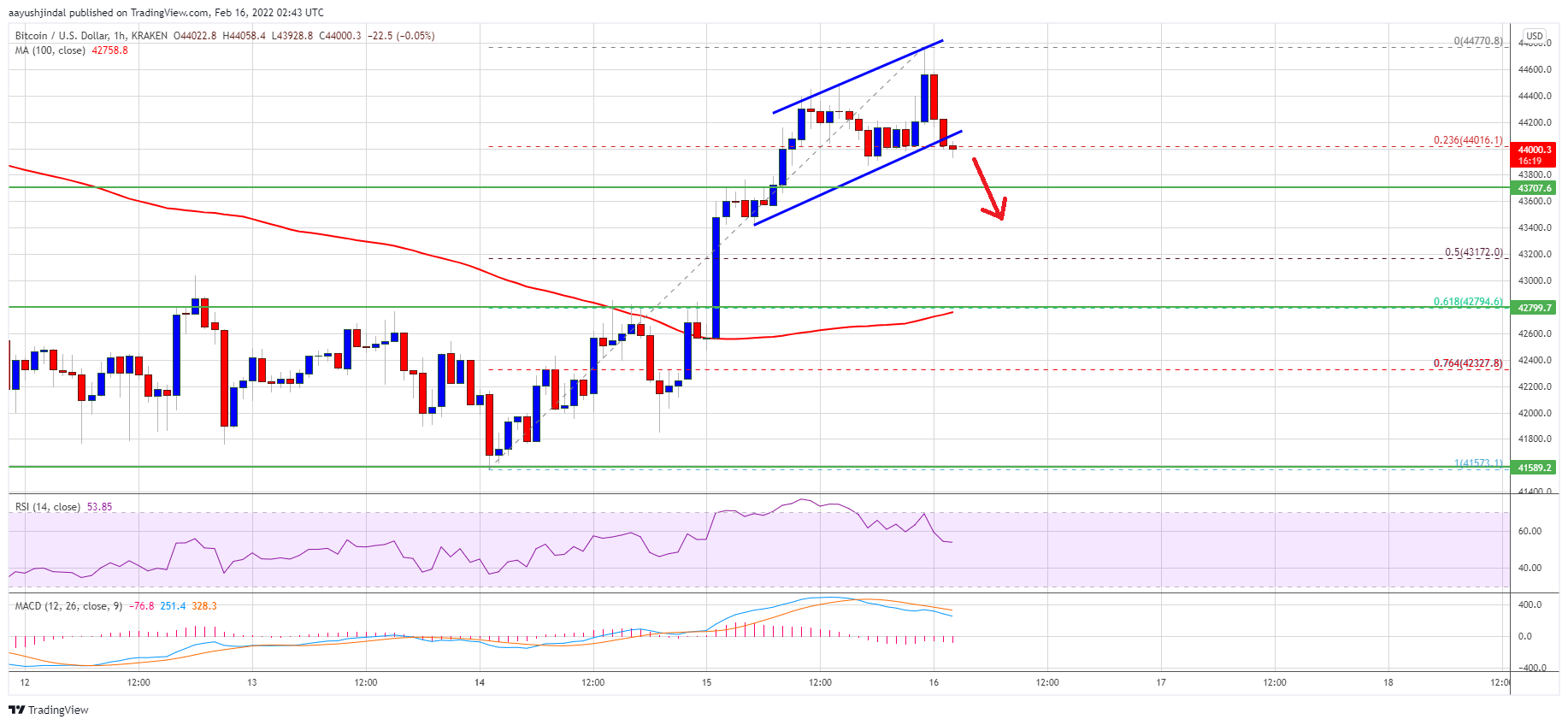
Bitcoin attempted a move towards $45,000 but failed against the US Dollar. BTC is correcting lower, but dips might be limited below $42,800.
Bitcoin extended increase above $44,000 before it faced sellers.
The price is trading above $43,500 and the 100 hourly simple moving average.
There was a break below a short-term rising channel with support near $44,200 on the hourly chart of the BTC/USD pair (data feed from Kraken).
The pair could drop to $43,000 or $42,800, where the bulls might take a stand.
Bitcoin Price Faces Resistance
Bitcoin price remained supported and extended increase above the $44,000 level. BTC even cleared the $44,500 resistance and settled above the 100 hourly simple moving average.
However, there was no test of the $45,000 resistance zone. A high was formed near $44,770 before the price started a downside correction. There was a break below the $44,500 support zone. Besides, there was a break below a short-term rising channel with support near $44,200 on the hourly chart of the BTC/USD pair.
Bitcoin is trading just below the 23.6% Fib retracement level of the upward move from the $41,573 swing low to $44,770 high. On the upside, the price might face resistance near the broken channel support at $44,200.
Source: BTCUSD on TradingView.com
The first major resistance is near the $44,500 level. A clear move above the $44,500 resistance zone might send the price further higher. The next major resistance is near $45,000, above which the price might rise towards the $45,500 resistance level.
Dips Limited in BTC?
If bitcoin fails to continue higher above the $44,500 resistance zone, it could start a downside correction. An immediate support on the downside is near the $43,800 zone.
The next major support is seen near the $43,150 level. It is near the 50% Fib retracement level of the upward move from the $41,573 swing low to $44,770 high. If there is a downside break below the $43,850 support zone, the price might struggle. The next support sits near $42,800 or the 100 hourly SMA, below which there is a risk of a sharp decline in the near term.
Technical indicators:
Hourly MACD – The MACD is now gaining pace in the bearish zone.
Hourly RSI (Relative Strength Index) – The RSI for BTC/USD is still above the 50 level.
Major Support Levels – $43,800, followed by $43,150.
Major Resistance Levels – $44,200, $44,500 and $45,500.
Boost Insurance, an insurance infrastructure-as-a-service platform, alongside go-to-market partner, Breach Insurance, a company that provides insurance technology and regulated insurance products for the cryptocurrency market, today announced the launch of Crypto Shield, an insurance product for cryptocurrency available to retail wallet holders.
Crypto Shield covers the theft of cryptocurrency while in the custody of a qualified custodian.
The Crypto Shield product allows individuals to purchase protection for their crypto wallets held by select custodians. In the case that the custodian is breached or suffers a social engineering attack resulting in lost assets, individuals insured under Crypto Shield can be reimbursed for the value of their policy.
Boost + Breach
While there is some commercial insurance available to cryptocurrency institutions, Breach envisioned Crypto Shield as a solution to the protection gap that currently exists for individuals holding crypto, securing a partnership with Boost to assist in bringing the Crypto Shield product to life.
Boost’s insurance infrastructure-as-a-service packages the necessary operational, technological, compliance, and capital requirements for new insurance programs into a white-label solution, enabling insurtechs like Breach to swiftly launch new lines of business.
“Boost’s deep expertise and insurance infrastructure-as-a-service platform, and Relm’s industry-leading crypto reinsurance capabilities, have positioned Breach to bring a highly complex insurance product to the market in a beautifully delivered customer experience.” – Eyhab Aejaz, Co-Founder & CEO at Breach
To deliver that product in a seamless experience, Boost and Breach’s platforms connect via API, allowing Boost’s policy administration system to deliver back-end management for the Crypto Shield product. Breach’s customers are then able to purchase and manage every part of their policy and claims process, all from within Breach’s proprietary crypto insurance platform.
“With Boost’s infrastructure-as-a-service platform, companies like Breach can launch and deliver innovative new insurance offerings, at a fraction of the time and cost required to build a full-stack insurance program from scratch.” – Alex Maffeo, CEO & Founder of Boost
In addition to powering the new product, Boost and Breach partnered to source and secure the necessary reinsurance backing from industry expert Relm Insurance Ltd. (Relm), underwritten by Trisura Specialty Insurance Company. Operating out of Bermuda, Relm is a capacity provider to the crypto sector with a track record of insuring companies across the ecosystem. Relm has recently been awarded an ‘A Exceptional’ Financial Stability Rating (FSR) by Demotech.
“Relm’s partnership with Boost and Breach to reinsure the US’s first cryptocurrency insurance product for retail wallet holders is a milestone in supporting the development of crypto and blockchain technologies.” – Joe Ziolkowski, CEO at Relm
By Shilpa Dhar, VP of Product, and Moheeth Alvi, Lead Product Manager, Payments
Introducing an instant, convenient way for your friends and family in Mexico to cash out the crypto you send them.
Initially, recipients in Mexico will be able to cash out crypto in local currency at over 37,000 locations across the country, or save the crypto they’ve received in their Coinbase account.
In 2020, immigrants and expats from around the world sent approximately $700 billion from the US to their family and friends back in their home countries, according to the World Bank. But many challenges exist with today’s traditional cross border payment offerings: sender fees can reach up to 6–7%, and recipients can only receive funds as cash in their local currency so they don’t have an option to save, grow, or protect their funds from losing purchasing power due to currency depreciation.
Coinbase has long presented a way to instantly send crypto (including stablecoins such as USDC) to family and friends anywhere in the world for free, and to allow recipients to invest in any of the 100+ cryptocurrencies that we support. Today, we’re introducing the ability for recipients in Mexico to cash out their crypto holdings in their local currency. The lower price of sending and cashing out crypto and flexibility in how to store funds will allow recipients to keep even more of their money.
Instantly Send Funds And Cash Out
Here’s how it works: customers today can already instantly send crypto to recipients in Mexico directly from their Coinbase app. Once sent, the recipient will receive a notification and can immediately view the crypto balance in their Coinbase account. From there, the recipient can choose to cash out or save the funds in their Coinbase account. If they choose to cash out any part of their balance, they can generate a redemption code from their Coinbase app that can be used to receive cash at 37,000 physical retail outlets and convenience stores located across Mexico. If they choose to keep their funds on Coinbase, they can simply hold the crypto asset they received or convert and invest their balance in any of the 100+ cryptocurrencies that Coinbase supports. That includes USDC, a stablecoin pegged to the US Dollar, which will help the recipient hedge against any devaluation of their local currency.
Free through March 31st
Coinbase customers in Mexico will be able to cash out their crypto using this new service free of charge through March 31, 2022. After that date, customers will be charged a nominal fee that’s still 25–50% cheaper than traditional cross border payment solutions.
We recognize this is a global issue. And while we’re starting in Mexico, over time we’ll consider other regions where customers face similar challenges.
Coinbase’s mission is to increase economic freedom around the world, and this new product is core to enabling that mission. We want to make it fast and easy for users to send crypto to anyone in the world, and allow recipients to participate in the cryptoeconomy. We’re just getting started.
By Nana Murugesan, VP, International and Business Development
Coinbase will adopt a go broad and go deep approach to scale globally in order to further its mission of bringing more economic freedom to each and every individual and business around the world. Leadership roles are now open across the globe to build our international presence.
Go Broad: launch foundational products that are a gateway to Web3 and crypto in every country*
Go Deep: launch localized infrastructure and public facing products with a full suite of services
I joined Coinbase around a month ago to lead business development and international operations teams to further our mission, strategy, and culture around the world. In this blog, I wanted to share our international strategy, how we are thinking about building our international operations, and the exciting leadership roles we just opened up around the world for those interested to join us!
By its very nature, crypto is global and decentralized, and as stated in our blog yesterday, we have an ambitious mission to increase economic freedom in the world that will rely on our ability to bring our products to customers globally. Crypto can have a seismic impact in driving toward a more equitable global economy. This is for a number of reasons, including, but not limited to, the fact that in new high growth markets, the barriers to entry into the traditional financial system may be beyond the reach of many citizens. For instance, traditional financial systems may require official identification or a credit history to access financial services and the security it provides. In larger, more diversified economies, we take these things for granted, but in many parts of the world, they’re unavailable to a majority of the population.
There are billions of people around the world who are underbanked or unbanked. According to the World Bank’s Global Financial Inclusion database, 1.7 billion adults are unbanked, and while the number of underbanked is harder to identify, it’s an issue that impacts almost every country. Yet two-thirds of those identified as unbanked own a mobile phone that could help them access financial services. These numbers are even worse for women, who are roughly 10 percent less likely than men to have access to financial services. Where women are not financially empowered, the trend lines are also more profoundly negative, correlated to a less established civil society and the seeds of undemocratic norms. These are precisely the types of challenges that crypto is uniquely equipped to solve.
Economic freedom is unevenly distributed around the world. Crypto enables economic freedom. At Coinbase, we believe everyone deserves access to financial services that can empower them to create a better life for themselves and their families, regardless of their location, gender or socioeconomic status.
Going global is complicated and this is compounded by rapidly evolving regulatory international frameworks for crypto. Our approach globally will be consistent with our approach in the United States: we will work with governments and regulators in different markets, and will always aim to be the most trusted and compliant crypto company in any market. As our co-founder & CEO Brian Armstrong has said, “clear rules of the road allow for technological innovation and investment and give the public and policy makers confidence that these markets are fair.” That is why, in Brian’s words, “we see [regulation] as a business enabler.” We will take that perspective in our global expansion.
A key first step of our strategy is to hire experienced regional and country leaders across the globe. We are now kicking off an extensive global expansion strategy, with hiring and investment plans to enter these markets which will ultimately allow Coinbase to serve customers more locally:
Americas — Latin America, Canada
EMEA — Europe, Middle East and North Africa, Sub-Saharan Africa
APAC — South Asia, Southeast Asia and Oceania, North and East Asia
[Link to newly opened Regional Managing Directors, Country Directors, and other Global & Regional Leadership roles. And, keep an eye out for more roles opening in the coming months]
With these leaders in place, we will develop and execute on in-market plans to (1) launch our products, (2) establish our presence with top local talent, (3) grow our customer base, (4) build our business, and (5) collaborate closely with our external constituents [including regulators, financial institutions and partners]. In parallel, we will explore new market entry through acquisitions.
To accelerate the growth of the cryptoeconomy globally, Coinbase Ventures will double down on regional investments, adding to our portfolio of platforms such as CoinSwitch Kuber and CoinDCX in India, Bitso in Latin America, and Rain in the Middle East.
We understand that a one-size-fits-all approach won’t work as each market is unique, with its own set of opportunities, challenges, political dynamics, and cultural norms. To address this, we plan to take a go broad and go deep approach.
Coinbase’s mission is to increase economic freedom in the world, and we take this commitment seriously. The first tenet of our global strategy is to get crypto into the hands of any person who wants it, regardless of their financial status. This means we may enter international markets at scale with our decentralized and non-custodial products such as Coinbase Wallet. This allows us to offer local communities a light-weight, user-controlled, simple and secure interaction with the crypto economy and to enable fun experiences such as NFT drops from local creators. As regulatory frameworks and markets develop, we will look to go deep, as elaborated below.
In those countries that have clearly defined crypto regulation and there is a clear path for us to offer services in a way that is fully compliant with local laws and with a reasonable content moderation philosophy, we will plan to provide access to a full suite tailored to the local market. For our retail customers, this includes our custodial, full-fiat trading products, such as our main Coinbase App, and products that host user generated content (or include social features) such as our upcoming Coinbase NFT marketplace. For our institutional customers, we will plan to offer a full suite of advanced prime brokerage services, including custody and private client support.
I am excited to embark on this journey, and I look forward to providing updates along the way. At Coinbase we’re building an open financial system for the world and we’re always looking for top talent ready to do the best work of their careers to help us get there. If you think this could be you, we’re hiring!
As concerns for environmental impact rose, the market started to require a framework that allows projects to showcase their ecological implications accurately. Because of this, climate-focused data tracking project Hyphen has found a market gap that it’s very eager to fill.
With the support of a Chainlink grant back in 2021, the project is now launching a decentralized oracle network (DON) that allows smart contracts to have access to a verified resource, providing greenhouse gas data starting with nitrous oxide (N2O). This sparks the creation of a reporting ecosystem that holds corporations accountable for their emissions and allows climate disclosures for compliance with regulations.
Miles Austin, the CEO of Hyphen, told Cointelegraph that the project provides “timely data flows of climate emissions information from global sources to both the private sector and public sector.” With this, capital markets are able to use “real-world climate data” as they strategically plan for sustainability.
“Corporations need the ability to accurately track and report their scope 1, 2 and 3 emissions in order to establish baselines to work from in order to reach climate commitments.”
Hyphen CTO Thierry Gilgen says the platform gives out “validated and trustworthy data streams” to emerging financial ecosystems built on blockchain or distributed ledger technology. With the Chainlink DON, data reported by companies will also go through a decentralized and independent verification process. It eliminates fraudulent and inaccurate reporting.
“We use Chainlink nodes to validate and make available data from scientific organizations for smart contract use, in order to build comprehensive climate tracking and regulatory services for governmental organizations, financial institutions and enterprises that are bound to the new green finance/climate regulations emerging worldwide.”
Related: Are we misguided about Bitcoin mining’s environmental impacts? Slush Pool’s CMO Kristian Csepcsar explains
The initial launch features N2O data from the Integrated Carbon Observation System using the Montreal Protocol framework, a global treaty protecting the ozone layer.
While the debate on the environmental impact of crypto continues to live on, recent reports show that Bitcoin (BTC) mining uses only 0.08% of the world’s carbon dioxide emissions. The network emitted 42 megatons (Mts) of CO2 while the total emissions amounted to 49,360 Mts.