Misconception first: many DeFi users assume that a wallet with a security label or audit badge eliminates the need for operational vigilance. That’s wrong in practice. Wallets reduce risk; they don’t remove it. For advanced DeFi activity — portfolio aggregation across chains, frequent contract approvals, cross-chain gas management, and interaction with complex yield strategies — the trade-off is usually between convenience and explicit visibility into what a transaction will do. Rabby Wallet positions itself toward the visibility-and-control end of that spectrum. Understanding how it achieves that, where it still leaves exposure, and how it compares to common alternatives helps you pick the right tool and the right operational habits for institutional or high-value retail use.
This article untangles the mechanism-level differences that matter to DeFi power users in the US market: transaction simulation versus blind signing, integrated approval revocation versus manual ERC-20 broom-cleaning, automatic network switching versus explicit context-switching, and hardware- or multi-sig-backed custody versus single-key browser extensions. Along the way I highlight the wallet’s limits, sensible mitigations, and decision heuristics you can use today.
How Rabby changes the signing decision: transaction simulation and pre-scan mechanics
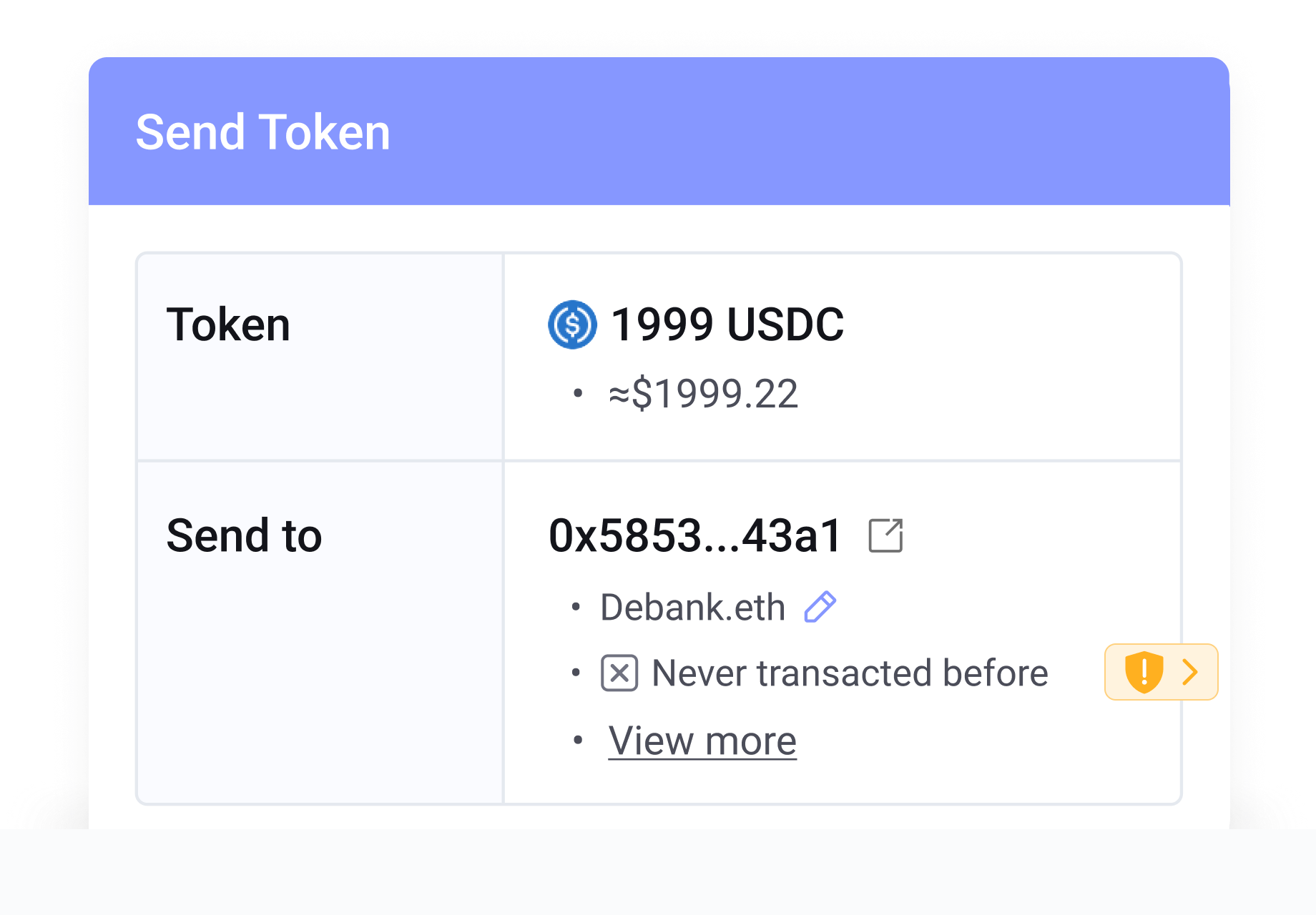
At the technical core that differentiates Rabby from many competitors is transaction simulation. Before a user signs, Rabby runs the proposed transaction in a local simulation that estimates token balance deltas and gas costs. Mechanically, this is not magic: the wallet builds the same call data and executes it against a node or a local state-copy to observe the result. The output is concrete — expected token in/out changes, slippage outcomes, and explicit fee exposure — instead of the abstract method signatures that most wallets show. For a power user, seeing the numeric balance changes before signing transforms a trust decision into a diagnostic check: does this match the dApp UI? Are the approvals consistent with my intentions?
Rabby complements simulation with a pre-transaction risk scanning engine that flags known hacked contracts, suspicious approval requests, and nonexistent recipient addresses. This layered approach addresses two failure modes: (1) accidental blind signing where the user cannot map the payload to a clear outcome, and (2) social-engineered or malicious dApp flows that try to trick a user into unsafe approvals. These are substantial risk reductions, but they are not foolproof — simulations depend on the node or state snapshot used, and blacklist databases can lag new exploits.
Comparing Rabby to MetaMask, Trust Wallet, and Coinbase Wallet: trade-offs and best-fit scenarios
If you ask “should I use Rabby or X?” the right answer depends on your priorities. Below I break down three common alternatives and the trade-offs that matter for high-frequency DeFi operators.
MetaMask — the ubiquitous default. Strength: broad dApp support and ecosystem-first integrations. Weakness: historically more minimal on proactive transaction simulation; users often end up blind signing unless they install additional tooling. Best fit: users prioritizing maximum dApp compatibility and who already use external risk tools or hardware wallets. Rabby’s edge: built-in simulation and automatic network switching reduce friction for multi-chain workflows and lower the cognitive load on the user.
Trust Wallet — mobile-first convenience and custodial hybrid design. Strength: straightforward mobile experience and native fiat on-ramps via partners. Weakness: less granular pre-sign risk detail and fewer institutional integrations. Best fit: casual-to-moderate DeFi users on mobile who value fiat access. Rabby’s edge: richer desktop/browser control, revocation tooling, and enterprise integrations for teams.
Coinbase Wallet — UX polished for mainstream users, with tie-ins to custodial services. Strength: brand trust and on-ramps for US retail. Weakness: still oriented toward retail simplicity rather than transaction forensic detail. Best fit: users wanting an easy bridge to centralized exchange rails. Rabby’s edge: simulation, deeper approval revocation, and multi-sig integrations for sophisticated operational security.
Mechanisms that matter for institutional users: multi-sig, hardware, and revocation
Rabby explicitly integrates with Gnosis Safe and enterprise custody providers like Fireblocks and Amber — that is a deliberate design choice. For institutions, the custody model and operational controls matter more than UI polish. Multi-party approval and hardware-backed key custody reduce single-point-of-failure risk. Rabby’s open-source MIT codebase also allows independent auditing and custom integrations, which institutional security teams appreciate because they can embed Rabby into internal workflows while reviewing the code.
Another practical mechanism is the native approval revocation tool. ERC-20 approvals are a persistent attack surface: once a contract is approved for a high allowance, a subsequent exploit or malicious update to that contract can drain funds. Rabby surfaces active approvals and simplifies revocation. That feature is not unique, but combining it with pre-sign scans and simulated balance changes gives users a clearer chain-of-evidence when deciding whether to grant or revoke allowances.
Where Rabby breaks or trades off: limits and realistic mitigations
No wallet eliminates systemic risk. Rabby’s known limitations include no built-in fiat on-ramp and no native in-wallet staking. For US users who need fiat rails, that means bridging via external on-ramps or custody providers; it adds time and operational steps. From a security posture, Rabby’s 2022 Rabby Swap contract exploit — ~ $190k loss — is a concrete example: even wallets with strong security can be affected by associated contracts or ecosystem components. The team’s response (freezing the contract, compensating users, and auditing more rigorously) is reassuring, but it also illustrates that the source of risk may live in swapped contracts, not the wallet UI itself.
Simulation also has boundary conditions. If the underlying node is out-of-sync, or if a transaction depends on off-chain oracle timing or mempool ordering, the simulated outcome can differ from live execution. Power users should therefore treat simulations as diagnostic signals, not absolute guarantees. Practical mitigation: pair Rabby’s simulations with hardware wallet signing for high-value transactions and use small test transactions when interacting with new contracts.
Operational heuristics — a reusable decision framework for DeFi power users
Here are three concise heuristics that turn the analysis above into practical behavior:
1) Reserve high-value transactions for multi-sig or hardware-backed flows. If the dollar amount exceeds your institutional or personal risk threshold, require at least two independent signing controls. Rabby’s Gnosis Safe and hardware integrations make this feasible without abandoning the browser workflow.
2) Treat the simulation as “red flag + context,” not a proof. If Rabby’s simulation shows unexpected token deltas or unusually large allowance grants, pause. Use small-value confirmation transactions and, where possible, review the contract ABI or source before proceeding.
3) Use the revocation tool as routine hygiene. Audit approvals monthly (more often if you trade or farm frequently). That reduces persistent exposure to exploited dApp contracts and is a low-effort, high-impact control.
Practical download and setup notes for US users
Rabby is available across form factors: Chromium-based browser extensions, desktop clients for Windows and macOS, and mobile apps for iOS and Android. Hardware wallet compatibility is extensive (Ledger, Trezor, Keystone, and others), which matters for both retail power users and institutional key ceremonies. If you are migrating from another wallet, Rabby supports seed phrase or private key import and offers a ‘Flip’ toggle to set itself as the default extension instead of MetaMask — a small usability detail that reduces interruption during complex workflows. For a direct resource on Rabby and setup guidance, see this page about the rabby wallet.
FAQ
Does Rabby’s transaction simulation prevent all rug pulls or contract-exploit losses?
No. Transaction simulation improves visibility by showing estimated balance changes and fees before signing; it does not alter the fact that a malicious or buggy contract can behave differently in certain runtime conditions, or that external oracles and front-running can change outcomes. Treat simulations as a powerful diagnostic tool rather than a guarantee.
Should institutions rely on Rabby alone for custody?
No. Institutions should combine Rabby’s integrations (Gnosis Safe, Fireblocks, Amber) with formal custody policies, hardware keys, threshold signatures, and audit procedures. Rabby can be part of a secure stack, but it is not a replacement for multi-layered institutional controls.
How does Rabby handle cross-chain fees when I don’t have gas on a target chain?
Rabby includes a cross-chain gas top-up feature that lets you send native gas tokens to a chain where you lack funds to execute a transaction. This is a practical convenience that reduces friction when navigating the 90+ EVM-compatible chains Rabby supports, but users should still account for bridge fees and potential slippage when routing gas assets.
Is Rabby open-source and auditable?
Yes. Rabby is released under the MIT license and its codebase is publicly visible, which enables independent security reviews. Open source reduces opacity but does not automatically make software secure; it enables community and professional audits which are only as effective as their scope and frequency.
Bottom line: Rabby Wallet is designed for users who want transactional visibility, routine attack-surface hygiene, and institutional-grade integrations without surrendering the convenience of a browser-based workflow. For DeFi power users in the US juggling multiple chains and complex interactions, its simulation, approval revocation, and multi-sig compatibility change how signing decisions are made — moving them from guesswork into evidence-based checks. But no single tool eliminates systemic and smart-contract risk; use Rabby’s features to reduce exposure, not to justify complacency. Watch for changes in node-performance assumptions, new exploit patterns, and the project’s ongoing audit disclosures — those will be the most actionable signals for whether Rabby’s safeguards are keeping pace with the evolving threat landscape.
Leave a Reply