Month: March 2024

  • Dogecoin Open Interest Hits Record $2.2 Billion

    Dogecoin Open Interest Hits Record $2.2 Billion

    [ad_1]

    The Dogecoin open interest has been on the rise over the past few weeks, breaking and setting new all-time highs twice this March. Unsurprisingly, the price of the meme coin has been reflecting the growth seen by its open interest.

    This recent bullish momentum pushed the price of DOGE to break the $0.22 mark, its highest point in three years. However, the question is – how far can this rally go for the foremost meme token?

    Dogecoin Open Interest Breaks Above $2 Billion

    According to data from CoinGlass, the Dogecoin open interest broke through the $2 billion mark on Friday, March 29. Although DOGE’s open interest stands at around 1.96 billion at press time, it rose as high as $2.21 billion on Friday, a new record for the meme coin.

    Open interest is a metric that measures the total number of futures or options contracts of a particular cryptocurrency (Dogecoin, in this case) in the market at a given time. It provides insight into the amount of money investors are pouring into DOGE derivatives at this time.

    The meme token’s open interest has had quite a performance since the start of March. DOGE’s open interest rose to $1.6 billion (an all-time high at the time) earlier in the month before retracing to below $1 billion by March 20.

    It is worth noting that there has been a high correlation between open interest and Dogecoin’s price, with both climbing at the same time and at almost the same pace. Typically, a rising open interest can suggest a continuation of the trend around the asset’s price at the moment.

    Ultimately, the current high open interest for DOGE could mean a rapid price movement for the meme coin in the near future. However, it would be difficult to tell the direction in which this spurt of volatility would take the price of Dogecoin, especially as open interest is not the most optimal indicator of trends or price action.

    DOGE Price Overview

    As of this writing, the Dogecoin price stands at $0.204, reflecting a 4.6% decline in the last 24 hours. While the meme token’s price has somewhat struggled since hitting the three-year high, it has managed to retain most of its profit from the past week.

    According to CoinGecko data, the Dogecoin price is up by a whopping 18% in the past seven days. This positive performance has strengthened DOGE’s position as the largest meme coin in the market, with a market capitalization of $29 billion.

    Dogecoin

    Dogecoin price sees slight correction on the daily timeframe | Source: DOGEUSDT chart on TradingView

    Featured image from Pexels, chart from TradingView

    Disclaimer: The article is provided for educational purposes only. It does not represent the opinions of NewsBTC on whether to buy, sell or hold any investments and naturally investing carries risks. You are advised to conduct your own research before making any investment decisions. Use information provided on this website entirely at your own risk.

    [ad_2]

    Source link

  • Crypto Expert Predicts Massive Shiba Inu Run As Price Mirrors 2021

    Crypto Expert Predicts Massive Shiba Inu Run As Price Mirrors 2021

    [ad_1]

    Crypto expert Rekt Capital has suggested that Shiba Inu (SHIB) could follow a similar trajectory to its move back in 2021. If so, this sets up the crypto token for a parabolic move that could see it hit its all-time high (ATH) and even surpass it. 

    2024 Shiba Inu To Mirror 2021 Action

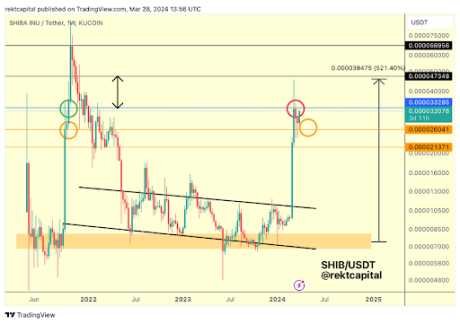
    Rekt Capital mentioned in an X (formerly Twitter) post that SHIB’s retest was successful and that history was repeating itself. According to him, SHIB needs to break above the $0.000033285 price range to begin its uptrend continuation. In a previous post, the crypto analyst raised the possibility of SHIB’s price action mirroring the one from 2021. 

    He noted how SHIB came close to that price range but couldn’t break this resistance level. This was the same thing in late 2021, as Shiba Inu didn’t break that resistance level on the first attempt. That forced the meme coin to retest the $0.000026041 price level as a new support before confirming further upside. 

    Shiba Inu

    Source: X

    This time, Shiba Inu also retested that $0.000026041 price level during its recent price dip, which was partly caused by a wave of profit-taking. The meme coin showed great resolve and somehow managed to hold above that level, and it has since made a good recovery. 

    Now, it needs to break above the $0.000033285 price range to confirm that history is repeating itself and that a price surge to the one in 2021 is on the horizon. 2021 was SHIB’s breakout year when it enjoyed a mouth-watering gain of 46,000,000% on its way to an ATH of $0.00008845 in October 2021. 

    Analysts Optimistic About Shiba Inu’s Future Trajectory

    Rekt Capital isn’t the only one optimistic about SHIB’s future trajectory. Crypto analyst and trader Xanrox recently predicted that SHIB could rise to $0.00008854 by July, representing a new ATH for the meme coin. Interestingly, that looks to be only the starting point for the meme coin, as other analysts have predicted that SHIB could shed another zero. 

    One of them is crypto investor and analyst Oscar Ramos, who expressed his bullish sentiment about the meme coin when he predicted it could rise to $0.0001. Technical analyst Javon Marks also echoed similar sentiments when he suggested that SHIB could rise to as high as $0.0001553. 

    Meanwhile, crypto analyst Ali Martinez once suggested that SHIB’s price gain in 2021 could be nothing compared to what lies ahead for the meme coin. Specifically, Martinez predicted that Shiba Inu could see a historic 122,000% price surge to $0.011.

    At the time of writing, SHIB is trading around $0.00003116, up over 3% in the last 24 hours according to data from CoinMarketCap. 

    Shiba Inu price chart from Tradingview.com

    SHIB price at $0.00003 | Source: SHIBUSDT on Tradingview.com

    Featured image from Coinpedia, chart from Tradingview.com

    Disclaimer: The article is provided for educational purposes only. It does not represent the opinions of NewsBTC on whether to buy, sell or hold any investments and naturally investing carries risks. You are advised to conduct your own research before making any investment decisions. Use information provided on this website entirely at your own risk.

    [ad_2]

    Source link

  • Bitcoin Technical Analysis: BTC Consolidation Points to Potential Shifts Ahead

    Bitcoin Technical Analysis: BTC Consolidation Points to Potential Shifts Ahead

    [ad_1]

    Bitcoin Technical Analysis: BTC Consolidation Points to Potential Shifts AheadOn March 29, 2024, with a trading price of $70,075, and oscillating within a 24-hour range of $68,362 to $71,754, bitcoin’s current market behavior reveals significant consolidation and neutrality. Bitcoin Bitcoin’s 1-hour chart reveals recent volatility, with a significant bounce from a low of approximately $68,362, suggesting a strong support level. Conversely, the resistance near […]

    [ad_2]

    Source link

  • Expert’s Advice for 2024 and Beyond

    [ad_1]

    Over the years, the rise of blockchain and its
    penetration into the financial sector has created all that is convenient to man. This includes streamlining payment systems to allow
    easier and cheaper cross-border transactions and the rise of the
    ever-popular and controversial cryptocurrency.

    All industries across the globe are
    experiencing the most drastic, exciting, and challenging innovation with the digitalization of the modern world and unstoppable technological advancements. These changes have been experienced in the financial sector.

    Blockchain is an unstoppable force that will continue to
    rock the entire financial industry and how we conduct business transactions in
    the future. Many investors have sacrificed money in their high savings interest accounts
    to trade cryptocurrency because of the significant returns. With the limitless possibilities of blockchain technology in finance,
    here’s what we’re looking forward to in 2024:

    Tokenization of Real-World Assets

    Boston Consulting Group believes that less than ten years
    from now, or by 2030, 10% of the global GDP will be held in tokenized illiquid assets valued at more than USD $16 trillion in the best-case scenario. This value can reach USD $68 trillion.

    Illiquid assets, such as real estate, land, commodities,
    natural resources, fine art, and private equity, pose challenges such as limited
    affordability to investors, inability to fractionalize, exclusivity, and
    regulatory issues. Once tokenized, illiquid assets can
    be fractionally owned and are affordable to small-scale
    investors, increasing their liquidity.

    Jim Pendergast, the Senior Vice President at altLINE Sobanco, mentioned: “This allows those rather ‘untradeable’ assets to become available to
    interested parties worldwide, even without being able to actually touch or see
    an asset, made through specifically defined smart contracts using asset or
    token trading platforms.”

    An example of this is four of Andy Warhol’s works being traded for a limited 1,000 tokenized lots each.

    According to Volodymyr Shchegel, the VP of Engineering at
    Clario: “Buying, selling, or trading tokenized assets is similar to stock
    exchanges. However, the challenge with globally dealing with asset token
    trading is that this practice is highly regulated, which can differ from
    jurisdiction to jurisdiction and involves a great understanding of legal
    requirements.”

    Stablecoins

    With cryptocurrency being the most popular arm of blockchain
    in the financial sector, the volatility and instability of most
    cryptocurrencies still deter many individuals from going all in (or going in at
    all) in the crypto world. This is where stablecoins come into the picture.

    Stablecoins are non-volatile cryptocurrencies, unlike most
    types of cryptocurrencies , because they are often tied to assets like currencies
    or commodities, making their value more ‘stable’ than the others.

    Government agencies are hesitant and negative when it comes
    to the conversation about the regulations of crypto assets. However, in 2024, the AICPA issued a reporting framework for stablecoins. This illustrates how
    stablecoins are becoming more acceptable in the financial sector.

    Jerry Han, the CMO at PrizeRebel, stated: “A reporting framework for stablecoins will allow better
    transparency and protection to token issuers, holders, regulators, and the
    entire financial industry.”

    Besides that, the stablecoin issuers in the EU will greatly benefit from
    the recently passed comprehensive crypto regulation called MiCA or Markets in
    Crypto Assets Regulation, the first major jurisdiction to introduce
    comprehensive rules for crypto assets. MiCA outlines stablecoins as e-money
    tokens tied to a fiat currency, and those stablecoins not tied to an EU
    currency will be outright banned from having more than one million transactions
    per day.

    The Rise of dApps

    We know of how DeFi, or decentralized finance,
    operates—challenging traditional centralized banking and financial institutions
    by eliminating the need for middlemen or brokers in loans and trading with the
    help of blockchain and secure distributed ledgers.

    According to Andrew Pierce, the CEO at LLC Attorney: “With
    security and safety being most at stake when it comes to digital assets, dApps,
    or decentralized applications, offer enhanced security and privacy
    features—from data being stored in a decentralized network to advanced
    cryptography.”

    Sustainable Cryptocurrency

    It is no secret how cryptocurrencies, especially Bitcoin,
    have done irreversible damage to the environment. Despite the business and
    financial sector benefiting from the rise of blockchain and crypto, scientists from the U.N. have reported the major impact of Bitcoin mining in increasing
    carbon footprint, as well as water and land footprints.

    Simply put, if Bitcoin were a country, it would have ranked
    27th in the world in terms of energy consumption. Comparatively, it uses an equivalent of half the entire U.K.’s energy consumption. With the negative environmental impact of digital assets, the popularity of sustainable cryptocurrencies is growing
    and will continue to grow in 2024.

    Puneet Gogia, the Founder at Excel Champs, mentioned: “So many individuals
    and businesses are finding joy in cryptocurrencies and how it has made such
    massive breakthroughs, especially in the financial sector, not knowing that
    these are the same things killing our planet.” He added: “We need
    sustainability, even while keeping up with technology.”

    Examples of sustainable cryptocurrencies on the rise are:

    • Green Bitcoin ($GBTC)
    • Solana (SOL)
    • IOTA
    • Cardano
    • eTukTuk
    • Nano

    Looking Forward: The Future of Blockchain in the Finance Industry

    There’s no stopping blockchain from changing how the
    financial sector, as well as the entire
    industry, works and operates. With illiquid asset tokenization, the rise of
    stablecoins, dApps, and sustainable cryptocurrency, blockchain is evolving and
    transforming a new era in finance that focuses on peer-to-peer transactions.

    With the ever-expanding and endless possibilities of DeFi in
    the financial blockchain, 2024 is going to be a year where blockchain is going
    to be more widely accepted and regulated, paving the way for safer and more
    transparent digital asset trading and exchange.

    Over the years, the rise of blockchain and its
    penetration into the financial sector has created all that is convenient to man. This includes streamlining payment systems to allow
    easier and cheaper cross-border transactions and the rise of the
    ever-popular and controversial cryptocurrency.

    All industries across the globe are
    experiencing the most drastic, exciting, and challenging innovation with the digitalization of the modern world and unstoppable technological advancements. These changes have been experienced in the financial sector.

    Blockchain is an unstoppable force that will continue to
    rock the entire financial industry and how we conduct business transactions in
    the future. Many investors have sacrificed money in their high savings interest accounts
    to trade cryptocurrency because of the significant returns. With the limitless possibilities of blockchain technology in finance,
    here’s what we’re looking forward to in 2024:

    Tokenization of Real-World Assets

    Boston Consulting Group believes that less than ten years
    from now, or by 2030, 10% of the global GDP will be held in tokenized illiquid assets valued at more than USD $16 trillion in the best-case scenario. This value can reach USD $68 trillion.

    Illiquid assets, such as real estate, land, commodities,
    natural resources, fine art, and private equity, pose challenges such as limited
    affordability to investors, inability to fractionalize, exclusivity, and
    regulatory issues. Once tokenized, illiquid assets can
    be fractionally owned and are affordable to small-scale
    investors, increasing their liquidity.

    Jim Pendergast, the Senior Vice President at altLINE Sobanco, mentioned: “This allows those rather ‘untradeable’ assets to become available to
    interested parties worldwide, even without being able to actually touch or see
    an asset, made through specifically defined smart contracts using asset or
    token trading platforms.”

    An example of this is four of Andy Warhol’s works being traded for a limited 1,000 tokenized lots each.

    According to Volodymyr Shchegel, the VP of Engineering at
    Clario: “Buying, selling, or trading tokenized assets is similar to stock
    exchanges. However, the challenge with globally dealing with asset token
    trading is that this practice is highly regulated, which can differ from
    jurisdiction to jurisdiction and involves a great understanding of legal
    requirements.”

    Stablecoins

    With cryptocurrency being the most popular arm of blockchain
    in the financial sector, the volatility and instability of most
    cryptocurrencies still deter many individuals from going all in (or going in at
    all) in the crypto world. This is where stablecoins come into the picture.

    Stablecoins are non-volatile cryptocurrencies, unlike most
    types of cryptocurrencies , because they are often tied to assets like currencies
    or commodities, making their value more ‘stable’ than the others.

    Government agencies are hesitant and negative when it comes
    to the conversation about the regulations of crypto assets. However, in 2024, the AICPA issued a reporting framework for stablecoins. This illustrates how
    stablecoins are becoming more acceptable in the financial sector.

    Jerry Han, the CMO at PrizeRebel, stated: “A reporting framework for stablecoins will allow better
    transparency and protection to token issuers, holders, regulators, and the
    entire financial industry.”

    Besides that, the stablecoin issuers in the EU will greatly benefit from
    the recently passed comprehensive crypto regulation called MiCA or Markets in
    Crypto Assets Regulation, the first major jurisdiction to introduce
    comprehensive rules for crypto assets. MiCA outlines stablecoins as e-money
    tokens tied to a fiat currency, and those stablecoins not tied to an EU
    currency will be outright banned from having more than one million transactions
    per day.

    The Rise of dApps

    We know of how DeFi, or decentralized finance,
    operates—challenging traditional centralized banking and financial institutions
    by eliminating the need for middlemen or brokers in loans and trading with the
    help of blockchain and secure distributed ledgers.

    According to Andrew Pierce, the CEO at LLC Attorney: “With
    security and safety being most at stake when it comes to digital assets, dApps,
    or decentralized applications, offer enhanced security and privacy
    features—from data being stored in a decentralized network to advanced
    cryptography.”

    Sustainable Cryptocurrency

    It is no secret how cryptocurrencies, especially Bitcoin,
    have done irreversible damage to the environment. Despite the business and
    financial sector benefiting from the rise of blockchain and crypto, scientists from the U.N. have reported the major impact of Bitcoin mining in increasing
    carbon footprint, as well as water and land footprints.

    Simply put, if Bitcoin were a country, it would have ranked
    27th in the world in terms of energy consumption. Comparatively, it uses an equivalent of half the entire U.K.’s energy consumption. With the negative environmental impact of digital assets, the popularity of sustainable cryptocurrencies is growing
    and will continue to grow in 2024.

    Puneet Gogia, the Founder at Excel Champs, mentioned: “So many individuals
    and businesses are finding joy in cryptocurrencies and how it has made such
    massive breakthroughs, especially in the financial sector, not knowing that
    these are the same things killing our planet.” He added: “We need
    sustainability, even while keeping up with technology.”

    Examples of sustainable cryptocurrencies on the rise are:

    • Green Bitcoin ($GBTC)
    • Solana (SOL)
    • IOTA
    • Cardano
    • eTukTuk
    • Nano

    Looking Forward: The Future of Blockchain in the Finance Industry

    There’s no stopping blockchain from changing how the
    financial sector, as well as the entire
    industry, works and operates. With illiquid asset tokenization, the rise of
    stablecoins, dApps, and sustainable cryptocurrency, blockchain is evolving and
    transforming a new era in finance that focuses on peer-to-peer transactions.

    With the ever-expanding and endless possibilities of DeFi in
    the financial blockchain, 2024 is going to be a year where blockchain is going
    to be more widely accepted and regulated, paving the way for safer and more
    transparent digital asset trading and exchange.


    [ad_2]

    Source link

  • US, UK Probe $20B Crypto Transfers Linked to Russian Exchange

    US, UK Probe $20B Crypto Transfers Linked to Russian Exchange

    [ad_1]

    Authorities from the US and the UK are investigating
    cryptocurrency transactions traversing Russian exchanges. Recent revelations
    suggest that over $20 billion in crypto transfers have been flagged for
    investigation.

    According to a report by Bloomberg, the suspicions
    revolve around Moscow-based Garantex and its use of the Tether cryptocurrency.
    At the center of the scrutiny is Tether, a dollar-pegged stablecoin. The sizable volume of transactions sent through
    Garantex using Tether has raised red flags, prompting regulatory bodies to
    delve deeper into potential sanctions evasion and illicit financial activities.

    Tether Holdings, the issuer of the eponymous
    stablecoin, finds itself entangled in the investigation. Authorities caution
    that unraveling the intricacies of these transactions requires time and
    resources, with no immediate conclusions drawn.

    Garantex, founded in Estonia but operating primarily
    out of Moscow, finds itself in the regulatory crosshairs. Stripped of its
    license in Estonia and sanctioned by Western powers, the exchange denies
    allegations of complicity in illicit activities.

    However, evidence suggests a pattern of facilitating
    transactions involving sanctioned entities and criminal groups. As the
    investigation unfolds, the spotlight on cryptocurrency exchanges intensifies. While asserting cooperation with law enforcement, the
    company faces scrutiny over the role of Tether in facilitating criminal
    activities, including investment scams and money laundering schemes.

    Challenges and Complexity

    Despite concerted efforts to clamp down on illicit
    financial flows, the task remains daunting. Cryptocurrency transactions present
    a myriad of challenges, from their decentralized nature to the cloak of
    anonymity they afford.

    Regulatory bodies are poised to implement stricter
    oversight measures to curb abuse and safeguard the integrity of the financial
    system. Yet, the evolving landscape of digital currencies underscores the
    ongoing challenges in combating financial crime in the digital age.

    As geopolitical tensions escalate due to Russia’s
    invasion of Ukraine, Western powers are tightening their grip on financial
    networks to stem the flow of funds that could support Vladimir Putin’s regime.

    Authorities from the US and the UK are investigating
    cryptocurrency transactions traversing Russian exchanges. Recent revelations
    suggest that over $20 billion in crypto transfers have been flagged for
    investigation.

    According to a report by Bloomberg, the suspicions
    revolve around Moscow-based Garantex and its use of the Tether cryptocurrency.
    At the center of the scrutiny is Tether, a dollar-pegged stablecoin. The sizable volume of transactions sent through
    Garantex using Tether has raised red flags, prompting regulatory bodies to
    delve deeper into potential sanctions evasion and illicit financial activities.

    Tether Holdings, the issuer of the eponymous
    stablecoin, finds itself entangled in the investigation. Authorities caution
    that unraveling the intricacies of these transactions requires time and
    resources, with no immediate conclusions drawn.

    Garantex, founded in Estonia but operating primarily
    out of Moscow, finds itself in the regulatory crosshairs. Stripped of its
    license in Estonia and sanctioned by Western powers, the exchange denies
    allegations of complicity in illicit activities.

    However, evidence suggests a pattern of facilitating
    transactions involving sanctioned entities and criminal groups. As the
    investigation unfolds, the spotlight on cryptocurrency exchanges intensifies. While asserting cooperation with law enforcement, the
    company faces scrutiny over the role of Tether in facilitating criminal
    activities, including investment scams and money laundering schemes.

    Challenges and Complexity

    Despite concerted efforts to clamp down on illicit
    financial flows, the task remains daunting. Cryptocurrency transactions present
    a myriad of challenges, from their decentralized nature to the cloak of
    anonymity they afford.

    Regulatory bodies are poised to implement stricter
    oversight measures to curb abuse and safeguard the integrity of the financial
    system. Yet, the evolving landscape of digital currencies underscores the
    ongoing challenges in combating financial crime in the digital age.

    As geopolitical tensions escalate due to Russia’s
    invasion of Ukraine, Western powers are tightening their grip on financial
    networks to stem the flow of funds that could support Vladimir Putin’s regime.

    [ad_2]

    Source link

  • Sam Bankman-Fried Sentenced to 25 Years in Prison

    Sam Bankman-Fried Sentenced to 25 Years in Prison

    [ad_1]

    Sam Bankman-Fried, the Co-Founder of the collapsed
    cryptocurrency exchange FTX, was sentenced to 25 years in prison by Judge Lewis Kaplan today (Thursday). Bankman-Fried was found guilty of multiple counts of
    wire fraud and conspiracy that led to the collapse of the crypto exchange and caused billions of dollars of losses to investors.

    The long-standing legal tussle culminated in the recent
    sentencing. Prosecutors in the case recently sought a staggering 40 to 50 years prison sentence for the disgraced crypto entrepreneur. Despite the verdict, Bankman-Fried’s
    defense team has vowed to appeal both the conviction and the
    sentence.

    According to a report by CNN Business, in addition to
    the prison sentence, Kaplan ordered forfeiture of $11.02 billion. The judge recommended that Bankman-Fried be placed in a lower or medium-security
    facility that the Bureau of Prisons would find appropriate. Medium-security facilities are characterized by
    strengthened perimeters and various work programs.

    During the sentencing, SBF
    apologized to the victims of the collapsed cryptocurrency exchange. Compared to prominent white-collar fraud cases, SBF’s jail term is shorter than Bernard Madoff’s 150-year term but longer than
    Elizabeth Holmes’ prison sentence of 11 years behind bars.

    According to Reuters, Bankman-Fried’s journey from MIT to being a prominent figure in the cryptocurrency world seemed
    nothing short of remarkable. With the founding of FTX exchange , he quickly
    became a symbol of innovation and success in the digital asset market.

    His net worth soared to unprecedented heights,
    reaching a staggering $26 billion before he turned 30, according to Forbes.
    Prosecutors alleged that Bankman-Fried had been embezzling funds from FTX’s
    customers for years, leading to the eventual collapse of the exchange in 2022.

    The Rise and Fall of a Crypto Titan

    The fallout from the scandal was immense, with
    customers losing a total of $8 billion, equity investors losing $1.7 billion,
    and lenders to Bankman-Fried’s hedge fund, Alameda Research, losing $1.3
    billion. Despite his claim of innocence and assertions that he
    had made mistakes but had no intention to defraud anyone, the jury found Bankman-Fried guilty on seven counts of fraud and conspiracy.

    Bankman-Fried reportedly expressed regret for the harm
    caused to FTX’s customers and his former colleagues, acknowledging the gravity
    of his actions. However, throughout the trial, he maintained that he was innocent. He claimed that any error in FTX’s management was not a deliberate act of fraud.

    Recently, Sam Bankman-Fried’s attorney, Marc Mukasey, petitioned Kaplan to reduce the sentence of his client. Bankman-Fried’s legal team advocated for a prison term ranging from five years and three months to six years and six months. As the cryptocurrency landscape continues to evolve, SBF’s
    downfall is a reminder of the need for integrity in the sector.

    Sam Bankman-Fried, the Co-Founder of the collapsed
    cryptocurrency exchange FTX, was sentenced to 25 years in prison by Judge Lewis Kaplan today (Thursday). Bankman-Fried was found guilty of multiple counts of
    wire fraud and conspiracy that led to the collapse of the crypto exchange and caused billions of dollars of losses to investors.

    The long-standing legal tussle culminated in the recent
    sentencing. Prosecutors in the case recently sought a staggering 40 to 50 years prison sentence for the disgraced crypto entrepreneur. Despite the verdict, Bankman-Fried’s
    defense team has vowed to appeal both the conviction and the
    sentence.

    According to a report by CNN Business, in addition to
    the prison sentence, Kaplan ordered forfeiture of $11.02 billion. The judge recommended that Bankman-Fried be placed in a lower or medium-security
    facility that the Bureau of Prisons would find appropriate. Medium-security facilities are characterized by
    strengthened perimeters and various work programs.

    During the sentencing, SBF
    apologized to the victims of the collapsed cryptocurrency exchange. Compared to prominent white-collar fraud cases, SBF’s jail term is shorter than Bernard Madoff’s 150-year term but longer than
    Elizabeth Holmes’ prison sentence of 11 years behind bars.

    According to Reuters, Bankman-Fried’s journey from MIT to being a prominent figure in the cryptocurrency world seemed
    nothing short of remarkable. With the founding of FTX exchange , he quickly
    became a symbol of innovation and success in the digital asset market.

    His net worth soared to unprecedented heights,
    reaching a staggering $26 billion before he turned 30, according to Forbes.
    Prosecutors alleged that Bankman-Fried had been embezzling funds from FTX’s
    customers for years, leading to the eventual collapse of the exchange in 2022.

    The Rise and Fall of a Crypto Titan

    The fallout from the scandal was immense, with
    customers losing a total of $8 billion, equity investors losing $1.7 billion,
    and lenders to Bankman-Fried’s hedge fund, Alameda Research, losing $1.3
    billion. Despite his claim of innocence and assertions that he
    had made mistakes but had no intention to defraud anyone, the jury found Bankman-Fried guilty on seven counts of fraud and conspiracy.

    Bankman-Fried reportedly expressed regret for the harm
    caused to FTX’s customers and his former colleagues, acknowledging the gravity
    of his actions. However, throughout the trial, he maintained that he was innocent. He claimed that any error in FTX’s management was not a deliberate act of fraud.

    Recently, Sam Bankman-Fried’s attorney, Marc Mukasey, petitioned Kaplan to reduce the sentence of his client. Bankman-Fried’s legal team advocated for a prison term ranging from five years and three months to six years and six months. As the cryptocurrency landscape continues to evolve, SBF’s
    downfall is a reminder of the need for integrity in the sector.


    [ad_2]

    Source link

  • XRP ETF Premium Primed For Big Leap: Eyes Set On $500

    XRP ETF Premium Primed For Big Leap: Eyes Set On $500

    [ad_1]

    XRP enthusiasts are in a frenzy after prominent community figure Chad Steingraber proposed a scenario where an XRP exchange-traded fund (ETF) could trade at a staggering 100x premium.

    Steingraber, a seasoned game designer, laid out his thoughts in a recent post, igniting discussions about the potential trajectory of an XRP ETF, particularly in light of the ongoing push for institutional adoption of the altcoin.

    Targeting A $500 XRP ETF Share Price

    Steingraber’s speculation centers around the price at which an XRP ETF’s shares might trade. His hypothesis hinges on the crypto reaching an unprecedented price of $5 per coin. In this scenario, he theorizes that the corresponding ETF could soar to equally unprecedented heights, potentially reaching a solid $500 per share.

    This hefty premium, according to Steingraber, would be fueled by a surge in institutional interest in the ETF. He cites the Grayscale Litecoin Trust (LTCN) as a prime example.

    Similar to his proposed XRP ETF, LTCN trades at a significant premium over Litecoin’s current market price. Despite Litecoin hovering around $95, investors in LTCN are currently paying a premium of over $250 per Litecoin equivalent within the trust.

    Can Arbitrage Opportunities Emerge?

    The prospect of such a high premium has sparked discussions about potential arbitrage opportunities. X user Zack, in response to Steingraber’s post, questioned whether individuals holding XRP could exploit this price disparity. Steingraber acknowledged the possibility, particularly if the issuing ETF allows for in-kind deposits, where investors can directly exchange their token for ETF shares.

    XRP market cap currently at $34 billion. Chart: TradingView.com

    However, he cautioned that in-kind deposits are still a rarity in the ETF market. While Steingraber expressed optimism about the future adoption of this practice, its absence presents a hurdle for immediate arbitrage opportunities.

    The XRP community has long advocated for asset managers, especially industry giant BlackRock, to launch an XRP ETF. They believe such a product would significantly bolster the value of XRP by increasing its accessibility to institutional investors.

    XRP up in the last seven days. Source: Coingecko


    A Speculative Outlook With Underlying Uncertainties

    It’s crucial to remember that Steingraber’s vision is entirely speculative. As of today, no asset manager has taken concrete steps towards applying for an XRP ETF. Furthermore, the justification for such a high premium rests heavily on the assumption of substantial institutional demand, a factor that remains uncertain.

    The applicability of the Grayscale Litecoin Trust comparison also requires further scrutiny. The specific structure and features of an XRP ETF would significantly influence whether a similar premium dynamic would emerge.

    A Reality Check For Investors

    While Steingraber’s prediction has certainly captured the community’s imagination, investors are advised to approach it with a healthy dose of caution. The approval timeline for an XRP ETF hinges on the US Securities and Exchange Commission’s stance on cryptocurrency ETFs.

    Additionally, competition from other potential ETFs could play a role in determining the premium, if any.

    Featured image from Freepik, chart from TradingView

    Disclaimer: The article is provided for educational purposes only. It does not represent the opinions of NewsBTC on whether to buy, sell or hold any investments and naturally investing carries risks. You are advised to conduct your own research before making any investment decisions. Use information provided on this website entirely at your own risk.


    [ad_2]

    Source link

  • CFTC Takes Legal Action Against Kucoin, Highlights BTC, ETH, and LTC as Commodities

    CFTC Takes Legal Action Against Kucoin, Highlights BTC, ETH, and LTC as Commodities

    [ad_1]

    CFTC Takes Legal Action Against Kucoin, Highlights BTC, ETH, and LTC as CommoditiesThe U.S. Commodity Futures Trading Commission (CFTC) has filed a lawsuit against Kucoin, emphasizing the classification of bitcoin, ethereum, and litecoin as commodities. The enforcement action, launched in the U.S. District Court for the Southern District of New York, accuses Kucoin of multiple regulatory breaches involving these digital assets. Kucoin’s Legal Battles Shine a Bright […]

    [ad_2]

    Source link

  • Galaxy Digital Becomes Profitable in 2023

    Galaxy Digital Becomes Profitable in 2023

    [ad_1]

    Michael Novogratz’s Galaxy Digital Holdings has turned a profit of $296 million in 2023, recovering from a loss of $1 billion in the previous year, as the upward movement of cryptocurrency prices picked up.

    Interestingly, the final quarter of 2023 turned the results for the company when it generated a net income of $302 million, compared to a loss of $288 million in the corresponding quarter of the precious year. Even in the third quarter of 2023, it had a loss of $94 million.

    “Since the end of the fourth quarter 2023, digital asset prices materially changed, and our business has benefited from heightened market volatility and increased trading volumes,” the company stated.

    Indeed, the price of Bitcoin and other digital assets picked up at the end of 2023 with the anticipation of the approval of Bitcoin exchange-traded funds in the United States. Further, with the approval last January, the bull market received a push as Bitcoin neared $74,000.

    The Boom in Crypto Prices Pushed the Revenue

    The financial report from Galaxy Digital, released yesterday (Tuesday), revealed its total annual revenue last year to be $613.8 million, a gain of over 46 percent. A realized gain of $311.8 million from digital assets pushed the total revenue higher. Another significant revenue generator was from derivatives, which brought in $151.5 million. Revenue from staking and lending services totaled $52.2 million, while earnings from mining operations was $33.1 million.

    Notably, the asset under management of the cryptocurrency funds managed by Galaxy Digital increased more than 200 percent in 2023 to reach $5.2 billion at the end of the year. This figure almost doubled in the next two consecutive months to reach $10.1 billion at the end of February 2024.

    “For the year-to-date period ending February 29, 2024, Galaxy Digital Holdings LP’s income before tax is estimated to be approximately $300 million, driven primarily by the appreciation of digital asset prices and growth in our operating businesses. Galaxy Digital Holdings LP’s equity capital increased to approximately $2.1 billion over the same period,” the company added.

    Michael Novogratz’s Galaxy Digital Holdings has turned a profit of $296 million in 2023, recovering from a loss of $1 billion in the previous year, as the upward movement of cryptocurrency prices picked up.

    Interestingly, the final quarter of 2023 turned the results for the company when it generated a net income of $302 million, compared to a loss of $288 million in the corresponding quarter of the precious year. Even in the third quarter of 2023, it had a loss of $94 million.

    “Since the end of the fourth quarter 2023, digital asset prices materially changed, and our business has benefited from heightened market volatility and increased trading volumes,” the company stated.

    Indeed, the price of Bitcoin and other digital assets picked up at the end of 2023 with the anticipation of the approval of Bitcoin exchange-traded funds in the United States. Further, with the approval last January, the bull market received a push as Bitcoin neared $74,000.

    The Boom in Crypto Prices Pushed the Revenue

    The financial report from Galaxy Digital, released yesterday (Tuesday), revealed its total annual revenue last year to be $613.8 million, a gain of over 46 percent. A realized gain of $311.8 million from digital assets pushed the total revenue higher. Another significant revenue generator was from derivatives, which brought in $151.5 million. Revenue from staking and lending services totaled $52.2 million, while earnings from mining operations was $33.1 million.

    Notably, the asset under management of the cryptocurrency funds managed by Galaxy Digital increased more than 200 percent in 2023 to reach $5.2 billion at the end of the year. This figure almost doubled in the next two consecutive months to reach $10.1 billion at the end of February 2024.

    “For the year-to-date period ending February 29, 2024, Galaxy Digital Holdings LP’s income before tax is estimated to be approximately $300 million, driven primarily by the appreciation of digital asset prices and growth in our operating businesses. Galaxy Digital Holdings LP’s equity capital increased to approximately $2.1 billion over the same period,” the company added.

    [ad_2]

    Source link

  • Bitcoin Held On Coinbase Exchange Reach 9-Year Low, Can Bitcoin Reach $75,000?

    Bitcoin Held On Coinbase Exchange Reach 9-Year Low, Can Bitcoin Reach $75,000?

    [ad_1]

    In a recent development, data from crypto analytics firm Glassnode shows that the amount of Bitcoin held on Coinbase has reached a 9-year low. This has raised the possibility of the flagship crypto rising to a new all-time high (ATH) of $75,000 soon enough. 

    BTC Held On Coinbase Drops Significantly 

    According to Glassnode, the Bitcoin balance on Coinbase dropped to a nine-year low of 344,856 on March 18. This suggests that Bitcoin investors are choosing to move their holdings off exchanges and hold for the long term rather than sell anytime soon. A move like this reduces the short-term pressure on Bitcoin and could spark an upward trend in BTC’s price. 

    Meanwhile, the drop in BTC held on Coinbase looks to be a trend, with data from market intelligence platform Santiment showing a drop in the total amount of Bitcoin held on centralized exchanges (CEXs). This data is also supported by the fact that these exchanges have recorded more outflows than inflows lately. 

    Further data from Santiment also shows that the supply on exchanges as of March 22 stood at just over 836,000 BTC compared to the 18.82 million BTC that resides out of these CEXs. The decline in the number of BTC held on exchanges is undoubtedly a welcome development, considering how the flagship crypto token has recently been plagued with a wave of profit-taking

    Before now, the bearish sentiment surrounding BTC was further strengthened by JPMorgan’s theory that Bitcoin was overbought and that the crypto token could experience further price declines soon enough. However, with BTC back over $70,000, there is the belief that this is just the beginning of an upward trend that could see it reach new highs. 

    Spot Bitcoin ETFs Record Net Inflows

    BitMEX Research revealed in an X (formerly Twitter) post that the Spot Bitcoin ETFs recorded a combined net inflow of $15.7 million on March 25. This represents a positive turn of events after these funds recorded negative flows throughout last week. The wave of profit-taking by these Bitcoin ETF investors contributed to the BTC dip that occurred during that period. 

    The crypto community will no doubt keep their eyes on the flows recorded by these Spot Bitcoin ETFs this week as they could give an idea of whether or not the outlook towards BTC has become bullish again. These Bitcoin ETFs now play a prominent role in the Bitcoin ecosystem, considering how much BTC these fund issuers accumulate whenever there is a high demand for them. 

    At the time of writing, Bitcoin is trading at around $70,700, up over 5% in the last 24 hours according to data from CoinMarketCap.

    Bitcoin price chart from Tradingview.com

    BTC price trending north of $70,000 | Source: BTCUSD on Tradingview.com

    Featured image from BBC, chart from Tradingview.com

    Disclaimer: The article is provided for educational purposes only. It does not represent the opinions of NewsBTC on whether to buy, sell or hold any investments and naturally investing carries risks. You are advised to conduct your own research before making any investment decisions. Use information provided on this website entirely at your own risk.

    [ad_2]

    Source link