Yesterday, Twitter confirmed its acquisition by Elon Musk in a deal worth nearly $44 billion. The announcement had a positive impact on the crypto market and specifically on Dogecoin (DOGE). The world’s largest meme coin jumped by approximately 25% within 24 hours.
Today, Dogecoin reached a high of almost $0.167, according to the data published by Coinmarketcap. With that, DOGE crossed the market cap of $20 billion for the first time in almost three weeks. The meme coin is now the 10th most valuable cryptocurrency in the world, just behind Cardano (ADA) and Terra (LUNA).
“Potentially related to the news of ElonMusk’s nearly formalized purchase of Twitter today, Dogecoin has pumped +19% over the past six hours. We have historically seen that meme coins benefit from Musk developments, & we’ll monitor this situation,” crypto analysis platform Santiment recently highlighted in a Twitter post.
Elon Musk has been one of the biggest supporters of Dogecoin. In March 2022, the CEO of Tesla confirmed that he is holding different crypto assets including Bitcoin, Ethereum and DOGE. In a Tweet last year, Elon Musk called Dogecoin “the people’s crypto.”
Meme Coins
Amid the retail frenzy in digital assets during 2021, meme coins gained significant popularity among users. DOGE and Shiba Inu witnessed monumental gains throughout last year. However, DOGE and SHIB saw consistent dips in the past 5 months. Despite the latest jump of approximately 25%, Dogecoin is still down by almost 50% compared to October 2021. A similar trend was witnessed across the Shiba Inu network. SHIB is now down by more than 60% from its all-time high in November 2021.
Despite price volatility, the adoption of DOGE and SHIB has increased in the past 12 months. Earlier this month, AMC mobile app started accepting Shiba Inu and Dogecoin for online payments.
Yesterday, Twitter confirmed its acquisition by Elon Musk in a deal worth nearly $44 billion. The announcement had a positive impact on the crypto market and specifically on Dogecoin (DOGE). The world’s largest meme coin jumped by approximately 25% within 24 hours.
Today, Dogecoin reached a high of almost $0.167, according to the data published by Coinmarketcap. With that, DOGE crossed the market cap of $20 billion for the first time in almost three weeks. The meme coin is now the 10th most valuable cryptocurrency in the world, just behind Cardano (ADA) and Terra (LUNA).
“Potentially related to the news of ElonMusk’s nearly formalized purchase of Twitter today, Dogecoin has pumped +19% over the past six hours. We have historically seen that meme coins benefit from Musk developments, & we’ll monitor this situation,” crypto analysis platform Santiment recently highlighted in a Twitter post.
Elon Musk has been one of the biggest supporters of Dogecoin. In March 2022, the CEO of Tesla confirmed that he is holding different crypto assets including Bitcoin, Ethereum and DOGE. In a Tweet last year, Elon Musk called Dogecoin “the people’s crypto.”
Meme Coins
Amid the retail frenzy in digital assets during 2021, meme coins gained significant popularity among users. DOGE and Shiba Inu witnessed monumental gains throughout last year. However, DOGE and SHIB saw consistent dips in the past 5 months. Despite the latest jump of approximately 25%, Dogecoin is still down by almost 50% compared to October 2021. A similar trend was witnessed across the Shiba Inu network. SHIB is now down by more than 60% from its all-time high in November 2021.
Despite price volatility, the adoption of DOGE and SHIB has increased in the past 12 months. Earlier this month, AMC mobile app started accepting Shiba Inu and Dogecoin for online payments.
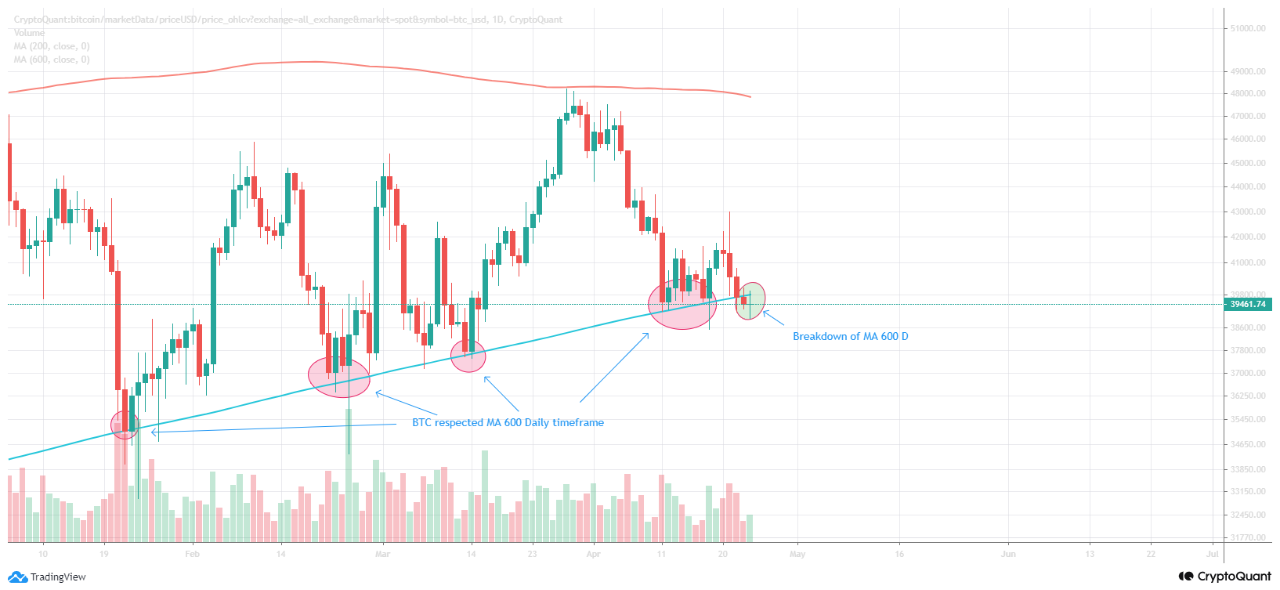
Charts show the Bitcoin price seems to be falling below the 600-day moving average, a sign that could be bearish for the crypto.
Bitcoin Begins To Lose 600-Day MA Support Line As Price Crashes Below $39k Again
As pointed out by an analyst in a CryptoQuant post, the price of the crypto is crossing below the 600-day MA curve now, a line that has served as support for BTC in the past.
A “moving average” (or MA in short) is an analytical tool that takes the average of any quantity over a particular time period. As the name already suggests, this average constantly updates itself as time passes and new values arrive.
What this tool does is that it removes any short-term fluctuations from the chart being studied (which is the Bitcoin price in this context), and smooths out the curve.
This makes moving averages quite useful for studying long-term trends, where local variations aren’t that important.
Related Reading | Is Bitcoin Gonna See Another Big Drop Soon? Historical Trend May Say Yes
MAs can be taken over any possible range, whether that be two days, two hundred days, or even only two minutes.
Now, here is a chart that shows the trend in the 600-day MA version of the Bitcoin price:
Looks like the price curve is dipping below the 600-day MA line now | Source: CryptoQuant
As you can see in the above graph, the Bitcoin 600-day MA curve has acted as support for the coin’s price many times in the year so far already.
However, the latest trend seems to suggest that this support line is now breaking down as the price line is crossing below the MA on the daily timeframe.
Related Reading | Time Vs Price: Why This Bitcoin Correction Was The Most Painful Yet
Though, the breakdown may not be yet fully confirmed. The quant in the post believes that if the breakdown fails here, Bitcoin may then use the level as a springboard to push higher.
In the case that the breakdown does stand, then a bearish outcome may perhaps be in store for the cryptocurrency.
BTC Price
At the time of writing, Bitcoin’s price floats around $38.8k, down 1% in the last seven days. Over the past month, the crypto has lost 12% in value.
The below chart shows the trend in the price of the coin over the last five days.
Looks like the price of the coin has plunged down over the last few days | Source: BTCUSD on TradingView
Bitcoin briefly seemed to have been on the path of recovery just a few days back as the coin broke above the $42k mark.
However, the cryptocurrency now seems to have plummeted down again as it once more revisits the sub-39k levels.
Featured image from Unsplash.com, charts from TradingView.com, CryptoQuant.com
Popular memecoin project Shiba Inu (SHIB) has launched a SHIB Burn Portal to decrease token supply and enable users to earn passive rewards while doing so.
The Shiba Inu team stated on the portal website that it was created explicitly to increase scarcity of SHIB and make it “one of the best digital assets in the history of cryptocurrencies.”
The portal was created as part of a partnership between Shiba Inu and the Ryoshi’s Vision (RYOSHI), which is an Ethereum-based decentralized finance (DeFi) project that aims to support the growth of the SHIB eco-system.
SHIB burners will enjoy two incentives for their efforts. Firstly, they aid in reducing the circulating supply of the memecoin which theoretically makes it more scarce and more valuable. Secondly, they receive burntSHIB tokens in their Ethereum (ETH) wallet which pays holders in RYOSHI rewards at a variable rate.
SHIB Burn Portal dashboard
The project tweeted today that within the first 24 hours of the portal coming online, “over 8 BILLION $SHIB was burned” on the portal
Woof!
In the first 24 hours over 8 BILLION $SHIB was burned through the SHIB Burn Portal!
Burn $SHIB and earn passive income at https://t.co/jSnPG8SEoF!
The launch hasn’t done much to sway the price of SHIB however, with the price dropping 3.3% over the past 24 hours to sit at $0.00002345 at the time of writing according to CoinGecko.
To date, 410 trillion SHIB tokens have been burned, representing about 41% of the total token supply according to SHIB token tracker Burn Dashboard. SHIB can also be burned by sending it to dead or unused crypto wallets.
The project initially sent Vitalik Buterin half of the total supply of SHIB. He famously burned nearly all of it last May and sent the remainder to a charity.
SHIB roundup
It appears that hype around SHIB is on the rise as pollster Benzinga found in a recent survey published on Apr. 23 that nearly two times as many people believe SHIB will reach $0.001 before Bitcoin (BTC) reaches $100,000. Of the 1000 people surveyed, 64.3% favored SHIB to rise first.
Related: Memecoins eye major revamps in an effort to return to their former glory
SHIB enthusiasts have also been urged by a SHIB developer to be on the lookout for a scammers who tried to spoof the Shiba Inu: deployer 2 wallet. Kaal Dhairya explained in an April 22 blog post that malicious code was inserted into the wallet so that it could be unclear who sent or received tokens from the deployer.
Dhairya said people should be aware of the bug but rest assured that their funds are safe. He wrote:
“The scammers / clever marketers make use of programming to fool lot of people of millions, sometimes more malicious code could drain your wallet on approval of the token, we see this everytime and it breaks our heart as we can’t do anything about it for them.”
Cryptocurrency adoption in the United States is picking up pace in 2022. According to the survey by Insider Intelligence that was reported in the Street, 10.7% of US crypto owners will use their cryptocurrencies for payments.
The use of crypto payments in 2022 is expected to increase by 70%. Approximately 3.6 million people are forecasted to pay for goods and services with their cryptocurrencies in the upcoming year.
More people (33.7 million) are also expected to adopt cryptocurrencies
Cryptocurrencies
By using cryptography, virtual currencies, known as cryptocurrencies, are nearly counterfeit-proof digital currencies that are built on blockchain technology. Comprised of decentralized networks, blockchain technology is not overseen by a central authority.Therefore, cryptocurrencies function in a decentralized nature which theoretically makes them immune to government interference. The term, cryptocurrency derives from the origin of the encryption techniques that are employed to secure the networks which are used to authenticate blockchain technology. Cryptocurrencies can be thought of as systems that accept online payments which are denoted as “tokens.” Tokens are represented as internal ledger entries in blockchain technology while the term crypto is used to depict cryptographic methods and encryption algorithms such as public-private key pairs, various hashing functions, and an elliptical curve. Every cryptocurrency transaction that occurs is logged in a web-based ledger with blockchain technology.These then must be approved by a disparate network of individual nodes (computers that maintain a copy of the ledger). For every new block generated, the block must first be authenticated and confirmed ‘approved’ by each node, which makes forging the transactional history of cryptocurrencies nearly impossible. The World’s First CryptoBitcoin became the first blockchain-based cryptocurrency and to this day is still the most demanded cryptocurrency and the most valued. Bitcoin still contributes the majority of the overall cryptocurrency market volume, though several other cryptos have grown in popularity in recent years.Indeed, out of the wake of Bitcoin, iterations of Bitcoin became prevalent which resulted in a multitude of newly created or cloned cryptocurrencies. Contending cryptocurrencies that emerged after Bitcoin’s success is referred to as ‘altcoins’ and they refer to cryptocurrencies such as Bitcoin, Peercoin, Namecoin, Ethereum, Ripple, Stellar, and Dash. Cryptocurrencies promise a wide range of technological innovations that have yet to be structured into being. Simplified payments between two parties without the need for a middle man is one aspect while leveraging blockchain technology to minimize transaction and processing fees for banks is another. Of course, cryptocurrencies have their disadvantages too. This includes issues of tax evasion, money laundering, and other illicit online activities where anonymity is a dire ingredient in solicitous and fraudulent activities.
By using cryptography, virtual currencies, known as cryptocurrencies, are nearly counterfeit-proof digital currencies that are built on blockchain technology. Comprised of decentralized networks, blockchain technology is not overseen by a central authority.Therefore, cryptocurrencies function in a decentralized nature which theoretically makes them immune to government interference. The term, cryptocurrency derives from the origin of the encryption techniques that are employed to secure the networks which are used to authenticate blockchain technology. Cryptocurrencies can be thought of as systems that accept online payments which are denoted as “tokens.” Tokens are represented as internal ledger entries in blockchain technology while the term crypto is used to depict cryptographic methods and encryption algorithms such as public-private key pairs, various hashing functions, and an elliptical curve. Every cryptocurrency transaction that occurs is logged in a web-based ledger with blockchain technology.These then must be approved by a disparate network of individual nodes (computers that maintain a copy of the ledger). For every new block generated, the block must first be authenticated and confirmed ‘approved’ by each node, which makes forging the transactional history of cryptocurrencies nearly impossible. The World’s First CryptoBitcoin became the first blockchain-based cryptocurrency and to this day is still the most demanded cryptocurrency and the most valued. Bitcoin still contributes the majority of the overall cryptocurrency market volume, though several other cryptos have grown in popularity in recent years.Indeed, out of the wake of Bitcoin, iterations of Bitcoin became prevalent which resulted in a multitude of newly created or cloned cryptocurrencies. Contending cryptocurrencies that emerged after Bitcoin’s success is referred to as ‘altcoins’ and they refer to cryptocurrencies such as Bitcoin, Peercoin, Namecoin, Ethereum, Ripple, Stellar, and Dash. Cryptocurrencies promise a wide range of technological innovations that have yet to be structured into being. Simplified payments between two parties without the need for a middle man is one aspect while leveraging blockchain technology to minimize transaction and processing fees for banks is another. Of course, cryptocurrencies have their disadvantages too. This includes issues of tax evasion, money laundering, and other illicit online activities where anonymity is a dire ingredient in solicitous and fraudulent activities. Read this Term by the end of 2022. Global crypto transactions are also forecasted to to come in above $10 billion.
Nazmul Islam, analyst at Insider Intelligence said: “It is easier now to invest in cryptocurrency than ever before. In 2021, cryptos became easier to purchase within apps consumers were already using, and while major financial institutions embraced crypto investments.
“Add hype surrounding meme stocks like Dogecoin to this easier accessibility, and you have a huge spike in ownership rates.
“Younger investors have a genuine positive outlook on blockchain
Blockchain
Blockchain comprises a digital network of blocks with a comprehensive ledger of transactions made in a cryptocurrency such as Bitcoin or other altcoins.One of the signature features of blockchain is that it is maintained across more than one computer. The ledger can be public or private (permissioned.) In this sense, blockchain is immune to the manipulation of data making it not only open but verifiable. Because a blockchain is stored across a network of computers, it is very difficult to tamper with. The Evolution of BlockchainBlockchain was originally invented by an individual or group of people under the name of Satoshi Nakamoto in 2008. The purpose of blockchain was originally to serve as the public transaction ledger of Bitcoin, the world’s first cryptocurrency.In particular, bundles of transaction data, called “blocks”, are added to the ledger in a chronological fashion, forming a “chain.” These blocks include things like date, time, dollar amount, and (in some cases) the public addresses of the sender and the receiver.The computers responsible for upholding a blockchain network are called “nodes.” These nodes carry out the duties necessary to confirm the transactions and add them to the ledger. In exchange for their work, the nodes receive rewards in the form of crypto tokens.By storing data via a peer-to-peer network (P2P), blockchain controls for a wide range of risks that are traditionally inherent with data being held centrally.Of note, P2P blockchain networks lack centralized points of vulnerability. Consequently, hackers cannot exploit these networks via normalized means nor does the network possess a central failure point.In order to hack or alter a blockchain’s ledger, more than half of the nodes must be compromised. Looking ahead, blockchain technology is an area of extensive research across multiple industries, including financial services and payments, among others.
Blockchain comprises a digital network of blocks with a comprehensive ledger of transactions made in a cryptocurrency such as Bitcoin or other altcoins.One of the signature features of blockchain is that it is maintained across more than one computer. The ledger can be public or private (permissioned.) In this sense, blockchain is immune to the manipulation of data making it not only open but verifiable. Because a blockchain is stored across a network of computers, it is very difficult to tamper with. The Evolution of BlockchainBlockchain was originally invented by an individual or group of people under the name of Satoshi Nakamoto in 2008. The purpose of blockchain was originally to serve as the public transaction ledger of Bitcoin, the world’s first cryptocurrency.In particular, bundles of transaction data, called “blocks”, are added to the ledger in a chronological fashion, forming a “chain.” These blocks include things like date, time, dollar amount, and (in some cases) the public addresses of the sender and the receiver.The computers responsible for upholding a blockchain network are called “nodes.” These nodes carry out the duties necessary to confirm the transactions and add them to the ledger. In exchange for their work, the nodes receive rewards in the form of crypto tokens.By storing data via a peer-to-peer network (P2P), blockchain controls for a wide range of risks that are traditionally inherent with data being held centrally.Of note, P2P blockchain networks lack centralized points of vulnerability. Consequently, hackers cannot exploit these networks via normalized means nor does the network possess a central failure point.In order to hack or alter a blockchain’s ledger, more than half of the nodes must be compromised. Looking ahead, blockchain technology is an area of extensive research across multiple industries, including financial services and payments, among others. Read this Term technology and are buying crypto to hold for a while, expecting prices to continue increasing in the long run.
“Older investors will be more risk-averse and leery of the volatile crypto market. Although, they are increasingly starting to invest in crypto as more retirement funds offer it as an option.”
Crypto-Friendly Countries
According to Coincub, Germany is the most crypto-friendly country for Q1 2022. Germany’s savings banks announced that it is considering adding a wallet for crypto trading. The savings banks’ assets are worth over 1 trillion euros and are the biggest financial group in Germany.
Singapore holds the second spot for the most crypto-friendly countries followed by the US Australia and Switzerland.
Coincub CEO, Sergiu Hamza remarked the following on the findings: “We look to give the most accurate picture of crypto worldwide, and to that end our ranking is always evolving. In Q1 2022, our scoring methodology better reflects the importance of some categories over others, and we have also added new categories including Talent (the availability of crypto courses by leading institutions) Fraud and numbers of ICOs within each country.
“As events develop, we go beyond legislation or pure numbers and introduce new dimensions that are crucial for defining a countries ‘crypto friendliness’ or maturity.”
Cryptocurrency adoption in the United States is picking up pace in 2022. According to the survey by Insider Intelligence that was reported in the Street, 10.7% of US crypto owners will use their cryptocurrencies for payments.
The use of crypto payments in 2022 is expected to increase by 70%. Approximately 3.6 million people are forecasted to pay for goods and services with their cryptocurrencies in the upcoming year.
More people (33.7 million) are also expected to adopt cryptocurrencies
Cryptocurrencies
By using cryptography, virtual currencies, known as cryptocurrencies, are nearly counterfeit-proof digital currencies that are built on blockchain technology. Comprised of decentralized networks, blockchain technology is not overseen by a central authority.Therefore, cryptocurrencies function in a decentralized nature which theoretically makes them immune to government interference. The term, cryptocurrency derives from the origin of the encryption techniques that are employed to secure the networks which are used to authenticate blockchain technology. Cryptocurrencies can be thought of as systems that accept online payments which are denoted as “tokens.” Tokens are represented as internal ledger entries in blockchain technology while the term crypto is used to depict cryptographic methods and encryption algorithms such as public-private key pairs, various hashing functions, and an elliptical curve. Every cryptocurrency transaction that occurs is logged in a web-based ledger with blockchain technology.These then must be approved by a disparate network of individual nodes (computers that maintain a copy of the ledger). For every new block generated, the block must first be authenticated and confirmed ‘approved’ by each node, which makes forging the transactional history of cryptocurrencies nearly impossible. The World’s First CryptoBitcoin became the first blockchain-based cryptocurrency and to this day is still the most demanded cryptocurrency and the most valued. Bitcoin still contributes the majority of the overall cryptocurrency market volume, though several other cryptos have grown in popularity in recent years.Indeed, out of the wake of Bitcoin, iterations of Bitcoin became prevalent which resulted in a multitude of newly created or cloned cryptocurrencies. Contending cryptocurrencies that emerged after Bitcoin’s success is referred to as ‘altcoins’ and they refer to cryptocurrencies such as Bitcoin, Peercoin, Namecoin, Ethereum, Ripple, Stellar, and Dash. Cryptocurrencies promise a wide range of technological innovations that have yet to be structured into being. Simplified payments between two parties without the need for a middle man is one aspect while leveraging blockchain technology to minimize transaction and processing fees for banks is another. Of course, cryptocurrencies have their disadvantages too. This includes issues of tax evasion, money laundering, and other illicit online activities where anonymity is a dire ingredient in solicitous and fraudulent activities.
By using cryptography, virtual currencies, known as cryptocurrencies, are nearly counterfeit-proof digital currencies that are built on blockchain technology. Comprised of decentralized networks, blockchain technology is not overseen by a central authority.Therefore, cryptocurrencies function in a decentralized nature which theoretically makes them immune to government interference. The term, cryptocurrency derives from the origin of the encryption techniques that are employed to secure the networks which are used to authenticate blockchain technology. Cryptocurrencies can be thought of as systems that accept online payments which are denoted as “tokens.” Tokens are represented as internal ledger entries in blockchain technology while the term crypto is used to depict cryptographic methods and encryption algorithms such as public-private key pairs, various hashing functions, and an elliptical curve. Every cryptocurrency transaction that occurs is logged in a web-based ledger with blockchain technology.These then must be approved by a disparate network of individual nodes (computers that maintain a copy of the ledger). For every new block generated, the block must first be authenticated and confirmed ‘approved’ by each node, which makes forging the transactional history of cryptocurrencies nearly impossible. The World’s First CryptoBitcoin became the first blockchain-based cryptocurrency and to this day is still the most demanded cryptocurrency and the most valued. Bitcoin still contributes the majority of the overall cryptocurrency market volume, though several other cryptos have grown in popularity in recent years.Indeed, out of the wake of Bitcoin, iterations of Bitcoin became prevalent which resulted in a multitude of newly created or cloned cryptocurrencies. Contending cryptocurrencies that emerged after Bitcoin’s success is referred to as ‘altcoins’ and they refer to cryptocurrencies such as Bitcoin, Peercoin, Namecoin, Ethereum, Ripple, Stellar, and Dash. Cryptocurrencies promise a wide range of technological innovations that have yet to be structured into being. Simplified payments between two parties without the need for a middle man is one aspect while leveraging blockchain technology to minimize transaction and processing fees for banks is another. Of course, cryptocurrencies have their disadvantages too. This includes issues of tax evasion, money laundering, and other illicit online activities where anonymity is a dire ingredient in solicitous and fraudulent activities. Read this Term by the end of 2022. Global crypto transactions are also forecasted to to come in above $10 billion.
Nazmul Islam, analyst at Insider Intelligence said: “It is easier now to invest in cryptocurrency than ever before. In 2021, cryptos became easier to purchase within apps consumers were already using, and while major financial institutions embraced crypto investments.
“Add hype surrounding meme stocks like Dogecoin to this easier accessibility, and you have a huge spike in ownership rates.
“Younger investors have a genuine positive outlook on blockchain
Blockchain
Blockchain comprises a digital network of blocks with a comprehensive ledger of transactions made in a cryptocurrency such as Bitcoin or other altcoins.One of the signature features of blockchain is that it is maintained across more than one computer. The ledger can be public or private (permissioned.) In this sense, blockchain is immune to the manipulation of data making it not only open but verifiable. Because a blockchain is stored across a network of computers, it is very difficult to tamper with. The Evolution of BlockchainBlockchain was originally invented by an individual or group of people under the name of Satoshi Nakamoto in 2008. The purpose of blockchain was originally to serve as the public transaction ledger of Bitcoin, the world’s first cryptocurrency.In particular, bundles of transaction data, called “blocks”, are added to the ledger in a chronological fashion, forming a “chain.” These blocks include things like date, time, dollar amount, and (in some cases) the public addresses of the sender and the receiver.The computers responsible for upholding a blockchain network are called “nodes.” These nodes carry out the duties necessary to confirm the transactions and add them to the ledger. In exchange for their work, the nodes receive rewards in the form of crypto tokens.By storing data via a peer-to-peer network (P2P), blockchain controls for a wide range of risks that are traditionally inherent with data being held centrally.Of note, P2P blockchain networks lack centralized points of vulnerability. Consequently, hackers cannot exploit these networks via normalized means nor does the network possess a central failure point.In order to hack or alter a blockchain’s ledger, more than half of the nodes must be compromised. Looking ahead, blockchain technology is an area of extensive research across multiple industries, including financial services and payments, among others.
Blockchain comprises a digital network of blocks with a comprehensive ledger of transactions made in a cryptocurrency such as Bitcoin or other altcoins.One of the signature features of blockchain is that it is maintained across more than one computer. The ledger can be public or private (permissioned.) In this sense, blockchain is immune to the manipulation of data making it not only open but verifiable. Because a blockchain is stored across a network of computers, it is very difficult to tamper with. The Evolution of BlockchainBlockchain was originally invented by an individual or group of people under the name of Satoshi Nakamoto in 2008. The purpose of blockchain was originally to serve as the public transaction ledger of Bitcoin, the world’s first cryptocurrency.In particular, bundles of transaction data, called “blocks”, are added to the ledger in a chronological fashion, forming a “chain.” These blocks include things like date, time, dollar amount, and (in some cases) the public addresses of the sender and the receiver.The computers responsible for upholding a blockchain network are called “nodes.” These nodes carry out the duties necessary to confirm the transactions and add them to the ledger. In exchange for their work, the nodes receive rewards in the form of crypto tokens.By storing data via a peer-to-peer network (P2P), blockchain controls for a wide range of risks that are traditionally inherent with data being held centrally.Of note, P2P blockchain networks lack centralized points of vulnerability. Consequently, hackers cannot exploit these networks via normalized means nor does the network possess a central failure point.In order to hack or alter a blockchain’s ledger, more than half of the nodes must be compromised. Looking ahead, blockchain technology is an area of extensive research across multiple industries, including financial services and payments, among others. Read this Term technology and are buying crypto to hold for a while, expecting prices to continue increasing in the long run.
“Older investors will be more risk-averse and leery of the volatile crypto market. Although, they are increasingly starting to invest in crypto as more retirement funds offer it as an option.”
Crypto-Friendly Countries
According to Coincub, Germany is the most crypto-friendly country for Q1 2022. Germany’s savings banks announced that it is considering adding a wallet for crypto trading. The savings banks’ assets are worth over 1 trillion euros and are the biggest financial group in Germany.
Singapore holds the second spot for the most crypto-friendly countries followed by the US Australia and Switzerland.
Coincub CEO, Sergiu Hamza remarked the following on the findings: “We look to give the most accurate picture of crypto worldwide, and to that end our ranking is always evolving. In Q1 2022, our scoring methodology better reflects the importance of some categories over others, and we have also added new categories including Talent (the availability of crypto courses by leading institutions) Fraud and numbers of ICOs within each country.
“As events develop, we go beyond legislation or pure numbers and introduce new dimensions that are crucial for defining a countries ‘crypto friendliness’ or maturity.”
Bitcoin is back below $40,000 as the general sentiment in the market seems to turn pessimistic. The first crypto by market cap has been unable to climb back to the $50,000 area and has been moving in a tight range around its current levels.
Related Reading | Bitcoin Follows US Stock Dive, Experts Predict $37,500 Price Level
Negative predictions for Bitcoin and other larger cryptocurrencies are increasing. The uncertainty around the war between Ukraine and Russia, and the U.S. Federal Reserve (FED) hike in interest rates seem to be the two main catalysts for the weakness in the global market.
Legendary trader Peter Brandt seems to favor the short-term bearish thesis. Pseudonym users shared a Bitcoin price prediction with Brandt which suggest the cryptocurrency could revisit critical areas of support below $30,000.
This could BTC’s price to $28,000 or $27,000 as soon as May or June this year. This prediction matches that of BitMEX CEO Arthur Hayes. He expects BTC and ETH to crash to $30,000 and $2,000, respectively.
As seen below, in the chart presented to Brandt, Bitcoin would drop to its support zone before resuming its bullish momentum into uncharted territory. In the months after that, the first crypto by market cap could rise by about $100,000. Brandt said:
Very possible. This has been my guess for many months. We will see.
Source: @CrypoFuture via Twitter
The crypto market is currently correlated with traditional finances. The price of Bitcoin has been moving in tandem with the Nasdaq 100.
When big tech stocks show weakness, so does the price of BTC. In that sense, the bearish thesis could find more support in the following chart.
Source: Peter Brandt via Twitter
Shared by Brandt, it suggests a bigger drop in big tech equities which could impact the price of Bitcoin and put additional selling pressure on the crypto market.
Bitcoin Could See Short Term Relief
However, traders should take any prediction with a grain of salt especially coming from Brandt or Hayes. They can change their opinions and forecasts if the market conditions support them.
For my uninitiated followers on Twitter I’m guided by following principles as chart trader -Strong opinions, weakly held -Flexible, not dogmatic about anything -An opinion is not a position, a position is not an opinion -A chart is not necessarily my opinion https://t.co/WwfqyYgx3O
In the short term, Bitcoin has managed to stay at its current levels despite the increase in selling pressure. Data from Material Indicators shows important support below the price.
There are over $33 million in bid orders from $39,000 to $38,000 which suggest BTC could bounce back from here in case of future downside price action. To the upside, $41,500 stands as the potential biggest resistance with around $8 million in asks orders.
BTC moving sideways on the 4-hour chart. Source: BTCUSD Tradingview
Related Reading | Bitcoin Follows US Stock Dive, Experts Predict $37,500 Price Level
As NewsBTC reported, the options market is positioning for a potential crash. There has been an uptick in calls selling for May and June and an increase in demand for put options. In other words, traders are getting bearish.
The United Nations Climate Change Conference, known as COP26, in Glasgow, Scotland catalyzed a commitment to carbon neutrality, achieving net-zero carbon emissions, requiring reducing emissions as much as possible, and balancing the remaining emissions with the purchase of carbon credits.
A carbon credit reduces, avoids or removes carbon emissions in one place to compensate for unavoidable emissions somewhere else through certified green-energy projects. Carbon credits represent one ton in carbon emission reduction. They are 1) Avoidance or reduction projects — e.g., renewable energy (wind, solar, hydro, biogas) — and 2) Removal or sequestration — e.g., reforestation and direct carbon capture, which are aimed at the voluntary carbon market (VCM). Carbon credits can be resold multiple times until it has been retired by the end-user who wants to claim the offset’s impact. Carbon credits can also have co-benefits, such as job creation, water conservation, flood prevention and preservation of biodiversity.
Carbon registries store the carbon credits issued by third-party independent and internationally certified auditors or verifiers, in accordance with independent standards. Serial-numbered credits are issued by the verifiers, and the offset reduction claim gets converted to carbon credits that can be traded or retired. Carbon markets turn CO2 emissions into a commodity or tradable environmental asset by giving it a price.
Related: UN’s COP26 climate change goals include emerging tech and carbon taxes
In the compliance market, carbon allowances are traded. There are currently 64 compliance markets in the world, and pricing is determined by the emitters and polluters. The European Union carbon market or Emissions Trading System (ETS), is the largest carbon market, with a 90% share in the global trade. Entry into the EU ETS is restricted to large polluters only and their brokers that are regulated by the operators of the program. The supply of credits is also controlled to manage the pricing. Only the carbon prices traded in the EU ETS reflect the true cost to pollute carbon, but access to the market is not equitable.
Small companies and individuals can only access the voluntary carbon market, where they buy credits at their own discretion to offset emissions from a specific activity. Voluntary credits usually cannot be traded under the compliance market regime. Voluntary carbon markets are expected to grow 15-fold by 2030 to respond to increased private sector demand for climate solutions, according to the “Taskforce for Scaling the Voluntary Carbon Market Final Report January 2021.” A significant problem with VCMs is that carbon credit prices have been low. The low costs of voluntary credits at $2–$3 per credit neither motivate nor incentivize project developers and do little to capture the true cost of climate pollution as compared to the compliance markets.
Related: The pandemic year ends with a tokenized carbon cap-and-trade solution
An excellent article for understanding VCM is “The Good Is Never Perfect: Why the Current Flaws of Voluntary Carbon Markets Are Services, Not Barriers to Successful Climate Change Action.” In this article, Oliver Miltenberger, Christophe Jospe and James Pittman highlight key issues around the design, function and the scale-up of VCMs.
Greenwashing. This happens when companies with false energy efficiencies claim to be more environmentally friendly than they really are, and thus high rates of ineffective credits are used to offset corporate emissions.
Carbon accounting. The number of claims for offsetting emissions is unrealistic, given ecosystem constraints. Net-zero ambitions should have disclosure requirements and be audited. Double-counting can happen intentionally but also occurs due to a lack of complete accounting protocols and a lack of alignment between market jurisdictions or operators.
Market failures and inefficiencies. One major critique emphasizes the risk to unfairly burden product and service markets with compliance costs, and there are few incentives for businesses that voluntarily take action to mitigate an environmental impact.
Monitoring, reporting and verifying. The costs of these activities can constitute the majority of the market value of a carbon credit, reducing the incentive for implementation.
Additionality and baselines. Carbon removal projects utilize inherently subjective baselines.
Permanence. This refers to the assurance that carbon will remain in a stock for an extended period of time, usually 30–100 years. However, there is an opportunity to protect and expand carbon sinks, incentivize low carbon production, and increase the flow of carbon from the atmosphere to short-term and durable stock, even in cases with shorter-term permanence.
Stakeholder inclusion and inequity. Projects can disenfranchise local livelihoods. In some early REDD + projects, the financialized carbon benefits resulted in local communities having restricted access to their traditional land and livelihoods.
These can help with: standardized accounting protocols for interoperability across accounting scales and systems; greater transparency from VCM operators and credit purchasers; standalone certifications on rights and ownership of credits; improved traceability. Traceability, liquidity and smart contracts allow carbon credits to be used in innovative ways, creating additional demand in the overall VCM.
Related: How blockchain technology is transforming climate action
When combined with remotely sensed data via satellite imagery, drones, laser-detecting devices and Internet-of-Things devices with machine learning and artificial intelligence, analytics can decrease development costs and increase rigor in measurement. Southpole pointed out:
“Blockchain technology has enormous potential for climate action. This is only the case, however, when the right safeguards are in place to ensure environmental integrity. Web3 applications can be part of the climate solution, but they have to be designed and applied in the right way.”
While the potential exists, we need action to rectify the problems in VCM, including:
Strengthening the incentives for decarbonization
Pricing carbon is urgently needed with improved price transparency
Reducing the cost of carbon credit creation
Reducing transaction costs and providing additional liquidity
Making the prices in the spot and futures market higher and more reliable
Building carbon credits as a viable asset class by providing predictable returns on investment and including value protection for buyers and sellers
Creating safeguards to protect reputation and legal processes for disputes settlement
Clarity on taxation exemption of carbon credits, moving from “polluter pays” to “polluter invests” and full price discovery goes to the green owners on the ground taking direct climate action on their behalf.
Kishore Butani of the Universal Carbon Registry in India pointed out, “Merely taking carbon credits on-chain does nothing for price discovery. It’s worse when the broker and middleman buy cheap and create tokens as we’re seeing currently, totally cutting off the project owner in the ground. What’s needed is not an NFT [nonfungible token] from the buy-side of the carbon market, but integration directly with carbon repositories that help rural developers and green project owners create the carbon NFTs.” He also added:
“Can we learn from Bitcoin and price all mining years equally and make the entry into the VCM affordable to the rural poor in developing countries and stop diverting carbon finance to projects in Annex 1 countries? These countries are obligated to go green, my India isn’t.”
VCM are an essential means to catalyze action but need major improvements to fulfill that role.
This article does not contain investment advice or recommendations. Every investment and trading move involves risk, and readers should conduct their own research when making a decision.
The views, thoughts and opinions expressed here are the author’s alone and do not necessarily reflect or represent the views and opinions of Cointelegraph.
Jane Thomason is the chairperson of Kasei Holdings, an investment company specializing in the digital asset ecosystem. She holds a Ph.D. from the University of Queensland and has had multiple roles with the British Blockchain & Frontier Technologies Association, the Kerala Blockchain Academy, the Africa Blockchain Center, the UCL Centre for Blockchain Technologies, Frontiers in Blockchain, and Fintech Diversity Radar. She has written multiple books and articles on blockchain technology. She has been featured in Crypto Curry Club’s 101 Women in Blockchain, the Decade of Women Collaboratory’s Top 10 Digital Frontier Women, Lattice80’s Top 100 Fintech for SDG Influencers, and Thinkers360’s Top 50 Global Thought Leaders and Influencers on Blockchain.
Hackathons have been a long-standing and important part of Coinbase culture, as they give our engineering teams the opportunity to collaborate with one another and experiment directly with the tools that are enabling a new era of open finance.
At Coinbase, we acknowledge that Web3 unlocks a whole new realm of possibilities for developers that are largely yet to be explored. In order to pursue these possibilities confidently, engineers need to have a baseline knowledge of the ecosystem, the Web3 stack, and key smart contract concepts across different blockchain protocols.
This year, we used the time set aside for the annual Coinbase hackathon to kick off Smart Contract Hack Days to give all of our engineers a crash course in Web3 development for real-world applications.
Time to BUIDL
In December, we assigned all participants to project pods of 5–10 individuals which were led by an experienced Coinbase team member that had been through in-depth blockchain engineering training. Following a day-long crash course in Solidity (developer tools and workflow), each pod had 48 hours to build a demo that would be judged on product, engineering, and design.
Participating pods had a chance to score one of the eight awards and crypto-forward prizes. Award categories included People’s Choice (selected by the entire audience), Learning Showcase (the pod that demonstrated the most learning through working on their project), Judges Choice (overall judge favorites), Best Executed (evaluates quality, teamwork and overall execution), and Most Creative (the most exciting and creative take on hack day guidelines).
Hack Day Showstoppers
Among the 44 pods that presented on Smart Contract Hack Demo Day, the top 5 categories of project submissions spanned Web3 infrastructure, gaming, DAOs, NFTs, and event ticketing.
While there were many strong ideas presented, some of the key ones to highlight (along with their taglines) include:
(Gas)tly: Complete gas transactions with confidence
Concert-AMWest-2: A NFT concert ticket and a marketplace contract that can transfer funds from the buyer to the marketplace and royalty to the musician
GenEd Labs: A charitable giving DAO that enables the ethical investor to leverage the blockchain to close the skill gap within underserved communities.
Real-Time Shibas: Capture the yield farms with your Shiba army
BridgeIt: Pooling deposits together for cost-efficient bridging
Not So Bored Apes: Decentralizing and revolutionizing the casino world one step at a time
What We’ve Learned After Experiencing a Day in the Life of a Web3 Dev
We were inspired by the number of creative product ideas that were presented during this time and took many important insights away to be applied for future training and hackathons.
Some of these insights include:
Teams need more focus time to execute — many projects felt they lacked adequate time to execute due to competing priorities from day-to-day work. We will improve by providing full dedicated time for all participants in the future.
Participants would like more autonomy in team creation — team dynamics are important. Finding teammates who share a similar vision or vibe or may have complementary work styles and perspectives can go a long way, especially in high-pressure scenarios.
Save room for ideation — rather than being assigned to projects, participants may feel more engaged or motivated to take an idea over the finish line if they feel more passionate about what they’re building.
What’s Next?
One of the most exciting things about Web3 is its limitless potential. It is likely that it will touch every single industry — whether that be as the infrastructure that underpins a wave of new products or as the tool for interacting with brands and businesses in a more trustless and equitable way. This year’s hackathon, in many ways, is a testament to the efforts needed to onboard developers from the world of Web2 to Web3.
At Coinbase, we remain optimistic about the future of the industry and are committed to spearheading new initiatives that will allow our teams to continue learning, creating and building together.
We are always looking for top talent to join our ever-growing team and #LiveCrypto. Learn more about open positions on our website.
To enhance its digital assets portfolio of exchange-traded cryptocurrencies (ETCs) in Europe, ETC Group, one of the largest providers of institutional-grade digital asset-backed securities, has recently announced the listing of XRPetc (ETC Group physical XRP) on Xetra.
The product is available under the ticker symbol GXRP. ETC Group already has a broad list of institutional-grade crypto exchange-traded products, including leading digital assets like BTC, ETH, Solana, and Cardano. With the launch of XRP-backed ETC on Xetra, the Group is planning to facilitate its clients in Europe.
“Ripple is rapidly becoming a leader in global payment systems with hundreds of financial institutions choosing Ripple to provide better international payments experience for their customers, in real-time. By launching this latest ETC to our expanding portfolio of high quality, physically-backed digital assets, we’re continuing to grow our offering to investors, providing access to an increasingly wide range of digital currencies and assets – especially those amassing large market caps,” Bradley Duke, Founder and co-CEO at ETC Group, commented.
XRP
XRP is one of the most valuable cryptocurrencies in the world. According to Coinmarketcap’s recent data, XRP is the 6th largest digital currency with a market cap of more than $35 billion.
According to ETC Group, its newly launched XRP-backed ETC will be marketed and distributed by HANetf.
“We are delighted to partner with ETC Group again to offer a new ETC backed by XRP. ETC Group, in partnership with HANetf, has established itself as a market leader in offering investment products focused on crypto assets. Interest in exchange-traded cryptocurrencies has been booming, providing investors with a safer and more liquid way to gain exposure to digital assets. Ripple is a growing blockchain-based digital payment network that is gaining traction thanks to its rapid speed and reliability,” Hector McNeil, co-Founder and co-CEO at HANetf, said.
To enhance its digital assets portfolio of exchange-traded cryptocurrencies (ETCs) in Europe, ETC Group, one of the largest providers of institutional-grade digital asset-backed securities, has recently announced the listing of XRPetc (ETC Group physical XRP) on Xetra.
The product is available under the ticker symbol GXRP. ETC Group already has a broad list of institutional-grade crypto exchange-traded products, including leading digital assets like BTC, ETH, Solana, and Cardano. With the launch of XRP-backed ETC on Xetra, the Group is planning to facilitate its clients in Europe.
“Ripple is rapidly becoming a leader in global payment systems with hundreds of financial institutions choosing Ripple to provide better international payments experience for their customers, in real-time. By launching this latest ETC to our expanding portfolio of high quality, physically-backed digital assets, we’re continuing to grow our offering to investors, providing access to an increasingly wide range of digital currencies and assets – especially those amassing large market caps,” Bradley Duke, Founder and co-CEO at ETC Group, commented.
XRP
XRP is one of the most valuable cryptocurrencies in the world. According to Coinmarketcap’s recent data, XRP is the 6th largest digital currency with a market cap of more than $35 billion.
According to ETC Group, its newly launched XRP-backed ETC will be marketed and distributed by HANetf.
“We are delighted to partner with ETC Group again to offer a new ETC backed by XRP. ETC Group, in partnership with HANetf, has established itself as a market leader in offering investment products focused on crypto assets. Interest in exchange-traded cryptocurrencies has been booming, providing investors with a safer and more liquid way to gain exposure to digital assets. Ripple is a growing blockchain-based digital payment network that is gaining traction thanks to its rapid speed and reliability,” Hector McNeil, co-Founder and co-CEO at HANetf, said.
It was a slow news day for all things NFT, but many of the concurrent stories that have dominated headlines throughout the week thus far have continued on their journeys, as we spectate the progression of MoonBirds, as well as the NBA’s struggling ‘The Association’ project, and more.
Thank goodness it’s Thursday, headed into Friday, with another Nightly Mint.
The Nightly Mint
Latest Mint: MoonBird Criticism
MoonBirds were criticized from the jump about their high mint price, and that isn’t slowing down one bit. There’s increased criticism over the last day regarding MoonBirds being gifted to celebrities and influencers. Nonetheless, price action around the project still remains strong, as the floor is now surged strongly above 30ETH, and volume within the project is still far above any other NFT collection currently. The floor over the past 24 hours (at time of publishing) has risen by over 35%, according to Nansen’s NFT data.
Moonbirds themselves are not to blame, but the mental effects & discouragement in result, is real. High mint price, while everyone else is struggling. Influencers showing off. It’s really taking the inclusiveness away from NFTs. If you’re reading this, just know you aren’t alone.
Related Reading | Why A “Boring” Bitcoin Could Be A Good Thing
The UFC's partnership with Dapper Labs runs on the Flow blockchain; UFC fighter Nate Diaz had some choice words surrounding the league's latest NFT release. | Source: FLOW-USD on TradingView.com
UFC fighter Nate Diaz has been making the rounds over the past day after tweets from Wednesday gained traction regarding the fighter’s disdain for the UFC’s latest NFT release via Dapper Labs. Diaz accuses the league of taking advantage of a situation for personal gain in releasing NFTs on 4/20 (widely considered a ‘cannabis holiday’) after suspending his brother from the league for several years for cannabis use.
Meanwhile, the NBA continues to take a toll with it’s NBAxNFT project, dubbed ‘The Association.’ After major flaws were exposed in the project’s contract, the team released an update early on Thursday that resulted in an expansion of minting from the initial 18,000 to 30,000. If you’re familiar with NFTs, you can guess how the community reacted to that news.
The ‘Minty Fresh’ Take
Can Yuga Labs Otherside overpower the momentum of MoonBirds?
If you thought the fomo with Moonbirds was bad, just wait for @yugalabs Otherside. This is arguably the biggest drop in the history of NFT’s. The level of fomo will be at an all time high. It’s going to be a fun week. Stay safe and don’t overextend yourself. 🤝 #BAYC#OTHERSIDE
— renegademaster / guccibayc.eth (@renegademasterr) April 21, 2022
Related Reading | The Top 5 Most Valuable NFT Collections And A Tool To Track Them Down
Featured image from Pexels, Charts from TradingView.com
The writer of this content is not associated or affiliated with any of the parties mentioned in this article. This is not financial advice.
Sentiment in the cryptocurrency market is on the upswing after small gains from Bitcoin (BTC) and altcoins hint that the market could be in the process of a bullish breakout.
A handful of altcoins are also finding momentum and a round of fresh partnership announcements appear to back the 40% gains seen in select assets on April 21.
Top 7 coins with the highest 24-hour price change. Source: Cointelegraph Markets Pro
Data from Cointelegraph Markets Pro and TradingView shows that the biggest gainers over the past 24-hours were Steem (STEEM), TrustSwap (SWAP) and 0x (ZRX).
Binance lists STEEM
The community-focused blockchain network Steem is the underling chain for the social media platform Steemit, which allows users to earn rewards for their posts and interactions within the community.
Data from Cointelegraph Markets Pro and TradingView shows the price of STEEM hit a low of $0.344 on April 20 and then proceeded to surge 77.16% to hit a daily high at $0.61 on April 21 as its 24-hour trading volume exploded.
STEEM/USDT 4-hour chart. Source: TradingView
The sudden burst in momentum and trading volume for STEEM follows an announcement from Binance exchange that it was adding support for the STEEM/USDT trading pair.
TrustSwap trades at Bithumb
TrustSwap is a decentralized finance protocol that specializes in the creation of multi-chain token swaps and offers a host of other features including staking, the ability to mint new tokens and an in-house launchpad.
VORTECS™ data from Cointelegraph Markets Pro began to detect a bullish outlook for SWAP on April 16, prior to the recent price rise.
The VORTECS™ Score, exclusive to Cointelegraph, is an algorithmic comparison of historical and current market conditions derived from a combination of data points including market sentiment, trading volume, recent price movements and Twitter activity.
VORTECS™ Score (green) vs. SWAP price. Source: Cointelegraph Markets Pro
As seen in the chart above, the VORTECS™ Score for SWAP spiked into the green zone and hit a high of 75 on April 16, around 65 hours before the price surged 120.96% higher over the next three days.
The rally in SWAP price follows a new listing on the South Korean cryptocurrency exchange Bithumb and an increased effort to market the protocol’s minting module, which allows users to easily create a cryptocurrency and launch it on the BNB Smart Chain as well as the Ethereum and Polygon blockchains.
Related: Coinbase is planning to purchase crypto exchange BtcTurk in $3.2B deal: Report
0x partners with Coinbase
ZRX is a decentralized exchange infrastructure protocol that specializes in facilitating the trading of assets on the Ethereum blockchain without needing to rely on centralized intermediaries.
VORTECS™ data from Cointelegraph Markets Pro began to detect a bullish outlook for ZRX on April 19, prior to the recent price rise.
VORTECS™ Score (green) vs. ZRX price. Source: Cointelegraph Markets Pro
As shown above, the VORTECS™ Score for ZRX peaked at a high of 75 on April 19, just one hour before its price began to rally 71.56% higher over the next two days.
The rapid spike in ZRX price came on the heels of an announcement that Coinbase had partnered with 0x to power their new social marketplace for nonfungible tokens, or NFTs.
The overall cryptocurrency market cap now stands at $1.94 trillion and Bitcoin’s dominance rate is 41.3%.
The views and opinions expressed here are solely those of the author and do not necessarily reflect the views of Cointelegraph.com. Every investment and trading move involves risk, you should conduct your own research when making a decision.