Month: March 2022

  • Riot Blockchain Reports 189% Increase in BTC Production for February 2022

    Riot Blockchain Reports 189% Increase in BTC Production for February 2022

    [ad_1]

    The recent dip in the price of Bitcoin is not impacting the mining activities across the BTC network. Nasdaq-listed Bitcoin mining company, Riot Blockchain recently announced its production and operation updates for February 2022 and reported a significant surge of 189% YoY in BTC production.

    During the recent month, the company produced 436 Bitcoin, compared to 179 coins in the same period last year. As of 28 February 2022, the mining firm held almost 5,783 BTC, produced by Riot’s self-mining operations.

    The Bitcoin mining company has expanded its hash rate substantially since the start of 2021. In the recent announcement, Riot provided updates on the expansion of its mining infrastructure.

    “Throughout the month of February, Riot has continued to make progress on the first phase of its 200 MW immersion-cooled Bitcoin mining deployment, with over 10,000 S19j Pro Antminers now deployed in immersion-cooling tanks,” said Jason Les, the CEO of Riot Blockchain.

    “We have begun the performance evaluation process and will be monitoring our immersion performance data closely over the next 60 days. As our team continues to build out our immersion operation, we are evaluating and assessing future opportunities to further leverage our expertise in immersion-cooling development and deployment,” Les added.

    As a result of the company’s enhanced mining infrastructure, its profits increased during last year. In 2021, Riot Blockchain announced collaborations with several leading firms around the world, including Bitmain Technologies Limited for the purchase of S19j Antminers.

    Hash Rate

    While providing details about the estimated hash rate in 2022, Riot mentioned that it is planning to reach a total self-mining hash rate capacity of 12.8 EH/s by January 2023.

    “Approximately 97% of Riot’s self-mining fleet will consist of the latest generation S19 series miner model. Upon full deployment of all currently contracted miners, the Company’s total self-mining fleet will consume approximately 370 MW of energy,” Riot highlighted.

    The recent dip in the price of Bitcoin is not impacting the mining activities across the BTC network. Nasdaq-listed Bitcoin mining company, Riot Blockchain recently announced its production and operation updates for February 2022 and reported a significant surge of 189% YoY in BTC production.

    During the recent month, the company produced 436 Bitcoin, compared to 179 coins in the same period last year. As of 28 February 2022, the mining firm held almost 5,783 BTC, produced by Riot’s self-mining operations.

    The Bitcoin mining company has expanded its hash rate substantially since the start of 2021. In the recent announcement, Riot provided updates on the expansion of its mining infrastructure.

    “Throughout the month of February, Riot has continued to make progress on the first phase of its 200 MW immersion-cooled Bitcoin mining deployment, with over 10,000 S19j Pro Antminers now deployed in immersion-cooling tanks,” said Jason Les, the CEO of Riot Blockchain.

    “We have begun the performance evaluation process and will be monitoring our immersion performance data closely over the next 60 days. As our team continues to build out our immersion operation, we are evaluating and assessing future opportunities to further leverage our expertise in immersion-cooling development and deployment,” Les added.

    As a result of the company’s enhanced mining infrastructure, its profits increased during last year. In 2021, Riot Blockchain announced collaborations with several leading firms around the world, including Bitmain Technologies Limited for the purchase of S19j Antminers.

    Hash Rate

    While providing details about the estimated hash rate in 2022, Riot mentioned that it is planning to reach a total self-mining hash rate capacity of 12.8 EH/s by January 2023.

    “Approximately 97% of Riot’s self-mining fleet will consist of the latest generation S19 series miner model. Upon full deployment of all currently contracted miners, the Company’s total self-mining fleet will consume approximately 370 MW of energy,” Riot highlighted.

    [ad_2]

    Source link
  • Ethereum Sports Bearish Signals As Crypto Market Shifts Back Into Fear

    Ethereum Sports Bearish Signals As Crypto Market Shifts Back Into Fear

    [ad_1]

    Ethereum has mostly mirrored bitcoin’s run in the recent rally. This has seen the digital asset break as high as $3,000 once again for the year. This point which has proved elusive for the cryptocurrency has continued to give it a hard time. In previous times, Ethereum has had a had time staying above this level. Such has been the case this time around as it fails to secure its spot above e$3K.

    Ethereum On The Decline

    Like all other cryptocurrencies, Ethereum is a highly volatile asset and as such is subject to wild fluctuations in its price. For the last few months, it has fluctuated but remained mostly around the $2,600 to $ 2,800=0 level. With the recent rally, it was finally able to break out of this trend and begin a whole new one, one which saw it rise above the coveted $3K level.

    Related Reading | TA: Ethereum Prints Bearish Pattern, Why It Could Correct To $2.8K

    Nevertheless, this recovery would prove to be short-lived given that ETH could not maintain this position. Meeting fierce resistance from the bears at the $3,000 point, the digital asset was unable to form any meaningful support above it. This meant that the price crumbled below it but it would prove to be a continuous downward trend given the current indicators.

    The fall below $3k saw the digital asset trading below its 50-day moving average. Now, this is an incredibly important point for cryptocurrencies in general given their high volatility. Since buyers are unwilling to purchase the digital asset at prices they did over the past few weeks, it indicates that Ethereum is still a seller’s market. Thus, it is expected that there will be a continuous downtrend as more coins are dumped on the market.

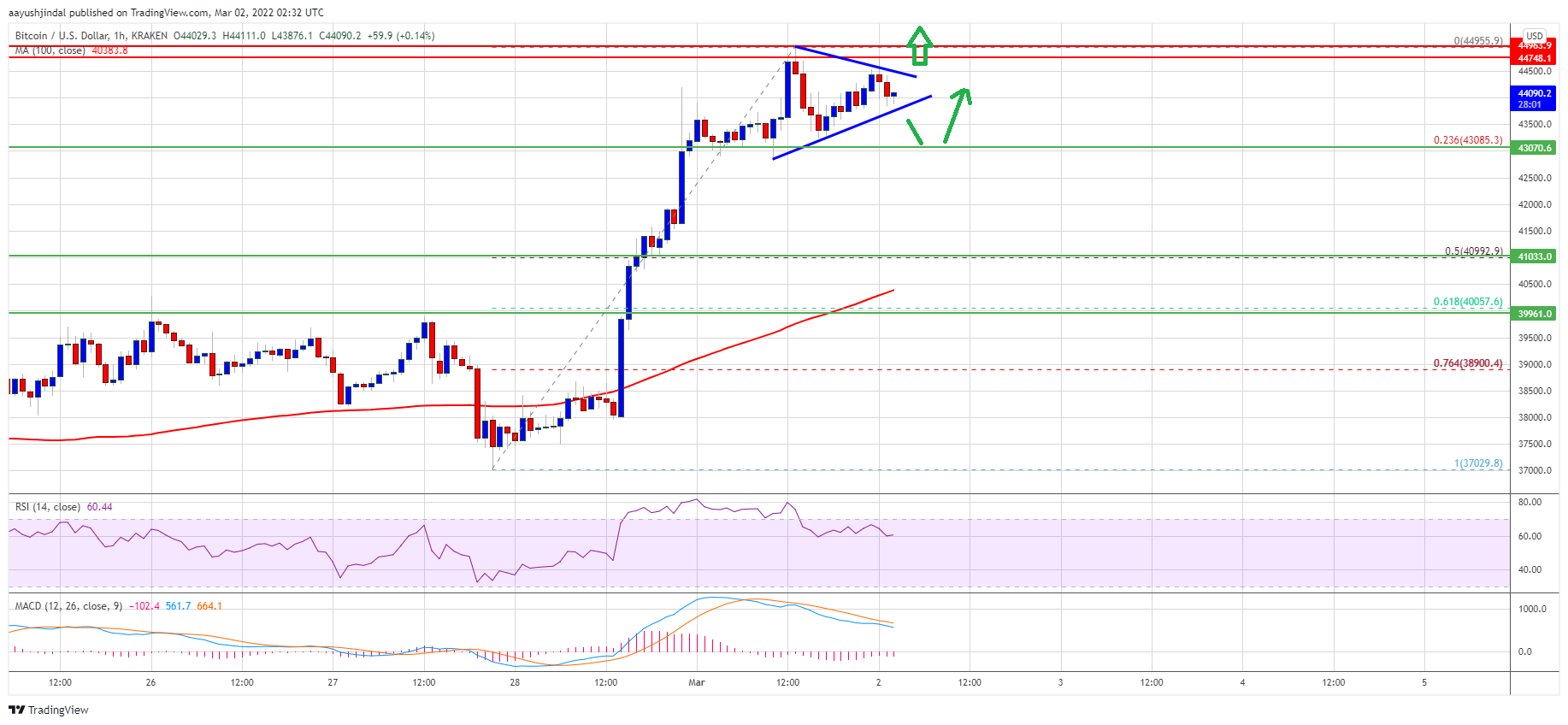
    Ethereum price chart on TradingView.com

    ETH falls below $3k | Source: ETHUSD on TradingView.com

    This however does not spell bad news all around though. A market like ETH’s can quickly switch up and turn into a buyer’s market, especially when prices are as low as they are right now. If this happens, then Ethereum could very well see another 10% bounce that will cement its position above the $3k resistance point.

    Market Sentiments Falls To Fear

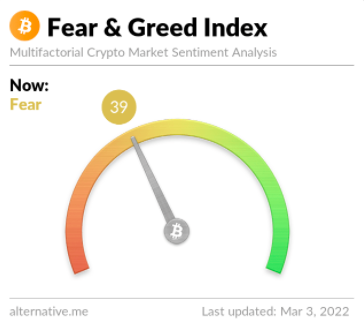
    The Fear & Greed Index had moved out of the fear territory back into a neutral point at the start of the week but this new wave of positive sentiment did not hold. The index has now moved back into fear at a current score of 39 as at the time of this writing, showing that despite recent rallies, investor sentiments are still more negative than anything.

    Related Reading | Terra (LUNA) Outperforms Popular Cryptos Ether, Dogecoin In The Past 24 Hours

    Ethereum and the crypto market are directly affected by investor sentiment as they show when investors are likely to put money in the market. Currently, with the index in fear, it shows that investors are very wary of putting money in the market. However, this does not necessarily spell bad news for ETH.

    Fear & Greed Index

    Market sentiments drop to fear | Source: Alternative.me

    Usually, when most investors are fearful, it can present a good buying opportunity. In the past, whales have been known to take advantage of moments like these to fill their bags. If so, then ETH can kickstart another rally. But only a large absorption of current supply can start the digital asset on this path.

    Featured image from CNBC, chart from TradingView.com

    [ad_2]

    Source link

  • Algorand upgrade adds quantum-secure keys, enhanced smart contracts

    Algorand upgrade adds quantum-secure keys, enhanced smart contracts

    [ad_1]

    Algorand, a next-gen blockchain application network, today announced a major release that will empower the creation of more sophisticated apps while marking a milestone for its cross-chain interoperability.

    Developers are now able to build complex dapps for the Algorand ecosystem with smart contract-to-contract calling, and network participants can take their first step towards trustless cross-chain interoperability with quantum-secure keys for the upcoming State Proof technology.

    These upgrades come on the heels of a $20 million incentive program from the Algorand Foundation focused on developer tooling and EVM compatibility, putting Algorand at the forefront of blockchain interoperability and post-quantum security while providing features advanced decentralized applications.

    “With this latest upgrade, Algorand continues its leadership position when it comes to ongoing delivery of highly sophisticated blockchain technology. We’ve received overwhelmingly positive feedback from developers during the beta testing and are excited to roll out these enhancements to the broader blockchain developer ecosystem.”
    – Paul Riegle, Chief Product Officer at Algorand

    Core elements of this release include:

    • Smart contract compatibility with contract-to-contract calls: Allows complex dApps that can efficiently and trustlessly interact with other smart contract-based dApps to extend functionality and usability.
    • Post-quantum secure Falcon Keys: These keys will, in the near future, be used to generate State Proofs, a new blockchain infrastructure that will allow Algorand to be trustlessly accessed in low-power environments like mobile phones, smartwatches, and on other blockchains.

    These features add to Algorand’s already advanced tech, high performance, and rich developer resources. Accessible to all types of developers, smart contracts on Algorand can be written in Python or Reach.

    Since its launch, Algorand has experienced zero downtime, the highly scalable blockchain supports the creation of DeFi protocols, NFTs, payment solutions, regulated digital assets, and more.

    Source:
    developer.algorand.org

    [ad_2]

    Source link

  • Ferrum to integrate Ethereum L2 solution zkSync in its crypto ecosystem

    Ferrum to integrate Ethereum L2 solution zkSync in its crypto ecosystem

    [ad_1]

     zkSync is a user-centric zero-knowledge (ZK)-rollup platform for Ethereum and is live on the mainnet.

    Matter Labs / zkSync

    Matter Labs is a pioneer of zero-knowledge rollups. The organization launched the first-ever public ZK-rollup prototype in early 2019, was the first to implement recursive ZK proofs on Ethereum, and created the world’s first practical FPGA-based hardware for ZKP acceleration in 2020.

    “When you really think about it, most of us in this space are here because of Ethereum. Ferrum’s mission has always been to breakdown barriers to mass adoption… and scaling Ethereum is one of the most important milestones in doing so. It’s a bit poetic to have zkSync — a project uniquely positioned to scale Ethereum — as our first official Ferrum Ventures investment.”
    – Ian Friend, Co-Founder & COO at Ferrum Network

    Integration of zkSync with Ferrum Network

    • Traditional Staking
    • VIP Staking
    • NFT Staking
    • Multi-Asset Staking
    • LP Staking

    zkSync enters the Ferrum ecosystem

    Ferrum Network will also extend the benefits of zkSync across its ecosystem with:

    “We couldn’t be more thrilled to be joining forces with Matter Labs and zkSync as they embark on a mission to scale Ethereum. We’ll look to facilitate the process via our stake through Ferrum Ventures, our suite of products, and introducing them to the Iron Alliance. Stay tuned!”
    – The Ferrum Network Team

    [ad_2]

    Source link

  • Coinbase provides institutions with trusted access and storage for DeFi tokens | by Coinbase | Mar, 2022

    Coinbase provides institutions with trusted access and storage for DeFi tokens | by Coinbase | Mar, 2022

    [ad_1]

    Coinbase

    By Sonia Pinto, Senior Product Marketing Manager and Alexis Hamel, Product Manager, Custody

    Coinbase Prime offers custody and trading for more than 50 DeFi coins and tokens, across a wide range of segments, including DEXs, lend, and borrow.We facilitate governance for a growing number of tokens including UNI, COMP, and MKR. This gives our customers the opportunity to directly participate in the governance of DeFi projects.

    Asset managers, like Grayscale and Bitwise, are increasingly stepping into DeFi beyond Bitcoin and Ethereum. FinTechs are also expanding their DeFi offerings to cater to growing demand. Venture capital funding for blockchain startups reached $25 billion last year, up 713% from $3.1 billion in 2020. Coinbase Ventures, A16Z and Paradigm are some of the VCs doubling down on DeFi.

    As one of the most trusted names in the industry, Coinbase offers access to a broad range of assets, customized account support, and a rapidly growing number of capabilities for our clients to participate in DeFi.

    DeFi Opportunities

    While Bitcoin or Ethereum are the currency of the blockchains, Defi tokens are built on top of the blockchain and represent a wide range of new opportunities for institutions. As of January 2022, nearly $200 Billion was deposited through smart contracts across major blockchains. This measure is referred to as the Total Value Locked (TVL). Ethereum-based projects alone account for 60% of DeFi TVL.

    Defi offers a global, open alternative to financial services consumers utilize today — including savings, loans, trading, and insurance — creating a financial system that is automated, accessible 24/7, permissionless and more transparent. DeFi protocols with the highest adoption rates include Compound and Aave for lending, Curve for stablecoins swap, Uniswap for token swaps, or DYDX for derivatives.

    Where do I start?

    Gain access to our prime broker by navigating to coinbase.com/prime. Click “Get started” and fill in the required information to apply for a Coinbase Prime account. For our existing clients who have a Coinbase Custody, or Coinbase Exchange account, please contact your account manager or PrimeOps@coinbase.com.

    [ad_2]

    Source link

  • Ledger CTO warns crypto users about the dangers of ‘blind signing’

    Ledger CTO warns crypto users about the dangers of ‘blind signing’

    [ad_1]

    With the recent attack on OpenSea highlighting blockchain vulnerabilities, Charles Guillemet, the CTO of Ledger warns users about “blind signing” which he defines as “consenting a transaction to be signed blindly, without understanding what it means.” 

    In an interview with Cointelegraph, Guillemet broke down the problems and highlighted issues with blind signing. The Ledger CTO notes that consenting to transactions requires signing a message to be sent to the blockchain. A user is the only one capable of signing transactions with the private key, while others can verify if it’s correct. “The issue is that this message is not intelligible by default. It’s a digital payload,” says Guillemet.

    Guillemet also explained that when a coin transfer is signed, it’s normally supported by a wallet that “properly parses the payload and displays its intent.” However, when it comes to signing complex interactions with smart contracts, Guillemet says that “parsing the display is not always properly supported and you have no choice but consenting blindly for a transaction that you don’t understand.”

    “It’s risky because you can think you’re signing a transaction to move part of your funds to address A while you actually sign a transaction to move all your funds to address B.”

    Related: OpenSea disables features temporarily as contract migration completes

    The security expert also gave examples where blind signing led to significant losses. In the most recent OpenSea exploit, users encountered a phishing attack that resulted in the loss of $1.7 million worth in nonfungible tokens (NFTs). Guillemet notes that in this incident, the attackers tricked their victims into blind-signing a message that made them consent to sell all their NFTs for 0 ETH.

    “The attacker had only to sign a transaction saying ‘I’m ok to buy these NFTs for 0 ETH,’ and then presented these two messages to OpenSea to actually execute the transaction swapping 0 ETH against all the victims’ NFTs.”

    When asked what he thinks is the solution to the issue of blind signing, Guillemet turned to an old crypto adage, “don’t trust, verify.” He tells crypto users to “always verify the transaction you consent to sign.” One suggestion that the security expert brought up is signing transactions using trusted displays that can be found on hardware wallets.