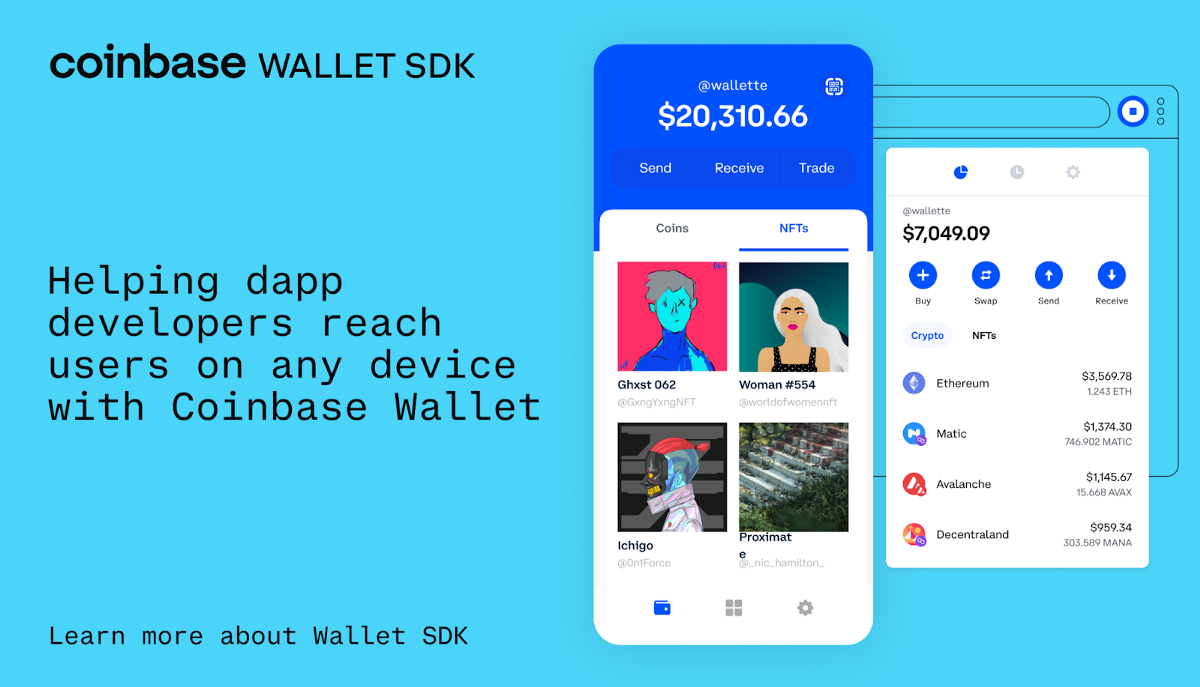
Expand your dapp’s reach with just a few lines of code
By Sid Coelho-Prabhu, Product Management Director, Wallet
Millions of people choose Coinbase Wallet to use dapps, earn yield with DeFi, trade more than hundreds of thousands of assets, and hold their NFTs. In just minutes you can integrate Coinbase Wallet in your dapp, expanding your reach to users on all of their devices — and open your dapp up to the multichain Coinbase ecosystem of over 89M users across 85 countries, on whatever device they prefer.
With just a few lines of code, you can open up access to your dapp to Coinbase Wallet users across the iOS and Android mobile apps as well as the Wallet browser extension on Chrome.
Coinbase Wallet SDK takes just 5 minutes to integrate and doesn’t require you to deploy any additional infrastructure. You can learn how to integrate with Coinbase Wallet in our technical documentation, read our post on using web3-react to connect, or watch the Coinbase Wallet SDK demo.
We are dedicated to making the benefits of crypto and the entire web3 ecosystem accessible to all — regardless of network or blockchain, country or currency, crypto savvy or crypto skeptical. We’re building Coinbase Wallet to reflect that commitment. With support for all EVM-compatible chains, including Avalanche, BNB Chain, Polygon, and many more, you can access millions of users for your dapp across the most popular ecosystems.
We also know that security is top-of-mind for anyone building in the web3 ecosystem. By offering integration with the most trusted and secure name in crypto, you can help put your users at ease while they explore your dapp, confident that their crypto and data are safe.
The built-in trust offered by Coinbase Wallet shows: As of February 2022 it’s the most downloaded mobile dapp wallet in the United States. Integrating your dapp with Coinbase Wallet can immediately unlock access to 12M Wallet users, with the potential to reach the full Coinbase ecosystem of over 89M users in 85 countries.
We see Coinbase Wallet SDK as a critical way to expand access to dapps, which is why we want this experience to be available to everyone in the crypto community. To make that possible, Coinbase Wallet SDK is open-source, making it available for any dapp developer that wants to integrate it into their product.
Crypto is just getting started, and Coinbase Wallet is your key to what’s next. For developers, Coinbase Wallet is the best self-custody wallet to integrate with, as it’s the most trusted name in crypto and offers unparalleled reach to 89M users across the entire Coinbase ecosystem. Coinbase Wallet also offers the most user-friendly self-custody experience, unlocking the entire world of crypto, including collecting NFTs, earning yield on your crypto, accessing play-to-earn games, engaging in DeFi, participating in DAOs, and more. To learn more, visit our website.
Disclaimer:
Coinbase Wallet is a self-custody wallet providing software services subject to Coinbase Wallet Terms of Service and Privacy Policy. Coinbase Wallet is distinct from Coinbase.com, and private keys for Coinbase Wallet are stored directly by the user and not by Coinbase. Fees may apply. You do not need a Coinbase.com account to use Coinbase Wallet.
Ron Wyden, a US Democrat Senator from Oregon and one of the most influential members of Congress in the country, has warned that a tough stance on cryptos could be unhealthy for the booming industry.
The congressman asked his colleagues to protect crypto innovators despite accusations of the industry being friendly with money laundering and fraud.
“There is obviously a debate [about stricter regulation
Regulation
Like any other industry with a high net worth, the financial services industry is tightly regulated to help curb illicit behavior and manipulation. Each asset class has its own set of protocols put in place to combat their respective forms of abuse.In the foreign exchange space, regulation is assumed by authorities in multiple jurisdictions, though ultimately lacking a binding international order. Who are the Industry’s Leading Regulators?Regulators such as the UK’s Financial Conduct Authority (FCA), the US’ Securities and Exchange Commission (SEC), Australian Security and Investment Commission (ASIC), and the Cyprus Securities and Exchange Commission (CySEC) are the most widely dealt with authorities in the FX industry.In its most basic sense, regulators help ensure the filing of reports and transmission of data to help police and monitor activity by brokers. Regulators also serve as a countermeasure against market abuse and malpractice by brokers. Brokers adhering to a list of mandated rules are authorized to provide investment activities in a given jurisdiction. By extension, many unauthorized or unregulated entities will also seek to market their services illegally or function as a clone of a regulated operation.Regulators are essential in snuffing out these scam operations as they prevent significant risks for investors.In terms of reporting, brokers are also required to regularly file reports about their clients’ positions to the relevant regulatory authorities. The most-recent regulatory push in the aftermath of the Great Financial Crisis of 2008 has delivered a material shift in the regulatory reporting landscape.Brokers typically outsource the reporting to other companies which are connecting the trade repositories used by regulators to the broker’s systems and are handling this crucial element of compliance.Beyond FX, regulators help reconcile all matters of oversight and are watchdogs for each industry. With ever-changing information and protocols, regulators are always working to promote fairer and more transparent business practices from brokers or exchanges.
Like any other industry with a high net worth, the financial services industry is tightly regulated to help curb illicit behavior and manipulation. Each asset class has its own set of protocols put in place to combat their respective forms of abuse.In the foreign exchange space, regulation is assumed by authorities in multiple jurisdictions, though ultimately lacking a binding international order. Who are the Industry’s Leading Regulators?Regulators such as the UK’s Financial Conduct Authority (FCA), the US’ Securities and Exchange Commission (SEC), Australian Security and Investment Commission (ASIC), and the Cyprus Securities and Exchange Commission (CySEC) are the most widely dealt with authorities in the FX industry.In its most basic sense, regulators help ensure the filing of reports and transmission of data to help police and monitor activity by brokers. Regulators also serve as a countermeasure against market abuse and malpractice by brokers. Brokers adhering to a list of mandated rules are authorized to provide investment activities in a given jurisdiction. By extension, many unauthorized or unregulated entities will also seek to market their services illegally or function as a clone of a regulated operation.Regulators are essential in snuffing out these scam operations as they prevent significant risks for investors.In terms of reporting, brokers are also required to regularly file reports about their clients’ positions to the relevant regulatory authorities. The most-recent regulatory push in the aftermath of the Great Financial Crisis of 2008 has delivered a material shift in the regulatory reporting landscape.Brokers typically outsource the reporting to other companies which are connecting the trade repositories used by regulators to the broker’s systems and are handling this crucial element of compliance.Beyond FX, regulators help reconcile all matters of oversight and are watchdogs for each industry. With ever-changing information and protocols, regulators are always working to promote fairer and more transparent business practices from brokers or exchanges. Read this Term], but I want to be on the side of the innovator. When I think about crypto, I think about remittances, or somebody who has a kid 1,000 miles away and wants to get them help in an emergency, rather than going through scores of banks, credit card companies,” Rep. Wyden told the Financial Times in an interview.
He added that he strives for innovations and will always be on that side. “That’s where my heart lies,” Wyden commented. The Senator is currently the chair of the Senate finance committee and one of the proponents of the US internet regulation.
Last year, Gary Gensler, the Chairman of the US Securities and Exchange Commission (SEC), recently expressed his views about Bitcoin and other cryptocurrency assets in a discussion with the House Committee on Financial Services. Gensler stated that the US will not completely follow China’s lead in banning cryptocurrencies
Cryptocurrencies
By using cryptography, virtual currencies, known as cryptocurrencies, are nearly counterfeit-proof digital currencies that are built on blockchain technology. Comprised of decentralized networks, blockchain technology is not overseen by a central authority.Therefore, cryptocurrencies function in a decentralized nature which theoretically makes them immune to government interference. The term, cryptocurrency derives from the origin of the encryption techniques that are employed to secure the networks which are used to authenticate blockchain technology. Cryptocurrencies can be thought of as systems that accept online payments which are denoted as “tokens.” Tokens are represented as internal ledger entries in blockchain technology while the term crypto is used to depict cryptographic methods and encryption algorithms such as public-private key pairs, various hashing functions, and an elliptical curve. Every cryptocurrency transaction that occurs is logged in a web-based ledger with blockchain technology.These then must be approved by a disparate network of individual nodes (computers that maintain a copy of the ledger). For every new block generated, the block must first be authenticated and confirmed ‘approved’ by each node, which makes forging the transactional history of cryptocurrencies nearly impossible. The World’s First CryptoBitcoin became the first blockchain-based cryptocurrency and to this day is still the most demanded cryptocurrency and the most valued. Bitcoin still contributes the majority of the overall cryptocurrency market volume, though several other cryptos have grown in popularity in recent years.Indeed, out of the wake of Bitcoin, iterations of Bitcoin became prevalent which resulted in a multitude of newly created or cloned cryptocurrencies. Contending cryptocurrencies that emerged after Bitcoin’s success is referred to as ‘altcoins’ and they refer to cryptocurrencies such as Bitcoin, Peercoin, Namecoin, Ethereum, Ripple, Stellar, and Dash. Cryptocurrencies promise a wide range of technological innovations that have yet to be structured into being. Simplified payments between two parties without the need for a middle man is one aspect while leveraging blockchain technology to minimize transaction and processing fees for banks is another. Of course, cryptocurrencies have their disadvantages too. This includes issues of tax evasion, money laundering, and other illicit online activities where anonymity is a dire ingredient in solicitous and fraudulent activities.
By using cryptography, virtual currencies, known as cryptocurrencies, are nearly counterfeit-proof digital currencies that are built on blockchain technology. Comprised of decentralized networks, blockchain technology is not overseen by a central authority.Therefore, cryptocurrencies function in a decentralized nature which theoretically makes them immune to government interference. The term, cryptocurrency derives from the origin of the encryption techniques that are employed to secure the networks which are used to authenticate blockchain technology. Cryptocurrencies can be thought of as systems that accept online payments which are denoted as “tokens.” Tokens are represented as internal ledger entries in blockchain technology while the term crypto is used to depict cryptographic methods and encryption algorithms such as public-private key pairs, various hashing functions, and an elliptical curve. Every cryptocurrency transaction that occurs is logged in a web-based ledger with blockchain technology.These then must be approved by a disparate network of individual nodes (computers that maintain a copy of the ledger). For every new block generated, the block must first be authenticated and confirmed ‘approved’ by each node, which makes forging the transactional history of cryptocurrencies nearly impossible. The World’s First CryptoBitcoin became the first blockchain-based cryptocurrency and to this day is still the most demanded cryptocurrency and the most valued. Bitcoin still contributes the majority of the overall cryptocurrency market volume, though several other cryptos have grown in popularity in recent years.Indeed, out of the wake of Bitcoin, iterations of Bitcoin became prevalent which resulted in a multitude of newly created or cloned cryptocurrencies. Contending cryptocurrencies that emerged after Bitcoin’s success is referred to as ‘altcoins’ and they refer to cryptocurrencies such as Bitcoin, Peercoin, Namecoin, Ethereum, Ripple, Stellar, and Dash. Cryptocurrencies promise a wide range of technological innovations that have yet to be structured into being. Simplified payments between two parties without the need for a middle man is one aspect while leveraging blockchain technology to minimize transaction and processing fees for banks is another. Of course, cryptocurrencies have their disadvantages too. This includes issues of tax evasion, money laundering, and other illicit online activities where anonymity is a dire ingredient in solicitous and fraudulent activities. Read this Term.
He pointed out at that time that any decision regarding a crypto ban would be up to Congress. “Our approach is really quite different,” Gensler said in the latest discussion.
China Crypto Crackdown
In 2021, China imposed a ban on all crypto-related activities, including mining. However, despite the reason that the US cryptocurrency ecosystem is still uncertain about the potential regulations in the region, the overall adoption has increased sharply in the last few months.
Four of Wyden’s colleagues recently wrote to Janet Yellen, US Treasury Secretary, expressing their concerns about cryptocurrencies being used to bypass international sanctions.
Ron Wyden, a US Democrat Senator from Oregon and one of the most influential members of Congress in the country, has warned that a tough stance on cryptos could be unhealthy for the booming industry.
The congressman asked his colleagues to protect crypto innovators despite accusations of the industry being friendly with money laundering and fraud.
“There is obviously a debate [about stricter regulation
Regulation
Like any other industry with a high net worth, the financial services industry is tightly regulated to help curb illicit behavior and manipulation. Each asset class has its own set of protocols put in place to combat their respective forms of abuse.In the foreign exchange space, regulation is assumed by authorities in multiple jurisdictions, though ultimately lacking a binding international order. Who are the Industry’s Leading Regulators?Regulators such as the UK’s Financial Conduct Authority (FCA), the US’ Securities and Exchange Commission (SEC), Australian Security and Investment Commission (ASIC), and the Cyprus Securities and Exchange Commission (CySEC) are the most widely dealt with authorities in the FX industry.In its most basic sense, regulators help ensure the filing of reports and transmission of data to help police and monitor activity by brokers. Regulators also serve as a countermeasure against market abuse and malpractice by brokers. Brokers adhering to a list of mandated rules are authorized to provide investment activities in a given jurisdiction. By extension, many unauthorized or unregulated entities will also seek to market their services illegally or function as a clone of a regulated operation.Regulators are essential in snuffing out these scam operations as they prevent significant risks for investors.In terms of reporting, brokers are also required to regularly file reports about their clients’ positions to the relevant regulatory authorities. The most-recent regulatory push in the aftermath of the Great Financial Crisis of 2008 has delivered a material shift in the regulatory reporting landscape.Brokers typically outsource the reporting to other companies which are connecting the trade repositories used by regulators to the broker’s systems and are handling this crucial element of compliance.Beyond FX, regulators help reconcile all matters of oversight and are watchdogs for each industry. With ever-changing information and protocols, regulators are always working to promote fairer and more transparent business practices from brokers or exchanges.
Like any other industry with a high net worth, the financial services industry is tightly regulated to help curb illicit behavior and manipulation. Each asset class has its own set of protocols put in place to combat their respective forms of abuse.In the foreign exchange space, regulation is assumed by authorities in multiple jurisdictions, though ultimately lacking a binding international order. Who are the Industry’s Leading Regulators?Regulators such as the UK’s Financial Conduct Authority (FCA), the US’ Securities and Exchange Commission (SEC), Australian Security and Investment Commission (ASIC), and the Cyprus Securities and Exchange Commission (CySEC) are the most widely dealt with authorities in the FX industry.In its most basic sense, regulators help ensure the filing of reports and transmission of data to help police and monitor activity by brokers. Regulators also serve as a countermeasure against market abuse and malpractice by brokers. Brokers adhering to a list of mandated rules are authorized to provide investment activities in a given jurisdiction. By extension, many unauthorized or unregulated entities will also seek to market their services illegally or function as a clone of a regulated operation.Regulators are essential in snuffing out these scam operations as they prevent significant risks for investors.In terms of reporting, brokers are also required to regularly file reports about their clients’ positions to the relevant regulatory authorities. The most-recent regulatory push in the aftermath of the Great Financial Crisis of 2008 has delivered a material shift in the regulatory reporting landscape.Brokers typically outsource the reporting to other companies which are connecting the trade repositories used by regulators to the broker’s systems and are handling this crucial element of compliance.Beyond FX, regulators help reconcile all matters of oversight and are watchdogs for each industry. With ever-changing information and protocols, regulators are always working to promote fairer and more transparent business practices from brokers or exchanges. Read this Term], but I want to be on the side of the innovator. When I think about crypto, I think about remittances, or somebody who has a kid 1,000 miles away and wants to get them help in an emergency, rather than going through scores of banks, credit card companies,” Rep. Wyden told the Financial Times in an interview.
He added that he strives for innovations and will always be on that side. “That’s where my heart lies,” Wyden commented. The Senator is currently the chair of the Senate finance committee and one of the proponents of the US internet regulation.
Last year, Gary Gensler, the Chairman of the US Securities and Exchange Commission (SEC), recently expressed his views about Bitcoin and other cryptocurrency assets in a discussion with the House Committee on Financial Services. Gensler stated that the US will not completely follow China’s lead in banning cryptocurrencies
Cryptocurrencies
By using cryptography, virtual currencies, known as cryptocurrencies, are nearly counterfeit-proof digital currencies that are built on blockchain technology. Comprised of decentralized networks, blockchain technology is not overseen by a central authority.Therefore, cryptocurrencies function in a decentralized nature which theoretically makes them immune to government interference. The term, cryptocurrency derives from the origin of the encryption techniques that are employed to secure the networks which are used to authenticate blockchain technology. Cryptocurrencies can be thought of as systems that accept online payments which are denoted as “tokens.” Tokens are represented as internal ledger entries in blockchain technology while the term crypto is used to depict cryptographic methods and encryption algorithms such as public-private key pairs, various hashing functions, and an elliptical curve. Every cryptocurrency transaction that occurs is logged in a web-based ledger with blockchain technology.These then must be approved by a disparate network of individual nodes (computers that maintain a copy of the ledger). For every new block generated, the block must first be authenticated and confirmed ‘approved’ by each node, which makes forging the transactional history of cryptocurrencies nearly impossible. The World’s First CryptoBitcoin became the first blockchain-based cryptocurrency and to this day is still the most demanded cryptocurrency and the most valued. Bitcoin still contributes the majority of the overall cryptocurrency market volume, though several other cryptos have grown in popularity in recent years.Indeed, out of the wake of Bitcoin, iterations of Bitcoin became prevalent which resulted in a multitude of newly created or cloned cryptocurrencies. Contending cryptocurrencies that emerged after Bitcoin’s success is referred to as ‘altcoins’ and they refer to cryptocurrencies such as Bitcoin, Peercoin, Namecoin, Ethereum, Ripple, Stellar, and Dash. Cryptocurrencies promise a wide range of technological innovations that have yet to be structured into being. Simplified payments between two parties without the need for a middle man is one aspect while leveraging blockchain technology to minimize transaction and processing fees for banks is another. Of course, cryptocurrencies have their disadvantages too. This includes issues of tax evasion, money laundering, and other illicit online activities where anonymity is a dire ingredient in solicitous and fraudulent activities.
By using cryptography, virtual currencies, known as cryptocurrencies, are nearly counterfeit-proof digital currencies that are built on blockchain technology. Comprised of decentralized networks, blockchain technology is not overseen by a central authority.Therefore, cryptocurrencies function in a decentralized nature which theoretically makes them immune to government interference. The term, cryptocurrency derives from the origin of the encryption techniques that are employed to secure the networks which are used to authenticate blockchain technology. Cryptocurrencies can be thought of as systems that accept online payments which are denoted as “tokens.” Tokens are represented as internal ledger entries in blockchain technology while the term crypto is used to depict cryptographic methods and encryption algorithms such as public-private key pairs, various hashing functions, and an elliptical curve. Every cryptocurrency transaction that occurs is logged in a web-based ledger with blockchain technology.These then must be approved by a disparate network of individual nodes (computers that maintain a copy of the ledger). For every new block generated, the block must first be authenticated and confirmed ‘approved’ by each node, which makes forging the transactional history of cryptocurrencies nearly impossible. The World’s First CryptoBitcoin became the first blockchain-based cryptocurrency and to this day is still the most demanded cryptocurrency and the most valued. Bitcoin still contributes the majority of the overall cryptocurrency market volume, though several other cryptos have grown in popularity in recent years.Indeed, out of the wake of Bitcoin, iterations of Bitcoin became prevalent which resulted in a multitude of newly created or cloned cryptocurrencies. Contending cryptocurrencies that emerged after Bitcoin’s success is referred to as ‘altcoins’ and they refer to cryptocurrencies such as Bitcoin, Peercoin, Namecoin, Ethereum, Ripple, Stellar, and Dash. Cryptocurrencies promise a wide range of technological innovations that have yet to be structured into being. Simplified payments between two parties without the need for a middle man is one aspect while leveraging blockchain technology to minimize transaction and processing fees for banks is another. Of course, cryptocurrencies have their disadvantages too. This includes issues of tax evasion, money laundering, and other illicit online activities where anonymity is a dire ingredient in solicitous and fraudulent activities. Read this Term.
He pointed out at that time that any decision regarding a crypto ban would be up to Congress. “Our approach is really quite different,” Gensler said in the latest discussion.
China Crypto Crackdown
In 2021, China imposed a ban on all crypto-related activities, including mining. However, despite the reason that the US cryptocurrency ecosystem is still uncertain about the potential regulations in the region, the overall adoption has increased sharply in the last few months.
Four of Wyden’s colleagues recently wrote to Janet Yellen, US Treasury Secretary, expressing their concerns about cryptocurrencies being used to bypass international sanctions.
We started our journey in 2012 by offering the safest and easiest platform to buy and sell Bitcoin. Fast forward to 2022, and we now offer over 150 tradable assets and our customers still enjoy Coinbase as the safest and easiest platform to use. But, this is just the beginning. Today, we’re excited to share some of our efforts to bring you more transparency and information for newly tradable assets, and how we’re introducing more tools and protections to elevate your trading experience on Coinbase.
More transparency and information than ever
As we expand our asset offerings, we will be bringing on more, often newly created assets or lesser known tokens that could come with additional trading risks, including higher price swings and increased order cancellations.
Our goal is to be as transparent as possible with our customers regarding trading risks, so we are introducing a new experimental label on asset pages and a disclosure when executing trades for some assets. Customers will now begin noticing this label and other transparency initiatives across Coinbase today. Learn more about experimental assets in our Help Center.
At Coinbase, your trust is our top priority. We want to help you trade more assets while keeping your account protected. We’re aiming to add even more assets and expand our coverage around the globe in the coming months, so stay tuned for more updates.
Goldman Sachs is relocating some of its Moscow-based staff to the United Arab Emirates as a result of Russia’s onslaught on Ukraine, numerous news agencies reported Sunday.
The Wall Street behemoth is sending some of its employees to Dubai, a key financial hub in the Middle East, as foreign corporations reevaluate their Russian operations as the Ukraine crisis enters its second week.
The Goldman Sachs Group, Inc. is a New York City-based international investment bank and financial services company.
Goldman Sachs employs over 40,500 people and had total assets of approximately $1.2 trillion as of 2021.
Related Article | Billionaire Investor Says Crypto Outlook Is ‘Very Bullish’ For Bitcoin
Urging Goldman Sachs To Abandon Russia
Georgy Egorov, a former Goldman Sachs banker, published an open letter to the company’s Chief Executive Officer David Solomon this week, urging the bank to exit Russia and shift workers in order to be “on the right side of history.”
Egorov, who was born in Russia, suggested that Goldman should suspend all operations in Russia “as a show of defiance” and join international sanctions against what he described as a “criminal regime.”
Russia has been slapped with heavy international sanctions that have thrown its economy into a tailspin – the outcome of a coordinated global effort to isolate Moscow in the aftermath of President Vladimir Putin’s invasion of Ukraine.
British MPs Pressure Banks To Halt Russian Operations
As a result of this development, British members of parliament are also pressing large banks to terminate their Moscow services, after campaigners accused them of “quietly benefitting” from their Russian activities while other industries are distancing themselves from the country.
Several of Moscow’s largest lenders, including HSBC, JP Morgan, Deutsche Bank, and Credit Suisse employ thousands of people to provide banking services to large firms and wealthy clients conducting business in Russia.
BTC total market cap at $723.85 billion on the daily chart | Source: TradingView.com
Goldman Sachs Asset Management reduced its exposure to Russia in its GQG foreign equities fund to around $222 million earlier this week, down from more than $1.7 billion six months ago.
On Monday, Netflix, American Express, and two leading accounting companies suspended connections with Russia in response to its atrocities in Ukraine.
Russia-Friendly Dubai
Dubai is regarded as one of the few flourishing cities in the world with a government that is friendly to Russia.
The UAE abstained from a United Nations Security Council resolution condemning Moscow’s invasion of Ukraine at the end of last month.
Related Article | Bitcoin Falls Back To $38,000 As Russia Steps Up Bombardment Of Ukraine
Goldman Sachs Bullish On Bitcoin
According to Goldman Sachs, Bitcoin currently holds a 20% share of the “store of value” market.
With gold reaching a critical level of $2,000 per ounce on Monday, Goldman Sachs analyst Zach Pandl believes Bitcoin has the ability to surpass the $100,000 mark in the coming years.
Bitcoin was priced at $38,181.82 on Monday, according to Coingecko’s monitoring. In the last 24 hours, the cryptocurrency has lost 3.5%.
Featured image from ODDS.com, chart from TradingView.com
Coinbase is committed to building a safe and responsible financial system that promotes economic freedom around the world. We strive to be the most trusted platform for buying, selling, and exchanging digital assets, helping everyday people to participate in the crypto economy. We earn that trust by working hard to ensure the integrity of all transactions supported by our platform, and a critical part of that goal is our compliance with economic sanctions.
Coinbase is committed to complying with sanctions
In the past few weeks, governments around the world have imposed a range of sanctions on individuals and territories in response to Russia’s invasion of Ukraine. Sanctions play a vital role in promoting national security and deterring unlawful aggression, and Coinbase fully supports these efforts by government authorities.Sanctions are serious interventions, and governments are best placed to decide when, where, and how to apply them.
No compliance program is perfect, including ours. But to play our part in these critical economic sanctions, Coinbase implements a multi-layered, global sanctions program. We take steps to:
Block access to sanctioned actors. During onboarding, Coinbase checks account applications against lists of sanctioned individuals or entities, including those maintained by the United States, United Kingdom, European Union, United Nations, Singapore, Canada, and Japan. To open a Coinbase account, individuals and entities must provide identifying information, including their name and country of residence. We screen this information via an independent vendor before permitting an individual to transact. If a customer lives in a sanctioned country or region, or if they are identified as a sanctioned individual or entity, they cannot open an account on our platform. Similarly, we use geofencing controls to prevent access to the Coinbase website, as well as our products and services, by anyone using an IP address in a sanctioned geography (e.g., Crimea, North Korea, Syria, and Iran). We routinely subject our sanctions compliance program to internal testing and independent audits by third-parties.
Detect attempts at evasion. Coinbase regularly updates the global sanctions lists that we use for screening. If someone has opened a Coinbase account and is later sanctioned, we use this ongoing screening process to identify that account and terminate it. Because sanctions evaders often try to mask their identities, Coinbase also proactively works to map transactions beyond the entities and individuals specifically flagged by governments. This allows us to identify potentially related parties and block accounts associated with prohibited actors.
Anticipate threats. Coinbase maintains a sophisticated blockchain analytics program to identify high-risk behavior, study emerging threats, and develop new mitigations. For example, we have methods for identifying accounts held by sanctioned individuals outside of Coinbase, even if we don’t have direct access to their personal information. For example, when the United States sanctioned a Russian national in 2020, it specifically listed three associated blockchain addresses. Through advanced blockchain analysis, we proactively identified over 1,200 additional addresses potentially associated with the sanctioned individual, which we added to our internal blocklist. This is just one example. Today, Coinbase blocks over 25,000 addresses related to Russian individuals or entities we believe to be engaging in illicit activity, many of which we have identified through our own proactive investigations (Note: this figure isn’t specific to the time period since the invasion of Ukraine, most of these addresses we identified prior to the invasion, and we have not seen a surge in sanctions evasion activity in the post-invasion context). Once we identified these addresses, we shared them with the government to further support sanctions enforcement.
The benefits of digital assets for sanctions enforcement extend beyond these initiatives. Digital assets have properties that naturally deter common approaches to sanctions evasion.
Ordinary fiat currency laundered through traditional financial institutions remains one of the most common mechanisms for sanctions evasion and money laundering. As the United States Treasury noted of sanctions against Iran, the “Iranian regime has long used front and shell companies to exploit financial systems around the world” to evade sanctions.
An entire money laundering industry has emerged to hide assets in ordinary fiat currency using these techniques. By transacting through shell companies, incorporating in known tax havens, and leveraging opaque ownership structures, bad actors continue to use fiat currency to obscure the movement of funds. In this way, they leave complex financial trails that are difficult to trace, requiring investigators to separately request information from many different financial institutions, and follow a trail across multiple countries (some of which refuse to cooperate or take years to produce records).
By contrast, digital asset transactions are traceable, permanent, and public. As a result, digital assets can actually enhance our ability to detect and deter evasion compared to the traditional financial system.
Public. Public blockchains offer unprecedented visibility into the details of transactions, including information about the date and time of each transaction, the type of virtual asset transacted, the amount, the wallet addresses involved, and the unique transaction identifier. Suspicious transaction activity can be traced without needing to gather information from multiple financial institutions. These advantages for investigation and enforcement simply do not exist with cash transactions or transactions across multiple countries.
Traceable. When applied to public blockchain data, analytics tools offer law enforcement additional capabilities. In many cases, law enforcement can trace the transaction history of a wallet from the very first transaction, follow transactions in real time, and group transactions according to risk level based on interactions with other wallets. Other techniques can help authorities to follow transactions between chains or through intermediaries. For example, Coinbase’s proactive on-chain analysis identified more than 16,000 addresses possibly associated with Iranian exchanges, many of which had not yet been identified by others. We used this analysis to strengthen our compliance systems and inform law enforcement in order to enhance industry-wide awareness.
Permanent. Once recorded on the blockchain, transactions remain immutable. No one (not crypto companies, not governments, not even bad actors) can destroy, alter, or withhold information to evade detection.
In addition to these technical advantages, adoption of digital assets is still nascent, making their use for widespread sanctions evasion — the kind that robs sanctions of their impact — unlikely, a fact recently noted by a national security expert.
For example, the Russian government and other sanctioned actors would need virtually unobtainable amounts of digital assets to meaningfully counteract current sanctions. The Russian central bank alone holds over $630 billion in largely immobilized reserve assets. That’s larger than the total market capitalization of all but one digital asset, and 5–10x the total daily traded volume of all digital assets. As a result, trying to obscure large transactions using open and transparent crypto technology would be far more difficult than other established methods (e.g., using fiat, art, gold, or other assets). This doesn’t mean that bad actors can’t try, but circumventing restrictions on this scale would require massive purchases that would be prohibitively expensive and detectable, as this buying activity would likely lead to price spikes.
We are always working to build trust in the crypto industry
These are just some of the ways that industry best practices and crypto technology help to support sanctions compliance. Of course, no traditional or crypto business can guarantee that its sanctions controls are completely airtight. Malicious individuals may find ways around even the strongest barriers.
The transparency of the blockchain is a formidable tool for law enforcement, and platforms like Coinbase work very hard to partner with law enforcement to root out bad actors. There is also a legitimate interest in protecting the privacy of individuals — a public policy principle long recognized in the traditional financial system. We believe we can balance these interests by continuing to support law enforcement efforts while promoting policy frameworks that respect individual privacy.
Coinbase helps everyday people to protect, build, and share their wealth through crypto technology. At the same time, we vigorously work to promote security, safety, and transparency on our platform, including through our commitment to sanctions compliance. We welcome public scrutiny of the crypto industry, and will continue working to enhance our overall compliance program and industry compliance standards. This is an integral part of our ongoing commitment to remaining the trusted platform that we, our customers, and the public expect.
Bitcoin (BTC) plunged below $40,000 on March 4 and has been trading below the level throughout the weekend.
Although the crypto price action has been volatile in the past few days, Glassnode data shows that institutional investors have been gradually accumulating Bitcoin through the Grayscale Bitcoin Trust (GBTC) shares since December 2021.
Another positive sign has been that fund managers have not panicked and dumped their holdings in GBTC. This suggests that managers possibly are bullish in the long term, hence they are riding out the short term pain.
Crypto market data daily view. Source:Coin360
Bloomberg Intelligence said in their crypto market outlook report on March 4 that Bitcoin may remain under pressure if the U.S. stock markets keep falling, but eventually, they expect crypto to come out ahead. On the other hand, if the stock market recovers, then Bitcoin could “rise at a greater velocity” if past patterns repeat.
Although crypto markets are facing strong headwinds, select altcoins are showing signs of life. Let’s study the charts of the top-5 cryptocurrencies that could benefit from a rebound in Bitcoin.
BTC/USDT
Bitcoin broke below the moving averages on March 4, suggesting that bears are attempting to gain the upper hand. The bulls tried to trap the aggressive bears by pushing the price back above the moving averages on March 5 and March 6 but they failed.
BTC/USDT daily chart. Source: TradingView
If the price sustains below the moving averages, the bears will try to pull the BTC/USDT pair to the support line of the ascending channel. The bulls are likely to defend this level aggressively. A strong rebound off this support will suggest that the pair could extend its stay inside the channel for a few more days.
This short-term bearish view will invalidate if the price turns up from the current level and breaks above the 20-day exponential moving average ($40,474). That will indicate strong buying at lower levels. The bulls will then attempt to push the price toward the resistance line of the channel. The next trending move is likely to begin after the pair breaks above or below the channel.
BTC/USDT 4-hour chart. Source: TradingView
The 20-EMA on the 4-hour chart has turned down and the relative strength index (RSI) is in the negative zone, indicating that bears have the upper hand. If the price breaks below $38,000, the pair could drop to $37,000 and then to $35,500.
Contrary to this assumption, if the price turns up from the current level and rises above the 20-EMA, it will suggest strong buying at lower levels. The bullish momentum could pick up after the pair breaks and closes above the 50-simple moving average. That could open the doors for a possible rally to $45,000.
XRP/USDT
Ripple (XRP) has been attempting to rise above the downtrend line for the past few days but the bears have held their ground. A minor positive is that the bulls have not given up and are trying to defend the 50-day SMA ($0.72).
XRP/USDT daily chart. Source: TradingView
The flattish moving averages and the RSI near the midpoint do not give a clear advantage either to the bulls or the bears. If bulls push and sustain the price above the downtrend line, the momentum is likely to pick up and the XRP/USDT pair could rally to $0.91.
A break and close above this level could clear the path for a possible retest of the psychological resistance at $1. Conversely, if the price slips and sustains below $0.69, it will suggest that bears are back in control. The pair could then drop to $0.62.
XRP/USDT 4-hour chart. Source: TradingView
The 4-hour chart shows that the pair is currently range-bound between $0.80 and $0.70. If buyers push the price above the downtrend line, the pair could challenge the overhead resistance at $0.80. A break and close above this level could signal that bulls have the upper hand. The pair could first climb to $0.85 and then to $0.91.
Contrary to this assumption, if the price turns down from the moving averages, it will suggest that bears are selling on rallies. The pair could then drop to $0.70. If this level cracks, the selling could accelerate and the pair could drop to $0.62.
NEAR/USDT
NEAR Protocol (NEAR) is sandwiched between the moving averages for the past few days. This shows that bears are selling on rallies to the 50-day SMA ($11) while bulls are buying on dips to the 20-day EMA ($10).
NEAR/USDT daily chart. Source: TradingView
The RSI is near the midpoint and the 20-day EMA has flattened out, indicating a status of equilibrium between the bulls and the bears. If the price rebounds off the current level and breaks above $12, it will suggest that bulls are on a comeback. The NEAR/USDT pair could then rally to $14 where it may again encounter strong resistance from the bears.
Contrary to this assumption, if the price breaks and sustains below the 20-day EMA, it will suggest that the bears have the upper hand. The pair could then drop to the strong support at $8.
NEAR/USDT 4-hour chart. Source: TradingView
The pair picked up bullish momentum after breaking above the downtrend line but the relief rally is facing strong resistance at $12. The bears pulled the price below the 20-EMA but the bulls have managed to defend the 50-SMA.
If buyers push and sustain the price above the 20-EMA, the bulls will again try to clear the overhead hurdle at $12. Alternatively, if the price breaks below the 50-SMA, the selling could intensify and the pair could slide to $9.50.
Related: Bitcoin heading to 36K, analysis says amid warning global stocks ‘look expensive’
XMR/USDT
Monero (XMR) has been correcting inside a descending channel for the past several weeks. The bulls are buying the dips to $134 and attempting to form a basing pattern.
XMR/USDT daily chart. Source: TradingView
This has resulted in a consolidation between $134 and $188 for the past few days. The 20-day EMA ($164) has flattened out and the RSI is close to the midpoint, indicating a balance between supply and demand.
This equilibrium will shift in favor of the buyers if they push and sustain the price above $188. That will complete a double bottom pattern, which has a target objective at $242. However, the rally is unlikely to be easy as the bears are expected to mount a strong defense at the resistance line of the channel.
Contrary to this assumption, if the price turns down and slips below $155, the bears will attempt to pull the XMR/USDT pair to $134.
XMR/USDT 4-hour chart. Source: TradingView
The 4-hour chart shows that the bulls pushed the price above the downtrend line, but could not sustain the higher levels. This indicates that the bears are aggressively defending this level. The moving averages are flattening out and the RSI is just below the midpoint, indicating a balance between supply and demand.
If the price turns down and slips below $155, the short-term trend could turn in favor of the bears. Conversely, a close above the downtrend line could improve the prospects of a possible rise to the overhead resistance at $188.
WAVES/USDT
Waves (WAVES) formed a double bottom pattern at $8 and rallied sharply to $21. The moving averages have completed a bullish crossover and the RSI is in the overbought zone, indicating that bulls have the upper hand.
WAVES/USDT daily chart. Source: TradingView
The bears are posing a stiff challenge near $20 but a positive point is that bulls have not given up much ground. If the price turns up from the current level, it will suggest that bulls are buying on dips. That will increase the possibility of a retest at $21.
If bulls push and sustain the price above $21, the WAVES/USDT pair could pick up momentum and rally toward $24 and then $27. This positive view will invalidate in the short term if bears pull and sustain the pair below $16.
WAVES/USDT 4-hour chart. Source: TradingView
The 4-hour chart shows that the correction from $21 pulled the RSI from deeply overbought levels to just below the midpoint. The bulls purchased the dip to the 38.2% Fibonacci retracement level at $16 and have pushed the price back above the 20-EMA.
If the price sustains above the 20-EMA, the bulls will attempt to drive the pair above the overhead resistance at $21.
Contrary to this assumption, if the price turns down from the current level and breaks below the moving averages, it will suggest that the short-term traders may be rushing to the exit. That could pull the pair to $14 and then $13.
The views and opinions expressed here are solely those of the author and do not necessarily reflect the views of Cointelegraph. Every investment and trading move involves risk, you should conduct your own research when making a decision.
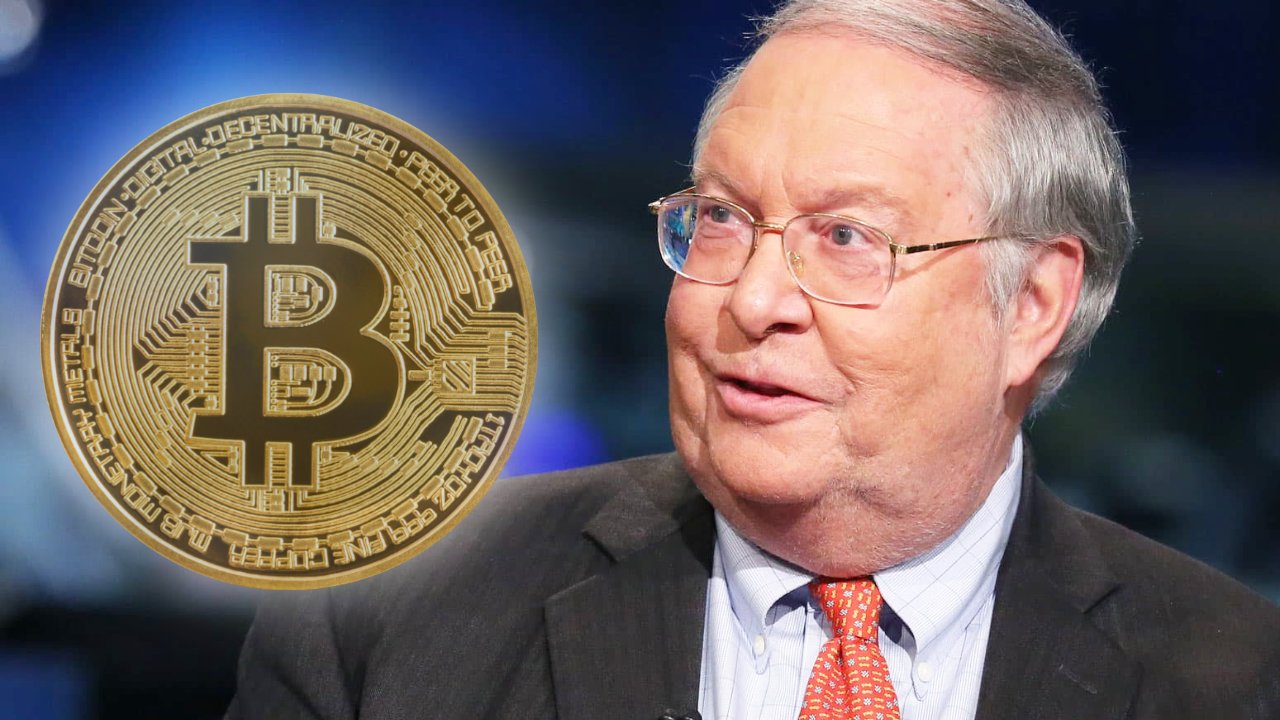
Billionaire Bill Miller, a seasoned billionaire investor, explains why he believes the current crypto outlook is very positive for Bitcoin.
Miller likens Bitcoin to digital gold when it comes to the digital currency. Other cryptos are simply “adventure investments” since they lack the uniqueness of Bitcoin, he said.
A fund manager, Miller highlighted that nearly half of Russia’s reserves are held in currencies controlled by individuals seeking to do them damage.
Miller, a co-founder of Miller Value Partners, spoke on the future of crypto in the face of Russia’s ongoing invasion of Ukraine.
Related Article | Criminal Whales Hold $25 Billion In Crypto Assets: Chainalysis Report
Crypto Outlook Favorable For Stakeholders
“The rest of crypto is a different story,” he said. The remainder of the cryptos could be called “adventure investments” since he believes they are all attempting to tackle different challenges.
The renowned value investor has been a long-term advocate of bitcoin. Last month, he revealed he had “a substantial” amount of bitcoin, and compared it to digital gold as a hedge against inflation.
He also referred to the current crypto outlook and Bitcoin as “insurance against financial disaster.”
Miller’s deep knowledge of investing and the stock market holds weight because of his vast business experience.
BTC total market cap at $740.14 billion in the daily chart | Source: TradingView.com
Russian Sanctions Good For Bitcoin?
Russia has 16% of its $640 billion in reserves in dollars, with 32% of assets denominated in euros.
According to Miller, they have 22% of their reserves in gold, which is the only component other nations cannot seize. He said:
“I believe this is very bullish for bitcoin.”
Several nations have slapped Russia with all sorts of sanctions since it attacked Ukraine.
As a result, the Russian currency and the stock prices of Russian enterprises listed on foreign exchanges have fallen precipitously.
European Union Commission President Ursula von der Leyen did not mince words, last week:
“We will paralyze the assets of Russia’s central bank,”
This announcement is expected to result in transactions being suspended and, in effect, will render the central bank unable to dispose of its assets.
War Drives Bitcoin Up: Devere CEO
Meanwhile, the CEO of Devere Group, Nigel Green, also shares the same level of optimism and has predicted that bitcoin’s price will reach $50,000 by the end of this month if the current outlook for the crypto is to be the gauge.
Bitcoin is now trading at $39,007. Green believes that the dollar’s standing as a global reserve currency might be threatened if viable and practical alternatives, such as cryptocurrency, emerge.
Related Article | Bitcoin Staggers After Putin’s Nuclear Deterrence Alert Warning
He said that the conflict between Russia and Ukraine has prompted people, corporations, and government agencies throughout the world to explore “alternatives to traditional systems” in response to the war.
According to Green, Bitcoin is now the 14th most valuable currency in the world, and he thinks it will rise much higher in the rankings in the coming months.
He said:
“Smart investors recognize this and will increase their exposure to cryptocurrencies before prices further climb.”
The Devere boss believes geopolitical tensions and institutional investors are driving the price of the (still) most sought-after crypto in the world.
Featured image from Bitcoin News, chart from TradingView.com
The number of Bitcoin millionaires, addresses with 1,000+ coins, has touched its highest level since April 2021. Glassnode’s on-chain data shows that 2,262 BTC addresses are now holding more than 1,000 coins.
According to the current price of Bitcoin, each of these addresses hold at least $40 million worth of cryptocurrency. “Number of addresses holding 1k+ coins just reached an 11-month high of 2,262,” Glassnode highlighted.
Despite price challenges and a drop in network activity, Bitcoin addresses holding more than 1,000 coins have increased. A sharp surge was observed at the start of March 2022. Relatively smaller Bitcoin holders with at least 1 BTC also joined the accumulation trend.
According to Glassnode, there are more than 820,000 addresses with at least $40,000 worth of BTC. “The number of BTC addresses holding 1+ Bitcoin just reached a 10-month high of 820,552,” the on-chain analytics platform mentioned.
BTC witnessed a decent rally at the start of March 2022 after global investors shifted their focus towards emerging assets. However, its price failed to sustain above $40,000 on Friday.
Bitcoin Adoption
The adoption of the digital asset kept rising at a rapid pace despite challenges in the recent weeks. In an interview with The Street, Jamie Iannone, CEO of eBay, said that the company is planning to explore the possibilities to accept digital currencies.
“Crypto adoption globally continues to soar and aligns with the thesis that we are in an accumulation phase. Ebay’s CEO hinted this week that they will soon integrate crypto payments, as they aim to capture GenZ and millennial audiences. This comes after the firm enabled NFT trading last year on its platform. Integrating crypto would be a great step for mainstream adoption, as eBay has around 160 million active buyers worldwide as of Q2 2021,” Marcus Sotiriou, Analyst at GlobalBlock, said.
The number of Bitcoin millionaires, addresses with 1,000+ coins, has touched its highest level since April 2021. Glassnode’s on-chain data shows that 2,262 BTC addresses are now holding more than 1,000 coins.
According to the current price of Bitcoin, each of these addresses hold at least $40 million worth of cryptocurrency. “Number of addresses holding 1k+ coins just reached an 11-month high of 2,262,” Glassnode highlighted.
Despite price challenges and a drop in network activity, Bitcoin addresses holding more than 1,000 coins have increased. A sharp surge was observed at the start of March 2022. Relatively smaller Bitcoin holders with at least 1 BTC also joined the accumulation trend.
According to Glassnode, there are more than 820,000 addresses with at least $40,000 worth of BTC. “The number of BTC addresses holding 1+ Bitcoin just reached a 10-month high of 820,552,” the on-chain analytics platform mentioned.
BTC witnessed a decent rally at the start of March 2022 after global investors shifted their focus towards emerging assets. However, its price failed to sustain above $40,000 on Friday.
Bitcoin Adoption
The adoption of the digital asset kept rising at a rapid pace despite challenges in the recent weeks. In an interview with The Street, Jamie Iannone, CEO of eBay, said that the company is planning to explore the possibilities to accept digital currencies.
“Crypto adoption globally continues to soar and aligns with the thesis that we are in an accumulation phase. Ebay’s CEO hinted this week that they will soon integrate crypto payments, as they aim to capture GenZ and millennial audiences. This comes after the firm enabled NFT trading last year on its platform. Integrating crypto would be a great step for mainstream adoption, as eBay has around 160 million active buyers worldwide as of Q2 2021,” Marcus Sotiriou, Analyst at GlobalBlock, said.
After two years and many COVID-19 restrictions finally subsiding, the world is welcoming the return of in-person theater, movies, comedy, music and sports. This has left some wondering what will happen to the legions of digital creatives who occupied and entertained us while normal life was at a standstill — and to the multibillion-dollar economy they inhabit.
Will the world forget the platforms and artists they discovered during the pandemic now the doors of festivals, fashion shows and concerts are open to them again? Is the creator economy, which recent estimates suggest will exceed $100 billion this year, strong enough to withstand a stampede back to real-life experiences?
I strongly believe it is. Government-imposed restrictions may have accelerated the pace of change, but the transformative trends in video streaming we witnessed during the pandemic were nascent before and would have caught hold regardless.
And, while I claim no deep training in macroeconomics, I am a technologist who has spent the past several years working in and around one of the most transformative new technologies to arise in decades: the blockchain. This is the technology that will completely reshape digital life, supercharging the creator economy in the process.
Related: Decentralization revolutionizes the creator’s economy, but what will it bring?
Playing on a digital stage
The enforced slowdown has given many artists the time — and the push — needed to experiment in the digital sphere, find new audiences and explore new ways to showcase their talents.
Even musicians who might never have given serious thought to live streaming a concert have taken to the digital stage. And, there’s evidence this will continue. Take singer Dua Lipa, who broke paid livestreaming records with 2020’s Studio 2054 concert. Initially said to be reluctant, Dua Lipa decided to go the livestream route after being forced to postpone an album tour. This turned out to be a good call: Her digital appearance drew more than five million views globally.
A survey from Middlesex University and funded by the UK Economic and Social Research Council showed that some 90% of musicians and 92% of fans believe livestreaming would remain an effective way to reach fans unwilling or unable to travel to venues in the post-pandemic world. Providers should take note: The study also found that audiences do not expect free access to live music and are not particularly discouraged by paywalls.
The rise in creative energy has inspired the developer community as well. New niche streaming platforms have grown up, helped by the emergence of low-cost decentralized infrastructure that allows application builders to encode video, store data and handle identity without having to pay expensive centralized cloud providers for such services.
Related: Music in the Metaverse creates social and immersive experiences for users
These centralized providers will increasingly find themselves on the defensive. Two attention-grabbing incidents in 2021 are illustrative: Hackers attacked Twitch and released private information about its code and its users to the world. And, Facebook suffered colossal reputational damage from a lengthy outage and whistleblower claims that its management has repeatedly chosen to prioritize profit over safety.
What comes next?
Big Tech’s woes and pandemic-related restrictions have sped up fundamental changes already underway in how the world produces, consumes and uses video content — changes likely to propel growth in the creator economy well into the future. And, given the increasing availability of low-cost decentralized blockchain infrastructure, these emerging players have a shot at mounting a serious challenge to the FAANG-run streaming providers.
There are five ways that blockchain will hasten growth in the creator economy, and help cement it as a central force in worldwide culture and entertainment:
Exclusivity: Nonfungible token- (NFT-) gated access and NFT ticketing are only two of the decentralized tools that improve the digital experience for event-goers: NFT tickets curb scalping while giving attendees a unique souvenir, all while token gating supports unique experiences for fans such as access to private groups and direct messaging with creators.
Fan ownership: The Web3 era is defined by the shift from extracting value from renters to accreting value to owners. Just as the blockchain enables fans to engage directly with their favorite creators, it offers a pathway to asset ownership in individual creator economies outside of traditional centralized platforms.
Low-cost streaming: Video streaming accounts for more than 80% of Web2 internet traffic and counting. Developers, eager to seize a piece of this market without being crushed by high costs, are increasingly seeking blockchain-based affordable infrastructure to support creator streams. With their new ability to draw global audiences through on-demand access-anywhere streams, creators are turning to uniquely Web3 features such as tipping, paid entry and live shopping to monetize their content.
Immersive interactivity: The one-way nature of Web2 publishing is already giving way to immersive interactivity that rewards users for participation. With the ability to record immutably and securely on the blockchain, creators can incentivize interactions without sacrificing privacy.
Niche down: While Web2 was built to scale up, Web3 is built to niche down. With its lower cost, increased security and resistance to censorship, the blockchain makes it possible to build micro-communities serving smaller niches than would be economically viable in Web2. That’s a fundamental shift that not only puts creators in control but also makes communities less appealing to attention-seeking trolls.
The stage has been set for a blossoming of creative activity, and those poised to take it will be assisted by decentralized infrastructure.
Related: The Metaverse will change the live music experience, but will it be decentralized?
Digital creatives have always recognized that they must be nimble to succeed. Now, there is a technology that will empower them and their analog peers to reach new audiences on their own terms without having to cede power or profit to tech behemoths like Google and Amazon.
My faith in the ability of musicians, gamers, influencers and creators to adapt to the new realities to come — and to thrive in them — has never been stronger.
The creator economy? The clue’s in the name.
This article does not contain investment advice or recommendations. Every investment and trading move involves risk, and readers should conduct their own research when making a decision.
The views, thoughts and opinions expressed here are the author’s alone and do not necessarily reflect or represent the views and opinions of Cointelegraph.
Doug Petkanics is a co-founder at Livepeer, where the team is building a decentralized live video broadcast platform to enable the next generation of video streaming. Prior to Livepeer, Doug was co-founder and CEO of Wildcard, a mobile browser. He also co-founded Hyperpublic, which was acquired by Groupon. He was the VP of Engineering at both.
MRHB DeFi recently announced a new strategic partnership with Sukhavati Labs, a decentralized cloud network service focused on storage. Now all NFTs minted on the MRHB DeFi network — such as on the SouqNFT Marketplace — will be stored in a secure and permissionless manner at a low cost on the decentralized Sukhavati network.
Lorsque vous explorez les différentes options de jeux en ligne, Spin Million Casino se distingue par son offre exceptionnelle de bonus et de promotions. Les joueurs expérimentés apprécieront non seulement la diversité des jeux disponibles, mais également les opportunités de gains qui se présentent à eux. Par exemple, ce casino offre des bonus de bienvenue attractifs qui augmentent considérablement votre capital de jeu dès le départ.
En outre, les options de paris sont variées, allant des machines à sous aux jeux de table en passant par le live casino. Les amateurs de jeux de table trouveront des versions classiques comme le blackjack et la roulette, tandis que les fans de machines à sous pourront profiter de jeux avec des thèmes et des fonctionnalités innovantes. Les jackpots progressifs ajoutent une couche d'excitation supplémentaire, offrant des gains potentiels qui peuvent changer la vie.
Les plateformes de jeu comme Yonibet
Lorsque vous recherchez un casino en ligne fiable, Yonibet est une option à considérer sérieusement. Ce casino a su établir une réputation solide grâce à sa large gamme de jeux, y compris des options de paris sportifs et des machines à sous captivantes. Les bonus offerts sont également un point fort, permettant aux joueurs de maximiser leurs mises et d'explorer de nouveaux jeux sans risque.
De plus, la légalité de ce casino est un autre aspect crucial. Yonibet opère sous une licence respectée, garantissant que toutes les transactions et les jeux sont effectués en toute sécurité. Les joueurs peuvent donc se concentrer sur l'essentiel : profiter de l'expérience de jeu. Les fonctionnalités telles que le live casino permettent une immersion totale, avec des croupiers en direct et une interaction en temps réel qui enrichissent l'expérience.
Roobet Casino : une expérience de jeu unique
Pour ceux qui recherchent une expérience de jeu différente, Roobet Casino offre une plateforme innovante qui attire les joueurs du monde entier. L'interface conviviale et les jeux variés en font un lieu de divertissement idéal pour les parieurs avertis. Les bonus réguliers et les promotions spéciales renforcent l'engagement des joueurs, leur permettant de maximiser leur expérience.
Les options de paris sont étendues, avec une section de paris sportifs bien développée qui attire de nombreux passionnés. Les jeux de casino sont également bien représentés, avec des machines à sous excitantes et des jeux de table classiques. L'accent mis sur la sécurité et la légalité est primordial pour Roobet, ce qui permet aux joueurs de profiter de leurs sessions de jeu en toute tranquillité d'esprit.
Cashwin : le choix des joueurs avertis
Enfin, Cashwin se présente comme un choix incontournable pour les joueurs à la recherche de bonus généreux et d'une sélection de jeux de qualité. Avec une interface fluide et des options de paiement variées, ce casino s'efforce de fournir une expérience de jeu optimale. Les promotions régulières et les programmes de fidélité récompensent les joueurs, ajoutant une dimension supplémentaire à leur aventure de jeu.
Cashwin se démarque également par son engagement envers la légalité et la sécurité. Les joueurs peuvent être assurés que leurs informations personnelles et financières sont protégées. Que ce soit pour des paris sportifs ou des jeux de casino, Cashwin offre un environnement sécurisé où l'amusement et le potentiel de gains sont au rendez-vous.