The conflict between Russia and Ukraine took center stage last month. The issue not only changed the global political landscape but also the economies of both countries. The financial infrastructure in Russia and Ukraine shattered in the past few weeks, but, for different reasons.
While the financial system in Ukraine broke down due to Russia’s aggression, Russia itself suffered severely due to economic sanctions. In the recent mayhem, crypto came to the rescue for Ukraine. Not to replace the existing financial system, but to support the humanitarian aid efforts and recovery initiatives. According to Alex Bornyakov, Ukraine’s Deputy Minister at the Ministry of Digital Transformation, the country has received a total of almost $100 million in crypto donations.
Ukraine has already spent nearly $15 million worth of crypto donations on military supplies. The nation has received crypto support in a wide range of digital currencies including Bitcoin and Ethereum. Apart from donations, the adoption of crypto assets has also increased in the country amid demolished banking system in the region.
On the other hand, the usage of cryptocurrencies climbed in Russia as well. The Ruble-denominated volumes are soaring. Reason? “Rising Sanctions”. Just in the past week, financial services giants like PayPal and Western Union suspended operations in Russia. In an effort to circumvent sanctions, Russians are moving towards digital assets for daily transactions. But, is it that easy to avoid sanctions through crypto? The answer is “No”. Especially under increasing regulatory pressure on the crypto ecosystem.
However, the bottom line is that the adoption of crypto assets is surging in Russia and Ukraine. To dig deeper into the details about the rising use of digital assets in both countries, Finance Magnates sat down with prominent crypto stakeholders to have their opinion.
“Once again, cryptocurrencies have demonstrated their value through a series of unfortunate events for human lives. The Ukrainian and Russian economies lie in shambles for different reasons. In the first two weeks of conflict, cryptocurrency was used as a tool of peace and war, but chiefly as an instrument that empowers individuals amidst a clash of nations,” Brian Pasfield, CTO at Fringe Finance, said.
“This is not the first armed conflict in the cryptocurrency age. Yet, it is proving to be the first in which cryptocurrency will be able to fulfill its intended role of returning power to individuals,” he added.
Crypto in Limelight
“The Russian invasion of Ukraine has brought cryptocurrencies into the limelight. It gave them more exposure in the media and among individuals in Russia and Ukraine who were looking to protect their assets from the effects of war. Cryptos have brought another dimension to the geopolitical equation as they have acted as an alternative to the traditional financial system to a certain extent when the latter seemed to fail in both Russia and Ukraine,” Daniel Takieddine, CEO MENA at BDSwiss, explained.
Takieddine mentioned that the authorities in Ukraine have made significant efforts in the past few weeks to make the crypto community realize the magnitude of the issue.
Need for Regulation
According to Takieddine, it is important for global regulatory authorities to introduce clear crypto regulations.
“The popularity of digital assets during the conflict has also brought up the need for adequate regulation. In this regard, European and American authorities sped up the process of creating a regulatory framework in order to make sure that Russia would not be able to use cryptocurrencies to circumvent sanctions,” Takieddine added.
Potential of Crypto
“The role of digital currencies in the Russia-Ukraine conflict represents the tip of the iceberg when it comes to the inherent capabilities of the nascent asset class to make a difference in social conflicts. The current situation once again shows how to complete dependence on traditional finance can put people in a hopeless situation. I believe it is worth considering crypto as an independent decentralized finance system that will be above sanctions and serve all sides, as it is currently doing in this Eastern European conflict, for the common good,” Daniele Casamassima, the Chief Executive Officer at Pure, said.
Alternative Assets
The recent surge in the adoption of crypto reinforced the idea of digital currencies as alternative assets. Joaquim Matinero Tor, a Blockchain Associate at Roca Junyent, said: “Due to this war in Ukraine we’ve seen that cryptos are good as alternative assets. The foreign minister of Ukraine asked for donations in BTC, ETH & other cryptos. This change of paradigm has shown the world that it’s a real alternative when things go wrong, and people started believing that such a “wallet” protects all their savings and investments,” Tor noted.
The conflict between Russia and Ukraine took center stage last month. The issue not only changed the global political landscape but also the economies of both countries. The financial infrastructure in Russia and Ukraine shattered in the past few weeks, but, for different reasons.
While the financial system in Ukraine broke down due to Russia’s aggression, Russia itself suffered severely due to economic sanctions. In the recent mayhem, crypto came to the rescue for Ukraine. Not to replace the existing financial system, but to support the humanitarian aid efforts and recovery initiatives. According to Alex Bornyakov, Ukraine’s Deputy Minister at the Ministry of Digital Transformation, the country has received a total of almost $100 million in crypto donations.
Ukraine has already spent nearly $15 million worth of crypto donations on military supplies. The nation has received crypto support in a wide range of digital currencies including Bitcoin and Ethereum. Apart from donations, the adoption of crypto assets has also increased in the country amid demolished banking system in the region.
On the other hand, the usage of cryptocurrencies climbed in Russia as well. The Ruble-denominated volumes are soaring. Reason? “Rising Sanctions”. Just in the past week, financial services giants like PayPal and Western Union suspended operations in Russia. In an effort to circumvent sanctions, Russians are moving towards digital assets for daily transactions. But, is it that easy to avoid sanctions through crypto? The answer is “No”. Especially under increasing regulatory pressure on the crypto ecosystem.
However, the bottom line is that the adoption of crypto assets is surging in Russia and Ukraine. To dig deeper into the details about the rising use of digital assets in both countries, Finance Magnates sat down with prominent crypto stakeholders to have their opinion.
“Once again, cryptocurrencies have demonstrated their value through a series of unfortunate events for human lives. The Ukrainian and Russian economies lie in shambles for different reasons. In the first two weeks of conflict, cryptocurrency was used as a tool of peace and war, but chiefly as an instrument that empowers individuals amidst a clash of nations,” Brian Pasfield, CTO at Fringe Finance, said.
“This is not the first armed conflict in the cryptocurrency age. Yet, it is proving to be the first in which cryptocurrency will be able to fulfill its intended role of returning power to individuals,” he added.
Crypto in Limelight
“The Russian invasion of Ukraine has brought cryptocurrencies into the limelight. It gave them more exposure in the media and among individuals in Russia and Ukraine who were looking to protect their assets from the effects of war. Cryptos have brought another dimension to the geopolitical equation as they have acted as an alternative to the traditional financial system to a certain extent when the latter seemed to fail in both Russia and Ukraine,” Daniel Takieddine, CEO MENA at BDSwiss, explained.
Takieddine mentioned that the authorities in Ukraine have made significant efforts in the past few weeks to make the crypto community realize the magnitude of the issue.
Need for Regulation
According to Takieddine, it is important for global regulatory authorities to introduce clear crypto regulations.
“The popularity of digital assets during the conflict has also brought up the need for adequate regulation. In this regard, European and American authorities sped up the process of creating a regulatory framework in order to make sure that Russia would not be able to use cryptocurrencies to circumvent sanctions,” Takieddine added.
Potential of Crypto
“The role of digital currencies in the Russia-Ukraine conflict represents the tip of the iceberg when it comes to the inherent capabilities of the nascent asset class to make a difference in social conflicts. The current situation once again shows how to complete dependence on traditional finance can put people in a hopeless situation. I believe it is worth considering crypto as an independent decentralized finance system that will be above sanctions and serve all sides, as it is currently doing in this Eastern European conflict, for the common good,” Daniele Casamassima, the Chief Executive Officer at Pure, said.
Alternative Assets
The recent surge in the adoption of crypto reinforced the idea of digital currencies as alternative assets. Joaquim Matinero Tor, a Blockchain Associate at Roca Junyent, said: “Due to this war in Ukraine we’ve seen that cryptos are good as alternative assets. The foreign minister of Ukraine asked for donations in BTC, ETH & other cryptos. This change of paradigm has shown the world that it’s a real alternative when things go wrong, and people started believing that such a “wallet” protects all their savings and investments,” Tor noted.
In October 2021, it was estimated that approximately 15% of the world’s supply of Bitcoin (BTC) was in circulation in Latin America. According to a recent report released by Crypto Literacy, however, 99% of Brazilian and Mexican respondents failed a basic assessment on crypto literacy. Crypto adoption is well underway across the region — on the rise even — but, people still lack a basic understanding of its underlying technology and use cases.
When this lack of basic crypto literacy is considered in the context of developing markets across Latin America, where the use cases for blockchain technologies hold real significance, it becomes a serious concern.
Latin American populations who lack crypto literacy risk missing out on stablecoins that can offer protection against Latin America’s rapidly rising inflation. As well as decentralized applications (DApps) that provide populations of unbanked individuals access to financial services from their mobile devices. In countries where remittances are a major facet of the economy, cryptocurrencies offer a faster and cheaper alternative for sending funds across borders.
So, how can we help Latin America’s most underserved populations access this life-changing technology? Education.
Related: Mass adoption of blockchain tech is possible, and education is the key
Unlocking mainstream adoption through education
Education has the potential to address three key obstacles preventing mainstream crypto adoption: financial literacy, trust and safety.
Financial literacy
Financial literacy, or lack thereof, does not just stand as a barrier to crypto adoption: It stands as a barrier to traditional bank adoption as well. Across Latin America and the Caribbean, nearly 50 percent of the population is unbanked as of August 2021, lacking access to a bank account or other financial services. In addition to living far from financial institutions, many individuals cite an absence of trust in institutions as a reason for remaining unbanked. Where there is little trust, there is often a lack of understanding.
Related: Decentralized finance may be the future, but education is still lacking
Trust
Speaking from personal experience, it’s not rare in Mexico to hear stories of parents recommending that their (adult) children exchange their savings for United States dollars and hide it away in a safe rather than trusting those earnings with a financial institution. By building financial literacy both around broad financial concepts and more concentrated blockchain-related concepts, we can inspire greater trust in financial institutions as a key pillar for promoting mainstream adoption.
Safety
The trust that education garners is more than just trust in financial institutions. It’s also trusting yourself: When people don’t understand the institutions and tools with which they’re interacting, those individuals are more likely to make risky financial decisions. And, they know that. Education can serve as one form of a safety net, teaching individuals which regulations are and are not in place to protect them so they can understand how financial services fit within those regulatory frameworks.
Teach where it matters most
Crypto has the potential to change the world and those who understand it best will be at a huge advantage. Knowing the power that education creates, it’s important that the crypto world targets audiences strategically to perpetuate already entrenched inequalities. Remote and underserved communities, as well as those with less access to traditional education, should be at the forefront of the recipients of blockchain education.
For remote communities, we must create mobile-friendly educational opportunities so that individuals can access learning materials from their phones without needing to travel miles to the nearest city.
For those with less education, we must consider multimedia educational materials that circumnavigate the need for literacy without assuming high-level base knowledge.
For women, mentorship programs and role models are key to creating welcoming and inclusive spaces that are explicitly designed to bring women into crypto.
Related: Women’s interest in crypto grows, but education gap persists
For global audiences, we should create resources in local languages — Spanish and Portuguese in Latin America — to ensure we reach the widest audience possible.
For everyone involved, we must avoid instituting financial barriers to education — trusting in the long-term gain of growing user bases through free and accessible education.
Blockchain technology and cryptocurrencies were built to break through the power structures of traditional finance. They have the potential to drastically improve financial inclusion and freedom in Latin America. So, it’s no wonder that crypto adoption is already on the rise. With mass adoption of such new technology, however, we face a new risk of leaving the most vulnerable populations behind. Education can solve this. Education can create trust in this rapidly-advancing technology and instill knowledge that enables individuals to interact safely with these new tools. Education can break the cycle of financial exclusion.
This article does not contain investment advice or recommendations. Every investment and trading move involves risk, and readers should conduct their own research when making a decision.
The views, thoughts and opinions expressed here are the author’s alone and do not necessarily reflect or represent the views and opinions of Cointelegraph.
Abraham Cobos Ramírez is the crypto strategy manager at Bitso, the cryptocurrency platform operating in Latin America, with more than four million users. Abraham is a blockchain and business specialist with deep experience in the creation, development and implementation of technology solutions. Prior to Bitso, Abraham was part of the integration consulting team where he designed and implemented solutions to complex problems for projects in Mexico, the U.S., Costa Rica, Panama and Colombia.
Recently, the blockchain company, Tezos announced that it has formed a collaboration with Misfits Gaming Group (MGG). Through a multi-year partnership deal, Tezos has become an official blockchain partner of the global eSports company.
In addition, MGG is planning to expand its presence in the blockchain ecosystem. The firm is introducing Block Born, a dedicated blockchain gaming community. In the partnership announcement, MGG highlighted the growing popularity of blockchain-based gaming projects.
MGG believes that Block Born will support the growth of the gaming community. Moreover, all Block Born tournaments will be carbon neutral.
“Gaming can do a lot better, and blockchain technologies will help get us there,” said Vas Roberts, the EVP of Partnerships at Misfits Gaming Group. “By building new practices upon a decentralized, indexed platform, we’ll reimagine how we work with our community, peers and partners. Tezos will help us share new levels of access, equity and decision-making, and we’re thrilled to pioneer how blockchain can help gaming organizations redefine how they operate.”
Tezos has increased its marketing and branding activities substantially since the start of 2022. The blockchain firm recently inked a partnership deal with Manchester United.
The latest deal with MGG will encompass marquee branding and sponsorship rights.
Sponsorships
eSports and gaming firms developed several sponsorship partnerships with some of the leading crypto and blockchain firms in 2021. The trend has witnessed a continuation in 2022 as well. In January 2022, Gen.G, a global eSports organization, confirmed a collaboration with the South Korean digital exchange, Bithumb.
“At such an exciting time for the broader gaming and esports industries, Misfits Gaming Group’s choice of Tezos as its official blockchain adds to the momentum that is growing for blockchain gaming, with community building and player engagement as a priority. I believe that Tezos’ sustainability and its unique ability to adapt to rapidly evolving technology is perfectly aligned to support MGG’s laudable goals,” added Mason Edwards, the Chief of Staff at Tezos Foundation.
Recently, the blockchain company, Tezos announced that it has formed a collaboration with Misfits Gaming Group (MGG). Through a multi-year partnership deal, Tezos has become an official blockchain partner of the global eSports company.
In addition, MGG is planning to expand its presence in the blockchain ecosystem. The firm is introducing Block Born, a dedicated blockchain gaming community. In the partnership announcement, MGG highlighted the growing popularity of blockchain-based gaming projects.
MGG believes that Block Born will support the growth of the gaming community. Moreover, all Block Born tournaments will be carbon neutral.
“Gaming can do a lot better, and blockchain technologies will help get us there,” said Vas Roberts, the EVP of Partnerships at Misfits Gaming Group. “By building new practices upon a decentralized, indexed platform, we’ll reimagine how we work with our community, peers and partners. Tezos will help us share new levels of access, equity and decision-making, and we’re thrilled to pioneer how blockchain can help gaming organizations redefine how they operate.”
Tezos has increased its marketing and branding activities substantially since the start of 2022. The blockchain firm recently inked a partnership deal with Manchester United.
The latest deal with MGG will encompass marquee branding and sponsorship rights.
Sponsorships
eSports and gaming firms developed several sponsorship partnerships with some of the leading crypto and blockchain firms in 2021. The trend has witnessed a continuation in 2022 as well. In January 2022, Gen.G, a global eSports organization, confirmed a collaboration with the South Korean digital exchange, Bithumb.
“At such an exciting time for the broader gaming and esports industries, Misfits Gaming Group’s choice of Tezos as its official blockchain adds to the momentum that is growing for blockchain gaming, with community building and player engagement as a priority. I believe that Tezos’ sustainability and its unique ability to adapt to rapidly evolving technology is perfectly aligned to support MGG’s laudable goals,” added Mason Edwards, the Chief of Staff at Tezos Foundation.
Dubai, U.A.E., March 10, 2022 — MRHB DeFi Network, the world’s first decentralized finance (DeFi) platform focused solely on providing ethical and halal crypto opportunities, is listing its $MRHB token on BitMart, a global centralized cryptocurrency exchange (CEX). This follows its current listing on LBank Global Exchange as well as popular DEX, Pancakeswap.
CEO of MicroStrategy Michael Saylor remains one of the most vocal supporters of bitcoin. Countless times in the past, Saylor has always lauded the benefits of the digital asset, which he says is the best investment. His convictions are shared by his firm which remains the publicly traded company with the largest bitcoin holdings in the world. Now, once again, Saylor has spoken out in favor of the cryptocurrency, effectively snubbing its competitors while he’s at it.
Bitcoin Is The Only Scarce Asset
Bitcoin’s scarcity has often been one of the strongest arguments for the value of the cryptocurrency. According to the code, there can only be 21 million bitcoins mined, meaning that once this supply is mined, there are no more bitcoins coming into circulation. More BTC cannot be created, making it one of the most scarce assets in the entire globe.
With bitcoin’s growth, it has fast become a rival for other top investment assets in the space. One of those assets is gold. Bitcoin which is referred to as digital gold has outperformed its physical rival over the course of the last few years, putting them in fierce competition with each other. However, according to Saylor, only one of these assets is truly scarce and that is bitcoin.
Speaking on the PBD Podcast, Saylor explained that all other assets can have more of them created. He called bitcoin the only scarcity known to humanity. The CEO referred to gold as a commodity, alongside other assets like real estate and luxury watches.
“I can create more real estate in New York City. I can create more cars. I can create more luxury watches. I can create more gold. I can create more shares of a stock. I can create more bonds,” Saylor explained.
BTC declines below $40,000 | Source: BTCUSD on TradingView.com
His reasoning was that since he can create more of these, then they are basically commodities. Whereas, bitcoin is “magical” given that there will only ever be 21 million tokens and no one else can create more BTC once they are all mined.
Related Reading | Bitcoin On Course To Hit $100K Nine Months From Now, Bitbull CEO Predicts
“I can create any commodity; they’re commodities by definition. Given enough money and time, I can create infinite of any of them,” Saylor continued.
Saylor’s advocacy for bitcoin runs both personal and professional. Saylor is known for using his personal bitcoin investment as an argument for why MicroStrategy should invest in the digital asset. As of the time of this writing, MicroStrategy owns over 120K BTC worth almost $5 billion, putting the firm in profit territory.
Featured image from Coingape, chart from TradingView.com
While the interest in metaverse seems to slow down, a pioneer in the space is still hard at work, advocating the open metaverse, a decentralized and interoperable multiverse.
In an interview with Cointelegraph Brazil, Sebastien Borget, the founder of the open-world blockchain game The Sandbox, shared some of his thoughts and expertise when it comes to Web3 and the state of the metaverse.
According to Borget, the metaverse is a gateway to new experiences limited only by what users can think of. He explained that:
“Web 3.0 and the metaverse are enabling each of us to become an explorer of our human imagination, inventing new parallel universes where we can choose the experiences we want to live.”
The Sandbox founder also mentions that the metaverse has already started to influence the way people “socialize, form economic relationships, and gather in communities.” He believes that within a decade, there will be more developments in the space.
“We envision that within the next 10 years, the metaverse will have transformed profoundly how we’re thinking about the way we’ll be working, socializing, playing, and earning through the economic opportunities and jobs it is creating.”
Borget believes that the role of platforms must be to ensure that the process of creation is fun and rewarding and that listening to what users want should be the priority. “We’ve brought this ecosystem into being, but experiences and assets that players make and share are what drives it,” says Borget.
Apart from these, the governance of the metaverse must be transferred over to the users according to Borget. This will be done through a decentralized autonomous organization (DAO) launch with voting mechanisms.
Related: The Sandbox metaverse hits 2M users, begins K-pop partnership
The Sandbox is offering a decentralized metaverse. Borget explains that this means that its users are not locked within its platform. “It’s important to us that the content you own or create in The Sandbox can be transferred to other open metaverses, and vice versa,” he said. Borget also stresses that decentralization is the way forward, rather than being stuck in a Web2 “microverse,” where content ownership is trapped by big tech.
“We’re strongly advocating for the core of the open metaverse to be decentralization, interoperability and creator-generated content.”
When asked what’s next for The Sandbox, the founder explained that the team is building the platform step by step. “Our vision of a decentralized entertainment metaverse where everyone can play, create, and be rewarded for their time through play-to-earn is resonating strongly. Step by step, we’re building out the ecosystem to realize the potential The Sandbox offers to players, creators, and partners,” says Borget.
Sebastien Borget, Founder and COO of The Sandbox. Source: borget.net
Apart from this, the founder explains that up next is enabling creators to build and share experiences within their lands. Borget says that people can expect more original content generated by the community going forward.
The Sandbox executive also underscored that despite nations like the United States, China and Turkey announcing metaverse strategies, these parties would be unable to control the metaverse. “This diversity of ownership means that no single party can control the metaverse,” he said.
Borget also mentions that the Sandbox also aims to make gaming more equitable. The founder says that they “especially want to make The Sandbox a welcoming place for women as creators and players.” This can potentially also bring more women to Web3.
“We support creator efforts to build inclusive worlds that can inspire players to see beyond the external differences while still appreciating them.”
Zellim, an integrated software solutions company, today announced a partnership with ClearSoftware, a build of decentralized systems, to launch a new decentralized autonomous organization (DAO) platform. The joint efforts will result in decentralized integration of Zellim’s all-in-one productivity platform.
Many of Clear’s companies and organizations operate as decentralized autonomous organizations (DAOs) with offices all over the world including the United States, Canada, New Zealand, Taiwan, China, the Netherlands, and India.
“With thousands of businesses having to shut their doors for good since the start of the pandemic, our team has worked hard to combine the most necessary communication and productivity tools into one affordable app. This partnership now allows us to give users the latest in privacy & security too.” – Jerry Ulrich, Zellim Founder & CEO
The Zellim platform includes popular productivity and communication tools including contacts, project management, video conferences, voice channels, encrypted team chat, an automated appointment calendar, document vault, and much more.
ClearSoftwares privacy quest is well underway and based on the partnership with Zellim, the exclusive decentralized integration of the ClearONE Teams Platform will soon be included on every ClearPHONE. These ‘new-age’ devices utilize blockchain technology to give users the utmost security.
“With the integration of this platform, users can communicate with their team, share files, and run their business with the peace of mind that comes with ClearSoftware products. While the platform is in Alpha release, we’re accepting pre-registrations. We’re offering early adoption pricing which allows users to benefit from significant discounts. This special offer will only last while we’re wrapping up the final stage of development.” – Michael Proper, ClearSoftware Chairman
State Street Corporation, a leading provider of financial services, announced on Wednesday that its dedicated Digital division, State Street Digital, has entered into a licensing agreement with London-based crypto custody and trading infrastructure provider Copper.co.
According to the press release, State Street Digital will develop and launch a digital custody offering where clients can store and settle their digital assets within an environment operated by State Street, subject to regulatory approval.
“As institutional investors’ interest in digital assets continues to grow, we are building the financial infrastructure needed to support our clients’ allocations to this new asset class. State Street Digital’s mission continues to focus on putting the right tools in place so we can provide clients with solutions to support their traditional as well as digital assets needs. Today’s exciting announcement will only enhance our ambition to deliver to our clients an amazing digital experience. We look forward to collaborating with the team at Copper as State Street Digital continues to grow,” Nadine Chakar, head of State Street Digital, commented on the announcement
Copper.co offers custody, trading, and settlement
Settlement
Settlement in finance refers to the process when a buyer makes payment and receives the agreed-upon services or goods. The term is used on exchanges such as New York Stock Exchange (NYSE) when security changes hands. When the asset is transferred and placed in the new buyer’s name, it is considered settled. This process could take a few hours or several days after a trade is made. It depends on the clearance process. In the United States, the settlement date for marketable stocks is usually 2 business days or T+2 after the trade is executed, and for listed options and government securities it is usually 1 day after the execution. Conversely in Europe, settlement date has also been adopted as 2 business days settlement cycles T+2.Settlement ExplainedA settlement is also the process of the payment of an outstanding account balance, an open invoice or charge. The electronic settlement system is a relatively new construct that has only become a standard in the past thirty years.For example, in real estate finance, you have settlement when the funds are accepted, and the deed to the property is traders to the new owner. Settlement can also mean an adjustment or agreement reached in matters of finance or business. For example, we have settled with the bank or the credit card company. A number of risks arise for the parties during the settlement process. These are effectively managed by the process of clearing, which follows trading and precedes settlement. By extension, clearing involves modifying those contractual obligations so as to facilitate settlement, often by netting and novation.
Settlement in finance refers to the process when a buyer makes payment and receives the agreed-upon services or goods. The term is used on exchanges such as New York Stock Exchange (NYSE) when security changes hands. When the asset is transferred and placed in the new buyer’s name, it is considered settled. This process could take a few hours or several days after a trade is made. It depends on the clearance process. In the United States, the settlement date for marketable stocks is usually 2 business days or T+2 after the trade is executed, and for listed options and government securities it is usually 1 day after the execution. Conversely in Europe, settlement date has also been adopted as 2 business days settlement cycles T+2.Settlement ExplainedA settlement is also the process of the payment of an outstanding account balance, an open invoice or charge. The electronic settlement system is a relatively new construct that has only become a standard in the past thirty years.For example, in real estate finance, you have settlement when the funds are accepted, and the deed to the property is traders to the new owner. Settlement can also mean an adjustment or agreement reached in matters of finance or business. For example, we have settled with the bank or the credit card company. A number of risks arise for the parties during the settlement process. These are effectively managed by the process of clearing, which follows trading and precedes settlement. By extension, clearing involves modifying those contractual obligations so as to facilitate settlement, often by netting and novation. Read this Term solutions across 450 crypto-assets and over 40 exchanges for institutional investors. With its infrastructure and experience, the firm will assist clients in transitioning to the new digital economy and thriving there.
“That State Street, one of the world’s largest custodians, is creating a new digital asset service is a hugely important development for institutional engagement in this new asset class. We are proud to be part of State Street’s goal to lead the way in the transformation of financial infrastructure,” Sabrina Wilson, COO at Copper.co, highlighted.
BNY Mellon Crypto Custody Platform
Last month, BNY Mellon, a major US global bank headquartered in New York, announced plans to launch a digital asset custody platform to enable institutional clients to get exposure to cryptocurrencies
Cryptocurrencies
By using cryptography, virtual currencies, known as cryptocurrencies, are nearly counterfeit-proof digital currencies that are built on blockchain technology. Comprised of decentralized networks, blockchain technology is not overseen by a central authority.Therefore, cryptocurrencies function in a decentralized nature which theoretically makes them immune to government interference. The term, cryptocurrency derives from the origin of the encryption techniques that are employed to secure the networks which are used to authenticate blockchain technology. Cryptocurrencies can be thought of as systems that accept online payments which are denoted as “tokens.” Tokens are represented as internal ledger entries in blockchain technology while the term crypto is used to depict cryptographic methods and encryption algorithms such as public-private key pairs, various hashing functions, and an elliptical curve. Every cryptocurrency transaction that occurs is logged in a web-based ledger with blockchain technology.These then must be approved by a disparate network of individual nodes (computers that maintain a copy of the ledger). For every new block generated, the block must first be authenticated and confirmed ‘approved’ by each node, which makes forging the transactional history of cryptocurrencies nearly impossible. The World’s First CryptoBitcoin became the first blockchain-based cryptocurrency and to this day is still the most demanded cryptocurrency and the most valued. Bitcoin still contributes the majority of the overall cryptocurrency market volume, though several other cryptos have grown in popularity in recent years.Indeed, out of the wake of Bitcoin, iterations of Bitcoin became prevalent which resulted in a multitude of newly created or cloned cryptocurrencies. Contending cryptocurrencies that emerged after Bitcoin’s success is referred to as ‘altcoins’ and they refer to cryptocurrencies such as Bitcoin, Peercoin, Namecoin, Ethereum, Ripple, Stellar, and Dash. Cryptocurrencies promise a wide range of technological innovations that have yet to be structured into being. Simplified payments between two parties without the need for a middle man is one aspect while leveraging blockchain technology to minimize transaction and processing fees for banks is another. Of course, cryptocurrencies have their disadvantages too. This includes issues of tax evasion, money laundering, and other illicit online activities where anonymity is a dire ingredient in solicitous and fraudulent activities.
By using cryptography, virtual currencies, known as cryptocurrencies, are nearly counterfeit-proof digital currencies that are built on blockchain technology. Comprised of decentralized networks, blockchain technology is not overseen by a central authority.Therefore, cryptocurrencies function in a decentralized nature which theoretically makes them immune to government interference. The term, cryptocurrency derives from the origin of the encryption techniques that are employed to secure the networks which are used to authenticate blockchain technology. Cryptocurrencies can be thought of as systems that accept online payments which are denoted as “tokens.” Tokens are represented as internal ledger entries in blockchain technology while the term crypto is used to depict cryptographic methods and encryption algorithms such as public-private key pairs, various hashing functions, and an elliptical curve. Every cryptocurrency transaction that occurs is logged in a web-based ledger with blockchain technology.These then must be approved by a disparate network of individual nodes (computers that maintain a copy of the ledger). For every new block generated, the block must first be authenticated and confirmed ‘approved’ by each node, which makes forging the transactional history of cryptocurrencies nearly impossible. The World’s First CryptoBitcoin became the first blockchain-based cryptocurrency and to this day is still the most demanded cryptocurrency and the most valued. Bitcoin still contributes the majority of the overall cryptocurrency market volume, though several other cryptos have grown in popularity in recent years.Indeed, out of the wake of Bitcoin, iterations of Bitcoin became prevalent which resulted in a multitude of newly created or cloned cryptocurrencies. Contending cryptocurrencies that emerged after Bitcoin’s success is referred to as ‘altcoins’ and they refer to cryptocurrencies such as Bitcoin, Peercoin, Namecoin, Ethereum, Ripple, Stellar, and Dash. Cryptocurrencies promise a wide range of technological innovations that have yet to be structured into being. Simplified payments between two parties without the need for a middle man is one aspect while leveraging blockchain technology to minimize transaction and processing fees for banks is another. Of course, cryptocurrencies have their disadvantages too. This includes issues of tax evasion, money laundering, and other illicit online activities where anonymity is a dire ingredient in solicitous and fraudulent activities. Read this Term.
The new custody platform will enable customers to hold the major crypto coins like Bitcoin and Ether in BNY Mellon crypto wallets which will be powered by Fireblocks technology.
State Street Corporation, a leading provider of financial services, announced on Wednesday that its dedicated Digital division, State Street Digital, has entered into a licensing agreement with London-based crypto custody and trading infrastructure provider Copper.co.
According to the press release, State Street Digital will develop and launch a digital custody offering where clients can store and settle their digital assets within an environment operated by State Street, subject to regulatory approval.
“As institutional investors’ interest in digital assets continues to grow, we are building the financial infrastructure needed to support our clients’ allocations to this new asset class. State Street Digital’s mission continues to focus on putting the right tools in place so we can provide clients with solutions to support their traditional as well as digital assets needs. Today’s exciting announcement will only enhance our ambition to deliver to our clients an amazing digital experience. We look forward to collaborating with the team at Copper as State Street Digital continues to grow,” Nadine Chakar, head of State Street Digital, commented on the announcement
Copper.co offers custody, trading, and settlement
Settlement
Settlement in finance refers to the process when a buyer makes payment and receives the agreed-upon services or goods. The term is used on exchanges such as New York Stock Exchange (NYSE) when security changes hands. When the asset is transferred and placed in the new buyer’s name, it is considered settled. This process could take a few hours or several days after a trade is made. It depends on the clearance process. In the United States, the settlement date for marketable stocks is usually 2 business days or T+2 after the trade is executed, and for listed options and government securities it is usually 1 day after the execution. Conversely in Europe, settlement date has also been adopted as 2 business days settlement cycles T+2.Settlement ExplainedA settlement is also the process of the payment of an outstanding account balance, an open invoice or charge. The electronic settlement system is a relatively new construct that has only become a standard in the past thirty years.For example, in real estate finance, you have settlement when the funds are accepted, and the deed to the property is traders to the new owner. Settlement can also mean an adjustment or agreement reached in matters of finance or business. For example, we have settled with the bank or the credit card company. A number of risks arise for the parties during the settlement process. These are effectively managed by the process of clearing, which follows trading and precedes settlement. By extension, clearing involves modifying those contractual obligations so as to facilitate settlement, often by netting and novation.
Settlement in finance refers to the process when a buyer makes payment and receives the agreed-upon services or goods. The term is used on exchanges such as New York Stock Exchange (NYSE) when security changes hands. When the asset is transferred and placed in the new buyer’s name, it is considered settled. This process could take a few hours or several days after a trade is made. It depends on the clearance process. In the United States, the settlement date for marketable stocks is usually 2 business days or T+2 after the trade is executed, and for listed options and government securities it is usually 1 day after the execution. Conversely in Europe, settlement date has also been adopted as 2 business days settlement cycles T+2.Settlement ExplainedA settlement is also the process of the payment of an outstanding account balance, an open invoice or charge. The electronic settlement system is a relatively new construct that has only become a standard in the past thirty years.For example, in real estate finance, you have settlement when the funds are accepted, and the deed to the property is traders to the new owner. Settlement can also mean an adjustment or agreement reached in matters of finance or business. For example, we have settled with the bank or the credit card company. A number of risks arise for the parties during the settlement process. These are effectively managed by the process of clearing, which follows trading and precedes settlement. By extension, clearing involves modifying those contractual obligations so as to facilitate settlement, often by netting and novation. Read this Term solutions across 450 crypto-assets and over 40 exchanges for institutional investors. With its infrastructure and experience, the firm will assist clients in transitioning to the new digital economy and thriving there.
“That State Street, one of the world’s largest custodians, is creating a new digital asset service is a hugely important development for institutional engagement in this new asset class. We are proud to be part of State Street’s goal to lead the way in the transformation of financial infrastructure,” Sabrina Wilson, COO at Copper.co, highlighted.
BNY Mellon Crypto Custody Platform
Last month, BNY Mellon, a major US global bank headquartered in New York, announced plans to launch a digital asset custody platform to enable institutional clients to get exposure to cryptocurrencies
Cryptocurrencies
By using cryptography, virtual currencies, known as cryptocurrencies, are nearly counterfeit-proof digital currencies that are built on blockchain technology. Comprised of decentralized networks, blockchain technology is not overseen by a central authority.Therefore, cryptocurrencies function in a decentralized nature which theoretically makes them immune to government interference. The term, cryptocurrency derives from the origin of the encryption techniques that are employed to secure the networks which are used to authenticate blockchain technology. Cryptocurrencies can be thought of as systems that accept online payments which are denoted as “tokens.” Tokens are represented as internal ledger entries in blockchain technology while the term crypto is used to depict cryptographic methods and encryption algorithms such as public-private key pairs, various hashing functions, and an elliptical curve. Every cryptocurrency transaction that occurs is logged in a web-based ledger with blockchain technology.These then must be approved by a disparate network of individual nodes (computers that maintain a copy of the ledger). For every new block generated, the block must first be authenticated and confirmed ‘approved’ by each node, which makes forging the transactional history of cryptocurrencies nearly impossible. The World’s First CryptoBitcoin became the first blockchain-based cryptocurrency and to this day is still the most demanded cryptocurrency and the most valued. Bitcoin still contributes the majority of the overall cryptocurrency market volume, though several other cryptos have grown in popularity in recent years.Indeed, out of the wake of Bitcoin, iterations of Bitcoin became prevalent which resulted in a multitude of newly created or cloned cryptocurrencies. Contending cryptocurrencies that emerged after Bitcoin’s success is referred to as ‘altcoins’ and they refer to cryptocurrencies such as Bitcoin, Peercoin, Namecoin, Ethereum, Ripple, Stellar, and Dash. Cryptocurrencies promise a wide range of technological innovations that have yet to be structured into being. Simplified payments between two parties without the need for a middle man is one aspect while leveraging blockchain technology to minimize transaction and processing fees for banks is another. Of course, cryptocurrencies have their disadvantages too. This includes issues of tax evasion, money laundering, and other illicit online activities where anonymity is a dire ingredient in solicitous and fraudulent activities.
By using cryptography, virtual currencies, known as cryptocurrencies, are nearly counterfeit-proof digital currencies that are built on blockchain technology. Comprised of decentralized networks, blockchain technology is not overseen by a central authority.Therefore, cryptocurrencies function in a decentralized nature which theoretically makes them immune to government interference. The term, cryptocurrency derives from the origin of the encryption techniques that are employed to secure the networks which are used to authenticate blockchain technology. Cryptocurrencies can be thought of as systems that accept online payments which are denoted as “tokens.” Tokens are represented as internal ledger entries in blockchain technology while the term crypto is used to depict cryptographic methods and encryption algorithms such as public-private key pairs, various hashing functions, and an elliptical curve. Every cryptocurrency transaction that occurs is logged in a web-based ledger with blockchain technology.These then must be approved by a disparate network of individual nodes (computers that maintain a copy of the ledger). For every new block generated, the block must first be authenticated and confirmed ‘approved’ by each node, which makes forging the transactional history of cryptocurrencies nearly impossible. The World’s First CryptoBitcoin became the first blockchain-based cryptocurrency and to this day is still the most demanded cryptocurrency and the most valued. Bitcoin still contributes the majority of the overall cryptocurrency market volume, though several other cryptos have grown in popularity in recent years.Indeed, out of the wake of Bitcoin, iterations of Bitcoin became prevalent which resulted in a multitude of newly created or cloned cryptocurrencies. Contending cryptocurrencies that emerged after Bitcoin’s success is referred to as ‘altcoins’ and they refer to cryptocurrencies such as Bitcoin, Peercoin, Namecoin, Ethereum, Ripple, Stellar, and Dash. Cryptocurrencies promise a wide range of technological innovations that have yet to be structured into being. Simplified payments between two parties without the need for a middle man is one aspect while leveraging blockchain technology to minimize transaction and processing fees for banks is another. Of course, cryptocurrencies have their disadvantages too. This includes issues of tax evasion, money laundering, and other illicit online activities where anonymity is a dire ingredient in solicitous and fraudulent activities. Read this Term.
The new custody platform will enable customers to hold the major crypto coins like Bitcoin and Ether in BNY Mellon crypto wallets which will be powered by Fireblocks technology.
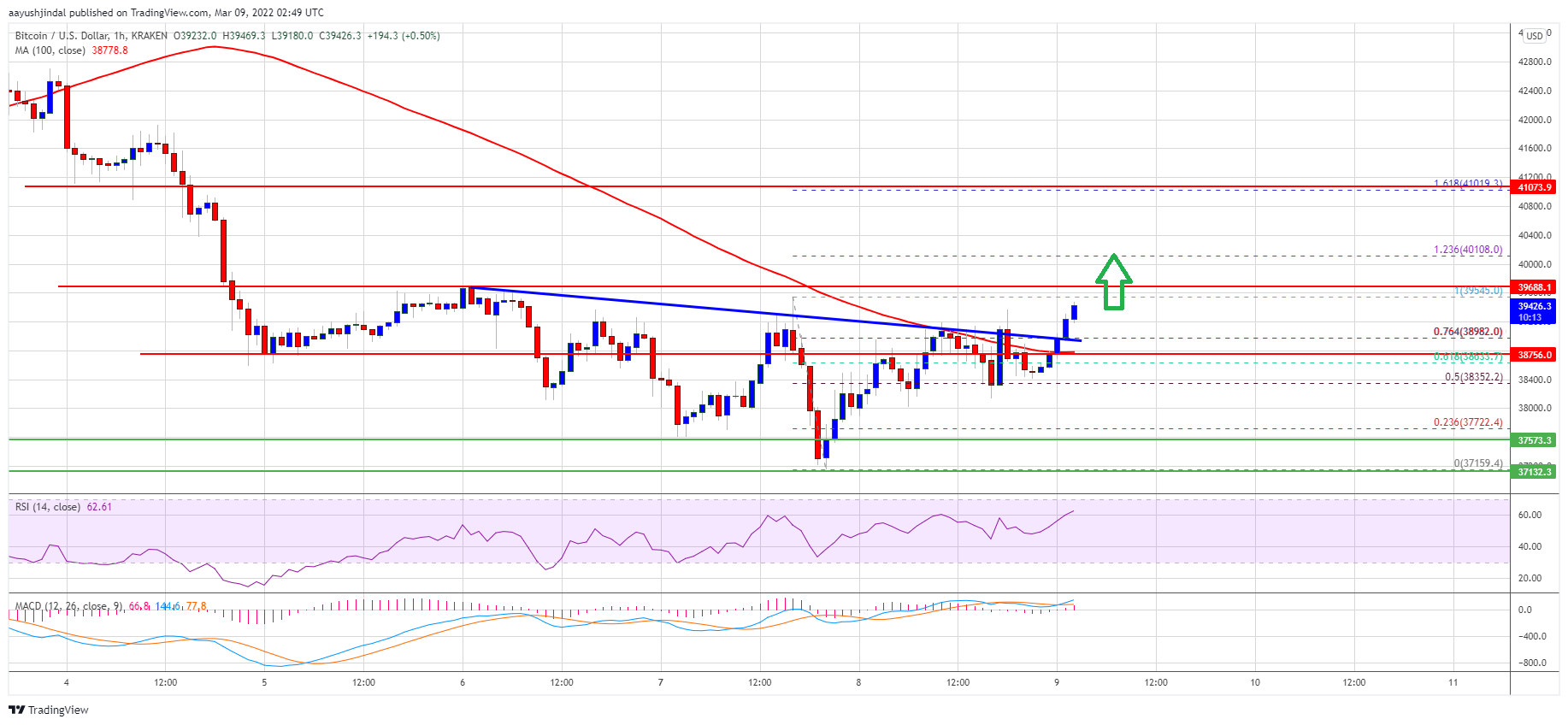
Bitcoin is correcting losses and trading above $39,000 against the US Dollar. BTC could gain bullish momentum if it clears the $40,000 resistance zone.
Bitcoin is slowly recovering and trading above the $39,000 zone.
The price is trading above $39,200 and the 100 hourly simple moving average.
There was a break above a major bearish trend line with resistance near $38,980 on the hourly chart of the BTC/USD pair (data feed from Kraken).
The pair might accelerate higher and could even surpass the $40,000 resistance zone.
Bitcoin Price Starts Correction
Bitcoin price extended decline below the $38,000 support zone. However, BTC found support near the $37,150 zone and started a decent recovery wave.
A low was formed near $37,159 before the price corrected higher. There was a move above the $38,000 and $38,500 resistance levels. The price was able to climb above the 76.4% Fib retracement level of the downward move from the $39,545 swing high to $37,159 low.
Besides, there was a break above a major bearish trend line with resistance near $38,980 on the hourly chart of the BTC/USD pair. Bitcoin is now trading above $39,200 and the 100 hourly simple moving average.
On the upside, an immediate resistance is near the $39,545 swing high. The next major resistance is near the $40,000 level. If there is a clear move above the $40,000 resistance zone, the price might accelerate higher. In the stated case, the price could rise towards the $41,000 zone.
Source: BTCUSD on TradingView.com
The 1.618 Fib extension level of the downward move from the $39,545 swing high to $37,159 low is also near the $41,000 level. Any more gains might send the price towards the $42,200 level.
Another Rejection in BTC?
If bitcoin fails to clear the $40,000 resistance zone, it could start another decline. An immediate support on the downside is near the $39,150 zone.
The next major support is seen near the $38,800 level and the 100 hourly simple moving average. If there is a downside break below the $38,800 support, the price might gain bearish momentum. In the stated case, there is a risk of a move towards the $37,500 level.
Technical indicators:
Hourly MACD – The MACD is now gaining pace in the bullish zone.
Hourly RSI (Relative Strength Index) – The RSI for BTC/USD is now above the 50 level.
Major Support Levels – $39,150, followed by $38,800.
Major Resistance Levels – $39,545, $40,000 and $41,000.
According to famed decentralized finance, or DeFi, detective zachxbt, 31 nonfungible-tokens, or NFTs, projects may be at risk due to “suspicious code.” In a lengthy Twitter thread published Tuesday, the DeFi detective first raised the issue of NFTs project Thestarlab — which was allegedly compromised for 197.175 Ether (ETH), worth $580,325 USD at time of publication. Zachxbt quoted fellow blockchain investigator _MouseDev, who came to the following conclusion after reviewing the code behind Thestarlab:
“The smart contract [for this project] can never truly be renounced or transferred—only an additional owner. The original deployer will always be considered the owner. This means if they still have the private key of the deployer, they can pull the money, even though the owner is the null address.”
_MouseDev claimed that when the projects’ developers deployed their contract, they stored two variables as the owner. “Then they later changed one of them to the null address to appear as though they relinquished but kept another unchanged variable,” says _MouseDev.
Based on this information, zachxbt claimed to have uncovered 31 NFTs projects that all contracted the same Fiverr developer to deploy the allegedly problematic smart contract. Additionally, the DeFi detective had the following remarks:
“Please do proper due diligence. Always review the contract beforehand, especially if outsourced. Luckily, since then a few of the projects were able migrate contracts and confront the Fiver dev. After reviewing internally, a few found other red flags as well.”
1/ Recently a NFT project was compromised rugging the team of 197 ETH. Interestingly enough, suspicious code lay within the smart contract potentially putting 31 other NFT projects at risk. How is this possible you ask? Well let’s dive in. pic.twitter.com/NelTIkoNVm