This year, Silvergate Capital paid $182 million for Diem’s technology assets, bringing an end to Facebook’s plan to build a crypto payments network.
The deal underscores how the social network giant, now Meta, has just a limited number of regulatory-approved options for becoming a prominent player in the blockchain space.
These well-known investors participated in a strategic investing round, which was led by investors including Tiger Global, Multicoin Capital, Katie Haun and Coinbase Ventures.
Blockchain System For Aptos
Aptos, a project founded by ex-Facebook employees who just left the firm in December, has already received unicorn money from Andreessen Horowitz and other prominent web3 investors.
Aptos Chief Executive Officer Mo Shaikh said in a recent blog post:
“We are the founders, researchers, designers, and builders of Diem, the first blockchain developed for this purpose… while the rest of the world never saw what we produced, our job is far from done.”
Aptos has disclosed that it has raised $200 million in capital from Tiger Global, Katie Haun, Multicoin Capital, 3 Arrows Capital, FTX Ventures, and Coinbase Ventures to pursue its goal of establishing a blockchain scalability system.
Another prominent first-round investor is Silvergate Capital, while the Aptos team assures that they will not license or use any of Silvergate’s Diem IP as they develop their blockchain.
Related Article | Gloomy Crypto Future? Book Author Warns We’re In The Biggest Bubble In History
Crypto total market cap at $1.78 trillion on the daily chart | Source: TradingView.com
No Direct Link With Facebook
However, some in the crypto industry are skeptical of implementing Facebook’s web3 vision, even though Diem proponents like Andreessen Horowitz may rally behind a group aiming to take up the effort.
“To be clear, we have no official connection with Facebook and no funding from them,” Shaikh said.
As a result, Aptos sees another challenge in recruiting developers. Move, an open-source programming language developed by Meta, is being used to lure new developers to the company.
The Aptos Devnet
Instead of building on top of existing decentralized networks like Ethereum or Solana, Aptos will create its own decentralized network from the ground up.
Additionally, Aptos launched its “devnet,” which will allow developers to explore and build on the Aptos blockchain before its public release, which the company expects to take place in the third quarter this year.
The fundamental objective of Aptos is to develop a blockchain that is more scalable, faster, and has cheaper transaction fees than the current major networks.
Customers that are interested in embracing blockchain technology should expect a more stable and dependable network from the project’s developers.
Related Article | Abra CEO Predicts Ethereum Could Reach $40,000 – But Some Fintech Analysts Don’t Agree
Featured image from SiliconANGLE, chart from TradingView.com
In a bipartisan letter put forward by Republican Minnesota Congressman Tom Emmer, a cohort of Congress members has written to Securities and Exchange Commission (SEC) Chairman Gary Gensler, challenging the regulator’s scrutiny of cryptocurrency firms and expressing concern that “overburdensome” investigation may be suffocating the crypto industry.
They suggest the SEC is drowning companies in paperwork in contravention of the SEC’s stated aims and mandated jurisdiction.
Emmer tweeted to his 51,000 followers:
“My office has received numerous tips from crypto and blockchain firms that SEC Chair @GaryGensler’s information reporting ‘requests’ to the crypto community are overburdensome, don’t feel particularly… voluntary… and are stifling innovation.”
In the letter, which was co-signed by four Democrats and three Republicans, all of whom are members of the bipartisan Congressional Blockchain Caucus, Emmer asserts that the Gary Gensler-led SEC is abusing its investigative powers and overburdening crypto firms — claiming that the regulator has been using the Division of Enforcement and Division of Examination authorities to unfairly bog down crypto and blockchain companies in excessive paperwork.
The legislators believe the regulator has been misusing these divisions and pointed out limitations in the SEC’s mandated jurisdiction,
“It appears there has been a recent trend towards employing the Enforcement Division’s investigative functions to gather information from unregulated cryptocurrency and blockchain industry participants in a manner inconsistent with the Commission’s standards for initiating investigations.”
The Congress members believe the SEC could be violating the Paperwork Reduction Act (PRA) of 1980, which regulates the volume of paperwork that any individual or private entity needs to provide to a federal agency.
Managing Partner at emerging technologies legal firm Brookwood, Collins Belton lauded Emmer’s work on Twitter, saying that the requests in the letter “will not paint the commission in a good light.”
This is actually an interesting move I wasn’t expecting, clearly some of y’all in DC have gone to work. The requests in the letter are particularly on point and will *not* paint the commission in a good light imo, and that’s solely off of the requests I’m personally aware of. https://t.co/ElguJ77sEa
Belton also shared that he was “really glad” the issues raised by Emmer and the other Congress members were coming to light, as legal privilege had made it difficult for him to express concerns about the SEC publicly.
“I haven’t been able to discuss much in public as much as I would like to due to privilege issues, but with answers to some of these, I think the public will see just how absurdly broad some of these requests have been.”
Related: Motions denied for both SEC and Ripple as battle continues
Emmer has been a staunch defender of blockchain technology and cryptocurrency in the past, introducing the Security Clarity Act in Jul. 2021, which aimed to provide a clear legal definition for digital assets. Emmer hopes that the bill will allow blockchain entrepreneurs to distribute their assets without fear of any additional regulatory burdens, after meeting the requirements set out in the bill. The bill is still in its introduction phase and is yet to pass through the House of Representatives.
By Prakash Hariramani, Senior Director, Product Management, and Bipul Sinha, Senior Product Manager
Today, we are introducing Coinbase Pay, the easiest way for Coinbase users to fund their Coinbase Wallet from the Chrome browser extension and explore web3.
Over the past year, DeFi, NFTs, and other web3 services have seen tremendous adoption. However, a key step in being able to access and use these services — funding a self-custody wallet — is a cumbersome process that involves multiple steps, switching between apps, and manual transfers.
Coinbase Pay eliminates these steps, and makes it easy and intuitive for anyone to participate in DeFi or purchase NFTs, in just a few clicks.
Cash. Click. Crypto.
Before Coinbase Pay, users who wanted to add funds to their Coinbase Wallet from the browser extension needed to navigate to Coinbase.com, sign in to their account, copy-paste their wallet address, and manually transfer funds from their Coinbase account.
The process was not only cumbersome, but also left the user vulnerable to user error. For example, if funds were accidentally sent to the wrong wallet address, they would be irretrievable.
Coinbase Pay makes the process faster, easier, and more secure than ever before. All you need to do is select “Add crypto with Coinbase Pay” when you want to add crypto to your Coinbase Wallet extension.
Next, you simply select the currency you want to add to your wallet, specify the amount, confirm the transaction–and that’s it. No more switching between apps, copy-pasting addresses, and manually transferring funds.
Coinbase users based in the US and Canada can currently use their debit cards and bank accounts for transfers, with more payment options enabled globally soon.
First-time users of Coinbase Wallet will need to link their self-custody wallet to their Coinbase account before being able to use Coinbase Pay.
Making it even easier to access the world of DeFi, NFTs, and more
At Coinbase, our mission is to increase economic freedom in the world. A key part of realizing this mission is building crypto products and services that are easy-to-use and accessible. Coinbase Pay makes it even easier for users to get web3-ready with Coinbase Wallet.
With the Coinbase Wallet extension, your Chrome browser can securely interact and engage with all manner of web3 applications. Kickstart your NFT collection, earn yield through DeFi lending protocols, and grow your crypto portfolio with hundreds of thousands of tokens supported via decentralized exchanges (DEXes).
And now you can engage with dapps with greater peace of mind, knowing that your payment credentials remain safely stored within Coinbase.
Looking forward
We are continuing to build new features into Coinbase Wallet to make it the most user-friendly and accessible self-custody wallet in the world, making it easier for more users to enter the world of web3. We will also continue to expand Coinbase Pay to bring the benefits of seamless fiat onramp to the crypto ecosystem. Stay tuned for more updates.
Make sure to follow us on Twitter for the latest news about Coinbase Wallet and Coinbase Pay.
Coinbase Wallet is a self-custody wallet providing software services subject to Coinbase Wallet Terms of Service and Privacy Policy. Coinbase Wallet is distinct from Coinbase.com, and private keys for Coinbase Wallet are stored directly by the user and not by Coinbase. Fees may apply. You do not need a Coinbase.com account to use Coinbase Wallet.
ConsenSys, a blockchain
Blockchain
Blockchain comprises a digital network of blocks with a comprehensive ledger of transactions made in a cryptocurrency such as Bitcoin or other altcoins.One of the signature features of blockchain is that it is maintained across more than one computer. The ledger can be public or private (permissioned.) In this sense, blockchain is immune to the manipulation of data making it not only open but verifiable. Because a blockchain is stored across a network of computers, it is very difficult to tamper with. The Evolution of BlockchainBlockchain was originally invented by an individual or group of people under the name of Satoshi Nakamoto in 2008. The purpose of blockchain was originally to serve as the public transaction ledger of Bitcoin, the world’s first cryptocurrency.In particular, bundles of transaction data, called “blocks”, are added to the ledger in a chronological fashion, forming a “chain.” These blocks include things like date, time, dollar amount, and (in some cases) the public addresses of the sender and the receiver.The computers responsible for upholding a blockchain network are called “nodes.” These nodes carry out the duties necessary to confirm the transactions and add them to the ledger. In exchange for their work, the nodes receive rewards in the form of crypto tokens.By storing data via a peer-to-peer network (P2P), blockchain controls for a wide range of risks that are traditionally inherent with data being held centrally.Of note, P2P blockchain networks lack centralized points of vulnerability. Consequently, hackers cannot exploit these networks via normalized means nor does the network possess a central failure point.In order to hack or alter a blockchain’s ledger, more than half of the nodes must be compromised. Looking ahead, blockchain technology is an area of extensive research across multiple industries, including financial services and payments, among others.
Blockchain comprises a digital network of blocks with a comprehensive ledger of transactions made in a cryptocurrency such as Bitcoin or other altcoins.One of the signature features of blockchain is that it is maintained across more than one computer. The ledger can be public or private (permissioned.) In this sense, blockchain is immune to the manipulation of data making it not only open but verifiable. Because a blockchain is stored across a network of computers, it is very difficult to tamper with. The Evolution of BlockchainBlockchain was originally invented by an individual or group of people under the name of Satoshi Nakamoto in 2008. The purpose of blockchain was originally to serve as the public transaction ledger of Bitcoin, the world’s first cryptocurrency.In particular, bundles of transaction data, called “blocks”, are added to the ledger in a chronological fashion, forming a “chain.” These blocks include things like date, time, dollar amount, and (in some cases) the public addresses of the sender and the receiver.The computers responsible for upholding a blockchain network are called “nodes.” These nodes carry out the duties necessary to confirm the transactions and add them to the ledger. In exchange for their work, the nodes receive rewards in the form of crypto tokens.By storing data via a peer-to-peer network (P2P), blockchain controls for a wide range of risks that are traditionally inherent with data being held centrally.Of note, P2P blockchain networks lack centralized points of vulnerability. Consequently, hackers cannot exploit these networks via normalized means nor does the network possess a central failure point.In order to hack or alter a blockchain’s ledger, more than half of the nodes must be compromised. Looking ahead, blockchain technology is an area of extensive research across multiple industries, including financial services and payments, among others. Read this Term technology solutions provider, announced on Tuesday that it had closed a $450 million financing round, bringing its valuation to over $7 billion. According to the press release, ParaFi Capital led the funding raise.
New investors joined them, including Temasek, SoftBank Vision Fund 2, Microsoft, Anthos Capital, Sound Ventures, and C Ventures. The United Talent Agency’s venture fund, UTA VC, and Third Point also participated in this round of funding. In this transaction, Sullivan & Cromwell LLP acted as ConsenSys’ legal advisor.
“I think of ConsenSys as a broad and deep capabilities machine for the decentralized protocols ecosystem, able to rapidly capitalize at scale on fundamental new constructs that emerge, such as developer tooling, tokenization, token launches, wallets, security audits, DeFi (1.0, 2.0 and beyond), NFTs, bridges, Layer-2 scaling, DAOs, and more. This view has resonated with our crypto native and growth investors in a Series D that will enable us to execute powerful growth strategies,” Joseph Lubin, Founder and CEO of ConsenSys, commented.
According to ConsenSys’ treasury strategy, the proceeds from this round will be converted to ETH in order to rebalance the ratio of ETH to USD equivalents. They added to ConsenSys’ “ultra sound money” position in advance of Ethereum’s merger to Proof of Stake.
A significant amount of Ethereum, stablecoins, and other crypto assets have been accumulated by ConsenSys over the years, which is actively investing them in DeFi protocols and via staking
Staking
Staking is defined as the process of holding funds in a cryptocurrency wallet to support the operations of a blockchain network. In particular, staking represents a bid to secure a volume of crypto to receive rewards. In most case however, this process relies on users participating in blockchain-related activities via a personal crypto wallet.The concept of staking is also closely tied to the Proof-of-Stake (PoS). PoS is a type of consensus algorithm in which a blockchain network aims to achieve distributed consensus.This notably differs from Proof-of-Work (PoW) blockchains that instead rely on mining to verify and validate new blocks.Conversely, PoS chains produce and validate new blocks through staking. This allows for blocks to be produced without relying on mining hardware. As such, instead of competing for the next block with heavy computation work, PoS validators are selected based on the number of coins they are committing to stake.Users that stake larger amounts of coins have a higher chance of being chosen as the next block validator. Staking ExplainedStaking requires a direct investment in the cryptocurrency, while each PoS blockchain has its particular staking currency.The production of blocks via staking enables a higher degree of scalability. Moreover, some chains have also moved to adopt the Delegated Proof of Staking (DPoS) model. DPoS allows users to simply signal their support through other participants of the network. In other words, a trusted participant works on behalf of users during decision-making events.The delegated validators or nodes are the ones that handle the major operations and overall governance of a blockchain network. These participate in the processes of reaching consensus and defining key governance parameters.
Staking is defined as the process of holding funds in a cryptocurrency wallet to support the operations of a blockchain network. In particular, staking represents a bid to secure a volume of crypto to receive rewards. In most case however, this process relies on users participating in blockchain-related activities via a personal crypto wallet.The concept of staking is also closely tied to the Proof-of-Stake (PoS). PoS is a type of consensus algorithm in which a blockchain network aims to achieve distributed consensus.This notably differs from Proof-of-Work (PoW) blockchains that instead rely on mining to verify and validate new blocks.Conversely, PoS chains produce and validate new blocks through staking. This allows for blocks to be produced without relying on mining hardware. As such, instead of competing for the next block with heavy computation work, PoS validators are selected based on the number of coins they are committing to stake.Users that stake larger amounts of coins have a higher chance of being chosen as the next block validator. Staking ExplainedStaking requires a direct investment in the cryptocurrency, while each PoS blockchain has its particular staking currency.The production of blocks via staking enables a higher degree of scalability. Moreover, some chains have also moved to adopt the Delegated Proof of Staking (DPoS) model. DPoS allows users to simply signal their support through other participants of the network. In other words, a trusted participant works on behalf of users during decision-making events.The delegated validators or nodes are the ones that handle the major operations and overall governance of a blockchain network. These participate in the processes of reaching consensus and defining key governance parameters. Read this Term using its own financial infrastructures, such as MetaMask Institutional and Codefi Staking.
MyCrypto Acquisition
Recently, ConsenSys announced the acquisition of MyCrypto, a market-leading Web3 wallet. Following the acquisition, ConsenSys will combine MyCrypto with its popular MetaMask wallet.
MetaMask and MyCrypto will integrate their efforts under a shared brand to enhance the security of all their products and build a cohesive user experience across browser, extension, mobile and desktop wallets.
ConsenSys, a blockchain
Blockchain
Blockchain comprises a digital network of blocks with a comprehensive ledger of transactions made in a cryptocurrency such as Bitcoin or other altcoins.One of the signature features of blockchain is that it is maintained across more than one computer. The ledger can be public or private (permissioned.) In this sense, blockchain is immune to the manipulation of data making it not only open but verifiable. Because a blockchain is stored across a network of computers, it is very difficult to tamper with. The Evolution of BlockchainBlockchain was originally invented by an individual or group of people under the name of Satoshi Nakamoto in 2008. The purpose of blockchain was originally to serve as the public transaction ledger of Bitcoin, the world’s first cryptocurrency.In particular, bundles of transaction data, called “blocks”, are added to the ledger in a chronological fashion, forming a “chain.” These blocks include things like date, time, dollar amount, and (in some cases) the public addresses of the sender and the receiver.The computers responsible for upholding a blockchain network are called “nodes.” These nodes carry out the duties necessary to confirm the transactions and add them to the ledger. In exchange for their work, the nodes receive rewards in the form of crypto tokens.By storing data via a peer-to-peer network (P2P), blockchain controls for a wide range of risks that are traditionally inherent with data being held centrally.Of note, P2P blockchain networks lack centralized points of vulnerability. Consequently, hackers cannot exploit these networks via normalized means nor does the network possess a central failure point.In order to hack or alter a blockchain’s ledger, more than half of the nodes must be compromised. Looking ahead, blockchain technology is an area of extensive research across multiple industries, including financial services and payments, among others.
Blockchain comprises a digital network of blocks with a comprehensive ledger of transactions made in a cryptocurrency such as Bitcoin or other altcoins.One of the signature features of blockchain is that it is maintained across more than one computer. The ledger can be public or private (permissioned.) In this sense, blockchain is immune to the manipulation of data making it not only open but verifiable. Because a blockchain is stored across a network of computers, it is very difficult to tamper with. The Evolution of BlockchainBlockchain was originally invented by an individual or group of people under the name of Satoshi Nakamoto in 2008. The purpose of blockchain was originally to serve as the public transaction ledger of Bitcoin, the world’s first cryptocurrency.In particular, bundles of transaction data, called “blocks”, are added to the ledger in a chronological fashion, forming a “chain.” These blocks include things like date, time, dollar amount, and (in some cases) the public addresses of the sender and the receiver.The computers responsible for upholding a blockchain network are called “nodes.” These nodes carry out the duties necessary to confirm the transactions and add them to the ledger. In exchange for their work, the nodes receive rewards in the form of crypto tokens.By storing data via a peer-to-peer network (P2P), blockchain controls for a wide range of risks that are traditionally inherent with data being held centrally.Of note, P2P blockchain networks lack centralized points of vulnerability. Consequently, hackers cannot exploit these networks via normalized means nor does the network possess a central failure point.In order to hack or alter a blockchain’s ledger, more than half of the nodes must be compromised. Looking ahead, blockchain technology is an area of extensive research across multiple industries, including financial services and payments, among others. Read this Term technology solutions provider, announced on Tuesday that it had closed a $450 million financing round, bringing its valuation to over $7 billion. According to the press release, ParaFi Capital led the funding raise.
New investors joined them, including Temasek, SoftBank Vision Fund 2, Microsoft, Anthos Capital, Sound Ventures, and C Ventures. The United Talent Agency’s venture fund, UTA VC, and Third Point also participated in this round of funding. In this transaction, Sullivan & Cromwell LLP acted as ConsenSys’ legal advisor.
“I think of ConsenSys as a broad and deep capabilities machine for the decentralized protocols ecosystem, able to rapidly capitalize at scale on fundamental new constructs that emerge, such as developer tooling, tokenization, token launches, wallets, security audits, DeFi (1.0, 2.0 and beyond), NFTs, bridges, Layer-2 scaling, DAOs, and more. This view has resonated with our crypto native and growth investors in a Series D that will enable us to execute powerful growth strategies,” Joseph Lubin, Founder and CEO of ConsenSys, commented.
According to ConsenSys’ treasury strategy, the proceeds from this round will be converted to ETH in order to rebalance the ratio of ETH to USD equivalents. They added to ConsenSys’ “ultra sound money” position in advance of Ethereum’s merger to Proof of Stake.
A significant amount of Ethereum, stablecoins, and other crypto assets have been accumulated by ConsenSys over the years, which is actively investing them in DeFi protocols and via staking
Staking
Staking is defined as the process of holding funds in a cryptocurrency wallet to support the operations of a blockchain network. In particular, staking represents a bid to secure a volume of crypto to receive rewards. In most case however, this process relies on users participating in blockchain-related activities via a personal crypto wallet.The concept of staking is also closely tied to the Proof-of-Stake (PoS). PoS is a type of consensus algorithm in which a blockchain network aims to achieve distributed consensus.This notably differs from Proof-of-Work (PoW) blockchains that instead rely on mining to verify and validate new blocks.Conversely, PoS chains produce and validate new blocks through staking. This allows for blocks to be produced without relying on mining hardware. As such, instead of competing for the next block with heavy computation work, PoS validators are selected based on the number of coins they are committing to stake.Users that stake larger amounts of coins have a higher chance of being chosen as the next block validator. Staking ExplainedStaking requires a direct investment in the cryptocurrency, while each PoS blockchain has its particular staking currency.The production of blocks via staking enables a higher degree of scalability. Moreover, some chains have also moved to adopt the Delegated Proof of Staking (DPoS) model. DPoS allows users to simply signal their support through other participants of the network. In other words, a trusted participant works on behalf of users during decision-making events.The delegated validators or nodes are the ones that handle the major operations and overall governance of a blockchain network. These participate in the processes of reaching consensus and defining key governance parameters.
Staking is defined as the process of holding funds in a cryptocurrency wallet to support the operations of a blockchain network. In particular, staking represents a bid to secure a volume of crypto to receive rewards. In most case however, this process relies on users participating in blockchain-related activities via a personal crypto wallet.The concept of staking is also closely tied to the Proof-of-Stake (PoS). PoS is a type of consensus algorithm in which a blockchain network aims to achieve distributed consensus.This notably differs from Proof-of-Work (PoW) blockchains that instead rely on mining to verify and validate new blocks.Conversely, PoS chains produce and validate new blocks through staking. This allows for blocks to be produced without relying on mining hardware. As such, instead of competing for the next block with heavy computation work, PoS validators are selected based on the number of coins they are committing to stake.Users that stake larger amounts of coins have a higher chance of being chosen as the next block validator. Staking ExplainedStaking requires a direct investment in the cryptocurrency, while each PoS blockchain has its particular staking currency.The production of blocks via staking enables a higher degree of scalability. Moreover, some chains have also moved to adopt the Delegated Proof of Staking (DPoS) model. DPoS allows users to simply signal their support through other participants of the network. In other words, a trusted participant works on behalf of users during decision-making events.The delegated validators or nodes are the ones that handle the major operations and overall governance of a blockchain network. These participate in the processes of reaching consensus and defining key governance parameters. Read this Term using its own financial infrastructures, such as MetaMask Institutional and Codefi Staking.
MyCrypto Acquisition
Recently, ConsenSys announced the acquisition of MyCrypto, a market-leading Web3 wallet. Following the acquisition, ConsenSys will combine MyCrypto with its popular MetaMask wallet.
MetaMask and MyCrypto will integrate their efforts under a shared brand to enhance the security of all their products and build a cohesive user experience across browser, extension, mobile and desktop wallets.
On-chain data shows around 82% of the Bitcoin short-term holder supply is currently in loss, suggesting that capitulation may occur soon.
82% Of Bitcoin Short-Term Holder Supply Now In Loss, While Total STH Supply Declines
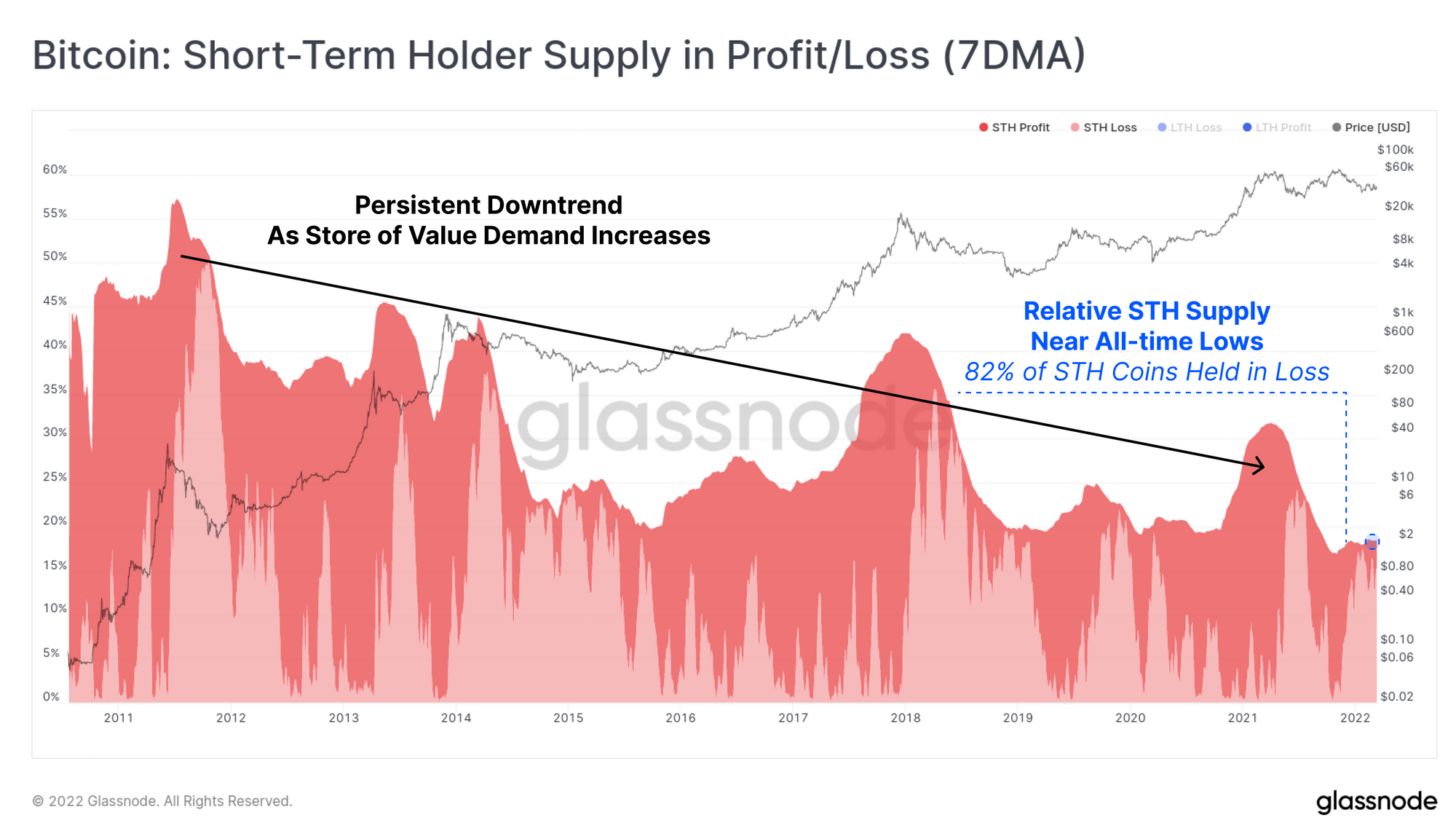
According to the latest weekly report from Glassnode, the BTC STH supply is nearing all-time lows at the moment. However, 82% of it is being held at a loss.
The “BTC short-term holder supply” is that part of the total Bitcoin supply that has been held for less than 155 days.
The investors holding this supply are usually the likeliest to sell their coins off during market volatility, and especially when a capitulation flush out occurs.
An on-chain indicator, the Bitcoin STH supply in profit/loss, tells us the percentage distribution between these coins being held at a profit and those being held at a loss.
When a high amount of this supply is in loss, there may be more sell-side pressure in the market as short-term holders capitulate easily.
Related Reading | Bitcoin MPI Rises To Highest Value Since March 2021, Bull Rally Soon?
Now, here is a chart that shows the trend in the BTC STH supply over the history of the coin:
Looks like the value of the indicator has declined over the years | Source: Glassnode's The Week Onchain - Week 11, 2022
As you can see in the above graph, the Bitcoin STH supply has been observing a constant downtrend over much of the history of the coin, and is currently near all-time low values. The decrease in this supply happens when some of the coins mature beyond the 155-day cutoff, thus becoming part of the “long-term holder supply” instead.
Since short-term holders can be a big source of sell-side pressure, the number of coins held by them severely going down can be bullish for the price of the crypto.
Related Reading | Bitcoin Hashrate Swells 15% Since Last Week As Analysts Expect Mining Difficulty To Increase
However, while the supply is low right now, around 82% of it is currently in loss. So despite the decline in total supply, these coins in loss still amount to around 2.5 million BTC, and thus they can add quite significant sell pressure to the market.
As macro uncertainties like the Russian invasion of Ukraine continue to loom over the Bitcoin market, these short-term holders may finally break and capitulate in case their coins remain in the red or go even deeper.
BTC Price
At the time of writing, Bitcoin’s price floats around $38.5k, down 1% in the last seven days. Over the past month, the crypto has lost 10% in value.
The below chart shows the trend in the price of BTC over the last five days.
BTC's price seems to have been in consolidation for a few days now | Source: BTCUSD on TradingView
Featured image from Unsplash.com, charts from TradingView.com, Glassnode.com
Over the past week, long-term holders of Bitcoin increased their spending to a level that suggests de-risking from the market, but hodling remains the predominant investing strategy.
Uncertain macroeconomic headwinds are likely to have precipitated the increase in the sell-offs last week by long-term holders and shaken some short-term holders out of their positions according to data from blockchain analytics firm Glassnode. Last week, coins older than six months accounted for 5% of total spending, which is a level not seen since last November.
Short-term holders (STH) who have held coins for less than 155 days continue to decline in number, but not necessarily due to selling. Glassnode suggests that while it is generally more common for STH to sell, the recent decline in STH supply “can only occur when large portions of the coin supply are dormant and crossing the 155-day age threshold, becoming Long-Term Holder supply.”
Bitcoin (BTC) accumulation patterns do not suggest bear market behaviors yet as overall sell pressure remains consistent. Also, more than 75% of the BTC circulating supply has been dormant for at least six months despite the recent uptick in selling. Glassnode says this is an indication that investors are still predominantly hodlers.
Long-term Bitcoin holders increased selling last week. – Glassnode
Glassnode noted that the sell-offs have been into a relatively strong market that has avoided any significant moves up or down and has remained range-bound for most of this yea. This is thought to be staving off a capitulation event which often comes at the end of a bear cycle. There has not been a significant capitulation since last May when BTC price crashed from $58,771 to $34,977 over the course of a 15-day period according to CoinGecko.
The period from the May capitulation event until October marked the last time BTC accumulation resembled bear market behavior.
BTC accumulation patterns are still above bear market trends. – Glassnode
The profit/loss ratio of STH supply is still near the all-time low set in mid-2021. Currently, 82% of STH coins are being held at a loss which Glassnode states is an indication of the later stage of a bear market when savvy investors send their coins to cold storage to lie in wait for the return to positive profit margins.
Short-term holders are in near-record losses. – Glassnode
Related: BTC price struggles below $39K ahead of expected interest rate hike by the Fed
As noted in last week’s BTC market update, exchange outflows remain quite high. Coinbase saw its largest outflows in nearly five years last week with 31,130 BTC leaving the exchange. These outflows illustrate Bitcoin’s increasing reputation as a must-have in a modern investor’s portfolio, and a further reluctance to liquidate in a hurry.
The Committee on Economic and Monetary Affairs (ECON) has
reportedly rejected a bill that aimed to ban Bitcoin (BTC) in the European
Union. According to Patrick Hansen, head of growth and strategy at Unstoppable DeFi, 32 members of the Parliament voted against, and
24 in favor.
The report noted that a majority of MEPs from the European
People’s Party (EPP), the European Conservatives and Reformists (ERC), Renew
Europe (Renew), and Identity and Democracy (ID) voted against it. In contrast,
a minority of MEPs from Greens, S&D, and GUE mainly voted in favor.
“Big relief & political success for the bitcoin &
crypto community in the EU,” Hansen said. However, he added that the MICA
regulation would likely no longer address mining but instead add the issue to
the EU sustainable finance taxonomy.
Next in the Parliament is that during the so-called “trilogues”
between the EU Commission/Parliament/Council, the MiCA draft will be
negotiated. The law will go into effect after their final agreement (in a
couple of months). Companies, however, will have a six-month transition period
to comply with the requirements.
Amendment Approved
Stefan Berger proposed an alternative amendment that does
not restrict Bitcoin mining, which was approved by the MEPs.
“Any chances left for the POW-ban? The groups that lost the
vote have one last option. They could veto a fast-track procedure of MiCA
through the trilogues & bring the discussion to the plenary of the
Parliament. They need 1/10 of the votes of the EP to do so, which they have,”
Hansen pointed out. He added: “That would bring the discussion around POW into
the high-level policy arena. As we can’t predict how that would play out, it
should be prevented. Even if it doesn’t change the vote on POW, it would
unnecessarily delay the regulation for at least a couple of months.”
The Committee on Economic and Monetary Affairs (ECON) has
reportedly rejected a bill that aimed to ban Bitcoin (BTC) in the European
Union. According to Patrick Hansen, head of growth and strategy at Unstoppable DeFi, 32 members of the Parliament voted against, and
24 in favor.
The report noted that a majority of MEPs from the European
People’s Party (EPP), the European Conservatives and Reformists (ERC), Renew
Europe (Renew), and Identity and Democracy (ID) voted against it. In contrast,
a minority of MEPs from Greens, S&D, and GUE mainly voted in favor.
“Big relief & political success for the bitcoin &
crypto community in the EU,” Hansen said. However, he added that the MICA
regulation would likely no longer address mining but instead add the issue to
the EU sustainable finance taxonomy.
Next in the Parliament is that during the so-called “trilogues”
between the EU Commission/Parliament/Council, the MiCA draft will be
negotiated. The law will go into effect after their final agreement (in a
couple of months). Companies, however, will have a six-month transition period
to comply with the requirements.
Amendment Approved
Stefan Berger proposed an alternative amendment that does
not restrict Bitcoin mining, which was approved by the MEPs.
“Any chances left for the POW-ban? The groups that lost the
vote have one last option. They could veto a fast-track procedure of MiCA
through the trilogues & bring the discussion to the plenary of the
Parliament. They need 1/10 of the votes of the EP to do so, which they have,”
Hansen pointed out. He added: “That would bring the discussion around POW into
the high-level policy arena. As we can’t predict how that would play out, it
should be prevented. Even if it doesn’t change the vote on POW, it would
unnecessarily delay the regulation for at least a couple of months.”
Ethereum extended decline below the $2,525 support zone against the US Dollar. ETH price remained bid near $2,500 and currently attempting an upside break.
Ethereum is still struggling to clear the $2,600 and $2,625 resistance levels.
The price is now trading below $2,600 and the 100 hourly simple moving average.
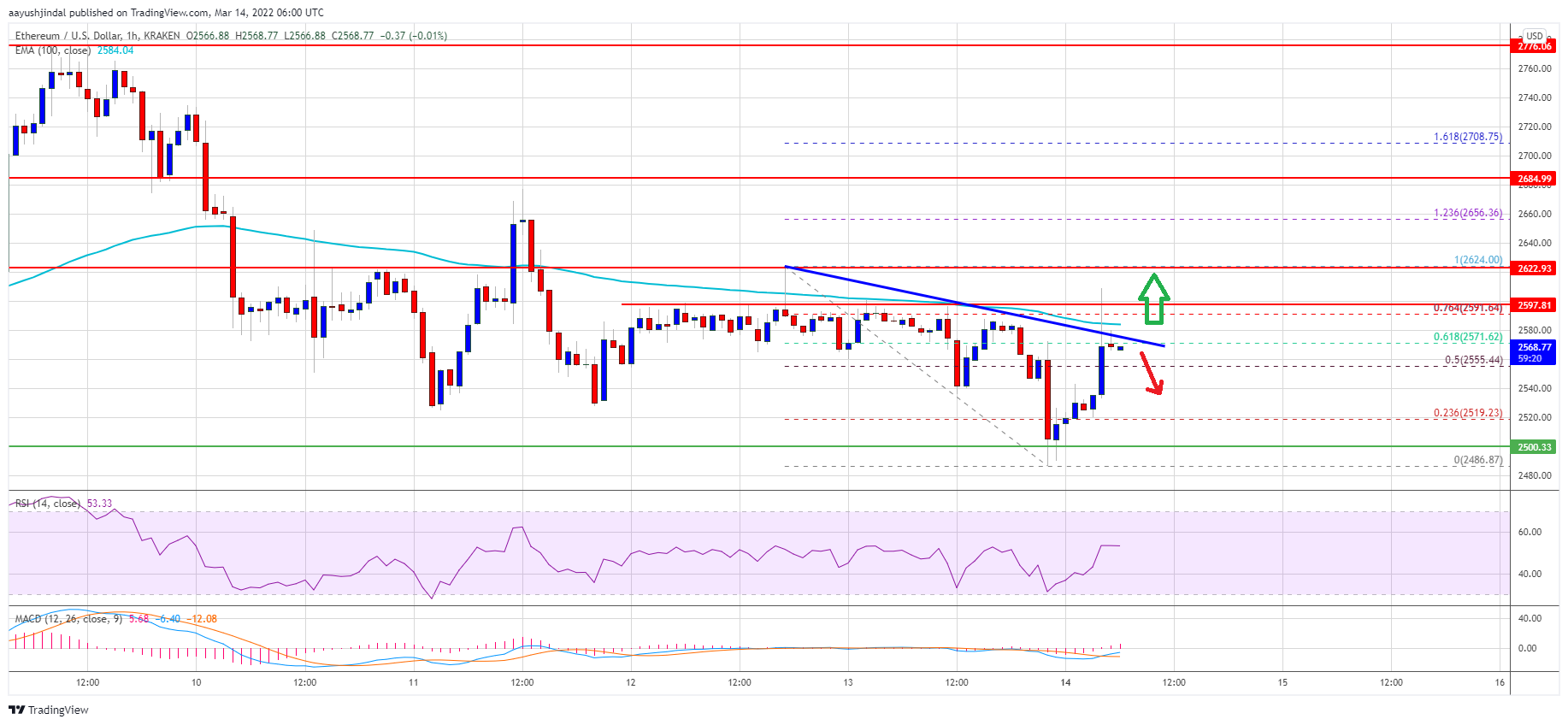
There is a key bearish trend line forming with resistance near $2,580 on the hourly chart of ETH/USD (data feed via Kraken).
The pair could start a fresh decline if it fails to clear $2,625.
Ethereum Price Faces Hurdles
Ethereum started a fresh decline from well the $2,625 zone. ETH traded below the $2,550 and $2,525 support levels to move into the red zone.
The price even spiked below $2,500 and settled below the 100 hourly simple moving average. Ether price traded as low as $2,486 and recently recovered sharply. There was a clear move above the $2,525 and $2,550 resistance levels.
The bulls pumped the price above the 50% Fib retracement level of the recent decline from the $2,624 swing high to $2,486 low. It is now facing resistance near the $2,580 level.
There is also a key bearish trend line forming with resistance near $2,580 on the hourly chart of ETH/USD. The trend line is close to the 61.8% Fib retracement level of the recent decline from the $2,624 swing high to $2,486 low.
Source: ETHUSD on TradingView.com
The first major resistance is seen near the $2,625 level. The next major resistance is near the $2,650 level. A close above the $2,650 resistance could start a steady increase. In the stated case, the price might rise towards the $2,750 level.
Fresh Decline in ETH?
If ethereum fails to start a fresh increase above the $2,625 level, it could start another decline. An initial support on the downside is near the $2,550 level.
The next major support is near the $2,500 level. A close below the $2,500 support zone could even push the price below $2,480. The next major support might be near the $2,420 level, where the bulls might take a stand. If they fail, there is a risk of a move towards the $2,350 level.
Technical Indicators
Hourly MACD – The MACD for ETH/USD is now gaining pace in the bullish zone.
Hourly RSI – The RSI for ETH/USD is now above the 50 level.
XRP price risks dropping by more than 25% in the coming weeks due to a multi-month bearish setup and fears surrounding excessive XRP supply.
XRP descending triangle
XRP has been consolidating inside a descending triangle pattern since topping out at its second-highest level to date — near $1.98 — in April 2021.
In doing so, the XRP/USD pair has left behind a sequence of lower highs on its upper trendline while finding a solid support level around $0.55, as shown in the chart below.
In the week ending March 13, XRP’s price again tested the triangle’s upper trendline as resistance, raising alarms that the coin could undergo another pullback move to the pattern’s support trendline near $0.55, amounting to a drop between 25% and 30%.
The downside outlook also takes cues from other bearish catalysts that has emerged around the triangle resistance.
For instance, XRP formed a bearish hammer on March 12, a single candlestick pattern with a small body and a long upside wick, suggesting lower buying pressure near the coin’s week-to-date top of around $0.85.
Additionally, the price turned lower after testing a confluence of resistances defined by its 20-week exponential moving average (20-week EMA; the green wave) and its 50-week EMA (the red wave), as shown in the attached image below.
XRP/USD weekly candle price chart with moving average resistances. Source: TradingView
Excessive supply FUD
More downside cues for XRP come after Ripple Labs locked 800 million XRP in escrow as a part of its programmed schedule for withdrawals.
The blockchain payment company moved around 100 million XRP worth nearly $40 million to exchange wallets on March 3. Meanwhile, it kept the other 700 million XRP (worth around $550 million) in an escrow account, raising anticipations that at least 200 million XRP would be flooded into the market to generate funds for Ripple’s operational expenses, as well as to distribute XRP among Ripple’s global clientele.
Meanwhile, it kept the other 700 million XRP (worth around $550 million) in an escrow account, raising anticipations that at least 200 million XRP would enter the market to generate funds for Ripple’s operational expenses, as well as to distribute XRP among Ripple’s global clientele.
I understood there are some 800 million $XRP that are locked up and ready to be sold…someone should check the increase in circulating supply to verify this
The selloff fears originated from the XRP price’s earlier response to unexpected supply hikes. For instance, XRP/USD fell by more than 50% to near $0.60 four months after its net supply in circulation increased from 40.46 billion to over 47 billion in just two days.
XRP circulating supply. Source: Messari
Nonetheless, Ripple’s withdrawal of 800 million XRP has not yet been reflected in its net circulating supply.
Profit-taking risks mount
Another catalyst that hints XRP’s price could fall 25-30% to reach its descending triangle target is a Santiment indicator that tracks social media trends and their impact on market trends.
XRP price versus $XRPNetwork trend. Source: Santiment
XRP’s price rose by over 15% week-to-date on March 12, notes Santiment, alongside a large spike in social media searches for the hashtag #XRPNetwork, suggesting that it could follow up with a potential selloff ahead. Excerpts:
“Historically, our social trends indicate that profit-taking is justified whenever the crowd makes the #XRPNetwork a top topic.”
The views and opinions expressed here are solely those of the author and do not necessarily reflect the views of Cointelegraph.com. Every investment and trading move involves risk, you should conduct your own research when making a decision.
Bitcoin’s price is at risk of going down because investors are funding short positions in Bitcoin by borrowing digital money from exchanges. Datamish shows that investors are funding short, causing the value of Bitcoin to go down.
Bitcoin fell again on Friday, despite a surge in capital inflow from large wallet investors and institutions. Brevan Howard Asset Management LLP and Tudor Investment Corp refreshed their bitcoin holdings by adding more of the cryptocurrency to their portfolios.
Related Reading | Bitcoin Outflows Spike As 30k BTC Exits Exchanges, Reserve Plunges Down
The growing geopolitical tension and the increasingly tense crisis in Russian-Ukraine are negatively impacting investor risk appetites for both equities as well crypto. This has fueled a bearish narrative surrounding Bitcoin’s price, which plunged below $40,000 with no signs of letting up.
Cryptocurrencies are not without their risks, and it seems that even large investors know this. On March 11th of 2022, survey data from Datamish showed 1,500 Bitcoin being lent out as short positions to finance those risks- a total debt amounting close enough for a 3,603 BTC loan. Following an increase in funding for short positions, there have usually been negative consequences such as price drops.
Analysts have been monitoring the recent changes in Bitcoin price, predicting that it will continue to fall. They believe there is still a significant risk for an upcoming decline, even after its recent recovery.
The Bitcoin price recovery is attributed to the first bearish Ichimoku breakout since December 4, 2021. Analysts believe Bitcoin price has formed a bottom in the $38,000 -$38500 range. This is an important confirmation zone for trading on bitcoin. This may signal more losses for investors who have been selling assets in anticipation of an upcoming crash.
Bitcoin is trading in its bottom range | Source: BTC/USD chat from Tradingview.com
According To Reuters, Russians Flooded The UAE With Liquidation Requests
In a Russia- drowning attempt to save their fortune, company executives and financial sources told Reuters that many Russians flooded the UAE’s cryptocurrency firms with liquidation requests.
That’s not all they want to do. Some of these investors are looking for real estate in the UAE. While others plan to convert it into fiat and hide their money somewhere else – insiders reported.
Related Reading | Bitcoin Exchange Withdrawals Suggests Whales Are Accumulating
The Swiss financial industry is currently in chaos. In fact, brokers requested the withdrawal of billions of dollars worth of Bitcoin. The request came from their clients concerned that Switzerland might freeze all funds. One representative claims they have received requests for up to $2B.
The UAE has been a neutral ground for Russians and Belarusians who have come to Dubai with their money to avoid being left out during any wars that may break out. There’s even been talk of people bringing cryptocurrencies here because they know it will always stay safe no matter what side wins.
According to sources in the UAE, many Russians purchase real estate with cryptocurrency. They’re using digital forms of money both ways – bringing their resources into Dubai while getting them out from other regions.
Featured image from Pixabay, chart from Tradingview.com