Bitcoin held on to the price level of $47,000 on Thursday despite the pressure of profit-taking. BTC exchange flow, an indicator that highlights the difference between the supply and demand of the world’s leading cryptocurrency on trading platforms, has seen immense volatility in the past few weeks.
Yesterday, the difference between Bitcoin exchange outflows and inflows surged substantially. According to Glassnode, a prominent on-chain analytics platform, approximately $2.1 billion worth of BTC moved away from exchanges, compared to the inflows of $1.2 billion.
Bitcoin whale movements are playing a major role in the latest surge. Whale Alert recently highlighted the movement of 2,000 Bitcoin worth more than $94 million from Coinbase to an unknown wallet. BTC balance on prominent exchanges has been plunging since the start of 2021.
Coinbase is one of the worst-hit digital exchanges in the recent trend. According to Glassnode, the BTC balance on Coinbase has declined by more than 36% since April 2020. During the second week of March 2022, crypto whale accounts moved nearly 30,000 Bitcoin away from Coinbase.
Bitcoin Balance
“Large outflows are actually part of a consistent trend in the Coinbase balance, which has been stair-stepping downwards over the last two years. As the largest exchange by BTC balance, and a preferred venue for US-based institutions, this further supports the adoption of Bitcoin as a macro asset by larger institutions,” Glassnode mentioned in a recent report.
BTC is not the only digital currency that saw a jump in exchange outflows. Ethereum, the world’s second-most valuable cryptocurrency, also witnessed a similar trend. Earlier this week, net daily ETH exchange flows reached -$1 billion. On 29 March, ETH exchange outflows touched $1.8 billion, compared to the inflows of $793 million.
However, net exchange flows related to Tether (USDT) have turned positive in the past 24 hours.
Bitcoin held on to the price level of $47,000 on Thursday despite the pressure of profit-taking. BTC exchange flow, an indicator that highlights the difference between the supply and demand of the world’s leading cryptocurrency on trading platforms, has seen immense volatility in the past few weeks.
Yesterday, the difference between Bitcoin exchange outflows and inflows surged substantially. According to Glassnode, a prominent on-chain analytics platform, approximately $2.1 billion worth of BTC moved away from exchanges, compared to the inflows of $1.2 billion.
Bitcoin whale movements are playing a major role in the latest surge. Whale Alert recently highlighted the movement of 2,000 Bitcoin worth more than $94 million from Coinbase to an unknown wallet. BTC balance on prominent exchanges has been plunging since the start of 2021.
Coinbase is one of the worst-hit digital exchanges in the recent trend. According to Glassnode, the BTC balance on Coinbase has declined by more than 36% since April 2020. During the second week of March 2022, crypto whale accounts moved nearly 30,000 Bitcoin away from Coinbase.
Bitcoin Balance
“Large outflows are actually part of a consistent trend in the Coinbase balance, which has been stair-stepping downwards over the last two years. As the largest exchange by BTC balance, and a preferred venue for US-based institutions, this further supports the adoption of Bitcoin as a macro asset by larger institutions,” Glassnode mentioned in a recent report.
BTC is not the only digital currency that saw a jump in exchange outflows. Ethereum, the world’s second-most valuable cryptocurrency, also witnessed a similar trend. Earlier this week, net daily ETH exchange flows reached -$1 billion. On 29 March, ETH exchange outflows touched $1.8 billion, compared to the inflows of $793 million.
However, net exchange flows related to Tether (USDT) have turned positive in the past 24 hours.
Data shows the Bitcoin fear and greed index has now reached the highest level since the peak in November as the price of the crypto rallies up.
Bitcoin Fear And Greed Index Now Points At “Greed”
As per the latest weekly report from Arcane Research, the BTC fear and greed index has surged to values of greed sentiment this week.
The “fear and greed index” is an indicator that tells us about the current general market sentiment among Bitcoin investors.
The metric uses a numeric scale that travels from one to hundred for representing this sentiment. All values above fifty signify that investors are greedy at the moment. While those below the cutoff suggest a fearful market.
Values above 75 and below 25, that is, the values toward the ends of the range, represent extreme greed and extreme fear, respectively.
Now, here is a chart that shows the trend in the Bitcoin fear and greed index over the past year:
Looks like the value of the indicator has surged up recently | Source: Arcane Research's The Weekly Update - Week 12, 2022
As you can see in the above graph, the Bitcoin fear and greed index has sharply risen over the past week. The indicator now has a value of 56, which shows the market is getting greedy.
This value of the metric is now more than in any other period in the year 2022 so far, and is the highest since the peak in early November of last year.
Related Reading | Glassnode’s RHODL Ratio May Suggest Bitcoin Market Is Near Capitulation
Historically, Bitcoin peaks have tended to happen while the sentiment is that of extreme greed, and bottoms have formed during periods of extreme fear.
There is a popular trading technique called “contrarian investing” that makes use of this fact. Traders following this methodology think that the best time to buy is during extreme fear, while extreme greed is when one should sell.
Related Reading | Bitcoin Weekly Momentum Flips Bullish For First Time In 2022: What Data Says
This famous quote by Warren Buffet sums up this philosophy: “Be fearful when others are greedy, and greedy when others are fearful.”
So, following the line of thinking of contrarian investors, the current market sentiment turning greedy may be a sign that you should now start getting fearful instead.
BTC Price
At the time of writing, Bitcoin’s price floats around $47.3k, up 12% in the last seven days. Over the past month, the crypto has gained 26% in value.
The below chart shows the trend in the price of the coin over the last five days.
The price of Bitcoin seems to have surged up over the past few days | Source: BTCUSD on TradingView
Featured image from Unsplash.com, charts from TradingView.com, Arcane Research
Opera, one of the major crypto-friendly internet browsers, announced the integration of eight blockchains in a continued effort to introduce Web3 to more than 380 million mobile and desktop users worldwide.
In Jan. 2022, Opera launched the Crypto Browser project, a Web3-focused initiative for facilitating navigation across decentralized applications (DApp), games and metaverse platforms. As part of this initiative, the browser company added support for eight major blockchain ecosystems, including Bitcoin (BTC), Solana (SOL), Polygon (MATIC), StarkEx, Ronin, Celo, Nervos DAO and IXO.
Opera said in the announcement that its users now have access to the Polygon and Solana DApp ecosystems, as well as “the benefits of Layer 2 DeFi via StarkWare-powered DiversiFi.”
The latest integrations enable Opera users to access Polygon proof-of-stake (POS) blockchain and Ethereum L2 ecosystem via StarkEx.
Opera’s Crypto Browser project. Source: Opera
According to the company, the intention behind integrating multiple blockchains was to ensure chain agnosticism and Web3 involvement in an environment-friendly manner. Jorgen Arnesen, EVP Mobile at Opera stated:
“Ultimately, Web3 is on its way to becoming a mainstream web technology and users won’t need to know they’re interacting with it. They need to get a superior user experience and a true benefit.”
The announcement further highlighted the need for carbon-neutral solutions with low gas fees, which stands as one of the main reasons for choosing Polygon over the Ethereum blockchain.
Related: Brave to integrate with Solana blockchain on its privacy-enabled browser
Back in Nov. 2021, Opera competitor Brave browser integrated Solana blockchain to strengthen its DApps capability.
We’ve partnered with @solana to integrate it into the browser and make it the default for DApp support. We will soon bring best-in-class wallet features for the Solana blockchain into our desktop & mobile browsers. #BreakpointLisbon https://t.co/tTB7NXKWjI
Citing the partnership, Brendan Eich, CEO and co-founder of Brave said that:
“With more and more users and creators requiring tools for fast and affordable access to the decentralized Web, this integration will seamlessly pave the way for the next billion crypto users to harness applications and tokens.”
Brave is yet to announce the addition of multi-chain support to rival its growing competition.
In our last post we walked through the basics of blockchain analytics and attribution. In this follow-up post, we will demonstrate how powerful blockchain analytics is and how tricky it can get at scale. We’ll start with reviewing some of the common blockchain analytics scaling methods used in fortifying Compliance programs as well as bolstering sanctions controls.
1. Commonspend
Blockchain analytics software relies on detecting patterns of certain address activities, known as heuristics. The primary heuristic applied to all UTXO blockchains (Unspent Transaction Output, like Bitcoin, Litecoin and their forks) is the commonspend heuristic.
It works as follows: take the following address 1P354Tw8VaSteYph84ext3f4fAYnSJQGuZ, as seen in this Youtube video involving a deposit to LocalBitcoins. So, we know this address belongs to LocalBitcoins and is an individual’s deposit address.
In this transaction we see that our LocalBitcoins address appears as one of the inputs:
Since we know that 1P354Tw8VaSteYph84ext3f4fAYnSJQGuZ belongs to LocalBitcoins and because we know that in order for this address and others to be spending funds together in the same transaction hash (i.e. inputs), the sender must have all of the private keys to each input address. We therefore can reason that all input addresses in this transaction belong to LocalBitcoins. Thus all input addresses belonging to Local Bitcoins can be clustered together.
Some block explorers automatically apply the commonspend heuristic to their analysis. For example, if you take a look at our original address in CryptoID or WalletExplorer, you’ll see that it belongs to a cluster of 990k+ addresses.
This heuristic remains a cornerstone of blockchain analytics. In fact, the most popular blockchain analytics tools already apply the commonspend heuristic to all Bitcoin addresses before they even know what the attributions for the addresses are.
But heuristics, even as straightforward as commonspend, can’t always be trusted.
2. Commonspend isn’t always common
So when does the common spend heuristic not apply? Consider this transaction:
The above transaction has multiple inputs and also multiple outputs. This is a more complex type of a transaction, referred to as coinjoin. Several users who don’t necessarily know each other might decide to participate together in a coinjoin transaction, pooling all their funds together. This is often done through dedicated privacy software such as Samourai or Wasabi wallets.
Coinjoin above leads to obfuscation of funds through seemingly random output addresses. It also renders any commonspend-based analysis ineffective, even though each party that participated in the coinjoin still gets out the same amount of Bitcoin that they originally put in (minus the fee paid to the service). Demixing such transactions is difficult (but not always impossible), and it is just one example of defeating commonspend.
3. Bringing it all together
Now that we’ve learned about ground truth, evidence quality, deconflictions, misattributions, and what commonspend is, let’s walk through how it comes together in identifying addresses belonging to illicit entities, like those 25k we discussed in our previous blog post.
The Office of Foreign Assets Control (OFAC) — a regulatory agency in the US responsible for sanctions enforcement — published a notice designating about 100 addresses, as well as entities they belong to. So, how did we go from under a hundred to over 25 thousand addresses?
3E7YbpXuhh3CWFks1jmvWoV8y5DvsfzE6 was one of the addresses designated by OFAC as belonging to Chatex — Russian Telegram bot that allows users to exchange crypto:
An official government website is a pretty reliable source of information, giving us confidence in the evidence quality. Now we need to assess each address to identify whether it’s a part of a larger group of addresses (e.g. a cluster) controlled by an entity. Using commonspend heuristic, we can associate 3E7YbpX…vsfzE6 address with a group of over 25k addresses. You too can verify this using a public block explorer, such as CryptoID:
After some additional checks we confirmed that all of these addresses belong to Chatex. And since the entity was sanctioned by OFAC, we are required to block respective transactions. It is worth noting that our list of blocked addresses is significantly larger. It includes other sanctioned entities as well as designated individuals. We also engage in proactive work to identify sanctioned activity originating from various jurisdictions, including Russia. But that’s a subject for another blogspot…
Bitcoin (BTC) has seen a boom in demand during the past 48 hours as its price spiked above $48,000 for the first time since 1 January 2022. In tandem with the recent price recovery, BTC’s network activity has jumped in the last few days.
The old BTC supply percentage, an indicator that shows the trend of long-term holders and Bitcoin whales, has increased substantially since August 2021.
According to Glassnode, an on-chain analytics firm, the overall percentage of Bitcoin supply last active at least 12 months ago has reached 63%, near the all-time high level of 63.4%.
“As we approach the end of Q1-2022, we can see an extraordinary increase in the proportion of coins aged 1yr+, which has risen by 9.4% of circulating supply over the last 8-months. These coins largely reflect BTC volumes accumulated in the Q1-2021 phase of the bull market and the owners have thus held through two 50%+ drawdowns and three all-time highs. This recovery is quite similar in scale and duration to the 2018-19 recovery,” Glassnode highlighted in its recent weekly report.
BTC Network
Bitcoin network activity has picked up pace recently amid a rise in price and institutional inflows. In addition, BTC exchange outflows are rising. According to the data published by Whale Alert, a blockchain tracking platform, a leading BTC wallet moved 2,163 coins worth more than $100 million from digital exchange Coinbase to an unknown wallet on 28 March.
“The Bitcoin market has seen a stronger week, rallying off the lows of $40,710, and breaking out of the consolidation range to a new local high of $47,649. This is the first sustained rally after many months of sideways choppy price action. Bitcoin bear markets can be long, painful and drawn out, however, they have the ultimate result of reshuffling supply ownership away from weaker and towards stronger hands,” the report added.
Bitcoin (BTC) has seen a boom in demand during the past 48 hours as its price spiked above $48,000 for the first time since 1 January 2022. In tandem with the recent price recovery, BTC’s network activity has jumped in the last few days.
The old BTC supply percentage, an indicator that shows the trend of long-term holders and Bitcoin whales, has increased substantially since August 2021.
According to Glassnode, an on-chain analytics firm, the overall percentage of Bitcoin supply last active at least 12 months ago has reached 63%, near the all-time high level of 63.4%.
“As we approach the end of Q1-2022, we can see an extraordinary increase in the proportion of coins aged 1yr+, which has risen by 9.4% of circulating supply over the last 8-months. These coins largely reflect BTC volumes accumulated in the Q1-2021 phase of the bull market and the owners have thus held through two 50%+ drawdowns and three all-time highs. This recovery is quite similar in scale and duration to the 2018-19 recovery,” Glassnode highlighted in its recent weekly report.
BTC Network
Bitcoin network activity has picked up pace recently amid a rise in price and institutional inflows. In addition, BTC exchange outflows are rising. According to the data published by Whale Alert, a blockchain tracking platform, a leading BTC wallet moved 2,163 coins worth more than $100 million from digital exchange Coinbase to an unknown wallet on 28 March.
“The Bitcoin market has seen a stronger week, rallying off the lows of $40,710, and breaking out of the consolidation range to a new local high of $47,649. This is the first sustained rally after many months of sideways choppy price action. Bitcoin bear markets can be long, painful and drawn out, however, they have the ultimate result of reshuffling supply ownership away from weaker and towards stronger hands,” the report added.
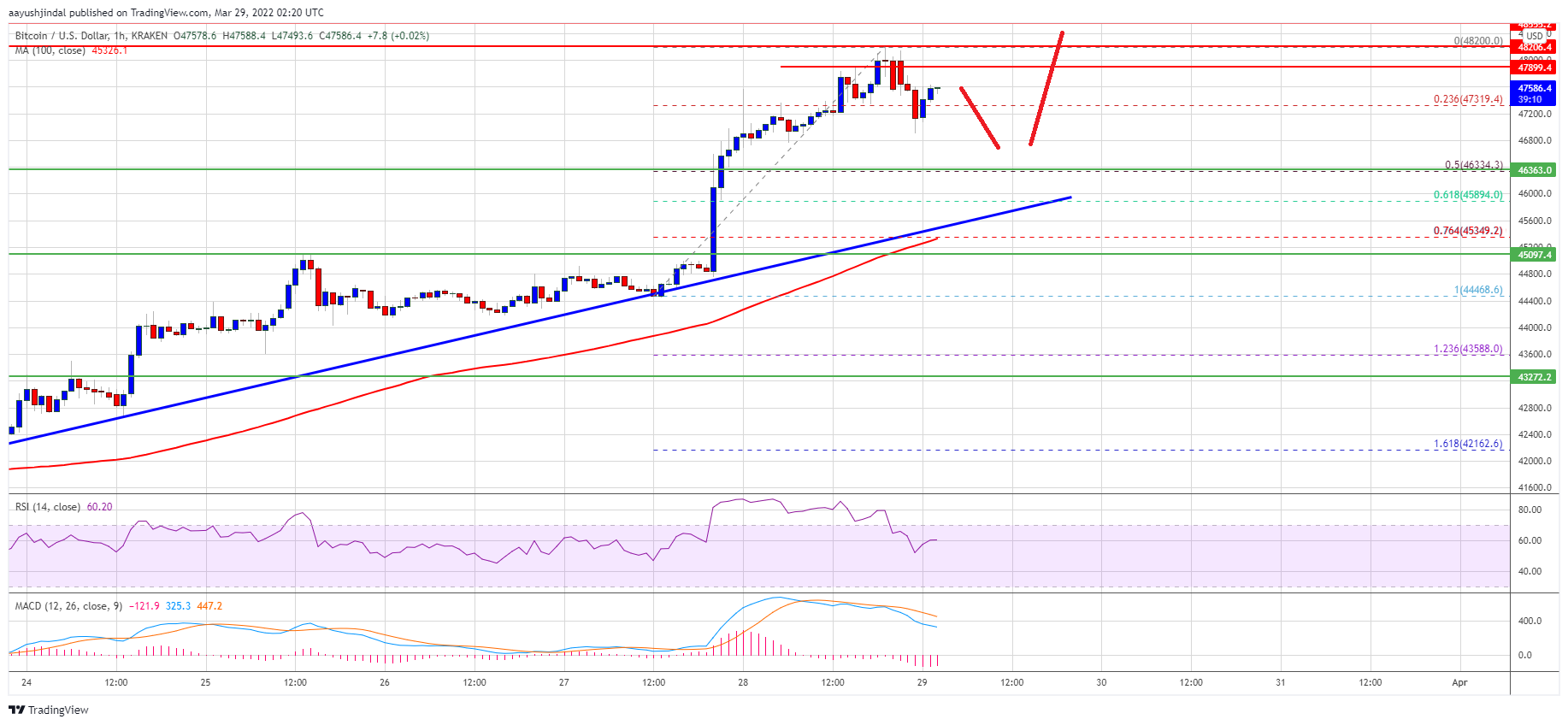
Bitcoin gained pace above the $47,000 resistance against the US Dollar. BTC is showing positive signs and might rally towards the $50,000 resistance zone.
Bitcoin saw a major technical breakout above the $45,500 resistance zone.
The price is trading above $46,500 and the 100 hourly simple moving average.
There is a crucial bullish trend line forming with support near $46,200 on the hourly chart of the BTC/USD pair (data feed from Kraken).
The pair could continue to rise and might trade towards the $50,000 resistance zone.
Bitcoin Price Breaks $48K
Bitcoin price remained strong above the $45,500 resistance zone. BTC started a fresh increase and was able to clear the $46,500 resistance zone.
The upward move gained pace above the $46,500 level and the price settled above the 100 hourly simple moving average. Finally, it spiked above the $48,000 level. A high was formed near $48,200 and the price is now consolidating gains.
There was a minor drop below the $48,000 level. Bitcoin traded below the 23.6% Fib retracement level of the upward move from the $44,470 swing low $48,200 high. Besides, there is a crucial bullish trend line forming with support near $46,200 on the hourly chart of the BTC/USD pair.
On the upside, the price is facing resistance near the $48,000 level. The next major resistance could be near the $48,200 zone. A successful break and close above the $48,200 level might push the price towards $49,000.
Source: BTCUSD on TradingView.com
The next major resistance could be near the $49,500 level. Any more gains could open the doors for a move towards the $50,000 level.
Dips Limited in BTC?
If bitcoin fails to clear the $48,200 resistance zone, it could start a downside correction. An immediate support on the downside is near the $47,000 zone.
The next major support is seen near the $46,350 level. It is near the 50% Fib retracement level of the upward move from the $44,470 swing low $48,200 high. The main support is near the $46,000 level and the trend line. A downside break below the $46,000 support zone could send the price to $45,000.
Technical indicators:
Hourly MACD – The MACD is slowly gaining pace in the bearish zone.
Hourly RSI (Relative Strength Index) – The RSI for BTC/USD is now above the 50 level.
Major Support Levels – $47,000, followed by $46,000.
Major Resistance Levels – $48,200, $49,000 and $50,000.
Bitcoin and many other cryptocurrencies are often referred to as pseudonymous. Everyone can view records on a public ledger, but not necessarily know who’s behind each address or transaction. But what does pseudonymity look like in practice? How are cryptocurrencies tracked? And can you really unmask someone on the blockchain? Let’s find out.
The public nature of blockchains allows for a certain degree of predictive analysis, enabling researchers to associate addresses and transactions with entities and sometimes individuals. Anybody can look at blockchain, but what makes a difference is the accurate interpretation of this public data, as well as corroborating it with other types of information gathered externally. Once combined such data can be used for blockchain analytics.
Blockchain analytics is widely used for market intelligence, trend analysis, and investigations, among many emerging spaces. The main objective of blockchain analytics is attribution — linking specific assets and events to particular entities or even individuals.
Attributing ownership, however, is often nuanced because outside observers can only infer it depending on factors such as availability and quality of the evidence. Evidence means proof that indeed an address belongs to an individual or entity. Unless you own an address yourself, it is very difficult to say with absolute certainty who an address is owned by. This is why it’s more fitting to consider blockchain analytics more of an art than science.
Let’s understand the basics of blockchain analytics and learn why attribution is often more complicated than it looks.
Attribution Basics
Can you tell what entity this address belongs to:
1JxXMEbYX6juuEK7QPe6CxGXywQ91ZB5mZ?
Is it an exchange? Is it a darknet market? Or maybe a private (otherwise known as an unhosted) wallet? To answer this question we need to dig for some ground truth.
1. Ground Truth Evidence
A search for truth often starts with plain googling or crowd-sourced sites like BitcoinAbuse.com:
Websites like BitcoinAbuse.com can be used by anyone to anonymously report BTC addresses linked to suspicious activity. Sadly, the reliability of such information can be very low. According to Blockchain.com, our address of interest received over 767 BTC. WalletExplorer.com implies this address is linked to a large offshore cryptocurrency exchange, which is corroborated by commercial blockchain analytics tools.
Indeed, commercial blockchain analytics tools identify this address as belonging to a large offshore cryptocurrency exchange.
So what about the nature of the activity? Is the exchange user involved in ransomware?
Further research connects this address to an exchanger called Coinguru.pw:
Coinguru allows users to swap between various cryptocurrencies, providing nothing more than an email address.
At this point you’re probably asking yourself: so who does this address belong to?
the BitcoinAbuse crowd-reported ransomware operator?
A large offshore cryptocurrency exchange?
Coinguru?
…all of the above?!
Well, the answer is complicated.
We have first-hand evidence of 1JxXMEbYX6juuEK7QPe6CxGXywQ91ZB5mZ being used by Coinguru, an exchange service operating an account on a large offshore cryptocurrency exchange. Exchangers like Coinguru often use bigger platforms’ infrastructure to reduce costs and get access to liquidity. We refer to these as nested services. These also cater to users who might not want to go to the trouble of creating their own accounts on an exchange. In fact, some nefarious actors may use these services to cash out of illicit funds.
For labeling purposes, it would suffice to say this is an exchange-owned address. If a regulator or a law enforcement agency investigating ransomware related transactions decides to enquire about the details, the cryptocurrency exchange will refer them to Coinguru who would be best positioned to provide further information on specific transactions.
2. Evidence quality and standard of proof
Evidence can vary in quality and blockchain analytics is no exception. Sometimes you might stumble upon a “smoking gun”, but it’s more likely you will need to spend time corroborating incomplete, circumstantial, fragmented or straight out misleading evidence. Nevertheless, even the weakest evidence can hint on a particular activity or entity behind it.
As we’ve already witnessed, crowd-reported sources such as BitcoinAbuse stand on the bottom of the reliability ladder. Not that they should be fully discounted, but evidence leading to attribution of crypto addresses is best gathered directly from the source. In the case of exchange services, the source would be their website displaying a deposit address.
The ultimate attribution comes from the ability to interact with the service, earning such evidence the highest confidence score. However, this is often prohibited, especially when investigating activities such as terror funding (TF). In cases like these, research shifts into the world of open source intelligence (OSINT). Much can be learned from aggregator websites, online forums, chat groups, mobile communication platforms, hidden domains on the Tor network and information scraping in an automated fashion by third party vendors. But even the best evidence is not helpful without proper investigative tools.
3. Deconflicting misattribution
Blockchain investigation tools include blockchain analytics software, private and open source databases, search engines, etc. The best investigative practice is to combine a mix of these tools, including commercially available software, and corroborate evidence using independent sources. Sometimes, however, those sources can offer conflicting information.
For instance, consider this address: 1N9SxKeNvFoBFuFKEDU8yFCwPwoeHqgmhu.
Imagine an investigator receiving intelligence linking this address to the sale of Child Sexual Abuse Material (CSAM). Attribution of this address will vary depending on which blockchain analytics tool you consult: some don’t have it labeled at all, while others attribute it to a merchant service. Open source research confirms this particular service allowed users to upload files and sell them for various cryptocurrencies. Addresses like the one above were generated for every user and were all connected to different types of activity, depending on what an individual user was buying.
While some uploads to this merchant service have been benign, some were identified as illicit, according to the Internet Watch Foundation (IWF), a non-profit combating the distribution of CSAM. Reportedly, the same merchant service was also used for ransomware decryptor key uploads. So, can the address of interest belong both to an illicit vendor and to the merchant service? Yes.
The correct way to attribute this service in a blockchain analytics tool would be to take all of the known addresses associated with the service and label them accordingly. Then, as a result of investigating individual addresses and their related activities, specific labels should be applied in accordance with documented findings. Labeling the whole service as illicit would be a misattribution. It can negatively impact tools and services that rely on blockchain analytics data, such as transaction monitoring systems or law enforcement subpoenas, leading to increased false positive alerts and erroneous leads.
4. The unknown unknowns
Back in October 2019, a medium article was published with a flashy title — “Huge Ethereum Mixer”. A Russian data scientist analyzed ETH flows between February and September 2017 claiming that “…68% of total Ethereum transaction value [is] controlled by one system… Funds come and leave within one hour, and addresses are never used again.” The researcher spent a great deal of effort analyzing the behavior of the “mixer”, its transaction patterns, and share of total transactions across Ethereum over time. At the center of the article was this diagram:
Notice how most large exchanges at the time are present: Kraken, Poloniex, Bitfinex, etc. Can you guess which one(s) are missing?
Hopefully, at this point it’s fairly evident that an external observer cannot possibly gain a full picture or claim 100% confidence in attribution. Keep in mind, when it comes to blockchain, everyone is an external observer, with the exception of addresses you control.
Stay tuned for the second part, where we’ll dive deeper into examples of how blockchain analytics can both enlighten and confuse.
Bad facts make bad law. We see this in jurisdictions all over the world, especially when it comes to digital assets. Unfortunately, we are about to see this again — this time in the European Union — in the form of a revision to the Transfer of Funds Regulation. If adopted, this revision would unleash an entire surveillance regime on exchanges like Coinbase, stifle innovation, and undermine the self-hosted wallets that individuals use to securely protect their digital assets. The vote will likely take place this week so time is running out.
Here are the bad “facts”:
(1) digital assets like Bitcoin, Ethereum and others are a primary way criminals hide and move money
(2) law enforcement has no way to track these movements
(3) requiring collection and verification of personal information associated with self-hosted is not a violation of their privacy
State of play
The truth is that digital assets are in general a markedly inferior way for criminals to hide their illicit financial activity. That’s why, according to the best research available, by far the most popular way to hide illicit financial activity remains cash. Unlike with cash, law enforcement can track and trace digital asset transfers with advanced analytics tools. None of this requires upsetting the settled privacy expectations of wallet holders because the open architecture underlying digital assets is public and offers unprecedented transparency into transaction details. The records are also permanent — no one (not crypto companies, not governments, not even bad actors) can destroy or alter information. In short, digital assets and the immutable nature of their blockchain technology actually enhances the ability to detect and deter illicit activity. But rather than embracing and leveraging the benefits that arise from the increasing use of digital assets, the EU’s proposal would cast them aside and impose a host of new privacy invasions on wallet users.
For example, all crypto transactions will be deemed “travel rule eligible”. This means crypto is treated differently to fiat (which has a 1,000 EUR threshold), which establishes a clear advantage for traditional financial service providers over new technology, with significant anti-competition and anti-innovation implications.
Among the worst of the proposed provisions are new obligations on exchanges to collect, verify and report information on non-customers using self-hosted wallets. For instance, one provision requires exchanges to not only collect personal data about wallet users who are not their customers, but to also verify the data’s accuracy before allowing a transfer to one of their customers. In fiat terms, this would basically mean you cannot take money out of your bank account to send to someone else until you share personal data with your financial institution about that person and verify their identity. Not only is this verification requirement nearly impossible to do but requiring exchanges to engage in extensive data collection, verification, and retention about non-customers runs against core EU data protection principles of data minimization and proportionality.
Another dangerous provision would require exchanges to inform “competent authorities” of every single transfer from a non-customer’s self-hosted wallet equal to or greater than 1,000 EUR — regardless of any suspicion of bad activity. The proposal even leaves the door open to a total ban on transfers to self-hosted wallets even though there is no evidence that such a ban would have any impact on illicit activity at all. Like we said, bad facts make bad policy.
Make your voice heard
There’s precious time to act and we need to makeour voices heard. A vote on Parliament’s draft proposal could come as early as Thursday, March 31st. If you care about protecting the privacy of individuals, and focusing the law on solutions that actually address legitimate concerns about the illicit use of digital assets, now is the time to speak up and be heard. We must speak with one, strong voice against this proposal before it’s too late.
In an effort to increase the security of users, DigiThree Labs and LCX recently announced a collaboration. Both companies have partnered to provide a formal Proof-of-Concept agreement.
According to the details shared by LCX, the new partnership will enhance user security and will eventually play an important role in the growth of the digital asset ecosystem. Founded in 2018, LCX is a regulated platform for buying and selling of digital currencies.
LCX highlighted the importance of a secure and efficient login procedure. The company added that it will pilot the DGMV Authenticator to secure its login procedures and safeguard passwords. LCX mentioned that the DGMV Authenticator is a highly secure authentication method based on blockchain technology.
Monty Metger, CEO of LCX, said: “Security threats are rising, and phishing attacks are often targeting login details of users. That’s why we are excited to work with DigiCorp Labs to pilot the latest cyber security technologies and in particular the DGMV Authenticator.”
LCX noted that the initial rollout will be in the second and third quarters of 2022. The exchange is headquartered in Vaduz with offices in Zug and New Delhi.
Security
With the growing popularity and user base of digital assets, exchanges have introduced several efficient methods in the past few years to increase the overall security of users in the crypto ecosystem.
Jozua van der Deijl, CEO at DigiCorp Labs, said, “DigiCorp Labs is excited that LCX is taking user security very seriously, and we hope this sets an example for other exchanges to integrate DGMV Authenticator as an extra level of security on their platforms.”
“With our consistent and friendly relationship with DigiCorp Labs, we are confident in the DGMV Authenticator and believe that it will digitally transform security in every industry,” the company added in the press release.
In an effort to increase the security of users, DigiThree Labs and LCX recently announced a collaboration. Both companies have partnered to provide a formal Proof-of-Concept agreement.
According to the details shared by LCX, the new partnership will enhance user security and will eventually play an important role in the growth of the digital asset ecosystem. Founded in 2018, LCX is a regulated platform for buying and selling of digital currencies.
LCX highlighted the importance of a secure and efficient login procedure. The company added that it will pilot the DGMV Authenticator to secure its login procedures and safeguard passwords. LCX mentioned that the DGMV Authenticator is a highly secure authentication method based on blockchain technology.
Monty Metger, CEO of LCX, said: “Security threats are rising, and phishing attacks are often targeting login details of users. That’s why we are excited to work with DigiCorp Labs to pilot the latest cyber security technologies and in particular the DGMV Authenticator.”
LCX noted that the initial rollout will be in the second and third quarters of 2022. The exchange is headquartered in Vaduz with offices in Zug and New Delhi.
Security
With the growing popularity and user base of digital assets, exchanges have introduced several efficient methods in the past few years to increase the overall security of users in the crypto ecosystem.
Jozua van der Deijl, CEO at DigiCorp Labs, said, “DigiCorp Labs is excited that LCX is taking user security very seriously, and we hope this sets an example for other exchanges to integrate DGMV Authenticator as an extra level of security on their platforms.”
“With our consistent and friendly relationship with DigiCorp Labs, we are confident in the DGMV Authenticator and believe that it will digitally transform security in every industry,” the company added in the press release.
Reactions have been pouring in from stakeholders in the crypto and digital assets industry in India following the approval of the country’s Finance Bill 2022 on Friday by Lok Sabha, the lower house of India’s bicameral parliament.
While some stakeholders were pessimistic of the section of the Bill mandating a capital gains tax of 30% on crypto transactions, others were optimistic that the law would relax with time.
Nirmala Sitharaman, India’s Finance Minister, during a budgetary speech delivered before the House in February had said the government would impose 30 percent taxation on the transfer of virtual assets from the financial year 2022-2023.
She also disclosed the government’s intention to lay a 1% tax deducted at source (TDS) on the purchase and sale of cryptocurrencies in the country. She added that any gifts made in digital currencies will also be taxed at the hands of the recipient.
The finance minister had also confirmed that crypto holders cannot offset their losses from cryptocurrencies with the capital gains tax, which is allowed for stock investors.
However, despite the industry’s call for the government to tone down the crypto taxation, the bill was passed into law, with Sitharaman insisting that the government was taxing crypto because people are profiting from it.
With the passage, the crypto taxes will come into effect on April 1, while the TDS will start on July 1.
Mixed Industry Reactions
Nischal Shetty, the Chief Executive Officer of WazirX, one of India’s biggest cryptocurrency exchanges, said the passage “is poised to do more harm than good,” adding that the law could shoot down patronage of Indian exchanges and a subsequent increase in capital outflow to foreign ones.
Sathvik Vishwanath, co-founder and CEO of Unocoin, was particularly concerned about the effect the law will have on crypto traders in the country.
“This will have some repercussions on traders, especially the 1% TDS assessment. This will not only affect traders but also tax collections. We hope that in the subsequent years the crypto industry gets treated like other investment-related industries,” he explained.
Abhay Aggarwal, CEO and founder of non-fungible token (NFT) marketplace, Colexion, said the law will hamper the overall growth of the sector by reducing countrywide adoption and credibility.
On the positive side, however, Coinstore, a Singapore-based crypto exchange
Exchange
An exchange is known as a marketplace that supports the trading of derivatives, commodities, securities, and other financial instruments.Generally, an exchange is accessible through a digital platform or sometimes at a tangible address where investors organize to perform trading. Among the chief responsibilities of an exchange would be to uphold honest and fair-trading practices. These are instrumental in making sure that the distribution of supported security rates on that exchange are effectively relevant with real-time pricing.Depending upon where you reside, an exchange may be referred to as a bourse or a share exchange while, as a whole, exchanges are present within the majority of countries. Who is Listed on an Exchange?As trading continues to transition more to electronic exchanges, transactions become more dispersed through varying exchanges. This in turn has caused a surge in the implementation of trading algorithms and high-frequency trading applications. In order for a company to be listed on a stock exchange for example, a company must divulge information such as minimum capital requirements, audited earnings reports, and financial reports.Not all exchanges are created equally, with some outperforming other exchanges significantly. The most high-profile exchanges to date include the New York Stock Exchange (NYSE), the Tokyo Stock Exchange (TSE), the London Stock Exchange (LSE), and the Nasdaq. Outside of trading, a stock exchange may be used by companies aiming to raise capital, this is most commonly seen in the form of initial public offerings (IPOs).Exchanges can now handle other asset classes, given the rise of cryptocurrencies as a more popularized form of trading.
An exchange is known as a marketplace that supports the trading of derivatives, commodities, securities, and other financial instruments.Generally, an exchange is accessible through a digital platform or sometimes at a tangible address where investors organize to perform trading. Among the chief responsibilities of an exchange would be to uphold honest and fair-trading practices. These are instrumental in making sure that the distribution of supported security rates on that exchange are effectively relevant with real-time pricing.Depending upon where you reside, an exchange may be referred to as a bourse or a share exchange while, as a whole, exchanges are present within the majority of countries. Who is Listed on an Exchange?As trading continues to transition more to electronic exchanges, transactions become more dispersed through varying exchanges. This in turn has caused a surge in the implementation of trading algorithms and high-frequency trading applications. In order for a company to be listed on a stock exchange for example, a company must divulge information such as minimum capital requirements, audited earnings reports, and financial reports.Not all exchanges are created equally, with some outperforming other exchanges significantly. The most high-profile exchanges to date include the New York Stock Exchange (NYSE), the Tokyo Stock Exchange (TSE), the London Stock Exchange (LSE), and the Nasdaq. Outside of trading, a stock exchange may be used by companies aiming to raise capital, this is most commonly seen in the form of initial public offerings (IPOs).Exchanges can now handle other asset classes, given the rise of cryptocurrencies as a more popularized form of trading. Read this Term that recently started operations in India, believes that the crypto tax is a good move that “will open the doors for crypto regulation in one of the largest democracies in the world.”
“India is a tech powerhouse and it has the potential to lead the world in the crypto and blockchain revolution. Some may feel that the tax structure is on the heavy side but it may undergo adjustments to match global expectations as the crypto industry in India enters a more mature phase. We are hopeful that Indian regulators will reach a consensus with the crypto industry soon,” said Charles Tan, Head of Marketing at Coinstore.
Lennix Lai, Director of OKX, formerly known as OKEx, the Seychelles-based cryptocurrency exchange
Cryptocurrency Exchange
A cryptocurrency exchange is an online platform that supports the exchange of various currencies for a cryptocurrency or digital asset.Comparable to a generalized financial exchange, a crypto exchange’s core function is to permit and encourage the buying and selling of cryptos.This is accomplished by producing a stable trading environment suitable for traders nested through different locations around the world. Sometimes a crypto exchange may be referred to as a digital currency exchange (DCE) for short.How Does Trading Take Place on a Crypto Exchange?Cryptocurrency trading occurs over a centralized exchange, although these crypto exchanges should be used with caution given the implications that surround the custody of new assets. Similar to the banking industry, when a crypto exchange holds cryptocurrencies of users they accrue interest and are no longer classified as client money.These provide an accessible platform for not only companies, hedge funds, and retail traders for exchanging digital currencies.Additionally, crypto exchanges serve a critical role in producing stability within the cryptocurrency sector given how the sourcing and pricing of these assets are innately volatile. One could think of a crypto exchange as an intermediary who provides a service by connecting buyers and sellers from various markets under one roof. In exchange for facilitating trades and for services rendered, a digital currency exchange generally collects a fee of an outgoing transaction that averages between 0.20% to 0.25% or will request a deposit fee that has been known to be as high as 11% for credit card deposits. Crypto exchanges may also support the exchange of crypto tokens, such as the Binance Token, which is ranked as the 9th most valuable cryptocurrency in the world.
A cryptocurrency exchange is an online platform that supports the exchange of various currencies for a cryptocurrency or digital asset.Comparable to a generalized financial exchange, a crypto exchange’s core function is to permit and encourage the buying and selling of cryptos.This is accomplished by producing a stable trading environment suitable for traders nested through different locations around the world. Sometimes a crypto exchange may be referred to as a digital currency exchange (DCE) for short.How Does Trading Take Place on a Crypto Exchange?Cryptocurrency trading occurs over a centralized exchange, although these crypto exchanges should be used with caution given the implications that surround the custody of new assets. Similar to the banking industry, when a crypto exchange holds cryptocurrencies of users they accrue interest and are no longer classified as client money.These provide an accessible platform for not only companies, hedge funds, and retail traders for exchanging digital currencies.Additionally, crypto exchanges serve a critical role in producing stability within the cryptocurrency sector given how the sourcing and pricing of these assets are innately volatile. One could think of a crypto exchange as an intermediary who provides a service by connecting buyers and sellers from various markets under one roof. In exchange for facilitating trades and for services rendered, a digital currency exchange generally collects a fee of an outgoing transaction that averages between 0.20% to 0.25% or will request a deposit fee that has been known to be as high as 11% for credit card deposits. Crypto exchanges may also support the exchange of crypto tokens, such as the Binance Token, which is ranked as the 9th most valuable cryptocurrency in the world. Read this Term, also toed Tan’s line, noting that taxing an certain asset class indicates that those assets are recognized as a tradable asset class by country’s regulator.
“That gives the industry a lot more clarity on the legal status of crypto and its derived income. Hence it’s good news for the industry in India with respect to building a more regulated operating environment for crypto,” Lai added.
Distrust in Cryptocurrencies?
For some time now, the Indian government has been mulling over the possibility of launching its own central bank digital currency (CBDC). In a budgetary speech in February, Shitaraman had said the Reserve Bank of India (RBI) was going to introduce the CBDC in the country’s next financial year.
Meanwhile, the Indian government had initially made efforts to impose a complete ban on cryptocurrencies as a payment mode with a bill that recommended strict jail terms for violators who could be arrested without any warrant.
The Cryptocurrency and Regulation of Official Digital Currency Bill had also sought to ban all private cryptocurrencies in the country, although it wanted to allow for “certain exceptions to promote the underlying technology of cryptocurrency and its uses.”
Tax evasion has also been a problem in the Indian cryptocurrency space. A raid on six Indian crypto exchanges earlier this year had uncovered $9.4M in unpaid taxes with WazirX alone evading $6 million in taxes.
Reactions have been pouring in from stakeholders in the crypto and digital assets industry in India following the approval of the country’s Finance Bill 2022 on Friday by Lok Sabha, the lower house of India’s bicameral parliament.
While some stakeholders were pessimistic of the section of the Bill mandating a capital gains tax of 30% on crypto transactions, others were optimistic that the law would relax with time.
Nirmala Sitharaman, India’s Finance Minister, during a budgetary speech delivered before the House in February had said the government would impose 30 percent taxation on the transfer of virtual assets from the financial year 2022-2023.
She also disclosed the government’s intention to lay a 1% tax deducted at source (TDS) on the purchase and sale of cryptocurrencies in the country. She added that any gifts made in digital currencies will also be taxed at the hands of the recipient.
The finance minister had also confirmed that crypto holders cannot offset their losses from cryptocurrencies with the capital gains tax, which is allowed for stock investors.
However, despite the industry’s call for the government to tone down the crypto taxation, the bill was passed into law, with Sitharaman insisting that the government was taxing crypto because people are profiting from it.
With the passage, the crypto taxes will come into effect on April 1, while the TDS will start on July 1.
Mixed Industry Reactions
Nischal Shetty, the Chief Executive Officer of WazirX, one of India’s biggest cryptocurrency exchanges, said the passage “is poised to do more harm than good,” adding that the law could shoot down patronage of Indian exchanges and a subsequent increase in capital outflow to foreign ones.
Sathvik Vishwanath, co-founder and CEO of Unocoin, was particularly concerned about the effect the law will have on crypto traders in the country.
“This will have some repercussions on traders, especially the 1% TDS assessment. This will not only affect traders but also tax collections. We hope that in the subsequent years the crypto industry gets treated like other investment-related industries,” he explained.
Abhay Aggarwal, CEO and founder of non-fungible token (NFT) marketplace, Colexion, said the law will hamper the overall growth of the sector by reducing countrywide adoption and credibility.
On the positive side, however, Coinstore, a Singapore-based crypto exchange
Exchange
An exchange is known as a marketplace that supports the trading of derivatives, commodities, securities, and other financial instruments.Generally, an exchange is accessible through a digital platform or sometimes at a tangible address where investors organize to perform trading. Among the chief responsibilities of an exchange would be to uphold honest and fair-trading practices. These are instrumental in making sure that the distribution of supported security rates on that exchange are effectively relevant with real-time pricing.Depending upon where you reside, an exchange may be referred to as a bourse or a share exchange while, as a whole, exchanges are present within the majority of countries. Who is Listed on an Exchange?As trading continues to transition more to electronic exchanges, transactions become more dispersed through varying exchanges. This in turn has caused a surge in the implementation of trading algorithms and high-frequency trading applications. In order for a company to be listed on a stock exchange for example, a company must divulge information such as minimum capital requirements, audited earnings reports, and financial reports.Not all exchanges are created equally, with some outperforming other exchanges significantly. The most high-profile exchanges to date include the New York Stock Exchange (NYSE), the Tokyo Stock Exchange (TSE), the London Stock Exchange (LSE), and the Nasdaq. Outside of trading, a stock exchange may be used by companies aiming to raise capital, this is most commonly seen in the form of initial public offerings (IPOs).Exchanges can now handle other asset classes, given the rise of cryptocurrencies as a more popularized form of trading.
An exchange is known as a marketplace that supports the trading of derivatives, commodities, securities, and other financial instruments.Generally, an exchange is accessible through a digital platform or sometimes at a tangible address where investors organize to perform trading. Among the chief responsibilities of an exchange would be to uphold honest and fair-trading practices. These are instrumental in making sure that the distribution of supported security rates on that exchange are effectively relevant with real-time pricing.Depending upon where you reside, an exchange may be referred to as a bourse or a share exchange while, as a whole, exchanges are present within the majority of countries. Who is Listed on an Exchange?As trading continues to transition more to electronic exchanges, transactions become more dispersed through varying exchanges. This in turn has caused a surge in the implementation of trading algorithms and high-frequency trading applications. In order for a company to be listed on a stock exchange for example, a company must divulge information such as minimum capital requirements, audited earnings reports, and financial reports.Not all exchanges are created equally, with some outperforming other exchanges significantly. The most high-profile exchanges to date include the New York Stock Exchange (NYSE), the Tokyo Stock Exchange (TSE), the London Stock Exchange (LSE), and the Nasdaq. Outside of trading, a stock exchange may be used by companies aiming to raise capital, this is most commonly seen in the form of initial public offerings (IPOs).Exchanges can now handle other asset classes, given the rise of cryptocurrencies as a more popularized form of trading. Read this Term that recently started operations in India, believes that the crypto tax is a good move that “will open the doors for crypto regulation in one of the largest democracies in the world.”
“India is a tech powerhouse and it has the potential to lead the world in the crypto and blockchain revolution. Some may feel that the tax structure is on the heavy side but it may undergo adjustments to match global expectations as the crypto industry in India enters a more mature phase. We are hopeful that Indian regulators will reach a consensus with the crypto industry soon,” said Charles Tan, Head of Marketing at Coinstore.
Lennix Lai, Director of OKX, formerly known as OKEx, the Seychelles-based cryptocurrency exchange
Cryptocurrency Exchange
A cryptocurrency exchange is an online platform that supports the exchange of various currencies for a cryptocurrency or digital asset.Comparable to a generalized financial exchange, a crypto exchange’s core function is to permit and encourage the buying and selling of cryptos.This is accomplished by producing a stable trading environment suitable for traders nested through different locations around the world. Sometimes a crypto exchange may be referred to as a digital currency exchange (DCE) for short.How Does Trading Take Place on a Crypto Exchange?Cryptocurrency trading occurs over a centralized exchange, although these crypto exchanges should be used with caution given the implications that surround the custody of new assets. Similar to the banking industry, when a crypto exchange holds cryptocurrencies of users they accrue interest and are no longer classified as client money.These provide an accessible platform for not only companies, hedge funds, and retail traders for exchanging digital currencies.Additionally, crypto exchanges serve a critical role in producing stability within the cryptocurrency sector given how the sourcing and pricing of these assets are innately volatile. One could think of a crypto exchange as an intermediary who provides a service by connecting buyers and sellers from various markets under one roof. In exchange for facilitating trades and for services rendered, a digital currency exchange generally collects a fee of an outgoing transaction that averages between 0.20% to 0.25% or will request a deposit fee that has been known to be as high as 11% for credit card deposits. Crypto exchanges may also support the exchange of crypto tokens, such as the Binance Token, which is ranked as the 9th most valuable cryptocurrency in the world.
A cryptocurrency exchange is an online platform that supports the exchange of various currencies for a cryptocurrency or digital asset.Comparable to a generalized financial exchange, a crypto exchange’s core function is to permit and encourage the buying and selling of cryptos.This is accomplished by producing a stable trading environment suitable for traders nested through different locations around the world. Sometimes a crypto exchange may be referred to as a digital currency exchange (DCE) for short.How Does Trading Take Place on a Crypto Exchange?Cryptocurrency trading occurs over a centralized exchange, although these crypto exchanges should be used with caution given the implications that surround the custody of new assets. Similar to the banking industry, when a crypto exchange holds cryptocurrencies of users they accrue interest and are no longer classified as client money.These provide an accessible platform for not only companies, hedge funds, and retail traders for exchanging digital currencies.Additionally, crypto exchanges serve a critical role in producing stability within the cryptocurrency sector given how the sourcing and pricing of these assets are innately volatile. One could think of a crypto exchange as an intermediary who provides a service by connecting buyers and sellers from various markets under one roof. In exchange for facilitating trades and for services rendered, a digital currency exchange generally collects a fee of an outgoing transaction that averages between 0.20% to 0.25% or will request a deposit fee that has been known to be as high as 11% for credit card deposits. Crypto exchanges may also support the exchange of crypto tokens, such as the Binance Token, which is ranked as the 9th most valuable cryptocurrency in the world. Read this Term, also toed Tan’s line, noting that taxing an certain asset class indicates that those assets are recognized as a tradable asset class by country’s regulator.
“That gives the industry a lot more clarity on the legal status of crypto and its derived income. Hence it’s good news for the industry in India with respect to building a more regulated operating environment for crypto,” Lai added.
Distrust in Cryptocurrencies?
For some time now, the Indian government has been mulling over the possibility of launching its own central bank digital currency (CBDC). In a budgetary speech in February, Shitaraman had said the Reserve Bank of India (RBI) was going to introduce the CBDC in the country’s next financial year.
Meanwhile, the Indian government had initially made efforts to impose a complete ban on cryptocurrencies as a payment mode with a bill that recommended strict jail terms for violators who could be arrested without any warrant.
The Cryptocurrency and Regulation of Official Digital Currency Bill had also sought to ban all private cryptocurrencies in the country, although it wanted to allow for “certain exceptions to promote the underlying technology of cryptocurrency and its uses.”
Tax evasion has also been a problem in the Indian cryptocurrency space. A raid on six Indian crypto exchanges earlier this year had uncovered $9.4M in unpaid taxes with WazirX alone evading $6 million in taxes.