Boost Insurance, an insurance infrastructure-as-a-service platform, alongside go-to-market partner, Breach Insurance, a company that provides insurance technology and regulated insurance products for the cryptocurrency market, today announced the launch of Crypto Shield, an insurance product for cryptocurrency available to retail wallet holders.
Crypto Shield covers the theft of cryptocurrency while in the custody of a qualified custodian.
The Crypto Shield product allows individuals to purchase protection for their crypto wallets held by select custodians. In the case that the custodian is breached or suffers a social engineering attack resulting in lost assets, individuals insured under Crypto Shield can be reimbursed for the value of their policy.
Boost + Breach
While there is some commercial insurance available to cryptocurrency institutions, Breach envisioned Crypto Shield as a solution to the protection gap that currently exists for individuals holding crypto, securing a partnership with Boost to assist in bringing the Crypto Shield product to life.
Boost’s insurance infrastructure-as-a-service packages the necessary operational, technological, compliance, and capital requirements for new insurance programs into a white-label solution, enabling insurtechs like Breach to swiftly launch new lines of business.
“Boost’s deep expertise and insurance infrastructure-as-a-service platform, and Relm’s industry-leading crypto reinsurance capabilities, have positioned Breach to bring a highly complex insurance product to the market in a beautifully delivered customer experience.” – Eyhab Aejaz, Co-Founder & CEO at Breach
To deliver that product in a seamless experience, Boost and Breach’s platforms connect via API, allowing Boost’s policy administration system to deliver back-end management for the Crypto Shield product. Breach’s customers are then able to purchase and manage every part of their policy and claims process, all from within Breach’s proprietary crypto insurance platform.
“With Boost’s infrastructure-as-a-service platform, companies like Breach can launch and deliver innovative new insurance offerings, at a fraction of the time and cost required to build a full-stack insurance program from scratch.” – Alex Maffeo, CEO & Founder of Boost
In addition to powering the new product, Boost and Breach partnered to source and secure the necessary reinsurance backing from industry expert Relm Insurance Ltd. (Relm), underwritten by Trisura Specialty Insurance Company. Operating out of Bermuda, Relm is a capacity provider to the crypto sector with a track record of insuring companies across the ecosystem. Relm has recently been awarded an ‘A Exceptional’ Financial Stability Rating (FSR) by Demotech.
“Relm’s partnership with Boost and Breach to reinsure the US’s first cryptocurrency insurance product for retail wallet holders is a milestone in supporting the development of crypto and blockchain technologies.” – Joe Ziolkowski, CEO at Relm
By Shilpa Dhar, VP of Product, and Moheeth Alvi, Lead Product Manager, Payments
Introducing an instant, convenient way for your friends and family in Mexico to cash out the crypto you send them.
Initially, recipients in Mexico will be able to cash out crypto in local currency at over 37,000 locations across the country, or save the crypto they’ve received in their Coinbase account.
In 2020, immigrants and expats from around the world sent approximately $700 billion from the US to their family and friends back in their home countries, according to the World Bank. But many challenges exist with today’s traditional cross border payment offerings: sender fees can reach up to 6–7%, and recipients can only receive funds as cash in their local currency so they don’t have an option to save, grow, or protect their funds from losing purchasing power due to currency depreciation.
Coinbase has long presented a way to instantly send crypto (including stablecoins such as USDC) to family and friends anywhere in the world for free, and to allow recipients to invest in any of the 100+ cryptocurrencies that we support. Today, we’re introducing the ability for recipients in Mexico to cash out their crypto holdings in their local currency. The lower price of sending and cashing out crypto and flexibility in how to store funds will allow recipients to keep even more of their money.
Instantly Send Funds And Cash Out
Here’s how it works: customers today can already instantly send crypto to recipients in Mexico directly from their Coinbase app. Once sent, the recipient will receive a notification and can immediately view the crypto balance in their Coinbase account. From there, the recipient can choose to cash out or save the funds in their Coinbase account. If they choose to cash out any part of their balance, they can generate a redemption code from their Coinbase app that can be used to receive cash at 37,000 physical retail outlets and convenience stores located across Mexico. If they choose to keep their funds on Coinbase, they can simply hold the crypto asset they received or convert and invest their balance in any of the 100+ cryptocurrencies that Coinbase supports. That includes USDC, a stablecoin pegged to the US Dollar, which will help the recipient hedge against any devaluation of their local currency.
Free through March 31st
Coinbase customers in Mexico will be able to cash out their crypto using this new service free of charge through March 31, 2022. After that date, customers will be charged a nominal fee that’s still 25–50% cheaper than traditional cross border payment solutions.
We recognize this is a global issue. And while we’re starting in Mexico, over time we’ll consider other regions where customers face similar challenges.
Coinbase’s mission is to increase economic freedom around the world, and this new product is core to enabling that mission. We want to make it fast and easy for users to send crypto to anyone in the world, and allow recipients to participate in the cryptoeconomy. We’re just getting started.
By Nana Murugesan, VP, International and Business Development
Coinbase will adopt a go broad and go deep approach to scale globally in order to further its mission of bringing more economic freedom to each and every individual and business around the world. Leadership roles are now open across the globe to build our international presence.
Go Broad: launch foundational products that are a gateway to Web3 and crypto in every country*
Go Deep: launch localized infrastructure and public facing products with a full suite of services
I joined Coinbase around a month ago to lead business development and international operations teams to further our mission, strategy, and culture around the world. In this blog, I wanted to share our international strategy, how we are thinking about building our international operations, and the exciting leadership roles we just opened up around the world for those interested to join us!
By its very nature, crypto is global and decentralized, and as stated in our blog yesterday, we have an ambitious mission to increase economic freedom in the world that will rely on our ability to bring our products to customers globally. Crypto can have a seismic impact in driving toward a more equitable global economy. This is for a number of reasons, including, but not limited to, the fact that in new high growth markets, the barriers to entry into the traditional financial system may be beyond the reach of many citizens. For instance, traditional financial systems may require official identification or a credit history to access financial services and the security it provides. In larger, more diversified economies, we take these things for granted, but in many parts of the world, they’re unavailable to a majority of the population.
There are billions of people around the world who are underbanked or unbanked. According to the World Bank’s Global Financial Inclusion database, 1.7 billion adults are unbanked, and while the number of underbanked is harder to identify, it’s an issue that impacts almost every country. Yet two-thirds of those identified as unbanked own a mobile phone that could help them access financial services. These numbers are even worse for women, who are roughly 10 percent less likely than men to have access to financial services. Where women are not financially empowered, the trend lines are also more profoundly negative, correlated to a less established civil society and the seeds of undemocratic norms. These are precisely the types of challenges that crypto is uniquely equipped to solve.
Economic freedom is unevenly distributed around the world. Crypto enables economic freedom. At Coinbase, we believe everyone deserves access to financial services that can empower them to create a better life for themselves and their families, regardless of their location, gender or socioeconomic status.
Going global is complicated and this is compounded by rapidly evolving regulatory international frameworks for crypto. Our approach globally will be consistent with our approach in the United States: we will work with governments and regulators in different markets, and will always aim to be the most trusted and compliant crypto company in any market. As our co-founder & CEO Brian Armstrong has said, “clear rules of the road allow for technological innovation and investment and give the public and policy makers confidence that these markets are fair.” That is why, in Brian’s words, “we see [regulation] as a business enabler.” We will take that perspective in our global expansion.
A key first step of our strategy is to hire experienced regional and country leaders across the globe. We are now kicking off an extensive global expansion strategy, with hiring and investment plans to enter these markets which will ultimately allow Coinbase to serve customers more locally:
Americas — Latin America, Canada
EMEA — Europe, Middle East and North Africa, Sub-Saharan Africa
APAC — South Asia, Southeast Asia and Oceania, North and East Asia
[Link to newly opened Regional Managing Directors, Country Directors, and other Global & Regional Leadership roles. And, keep an eye out for more roles opening in the coming months]
With these leaders in place, we will develop and execute on in-market plans to (1) launch our products, (2) establish our presence with top local talent, (3) grow our customer base, (4) build our business, and (5) collaborate closely with our external constituents [including regulators, financial institutions and partners]. In parallel, we will explore new market entry through acquisitions.
To accelerate the growth of the cryptoeconomy globally, Coinbase Ventures will double down on regional investments, adding to our portfolio of platforms such as CoinSwitch Kuber and CoinDCX in India, Bitso in Latin America, and Rain in the Middle East.
We understand that a one-size-fits-all approach won’t work as each market is unique, with its own set of opportunities, challenges, political dynamics, and cultural norms. To address this, we plan to take a go broad and go deep approach.
Coinbase’s mission is to increase economic freedom in the world, and we take this commitment seriously. The first tenet of our global strategy is to get crypto into the hands of any person who wants it, regardless of their financial status. This means we may enter international markets at scale with our decentralized and non-custodial products such as Coinbase Wallet. This allows us to offer local communities a light-weight, user-controlled, simple and secure interaction with the crypto economy and to enable fun experiences such as NFT drops from local creators. As regulatory frameworks and markets develop, we will look to go deep, as elaborated below.
In those countries that have clearly defined crypto regulation and there is a clear path for us to offer services in a way that is fully compliant with local laws and with a reasonable content moderation philosophy, we will plan to provide access to a full suite tailored to the local market. For our retail customers, this includes our custodial, full-fiat trading products, such as our main Coinbase App, and products that host user generated content (or include social features) such as our upcoming Coinbase NFT marketplace. For our institutional customers, we will plan to offer a full suite of advanced prime brokerage services, including custody and private client support.
I am excited to embark on this journey, and I look forward to providing updates along the way. At Coinbase we’re building an open financial system for the world and we’re always looking for top talent ready to do the best work of their careers to help us get there. If you think this could be you, we’re hiring!
As concerns for environmental impact rose, the market started to require a framework that allows projects to showcase their ecological implications accurately. Because of this, climate-focused data tracking project Hyphen has found a market gap that it’s very eager to fill.
With the support of a Chainlink grant back in 2021, the project is now launching a decentralized oracle network (DON) that allows smart contracts to have access to a verified resource, providing greenhouse gas data starting with nitrous oxide (N2O). This sparks the creation of a reporting ecosystem that holds corporations accountable for their emissions and allows climate disclosures for compliance with regulations.
Miles Austin, the CEO of Hyphen, told Cointelegraph that the project provides “timely data flows of climate emissions information from global sources to both the private sector and public sector.” With this, capital markets are able to use “real-world climate data” as they strategically plan for sustainability.
“Corporations need the ability to accurately track and report their scope 1, 2 and 3 emissions in order to establish baselines to work from in order to reach climate commitments.”
Hyphen CTO Thierry Gilgen says the platform gives out “validated and trustworthy data streams” to emerging financial ecosystems built on blockchain or distributed ledger technology. With the Chainlink DON, data reported by companies will also go through a decentralized and independent verification process. It eliminates fraudulent and inaccurate reporting.
“We use Chainlink nodes to validate and make available data from scientific organizations for smart contract use, in order to build comprehensive climate tracking and regulatory services for governmental organizations, financial institutions and enterprises that are bound to the new green finance/climate regulations emerging worldwide.”
Related: Are we misguided about Bitcoin mining’s environmental impacts? Slush Pool’s CMO Kristian Csepcsar explains
The initial launch features N2O data from the Integrated Carbon Observation System using the Montreal Protocol framework, a global treaty protecting the ozone layer.
While the debate on the environmental impact of crypto continues to live on, recent reports show that Bitcoin (BTC) mining uses only 0.08% of the world’s carbon dioxide emissions. The network emitted 42 megatons (Mts) of CO2 while the total emissions amounted to 49,360 Mts.
At Coinbase we have an ambitious mission to increase economic freedom in the world. If we’re going to execute against the opportunity in front of us, we’re going to need more help to scale our existing products, and build new ones. In 2022, we plan to add up to 2,000 employees across our Product, Engineering, and Design teams.
We see enormous product opportunities ahead for the future of Web3. We believe our industry is in its infancy and that building onramps for individuals to participate is critical to driving the next generation use case of crypto. We’re also expanding to include products that host user generated content like NFTs, and we’re excited about our ambitious plans for the future of Coinbase Wallet, enhancing security, ease of use, and accessibility.
We are unwavering in our focus to build for the long-term, through every crypto cycle. It’s been one of the greatest drivers of our success to date. Through the highs, we get to focus on scaling and many new people get introduced to crypto. During the lows, we get to focus on product innovation. Whether the market is up or down, we see a clear opportunity, making Coinbase one of the most exciting places to work right now.
Who we’re looking for
There are a few things we look for across all hires we make at Coinbase, regardless of role or team. First, we look for signals that a candidate will thrive in a culture like ours, where we prioritize clear communication, efficient execution, and continuous learning, among other qualities. We look for people that choose to take a mission-focused approach to their work. And we seek people with the desire and capacity to #LiveCrypto, actively building and sharing their expertise in crypto with those around them.
In return, we offer a once-in-a-career opportunity, with competitive, transparent compensation; unique benefits like multiple company-wide recharge weeks; and a remote-first environment where you’ll work on a championship team with some of the most talented people in our industry.
Crypto is at a critical juncture — public adoption is at an all-time high, crypto companies are more visible than ever before, and the explosion of Web3 applications is uncovering new possibilities every day. So if you’re excited by this opportunity and want to join us on our mission to increase economic freedom in the world, check out our Careers Page. We’re hiring.
This communication contains “forward-looking statements” including, among other things, statements relating to our anticipated hiring in 2022. Statements containing words such as “could,” “believe,” “expect,” “intend,” “will,” “anticipate,” “plan,” or similar expressions constitute forward-looking statements. These forward-looking statements are made pursuant to the safe harbor provisions of the Private Securities Litigation Reform Act of 1995. These statements involve risks and uncertainties that could cause actual results to differ materially, including, but not limited to, risks and uncertainties related to our ability to successfully execute our business and growth strategy and maintain future profitability, market acceptance of our products and services, our ability to further penetrate our existing customer base and expand our customer base, our ability to develop new products and services, our ability to expand internationally, the effects of increased competition in our markets, and market conditions across the cryptoeconomy. The foregoing list of risks and uncertainties is illustrative, but is not exhaustive. Further information on risks that could cause actual results to differ materially from forecasted results are, or will be included in our filings with the Securities and Exchange Commission including our Quarterly Report on Form 10-Q for the quarterly period ended September 30, 2021. Except as may be required by law, we undertake no obligation, and do not intend, to update these forward-looking statements after the date of this communication.
Animoca Brands announced today that the company has formed a collaboration with Brinc, a Hong Kong-based leader in global venture acceleration, to launch a $30 million program.
Dubbed ‘Guild Accelerator Program’, the newly introduced program will facilitate the expansion of the global play-to-earn guild ecosystem. Moreover, it will provide funding of up to $500,000 per guild. According to Animoca Brands, the application for the program, led by Richard Robinson, is now open.
Through the program, early-stage companies will be able to receive support from different mentors and experts, including Brendan Wong (the Founder of Avocado Guild), Saruboti Sasuke (the Head of Partnerships for YGG), and Howard Xu (Co-Founder of the Vietnam-based guild, Ancient8).
Yat Siu, the Co-Founder and Executive Chairman of Animoca Brands, commented: “As the world enters a new era of work and play, the play-to-earn guilds space has enormous potential for growth. The management of digital assets in games and in the open metaverse represents a significant source of income for hundreds of millions of people. The future of work in the metaverse is being written today, and we are proud to foster the guilds that are driving the evolution of these new opportunities.”
In December last year, the digital exchange, Binance established a partnership with Animoca Brands to set up a $200 million fund. Through the fund, the companies are facilitating blockchain gaming projects on BSC.
Blockchain & Gaming
Blockchain-based gaming platforms have gained immense traction in the past few months, thanks to the growing interest in Web3, Metaverse and crypto. Manav Gupta, the Founder, and CEO of Brinc, believes that the latest partnership will support promising communities.
“Web3-enabled guilds provide an onramp for the future of earning in a way that Web2 and traditional industries never could. The technologies, principles and business models developed in gaming that have enabled true digital asset ownership and utilization (with aligned stakeholders) can be leveraged across all future areas of jobs and work,” Gupta said.
Animoca Brands announced today that the company has formed a collaboration with Brinc, a Hong Kong-based leader in global venture acceleration, to launch a $30 million program.
Dubbed ‘Guild Accelerator Program’, the newly introduced program will facilitate the expansion of the global play-to-earn guild ecosystem. Moreover, it will provide funding of up to $500,000 per guild. According to Animoca Brands, the application for the program, led by Richard Robinson, is now open.
Through the program, early-stage companies will be able to receive support from different mentors and experts, including Brendan Wong (the Founder of Avocado Guild), Saruboti Sasuke (the Head of Partnerships for YGG), and Howard Xu (Co-Founder of the Vietnam-based guild, Ancient8).
Yat Siu, the Co-Founder and Executive Chairman of Animoca Brands, commented: “As the world enters a new era of work and play, the play-to-earn guilds space has enormous potential for growth. The management of digital assets in games and in the open metaverse represents a significant source of income for hundreds of millions of people. The future of work in the metaverse is being written today, and we are proud to foster the guilds that are driving the evolution of these new opportunities.”
In December last year, the digital exchange, Binance established a partnership with Animoca Brands to set up a $200 million fund. Through the fund, the companies are facilitating blockchain gaming projects on BSC.
Blockchain & Gaming
Blockchain-based gaming platforms have gained immense traction in the past few months, thanks to the growing interest in Web3, Metaverse and crypto. Manav Gupta, the Founder, and CEO of Brinc, believes that the latest partnership will support promising communities.
“Web3-enabled guilds provide an onramp for the future of earning in a way that Web2 and traditional industries never could. The technologies, principles and business models developed in gaming that have enabled true digital asset ownership and utilization (with aligned stakeholders) can be leveraged across all future areas of jobs and work,” Gupta said.
Ethereum (ETH) is trading at USD2,932.45, with a trading volume of USD9,666,018,686 in the last 24 hours. Ethereum price posted a gain of 1.23%, a 24-hour low of $2,870.18, and a high of $2,980.08.
It is currently at the No. 2 spot on the Coin Market Cap chart, with a current market cap of USD350,616,744,281. Tokens in circulation now total 119,564,241 ETH.
Three months ago, ETH – the second-biggest cryptocurrency – was trading at $4,809; on Jan. 11, 2022, it dropped to $3,251, and on Feb. 4, it was at $3,026.
Other currencies, including Tether, BNB, USD Coin, XRP, Cardano, Solana, and Terra, are also seeing significant drops, hurting the market.
These recent significant dips in Ethereum and Bitcoin are also driven by sustained increasing inflation, a dismal December employment report, and persistent hints by the Federal Reserve that the central bank may begin slowing down steps to prop up the economy as it improves.
Ethereum Price Forecast
Based on current data, Ethereum’s price will average $2,822.07 and reach a high of USD3,174.82.
After reaching a high of $4,100 on Dec. 27, Ethereum has fluctuated between $2,100 and $4,000 in the days afterward.
Despite the poor start to 2022, many analysts remain optimistic, forecasting that Ethereum would reach and exceed $12,000 this year.
ETH/USD at $2886.5 in the daily chart | Source: TradingView.com
Related Reading | Ethereum Faces Rejection, Why ETH Could Nosedive Below $3K
Meanwhile, after a robust November, Bitcoin has also paused over the previous month. Bitcoin achieved a new all-time high when it crossed $68,000.
There is little doubt that Bitcoin and Ethereum will continue to fluctuate in the future, and experts advise investors to remain cautious.
Experts say to overlook the ups and downs while making a long-term investment. That doesn’t imply that the recent slide in price has extinguished Ethereum’s volatility.
Crypto Expert Advises On ETH
The real issue is whether or not these currencies will continue to increase after they are owned, Jeremy Schneider, the Personal Finance Club’s investment guru, said.
“No more than 5% of your whole portfolio should be held as Ethereum due to the lack of assurance that its value will rise,” Schneider said.
The investment expert added that people should not invest at the risk of not accomplishing their other financial objectives, such as paying off high-interest debt or preparing for future retirement.
Like Bitcoin, Ethereum has its blockchain, maintained by a global network of over 2.4 million computers known as “nodes.” Anyone with the required hardware, skills, and time may run an Ethereum node and contribute to network validation.
Miners are in charge of finding new blocks on the Ethereum network. These are analogous to digital boxes that store transaction and other data.
Miners compete by utilizing specialized computer equipment to be the next person to add a block to the chain and collect transaction fees (from the transactions they add to the block) as well as “block rewards.”
Related Reading | Ethereum Prints Bearish Technical Pattern, Why It Could Revisit $2.5K
Featured image from CoinSpeaker, chart from TradingView.com
Bitcoin (BTC) has given back some of its recent gains, but on-chain data resource Ecoinometrics said that whales are accumulating because they believe the price is attractive from a long-term perspective.
On the downside, analyst Willy Woo believes that $33,000 is a strong bottom for Bitcoin. Popular Twitter trader Credible Crypto citing data from PlanC said that the odds of Bitcoin declining below $30,000 are poor.
Crypto market data daily view. Source:Coin360
Fidelity Digital Assets Head of Research Chris Kuiper believes that Bitcoin’s downside risk could be minimal when compared to other digital assets, but it could rally substantially if it manages to replace gold as a store of value.
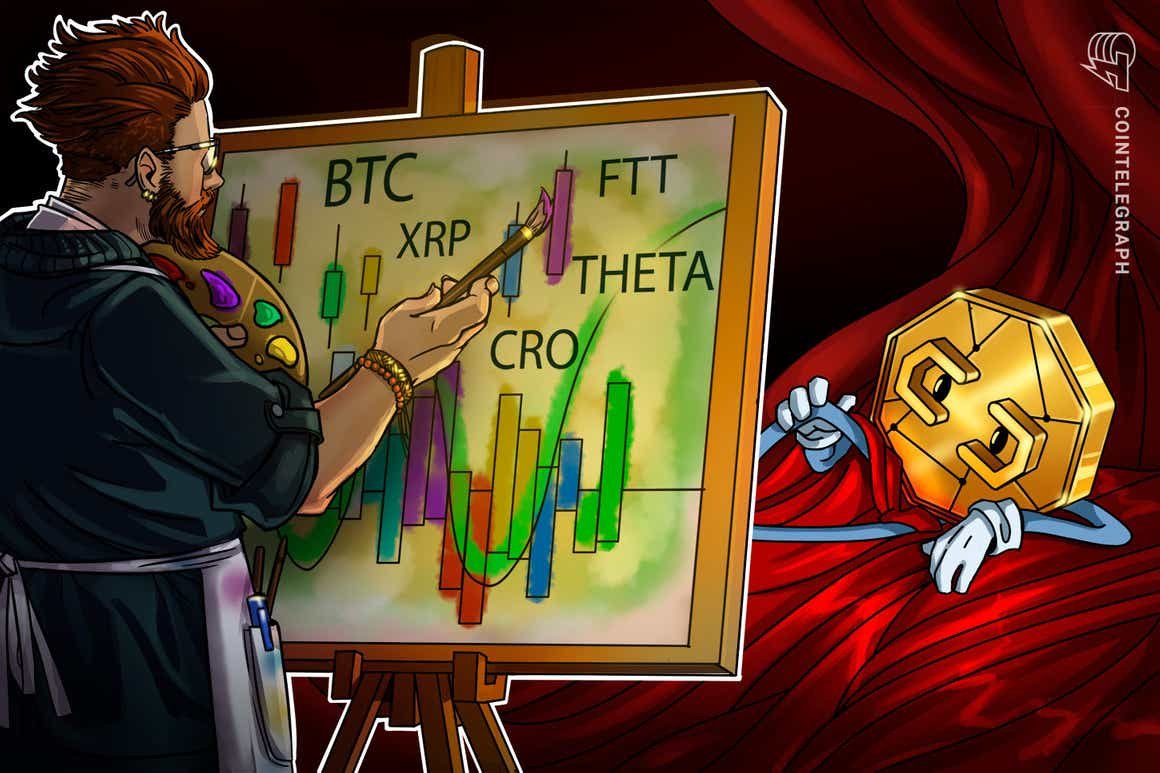
Could Bitcoin and altcoins stage a recovery after the recent pullback? Let’s study the charts of the top-5 cryptocurrencies that may attract investor attention in the short term.
BTC/USDT
Bitcoin turned down from the overhead resistance at $45,456 but a minor positive is that the bulls have not allowed the price to break below the 20-day exponential moving average ($41,383).
BTC/USDT daily chart. Source: TradingView
If the price rebounds off the current level, the bulls will try to propel the BTC/USDT pair above $45,456. A close above this level will complete a bullish inverse head and shoulders pattern.
The pair could then rally to $52,088 where the bears are likely to mount a strong challenge. If bulls thrust the price above this level, the pair could start its northward march toward the pattern target at $56,904.
This positive view will be negated if the price breaks and sustains below $39,600. Such a move could open the doors for a possible drop to $36,250.
BTC/USDT 4-hour chart. Source: TradingView
The pair turned down from $45,456 and broke below the moving averages. The bulls are currently attempting to defend the minor support at $41,688.88 but are facing stiff resistance at the moving averages.
If the price turns down from the current level and breaks below $41,688.88, the pair could slide to $39,600. If the price rebounds off this level, then the pair could remain range-bound between $39,600 and $45,456 for a few days.
On the upside, a break and close above the moving averages will be the first indication that bulls have a slight edge. The pair could then rise to $43,920 and later to $45,456.
XRP/USDT
Ripple (XRP) broke and closed above the moving averages on Feb. 7, indicating that the downtrend could be coming to an end. The bears tried to pull the price back below the breakout level at $0.75 but the bulls thwarted their attempt.
XRP/USDT daily chart. Source: TradingView
The price rebounded off $0.75 and the bulls are trying to push the XRP/USDT pair toward the overhead resistance at $1. A break and close above this resistance could open the doors for a possible rally to $1.41.
The moving averages are on the verge of a bullish crossover and the relative strength index (RSI) is in the positive zone, indicating that buyers have the upper hand. This positive view will invalidate on a break and close below $0.75. Such a move will indicate that bears continue to sell on rallies.
XRP/USDT 4-hour chart. Source: TradingView
The 4-hour chart shows that the bulls and the bears are battling it out near the $0.82 mark. The bulls pushed the price above this level but the bears stalled the rally at $0.85 and have pulled the pair back below $0.82.
A minor positive is that bulls are buying the dips to the 50-SMA. If the price rebounds off this support, the bulls will try to drive the pair above $0.85 and challenge the resistance at $0.91. Conversely, a break and close below the 50-SMA could pull the pair to $0.75. A break and close below this support could indicate the start of a deeper correction.
CRO/USDT
Crypto.com’s native coin (CRO) broke above the 50-day SMA ($0.47) on Feb. 7, suggesting that the corrective phase could be over. The price rallied to $0.54 on Feb. 10 where the bears are mounting a strong defense.
CRO/USDT daily chart. Source: TradingView
The moving averages are on the verge of a bullish crossover and the RSI is in the positive territory, indicating that the buyers have a slight edge. If the current rebound off the moving averages sustains, it will suggest that bulls are buying on dips. The bulls will then attempt to push the price above $0.54 and resume the uptrend.
If they can pull it off, the CRO/USDT pair could rise to $0.60 and then to $0.68. Contrary to this assumption, if the price turns down and breaks below the 20-day EMA, the pair could drop to $0.39.
CRO/USDT 4-hour chart. Source: TradingView
The 4-hour chart shows the pair is rising inside an ascending channel pattern. The bulls tried to push the price above the channel but the bears had other plans. They pulled the price back into the channel, trapping the aggressive bulls.
The buyers are attempting to defend the 50-SMA. If the price sustains above the 20-EMA, the bulls will again try to push the pair above the resistance line of the channel. This positive view will invalidate if the price turns down and plummets below the support line of the channel.
Related: Can XRP price reach $1 after 25% gains in one week? Watch this key support level
FTT/USDT
FTX Token (FTT) has been volatile inside a broadening formation. The failure of the buyers to propel the price above the resistance line indicates that bears are selling the rallies to this level.
FTT/USDT daily chart. Source: TradingView
However, a minor positive is that bulls are buying the dips in the zone between the 20-day EMA ($43.85) and the 50-day SMA ($41.50). If the price rebounds off the current level, the buyers will make one more attempt to clear the overhead hurdle.
If they manage to do that, the FTT/USDT pair could start a new uptrend. The pair could then rally to $53.50 where the bears may again pose a strong challenge but if this resistance is crossed, the rally could extend to $65.
This bullish view will invalidate if the price turns down and plummets below the 50-day SMA. That will indicate that the pair could extend its stay inside the broadening pattern for a few more days.
FTT/USDT 4-hour chart. Source: TradingView
The failure of the bulls to push the price above the $48 to $50 overhead resistance zone may have attracted profit-booking from short-term traders. The pair has broken below both moving averages and could drop to the 38.2% Fibonacci retracement levels at $41.99.
If the price rises from the current level or $41.99, it will suggest that buyers are accumulating on dips. The bulls will then again try to push the price above the 50-SMA. If they succeed, the pair could challenge the overhead resistance.
On the downside, a break and close below $41.99 could signal the start of a deeper correction to the 50% retracement level at $39.95.
THETA/USDT
Theta Network (THETA) broke and closed above the downtrend line on Feb.10, indicating that the downtrend could be coming to an end. Generally, a rally above a stiff resistance tends to turn back and retest the breakout level.
THETA/USDT daily chart. Source: TradingView
If bulls succeed in flipping the breakout level into support, it suggests a change in sentiment from sell on rallies to buy on dips. The 20-day EMA ($3.49) has started to turn up and the RSI is in the positive territory, suggesting advantage to buyers.
If the price rebounds off the downtrend line, the bulls will attempt to start a new uptrend. A break and close above $4.39 could attract further buying and the THETA/USDT pair could rise toward $6.
This bullish view will invalidate if the price turns down from the current level and plummets below the downtrend line. Such a move will suggest that the break above the downtrend line could have been a bull trap.
THETA/USDT 4-hour chart. Source: TradingView
The pair has been rising inside an ascending channel pattern. The bulls tried to push the price above the resistance line of the channel but the bears did not relent. This may have led to profit-booking by the short-term bears, pulling the price toward the support line.
The price has bounced off the support line on three previous occasions hence, the bulls will again try to defend it. If the price rebounds off the level and rises above the downtrend line, it will signal the resumption of the uptrend.
Alternatively, a break and close below the support line of the channel could signal a deeper correction to $3.20.
The views and opinions expressed here are solely those of the author and do not necessarily reflect the views of Cointelegraph. Every investment and trading move involves risk, you should conduct your own research when making a decision.
Central Bank Digital Currencies (CBDCs), a phenomenon that took over the global financial system in 2021, is now getting popular among African economies. Recently, the Central Bank of Kenya (CBK) published a discussion paper on CBDCs to highlight different opportunities and risks associated with the central bank digital currencies.
CBK noted that AML, technology risks, and infrastructure costs are some of the major risks associated with CBDCs. However, the bank also outlined a few prominent features of the digital currencies including the expansion of cross-border payments, financial stability, innovation, and financial inclusion.
The Kenyan central bank highlighted the rising popularity of digital tools in the global payments industry. “Following the outbreak of the coronavirus (COVID-19) pandemic, digital platforms have emerged as important financial inclusion tools across the world. To reap the full benefits and manage risks, policymakers are looking to step up. Central banks are exploring the possibility of rolling out CBDC solutions to meet their future payments needs in a digital economy,” CBK mentioned.
According to a recent survey conducted by the Bank for International Settlements, nearly 86% of central banks around the world are exploring the possibilities of CBDCs.
Risks
The Central Bank of Kenya said that it is monitoring the ongoing developments in the global CBDC ecosystem. While the bank outlined the potential advantages of CBDCs, it added that the disadvantages of digital assets must be considered before further developments.
“There are significant potential risks with CBDC issuance. These include financial exclusion, technology risks, competing with bank deposits and undermining bank intermediation, hampering monetary policy transmission, Anti-Money Laundering and Combating the Financing of Terrorism (AML/CFT), and data privacy balance and infrastructure costs,” the Central Bank of Kenya added.
Recently, the Bank of Korea announced the completion of the first phase of its central bank digital currency testing.
Central Bank Digital Currencies (CBDCs), a phenomenon that took over the global financial system in 2021, is now getting popular among African economies. Recently, the Central Bank of Kenya (CBK) published a discussion paper on CBDCs to highlight different opportunities and risks associated with the central bank digital currencies.
CBK noted that AML, technology risks, and infrastructure costs are some of the major risks associated with CBDCs. However, the bank also outlined a few prominent features of the digital currencies including the expansion of cross-border payments, financial stability, innovation, and financial inclusion.
The Kenyan central bank highlighted the rising popularity of digital tools in the global payments industry. “Following the outbreak of the coronavirus (COVID-19) pandemic, digital platforms have emerged as important financial inclusion tools across the world. To reap the full benefits and manage risks, policymakers are looking to step up. Central banks are exploring the possibility of rolling out CBDC solutions to meet their future payments needs in a digital economy,” CBK mentioned.
According to a recent survey conducted by the Bank for International Settlements, nearly 86% of central banks around the world are exploring the possibilities of CBDCs.
Risks
The Central Bank of Kenya said that it is monitoring the ongoing developments in the global CBDC ecosystem. While the bank outlined the potential advantages of CBDCs, it added that the disadvantages of digital assets must be considered before further developments.
“There are significant potential risks with CBDC issuance. These include financial exclusion, technology risks, competing with bank deposits and undermining bank intermediation, hampering monetary policy transmission, Anti-Money Laundering and Combating the Financing of Terrorism (AML/CFT), and data privacy balance and infrastructure costs,” the Central Bank of Kenya added.
Recently, the Bank of Korea announced the completion of the first phase of its central bank digital currency testing.
In 2021, crypto has been one of the biggest trends shaping tech and finance, and according to mainstream news headlines, decentralized autonomous organizations (DAOs) are set to be a force to be reckoned with in crypto in 2022. Mark Cuban called them the “ultimate combination of capitalism and progressivism.” Yet, while DAOs are relatively easy to understand conceptually, they’re a segment of the crypto market in a state of rapid flux, with many innovative use cases emerging. However, setting up and running a DAO also comes with its own set of unique challenges, which are also changing and developing over time.
What is a DAO?
The purest definition of a DAO is inherent in the name. An organization is a group of people and entities with a common goal or idea. It’s decentralized, so there is no CEO or board of executives responsible for decision-making, and it’s autonomous, meaning it’s self-governing. Self-governing means that there are governance rules programmed into blockchain-based smart contracts, and members of the DAO vote on matters affecting the DAO according to those rules.
One of the earliest DAOs, a project called The DAO, illustrates one of the most straightforward use cases of a DAO and also happens to be pivotal in the history of DAOs. The Genesis DAO, as it was also known, was an investment contract allowing Ether (ETH) holders to deposit their funds. Projects could apply to The DAO for funding, and if DAO token holders agreed to the investment terms, the smart contract would disburse funds. However, in June 2016, within weeks of launch, a hacker found a bug in the underlying smart contract code and managed to drain The DAO of around $70 million worth of ETH.
At the time, the incident wreaked havoc in the Ethereum community, and as a result, DAOs made little progress over the subsequent two or three years. However, once the touch paper of the DeFi movement was lit, the idea of DAOs took off once again.
Related: DAOs are meant to be completely autonomous and decentralized, but are they?
DeFi and the return of DAOs
DeFi emerged from the desire among the blockchain community to create an open, permissionless, decentralized financial system. As such, DAOs offered an attractive way for projects to demonstrate their commitment to decentralization through community governance.
As a result, during 2020, when DeFi began to gain rapid ground, governance tokens became vastly popular. Flagship DeFi apps including Compound (COMP), Uniswap (UNI) and Aave (AAVE) launched tokens allowing users to participate in decentralized governance, while newcomer DeFi projects have taken to launching their governance tokens from the start.
Current and emerging trends
So why are DAOs now making such a splash even among mainstream news outlets? Part of the reason is the surge in popularity of nonfungible tokens (NFTs), which are set to play a more significant role in DAO governance and who gets to participate.
In September, Andreessen Horowitz invested $5 million into “Friends with Benefits,” a Discord chat comprised of various crypto enthusiasts, artists and NFT collectors. The group raised a total of $10 million when it decided to operate as a DAO, demonstrating the value to be generated from the vast online communities that have formed — even without economic incentives — on platforms like Facebook and Telegram.
In November, things took an even more intriguing turn when “ConstitutionDAO” raised more than $40 million to bid on the rights to acquire an official copy of the U.S. constitution document in a Sotheby’s auction. It was the first time Sotheby’s had worked with a DAO, which had managed to gather support from over 17,000 donors in advance of the auction. Although ConstitutionDAO was ultimately outbid by Citadel CEO, Ken Griffin, the experiment itself was arguably a success in that it demonstrated its intended concept.
Another emerging trend is investment DAOs, as some believe that DAOs are set to disrupt the traditional VC model of funding entirely. These DAOs are allowing groups of Web3 natives to pool and deploy capital in such a way that now allows individuals to compete with traditional finance entities.
So it’s understandable that with such a wide range of applications out there, DAOs are causing considerable excitement and could prove to be as big as NFTs have been in 2021. However, there will be challenges along the way.
The path to DAO adoption isn’t smooth
Firstly, education is still a considerable gap. Even within the cryptocurrency community, the DAO concept is still gaining traction, and implementation is far from advanced. There are still relatively few “user interfaces” for DAO governance, although more and more tools are coming online to help organize and overcome the challenges that traditional organization structures have wrestled with for years.
Regulation can be another challenge that DAOs will have to grapple with as they transition into the mainstream. Laws around incorporation and tax structuring are ambiguous and often outdated, leaving DAOs to make their interpretation to fill in the gaps.
It’s also worth noting that decentralization is a spectrum and not binary. Although DAO governance tokens allow users to participate in decentralized governance, most projects still operate with a degree of centralization.
Related: Decentralization vs. centralization: Where does the future lie? Experts answer
Finally, decentralized governance is hard, particularly at scale. It’s a large challenge with multiple obstacles that have plagued blockchain developers since the early days. How do you keep voters engaged once the community becomes large enough, and votes need to be conducted with increasing frequency?
How do you stop wealthy whales from buying their way to power by scooping up a majority of tokens? To what extent should code be law, and shouldn’t there be fail-safes in place in case a malicious entity manages to wrest majority control? If so, who controls the fail-safes?
There are no easy answers to these questions, but now that crypto, NFTs and DeFi have found a foothold to reach the mainstream consciousness, it seems natural that DAOs will follow. Furthermore, as they become more mainstream, it should become easier to identify smother means by which communities can decentralize governance.
This article does not contain investment advice or recommendations. Every investment and trading move involves risk, and readers should conduct their own research when making a decision.
The views, thoughts and opinions expressed here are the author’s alone and do not necessarily reflect or represent the views and opinions of Cointelegraph.
Hannes Graah is the former vice president of growth at Revolut, and founder of stablecoin yielding protocol Gro. He also spent eight years at Spotify scaling company operations and assorted growth projects until mid-stage, then launching new regions until the initial public offering. A four-time startup founder, he is also an investor and advisor in more than 10 companies as well as a growth strategist for more than 30 brands and companies.