Bitcoin continues to trend lower over the weekend and seems at risk of re-testing previous lows. The first crypto by market cap was rejected at mid-area north of $40,000 and was unable to muster the momentum to hold those levels.
Related Reading | Did Top Three Bitcoin Addresses Just Call Another Local Bottom?
As of press time, Bitcoin trades at $39,921 with a 1.2% and 5.2% loss in the last day and 7 days, respectively.
BTC trends to the downside on the daily chart. Source: BTCUSD Tradingview
Yuya Hasegawa, analyst for Bitbank, attributes BTC’s price recent price action to the Russia-Ukraine situation. In that sense, the analyst expects potential relief as the U.S. Secretary of State Antony Blinken and the Russian Minister of Foreign Affairs Sergey Lavrov scheduled a phone call for next week.
This could tone down the tensions around the situation at the border. On top of that, the analyst claims Bitcoin is sitting at “ample technical support” which could protect its price from further downside.
However, is a long weekend in the U.S. which usually leads to potential periods of high volatility driven by low trading volumes across the crypto market. Hasegawa said talking about BTC’s price immediate and medium-term potential headwinds:
We still have the January U.S. PCE, February jobs report, and CPI until the March FOMC meeting, so it is safe to say that, depending especially on these inflation data, the worst may be still ahead of us, and even if the price rebounds from the current level in the short term, upside is likely quite limited unless the Russian military shows some signs of retreating.
The macro-situation seems to occupy everyone’s attention. A separate analyst from Material Indicators (MI) claims the Russia-Ukraine situation could see an outcome after the Winter Olympics in Beijing. These events have been linked to similar crises in the past, such as the invasion of Crimea which took place in 2014 during the Olympics hosted by Russia.
Bitcoin To See Short Squeeze Over Long Weekend?
Further data provided by Material Indicators claims BTC could have entered a distribution phase. Recommending traders to “avoid knife catching”, especially during periods of low volume, MI presented their Trend Precognition indicator which flashed a bearish arrow on the daily chart as BTC’s price trend below $40,000.
Material Indicator’s Trend Precognition Indicator flashed a bearish signal on the daily chart. Source: Material Indicators via Twitter
This could suggest the benchmark crypto might re-test its lows which could find good support, as MI claimed, “in areas of prior consolidation”. The levels between $35,000 to $38,000 were relevant during BTC’s price previous sell-off and could operate as support.
However, MI noted that there are “Liquidity gaps”, levels on the order book with low bids or asks orders, on both sides of the BTC/USDT trading pair. Thus, Bitcoin could see a short squeeze to the upside or downside.
Related Reading |Comparing Apple’s Growth With Bitcoin, Why This Expert Sets $700K As Long-Term Goal
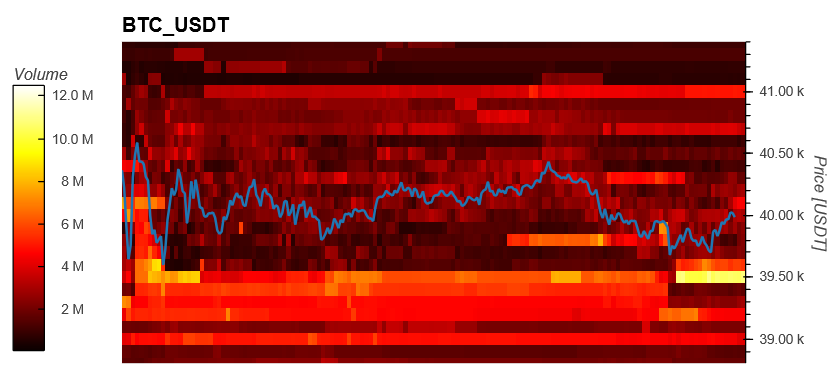
Currently, there are around $10 million in bid order around $39,500. Therefore, there seems to be strong support for BTC at that level which could favor the bulls, at least in the short term.
BTC’s price (blue line on the chart) with potential support on $39,500 due to concentration of bid orders (levels below the price). Source Material Indicators
The frenzy around meme coins took over the crypto market in 2021. With a monumental rise of more than 10,000%, Dogecoin (DOGE) thrashed every opponent and entered the list of top 10 digital currencies. The story of Shiba Inu (SHIB) was no different. The biggest rival of Dogecoin performed better than its counterpart in 2021. In fact, for a brief period, the market cap of Shiba Inu jumped above the overall value of Dogecoin.
Both meme coins witnessed strong growth among crypto communities during the last year. However, with a drop of over 60% from their all-time highs, several questions are rising around the future of Shiba Inu and Dogecoin. Even after the massive market correction, DOGE and SHIB have a market cap of $18 billion and $14 billion, respectively. Finance Magnates asked leading crypto voices to share their opinions regarding the future of meme coins.
“Memecoins like Dogecoin and Shiba Inu may be performing woefully at the moment, but this by no means implies they are fizzling out their relevance. The broader market is underperforming at the moment and by virtue of the nature, meme coins are poised to print a far wider rate of decline based on their volatility,” Sven Wenzel, co-founder of Castello Coin, said.
Market Conditions
According to Wenzel, the current market conditions are tough but under the normal market situation, meme coins will skyrocket once again. “When normalcy seems to return to the market, we can expect Dogecoin and Shiba Inu to do what they know how to do best-that is, chart a massive upward growth. With the current market downturn, a number of investors have lost a lot of money, and the first instinct by many risk-takers will be to invest in tweet-sensitive coins that can help boost the prices of Dogecoin and Shiba Inu. Based on this, we are likely to see massive retail cash inflows into these top meme coins in a short while,” Wenzel added.
Doge and SHIB
Maria Stankevich, the Chief Business Development Officer at EXMO UK, believes that not all meme coins will disappear, some are here to stay.
“It is difficult to argue with the statement that along with the formation of the market, we will inevitably observe its natural cleansing from empty projects. But we’re still in the nascent phase, where most players feel pretty free with little to no regulation. For example, we can take the current situation with Elon Musk and McDonald’s. After the publication of McDonald’s, the Grimacecoin token was created on the Binance Smart Chain network, the value of which at the moment increased by more than 200,000%, to $2. It isn’t easy to imagine such a situation in the traditional finance market, so most classic traders look at cryptocurrencies as a sandbox where children play,” she said.
“However, there is a trend mainly related to the regulation and protection of clients from scams. I would not say that all meme-coins will disappear. Dogecoin is a specific marker of the era of creation and formation of cryptocurrencies. The creators had no plans to launch the coin into space, and I am sure that none of them expected Elon Musk to become their ambassador. I think that shortly the number of dummy projects will decrease. Still, until there is proper regulation, there will always be people who hope for a magical way to earn money without doing anything quickly,” Maria explained.
Rising Demand
Johnny McCamely, CEO of CryptoClear, said that the short-term spike in Shiba Inu and Dogecoin is due to a rise in demand from investors. “Recent rallies in coins such as DOGE and SHIB are driven by a surge in demand to get rich quick, bitcoin is back above $40,000 USD and traders and investors are switching back onto Crypto. Many are wanting to make a quick gain via the likes of DOGE and SHIB, many other “meme coins” as they are termed have popped up recently such as Marshall Rogan Inu (MRI). I believe this is a short-term spike due to the investor’s demand to get rich quick,” he said.
The frenzy around meme coins took over the crypto market in 2021. With a monumental rise of more than 10,000%, Dogecoin (DOGE) thrashed every opponent and entered the list of top 10 digital currencies. The story of Shiba Inu (SHIB) was no different. The biggest rival of Dogecoin performed better than its counterpart in 2021. In fact, for a brief period, the market cap of Shiba Inu jumped above the overall value of Dogecoin.
Both meme coins witnessed strong growth among crypto communities during the last year. However, with a drop of over 60% from their all-time highs, several questions are rising around the future of Shiba Inu and Dogecoin. Even after the massive market correction, DOGE and SHIB have a market cap of $18 billion and $14 billion, respectively. Finance Magnates asked leading crypto voices to share their opinions regarding the future of meme coins.
“Memecoins like Dogecoin and Shiba Inu may be performing woefully at the moment, but this by no means implies they are fizzling out their relevance. The broader market is underperforming at the moment and by virtue of the nature, meme coins are poised to print a far wider rate of decline based on their volatility,” Sven Wenzel, co-founder of Castello Coin, said.
Market Conditions
According to Wenzel, the current market conditions are tough but under the normal market situation, meme coins will skyrocket once again. “When normalcy seems to return to the market, we can expect Dogecoin and Shiba Inu to do what they know how to do best-that is, chart a massive upward growth. With the current market downturn, a number of investors have lost a lot of money, and the first instinct by many risk-takers will be to invest in tweet-sensitive coins that can help boost the prices of Dogecoin and Shiba Inu. Based on this, we are likely to see massive retail cash inflows into these top meme coins in a short while,” Wenzel added.
Doge and SHIB
Maria Stankevich, the Chief Business Development Officer at EXMO UK, believes that not all meme coins will disappear, some are here to stay.
“It is difficult to argue with the statement that along with the formation of the market, we will inevitably observe its natural cleansing from empty projects. But we’re still in the nascent phase, where most players feel pretty free with little to no regulation. For example, we can take the current situation with Elon Musk and McDonald’s. After the publication of McDonald’s, the Grimacecoin token was created on the Binance Smart Chain network, the value of which at the moment increased by more than 200,000%, to $2. It isn’t easy to imagine such a situation in the traditional finance market, so most classic traders look at cryptocurrencies as a sandbox where children play,” she said.
“However, there is a trend mainly related to the regulation and protection of clients from scams. I would not say that all meme-coins will disappear. Dogecoin is a specific marker of the era of creation and formation of cryptocurrencies. The creators had no plans to launch the coin into space, and I am sure that none of them expected Elon Musk to become their ambassador. I think that shortly the number of dummy projects will decrease. Still, until there is proper regulation, there will always be people who hope for a magical way to earn money without doing anything quickly,” Maria explained.
Rising Demand
Johnny McCamely, CEO of CryptoClear, said that the short-term spike in Shiba Inu and Dogecoin is due to a rise in demand from investors. “Recent rallies in coins such as DOGE and SHIB are driven by a surge in demand to get rich quick, bitcoin is back above $40,000 USD and traders and investors are switching back onto Crypto. Many are wanting to make a quick gain via the likes of DOGE and SHIB, many other “meme coins” as they are termed have popped up recently such as Marshall Rogan Inu (MRI). I believe this is a short-term spike due to the investor’s demand to get rich quick,” he said.
At Coinbase, our number one priority is ensuring that we uphold our security commitments to our customers. On February 11, 2022, we received a report from a third-party researcher indicating that they had uncovered a flaw in Coinbase’s trading interface. We promptly mobilized our security incident response team to identify and patch the bug, and resolved the underlying system issue without any impact to customer funds.
This blog post provides a deeper look into the timeline of events surrounding the bug report, as well as an explanation of the bug itself and the steps we took to resolve it and ensure it cannot happen again.
(note, all events occurred on February 11, 2022, and all times are in PST)
10:16 AM: A member of the crypto community tweets that they have uncovered a serious flaw in the Coinbase trading interface, and requests contacts in the Coinbase Security team.
11:00 AM: Based on limited initial information provided by intermediaries, Coinbase Security declares an incident and mobilizes engineering resources to begin testing all trading interfaces to determine the validity of the alleged bug.
11:21 AM: The crypto researcher files a vulnerability report via HackerOne, Coinbase’s bug bounty platform, indicating that the flaw resides in a specific API for Retail Advanced Trading. Coinbase engineers also complete a review of all other user interfaces and Coinbase Exchange APIs and determine that they are not impacted.
11:42 AM: Coinbase engineers are able to reproduce the bug, and the Retail Advanced Trading platform is placed into cancel-only mode, disabling new trades.
4:01 PM: A patch is validated and released, resolving the incident.
The underlying cause of the bug was a missing logic validation check in a Retail Brokerage API endpoint, which allowed a user to submit trades to a specific order book using a mismatched source account. This API is only utilized by our Retail Advanced Trading platform, which is currently in limited beta release.
To give an example:
A user has an account with 100 SHIB, and a second account with 0 BTC.
The user submits a market order to the BTC-USD order book to sell 100 BTC, but manually edits their API request to specify their SHIB account as the source of funds.
Here, the validation service would check to determine whether the source account had a sufficient balance to complete the trade, but not whether the source account matched the proposed asset for submitting the trade.
As a result, a market order to sell 100 BTC on the BTC-USD order book would be entered on the Coinbase Exchange.
There were mitigating factors that would have limited the impact of this flaw had it been exploited at scale. For example, Coinbase Exchange has automatic price protection circuit breakers, and our trade surveillance team continuously monitors our markets for health and anomalous trading activity.
Thanks to the researcher who responsibly disclosed this issue, Coinbase was able to fix this bug in a matter of hours, and conclusively determine that it has never been maliciously exploited. We have also implemented additional checks to ensure that it cannot happen again.
Coinbase strongly supports independent security research, and when those researchers uncover serious issues, we want to ensure that they are rewarded accordingly. As a result, we are paying our largest-ever bug bounty for this finding: $250,000.
We welcome future submissions from this researcher and others via our HackerOne program: https://hackerone.com/coinbase.
From video game enthusiasts monetizing their passions as shout casters to fashion influencers supercharging their careers into livestreamers on e-commerce platforms, the creator economy flourished, evolved and matured in the past year. Largely catalyzed by the ongoing COVID-19 pandemic, contemporary creators benefited from the gradual shift in consumer behaviors as more people came online across the globe. Now valued at over $100 billion, the creator economy is witnessing staggering growth as the worlds of e-commerce, social media and online communities converge.
With opportunities mounting in social tokens and corresponding virtual playgrounds such as the Metaverse, the year ahead seems to be filled with a great deal of promise. What lies ahead for creators in an increasingly digital and decentralized 2022?
A more equitable dynamic
From OnlyFans to TikTok, social networks may give creators access to communities but these creators are what drive traffic to these platforms due to the strength of their content. Whether they are an artist, musician, writer, photographer or all-around influencer, they are the true revenue drivers on these platforms. However, the relationship between a creator and their community is ultimately intermediated by a third party — the platform — which can impact the extent to which a creator is fully rewarded and compensated for their work. Sometimes this manifests itself as a cut in revenue and can even impact the type of content created and what it can include.
Related: Twitter and TikTok embrace NFTs: Mainstream adoption incoming?
Imagine if you could create without limits. This is the benefit that social tokens stand to offer. Blockchain-powered fan tokens can fulfill several functions: For one, they can be used to reward fans for their engagement, further encouraging them to engage with a universe of content. Not only does this help in growing one’s community, but social tokens can also be used as a medium of exchange — fans can directly compensate creators for work that they like, powering a mini economy that effectively cuts out the middleman from the equation. By essentially tokenizing themselves, creators invite their fans to take a stake in all they do — consider the example of 23-year-old entrepreneur Alex Masmej who launched ALEX to raise enough funds for a flight to San Francisco to launch his startup.
Social tokens essentially represent the ethos of Web3, connecting creators and consumers of content directly and enabling them to benefit from a value exchange. However, there are philosophical questions that merit some thought. What does it mean to tokenize yourself? Do you risk raising the bar and the pressure to perform? After all, incidents of social media influencers struggling to meet the demands of their followers have been well-chronicled. But as the creator economy continues to evolve, social tokens are still a valuable step forward that looks to level the financial playing field for what’s fast becoming a legitimate career path.
Revitalizing the meaning of engagement
Much like social tokens, nonfungible tokens (NFTs) are another innovation shaping the creator economy. Consider that the NFT-based crypto art market is now worth over $2.3 billion (as of mid-February 2022), pointing to the lucrative opportunity that artists have in accessing new monetization streams for their work.
Meanwhile, NFTs can also be leveraged to engineer a new model of fan engagement as they reconcile virtual assets with real-world experiences. Enter the phygital experience — a mix of physical and digital. NFTs can be tied to real-world perks — if you’re a musician, that could mean a lifetime supply of concert tickets or VIP meet and greets and as an artist, a select number of prints in a collection — all while ensuring that these assets verifiably belong to a fan, attesting to their ownership and authenticity. As economies gradually reopen and we continue to see the eventual normalization of social activities, experiential NFTs as a tool for long-term fan engagement are likely to grow in popularity.
Let’s not stop there, though: Enter interactive NFTs. These assets can change over time based on a fan’s modification to the content. Consider a digital collectible like a player card issued by an athlete — a fan can request for a digital autograph to be emblazoned onto the item, effectively adding to and altering the NFT, adding to its scarcity. For artists, this could mean creating collaborating digital artworks that their fans can add to, allowing for a more active two-way fan-creator relationship.
Related: Bull or bear market, creators are diving headfirst into crypto
Celebrating the rise of Asia
Much has been said about the age of Asia and that phenomenon certainly extends to the continent’s creator economy. In 2021, the number of influencers across the region grew by 66 percent, particularly in markets such as Indonesia, Japan, the Philippines, Taiwan and Thailand. While the influence of Western social networks is certainly widespread across the continent — with the likes of Indonesia’s growing population of digital natives ranking fourth in the world for Instagram usage — localized homegrown alternatives continue to proliferate. From China’s Sina Weibo to Japan’s LINE, creators need to master strategies to best navigate the cultural and communal nuances unique to each market.
Though the majority of Asian nations are still on the rise, China has arguably solidified its position as a leader in the creator economy, backed by a mature, professionalized network of e-commerce platforms that have helped to popularize live streaming as a career — a market that is estimated to rake in $60 billion each year. The model is fast replicating itself in other Asian markets, especially across Southeast Asia by e-commerce marketplaces such as Lazada and Shopee.
Related: All eyes on Asia: Crypto’s new chapter post-China
Meanwhile, a digital-savvy approach to tackling the physical restrictions posed by the coronavirus has been actively employed by Asian creators — to see this, one doesn’t need to look further than K-pop musicians who’ve seamlessly transitioned to offering virtual experiences to their fans and has entered the world of NFTs to mint audio-visual digital collectibles that their fans can buy, sell and trade.
Asia is primed to play host to this development given the legitimization and formalization of its continental creator economy. Whether it’s a traditional celebrity or an entrepreneur turned livestreamer, the opportunities for them to rally a community of loyal fans and shoppers rests firmly in their hands. But in light of the unique nuances to navigate across each culture, local firms should be taking a distinctly localized approach to celebrating the very differences that add to the challenge of mastering Asia’s creator landscape. A decentralized community strives to put the power back in the hands of creators with a model that’s uniquely made in Asia for Asia. As the continent’s creator economy continues to flourish, only time will tell how both fans and creators will adapt to the incoming wave of decentralization.
The value of alternatives
Contemporary creators are burdened by choice — forced to reckon with the growing number of platforms and access points to cultivate new and existing communities of fans. With the era of Web3 upon us, it’s truly an exciting time to be a creator. What we can hope to see is a creator economy that no longer rests on a disparate landscape of channels, but a distributed, interoperable network that maximizes all the touchpoints and opportunities to meaningfully engage. Meanwhile, the staggering rise of Asia and its influential position in generating cultural products and developing new platforms that have the potential to shape multiple industries is set to redefine the creator economy and its participants as we know it.
As we look to 2022, creators are now, more than ever, armed with innovations to set apart their offerings — from virtual worlds to collectibles growing in sophistication. Beyond that, they now have new pathways to explore, ones that can ultimately promise a more equitable, leveled playing field as they transform their passions into careers. The opportunities on the horizon are clear: The dawn of decentralization is the next step in bringing the creator economy to new heights.
This article does not contain investment advice or recommendations. Every investment and trading move involves risk, and readers should conduct their own research when making a decision.
The views, thoughts and opinions expressed here are the author’s alone and do not necessarily reflect or represent the views and opinions of Cointelegraph.
Weiwei Geng is the CEO of Unite, a creator ecosystem built in Asia for Asia that looks to put power into the hands of the continent’s creative communities. In addition to his role at Unite, Weiwei is also the co-founder of Rally and serves as an executive board member of the RLY Network Association. Previously, Weiwei served as managing director of China at Gen.G, a leading esports organization with top teams in China, South Korea and the United States.
Electricity consumption has been one of the major concerns with the advent of cryptocurrencies especially Polkadot. Though with models running with the Proof-of-Stake (PoS) consensus mechanism, this electricity use seems to be minimal since their process for transaction validations is staking. But the story is not the same for those running with Proof-of-Work (PoW) such as Bitcoin.
Mining is the associated process through which the PoW models could validate their network transactions. However, the process consumes lots of electricity as it uses highly computational equipment to solve cryptographic puzzles.
DOT sits at $18 Source: DOTUSD on TradingView.com
This high energy consumption led to several crackdowns on crypto mining in different countries, especially Bitcoin, in 2021. The move was in line with the argument that such practices facilitate environmental pollution.
This concern on energy consumption propelled the Crypto Carbon Ratings Institute (CCRI) to research the rate of electricity consumption by some blockchains. CCRI studied some networks like Solana, Bitcoin, Ethereum, and Polkadot in its research.
Related Reading | Lessons From Reason’s “The Fake Environmentalist Attack on Bitcoin” Mini-Doc
Based on the results from CCRI research, Polkadot, the strong competitor of Ethereum, emerged as the network with the least electricity consumption compared with Ethereum, Solana, Bitcoin, and other top cryptocurrencies.
This indicates that Polkadot minimally impacts environmental and climatic changes and pollution more than the other networks. According to the CCRI rating, Polkadot’s energy consumption is 6.6 times the annual value of electricity used by an average U.S. family.
A blockchain’s electricity consumption stands as a high determinant factor of its capital inflow from institutional investors. This formed Tesla’s 2021 move against Bitcoin as the electric car company suspended BTC as one of its payment options. The car giant cited BTC mining’s environmental impact as totally unacceptable.
Among all the networks involved in the research, Bitcoin shows the highest energy consumption. Next in the line are Ethereum, Solana, Cardano, Algorand, Avalanche, and Tezos.
Polkadot Announces Pioneers Prize Program
Polkadot has announced its Pioneers Prize Program in a recent move for more technological innovation within its ecosystem. This program is packed with $20 million rewards. The picking of winners will be through a series of challenges and some set prizes. It’s part of the network’s plan to facilitate the growth of its ecosystem and Web3.
The field and general outlook of the network have put DOT on a bullish trend for investors. The contributory influences are coming from Polkadot’s rating of low electricity consumption and its Pioneers Prize Program.
Related Reading | Bitcoin On-Chain Demands Suggests That The Market Has Reached Its Bottom
From analysts’ evaluation of the Polkadot price trend, the protocol has rounded off both its retest and breakout. Most of them think that the DOT has moved to its buy zone.
Featured image from Pixabay, chart from TradingView.com
Charlie Munger, the ancient vice chairman of Berkshire Hathaway and Warren Buffet’s right hand man, has no issue with providing his honest thoughts on cryptocurrency: He hates it.
Speaking at a shareholder’s Q&A session at the annual meeting for LA-based newspaper company, Daily Journal Corp, the 98-year-old investing icon likened crypto to a sexually transmitted disease.
“I certainly didn’t invest in crypto. I’m proud of the fact that I avoided it. It’s like some venereal disease.”
Munger continued to express his contempt for Bitcoin and other cryptocurrencies, adding, “I wish it had been banned immediately… I admire the Chinese for banning it. I think they were right and we were wrong to allow it.”
Munger and Buffet are no strangers to criticizing and downplaying the emergence of cryptocurrency. Buffett has previously ridiculed Bitcoin for being an asset that “does not create anything,” he’s called it “rat poison squared” and said that it is nothing more than a “delusion that attracts charlatans”.
Munger’s imaginative depiction of cryptocurrency do not seem to be reflected in the new investment thesis of Berkshire Hathaway, which is softening up on its exposure to cryptocurrency.
In a securities filing late Feb. 14, Berkshire Hathaway disclosed that it had increased its exposure to cryptocurrency by purchasing $1 billion worth of Nubank stock, Brazil’s largest fintech bank which is popular amongst Brazil’s crypto investors.
“The Nubank investment can be tagged as Buffett’s way of supporting the fintech/crypto world without taking back his criticisms of the past,” asserted Greg Waisman, co-founder and chief operating officer of crypto wallet service Mercuryo, adding that Berkshire is now backing the “digital currency ecosystem indirectly.”
Related: Warren Buffett Doesn’t Want to Own any Cryptocurrency
Crypto Twitter has been quick to respond to Munger’s comments on digital assets.
@gmoneyNFT called out the irony in Munger’s recent remarks point blank to their 225,000 followers:
Charlie Munger: Fiat currency is going to zero
Also Charlie Munger: Crypto is like some venereal disease. I’m proud of the fact that I’ve avoided it. pic.twitter.com/ua85ubdy35
While @cryptonator1337 took aim at Munger’s age, stating to his 35k followers that Munger may not be the best person to consult when it comes to new technology.
When Munger was born in 1924…
.. Lenin died .. the Ottoman Empire ended .. Disney created the first cartoon .. IBM was founded in New York State .. the US president delivered a radio broadcast the first time
But sure let’s listen to him talking about #Bitcoin
MRHB DeFi follows the successful DEX (decentralized exchange) listing on Pancakeswap with its first CEX (centralized exchange) listing on LBank as it continues to bring DeFi opportunities to communities previously discouraged or excluded from the cryptoverse.
One of the fastest-growing cryptocurrency companies, Fireblocks announced the acquisition of First Digital today. The acquisition will facilitate the expansion of the company’s payment offering.
Fireblocks noted that the integration of First Digital will support B2C, B2B, cross-border and other forms of payment through USDC, Celo, other stable coins and digital currencies. In addition, the crypto firm outlined the rising retail and institutional demand for digital asset-related payments.
Earlier this year, Fireblocks raised a whopping $550 million in its Series E funding round. With a valuation of approximately $8 billion, Fireblocks is one of the most valuable companies in the digital asset ecosystem.
“We’re thrilled to welcome First Digital to the Fireblocks family as we accelerate our expansion plans to help every business become a crypto business. We’re pushing ‘fast forward’ to give PSPs the suite of tools they need to begin accepting crypto payments,” Michael Shaulov, the CEO and Co-Founder of Fireblocks, said.
Payments with Digital Assets
According to research conducted by Mastercard, nearly 40% of the consumers in Africa, the Middle East, Asia-Pacific and the American region are planning to use digital currencies for purchases in the next year. Additionally, a large percentage of the respondents are exploring different technology-driven solutions for the settlement of cryptocurrency payments.
Fireblocks and First Digital believe that the acquisition will increase the global adoption of digital assets. “It is amazing to see what the entire Fireblocks team has built and accomplished in such a short period of time. This is an exciting opportunity for the First Digital team based on a proven, successful partnership with Fireblocks. We believe that payments should be a core functionality for all fintech apps, and via Fireblocks’ platform, we will make it available to the world at scale,” Ran Goldi, the CEO of First DAG, commented on the acquisition announcement.
One of the fastest-growing cryptocurrency companies, Fireblocks announced the acquisition of First Digital today. The acquisition will facilitate the expansion of the company’s payment offering.
Fireblocks noted that the integration of First Digital will support B2C, B2B, cross-border and other forms of payment through USDC, Celo, other stable coins and digital currencies. In addition, the crypto firm outlined the rising retail and institutional demand for digital asset-related payments.
Earlier this year, Fireblocks raised a whopping $550 million in its Series E funding round. With a valuation of approximately $8 billion, Fireblocks is one of the most valuable companies in the digital asset ecosystem.
“We’re thrilled to welcome First Digital to the Fireblocks family as we accelerate our expansion plans to help every business become a crypto business. We’re pushing ‘fast forward’ to give PSPs the suite of tools they need to begin accepting crypto payments,” Michael Shaulov, the CEO and Co-Founder of Fireblocks, said.
Payments with Digital Assets
According to research conducted by Mastercard, nearly 40% of the consumers in Africa, the Middle East, Asia-Pacific and the American region are planning to use digital currencies for purchases in the next year. Additionally, a large percentage of the respondents are exploring different technology-driven solutions for the settlement of cryptocurrency payments.
Fireblocks and First Digital believe that the acquisition will increase the global adoption of digital assets. “It is amazing to see what the entire Fireblocks team has built and accomplished in such a short period of time. This is an exciting opportunity for the First Digital team based on a proven, successful partnership with Fireblocks. We believe that payments should be a core functionality for all fintech apps, and via Fireblocks’ platform, we will make it available to the world at scale,” Ran Goldi, the CEO of First DAG, commented on the acquisition announcement.
Coinbase is proud to announce the launch of the Travel Rule Universal Solution Technology (TRUST), an industry-driven solution designed to comply with a requirement known as the Travel Rule while protecting the security and privacy of our customers. TRUST is a platform that allows cryptocurrency exchanges to securely send information legally required by the Travel Rule. The solution is named TRUST because that’s what we seek to instill in our customers when they use our products and services.
The current U.S. TRUST membership includes the following: Anchorage, Avanti, BitGo, bitFlyer, Bittrex, BlockFi, Circle, Coinbase, Fidelity Digital Assetsˢᵐ, Gemini, Kraken, Paxos, Robinhood, Standard Custody & Trust, Symbridge, TradeStation, Zero Hash, and Zodia Custody. And we are soon expanding to other global jurisdictions.
Why is TRUST necessary?
The Travel Rule requires financial institutions to share certain basic information about their customers when sending funds over a certain amount to another financial institution. Custodial cryptocurrency exchanges (like other financial institutions) have to satisfy this rule, which was written before crypto even existed. To do this, a leading group of crypto exchanges came together to create a solution in the crypto space, while continuing to protect the security and privacy of our customers’ personal information. This unprecedented effort led to a jointly designed solution, TRUST, which we hope will soon become the industry standard for complying with these requirements.
What was the goal in designing the TRUST solution, and how was it achieved?
The core goal in designing TRUST was to achieve top-tier compliance with the Travel Rule, while fully honoring customers’ expectations over how their information is handled. To do this, important safeguards were incorporated as part of the TRUST solution:
No central store of personal data: We never centrally store sensitive customer information where it could be targeted by an attacker or misused by a third party. The required information is only directly sent from one TRUST member to another, through end-to-end encrypted channels, and the receiver is required to safeguard it.
Proof of address ownership: TRUST includes a mechanism for the receiving exchange to prove that it’s the owner of the receiving crypto address before customer information is sent — to ensure the right information is sent to the right exchange.
Core security & privacy standards: We require all TRUST members to meet core anti-money laundering, security, and privacy requirements before joining the solution. And we are partnering with Exiger, a global market leader in technology-enabled compliance and risk management solutions, to help us meet that bar, and to provide ongoing compliance support.
Now that TRUST has launched, what are the next steps?
The next step is adding new members, so that TRUST can provide comprehensive compliance across the crypto industry. The Travel Rule’s reach is expanding internationally, and so must the TRUST solution. TRUST is focused on expanding to many other jurisdictions this year.
The launch of TRUST resoundingly demonstrates that top-tier compliance can go hand-in-hand with a core industry value — robust protection of customer privacy and security.
Bitcoin attempted a move towards $45,000 but failed against the US Dollar. BTC is correcting lower, but dips might be limited below $42,800.
Bitcoin extended increase above $44,000 before it faced sellers.
The price is trading above $43,500 and the 100 hourly simple moving average.
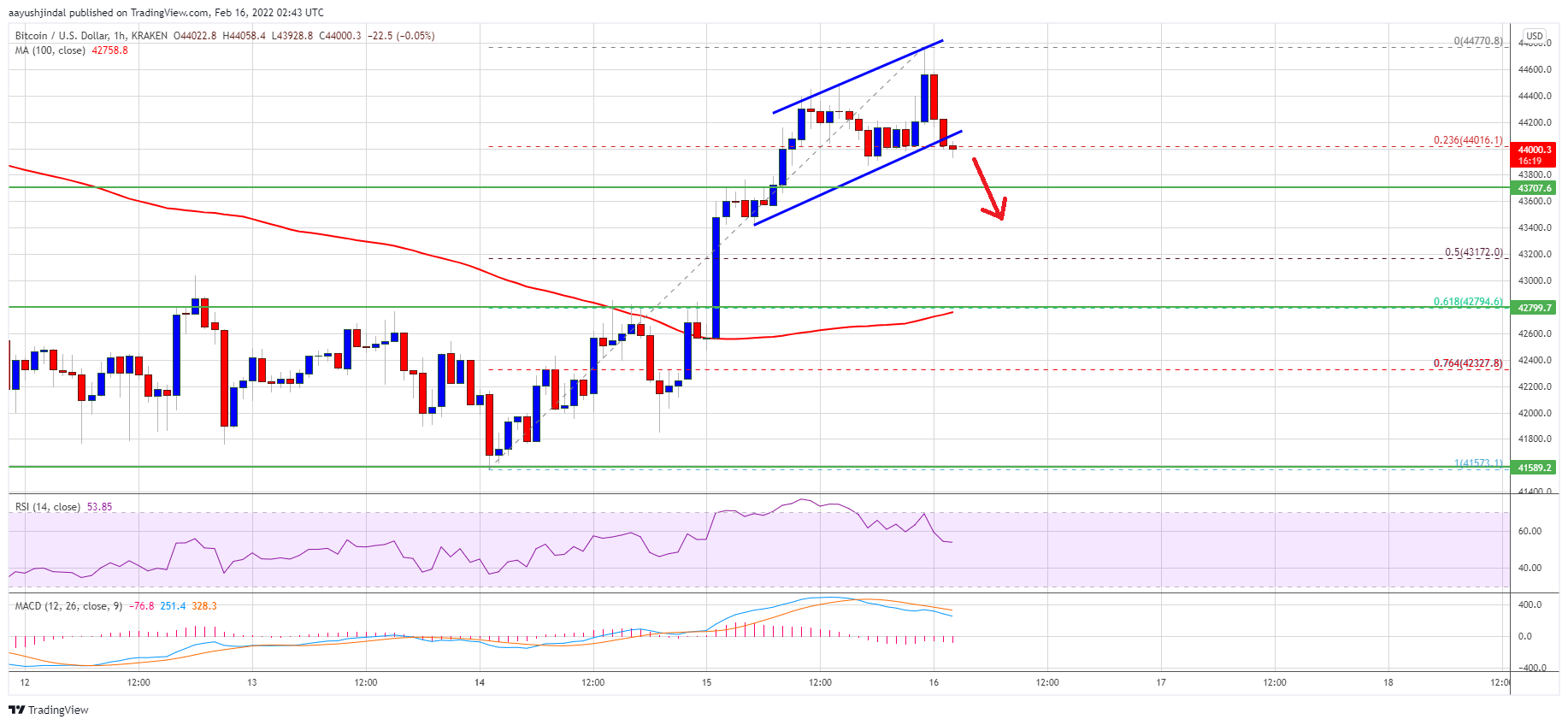
There was a break below a short-term rising channel with support near $44,200 on the hourly chart of the BTC/USD pair (data feed from Kraken).
The pair could drop to $43,000 or $42,800, where the bulls might take a stand.
Bitcoin Price Faces Resistance
Bitcoin price remained supported and extended increase above the $44,000 level. BTC even cleared the $44,500 resistance and settled above the 100 hourly simple moving average.
However, there was no test of the $45,000 resistance zone. A high was formed near $44,770 before the price started a downside correction. There was a break below the $44,500 support zone. Besides, there was a break below a short-term rising channel with support near $44,200 on the hourly chart of the BTC/USD pair.
Bitcoin is trading just below the 23.6% Fib retracement level of the upward move from the $41,573 swing low to $44,770 high. On the upside, the price might face resistance near the broken channel support at $44,200.
Source: BTCUSD on TradingView.com
The first major resistance is near the $44,500 level. A clear move above the $44,500 resistance zone might send the price further higher. The next major resistance is near $45,000, above which the price might rise towards the $45,500 resistance level.
Dips Limited in BTC?
If bitcoin fails to continue higher above the $44,500 resistance zone, it could start a downside correction. An immediate support on the downside is near the $43,800 zone.
The next major support is seen near the $43,150 level. It is near the 50% Fib retracement level of the upward move from the $41,573 swing low to $44,770 high. If there is a downside break below the $43,850 support zone, the price might struggle. The next support sits near $42,800 or the 100 hourly SMA, below which there is a risk of a sharp decline in the near term.
Technical indicators:
Hourly MACD – The MACD is now gaining pace in the bearish zone.
Hourly RSI (Relative Strength Index) – The RSI for BTC/USD is still above the 50 level.
Major Support Levels – $43,800, followed by $43,150.
Major Resistance Levels – $44,200, $44,500 and $45,500.