New York, USA, 22.2.22 — NFT marketplace, Mintable, is sending 3 NFTs that were stolen in a recent OpenSea exploit, back to their rightful owners. They found the NFTs on the LooksRare marketplace, which has garnered its own reputation for over USD 10 billion in wash trading and stolen NFTs, while acquiring NFTs for Mintable’s most recent flash sale.
KR1, a blockchain and crypto-asset investment company, has now announced it has participated in the HydraDX (HDX) crowdloan and Polkadot (DOT) parachain auction. KR1 contributed a total of 350,000.00 DOT to the HydraDX crowdloan campaign, which successfully secured a parachain slot in the ongoing round of Polkadot parachain auctions.
HydraDX.io is a cross-chain liquidity protocol designed to enable frictionless liquidity for crypto assets across various chains. In contrast to most decentralized exchanges in production today, which rely on separate pools for separate assets, HydraDX’s solution enables deposits of ‘all’ assets into one shared liquidity pool, the ‘Omnipool’, unlocking unparalleled efficiencies.
The contributed DOT will be time-locked on the Polkadot blockchain for 96 weeks and will be returned to KR1 following the completion of the respective HydraDX parachain lease. Following the successful HydraDX parachain auction bid, KR1 is going to receive a to-be-determined amount of HydraDX tokens over a time period of 96 weeks in return for supporting the HydraDX crowdloan campaign.
This method of token distribution involves no direct investment of capital, instead, it is an indirect investment with the opportunity costs being the inaccessibility of the locked DOT funds as well as foregoing any staking yields on the contributed DOT for the time period.
In addition, KR1 will receive a total of 45,000,000 HDX tokens (and a yet-to-be-determined amount of Basilisk (BSX) tokens) in line with KR1’s previous backing of HydraDX’s seed funding round that was announced on December 22nd, 2020, and a much smaller, yet-to-be-determined amount of HDX tokens in line with the company’s contribution to Basilisk’s Kusama crowdloan campaign and parachain auction that was announced on September 22nd, 2021.
HDX is the native token of HydraDX. It will be used for governance, staking, and more.
“HydraDX winning a Polkadot parachain slot is the next big step for the project and a huge endorsement by the community of the protocol’s objective to bring all liquidity together in an ‘ocean of liquidity.’ We see HydraDX as the endgame of liquidity in a cross-chain world and we have a high conviction rate in the team’s ability to achieve this goal.” – Keld van Schreven, Managing Director & Co-Founder of KR1
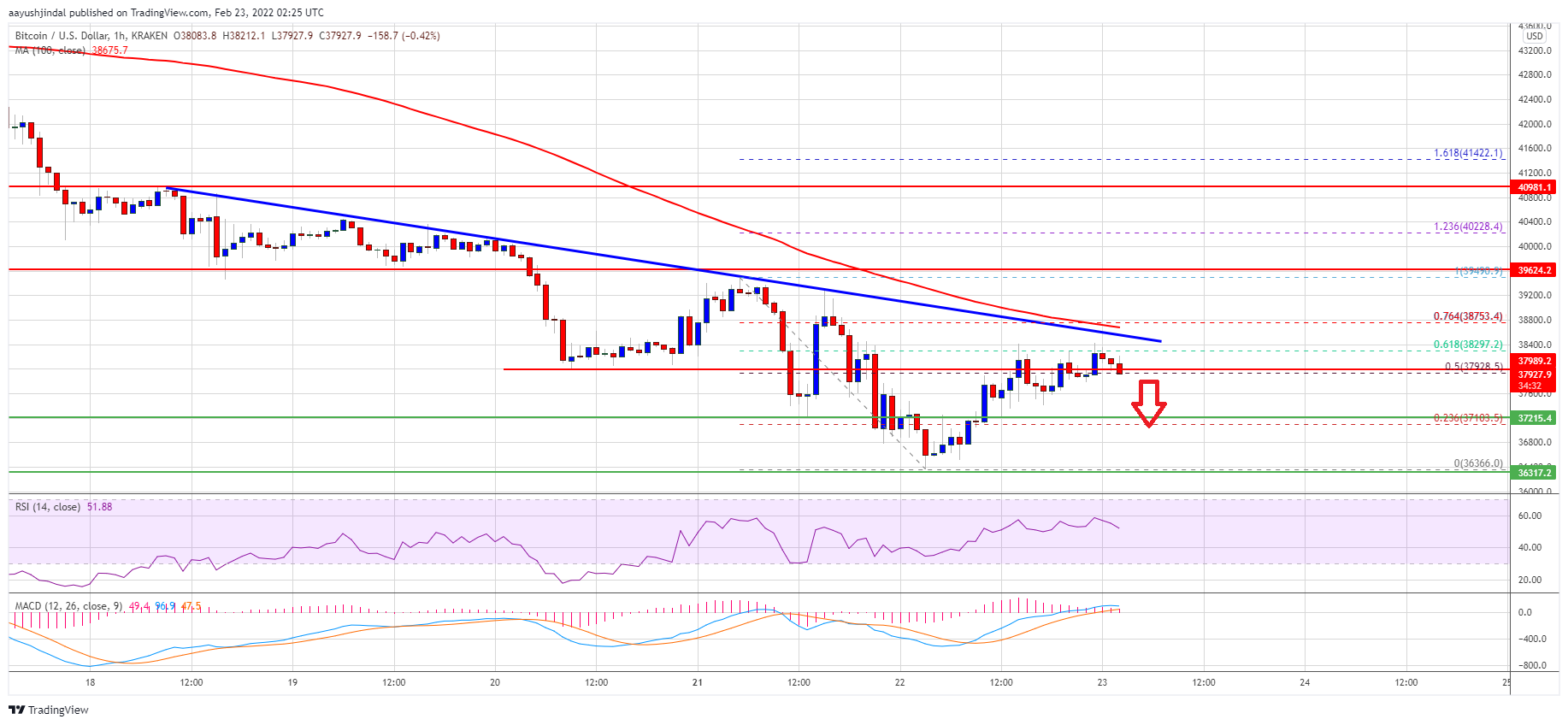
Bitcoin is struggling to recover above the $38,400 resistance zone against the US Dollar. BTC could resume decline if it stays below the $38,500 level.
Bitcoin is currently facing resistance near the $38,400 and $38,500 levels.
The price is trading below $38,500 and the 100 hourly simple moving average.
There is a crucial bearish trend line forming with resistance near $38,450 on the hourly chart of the BTC/USD pair (data feed from Kraken).
The pair could start a fresh decline if there is no clear move above $38,500.
Bitcoin Price Faces Hurdle
Bitcoin price found support near the $36,350 after a sharp decline. BTC formed a base and started a recovery wave above the $37,000 level. The price was able to surpass the $37,500 resistance level.
The bulls pushed the price above the 50% Fib retracement level of the key decline from the $39,492 swing high to $36,366 low. There was also a push above the $38,000 level. However, the price is now facing a strong resistance near the $38,250 level.
The 61.8% Fib retracement level of the key decline from the $39,492 swing high to $36,366 low is also near the $38,250 level. The next key resistance is near the $38,400 level.
There is also a crucial bearish trend line forming with resistance near $38,450 on the hourly chart of the BTC/USD pair. A clear move above the trend line resistance could send the price to $38,800 and the 100 hourly simple moving average.
Source: BTCUSD on TradingView.com
To gain bullish momentum, the price must settle above the $38,800 level. In the stated case, there are chances of a move above the $39,500 resistance.
Fresh Decline in BTC?
If bitcoin fails to start a recovery wave above the $38,400 resistance zone, it could start a fresh decline. An immediate support on the downside is near the $37,250 zone.
The next major support is seen near the $37,000 level. If there is a downside break below the $37,000 support zone, the price might gain bearish momentum for a move to $36,000. Any more losses could lead the price to $35,000.
Technical indicators:
Hourly MACD – The MACD is now losing pace in the bullish zone.
Hourly RSI (Relative Strength Index) – The RSI for BTC/USD is declining towards the 50 level.
Major Support Levels – $37,250, followed by $37,000.
Major Resistance Levels – $38,250, $38,400 and $39,500.
This report updates on what WEFUZZ, Coinbase Crypto Community Fund grant recipient, has been working on over the first part of their year-long Crypto development grant. This specifically covers their work on a decentralized, crowdsourced security audit and bug bounty solution.
By WEFUZZ, Coinbase Crypto Community Fund grant recipient
WEFUZZ implements a fully decentralized, crowdsourced security audit and bug bounty solution: a set of smart contracts that allow developers and companies to get their smart contracts, blockchains, websites, etc., audited by the auditors and hackers community. With this work, WEFUZZ aims to become the *Hacker DAO*.
Crowdsourcing is a sourcing model in which individuals or organizations obtain goods or services — including ideas, voting, micro-tasks etc., from a large, relatively open, and rapidly evolving group of participants. Companies like Uber, Gitcoin and GoJek already use this model. Crowdsourcing model offers improved costs, speed, quality, flexibility, scalability, and diversity.
The traditional crowdsourcing system consists mainly of three roles: requesters, workers (auditors in our case), and a centralized system. Requesters submit tasks to be completed through the crowdsourcing system. A set of auditors complete this task and submit solutions to the crowdsourcing system. Requesters will then select a proper solution (usually the first or the best one that solves the task) and reward the corresponding worker
This makes centralized systems vulnerable. User’s sensitive information (e.g. name, email address etc.,) and vulnerability reports are saved in the database of these centralized systems, which has the inherent risk of privacy disclosure and data loss. Centralized choke points are not only attack vectors for leaks and hacks, but also for outages.
Crowdsourcing companies are keen on maximizing their benefits and require requesters paying for services, which in turn increase user’s costs. Most crowdsourcing systems demand a 10–25% service fee.
All these issues add up to the already existing concerns of smart contract and multi-chains owners and developers (the audit requesters), freelance auditors’ and ethical hackers’ concerns. Some of these concerns are:
Ensuring their assets are safe from cyber theft, data hacks or any other risk that can result in a loss of funds and compromised data
Being able to get audits done in a cost-effective way — be it private or public security audits
Making sure the smart contracts are audited by multiple auditors
Hackers do not want to share sensitive personal data
Hackers and auditors and developers need complete transparency
WEFUZZ is a fully decentralized, crowdsourced audit and bug bounty platform aiming to be the Hacker DAO. WEFUZZ aims to provide reliability, fairness, security and low service fees by design.
The decentralized platform has many advantages such as higher user security, service availability, and lower costs. Smart contracts running on a chosen blockchain are used to perform the whole process of crowdsourcing tasks which contains posting audit and bounty campaigns, submitting audit and bug reports, bounty assignment, etc.
WEFUZZ solution offers numerous added benefits to users:
Data Security: Reports are encrypted with auditors’ and target developers’ public key, so that the bug reports only gets read by who it is intended for. Files are encrypted and stored on the decentralized network storage. No more data breaches, hacks, password leaks or any other risk affecting existing cloud based audit and bug bounty platforms.
Cost Effectiveness: Allowing smart contract developers, multi-chain developers, and companies to get audits performed in a cost-effective way directly by the auditors and hacker crowd on the WEFUZZ platform. This helps the developers and companies avoid huge fees and congestion issues affecting the traditional bug bounty platforms.
Flexible anonymity: Auditors and hackers can choose to remain anonymous while submitting reports, protecting their privacy, and still getting paid.
Communication Security: No centralized data storage, complete anonymity, no data transfers, no moderators and complete end-to-end encryption. All the data resides encrypted on the Solana blockchain and all the files reside on the IPFS blockchain.
Audit Requestors: Developers, companies or any individual can request audits or start a private/public bug bounty campaign.
Auditors: Auditors can be anyone from ethical hackers to audit firms who can perform the requested audits or participate in bug bounty campaigns.
Judges: Judges are community members who are either elected by the community or have been raised to the Judge category through reputation.
Currently, we are working on the conceptualization, technical architecture, and system design of WEFUZZ, besides building our MVP on Solana and Polygon blockchains, and testing the optimal chain for our project.
Please join our Discord and follow us on our Twitter and Medium to keep track of the progress. We are going to release the code and other tools we build as part of the research and development in this Github account.
Dubai, U.A.E., February 22nd, 2022 — MRHB DeFi, the world’s first ethics-based decentralized finance (DeFi) platform, is announcing the 22.2.22 launch of Sahal Wallet, a non-custodial cryptocurrency wallet that functions as a gateway to the entire MRHB ecosystem of ethical DeFi products.
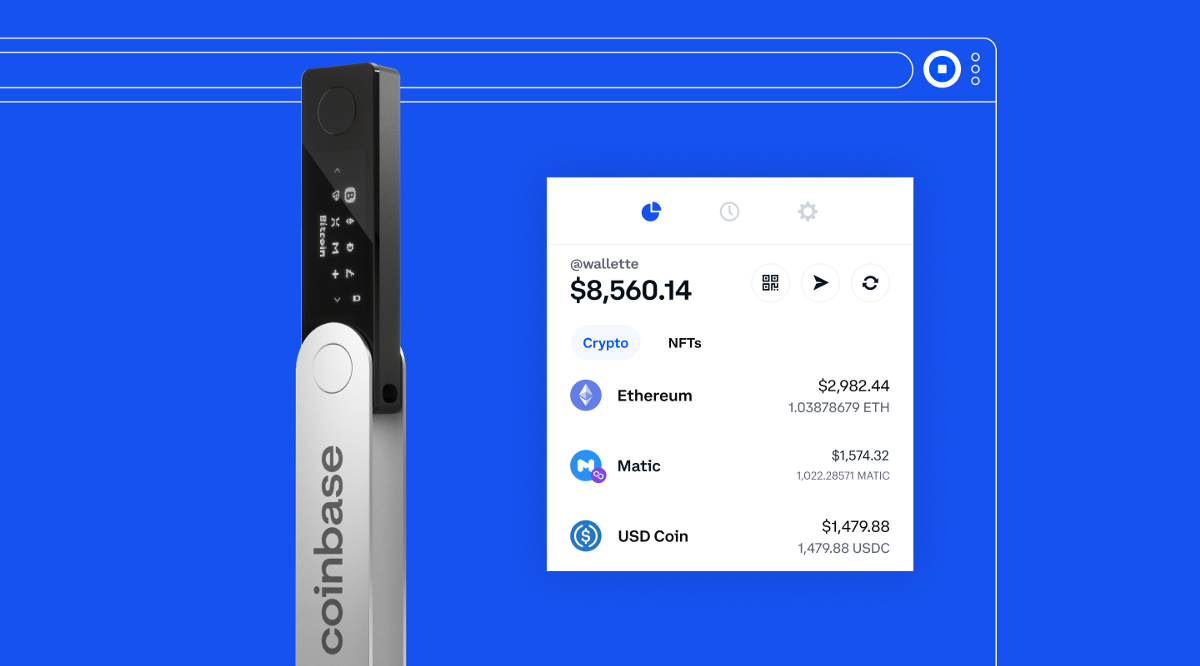
Since launching the Coinbase Wallet browser extension as a standalone self-custody option in November, we’ve seen incredible adoption. Wallet extension makes it even easier to explore web3 by bringing the world of decentralized apps (dapps) to more devices. Today, we’re adding support for Ledger hardware wallets to Coinbase Wallet extension, providing an additional layer of security and greater peace of mind for our users.
Ledger is an industry leader in hardware wallets, with more than 4 million people putting their trust in Ledger to keep their crypto safe. To celebrate today’s launch, we have partnered with Ledger to release the Nano X Coinbase Edition, which is available for a limited time in Ledger’s online store.
Building the most user-friendly self-custody experience in crypto means giving our users more ways to keep their crypto secure while they access web3 and the world of crypto. And today’s launch is just the beginning — we will continue to build out support for more hardware wallets across all of our users’ devices.
Coinbase Wallet is your passport to collecting NFTs, participating in DeFi, joining a DAO, and so much more. As you start to live more of your life on the blockchain, it’s more important than ever to keep your assets safe.
Fortunately, there are many steps you can take to keep you and your assets safe as you explore web3. It all starts with your recovery phrase, backing it up in a secure location, and making sure to never share it with anyone. And as a reminder, Coinbase will never ask you for your recovery phrase.
Coinbase Wallet offers additional layers of security for our users. For users of Wallet browser extension, we recommend adding a password to keep your assets safe. And in the Coinbase Wallet mobile app, you can use biometrics or a PIN to secure your Wallet.
Today, we are adding support for Ledger hardware wallets in the Coinbase Wallet browser extension, introducing an additional security option for our users. Hardware wallets are physical devices that store the private keys to your crypto wallet offline. Because every transaction on the blockchain requires both a user’s public and private keys, a hardware wallet ensures that only the user who holds the physical device can complete a transaction.
Using a hardware wallet is a lot like using two factor authentication to secure a website login, but instead of a six digit code that is sent as an SMS or generated in an authenticator app, your hardware wallet is used to physically confirm transactions with the press of a button.
Whether you are a first-time hardware wallet user or already have a Ledger it is easy to use Coinbase Wallet to connect to the ever-growing world of NFTs, dapps, and DeFi. All you need to do is download the Coinbase Wallet browser extension, connect your Ledger to your computer, and follow the on-screen instructions.
While today’s launch brings support for Ledger devices to the Wallet extension, we have ambitious plans to support more types of hardware wallets not only in Coinbase Wallet extension, but with our mobile apps as well. We will soon also add support for users with multiple active wallet addresses on a single Ledger device to select which address they want to use with Coinbase Wallet.
We want to empower everyone to use dapps and access web3, and that requires building the easiest-to-use and most accessible self-custody wallet in the ecosystem. Today’s release solves another set of important user needs, including the ability to use a hardware wallet for enhanced security.
You can experience the latest enhancements for yourself by downloading Coinbase Wallet for free from the App Store on iOS, Google Play on Android, or the Chrome web store. Make sure to follow us on Twitter @CoinbaseWallet for the latest Wallet-related news.
Coinbase Wallet is a self-custody wallet providing software services subject to Coinbase Wallet Terms of Service and Privacy Policy. Coinbase Wallet is distinct from Coinbase.com, and private keys for Coinbase Wallet are stored directly by the user and not by Coinbase.com. Fees may apply. You do not need a Coinbase.com account to use Coinbase Wallet.
Ledger and the Ledger logo are registered trademarks of Ledger SAS. Purchase of the Ledger Nano X Coinbase Edition can be made on Ledger’s website and subject to Ledger Sales Terms and Conditions and Privacy Policy. Subject to availability.
Data from Cointelegraph Markets Pro and TradingView showed an eerily calm start to the first Wall Street session of the week for both stocks and crypto.
Fears of a dramatic bout of volatility accompanying the open thanks to Feb. 21’s announcement by Russian President Vladimir Putin that he would recognize two breakaway republics in eastern Ukraine had been high.
Sanctions, still being announced at the time of writing, were likewise assumed to be about to fuel the fire but on the day, there was little movement.
The S&P 500 was all but flat thirty minutes after trading began, leaving Russian markets as the main losers and gold as the standout winner.
“I think that we’re going to open in the red and then, immediately bounce up on the risk-on assets and have a slight correction on gold,” Cointelegraph contributor Michaël van de Poppe previously forecast.
Fellow trader and analyst Scott Melker meanwhile focused attention on the potential for the Russia-Ukraine debacle to influence policy at the United States Federal Reserve.
According to banking giant JPMorgan, the effect of a potential conflict could be to make the Fed abandon the veracity of its planned interest rate hikes this year.
Lol
So war potentially means more stimulus and printing = good for assets.
According to a note published Feb. 22 quoted by various media outlets, analysts at JPMorgan believe that the trigger for a Fed rethink would come in the form of commodity price increases.
“Russia-Ukraine tension is a low earnings risk for U.S. corporates, but an energy price shock amid an aggressive central bank pivot focused on inflation could further dampen investor sentiment and growth outlook,” they wrote.
The sanctions meanwhile held off on all-out economic retaliation, with Russia’s two largest state-owned banks, Sberbank and VTB, left untouched.
Traders take Bitcoin’s recovery one step at a time
Looking ahead on Bitcoin, popular trader Anbessa meanwhile eschewed calm as BTC/USD conformed to expectations without a significant trend violation.
Related: Bitcoin Mayer Multiple returns to July 2021 levels in fresh sign $37K BTC is a long-term buy
A potential support/resistance flip near $37,700 was on the cards, he said, this hopefully becoming an important feature for the higher timeframe chart going forward.
If you expect the HTF S/R flip u don’t care how high #BTC pumps shortterm.
Patience is a virtue. Today #BTC followed the projection after hitting $45,8k and while your Guru panics, you have to know throwbacks are healthy.
As Cointelegraph reported, however, Bitcoin and altcoins remain off the radar for the majority of mainstream consumers, with mostly large-volume institutional players and whales maintaining meaningful participation.
“If we are bleeding new users but still have heavy dilution and retail outflows. There is no recovery. Maybe for BTC. But not alts far out on the risk curve,” fellow trader Pentoshi added in his own discussion of the macro environment.
Solana (SOL), also known as the ‘Ethereum Killer’ suffered from heavy losses since November 2021. At its peak Solana was trading at $260 (approx.) and is currently orbiting around $94. We will discuss whether SOL has the potential to break higher with its projects and tokens.
Why Investors Are Selling Solana?
Before attempting to assess whether Solana can indeed rebound from its current levels, it is important to understand what leads to the strong selling in the cryptocurrency. While some analysts are pointing to the recent OpenSea phishing attack as the cause, Solana has suffered from more severe issues.
Congestion in the network weighed on the cryptocurrency last month. The recent wormhole bridge hack only fueled the selling.
source: ethexplorer
Over $320 million was stolen via the wormhole bridge that allowed investors to ETH from the Ethereum blockchain to Solana. The ETH is converted to Wormhole ETH or wETH for short, which is pegged to the value Ethereum in the ETH blockchain.
A vulnerability in the bridge’s function (validator action approval or VAA for short) enabled the hacker to mint 120,000 wETH, which was valued at a notch over $322 million. The hacker transferred 93,750 wETH back to ETH, the remaining 26,250 wETH was swapped for 432,662 SOL (approx.).
source: wETH minting hack recorded at solana explorer
As 120,000 wETH went missing (from the mint) it was required for the sum to be replaced. Initially, there was great uncertainty as to who would provide the missing cryptocurrencies.
Jump Crypto Replaced 120,000 wETH
A message was sent to the attacker via Notifi, an Ethereum messaging service. The hacker was offered a bounty of $10 million for the exploit details and the return of the minted wETH,
“We noticed you were able to exploit the Solana VAA verification and mint tokens. We’d like to offer you a whitehat agreement, and present you a bug bounty of $10 million for exploit details, and returning the wETH you’ve minted.”
(View the full message on Notifi)
The hacker ignored the message and kept the 93,750 ETH in his account.
Jump Crypto shortly announced on Twitter that it has replaced the missing 120,000 wETH in order to sustain the network. Without the cryptocurrencies, there would have been serious repercussions. The vulnerability in the wormhole bridge was patched.
The bridge hack is what took SOL below $100 in the market. Investors would like to see some reassurance that security is a top priority. Solana is trading in tandem with leading
cryptocurrencies
Cryptocurrencies
By using cryptography, virtual currencies, known as cryptocurrencies, are nearly counterfeit-proof digital currencies that are built on blockchain technology. Comprised of decentralized networks, blockchain technology is not overseen by a central authority.Therefore, cryptocurrencies function in a decentralized nature which theoretically makes them immune to government interference. The term, cryptocurrency derives from the origin of the encryption techniques that are employed to secure the networks which are used to authenticate blockchain technology. Cryptocurrencies can be thought of as systems that accept online payments which are denoted as “tokens.” Tokens are represented as internal ledger entries in blockchain technology while the term crypto is used to depict cryptographic methods and encryption algorithms such as public-private key pairs, various hashing functions, and an elliptical curve. Every cryptocurrency transaction that occurs is logged in a web-based ledger with blockchain technology.These then must be approved by a disparate network of individual nodes (computers that maintain a copy of the ledger). For every new block generated, the block must first be authenticated and confirmed ‘approved’ by each node, which makes forging the transactional history of cryptocurrencies nearly impossible. The World’s First CryptoBitcoin became the first blockchain-based cryptocurrency and to this day is still the most demanded cryptocurrency and the most valued. Bitcoin still contributes the majority of the overall cryptocurrency market volume, though several other cryptos have grown in popularity in recent years.Indeed, out of the wake of Bitcoin, iterations of Bitcoin became prevalent which resulted in a multitude of newly created or cloned cryptocurrencies. Contending cryptocurrencies that emerged after Bitcoin’s success is referred to as ‘altcoins’ and they refer to cryptocurrencies such as Bitcoin, Peercoin, Namecoin, Ethereum, Ripple, Stellar, and Dash. Cryptocurrencies promise a wide range of technological innovations that have yet to be structured into being. Simplified payments between two parties without the need for a middle man is one aspect while leveraging blockchain technology to minimize transaction and processing fees for banks is another. Of course, cryptocurrencies have their disadvantages too. This includes issues of tax evasion, money laundering, and other illicit online activities where anonymity is a dire ingredient in solicitous and fraudulent activities.
By using cryptography, virtual currencies, known as cryptocurrencies, are nearly counterfeit-proof digital currencies that are built on blockchain technology. Comprised of decentralized networks, blockchain technology is not overseen by a central authority.Therefore, cryptocurrencies function in a decentralized nature which theoretically makes them immune to government interference. The term, cryptocurrency derives from the origin of the encryption techniques that are employed to secure the networks which are used to authenticate blockchain technology. Cryptocurrencies can be thought of as systems that accept online payments which are denoted as “tokens.” Tokens are represented as internal ledger entries in blockchain technology while the term crypto is used to depict cryptographic methods and encryption algorithms such as public-private key pairs, various hashing functions, and an elliptical curve. Every cryptocurrency transaction that occurs is logged in a web-based ledger with blockchain technology.These then must be approved by a disparate network of individual nodes (computers that maintain a copy of the ledger). For every new block generated, the block must first be authenticated and confirmed ‘approved’ by each node, which makes forging the transactional history of cryptocurrencies nearly impossible. The World’s First CryptoBitcoin became the first blockchain-based cryptocurrency and to this day is still the most demanded cryptocurrency and the most valued. Bitcoin still contributes the majority of the overall cryptocurrency market volume, though several other cryptos have grown in popularity in recent years.Indeed, out of the wake of Bitcoin, iterations of Bitcoin became prevalent which resulted in a multitude of newly created or cloned cryptocurrencies. Contending cryptocurrencies that emerged after Bitcoin’s success is referred to as ‘altcoins’ and they refer to cryptocurrencies such as Bitcoin, Peercoin, Namecoin, Ethereum, Ripple, Stellar, and Dash. Cryptocurrencies promise a wide range of technological innovations that have yet to be structured into being. Simplified payments between two parties without the need for a middle man is one aspect while leveraging blockchain technology to minimize transaction and processing fees for banks is another. Of course, cryptocurrencies have their disadvantages too. This includes issues of tax evasion, money laundering, and other illicit online activities where anonymity is a dire ingredient in solicitous and fraudulent activities. Read this Term such as ETH and Bitcoin.
Solana OpenSea Integration?
The hacker house events are a great idea. Core Solana Labs engineers participate in offline events, providing educational programming on DeFi, NFTs and how to start working with Solana. If the events would have been announced following the bridge exploitations and not in January, perhaps it would have had some impact on SOL.
We explored the play to earn games that are based on Solana’s blockchain. According to playtoearn.net which is listing the top 50 games per
blockchain
Blockchain
Blockchain comprises a digital network of blocks with a comprehensive ledger of transactions made in a cryptocurrency such as Bitcoin or other altcoins.One of the signature features of blockchain is that it is maintained across more than one computer. The ledger can be public or private (permissioned.) In this sense, blockchain is immune to the manipulation of data making it not only open but verifiable. Because a blockchain is stored across a network of computers, it is very difficult to tamper with. The Evolution of BlockchainBlockchain was originally invented by an individual or group of people under the name of Satoshi Nakamoto in 2008. The purpose of blockchain was originally to serve as the public transaction ledger of Bitcoin, the world’s first cryptocurrency.In particular, bundles of transaction data, called “blocks”, are added to the ledger in a chronological fashion, forming a “chain.” These blocks include things like date, time, dollar amount, and (in some cases) the public addresses of the sender and the receiver.The computers responsible for upholding a blockchain network are called “nodes.” These nodes carry out the duties necessary to confirm the transactions and add them to the ledger. In exchange for their work, the nodes receive rewards in the form of crypto tokens.By storing data via a peer-to-peer network (P2P), blockchain controls for a wide range of risks that are traditionally inherent with data being held centrally.Of note, P2P blockchain networks lack centralized points of vulnerability. Consequently, hackers cannot exploit these networks via normalized means nor does the network possess a central failure point.In order to hack or alter a blockchain’s ledger, more than half of the nodes must be compromised. Looking ahead, blockchain technology is an area of extensive research across multiple industries, including financial services and payments, among others.
Blockchain comprises a digital network of blocks with a comprehensive ledger of transactions made in a cryptocurrency such as Bitcoin or other altcoins.One of the signature features of blockchain is that it is maintained across more than one computer. The ledger can be public or private (permissioned.) In this sense, blockchain is immune to the manipulation of data making it not only open but verifiable. Because a blockchain is stored across a network of computers, it is very difficult to tamper with. The Evolution of BlockchainBlockchain was originally invented by an individual or group of people under the name of Satoshi Nakamoto in 2008. The purpose of blockchain was originally to serve as the public transaction ledger of Bitcoin, the world’s first cryptocurrency.In particular, bundles of transaction data, called “blocks”, are added to the ledger in a chronological fashion, forming a “chain.” These blocks include things like date, time, dollar amount, and (in some cases) the public addresses of the sender and the receiver.The computers responsible for upholding a blockchain network are called “nodes.” These nodes carry out the duties necessary to confirm the transactions and add them to the ledger. In exchange for their work, the nodes receive rewards in the form of crypto tokens.By storing data via a peer-to-peer network (P2P), blockchain controls for a wide range of risks that are traditionally inherent with data being held centrally.Of note, P2P blockchain networks lack centralized points of vulnerability. Consequently, hackers cannot exploit these networks via normalized means nor does the network possess a central failure point.In order to hack or alter a blockchain’s ledger, more than half of the nodes must be compromised. Looking ahead, blockchain technology is an area of extensive research across multiple industries, including financial services and payments, among others. Read this Term, only 3 games that are based on Solana are actually live. Most of the games are in development or in beta and alpha.
Age of Sam, a popular NFT Solana based project may be insufficient to lift the cryptocurrency higher.
At the end of January speculations on the Solana OpenSea integration surfaced. A well-known Hong Kong hacker by the name of Jane Manchun Wong is notorious for unearthing app features before they are publicly announced.
Jane has already revealed features on Instagram, Spotify and Facebook before they were announced to the public. According to a tweet on 25 January 2022, OpenSea is developing an integration with Phantom wallet.
Phantom wallet is used for buying and selling crypto and NFTs on the Solana blockchain.
Jane claims she used reverse engineering to unmask OpenSea’s intentions to integrate Solana into the NFT marketplace. OpenSea declined to confirm it has such plans.
Adding SOL to OpenSea, which is currently the biggest NFT marketplace platform, may contribute to SOL recovery from the bridge hack. Because of the recent phishing attack OpenSea experienced, the chance that such plans having ever existed may now be delayed.
OpenSea is currently busy dealing with the phishing attack. If there were integrations plans they may be delayed.
Is It a Good Time to Buy Solana?
From the technical end, Solana may struggle to trade back above $130. The next support based on the monthly chart is around $52. To invalidate the downtrend in the monthly chart, SOL may require to trade back above $160.
Based on the daily chart, some support is offered at the $84 mark. If Solana succeeds in breaking above $121, it may extend its gains towards $140.
Portals announced last week they have raised $5 million to build a metaverse platform based on the Solana blockchain. Foundation Capital and Alameda Research participated in the funding round.
Adam Gomez, the Co-Founder of Portals, said, “We are building an entirely new Times Square in the metaverse.” Building the platform may take time and had no impact on cryptocurrency.
President Biden is expected to issue the executive order on cryptocurrencies this week. The executive order will instruct governing bodies to begin the coordination of crypto regulations. It is unclear at the time of writing the impact the order will have as it is widely anticipated.
One event that has triggered a reaction in the crypto markets is the Fed monetary policy. A rate hike is expected in March 2022 with possible insights into the pace of future rate hikes. It is still early to predict how will the Fed impact SOL as it greatly depends on the monetary policy.
The daily support at $84 appears to be the only lifeboat for SOL at the time of writing.
Solana (SOL), also known as the ‘Ethereum Killer’ suffered from heavy losses since November 2021. At its peak Solana was trading at $260 (approx.) and is currently orbiting around $94. We will discuss whether SOL has the potential to break higher with its projects and tokens.
Why Investors Are Selling Solana?
Before attempting to assess whether Solana can indeed rebound from its current levels, it is important to understand what leads to the strong selling in the cryptocurrency. While some analysts are pointing to the recent OpenSea phishing attack as the cause, Solana has suffered from more severe issues.
Congestion in the network weighed on the cryptocurrency last month. The recent wormhole bridge hack only fueled the selling.
source: ethexplorer
Over $320 million was stolen via the wormhole bridge that allowed investors to ETH from the Ethereum blockchain to Solana. The ETH is converted to Wormhole ETH or wETH for short, which is pegged to the value Ethereum in the ETH blockchain.
A vulnerability in the bridge’s function (validator action approval or VAA for short) enabled the hacker to mint 120,000 wETH, which was valued at a notch over $322 million. The hacker transferred 93,750 wETH back to ETH, the remaining 26,250 wETH was swapped for 432,662 SOL (approx.).
source: wETH minting hack recorded at solana explorer
As 120,000 wETH went missing (from the mint) it was required for the sum to be replaced. Initially, there was great uncertainty as to who would provide the missing cryptocurrencies.
Jump Crypto Replaced 120,000 wETH
A message was sent to the attacker via Notifi, an Ethereum messaging service. The hacker was offered a bounty of $10 million for the exploit details and the return of the minted wETH,
“We noticed you were able to exploit the Solana VAA verification and mint tokens. We’d like to offer you a whitehat agreement, and present you a bug bounty of $10 million for exploit details, and returning the wETH you’ve minted.”
(View the full message on Notifi)
The hacker ignored the message and kept the 93,750 ETH in his account.
Jump Crypto shortly announced on Twitter that it has replaced the missing 120,000 wETH in order to sustain the network. Without the cryptocurrencies, there would have been serious repercussions. The vulnerability in the wormhole bridge was patched.
The bridge hack is what took SOL below $100 in the market. Investors would like to see some reassurance that security is a top priority. Solana is trading in tandem with leading
cryptocurrencies
Cryptocurrencies
By using cryptography, virtual currencies, known as cryptocurrencies, are nearly counterfeit-proof digital currencies that are built on blockchain technology. Comprised of decentralized networks, blockchain technology is not overseen by a central authority.Therefore, cryptocurrencies function in a decentralized nature which theoretically makes them immune to government interference. The term, cryptocurrency derives from the origin of the encryption techniques that are employed to secure the networks which are used to authenticate blockchain technology. Cryptocurrencies can be thought of as systems that accept online payments which are denoted as “tokens.” Tokens are represented as internal ledger entries in blockchain technology while the term crypto is used to depict cryptographic methods and encryption algorithms such as public-private key pairs, various hashing functions, and an elliptical curve. Every cryptocurrency transaction that occurs is logged in a web-based ledger with blockchain technology.These then must be approved by a disparate network of individual nodes (computers that maintain a copy of the ledger). For every new block generated, the block must first be authenticated and confirmed ‘approved’ by each node, which makes forging the transactional history of cryptocurrencies nearly impossible. The World’s First CryptoBitcoin became the first blockchain-based cryptocurrency and to this day is still the most demanded cryptocurrency and the most valued. Bitcoin still contributes the majority of the overall cryptocurrency market volume, though several other cryptos have grown in popularity in recent years.Indeed, out of the wake of Bitcoin, iterations of Bitcoin became prevalent which resulted in a multitude of newly created or cloned cryptocurrencies. Contending cryptocurrencies that emerged after Bitcoin’s success is referred to as ‘altcoins’ and they refer to cryptocurrencies such as Bitcoin, Peercoin, Namecoin, Ethereum, Ripple, Stellar, and Dash. Cryptocurrencies promise a wide range of technological innovations that have yet to be structured into being. Simplified payments between two parties without the need for a middle man is one aspect while leveraging blockchain technology to minimize transaction and processing fees for banks is another. Of course, cryptocurrencies have their disadvantages too. This includes issues of tax evasion, money laundering, and other illicit online activities where anonymity is a dire ingredient in solicitous and fraudulent activities.
By using cryptography, virtual currencies, known as cryptocurrencies, are nearly counterfeit-proof digital currencies that are built on blockchain technology. Comprised of decentralized networks, blockchain technology is not overseen by a central authority.Therefore, cryptocurrencies function in a decentralized nature which theoretically makes them immune to government interference. The term, cryptocurrency derives from the origin of the encryption techniques that are employed to secure the networks which are used to authenticate blockchain technology. Cryptocurrencies can be thought of as systems that accept online payments which are denoted as “tokens.” Tokens are represented as internal ledger entries in blockchain technology while the term crypto is used to depict cryptographic methods and encryption algorithms such as public-private key pairs, various hashing functions, and an elliptical curve. Every cryptocurrency transaction that occurs is logged in a web-based ledger with blockchain technology.These then must be approved by a disparate network of individual nodes (computers that maintain a copy of the ledger). For every new block generated, the block must first be authenticated and confirmed ‘approved’ by each node, which makes forging the transactional history of cryptocurrencies nearly impossible. The World’s First CryptoBitcoin became the first blockchain-based cryptocurrency and to this day is still the most demanded cryptocurrency and the most valued. Bitcoin still contributes the majority of the overall cryptocurrency market volume, though several other cryptos have grown in popularity in recent years.Indeed, out of the wake of Bitcoin, iterations of Bitcoin became prevalent which resulted in a multitude of newly created or cloned cryptocurrencies. Contending cryptocurrencies that emerged after Bitcoin’s success is referred to as ‘altcoins’ and they refer to cryptocurrencies such as Bitcoin, Peercoin, Namecoin, Ethereum, Ripple, Stellar, and Dash. Cryptocurrencies promise a wide range of technological innovations that have yet to be structured into being. Simplified payments between two parties without the need for a middle man is one aspect while leveraging blockchain technology to minimize transaction and processing fees for banks is another. Of course, cryptocurrencies have their disadvantages too. This includes issues of tax evasion, money laundering, and other illicit online activities where anonymity is a dire ingredient in solicitous and fraudulent activities. Read this Term such as ETH and Bitcoin.
Solana OpenSea Integration?
The hacker house events are a great idea. Core Solana Labs engineers participate in offline events, providing educational programming on DeFi, NFTs and how to start working with Solana. If the events would have been announced following the bridge exploitations and not in January, perhaps it would have had some impact on SOL.
We explored the play to earn games that are based on Solana’s blockchain. According to playtoearn.net which is listing the top 50 games per
blockchain
Blockchain
Blockchain comprises a digital network of blocks with a comprehensive ledger of transactions made in a cryptocurrency such as Bitcoin or other altcoins.One of the signature features of blockchain is that it is maintained across more than one computer. The ledger can be public or private (permissioned.) In this sense, blockchain is immune to the manipulation of data making it not only open but verifiable. Because a blockchain is stored across a network of computers, it is very difficult to tamper with. The Evolution of BlockchainBlockchain was originally invented by an individual or group of people under the name of Satoshi Nakamoto in 2008. The purpose of blockchain was originally to serve as the public transaction ledger of Bitcoin, the world’s first cryptocurrency.In particular, bundles of transaction data, called “blocks”, are added to the ledger in a chronological fashion, forming a “chain.” These blocks include things like date, time, dollar amount, and (in some cases) the public addresses of the sender and the receiver.The computers responsible for upholding a blockchain network are called “nodes.” These nodes carry out the duties necessary to confirm the transactions and add them to the ledger. In exchange for their work, the nodes receive rewards in the form of crypto tokens.By storing data via a peer-to-peer network (P2P), blockchain controls for a wide range of risks that are traditionally inherent with data being held centrally.Of note, P2P blockchain networks lack centralized points of vulnerability. Consequently, hackers cannot exploit these networks via normalized means nor does the network possess a central failure point.In order to hack or alter a blockchain’s ledger, more than half of the nodes must be compromised. Looking ahead, blockchain technology is an area of extensive research across multiple industries, including financial services and payments, among others.
Blockchain comprises a digital network of blocks with a comprehensive ledger of transactions made in a cryptocurrency such as Bitcoin or other altcoins.One of the signature features of blockchain is that it is maintained across more than one computer. The ledger can be public or private (permissioned.) In this sense, blockchain is immune to the manipulation of data making it not only open but verifiable. Because a blockchain is stored across a network of computers, it is very difficult to tamper with. The Evolution of BlockchainBlockchain was originally invented by an individual or group of people under the name of Satoshi Nakamoto in 2008. The purpose of blockchain was originally to serve as the public transaction ledger of Bitcoin, the world’s first cryptocurrency.In particular, bundles of transaction data, called “blocks”, are added to the ledger in a chronological fashion, forming a “chain.” These blocks include things like date, time, dollar amount, and (in some cases) the public addresses of the sender and the receiver.The computers responsible for upholding a blockchain network are called “nodes.” These nodes carry out the duties necessary to confirm the transactions and add them to the ledger. In exchange for their work, the nodes receive rewards in the form of crypto tokens.By storing data via a peer-to-peer network (P2P), blockchain controls for a wide range of risks that are traditionally inherent with data being held centrally.Of note, P2P blockchain networks lack centralized points of vulnerability. Consequently, hackers cannot exploit these networks via normalized means nor does the network possess a central failure point.In order to hack or alter a blockchain’s ledger, more than half of the nodes must be compromised. Looking ahead, blockchain technology is an area of extensive research across multiple industries, including financial services and payments, among others. Read this Term, only 3 games that are based on Solana are actually live. Most of the games are in development or in beta and alpha.
Age of Sam, a popular NFT Solana based project may be insufficient to lift the cryptocurrency higher.
At the end of January speculations on the Solana OpenSea integration surfaced. A well-known Hong Kong hacker by the name of Jane Manchun Wong is notorious for unearthing app features before they are publicly announced.
Jane has already revealed features on Instagram, Spotify and Facebook before they were announced to the public. According to a tweet on 25 January 2022, OpenSea is developing an integration with Phantom wallet.
Phantom wallet is used for buying and selling crypto and NFTs on the Solana blockchain.
Jane claims she used reverse engineering to unmask OpenSea’s intentions to integrate Solana into the NFT marketplace. OpenSea declined to confirm it has such plans.
Adding SOL to OpenSea, which is currently the biggest NFT marketplace platform, may contribute to SOL recovery from the bridge hack. Because of the recent phishing attack OpenSea experienced, the chance that such plans having ever existed may now be delayed.
OpenSea is currently busy dealing with the phishing attack. If there were integrations plans they may be delayed.
Is It a Good Time to Buy Solana?
From the technical end, Solana may struggle to trade back above $130. The next support based on the monthly chart is around $52. To invalidate the downtrend in the monthly chart, SOL may require to trade back above $160.
Based on the daily chart, some support is offered at the $84 mark. If Solana succeeds in breaking above $121, it may extend its gains towards $140.
Portals announced last week they have raised $5 million to build a metaverse platform based on the Solana blockchain. Foundation Capital and Alameda Research participated in the funding round.
Adam Gomez, the Co-Founder of Portals, said, “We are building an entirely new Times Square in the metaverse.” Building the platform may take time and had no impact on cryptocurrency.
President Biden is expected to issue the executive order on cryptocurrencies this week. The executive order will instruct governing bodies to begin the coordination of crypto regulations. It is unclear at the time of writing the impact the order will have as it is widely anticipated.
One event that has triggered a reaction in the crypto markets is the Fed monetary policy. A rate hike is expected in March 2022 with possible insights into the pace of future rate hikes. It is still early to predict how will the Fed impact SOL as it greatly depends on the monetary policy.
The daily support at $84 appears to be the only lifeboat for SOL at the time of writing.
Recently we sat down with Matas Sauciunas, CEO of one of the most exciting DeFi projects of the year: ALF Protocol. Matas and his team have already secured significant Venture Capital funding which they have used to develop a protocol for capital deployment on Solana for the purposes of liquidity provision and yield farming. Alf aims to become the go-to place for blockchain liquidity, initially launching on Solana and then potentially expanding to other chains.
Matas is passionate about the Solana ecosystem and how its low fees and extremely high speed give it the potential to be the leading Layer 1 solution, and his team is building out a core piece of the Solana native Decentralized Financial services. I trust you enjoy this conversation as much as I did and I look forward to watching this dynamic team and project go from strength to strength in 2022.
Interviewer: Hi Matas, thank you for setting aside the time for this interview. I can imagine how busy everything is at your side, knowing that the development of the protocol is well underway. Please, could you explain in a simple way what is Alfprotocol?
Matas: Hi there. Yes, everything is super busy on our side, but anyway it’s great meeting you and speaking with you today. I get this question quite often because of the complexity of the project so my usual reply is that Alfprotocol is a decentralized application built on the Solana blockchain that lets the user supply their tokens to earn interest, borrow some funds for outside use by providing collateral, use our in-house built decentralized exchange & become liquidity providers by supplying tokens to the farms and earn yield rewards and token rewards. What’s unique is that Alfprotocol will provide leverage for users to use to increase their position size while investing in the liquidity provision.
Interviewer: The idea that you and your team are building sounds complex but exciting! Could you tell me a bit more about Decentralised Finance (DeFi)? Why is DeFi getting so much hype and what is your personal opinion on the future of DeFi?
Matas: Decentralized Finance lets users use financial services like lending and borrowing without centralized intermediaries, it also provides endless opportunities to create different protocols that are providing unique use cases of the decentralized money market. What’s important is that DeFi had a growth of 88x last year and is expected to grow by another 10x this year. Also, DeFi comprises only around 5-6% of the entire cryptocurrency market cap. That statistic alone gives me the insight that we’re still in the early stages of DeFi, and we can lock a decent spot within the ecosystem itself.
Interviewer: Thank you for such an explanation. Alfprotocol has chosen the Solana blockchain to work on. Why Solana?
Matas: First of all, Solana is experiencing tremendous growth in attention from developers and investors. And that attention comes for a reason. Solana blockchain is super fast and super cheap and next to that the whole ecosystem of Solana is growing rapidly. We chose Solana because we’re building a leveraged protocol, so we need a blockchain that is super fast with the transactions and also cheap to use. Solana can provide that. Also, the DeFi protocols within the Solana are still at the early stages. So we do have a great opportunity to lock a decent spot for the future of Solana and aim to become a homepage for DeFi on Solana.
Interviewer: Thank you. Solana is definitely on a massive growth trend as you said. Your and your team’s decision to build on this fast and inexpensive blockchain does make sense. Could you provide the top three advantages of the Alfprotocol?
Matas: Certainly. The first advantage would be that users will have an all-in-one place, (a “one-stop shop”) for all DeFi services which at the moment isn’t widely available in the ecosystem, meaning users need to move between different protocols. The second advantage is that those who are risk-seeking investors will have an opportunity to use higher leverage (in some cases up to 200x) for liquidity provision. Of course, the use of high leverage will be highly monitored and will be available for limited farms and users. And lastly, the third advantage is that the entire team building and collaborating on the protocol is transparent and provides regular updates on the development status, educational material, etc. So having a strong and transparent team behind the protocol is a very important aspect.
Interviewer: Absolutely. Transparency and regular communication with the community is always necessary. Just a few more questions Matas, at what stage is your project now and who are the backers of the Alfprotocol right now?
Matas: At the moment Alfprotocol is at the early development stage. We aim to have our public IDO within Q2 of 2022 and aim to launch a fully working protocol in late Q3, 2022. The MVP release of the protocol is expected to take place in early Q2, 2022. The current backers of the project are Zen Capital, Dust Ventures, DIB Ventures, SRT Ventures, Alpha Hunt and Scorpio VC.
Interviewer: Last question for you Matas: how can users participate in the early stage of the Alfprotocol?
Matas: Users do have an opportunity to apply an allocation of Alfprotocol tokens at this early stage of the protocol just like Venture Capital firms do. We cal this round a Pre-IDO round and it is available on our website. Alternatively, users can send us an email via [email protected] with the headline of “Pre-IDO round” and our dedicated person will reply and help with the allocation process.
Interviewer: Thank you for answering all of the questions! It’s been a great time speaking with you and I would like to wish you all the best for the future of Alfprotocol!
Matas: It’s been a great talk with you as well – thank you for your time.