Now that altcoin season is upon us again, multiple tokens are witnessing illustrious price hikes every day. In a sideways market, a key skill for a trader is the ability to anticipate when an asset will break out — and when everything is green, knowing when the rallies are coming to an end becomes equally essential.
This week, CELO embarked on a flash rally that generated an almost vertical line on its price chart, but then it quickly faded without ushering in a strong second wave.
Aside from keeping a steady eye on candlestick charts, was there a better way for traders to know in advance when to hop off?
A new DeFi initiative fuels CELO’s price spike
CELO is the native asset of the Celo blockchain ecosystem, whose main goal is to introduce the convenience of decentralized finance, or DeFi, to underbanked smartphone users around the world. A utility token that utilizes a proof-of-stake consensus mechanism, CELO is designed to facilitate transactions and governance processes on the platform.
On Aug. 30, a consortium of DeFi entities — including Aave, SushiSwap, Curve, 0x, PoolTogether and Celo — announced a joint educational effort aimed at raising global awareness of decentralized finance, to which they pledged up to $100 million in grants and incentives.
In terms of the immediate effect on crypto-asset prices, CELO stood to benefit the most from the news, as the Celo platform will serve as the primary infrastructure for the initiative. The coin’s price soared immediately, gaining some 170% within the next 24 hours.
Extraordinary price spikes like this one often end with hard corrections. However, there is always hope for investors that an even more powerful pump is just around the corner. In CELO’s case, however, the first peak at $9 remained the high-water mark, and the coin’s price only went down from there.
Anticipating a price decline
In addition to being one of the week’s top gainers, CELO is also one of the few assets that recorded a low VORTECS™ Score.
The VORTECS™ Score is a machine learning algorithm that compares historic and current market conditions around digital assets to aid crypto traders’ decision-making. Available exclusively to Cointelegraph Markets Pro subscribers, the indicator considers a host of variables — including price movement, trading volume, social sentiment and market outlook — to arrive at a score that assesses whether the present conditions for a given coin are historically bullish, neutral or bearish.
High scores indicate the model’s confidence that the conditions currently observed are historically favorable; low scores, which occur less frequently, appear when the algorithm sees a pattern that in the past consistently preceded significant price drops.
CELO price vs VORTECS™Score. Source: Cointelegraph Markets Pro
As visible in the above graph, CELO’s VORTECS™ Score dipped into the red zone below 30 when the asset’s price briefly recovered from $7.03 to $7.24 on its way down from the peak value of $9. While this bounce could look like the beginning of the rally’s second leg, historical precedent suggested that the conditions around the coin were bearish.
Traders could use this insight in several ways. Those who had hoped for the price to soar again could be nudged to abandon these hopes and lock in their profits above $7. Another strategy could be to short CELO, wagering that its price would soon return to a downward slope.
As for CELO, the asset soon stabilized in the range between $5.50 and $6, which still represented considerable growth from the $4.30 region from which it exploded during the initial rally.
Cointelegraph is a publisher of financial information, not an investment adviser. We do not provide personalized or individualized investment advice. Cryptocurrencies are volatile investments and carry significant risk including the risk of permanent and total loss. Past performance is not indicative of future results. Figures and charts are correct at the time of writing or as otherwise specified. Live-tested strategies are not recommendations. Consult your financial advisor before making financial decisions.
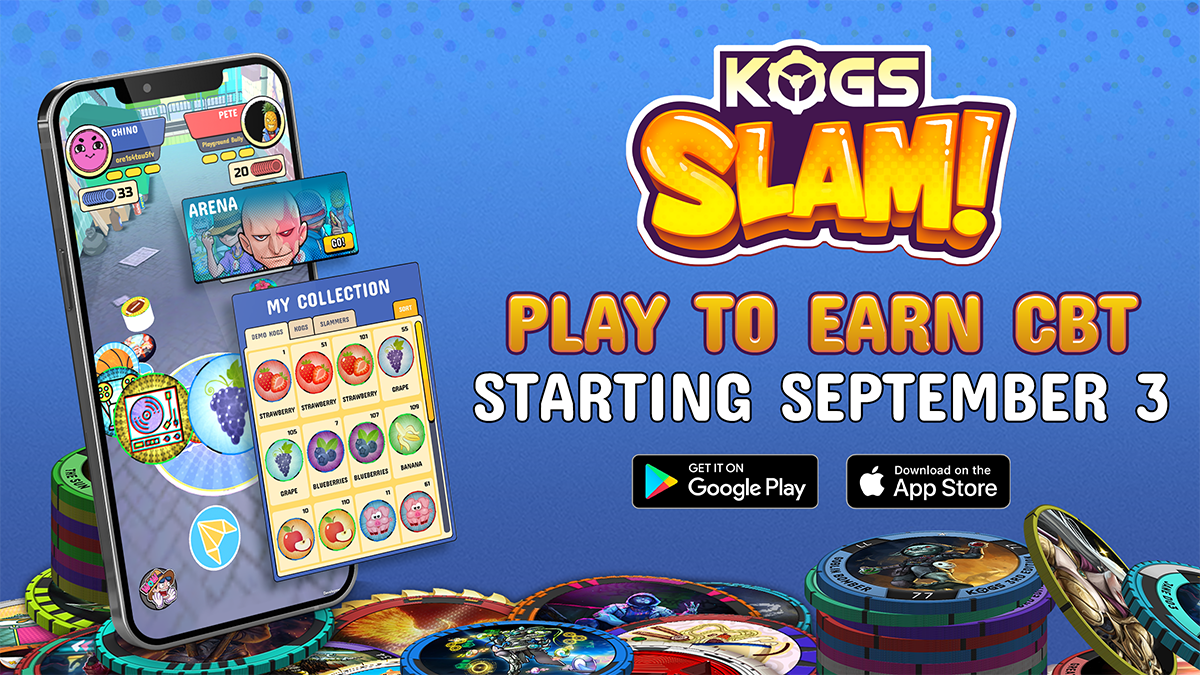
Manila, Philippines, September 3, 2021 — Southeast Asian based RFOX Games (a subsidiary of RedFOX Labs $RFOX) will release its free-to-play play-to-earn game KOGs SLAM! in closed beta this Friday the 3rd of September and welcome YGG (Yield Guild Games) to the beta release.
RFOX Games’ maiden release KOGs SLAM! is a digital gaming experience inspired by the 90’s schoolyard phenomenon POGs. RFOX Games will introduce a free play-to-earn model to millions of users in the Southeast Asian region.
RFOX Games, a subsidiary of Southeast Asian venture builder RedFOX Labs, has been working on a game that focuses on digital inclusion and allows people hit hardest by economic challenges an opportunity to earn from their mobile phones.
The closed beta trial for play-to-earn will kick off on September 3 and run for a month before its international public release. The beta release will allow for 5,000 participants to compete for the $RFOX token and prizes and is expected to be heavily oversubscribed.
The easy-to-learn game also has a popular NFT collection called KOGs, which is an acronym for Keys to Other Games. KOGs recently launched its limited Bad Days NFT collection featuring Marvel characters created by Stan Lee. The sale ended last August 28 but you can still buy KOGs here.
Ben Fairbank, CEO, and Co-founder of RedFOX Labs commented:
“It is highly likely that this game could reach millions of users across Southeast Asia and beyond when you consider that a free play-to-earn model would be welcomed with open arms by those most impacted by COVID, with many having lost their jobs.”
“We had an ambitious plan and model, and we are finally ready to go to the closed beta for the play-to-earn. We are thrilled to welcome YGG and Real Deal to the trial who can help us gain exposure to a wider audience of play-to-earn gamers. We are thrilled to have organizations of this caliber join the trial.”
Gabby Dizon, Co-founder of Yield Guild Games commented:
“We’re happy to be working with RFOX GAMES to bring YGG members into the KOGS SLAM closed beta. This gives an opportunity for our underserved members to start earning while they move up our scholarship waitlist. Being able to start playing for free and move earnings directly to GCash will massively increase play-to-earn adoption in the Philippines.”
Register here for the closed beta and early releases.
RedFOX Labs will also feature the KOGs collection and games in its upcoming metaverse the RFOX VALT
About RFOX Games
RFOX Games, launched by RedFOX Labs, Southeast Asia’s first blockchain venture builder. RFOX Games is building a series of interoperable games that are PLAY TO EARN and support the KOGs NFT collection. The entire RFOX ecosystem is supported by its native currency $RFOX and users will be able to compete in head-to-head and tournament-based games to win NFT prizes and $RFOX.
About Yield Guild Games
Yield Guild Games (YGG) is a decentralized autonomous organization (DAO) for investing in non-fungible tokens (NFTs) used in virtual worlds and blockchain-based games. The organization’s mission is to create the biggest virtual world economy, optimizing its community-owned assets for maximum utility and sharing its profits with its token holders.
Steven Ehrlich, director of research for digital assets at Forbes, discusses the FTX.US-LedgerX merger, what to expect from FTX going forward, DeFi regulation, and more. Show highlights:
why the FTX.US acquisition of derivatives platform LedgerX is significant
how FTX.US stacks up against other US cryptocurrency exchanges
who should use crypto derivative products
how regulators might handle FTX.US and crypto derivative ETFs
what to expect from FTX going forward
how long FTX CEO Sam Bankman-Fried spends talking to regulators every day
why Steven thinks crypto mergers and acquisitions will be a trend going forward
what Steven learned from his conversations with Polygon and Hermez
how Fereshteh Forough, a woman living in Afghanistan, is using crypto to help teach women to build dapps, smart contracts, and use crypto
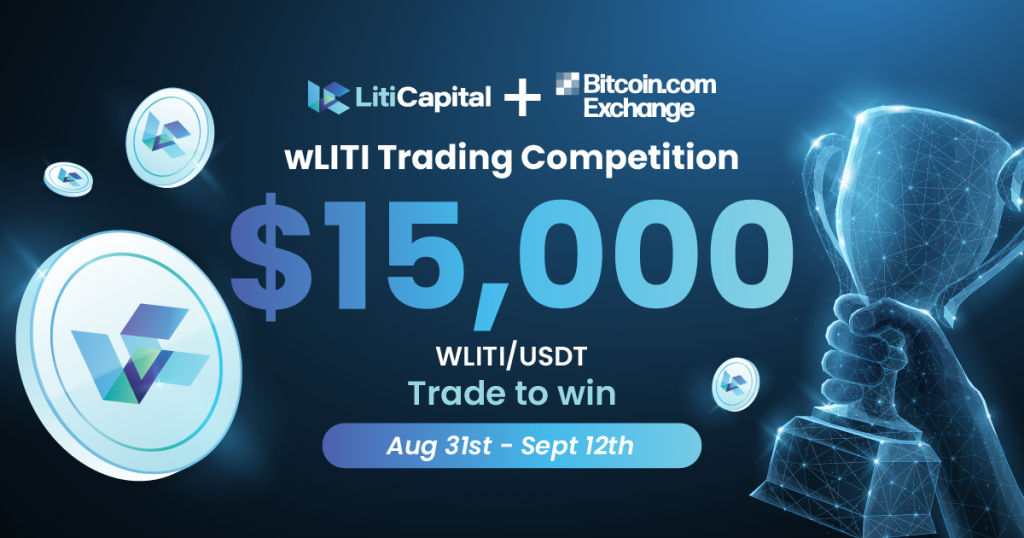
To celebrate the listing of wLITI on Bitcoin.com Exchange, apply to win a piece of a $15,000 prize pool!
The top X Traders with the highest trading volume will be sharing the prize pool. The competition starts on August 31st at 0:01 UTC and runs until September 12th at 23:59 UTC.
You can join by simply going to our competition page, clicking the apply now button, and registering for it. Your trading volume will then automatically be tallied.
GO TO COMPETITION PAGE
Prizes will be awarded in the following manner:
1. $1,950 wLITI
2. $1,000 wLITI
3. $950 wLITI
4. $850 wLITI
5. $750 wLITI
6. $700 wLITI
7. $600 wLITI
8. $550 wLITI
9. $500 wLITI
10. $450 wLITI
11. $400 wLITI
12. $350 wLITI
13. $300 wLITI
14. — 24. $250 wLITI
25. — 30. $200 wLITI
31. — 32. $150 wLITI
33. — 42. $100 wLITI
43. — 50. $50 wLITI
Terms and conditions apply.
About wLITI and LITI Capital
wLITI is the wrapped version of Liti Capitals equity token: LITI. Liti Capital is a Swiss Fintech company that provides an all-in-one platform for litigation finance. Through litigation, finance plaintiffs who lack financial resources to make their claims can gain access to financing. At the same time, the platform enables investors to earn returns independent of the macroeconomic climate.
Terms and conditions apply.
“Trading Volume” is defined as the sum of a trader’s total buys and sells (excluding wash trades) of wLITI/USDT trading pairs on Bitcoin.com Exchange. We calculate Trading Volume in the following way: Trading Volume = Sum (executed buys of wLITI/USDT pair ) + Sum (executed sells of wLITI/USDT pair).
Winning traders will be notified by email and rewards will be deposited to their Bitcoin.com Exchange wLITI wallets within 3 weeks after the end of the promotion period.
The trading competition runs for days from Friday, August 27th at 00:01 UTC until Friday, September 10th, 23:59 UTC.
Participation in the $15,000 wLITI Trading Competition is limited to one trader account per legal or natural person. Persons found to have competed with more than one trader account will be disqualified from the competition.
Please note in the event of disqualification of any participants due to a breach of the terms and conditions of the trading competition, the leaderboard ranking might not be adjusted.
Bitcoin.com Exchange will use the ad hoc average daily closing prices of the wLITI/USDT trading pair during the competition period as the wLITI/USDT exchange rate for wLITI distribution. For an explanation of the calculation of the ad-hoc average daily closing rate, refer to this article.
The $15000 wLITI Trading Competition is hosted by FMFW Ltd (the “Bitcoin.com Exchange”) and the terms and conditions of this competition form part of the User Agreement. The Bitcoin.com Exchange reserves the right to cancel it or amend its terms or conditions unilaterally without prior notification. All existing terms and conditions on the Bitcoin.com Exchange website are applicable to this wLITIst Trading Competition.
By participating you confirm the following: “I accept that performing wash trades and using multiple accounts during one trading competition will lead to my being excluded from the competition. Bitcoin.com Exchanges´s decision is final and binding”.
Melbourne, Australia, Sep 2, 2021 — The world’s first halal decentralized finance (DeFi) ecosystem MRHB DeFi is pleased to announce a strategic partnership with Sheesha Finance, a leading tokenized DeFi mutual fund platform — оnе оf thе hottest рrоjесtѕ in the industry.
A Strategic Alliance, A Shared Vision
The partnership deal with UAE-based Sheesha Finance includes a strategic investment from the DeFi mutual fund to MRHB DeFi for an undisclosed amount. The partnership will also see both parties collaborate alongside mutually beneficial initiatives that align with and promote Islamic Finance business practices. In addition, MRHB DeFi stands to benefit from the premium network and connections of Sheesha Finance.
As an early investor and supporter of MRHB DeFi, Sheesha Finance fully recognizes the vision, ambition and potential of the faith-based DeFi project, as well as its first-mover advantages in the DeFi space.
“As a decentralized fund we’re always on the lookout for like-minded projects and ideas that are looking to advance ethical finance and decentralize finance more. We’re very excited to have partnered with Marhaba, a unique value proposition in DeFi, who are doing that, and a lot more,” says Sheesha Finance CEO, Saeed Al Darmaki.
MRHB DeFi Founder & CEO Naquib Mohammed, echoes the sentiment:
“Sincere thanks to the Sheesha team led by Mr Saeed for this strategic investment and partnership opportunity. We are delighted to have Sheesha Finance as one of our early supporters and partners and are absolutely looking forward to utilizing the team’s crypto and DeFi market expertise and experience.This partnership with Sheesha Finance will open new avenues for growth and expansion for MRHB DeFi across its network.”
Unlocking the Untapped Potential of Ethical and Inclusive DeFi
MRHB DeFi has been developed as an inclusive DeFi ecosystem that allows people of all faiths with an ‘ethics-first’ stance to benefit from the opportunities available in the decentralized digital asset sector.
Complying with the central beliefs governing Islamic finance, MRHB DeFi follows ethical financial and business principles that avoid interest, usury, exploitation and other business practices deemed unethical.
According to the Population Reference Bureau, the total Muslim global population is growing and by 2030, is estimated to increase to 2.2 billion people.
MRHB DeFi is committed to providing exceptional decentralized financial services all within a Shariah-compliant framework, allowing its community to participate in a booming sector while still adhering to the key tenets of their faith.
Strong Backing
Founded by investment and finance expert Saeed Al Darmaki, Sheesha Finance is a decentralized mutual fund that provides investment solutions for crypto portfolio diversification and rewards across the DeFi space, which currently has a total value locked (TVL) of USD 162 billion.
Sheesha Finance has backing across the investment space from Alphabit and Galaxy Digital, led by a team of top cryptocurrency and digital asset experts including David Namdar, a founding partner of Galaxy Digital, and Michael Terpin CEO of Transform Group, among others.
Earlier this year, Sheesha Finance raised USD 9.4 million in investment following a two-week liquidity generation event (LGE).
The Sheesha team has investment partnerships with TeraBlock, Zignaly, Base Protocol, Plasma Finance and Royale Finance, to name a few.
About MRHB DeFi
MRHB DeFi is a halal, decentralised finance platform built to embody the true spirit of an “Ethical and Inclusive DeFi” by following faith-based financial and business principles, where all excluded communities can benefit from the full empowerment potential of DeFi.
Based on the tenets of blockchain such as trust, transparency, and security, MRHB DeFi has encapsulated universally applicable principles of Shariah into those tenets of blockchain to render a suite of offerings. It is a complete DeFi ecosystem whose products, protocols and crypto-assets are governed primarily by the ethical, inclusive, sustainable and charitable investment principles associated with the Islamic faith or ‘Islamic Finance’ (‘IF’ as it is commonly known).
The diverse team is comprised of researchers, technocrats, influencers, Islamic fintech experts & business entrepreneurs, who came together to ensure that MRHB DeFi prevails in a manner that will impact society as a whole, essentially bridging the gap between the faith-conscious communities and the blockchain world.
Read more about MRHB DeFi’s Shariah Concept Paper, Lite and White Paper here.
Sheesha Finance is the leading decentralized DeFi mutual fund allowing for premium cryptocurrency portfolio diversification and rewards. Sheesha Finance rewards investors of any size, from small to large ticket holders, with unlimited DeFi tokens from a diversified portfolio of projects. Sheesha Finance’s easily convertible assets can be freely utilized to maximize rewards and gain exposure to existing and upcoming DeFi projects. With plans to become a member-managed decentralised autonomous organization (DAO), Sheesha Finance is dedicated to upholding full transparency and integrity within the DeFi space.
As decentralized finance (DeFi) garners more traction in the blockchain industry, more projects also get launched into the market. By the end of 2020, the DeFi market size stood at approximately $16 billion. However, within the Q3 2021, the market size has grown to an estimated $154 billion in total value locked.
The exponential market growth is the major reason we have more projects entering the DeFi market. These new projects are not just launching into the market; they are offering solutions to some of the issues in the industry. This is the case of Hashbon FiRe (Finance Reinvented ecosystem) as it enters the DeFi market with its Hashbon Rocket, a decentralized cross-chain token exchange.
The Hashbon Rocket CDEX Platform
Hashbon Finance Reinvented prepares to launch its Hashbon Rocket on September 9, 2021. The Hashbon Rocket CDEX platform is to become the first cross-chain decentralized exchange. This pioneer CDEX platform seeks to solve the problem of exchanging any ERC-20 token for any BEP-20 token in a decentralized finance manner. Unlike the traditional decentralized exchanges that support only intra-chain swaps, Hashbon Rocket CDEX will begin with exchanges between Ethereum and Binance Smart Chain blockchain protocols. The platform will later expand to accommodate other Ethereum Virtual Machine (EVM) compatible networks.
Hashbon Rocket CDEX-platform will use the proof-of-stake (PoS) consensus mechanisms. Here, the arbiters (judges) make decisions, and the power of their share is dependent on their share of HASH tokens. The higher the number of HASH tokens that arbiters have, the higher the reward for a correct response and, conversely, the higher penalty for an incorrect vote. If you want to study the full details of the Hashbon Rocket algorithm, kindly see the project’s whitepaper.
According to the CEO of Hashbon Rocket, Grigory Bibaev, “cross-chain exchange between EVM-compatible blockchains is just the first step. In the future, we see Hashbon Rocket as a multifunctional DeFi platform that provides a variety of services from DeFi bonds for corporations to lending and staking.”
Token for Governing Hashbon Rocket (HASH)
HASH token is a BEP-20 and ERC-20 compliant token and can be tracked on EtherScan and BscScan. It will serve as the utility and governance token for the Hashbon Rocket cross-chain decentralized exchange. It is the fuel that empowers the different system participants. To make exchanges on the Hashbon Rocket CDEX platform, liquidity providers must pay arbiters with HASH tokens. In turn, these arbiters will use the tokens as voting power for verifying and approving transactions. The tokens can also give arbiters the power to submit proposals to Hashbon.
Also, the people wishing to issue DeFi bonds or launch a crowdsale make use of the HASH token. Currently, HASH is available on the Pre-Sale before Rocket’s launch for those who are ready to take advantage of its price and entering this DeFi ecosystem at the earliest stage. Before, HASH was listed on Uniswap, PancakeSwap, BurgerSwap, and also placed on CoinMarketCap and CoinGecko.
Overview of the Hashbon Ecosystem
Hashbon FiRe is a crypto payment ecosystem that was launched in 2016. The vision of the platform has been to bring crypto payments to crypto enthusiasts and day-to-day businesses. As the team seeks a new era of blockchain and decentralized finance development, “Finance Reinvented” (FiRe) became their mission.
In their quest to revolutionize the crypto payment landscape, Hashbon has created a diversified ecosystem that includes the following:
Hashbon Rocket CDEX-platform: Designed for swapping cross-chain tokens.
Hashbon Quant Wallet: Developed for the smooth transfer and receiving cryptos safely.
Hashbon React Payment Gateway: It allows merchants to accept payments in 30+ cryptocurrencies without having to pay any commission.
Curtis Sliwa, a beret-wearing Republican running to be the mayor of New York City, said one of the goals of his campaign is to focus on crypto.
In a Wednesday tweet, Sliwa said he would be focusing on creating greater financial inclusivity in New York City by opening more crypto ATMs and incentivizing businesses to accept cryptocurrency. According to his campaign website, however, the mayoral candidate currently only accepts donations in U.S. dollars using personal checks or credit cards.
As NYC #Mayor, I will make #NYC the most cryptocurrency-friendly city in the nation
Property taxes, fines & fees will be payable in #crypto
We will open more crypto ATMs & incentivize businesses to accept crypto
Sliwa announced his intentions for the adoption of cryptocurrencies in NYC in June, before winning the Republican primary in the city’s mayoral race. The founder of the crime prevention group Guardian Angels and reportedly the owner of 16 rescue cats, he will face off against Democratic candidate Eric Adams in November.
Adams, who has also taken a seemingly pro-crypto stance by pledging to make New York City “the center of Bitcoins,” won the Democratic primary against former presidential candidate and crypto advocate Andrew Yang in July. Yang also claimed he wanted to make the city “a hub for BTC and other cryptocurrencies.”
Related: Miami mayor aiming for ‘the most progressive crypto laws’
Some mayors of cities large and small in the United States have been pushing for the adoption of cryptocurrencies or otherwise taking a position in favor of digital assets. In August, Mayor Jayson Stewart of Cool Valley, Missouri proposed giving away more than $1 million in Bitcoin (BTC) to the city’s roughly 1,500 residents. Miami Mayor Francis Suarez has also said he is a HODLer and wants to make the Florida city attractive to those in the crypto and blockchain industry.
Starting today, DerivaDAO (DDX), DFI.money (YFII) and Radicle (RAD) are available on Coinbase.com and in the Coinbase Android and iOS apps. Coinbase customers can now trade, send, receive, or store DDX, YFII and RAD in most Coinbase-supported regions, with certain exceptions indicated in each asset page here. Trading for these assets is also supported on Coinbase Pro.
DerivaDAO (DDX) is an Ethereum token that powers DerivaDEX, a decentralized exchange for derivative contracts. The DDX token allows users to participate in the governance and operation of the exchange.
DFI.money (YFII) is an Ethereum token that governs the DFI.Money platform. The platform is a fork of Yearn.finance and acts as a yield optimizer for tokens deposited to the platform.
Radicle (RAD) is an Ethereum token that powers Radicle, a project that describes itself as an “open-source, community-led, and self-sustaining network for software collaboration.” The RAD token can enable reduced or zero fees when interacting with Radicle smart contracts in addition to governance through voting and proposals.
One of the most common requests we hear from customers is to be able to buy and sell more cryptocurrencies on Coinbase. We announced a process for listing assets, designed in part to accelerate the addition of more cryptocurrencies. We are also investing in new tools to help people understand and explore cryptocurrencies. We launched informational asset pages (see DDX, YFII, RAD), as well as a new section of the Coinbase website to answer common questions about crypto.
Customers can sign up for a Coinbase account here to buy, sell, convert, send, receive, or store e Coinbase Android and iOS apps. Coinbase customers can now trade, send, receive, or store DDX, YFII and RAD today.
Please note: Coinbase Ventures may be an investor in the crypto projects mentioned here, and additionally, Coinbase may hold such tokens on its balance sheet for operational purposes. A list of Coinbase Ventures investments is available at https://ventures.coinbase.com/. Coinbase intends to maintain its investment in these entities for the foreseeable future and maintains internal policies that address the timing of permissible disposition of any related digital assets, if applicable. All assets, regardless of whether Coinbase Ventures holds an investor or Coinbase holds for operational purposes, are subject to the same strict review guidelines and review process.
This website contains links to third-party websites or other content for information purposes only (“Third-Party Sites”). The Third-Party Sites are not under the control of Coinbase, Inc., and its affiliates (“Coinbase”), and Coinbase is not responsible for the content of any Third-Party Site, including without limitation any link contained in a Third-Party Site, or any changes or updates to a Third-Party Site. Coinbase is not responsible for webcasting or any other form of transmission received from any Third-Party Site. Coinbase is providing these links to you only as a convenience, and the inclusion of any link does not imply endorsement, approval or recommendation by Coinbase of the site or any association with its operators.
Crypto is a new type of asset. Besides potential day to day or hour to hour volatility, each crypto asset has unique features. Make sure you research and understand individual assets before you transact.
All images provided herein are by Coinbase.
DerivaDAO (DDX), DFI.money (YFII) and Radicle (RAD) are now available on Coinbase was originally published in The Coinbase Blog on Medium, where people are continuing the conversation by highlighting and responding to this story.
Around the Block from Coinbase Ventures sheds light on key trends in crypto. In this edition, Justin Mart, Connor Dempsey, and Hassan Ahmed explore the growth of NFT games and the play-to-earn economy. Plus, a look at NFT marketplace activity and the Poly Network exploit.
We’re at an exciting time in crypto: one in which cryptonetworks are blossoming into full-fledged virtual economies. Nowhere is this more on display than with NFT gaming.
At the forefront of NFT gaming sits Axie Infinity and its play-to-earn model: a model that pays people in crypto to play a fun video game. With over one million daily active users, Axie Infinity has exploded in popularity in emerging markets and is showing the potential to be a trojan horse for on-boarding the next generation of crypto users.
On top of that, Axie Infinity and play-to-earn gaming has spawned its own thriving financial services sector.
The rise of Axie Infinity
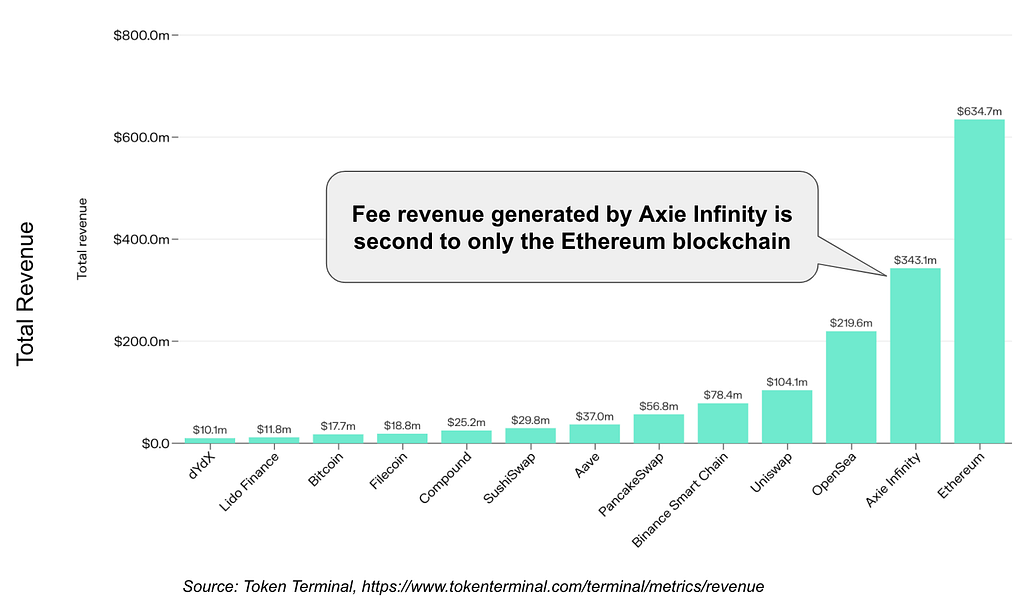
Over the last 30 days, Axie Infinity generated a head turning $343M in fee revenue. This is more than any app or protocol in crypto aside from the Ethereum blockchain, according to Token Terminal.
So where’s that revenue coming from?
How Axie Infinity generates revenue
The Axie Infinity economy consists of a governance token (AXS) and a second token called Smooth Love Potion (SLP) that serves as an in-game currency, along with NFTs that represent both game characters and virtual real estate.
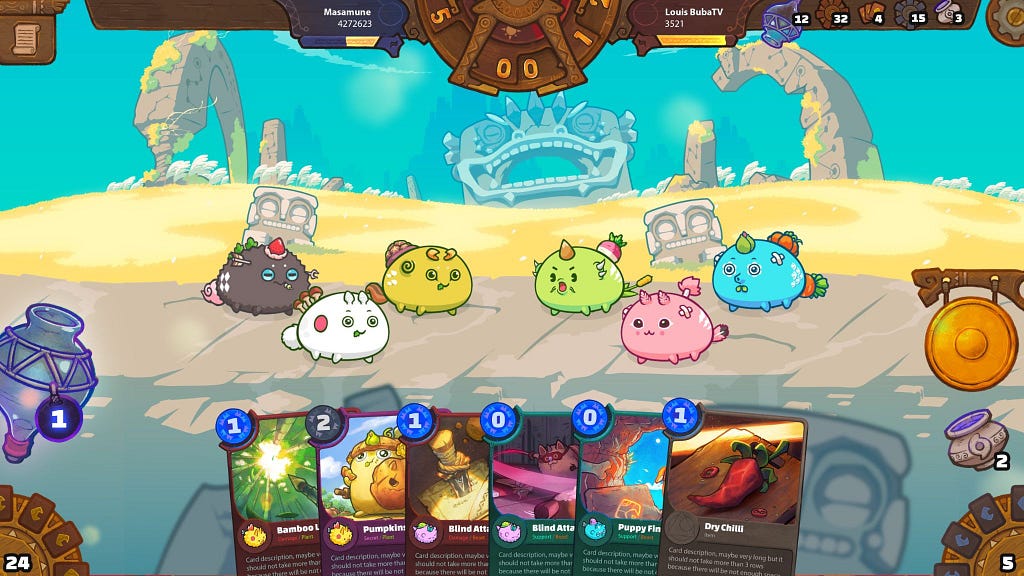
The gameplay itself is often compared to Pokemon, where players battle “Axies” (pictured below) against those of other players. Different Axies have different strengths and weaknesses, and the strategy of the game comes down to playing to your Axies strengths better than your opponent. Players get paid in SLP for defeating opponents. Additionally, players can compete daily quests to earn additional SLP. Axies can also be “bred” together to create new Axies which can in turn be sold to other players for profit.
Every time an Axie is traded, a plot of real estate is sold, or two Axies are bred, the protocol takes a fee priced in a combination of AXS and SLP. Rather than go to the developers, this revenue is placed in the Axie treasury, which has ballooned to nearly $600 million.
While the protocol revenue numbers alone depict the emergence of a new breakout crypto application, what’s more exciting is where Axie Infinity is taking off: in developing nations where players can often earn more playing the game and selling SLP for their native currencies than they can with a typical day job.
With an estimated 50% of daily active users (DAUs) coming from the Philippines, the game is also picking up steam in other emerging markets like Indonesia, Brazil, Venezuela, India, and Vietnam.
Created by game developer Sky Mavis in 2018, Axie started picking up organic traction in the Philippines in early 2020 after a few players realized they could make legitimate incomes by playing. When Covid lockdowns hit and many were put out of work, more were encouraged to give it a try. A documentary on the game’s growth called PLAY-TO-EARN went viral in May 2021 and DAUs went vertical soon after.
Business models of the metaverse
Unlike many mobile games, Axie Infinity is not free to play. To get started, players need to obtain 3 Axie Infinity characters. In the earlier days of the game, the average Axie was selling for under $10. With the game’s rapid growth and the broader NFT rally, the average Axie is now selling for nearly $500 according to CryptoSlam.
Given Axie’s base within the Philippines and other emerging markets, a $1,500 entry tag is a non-starter for most would-be players. To mitigate this barrier to entry, an informal market emerged in which NFT owners began lending players the NFTs needed to play the game in exchange for a cut of their winnings. This is done through QR codes that let players use Axie NFTs in game without the lender having to cede ownership on-chain.
This informal market has blossomed into a formal play-to-earn financial services sector. The largest and most prominent player is a project called Yield Guild Games.
Yield Guild Games (YGG)
Founder Gabby Dizon likes to say that Yield Guild Games is one part Berkshire Hathaway and one part Uber.
Just as Berkshire Hathaway is a holding company for a multitude of businesses, YGG is essentially a holding company for play-to-earn gaming assets. Starting in 2020, they’ve been buying up yield producing NFTs, governance tokens, and ownership stakes in promising gaming projects and protocols.
Similar to how Uber pairs people who want to earn money driving with people who need rides, YGG pairs people who want to make money gaming with the NFTs they need to earn in play-to-earn games. In many parts of the world, people are opting to work with YGG over Uber simply because it pays more.
YGG recently released its July Asset & Treasury Report that offers an interesting glimpse into the new kinds of business models NFTs and play-to-earn games are creating.
YGG by the numbers
Within YGG, there are scholars and community managers. Scholars receive NFTs that they in turn put to work earning crypto. Community managers recruit and train new scholars. 70% of winnings go to scholars, 20% to community managers, and 10% to the Yield Guild Games treasury.
According to the report, 2,058 new scholars joined YGG in July bringing the total to 4,004. In the same month, YGG scholars generated 11.7M SLP by playing Axie Infinity, which equated to over $3.25M in direct revenue. From April through July, scholars and community managers have earned a cumulative of $8.93M.
From its cut of all SLP earned by scholars, YGG earned $329,500 in July and a total of $580,000 since April. YGG’s expenses currently outstrip revenue, as they spent $1.62M in July alone “breeding” new Axie’s to meet scholar demand (breeding can cost anywhere from $200 to $1,200 per Axie).
The YGG Treasury
The YGG treasury consists of tokens and stablecoins held in a wallet, NFTs, and venture investments made in various play-to-earn games. The project has been funded by a $1.325M seed round led by Delphi Digital and another $4.6M round from a16z. They also raised $12.49M from the sale of the YGG governance token, while holding 13.3% of its outstanding supply.
As of the end of July, the YGG wallet’s holdings stood at $415M, with the majority stemming from the YGG token ($373M). The YGG token is part of Yield Guild Game’s plan to transition into a community-governed DAO.
Much of YGG’s capital has been put to work buying NFTs that can earn yield from play-to-earn games. By the end of July, the YGG treasury had amassed 19,460 NFTs valued at over $10M across 12 play-to-earn games. Axie Infinity NFTs comprised close to 90% of that value.
YGG has also made early stage investments across 8 play-to-earn games via SAFT (Simple Agreement for Future Tokens), and locked in ~$1M for yield farming in blue-chip DeFi projects.
A key element of the YGG model is that players are lent NFTs with zero downside risk and without having to put down any upfront capital. In return, they surrender 30% of their winnings but retain the majority — a critical hook to onboarding a new class of crypto users that have historically been priced out.
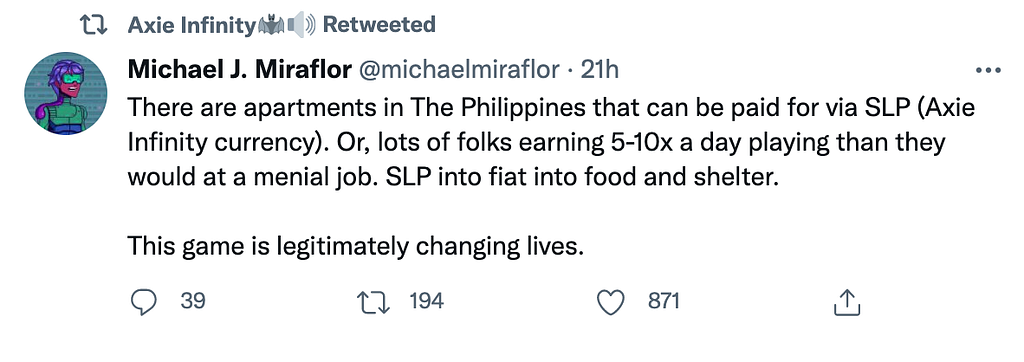
In fact, some players in the Philippines are earning 5–10x what they were making from their previous jobs. New homes have been purchased, charitable acts have been made, and even shops are accepting SLP as payment.
Beyond the wealth Axie Infinity has created, the game’s popularity has served as a means for getting a large new class of users comfortable using crypto applications. As these 1 million users interface with cryptocurrencies, NFTs, digital wallets, and DEXs, it’s not hard to see this new cohort as natural users of other DeFi and Web3 applications.
Play-to-earn sustainability
If Axie Infinity is its own digital nation, game developer Sky Mavis serves as its Federal Reserve. Where the Fed has various tools it uses to influence the economy, Sky Mavis can adjust the SLP issuance rate and breeding fees with the aim of keeping the Axie economy healthy. Just like a real economy, digital economies have to consider the effects of inflation.
ETH has been flowing into the Axie economy due to high demand for Axie NFTs. Increased demand for Axie NFTs has led to rising Axie NFT prices. Higher NFT prices have made breeding more profitable. Breeding requires fees paid in SLP & AXS, leading to a rise in token prices. With rising SLP prices, playing becomes more profitable, encouraging others to join. A powerful positive feedback loop no doubt — but what if market conditions change?
Winning Axie Infinity battles and quests yields SLP, inflating the SLP supply. And since breeding is priced in SLP, additional supply of SLP equates to cheaper breeding fees to create new Axie NFTs, inflating Axie NFT supply. These dynamics could have an impact on NFT market prices, which in turn may have a direct effect on the economics for players — a possible negative feedback loop.
Ultimately, Sky Mavis has to keep the SLP supply in-check while improving overall gameplay to keep its player economy and ETH deposits growing. They must also offset the number of players seeking to extract a profit with players who are pure consumers — i.e. playing for the fun of it.
Playing the Long Game
While Sky Mavis works to keep the Axie economy strong, Yield Guild Games is banking on the continued growth of play-to-earn gaming as a whole. By replicating its model for Axie Infinity across new games, it seeks to build a play-to-earn empire. Over the long run, founder Gabby Dizon sees YGG as the “recruitment agency of the metaverse” that ultimately competes with the Ubers of the world for labor. A future straight out of Ready Player One in which millions of people earn a living in the digital world in order to cover expenses in the physical one.
Final word
With the exploding revenue of Axie Infinity, the emergence of DAOs like Yield Guild Games, and the multitude of play-to-earn games on the horizon, it’s clear that this trend has legs. With DeFi, NFTs, and now crypto gaming, we’re rapidly evolving past the original crypto killer app of speculative trading and into a universe of expressive new apps and models. We’re in fascinating times as crypto’s utility phase marches forward with a full head of steam.
Quick Hits
OpenSea Hits $3B monthly volume
In the month of August, NFT exchange OpenSea hit $3B in monthly volume as over 1.5 million NFTs changed hands. Its August volume alone exceeds that of every other month in its history, combined.
OpenSea’s August volume is on par with $3B in gross sales Etsy put up in all of Q2: another sign of just how big the NFT market has grown relative to other online marketplaces in a very short timespan.
Data from The Block shows how dominant OpenSea’s dominance over the NFT landscape really is.
Notably absent from this exchange landscape are any kind of decentralized venues for trading NFTs. This follows past market cycles in which centralized exchanges found product market fit first, before ultimately paving the way for decentralized alternatives (think Uniswap during the DeFi summer).
The DEX market for NFTs is still nascent but one we’re watching is the recently launched Punks.house which is a permissionless venue for trading CryptoPunks made by Zora. We’re also seeing NFT markets begin to decentralize themselves, with NFT art marketplace Super Rare making the first move with the introduction of its RARE governance token. Many suspect OpenSea will eventually take this route as well.
Lastly, while OpenSea is a centralized for profit entity, its code is open source. It wouldn’t surprise us to see a low-fee competitor forked from OpenSea emerge in the coming months.
$611M whitehat hack?
In the largest DeFi hack to date, an attacker drained over $611M from the Ethereum, Binance Smart Chain, and Polygon blockchains. Then in a surprise move, he returned almost all of it.
The hack was done by exploiting vulnerabilities on the Poly Network, a cross-chain interoperability protocol that connects different blockchains. These types of networks are usually among the most complex, owing to challenges in getting two different blockchains to talk to each other in a secure, safe fashion (it’s hard enough getting one blockchain to be secure!). And complexity is the enemy of security because added complexity increases the surface area for attackers to find exploits.
In this case, the hacker tricked Poly Network’s smart contracts into thinking that the hacker’s address had permission to unlock the $611M+ across chains (detailed technical analysis here, simple explainer here). But in an odd turn of events, the hacker ended up returning nearly all of it to the Poly Network team (sans $33M USDT frozen by Tether).
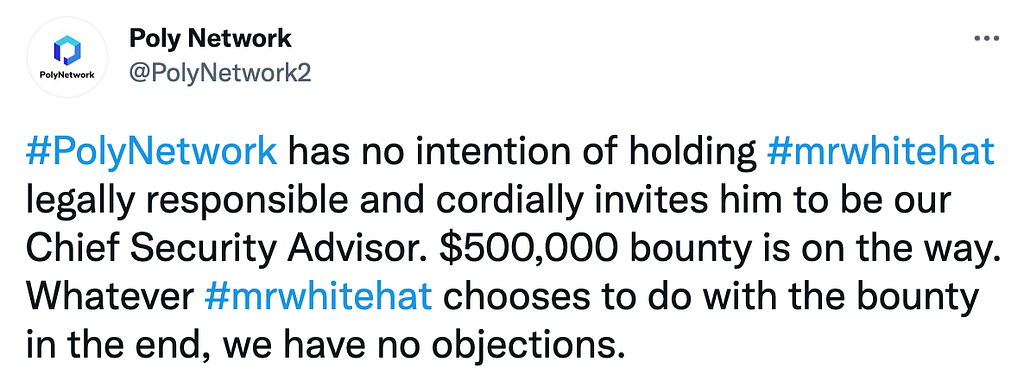
There remains speculation around the hacker’s motives to return the funds. Security firm SlowMist stated that they were able to identify the hacker’s IP and email addresses, so some think the funds were returned because the hacker knew they wouldn’t be able to launder that much money undetected. The hacker, on the other hand, conducted an AMA and stated that they did it, “for fun.” And in a separate twist, the Poly Network team offered the hacker a job as their Chief Security Officer in addition to sending a $500,000 bounty for returning some of the funds.
What’s going on here? We can’t know for sure, but it is rare for a hacker to return funds, especially in such a public fashion. Occam’s razor suggests that the repercussions involved with getting caught (if their info was truly identified) were too great to bear.
While it’s disconcerting to see more hacks happening, we should note that this is simply an evolutionary fitness-function in action. Each hack teaches us how to improve, and we learn, adapt, and improve. While bleeding edge crypto protocols pioneering new use cases will inevitably carry more risk, the space hardens over time.
And Poly Network is not alone. Note the other week when Paradigm’s samczsun discovered and reported a vulnerability in SushiSwap’s MISO platform that would have left $350M ETH at risk. Most recently, Cream Finance was exploited in a flashloan attack for $25M.
But for crypto to really succeed, we need security guarantees. Insurance markets are critical.
Retail news
Binance Tightens KYC Requirements — Leans into Compliance
The 2021 Global Crypto Adoption Index: Worldwide Adoption Jumps Over 880% With P2P Platforms Driving Cryptocurrency Usage in Emerging Markets
Crypto grows from 2% to 41% of Robinhood’s total revenue in past year
Japan’s Liquid Global Exchange Hacked; $90M in Crypto Siphoned Off
‘Novi is ready to come to market,’ says David Marcus as Diem’s future remains uncertain
Facebook Considering NFT Support in Novi Digital Wallet
Austrian crypto unicorn Bitpanda raises another $263 million
Institutional news
US Mortgage Lender UWM Plans to Accept Bitcoin Payments
Galaxy files for ETF that provides indirect exposure to bitcoin
Bloomberg and Galaxy team up on decentralized finance index
Former SEC chair Clayton joins Fireblocks advisory board
Galaxy reports losing $175 million during the last quarter in recent earnings call
Wells Fargo Launches Passive Bitcoin Fund for Wealthy Clients
Ecosystem news
Visa Enters Metaverse With First NFT Purchase
Budweiser buys Beer.ETH domain and a rocket NFT
Twitter taps crypto developer to lead decentralized social media initiative Bluesky
TikTok Picks Streaming Service Audius to Power New ‘Sounds’ Library
DeFi projects could come under SEC’s oversight, says chairman Gensler
a16z announces $4.6 million financing round in Yield Guild Games
Avalanche launches $180 million DeFi incentive scheme with Aave and Curve
Walmart is looking for a crypto product lead
Polygon acquires Hermez in $250 million deal that includes first-ever token ‘merger’
Ethereum 2.0 Staking Contract Now Holds the Most Ether: $21.3B
This website does not disclose material nonpublic information pertaining to Coinbase or Coinbase Venture’s portfolio companies.
Disclaimer: This material is the property of Coinbase, Inc., its parent and affiliates (“Coinbase”). The views and opinions expressed herein are those of the author and do not necessarily reflect the views of Coinbase or its employees and summarizes information and articles with respect to cryptocurrencies or related topics that the author believes may be of interest. This material is for informational purposes only, and is not (i) an offer, or solicitation of an offer, to invest in, or to buy or sell, any interests or shares, or to participate in any investment or trading strategy, (ii) intended to provide accounting, legal, or tax advice, or investment recommendations or (iii) an official statement of Coinbase. No representation or warranty is made, expressed or implied, with respect to the accuracy or completeness of the information or to the future performance of any digital asset, financial instrument or other market or economic measure. The information is believed to be current as of the date indicated on the materials. Recipients should consult their advisors before making any investment decision. Coinbase may have financial interests in, or relationships with, some of the entities and/or publications discussed or otherwise referenced in the materials. Certain links that may be provided in the materials are provided for convenience and do not imply Coinbase’s endorsement, or approval of any third-party websites or their content. Coinbase, Inc. is not registered or licensed in any capacity with the U.S. Securities and Exchange Commission or the U.S. Commodity Futures Trading Commission.
Axie Infinity, Yield Guild Games & the play-to-earn economy was originally published in The Coinbase Blog on Medium, where people are continuing the conversation by highlighting and responding to this story.
Manila, Philippines, September 1, 2021 — Southeast Asian based RFOX Media (a subsidiary of RedFOX Labs $RFOX) has combined forces with, Goama, to address their combined audience of more than 20 million Southeast Asian residents and to go after the largely untapped gaming market in Myanmar.
The deal will see prolific tournament game platform Goama, build and provide a casual game for RFOX Media in order to use play-to-win as an acquisition driver to the new
RFOX Media platform.
RFOX Media acquired MYMEDIA Myanmar, one of the larger media players in Southeast Asia earlier this year, instantly giving it access to over 13 million followers across its popular content sites. RFOX Media is now on a trajectory to create a superhighway of media content that can be monetized through advertising as well as through the creation of NFTs.
Goama is a gaming platform that is built for businesses, combining the best of esports and the best of casual games to create a competitive casual gaming environment, where players compete on casual games, ranked on live leaderboards, to win real-world prizes. It has been so popular since its inception and is made available to millions of users in the leading apps across 24 countries and counting.
The two companies combine to launch a game titled ‘RFOX run’ which will offer competitors a chance to win rare and exclusive NFTs based on their tournament performance and leaderboard positions.
Ben Fairbank, CEO, and Co-founder of RedFOX Labs commented:
“We currently have a gaming division called RFOX Games, but to partner with a non-blockchain gaming platform with such a large daily user base is wonderful exposure in a very different sector for us.
“The Myanmar market is still so young, with a lot of potential, and through this collaboration we will launch tournament games alongside Goama who have over 80K people competing in each gaming tournament”.
“We have been planning this for a long time and to finally bring it all together is a wonderful achievement for us and for RFOX Media. We will soon look to partner with Goama across the Philippines and other SEA countries as we follow our aggressive acquisition and growth campaigns across the region”
Wayne Kennedy, CPO and Co-founder of Goama said: “Innovation is at the core of our mission. We are excited to team up with RedFox and bring NFTs as tournament prizes for the first time in Myanmar! This is the first of many innovations we have in plan for our casual eSports platform on leading Superapps throughout Southeast Asia.
“We’re proud to have created RFOX Run, which we know our users are going to love playing and chasing top spot on the leaderboard!
Wayne further adds “We look forward to a successful and long partnership with RedFOX and extending the relationship across our entire footprint.”
About RedFOX Labs
RedFOX Labs is a Southeast Asian venture builder, that identifies and builds successful business models for the region’s emerging markets. It is focused on unlocking the true market value of the Southeast Asian digital economy for high consumer demand services such as e-commerce, e-media, e-travel, and esports/gaming and focuses on adding value to the digital economy through the use of emerging technologies such as blockchain. As a company, its value is tradable through its native token ($RFOX). Subscribe here.
Goama is a leader in platform gamification, setting the benchmark in digital innovation and user engagement, working with some of the world’s biggest superapps and brands. Its turnkey solution offers a plug and play platform that creates unique gamified experiences that empower its business partners to build engaged communities. Goama has partnerships with the leading apps across 24+ countries to help them drive user engagement, increase monetization opportunities, and acquire new users.