Singapore, Sep 10, 2021 — Bitkub Capital Group Holdings, a leading Thai blockchain & cryptocurrency company has officially partnered with Miss Universe Thailand 2021 as the world’s first blockchain & cryptocurrency firm to bring NFT and Digital Asset solutions, as well as other cryptocurrency trends to beauty pageants.
Ephrat Livni, a DealBook business and policy reporter at the New York Times, discusses Coinbase’s fight with the SEC over its Lend product and El Salvador’s adoption of Bitcoin as legal tender. Show highlights:
why Coinbase is unhappy with what it calls the SEC’s “sketchy” behavior
how Coinbase’s Lend product is structured and why it might be a security
why Ephrat considers Coinbase’s reaction to the SEC’s decision on Lend to be “trolling”
what we can learn from SEC chair Gary Gensler’s letters with Senator Elizabeth Warren
what legal precedence the SEC is leaning on in its decision about Lend
how to explain the SEC’s choice to not meet with Coinbase in Washington
why Ephrat thinks Brian Armstrong sounds entitled
Why even pro-Bitcoin groups in the US take issue with El Salvador’s adoption of Bitcoin as legal tender
why Ephrat thinks Bitcoin is not a practical payment mechanism for El Salvadorans
how El Salvadorans have reacted to the law
why Ephrat believes El Salvador’s mandate to accept BTC is philosophically problematic for Bitcoiners
Global Shipping Business Network (GSBN) has launched a new blockchain-based platform that could potentially track one-third of shipping containers across the globe.
The GSBN was founded in October 2020 by eight global national freight maritime cargo companies to build a blockchain platform that digitizes shipping processes such as document issuance, clearance and logistics data.
Members of the Hong-Kong-based non-profit consortium GSBN are said to “account for one in every three containers handled in the world,” and this may soon be verifiable on the blockchain once the platform is fully utilized.
The GSBN announced the launch of the new blockchain platform on Sept. 8 in partnership with Oracle, Microsoft Azure, AntChain and Alibaba Cloud.
“As an independent consortium, it chose a best-of-breed approach to technology to ensure the infrastructure is strong, reliable and highly scalable,” the announcement read.
GSBN noted that the partnerships were sought out for geostrategic purposes such as Oracle’s global trade operating system and Azure’s service reliability in southeast Asia. Ant Group and Alibaba Cloud will be used for deployment in China.
To ensure information control by GSBN, the data will be encrypted before being sent to the blockchain platform which means the members cannot access the data without authorization. The consortium also emphasized that blockchain technology enables it to collaborate with “disparate and often competing market participants.”
In July the GSBN launched its first blockchain-based application in China dubbed “Cargo Release,” which was designed to speed up processing time by removing paper and storing data on the blockchain.
Related: Fruits of the land: Blockchain traceability gives farmers a competitive advantage
Around the same time the GSBN was formed in October last year, two of the world’s largest container carriers in CMA CGM and MSC Mediterranean Shipping Company announced a full integration onto IBM and Maersk’s TradeLens blockchain platform.
The competing platform offers supply-chain digitizing services, and the integration with CMA CGM and MSC brought data from nearly half of the world’s ocean container cargo to the TradeLens network.
Cardano’s developer IOHK has now confirmed smart contracts capability is set to launch on the network on September 12th. The long-awaited upgrade to the Cardano Mainnet will see the addition of smart contracts capability to the network, which would open the door to both developers and investors alike on the network. The launch is scheduled for Sunday, only four days away.
LAUNCH CONFIRMED: Today, around 17:26 UTC we successfully submitted an update proposal to the #Cardano mainnet, to trigger a hard fork combinator event on Sunday 💪🙌 #Cardano$ADA 1/6 pic.twitter.com/rEtjrdGiBV
Related Reading | Analyst Lays Out Theory That Suggests A 290% Move In Cardano (ADA) Before Rally Is Over
Taking to Twitter, the developer shared with the wider community that they had successfully submitted an upgrade proposal to the Cardano Mainnet. This would trigger the hard fork combinator (HFC) event that would take place on Sunday. “The Alonzo HFC event will be the most significant upgrade yet, laying the firmest of foundations for an exciting new era of smart contracts on Cardano,” said the developer.
Using the HFC technology will enable the deployment of smart contracts capability with the core Plutus, which will come will all compatibility upgrades across the entire software stack. Testing has already been underway for the smart contracts capability with trusted testers from previous upgrade iterations. So far, the smart contracts are processing transactions accordingly and developers have taken to building their DApps on the platform.
Gearing Up To Compete
The final deployment will see Cardano competing with other networks successfully operating in the space. Going up against well-known smart contracts platforms like Ethereum, and a new contender that has taken the market by storm, Solana.
Alonzo Hard Fork will bring decentralized finance (DeFi) and decentralized exchanges (DEX) to the ecosystem, as well as capabilities like being able to mint NFTs on the Cardano blockchain. Effectively expanding the scope of use cases of the network.
Related Reading | New To Bitcoin? Learn To Trade Crypto With The NewsBTC Trading Course
The network ran into some problems earlier when rumors started making the rounds on social media that the smart contracts could only handle one transaction at a time. But this was soon after cleared up by the developers, who showed that the problem was not with the network, but rather with the DApp Minswap. IOHK further encouraged developers to keep testing on the network, adding that “this is what a testnet is for.”
Cardano (ADA) Price Reaction
Cardano, like the rest of the market, is still reeling from the flash crash which it experienced yesterday. Although it has recovered from the lows of the flash crash, the digital asset continues to struggle to find footing back to positions before the crash. The announcement from Cardano’s developer did not do much to push the price upwards, which has left the asset trading around the $2.3 range. Putting it back down below highs from May.
ADA price struggles as market reels from crash | Source: ADAUSD on TradingView.com
At the time of writing, the asset is trading at $2.38, down more than 9% in the last 24 hours. The crash in its value has brought the total market cap of the asset down to $76 billion. Although remaining the third-largest cryptocurrency by market cap.
Featured image from Ethereum World News, chart from TradingView.com
Melbourne, Australia, Sep 8, 2021 — On the heels of the strategic investment received from UAE-based Sheesha Finance last week, the world’s first halal decentralized finance (DeFi) ecosystem MRHB DeFi is pleased to announce yet another strategic investment — this time…
Last Wednesday, after months of effort by Coinbase to engage productively, the SEC gave us what’s called a Wells notice about our planned Coinbase Lend program. A Wells notice is the official way a regulator tells a company that it intends to sue the company in court. As surprised as we were at the SEC’s threat to sue without ever telling us why, we want to be transparent with you about the course of events leading up to it.
Background
Coinbase has been proactively engaging with the SEC about Lend for nearly six months. We’ve been eager to hear their perspective as we explore innovative ways for our customers to gain more financial empowerment on Coinbase. Specifically for Lend, we’re seeking to allow eligible customers to earn interest on select assets on Coinbase, starting with 4% APY on USD Coin (USDC). We could have simply launched the product but we chose not to. This is far from the norm in our industry. Other crypto companies have had lending products on the market for years, and new lending products continue to launch as recently as last month. But Coinbase believes in the value of open and substantive dialogue with our regulators. So we took Lend to the SEC first.
What we’ve provided to the SEC
Coinbase’s Lend program doesn’t qualify as a security — or to use more specific legal terms, it’s not an investment contract or a note. Customers won’t be “investing” in the program, but rather lending the USDC they hold on Coinbase’s platform in connection with their existing relationship. And although Lend customers will earn interest from their participation in the program, we have an obligation to pay this interest regardless of Coinbase’s broader business activities. What’s more, participating customers’ principal is secure and we’re obligated to repay their USDC on request.
We shared this view and the details of Lend with the SEC. After our initial meeting, we answered all of the SEC’s questions in writing and then again in person. But we didn’t get much of a response. The SEC told us they consider Lend to involve a security, but wouldn’t say why or how they’d reached that conclusion. Rather than get discouraged, we chose to continue taking things slowly. In June, we announced our Lend program publicly and opened a waitlist but did not set a public launch date. But once again, we got no explanation from the SEC. Instead, they opened a formal investigation. They asked for documents and written responses, and we willingly provided them. They also asked for us to provide a corporate witness to give sworn testimony about the program. As a result, one of our employees spent a full day in August providing complete and transparent testimony about Lend. They also asked for the name and contact information of every single person on our Lend waitlist. We have not agreed to provide that because we take a very cautious approach to requests for customers’ personal information. We also don’t believe it is relevant to any particular questions the SEC might have about Lend involving a security, especially when the SEC won’t share any of those questions with us.
State of play & next steps
Despite Coinbase keeping Lend off the market and providing detailed information, the SEC still won’t explain why they see a problem. Rather they have now told us that if we launch Lend they intend to sue. Yet again, we asked if the SEC would share their reasoning with us, and yet again they refused. They have only told us that they are assessing our Lend product through the prism of decades-old Supreme Court cases called Howey and Reves. The SEC won’t share the assessment itself, only the fact that they have done it. These two cases are from 1946 and 1990. Formal guidance from the SEC about how they intend to apply Howey and Reves tests to products like Lend would be a big help to regulating our industry in a responsible way. Instead, last week’s Wells noticetells us that the SEC would rather skip those basic regulatory steps and go right to litigation. They’ve offered us the chance to submit a written defense of Lend, but that would be futile when we don’t know the reasons behind the SEC’s concerns.
The SEC has repeatedly asked our industry to “talk to us, come in.” We did that here. But today all we know is that we can either keep Lend off the market indefinitely without knowing why or we can be sued. A healthy regulatory relationship should never leave the industry in that kind of bind without explanation. Dialogue is at the heart of good regulation.
The net result of all this is that we will not be launching Lend until at least October. Coinbase continues to welcome additional regulatory clarity; mystery and ambiguity only serve to unnecessarily stifle new products that customers want and that Coinbase and others can safely deliver.
We will keep our customers informed at every step as things progress.
The SEC has told us it wants to sue us over Lend. We don’t know why. was originally published in The Coinbase Blog on Medium, where people are continuing the conversation by highlighting and responding to this story.
The IOTA Foundation, the non-profit supporting the research and development of new distributed ledger technologies (DLT), including the IOTA Tangle, announced today it been selected to participate in the pre-commercial procurement process for the European Blockchain Services Infrastructure (EBSI), a network of blockchain nodes across the European Union (EU).
Established in 2019 by the European Blockchain Partnership, the EBSI aims to develop a distributed ledger network across the European community to support cross-border services between governments, businesses, and individuals. Its goals are to enhance cross-border mobility, reduce waste of resources, enforce compliance with EU regulations, and encourage the growth of tech hubs and projects. Thanks to EBSI, verified information will flow quickly and reliably Europe-wide.
The EBSI network’s nodes will be run on both by the European Commission and by individual member states. Current and planned use cases include the digital management of educational credentials, the establishment of trusted digital audit trails in notarization, SME financing, data sharing among authorities, and European digital identity. After initial implementation in the EU, the technology will also have the potential to extend beyond the 27 member states.
IOTA is well-positioned to enable EBSI’s vision of secure ledger-based transactions for an EU digital single market. IOTA’s technology fits EBSI’s goals of being scalable, open, decentralized, and interoperable. Permissionless by nature, still IOTA can grant permission to some resources and control data distribution to ensure EU data-sharing compliance. It also supports high throughput and a large number of nodes.
In addition, IOTA’s feeless nature makes micropayments possible and opens up the network to a broad audience. Anyone can afford to use it, whereas the cost of transactions on other blockchains makes notarizing small information exchanges, such as the cost of stamping a single document, prohibitive. IOTA is also energy-efficient and complements the European Green Deal, the EU’s overarching aim of making Europe carbon-neutral by 2050.
“We are very excited about moving forward in the rigorous EBSI procurement process, and we feel great about our chances to play a central role in bringing distributed ledger technology to European administrations. EBSI is an excellent fit, both technologically and ideologically. We do not need to adapt an existing blockchain or to start developing a new solution that fits EBSI’s needs. Our core technology already offers a near-perfect match to the strict requirements and precise specifications for a European ledger infrastructure, and it is ready for widespread adoption with only minimal adjustment.” – Dominik Schiener, Co-Founder & Chairman of the IOTA Foundation
Since 2018, 29 countries (All EU Member States, Norway, and Lichtenstein) and the European Commission have joined forces to form the European Blockchain Partnership (EBP). They have committed to working together towards realizing the potential of blockchain-based services for the benefit of citizens, society, and the economy.
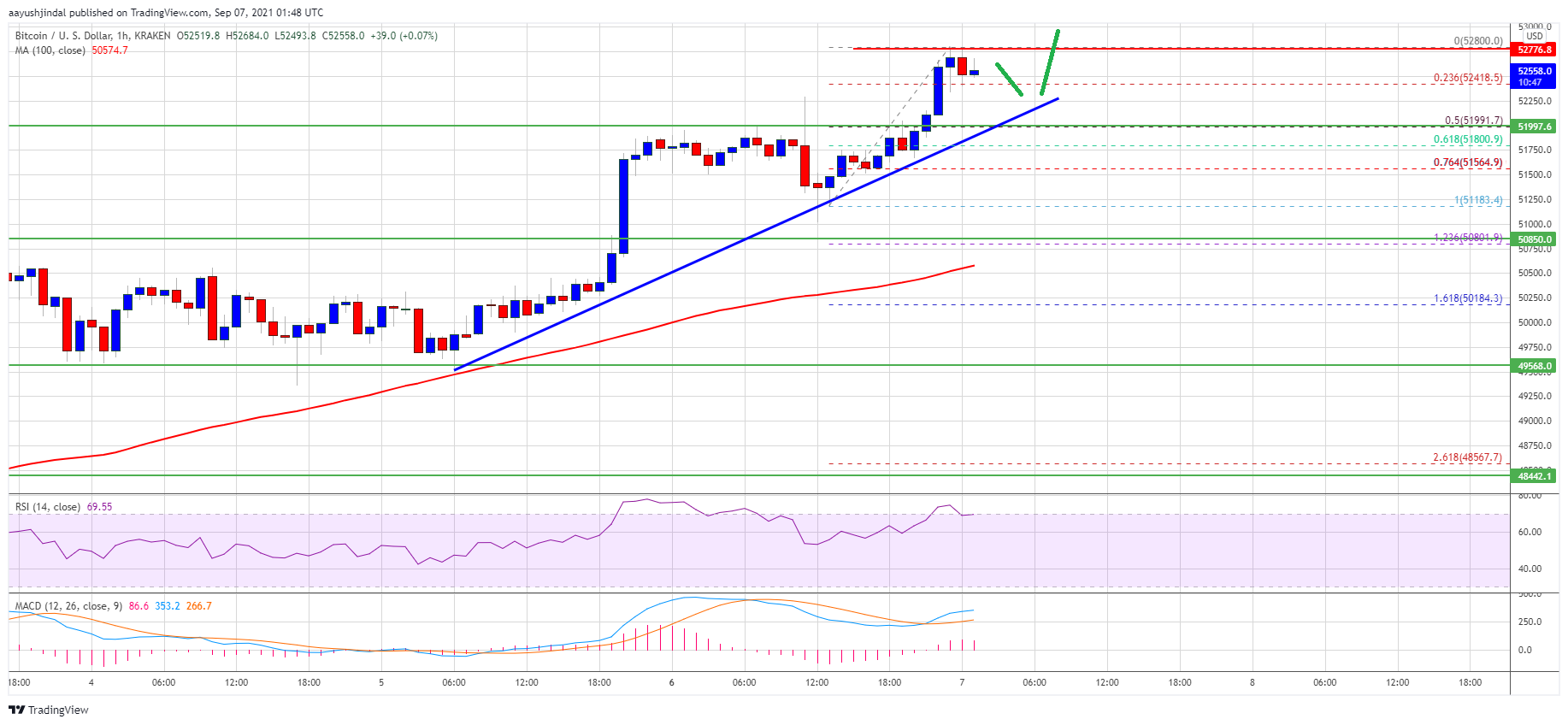
Bitcoin price broke the key $52,000 resistance zone against the US Dollar. BTC remains supported and it could continue to climb higher towards $55,000.
Bitcoin started a fresh increase above the $51,500 and $52,000 resistance levels.
The price is now trading above $52,000 and the 100 hourly simple moving average.
There is a key bullish trend line forming with support near $52,250 on the hourly chart of the BTC/USD pair (data feed from Kraken).
The pair could dips a few points, but it might find support near $52,250 and $52,000.
Bitcoin Price Extends Gains
Bitcoin price consolidated above the $51,000 zone for some time before starting a fresh increase. BTC broke the key $52,000 resistance zone and the 100 hourly simple moving average to move further into a positive zone.
The price even broke the $52,500 resistance and traded as high as $52,800. It is now trading well above $52,000 and the 100 hourly simple moving average. An immediate support is near the $52,400 level. It is near the 23.6% Fib retracement level of the recent increase from the $51,183 swing low to $52,800 high.
The next support could be near the $52,250 level. There is also a key bullish trend line forming with support near $52,250 on the hourly chart of the BTC/USD pair.
Source: BTCUSD on TradingView.com
The main support is now forming near the $52,000 level. It is close to the 50% Fib retracement level of the recent increase from the $51,183 swing low to $52,800 high. If there is a downside break below the $52,000 support zone, the price could extend its decline. In the stated case, the price could test the $50,850 support or the 100 hourly SMA.
More Upsides In BTC?
If bitcoin stays above the $52,000 support zone and the trend line, it could rise further. An immediate resistance on the upside is near the $52,650 level.
The first major resistance is near the $52,800 level. A close above the $52,800 level could pump the price further in the near term. The next major hurdle for the bulls could be near the $53,500 zone. Any more gains could lead the price towards the $54,200 level.
Technical indicators:
Hourly MACD – The MACD is slowly gaining pace in the bullish zone.
Hourly RSI (Relative Strength Index) – The RSI for BTC/USD is well above the 60 level.
Major Support Levels – $52,250, followed by $52,000.
Major Resistance Levels – $56,650, $52,800 and $53,500.
Flirt invest is a platform developed by Brandon West to attract investments in cryptocurrency from anyone who wants to invest their funds in the development of Brandon’s webcam studios network.
Due to the niche specifics, the company cannot enter an IPO and become public by placing its shares, so the company chose cryptocurrency so anyone could invest in it. In addition, Brandon West himself is a crypto enthusiast and a fan of bitcoin.
Let’s figure out how to work with it, how much you can earn and answer the most frequent questions about the platform from our readers.
Registration and work on the platform
1) First, you need to register. For that, you should go to the ‘registration’ tab and create an account.
2) After registration, you will be able to log in to your account. Go to the account settings to put your crypto wallets for receiving payments. You don’t have to put every single one, you can put only the wallet, whose blockchain coins you will be investing.
IMPORTANT: the platform pays out funds exactly in those coins in which you made a deposit. For example: If you have invested BTC, you will receive payments in BTC and will be able to withdraw them to a BTC wallet.
3) Go to the ‘make a deposit’ tab, select the payment system, select the tariff of interest and specify the desired investment amount. Click on the ‘make a deposit’ button.
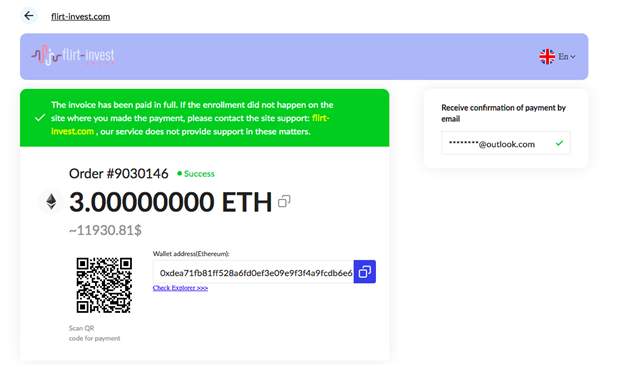
4) After that, you will be redirected to the payment page in the PayKassa merchant. The amount of funds that you’ll need to pay and the wallet for sending the funds will be indicated there. Make sure to send the exact amount that is indicated in the invoice!
5) After receiving 3 confirmations online, you will see that on the invoice payment page. Immediately after that on the Flirt Invest platform, you will see that your deposit has been successfully created. After that, you will be receiving payments every day.
How much will you receive and how much can you earn?
It is important to understand that the initial deposit that you make will be locked for 1 year, but you will be receiving a certain amount every day and will be able to immediately withdraw it or reinvest it back.
It all depends on the amount you are investing. Now the conditions are very favorable, since the company has just started raising funds. Later, the company is planning to reduce the profit for investors. However, the conditions for those who invest now will remain for the whole year.
Let’s figure out how much you can get. The company offers 4 tariffs, with a net profit of 0.5% to 3% per day.
If you invest:
From $100 to $1,000, you will be receiving 0.5% of the invested amount every day. From $1,000 to $10,000, you will be receiving 1% of the invested amount every day. From $10,000 to $50,000, you will be receiving 2% of the invested amount every day. From $50,000 to $250,000, you will be receiving 3% of the invested amount every day.
For example: You invest $12,000 in USDT, that is, 12,000 USDT. That means, that you will be receiving 2% of profit from the initial deposit every day, that is, 240 USDT per day. In 2 months you will earn as much as 14.400 USDT!
You will be able to withdraw a daily payment of 240 USDT immediately or make another deposit and reinvest your profit.
In order to withdraw funds, go to the ‘withdraw funds’ tab, select the payment system, the needed amount and click the ‘withdraw funds’ button. Within a few hours, you will receive a payment to the wallet specified in the account settings.
As you can see, everything is very simple.
In addition to payments from your deposits, you can also participate in the affiliate program and invite your friends or colleagues and receive a bonus of 5% of their deposits. For example: if an invited friend makes a deposit of 1000 USDT, you will receive 50 USDT to your account, which you will also be able to withdraw immediately.
To invite a friend, just send your referral link for registration on the platform to your friend. The link can be found in your personal account.
And now let’s answer the most popular questions:
1) Will the initial deposit be returned after 1 year of freezing? – Yes, after 365 days you will be able to withdraw your initial deposit.
2) Is it possible to exchange coins inside the platform? – No, you strictly get the same coins that you used for the deposit.
3) Are there any restrictions on the amount of deposit? – Yes, one deposit can be made for a maximum amount of $250,000. If you want to invest more, you should make another deposit.
4) Is it possible to make several deposits with different rates? – Yes, the number of deposits is not limited
5) If I invested $500 in the first tariff, and I get 0.5% per day, can I add another $500 and so get 1% from $ 1000? – No, to have 1%, you need to open 1 deposit for $1000 or more. It is not possible to add funds to the current deposit.
6) What are the guarantees that my funds will not be lost? – The rules of the site indicate that the company is fully responsible for the safety of investors’ funds. Flirt Invest also has an authorized capital of 1,000,000 pounds to insure the deposits of its customers.
7) Are there any restrictions on the number of invited friends? – No, the more you invite, the more you will earn. For bloggers, website owners and people with a large audience, the company offers even more favorable terms of the affiliate program.
8) If I have any tech problems with the platform, whom should I contact? – You can write us via the ‘support’ window on the website or send us an email on [email protected]
Conclusions
We hope that after reading this article, you don’t have any questions about the work of the platform. We also hope that you will not miss the chance to take advantage of the current profit percentage that the company offers. As Brandon West mentioned in his recent interview, after receiving the necessary amount, the platform will reduce payments for new investors. After that, the company, according to West, will stop accepting new investors altogether, since it already can develop further due to its own capital.
Buying an asset in a downtrend can be a risky maneuver because most investors struggle to spot reversals and as the trend deepens traders take on deep losses. In instances like these, being able to spot descending channel patterns can help traders avoid buying in a bearish trend.
A “descending channel,” also known as a “bearish price channel” is formed by drawing two downward trendlines, parallel to each other, which confine the price action of the asset.
Descending channel basics
In a downtrend, the price action forms a series of lower highs and lower lows. A descending channel is drawn by joining the lower highs and the lower lows using parallel trendlines. The main trendline is drawn first where two or more lower highs are connected. Then a parallel line, also called the channel line, is drawn connecting the lower lows.
The price action inside a descending channel continues to move south as bears sell on any relief rallies to the main trendline.
Descending channel pattern. Source: TradingView
The asset in the chart above is in a downtrend, forming lower highs and lower lows. The main trendline is drawn by joining two lower highs (marked as ellipses) while the parallel channel line is drawn by joining the two reaction lows.
When the price reaches the channel line, bulls believe that the price has become attractive and they buy, but the bears are in no mood to allow the bulls to have their way. They sell when the price reaches the main trendline and the trend remains down.
The trading inside the channel is usually random but bound between the two parallel lines. A break below the channel indicates that the bearish momentum has picked up and that could result in a spike down.
Conversely, a breakout of the descending channel suggests a possible change in trend. Sometimes these breakouts result in a new uptrend, but on other occasions the price action forms a range before resuming the downtrend.
Descending channel breakouts
THETA/USDT daily chart. Source: TradingView
The chart above shows THETA token in a descending channel where the main trendline is formed by joining the two lower highs made on April 16 and May 9. The parallel line drawn from the reaction low on April 18 forms the channel line.
As seen above, the price action is largely caged between these two lines. The bulls pushed the price above the channel on June 17 but could not sustain the higher levels. The bears again quickly pulled the price back into the channel, trapping the aggressive bulls.
There were a few spikes below the channel line but the long tails on the candlesticks show that bulls used these dips to buy. This shows how the lines act as strong support and resistance.
Finally, the price broke above the channel on July 24 and after a minor consolidation, the recovery continued. This confirmed a legitimate breakout, indicating a possible trend change.
XMR/USDT daily chart. Source: TradingView
Monero (XMR) topped out on June 23, 2019, and then started a downtrend. The main trendline of the channel was formed by connecting the lower highs on July 8, 2019, and Aug. 8, 2019, while the channel line was drawn from the low on July 16, 2019. The XMR/USDT pair continued to trade inside the channel until Jan. 4, 2020.
The bulls pushed and closed the price above the channel on Jan. 5, 2020. This signaled a possible change in trend. The target objective can be arrived at by adding the height of the channel to the breakout level.
In the above case, the depth of the channel was $31.50. Adding this to the breakout level at $51.80, gave a target objective of $83.30. The pair easily exceeded the pattern target and turned down from $96.90 on Feb. 15, 2020.
This suggests that traders should use the target as a guide but decide on closing the position after analyzing other supportive indicators and patterns.
Descending channel breakdowns
LUNA/USDT daily chart. Source: TradingView
Terra’s LUNA token topped out at $22.40 on March 21. Thereafter, it started trading inside a descending channel pattern. The bears pulled the price below the channel line on April 18 but they could not sustain the lower levels. The bulls pushed the price back into the channel on April 23 and trapped the aggressive bears.
The sellers again broke below the channel line on May 19. Attempts by the bulls to push the price back into the channel failed on May 20 and May 21, confirming a valid breakdown. The pattern target of the breakdown was $5.10 and the LUNA/USDT pair bottomed out at $3.91.
Take care to not mix up bull flags and descending channels
BTC/USDT daily chart. Source: TradingView
Bitcoin (BTC) rallied sharply from $17,572.33 on Dec. 11, 2020 to $41,950 on Jan. 8, 2021. Subsequently, the price corrected inside two parallel lines, which was a bullish flag pattern but could have been easily mistaken for a descending channel.
Thomas Bulkowski, author of the book Encyclopedia of Chart Patterns, says when a pattern is less than three weeks long, it is a flag, but longer than that can be considered as a channel.
In the above example, the correction lasted for just over three weeks and the price resumed its up-move after breaking out of the flag.
The views and opinions expressed here are solely those of the author and do not necessarily reflect the views of Cointelegraph.com. Every investment and trading move involves risk, you should conduct your own research when making a decision.