As financial authorities around the globe become increasingly concerned about stablecoin regulation, a jurisdiction in China is preparing to pilot a new yuan-pegged stablecoin for international trade.
Chris Banbury, head of global operations at permissionless blockchain project Conflux, told Cointelegraph on Sept. 21 that the firm will provide its technology to launch an offshore renminbi (RMB) stablecoin pegged to China’s central bank digital currency (CBDC), the digital yuan.
“This is going to be pegged to the digital yuan in price only with no formal integration,” Banbury noted, adding that the project will be exploring how the token trades against other currencies.
The new stablecoin project will facilitate international trade in Shanghai’s Lin-gang Special Area after the Chinese government granted the free economic zone permission to explore free trade with an offshore RMB stablecoin in July.
“While the use case for the offshore RMB stablecoin has been approved by the government of China and Shanghai, the pilot program is not endorsed by or connected with the government,” Banbury noted.
In contrast to popular stablecoins like Tether (USDT) and USD Coin (USDC), the upcoming offshore RMB stablecoin will not be a private stablecoin because it is fully decentralized, Banbury said. The executive said that the new stablecoin is called the “offshore RMB stablecoin” because its functionality will be limited to global trading:
“The term ‘offshore’ refers to the RMB’s use for international trading purposes — not domestic trading. The digital yuan is used exclusively for domestic purposes. As such, the offshore RMB is not an ‘offshore yuan.’ The digital yuan is for domestic purposes overseen by the People’s Bank of China.”
Related: Chinese banks explore e-yuan for selling investment funds and insurance
According to Banbury, the offshore RMB stablecoin is being held through the Shanghai ShuTu Blockchain Research Institute, a branch of the Conflux Tree-Graph Institute for blockchain research and development. The stablecoin has not yet received a dedicated ticker as the development team is still determining when to launch, he added.
One of the world’s first nations to debut a CBDC, China has continued to crack down on cryptocurrency trading and mining, with local authorities shutting down multiple mining farms and suspending crypto trading transactions this year.
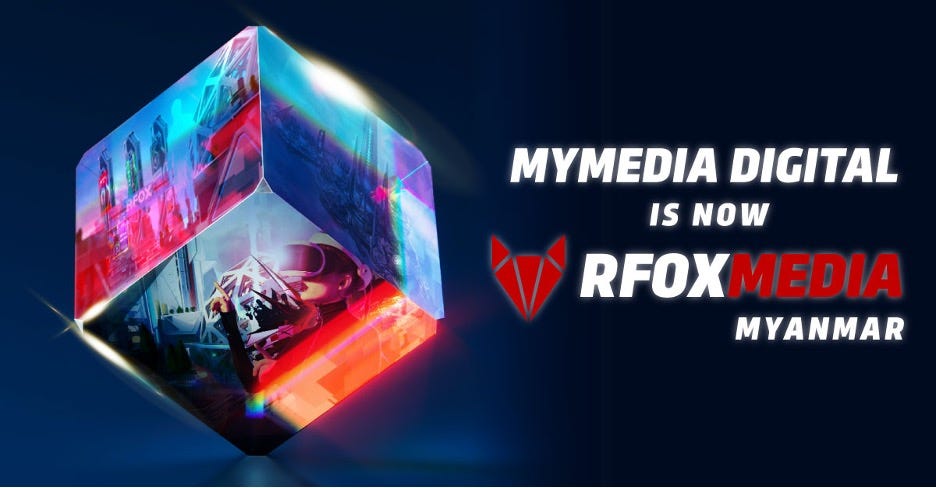
MANILA, Philippines — MYMEDIA Digital, the largest digital marketing platform in Myanmar, has rebranded into RFOX MEDIA, the new media venture that acts as the brand and marketing division for the blockchain-driven ecosystem created by Southeast Asia-based venture builder RedFOX Labs. The rebrand follows RedFOX Labs’ acquisition of MYMEDIA in February 2021.
The new RFOX MEDIA venture strengthens MYMEDIA’smarket-leading platform, which connects consumers directly to brands and influencers across food, fashion, sport, and entertainment. Advertisers that have worked with MYMEDIA include global brands such as Samsung, Huawei, Nestle, Lenovo, Grab, Oppo, Realme, VIVO, and GrandRoyal. The MYMEDIA Facebook page, which also reflects the rebrand to RFOX MEDIA, together with all social media channels and websites, have 13 million followers and 40-million-page impressions, driven by 20 million minutes of viewed video footage per month and other content that extends its reach to 30 million users per month.
Digital media marketing leader in Myanmar and Southeast Asia
As part of the rebranding and further integration within the RFOX ecosystem, RFOX MEDIA has launched a new dual-language website in Burmese and English, reflecting both its status as the digital marketing leader in Myanmar and its next phase of growth into different parts of the world, with an initial focus on Southeast Asia as a fast-growing regional hub. The expansion plans for RFOX MEDIA will drive further growth to the already-impressive social media metrics that it has gained in just one country so far.
Partnerships for games, e-commerce, digital finance and more
Amid projected international growth, RFOX MEDIA continues its work of maintaining market leadership in Myanmar by leveraging many products and services from the RFOX ecosystem. Earlier this month, RFOX MEDIA introduced RFOX Run, an upcoming jump-and-run casual game in Myanmar that will debut a new gaming rewards model called Play-to-Eat, an innovation on the increasingly popular Play-to-Earn model. Through Play-to-Eat, all winning players from Myanmar can soon get free food vouchers that they can redeem on foodpanda, the leading food delivery service in Myanmar.
Expect more innovations of this nature as RFOX MEDIA helps expand the utility of the RFOX token through partnerships for games, e-commerce, digital finance, and more industries, as well as through new solutions like the upcoming RFOX TV streaming service.
Rene Heumueller, COO of RFOX MEDIA, commented:
“I’m extremely happy to be part of RedFOX Labs as we build out RFOX MEDIA. I am passionate about building products and services that improve people’s lives, and this is the right place to be. The RFOX MEDIA team is built on the back of the existing team of MYMEDIA and pulls on years of experience and a library of content. This gives us a strong head start we need in a fiercely competitive landscape, especially as we expand our operations internationally.”
Ben Fairbank, CEO and Co-founder of RedFOX Labs, commented:
“The rebranding of MYMEDIA into RFOX MEDIA is the initial step towards applying our expertise in scaling technology and building integrations and interoperability, providing exponential value to a digital marketing platform that is ready to expand into Southeast Asia and beyond.
Our acquisition of MYMEDIA earlier this year allows us to build out equivalent platforms in other countries in Southeast Asia, leveraging a Rolodex of global advertisers already using MYMEDIA who are chomping at the bit to get exposure in the region. Southeast Asia has 360 million internet users, including 104 million aged between 25 to 34 — the most valuable age group to major advertisers.”
About RedFOX Labs
RedFOX Labs is a Southeast Asian venture builder that identifies and builds successful business models for the region’s markets. It is focused on unlocking the true market value of the Southeast Asian digital economy for high consumer demand services such as e-commerce, e-media, e-travel, and esports/gaming and focuses on adding value to the digital economy using emerging technologies such as blockchain. As a company, its value is tradable through its native token ($RFOX).
By Casper Sorensen, Vice President, Customer Experience
The following is the latest update in our series of blog posts describing our commitment to continually improving our customer experience.
One of our Coinbase cultural tenets is Customer Focus. This tenet sets the expectation that we solve customer problems with technology that is instinctive to use and continuously ask “How does this create more value for our customers?”
We recognize that when it comes to our customer support experience, we’re early in our journey of creating more value for customers.
In past blog posts we highlighted how improving our customer support experience is a top priority and this year we have more than quadrupled our capacity and launched new ways to contact us. As the journey continues, we are excited to share that we will implement the capabilities below by year end:
Faster Response Times: Speed matters in the fast moving cryptoeconomy, so we are matching that speed by further increasing our capacity to provide customers with the best response times in the industry. Customers should trust that we will match their sense of urgency when they contact us.
24/7 Live Phone Support: Direct connections matter, so 24/7 phone support will be available for all retail customers who prefer speaking live with an expert. Whether the question is simple or complex, customers in the US, UK, Germany, and Japan will have the option to connect with our in-country based customer service teams before the end of 2021 with further expansion planned for 2022.
Live Messaging: We value our customers’ time, so we’re launching messaging, which means customers can connect with us when the time is right and continue the conversation seamlessly if they have to step away. Our team of customer service experts will be available via messaging 24/7 with the speed our customers expect.
In-Product Support: Ease of use is important, so this year we are creating a more seamless support experience within our iOS and Android apps. This suite of features will provide users with an intelligent and personalized self service experience, saving customers time when they have questions. Live support will be a core part of this experience as well, allowing customers to quickly message our team of experts when needed.
Our goal is to provide our customers with the most trusted customer service experience in crypto. We look forward to providing these new capabilities to you, so please stay tuned as we will continue to update this blog with the status of our journey.
Coinbase To Launch 24/7 Phone Support and Other Enhancements to Customer Support by End of Year was originally published in The Coinbase Blog on Medium, where people are continuing the conversation by highlighting and responding to this story.
MANILA, Philippines — RFOX Media, a subsidiary of Southeast Asia based RedFOX Labs, has launched RFOX Run, a new jump-and-run casual game in Myanmar, powered by prolific tournament game platform Goama. RFOX Run introduces a new gaming rewards model called Play-to-Eat, an innovation of the increasingly popular Play-to-Earn model, where players that are identified as winners and have signed up for an RFOX ID can redeem food vouchers from foodpanda, the leading food delivery service in Myanmar.
At RedFOX Labs, we believe that blockchain companies have a responsibility to explore humanitarian approaches to the innovations they produce. Through our Play-to-Eat model, we believe that RFOX Run users will gain the dual benefits of food rewards and blockchain education, providing them with both immediate- and long-term solutions.
The top RFOX Run players can claim their prizes through the RFOX Media website by registering for an RFOX ID. Winners will receive foodpanda vouchers redeemable with a unique voucher ID, and get their choice of food delivered to their doorstep. To kickstart the campaign, RFOX Media has allocated $22,000 worth of vouchers as rewards.
The global play-to-earn market, mainly driven by blockchain-based companies, has experienced exponential growth this year, with a total market capitalization of $9.21 billion and average year-to-date growth rates of 1,604.12%, according to analysis from CoinMarketCap data on 36 identified play-to-earn companies. From a larger perspective, the video game industry is currently valued at around $170 billion and is expected to grow to $268 billion after five years, according to CoinTelegraph.
In this context, RFOX Media can become a crucial participant in the high-growth play-to-earn market through RFOX Run. Its unique approach to encourage further adoption through play-to-eat and other models reflects RedFOX Labs’ endeavors in empowering blockchain-related growth in Southeast Asia. RedFOX Labs also operates RedFOX Games, which currently runs the KOGs Slam! NFT game on closed beta testing, with more products about to launch.
Earlier this month, RFOX Media and Goama entered a partnership for the launch of RFOX Run in Myanmar, with plans to extend the relationship across the Southeast Asia region. This collaboration brings together an audience of more than 20 million Southeast Asian residents and aims at serving the largely untapped gaming market in Myanmar.
Ben Fairbank, CEO, and Co-founder of RedFOX Labs commented:
“Just weeks after we revealed the partnership between RFOX Media and Goama, I’m happy to see that it has delivered innovative results through the new RFOX Run game and the first-of-its-kind Play-to-Eat model in Myanmar. The Myanmar market is still so young, with a lot of potential, and through this collaboration we have quickly launched a new casual game that has an added benefit of rewarding top players with food. We look forward to serving millions in Myanmar with innovative gaming solutions like this, among other things we are planning to launch in the future for the country.”
Wayne Kennedy, CPO and Co-founder of Goama said:
“We at Goama are very thrilled to work with RedFOX Labs to be the first ones to bring both NFTs and tournament prizes to Myanmar! This furthers our ambition of bringing a casual eSports platform to leading apps throughout Southeast Asia. We’re also very happy to have created RFOX Run, where users can compete for the top spot and at the same time be compensated with food vouchers!”
About RedFOX Labs
RedFOX Labs is a Southeast Asian venture builder that identifies and builds successful business models for the region’s emerging markets. It is focused on unlocking the true market value of the Southeast Asian digital economy for high consumer demand services such as e-commerce, e-media, e-travel, and esports/gaming and focuses on adding value to the digital economy using emerging technologies such as blockchain. As a company, its value is tradable through its native token ($RFOX).
foodpanda is a leading delivery platform in Asia dedicated to bringing consumers a wide range of food, groceries and more, quickly and conveniently. Powered by technology and operational excellence, foodpanda is spearheading the growth of quick-commerce (q-commerce) across the region with its network of retail partners, as well as pandamart cloud stores to provide more on-demand options beyond the millions of food delivery options. foodpanda operates in more than 400 cities across 12 markets in Asia — Singapore, Hong Kong, Thailand, Malaysia, Pakistan, Taiwan, Philippines, Bangladesh, Laos, Cambodia, Myanmar, and Japan. foodpanda is a subsidiary of Delivery Hero, a global leader of the food delivery industry. www.foodpanda.com
About Goama
Goama is a leader in platform gamification, setting the benchmark in digital innovation and user engagement, working with some of the world’s biggest superapps and brands. Its turnkey solution offers a plug and play platform that creates unique gamified experiences that empower its business partners to build engaged communities. Goama has partnerships with the leading apps across 24+ countries to help them drive user engagement, increase monetization opportunities, and acquire new users. https://goama.com
Ethereum settled below the $3,000 support zone against the US Dollar. ETH price could resume its decline unless there is a clear break above the $3,000 resistance zone.
Ethereum started a fresh decline below the $3,100 and $3,000 support levels.
The price is now trading below $3,000 and the 100 hourly simple moving average.
There is a major bearish trend line forming with resistance near $3,000 on the hourly chart of ETH/USD (data feed via Kraken).
The pair could resume its decline unless there is a clear break above the $3,000 resistance zone.
Ethereum Price Remains At Risk
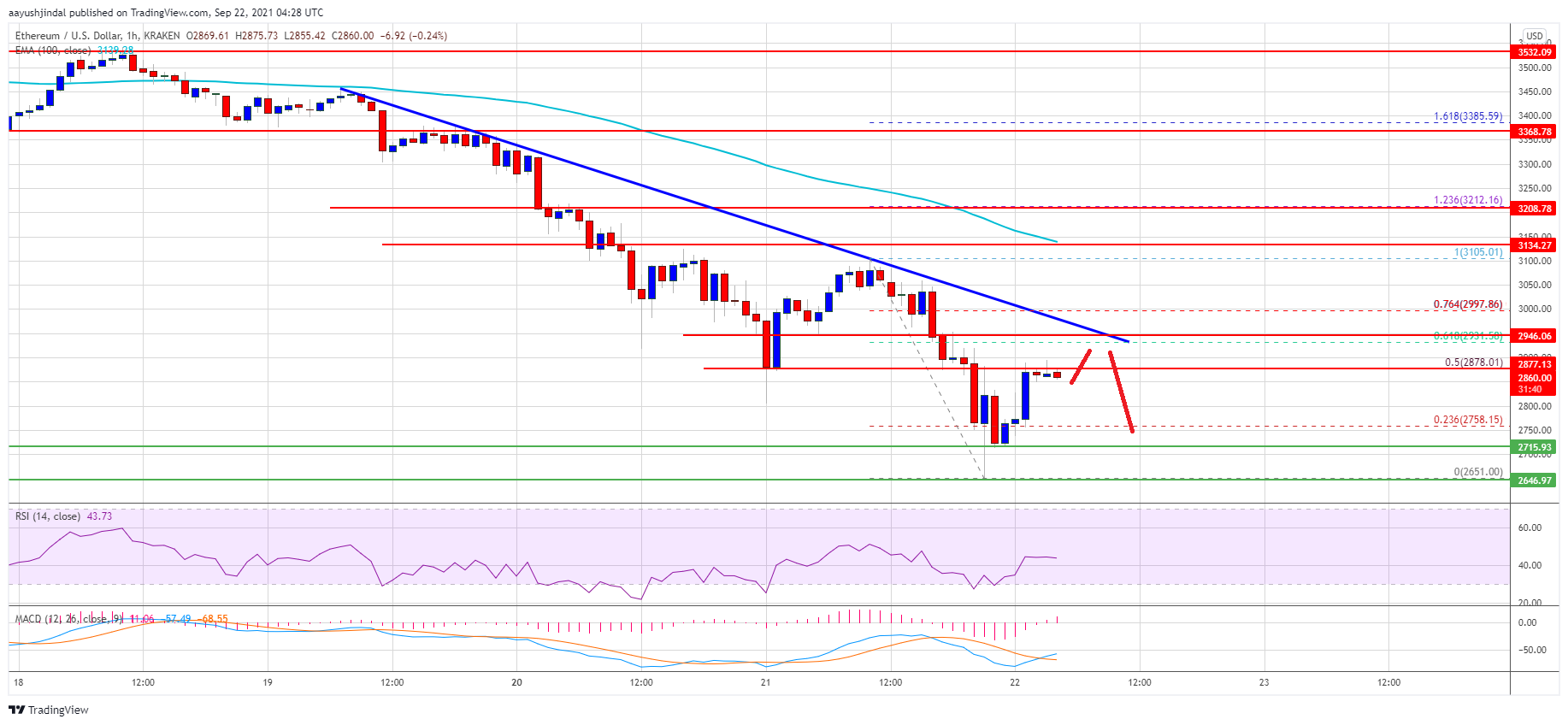
Ethereum started another decline from the $3,100 resistance zone. ETH traded below many important support zones near $3,000 and the 100 hourly simple moving average, similar to bitcoin.
The price even broke the $2,800 support level to move further into a bearish zone. A low is formed near $2,651 and the price is now correcting losses. There was a break above the $2,800 and $2,850 resistance levels.
The price recovered above the 23.6% Fib retracement level of the recent drop from the $3,105 swing high to $2,651 low. An immediate resistance on the upside is near the $2,880 level. There is also a major bearish trend line forming with resistance near $3,000 on the hourly chart of ETH/USD.
Source: ETHUSD on TradingView.com
The trend line is close to the 50% Fib retracement level of the recent drop from the $3,105 swing high to $2,651 low. A close above the $3,000 resistance could start a decent recovery. The next major resistance might be near the $3,105 level. A clear break and close above the $3,105 level could start a steady increase. The next major resistance sits near $3,135 and the 100 hourly SMA.
More Losses in ETH?
If ethereum fails to correct higher above the $2,880 and $3,000 resistance levels, it could start another decline. An initial support on the downside is near the $2,800 level.
The next major support seems to be forming near the $2,650 level. A downside break below the $2,650 support zone could lead the price towards the $2,550 zone. The next major support is near the $2,500 level, below which ether price might decline towards the $2,420 support zone.
Technical Indicators
Hourly MACD – The MACD for ETH/USD is slowly losing pace in the bullish zone.
Hourly RSI – The RSI for ETH/USD is still below the 50 level.
Ether (ETH) price fell below the $3,000 support on Sept. 20 as global markets entered a risk-aversion mode. The Invesco China Technology ETF (CQQQ) closed down 4.2%, while the SPDR S&P Metals and Mining ETF (XME) lost 3.8%.
Some analysts pointed to the potential ripple effects of the default of Evergrande, a major Chinese real estate company. In contrast, others blame the ongoing debates over the debt limit in Washington as the catalyst for this week’s volatility. As a result, the CBOE Volatility Index (VIX), usually referred to as the “stock market fear index,” jumped by more than 30% to reach its highest level since May.
On Sept.19, U.S. Treasury Secretary Janet Yellen called for Congress to raise the U.S. debt ceiling again in a Wall Street Journal op-ed. Yellen suggested that avoiding this would risk causing the government to default on payments and generate a “widespread economic catastrophe.”
One of the major focuses for traditional markets is this week’s U.S. Federal Open Market Committee meeting, which ends on Sept. 22. At the meeting, the Federal Reserve is expected to signal when it will cut back its $120 billion monthly asset purchase program.
How these events impact Ether price
Ether price in USD at Bitstamp. Source: TradingView
Even though the $3,000 level sits near the bottom range of the previous performance of the past 45 days, Ether still accumulated 210% gains in 2021. The network’s adjusted total value locked (TVL) jumped from $13 billion in 2020 to $60 billion and the decentralized finance (DeFi), gaming, and nonfungible token (NFT) sectors experienced an impressive surge while Ethereum maintained dominance of the sector’s market share.
Despite mean gas fees surpassing $20 in September, Ethereum has kept roughly 60% of the decentralized exchange (DEX) volume. Its largest competitor, Binance Smart Chain, held an average daily volume slightly below $1 billion, albeit having a transaction fee below $0.40.
Ether futures data shows pro traders are still bullish
Ether’s quarterly futures are the preferred instruments of whales and arbitrage desks due to their settlement date and the price difference from spot markets. However, the contract’s biggest advantage is the lack of a fluctuating funding rate.
These fixed-month contracts usually trade at a slight premium to spot markets, indicating that sellers request more money to withhold settlement longer. Therefore, futures should trade at a 5% to 15% annualized premium in healthy markets. This situation is technically defined as “contango” and is not exclusive to crypto markets.
ETH futures 3-month annualized premium. Source: Laevitas
As displayed above, Ether’s futures contracts premium spiked to 15% on Sept. 6 as ETH price tested the $4,000 resistance. Apart from that brief overshot, the basis indicator ranged from 8% to 12% over the past month, considered healthy and bullish.
The crash to sub-$3,000 in the early hours of Sept. 21 was not enough to scare seasoned traders. More importantly, U.S. Securities and Exchange Commission chairman Gary Gensler’s interview on cryptocurrency regulation also had no noticeable impact on Ether price. Had there been a generalized fear, Ether futures premium would have reflected this.
The views and opinions expressed here are solely those of the author and do not necessarily reflect the views of Cointelegraph. Every investment and trading move involves risk. You should conduct your own research when making a decision.
I joined Coinbase in March 2019, and I quickly realized that to get stuff done, you generally had to be at Coinbase — in the conference room, in the hallway conversation, at the lunch table — working, chatting and collaborating side-by-side with your colleagues. Sure, employees worked from home here and there, but doing so always carried the risk of leaving you slightly out of the loop.
Of course, COVID changed all that. But while many companies approached this unprecedented work-from-home era as a temporary disruption to their normal way of doing business, we decided in May 2020 — only a few months into the pandemic — that Coinbase would become a remote-first company. Now, more than a year later, we’re more certain than ever: We’re never going back to the way we used to work.
We’re often asked — how did you shift to remote-first while doubling your headcount and becoming a public company? With that question in mind, I wanted to share some of our most important learnings from the last 15 months. (Hint: the company’s culture is key.)
First, some ground rules: At Coinbase, “remote-first” means that after we can safely return to in-person work, about 95% of our employees will still have the option to work from home, an office, or a mix — whatever works best for them.
Just as importantly, “remote-first” at Coinbase also means that the employee experience should be the same for everyone, no matter where you live or how often you do (or don’t) work from an office. While everyone will have the option to work in an office, doing so will not benefit your career at Coinbase in any way — at Coinbase, career progression is determined by performance, not by facetime with colleagues.
With that as our baseline, I think the following four learnings go a long way towards explaining why the shift to remote-first has gone so well for us, and why we’re so excited to stay remote-first.
1. We now have access to top talent around the world. Before COVID, most of our US-based recruiting focused on people who were living in the Bay Area, or were willing to move there and endure a daily commute into downtown San Francisco. This severely limited the talent pool we could draw from and meant we were often in direct competition with peer employers for the same candidates.
Today, those geographic restrictions are gone. We can now focus our recruiting in regions that have many candidates with deep experience in a certain field or speciality. We’ve also become a top destination for people who aren’t excited about being forced to return to an office by their current employer.
As a result, our workforce has become more geographically diverse. In March 2020, 69% of our employees were based in the Bay Area. Today, only 30% of our employees live there, even though our total headcount has more than doubled in that time. (To be clear, we do have some common-sense rules about where employees can live, both to avoid negative tax implications and to ensure teams aren’t spread out across too many time zones.)
This geographic diversity also better serves our mission to increase economic freedom in the world. The more geographically distributed we are, the more we all bring different perspectives to the table.
2. A centralized workforce doesn’t make sense for a decentralized company. In the months following our shift to remote-first, we realized that our new remote-first mindset was also more in line with the broader ethos of crypto. Earlier this year, we took our shift a step further by making it clear that Coinbase no longer has a headquarters located in any one city. After all, if crypto is centered on the benefits of decentralization, why should our employees be required to work from a limited number of locations? We’ve learned that remote-first enables our employees to advance in their careers based on their capabilities and their performance, not their location.
3. A little flexibility goes a long way. We know from internal surveys that our employees appreciate being able to work remotely — in our most recent survey, 94% of employees said the benefits of remote-first outweigh the drawbacks, or that the benefits and drawbacks balance each other out. Today, nearly half our employees (46%) are “fully remote,” up from 6% just before the pandemic, when very few of our roles were remote.
But those data points only tell part of the story. I know several employees who have been able to move closer to family, or move to another city so their significant other could pursue a career or educational opportunity, or move to a place they’d always dreamed of living, or simply trade their commutes for more time with their families, all without having to give up their jobs at Coinbase — and without us having to needlessly lose their talents and institutional knowledge.
I’m part of this group — our shift to remote-first enabled me and my family to move to North Carolina, the place we’ve always considered home, far sooner than we’d originally planned.
4. Your culture has to be set up for going remote. Long before we went remote, we had established cultural norms and decision-making frameworks that became even more important once we were no longer in offices together.
For example, because we had several offices around the world before the pandemic, we had a norm of sharing detailed agendas and background documents before meetings, and capturing meeting discussions and decisions in writing. We also relied on two simple document templates — one for complex decisions and one for lighter-weight decisions — to make decision-making more efficient and reduce swirl across the company.
This emphasis on tracking decisions in writing was important before we became remote-first, but it was critical after we made the switch — and because these norms were already in place, our internal workflow wasn’t derailed.
Another company value that worked to our advantage when going remote is efficient execution. Since our founding, we’ve moved fast and overcome challenge after challenge to build a hypergrowth company in a new, volatile industry. Shifting to remote-first while doubling our headcount and becoming a public company? Just another challenge for us to overcome through our commitment to making forward progress, no matter what.
Final thought: Remote-first isn’t right for every company. When peers at other companies that are considering a shift to remote-first (or something like it) have reached out to me, I’ve asked each of them the same question: Can your company’s culture accommodate the shift? Some cultures can, but many can’t, and that’s OK — I don’t think remote-first is right for every company. Either way, the first step is making an honest assessment about whether the company’s culture can handle the change.
Thankfully, our culture was primed for the shift to remote-first. Fifteen months later, we’re more excited than ever about the opportunities remote-first has created for us, both as a company and as individuals.
If this sounds like the kind of work environment you’re looking for, take a look at our open roles here.
This piece originally appeared in Protocol.
4 reasons Coinbase is staying remote was originally published in The Coinbase Blog on Medium, where people are continuing the conversation by highlighting and responding to this story.
Southeast Asian based RFOX Games (a subsidiary of RedFOX Labs $RFOX) has released its free-to-play game KOGs SLAM! in closed beta. The Bitcoin News finds out more about the KOGs SLAM! digital gaming experience and the collaboration with YGG (Yield Guild Games).
Q. Please introduce yourself and what you do at RFOX Games.
I’m Fadzly Yusof, General Manager of RFOX Games, a subsidiary of Redfox Labs, a crypto and blockchain venture builder based in South East Asia.
Q. Can you tell us more about RFOX Games?
RFOX Games wasset up with the purpose of bringing people into the blockchain era through games. Our team is made up of gaming veterans and artists who want to make digital inclusion into the blockchain space easy, relevant and fun.
Q. You recently released your free-to-play play-to-earn game KOGs SLAM in closed beta. How is that going for you?
We have on-boarded a few thousand gamers to stress testers our system for bugs and issues related to gameplay. There is also an incentive program that awards players with RFOX for leaderboard rankings and an exclusive NFT slammer to be used in the game if they qualify.
Q. Care to comment on your collaboration with Yield Guild Games on this as well as the ‘inclusion’ aspect?
YGG has been very active in managing their community with play to earn opportunities in gaming to help them monetise their time and effort, with Kogs, we hope to give them another opportunity to earn financial rewards through our NFT and token once we go open beta. A lot of their members who are waiting for scholarships or sponsors can consider our content as a viable option for income. We are facilitating cash out options for them to make the experience less tedious for first time users who are not savvy with crypto yet.
Q. Would you say you are leading in this field in the SEA/APAC markets?
We are a young company hoping to expand the play-to-earn ecosystem in as many countries as possible. We are just starting so we have a lot of opportunities to grow. The space is still mostly untapped and will be a huge benefit to economies that have been affected by COVID.
Q. Thanks for your comprehensive answers! We would love to know what’s next for RFOX Games.
We will be announcing more activities and content for our communities, visit our discord channel at https://discord.io/kogs and our Facebook page at https://fb.com/kogs.gg for the latest news and updates!
About RFOX Games
RFOX Games, launched by RedFOX Labs, Southeast Asia’s first blockchain venture builder. RFOX Games is building a series of interoperable games that are PLAY TO EARN and support the KOGs NFT collection. The entire RFOX ecosystem is supported by its native currency $RFOX and users will be able to compete in head-to-head and tournament-based games to win NFT prizes and $RFOX.
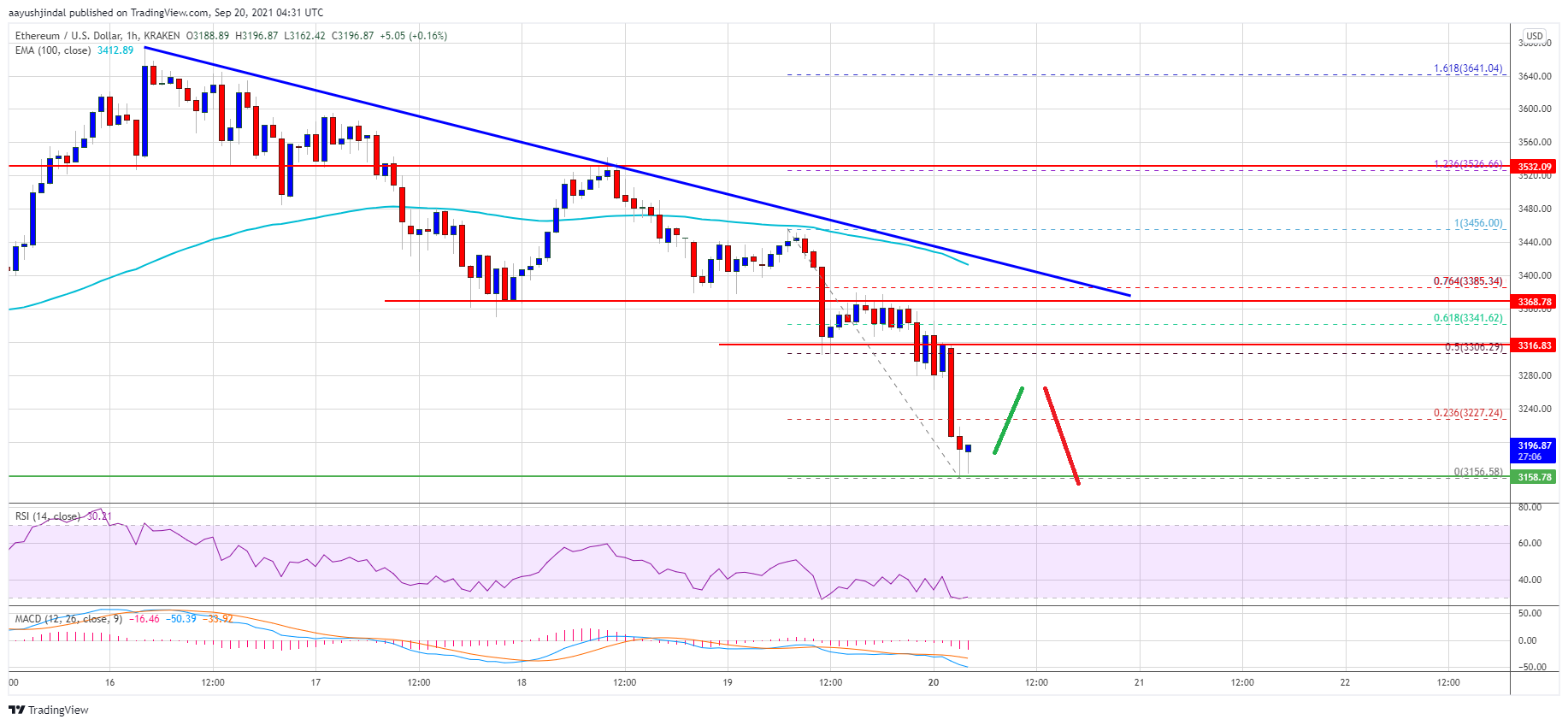
Ethereum started another decline below the $3,400 support zone against the US Dollar. ETH price must stay above $3,150 to avoid more losses in the near term.
Ethereum started a fresh decline from the $3,500 and $3,550 resistance levels.
The price is now trading below $3,300 and the 100 hourly simple moving average.
There is a major bearish trend line forming with resistance near $3,360 on the hourly chart of ETH/USD (data feed via Kraken).
The pair could a steady increase as long as it is above the $3,150 support zone.
Ethereum Price is Eyeing Decent Recovery
Ethereum failed to clear the main $3,500 resistance zone. ETH started a major decline below the $3,400 support zone and the 100 hourly simple moving average, similar to bitcoin.
The price traded below the $3,320 and $3,250 support levels. Finally, ether spiked below $3,200, but the bulls were active near the key $3,150 support zone. A low is formed near $3,156 and the price is now consolidating losses.
An immediate resistance on the upside is near the $3,230 level. It is close to the 23.6% Fib retracement level of the recent drop from the $3,456 high to $3,156 low. The first major resistance is now forming near the $3,320 level (the last key support).
Source: ETHUSD on TradingView.com
The 50% Fib retracement level of the recent drop from the $3,456 high to $3,156 low is also near $3,320. Besides, there is a major bearish trend line forming with resistance near $3,360 on the hourly chart of ETH/USD. A clear break and close above the $3,400 level could start another increase. The next major resistance sits near $3,500.
More Losses in ETH?
If ethereum fails to correct higher above the $3,250 and $3,320 resistance levels, it could start another decline. An initial support on the downside is near the $3,180 level.
The next major support seems to be forming near the $3,150 level. A downside break below the $3,150 support zone could spark a sharp decline. The next major support is near the $3,000 level, below which ether price might decline towards the $2,880 support zone in the near term.
Technical Indicators
Hourly MACD – The MACD for ETH/USD is slowly losing pace in the bearish zone.
Hourly RSI – The RSI for ETH/USD is now well below the 50 level.
One of the reasons behind Bitcoin’s (BTC) volatility, the substantial price oscillations that occur regularly, is the discrepancy of its use cases. Some pundits deem it “digital gold,” a truly scarce and perfect store of value (SoV). Others consider Bitcoin a technology project or a type of software with a corresponding network.
El Salvador’s adoption as legal tender will likely evidence the means of exchange (MoE) functionality that the Lightning Network provides. The Layer-2 scaling solution allows instant and insanely cheap transfers, although it requires regular on-chain transactions to enter or exit this parallel network.
As these narratives about Bitcoin shift over time, so does BTC’s correlation to traditional assets. For example, there have been sustained periods of a strong correlation with gold.
Bitcoin vs. gold (precious metal) in 2020. Source: TradingView
The March 2020 crash was devastating for almost every asset class, but the recovery pattern that followed those six or seven months was virtually identical for gold and Bitcoin. Curiously, the opposite movement occurred in 2021, displaying an inverse correlation between the two assets.
Is Bitcoin a tech stock proxy?
On the other hand, Bitcoin started to mimic the Hong Kong stock market, as measured by the Hang Seng Index (HSI). Among its top constituents are Tencent, Alibaba, and Meituan, which are billion-dollar Asian technology companies.
Bitcoin vs. Hang Seng Index (stocks). Source: TradingView
This shift in investors’ perspective — from tracking gold price to tech stocks — begs one the question of whether Bitcoin will succumb to the Hang Seng downward movement seen in the past 90 days. Does it make sense to decouple right now? If so, will Bitcoin continue to act as a safe haven amid a general correction?
On Sept. 14, China’s second-largest property developer, Evergrande Group, announced that a significant decline in sales forced the company to postpone payments over its debt. This single company has over $300 billion in liabilities, which and according to analysts this could severely impact the broader market.
In August, China’s retail sales disappointed at 2.5% versus the previous year, where investors expected a 7% growth rate. Obviously, growth and the economy were heavily impacted in 2020 by governments’ reaction to the Covid-19 outbreak.
However, one must consider that the most influential Central Banks have been practicing near zero or even negative interest rates since the Q1 of 2020. Thus, if the economy fails to gain momentum amid multiple trillion-dollar stimulus packages, there’s not much that can be done to prevent a generalized stock market correction and potential losses on debt markets.
The problem is: Bitcoin might be 12 years old, but it has never faced a significant economic crisis, at least nothing that puts the $250 trillion-plus global debt markets at risk. Therefore, any analysis or estimate will unlikely yield a credible assessment.
Bitcoin might be less impacted by a market meltdown
However, the cryptocurrency has an edge over traditional markets like commercial real estate, stocks, and bonds. Lenders will foreclose on these assets if clients default on their payments, and this adds further pressure because the bank or institution has no interest in keeping them.
On the other hand, generally speaking, Bitcoin and cryptocurrencies cannot be used as collateral.
Regarding the billion-dollar Bitcoin futures liquidations on derivatives markets, those are just synthetic instruments. Undoubtedly these events will impact the price, but at the end of the day, the effective BTC stays at the derivatives’ exchange. It solely moves from the long (buyer) balance to the short (seller) account.
Until Bitcoin becomes fully entrenched in financial markets and accepted as collateral and deposits, the mid-term systemic risk for the cryptocurrency is lower than the traditional market.
The views and opinions expressed here are solely those of the author and do not necessarily reflect the views of Cointelegraph. Every investment and trading move involves risk. You should conduct your own research when making a decision.